Market Overview
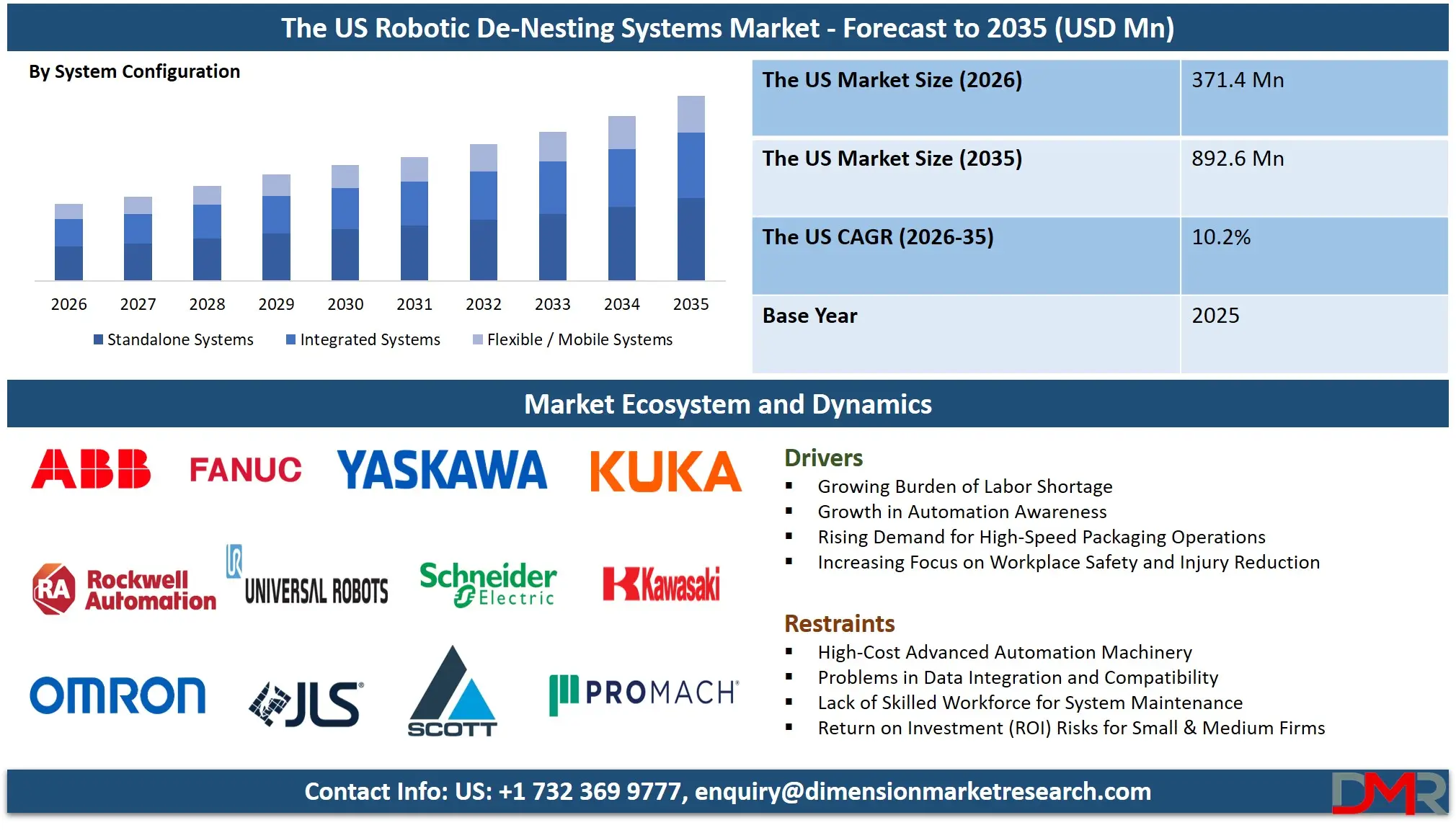
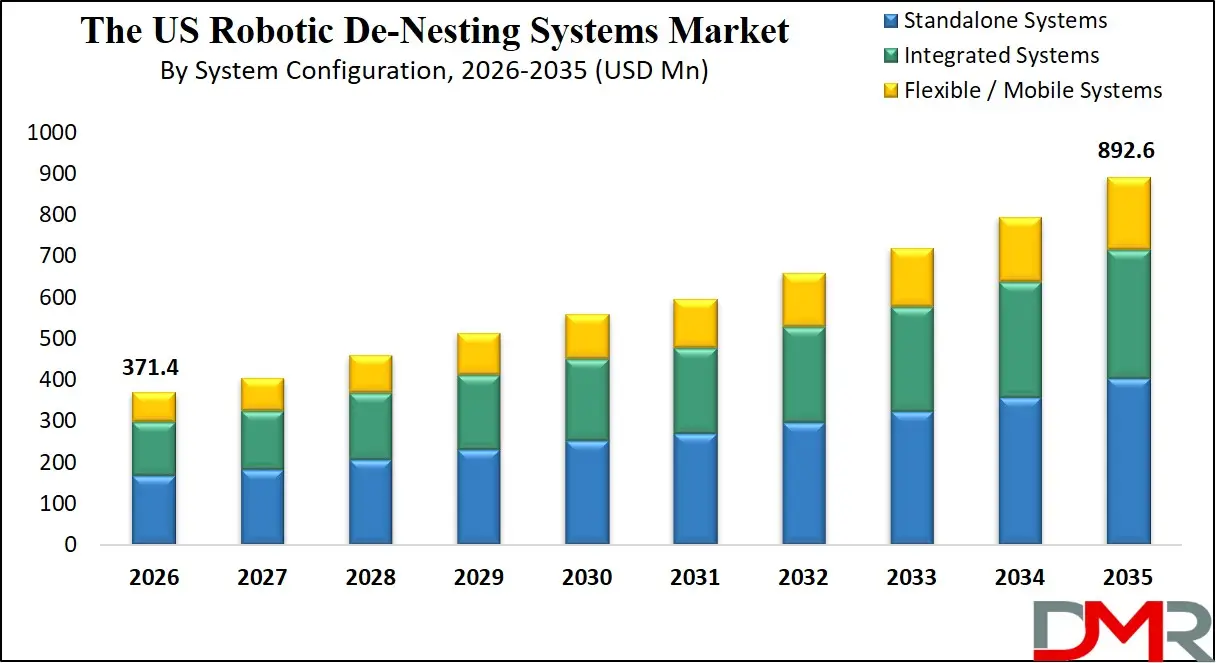
The US Robotic De-Nesting Systems Market size is expected to reach USD 371.4 million in 2026 and is anticipated to expand at a CAGR of 10.2%, reaching approximately USD 892.6 million by 2035.
ℹ
To learn more about this report –
Download Your Free Sample Report Here
A robotic de-nesting system is an automated system that is used to de-nest and offload products, components, or packages from stacked, trayed, or containerized nests, trays, or containers to enhance operational efficiency and to reduce manual labor. These systems are finding more and more applications in food and beverage, pharmaceutical, packaging, automotive, and electronics industries.
The market of robotic de-nesting systems in the US is developing towards more automated material handling systems not only in large manufacturing facilities, but also in logistics and warehousing facilities as a response to the increasing demand on operational efficiency, the high demand on labor-saving robots, increased use of flexible manufacturing, and the integration of digital control systems that would provide real-time production information and improved supply chain decision-making.
ℹ
To learn more about this report –
Download Your Free Sample Report Here
The US Robotic De-Nesting Systems Market: Key Takeaways and Other Influencing Factors
- Outlook of Market Growth Expansion: The US Robotic De-Nesting Systems Market is projected to reach USD 371.4 million in 2026 and nearly USD 892.6 million by 2035, due to the use of industrial automation and the growth of smart factories.
- High Growth Rate Momentum: The market has the potential to grow at a rate of 10.2% CAGR in the period ranging from 2026 to 2035, because of the increasing labor costs, e-commerce logistics requirements, and the integration of AI-based robotic vision.
- Segment Leadership Structure: The product type segment has the highest share of 66.4% in 2026 with Automatic robotic de-nesting systems at the forefront of the segment, the application segment has the highest share of 58.9% and the end-user segment has the highest share of 54.1%, indicating high dependence on advanced automated de-nesting solutions.
- Technology Driven Operational Shift: The market is moving to flexible automation, AI-driven robots picking, and cloud-connected systems, which enhance throughput accuracy and decrease the use of manual de-nesting.
- Labor shortage Burden: As US Bureau of Labor Statistics indicates, the manufacturing and logistics industries experience over 700,000 vacancies every year, which supports the high demand in automated de-nesting systems.
- Operational Downtime Insight: Industry data shows that manual de-nesting errors happen about every 34 seconds on high-speed packaging lines, which supports the need to have real-time robotic de-nesting technologies.
- Reduction of Errors in Large-Volume Lines: According to research in the industry, the probability of delays in production is almost 5 times higher in facilities that de-nest manually, making automated robotic de-nesting a significant factor in reduction and prevention.
Impact of the Iran conflict on the US Robotic De-Nesting Systems Market
The escalation of Iranian conflict is disrupting the global supply chains which influence the output of de-nesting systems in the US in terms of availability of robotic components and robot controllers, rising energy prices are raising the cost of transporting and manufacturing systems which in turn raise the cost of the system, and scarcity of electronic parts and industrial grade materials may affect volumes of production, cybersecurity and operational risks are making differences to the US automation companies.
The US Robotic De-Nesting Systems Market: Use Cases
- Automated Tray Unloading: This can be applied in the separation of stack trays or containers in food and beverage lines by running continuously with robots that work faster and provide greater precision and less damage to the products at an earlier stage.
- Remote System Monitoring: Provides real-time monitoring of production and predictive maintenance assistance by monitoring robotic de-nesting performance on a remote or centralized control environment.
- Post-Production Material Handling: Helps in controlling the output and any form of bottlenecks that may arise after packaging, is done through automated de-nesting systems.
- Preventive Maintenance Scheduling: Enables the early detection of risks in the high-volume lines based on the performance of the robotic arms in the long run.
The US Robotic De-Nesting Systems Market: Market Dynamics
Driving Factors in the US Robotic De-Nesting Systems Market
Growing Burden of Labor Shortage
The increasing number of vacancies in the manufacturing, logistics as well as warehousing industries in the US is adding to the push to deploy automated de-nesting solutions. Robotic de-nesting systems can be used to achieve operational efficiency by enabling continuous material handling to increase the throughput and eliminate reliance on manual labor.
Growth in Automation Awareness
Robotic automation devices are being adopted at an accelerated pace because of the growth of Industry 4.0 and smart manufacturing services. Live transmissions of production data, analytics based on the cloud, and linkage of factory ecosystems are enhancing the operation management and reducing the dependency of the facility on manual de-stacking.
Restraints in the US Robotic De-Nesting Systems Market
High-Cost Advanced Automation Machinery
The prohibitive nature of robotic de-nesting systems and other integration services makes these systems inaccessible and the application of these solutions by small and medium-sized enterprises. The use of advanced robotic de-nesting technology on large scale basis may not be welcome to be adopted by the cost-sensitive facilities.
Problems in Data Integration and Compatibility
System interoperability and equipment validation have compliance requirements that are strict and hamper market expansion. Some of the problems that affect the implementation of connected robotic de-nesting systems include cybersecurity, data integration, and compatibility with legacy systems.
Opportunities in the US Robotic De-Nesting Systems Market
Predictive Vision Systems and Artificial Intelligence
Adoption of artificial intelligence in robotic vision will enable object recognition and predictive picking to be automated. AI-based de-nesting will increase accuracy, decrease the number of manual operators required, and improve the value of long-term automated material handling solutions.
E-Commerce and Logistics Services Expansion
The growing popularity of online retail is creating the demand of high-speed automated de-nesting systems. Robotic de-nesters assist with the procedure of continuous package separation in unstandardized environments that enable the control of high-quantity order fulfillment as well as offers just-in-time logistics.
Trends in the US Robotic De-Nesting Systems Market
Shift toward Automatic Robotic De-Nesting Devices
The transition to fully automatic robotic de-nesting systems with increased throughput and decreased operator involvement is self-evident as semi-automatic systems are on the decline. The trend assists in maintaining flowing material with a minimum amount of interference with the normal production processes.
Advancements in Wireless and Cloud-Linked Controls
The robotic de-nesting data management is changing with the growing application of wireless connectivity, mobile dashboards, and cloud platforms. The automation of material handling in the US will be in the form of smooth information sharing, remote diagnostics and connectivity to the warehouse management systems.
The US Robotic De-Nesting Systems Market: Research Scope and Analysis
By Product Type Analysis
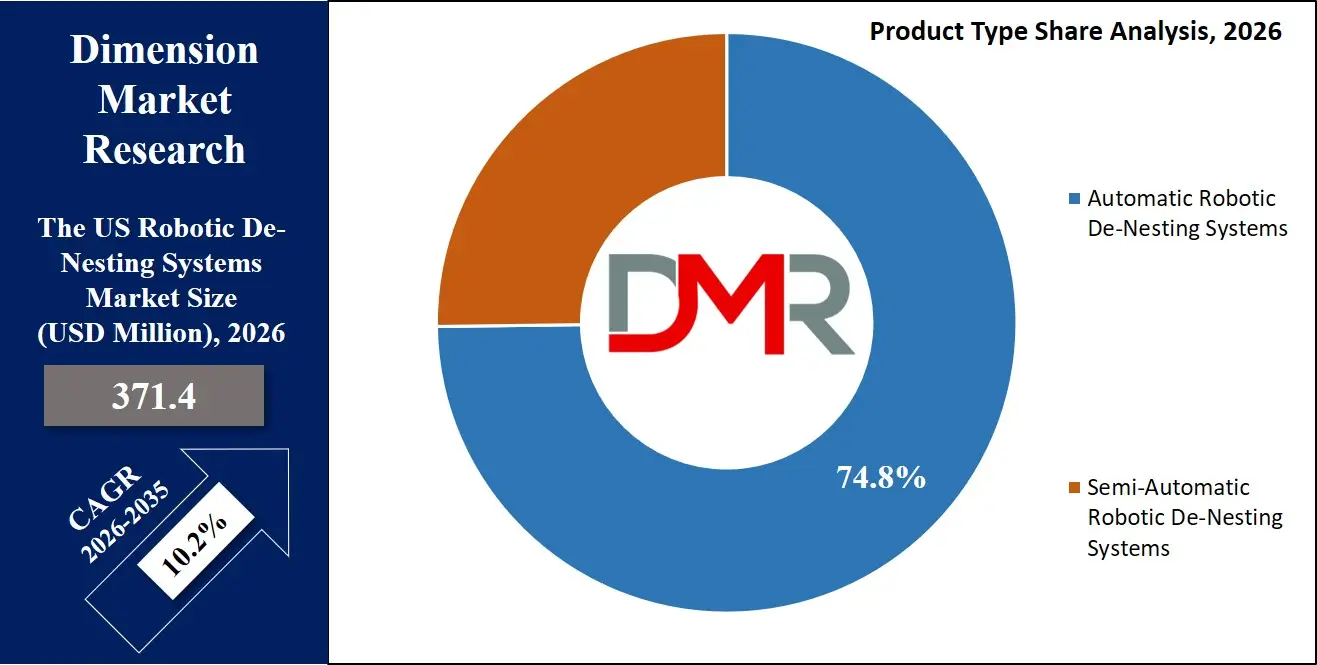
It is estimated that automatic robotic de-nesting will dominate the product type segment with a projected share of about 66.4% in the year 2026 due to the improved operational efficiency, less dependence on labor and the growing use of these systems in high-speed manufacturing and logistics.
ℹ
To learn more about this report –
Download Your Free Sample Report Here
Such systems help in the continuous supply of materials and improved throughput which helps in augmentation of usage. On the other hand, semi-automatic robotic de-nesting systems remain useful in smaller-scale processes and plants with variable output volumes because of reduced initial investment and already realized usage, although reduced speed and increased operator engagement inhibit their evolution relative to the automatic systems.
By System Configuration Analysis
The system configuration segment is projected to be dominated by standalone systems with approximately 58.9% of the share in 2026 because of the growing need for flexible and easily deployable de-nesting systems in manufacturing and warehousing environments. This growth is also helped by a focus on modular automation. The growing adoption of full-connect production lines is the motivation behind integrated systems, with robotic de-nesting systems built in with conveyors, palletizers, and packaging equipment, allowing a continuous flow in the handling of materials. Flexible or mobile systems are becoming more popular in dynamic environments with the need to reconfigure and multi-use stations.
By Application Analysis
The application segment is projected to be dominated by food and beverage with approximately 59.0% in 2026 as a result of the rising need to have hygienic, fast-speed de-nesting of trays, lids, cups, and containers in packaging lines. This growth is also supported by the emphasis on the reduction of product damage, the risk of contamination, and the compliance with FDA standards. Robotic de-nesting solutions are still being implemented in pharmaceuticals, packaging, automotive, electronics, and other applications at different rates based on industry-specific needs and volumes of production.
By Distribution Channel Analysis
It is estimated that direct sales will dominate the segment of the distribution channel with about 61.7% in 2026 due to the very technical nature of robotic de-nesting systems that demand tailored integration, in-site consultations, and post-sales services. The big manufacturers and logistics companies are interested in direct contact with automation providers to receive specific solutions and a long-term service contract. The remaining market is addressed through distributors, online sales, and other channels, especially the small and medium-sized enterprises, which are interested in standardized solutions.
By End-User Analysis
In 2026, manufacturing is projected to take up a larger market share of approximately 54.1% in the end-user segment as a result of high volumes of production, highly developed infrastructure of automation and the high preference of industrial-grade robotic de-nesting systems to ensure precise and consistent separation of materials. Robotic de-nesters are also commonplace in these settings, both in primary packaging and in assembly line feeding, in automotive, electronics companies and consumer goods. Logistics, warehousing, and other end-users are also increasing their use of robotic de-nesting systems, as automation is increasingly affordable and accessible.
The US Robotic De-Nesting Systems Market Report is segmented on the basis of the following:
By Product Type
- Automatic Robotic De-Nesting Systems
- Semi-Automatic Robotic De-Nesting Systems
By System Configuration
- Standalone Systems
- Integrated Systems
- Flexible / Mobile Systems
By Application
- Food and Beverage
- Pharmaceuticals
- Packaging
- Automotive
- Electronics
- Others
By Distribution Channel
- Direct Sales
- Distributors
- Online Sales
- Others
By End-User
- Manufacturing
- Logistics
- Warehousing
- Others
Impact of Artificial Intelligence in the US Robotic De-Nesting Systems Market
The US robotic de-nesting systems market is being improved with the help of artificial intelligence that allows automatic recognition of objects and makes picking decisions more accurate and faster. The de-nesting robots powered by AI facilitate real-time modifications and detect misaligned or damaged products early on. It can be integrated with warehouse management systems to enhance predictive knowledge and minimize the workload of operators. Machine learning is also used to process large amounts of item data. In general, AI is enhancing efficiency, precision, and the use of modern automated de-nesting systems.
The US Robotic De-Nesting Systems Market: Competitive Landscape
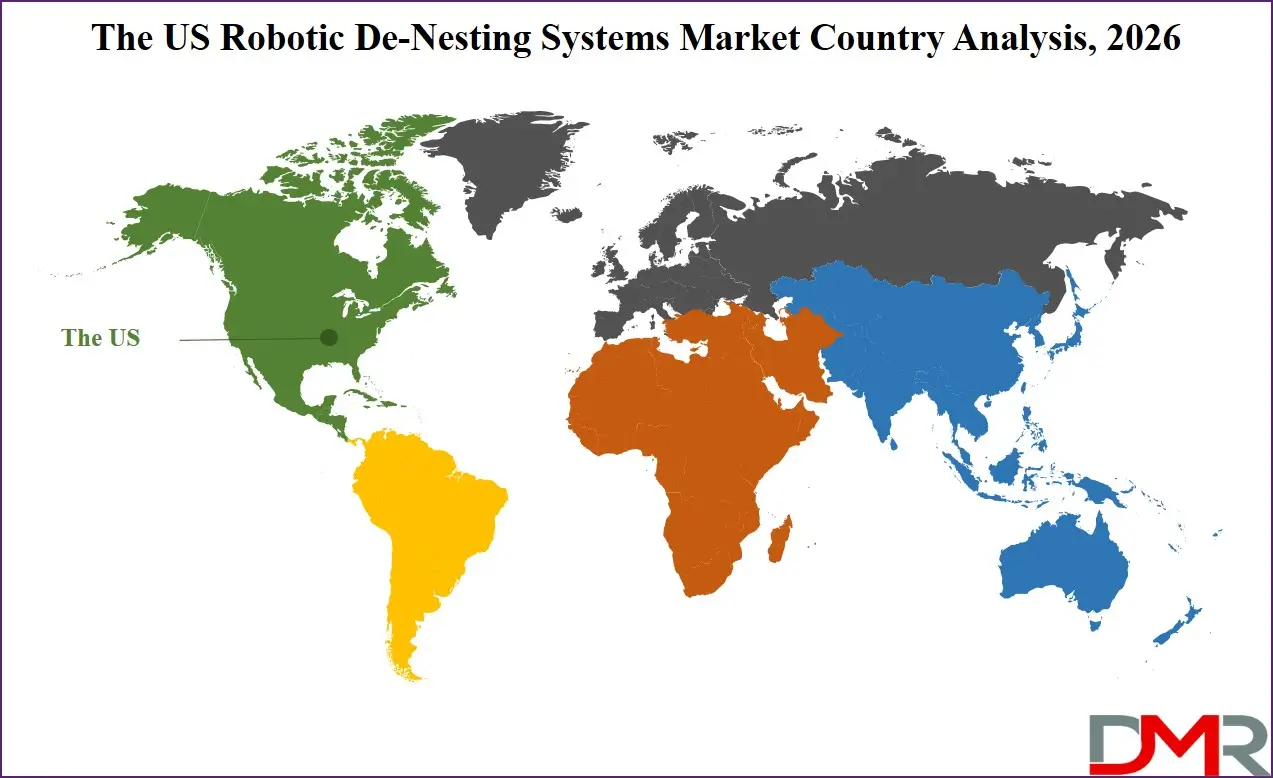
The US robotic de-nesting systems market is very competitive with great interest in innovation in automated material handling and robotic picking systems.
ℹ
To learn more about this report –
Download Your Free Sample Report Here
Food, pharmaceutical, packaging, automotive and electronics industries are also witnessing improvement in accuracy, speed and flexibility in systems that can be developed by the companies in advanced systems. The competition is growing with the increase in the adoption of Industry 4.0 and AI-based vision systems. The important growth strategies are product innovation and strategic partnerships.
Some of the prominent players in the US Robotic De-Nesting Systems Market are:
- ABB Ltd.
- FANUC Corporation
- KUKA AG
- Yaskawa Electric Corporation
- Schneider Electric SE
- Rockwell Automation, Inc.
- Universal Robots A/S
- Stäubli International AG
- Kawasaki Heavy Industries, Ltd.
- Omron Corporation
- Marel hf.
- BluePrint Automation, Inc.
- JLS Automation
- Brillopak Ltd.
- FlexLink (part of Coesia Group)
- Scott Technology
- Schubert Group
- IMA Group
- Midwest Engineered Systems Inc. (MWES)
- ProMach Corporation
- Other Key Players
Recent Developments in the US Robotic De-Nesting Systems Market
- June 2025: FANUC Corporation introduced the ROBOGUIDE V10 simulation software, enhancing offline programming and digital twin capabilities for robotic system optimization.
- June 2025: JLS Automation has debuted its Peregrine robotic cartoning system in IBIE and PACK EXPO 2025, which was a vision-guided robotic carton picking and automated carton loading system, focused on enhancing efficiency, handling randomly oriented products in particular, which is directly related to de-nesting operations.
- May 2025: ProMach Corporation announced the acquisition of DJS Systems, a U.S.-based automation provider, strengthening its capabilities in food packaging automation, thermoforming, and end-of-line robotic solutions, which are closely aligned with de-nesting and handling applications.
- January 2025: ABB Ltd. launched its OmniCore automation platform, delivering up to 25% faster processing and enhanced AI-driven control, significantly improving efficiency in packaging and robotic handling applications.
Report Details
| Report Characteristics |
| Market Size (2026) |
USD 371.4 Mn |
| Forecast Value (2035) |
USD 892.6 Mn |
| CAGR (2026–2035) |
10.2% |
| Historical Data |
2021 – 2025 |
| Forecast Data |
2027 – 2035 |
| Base Year |
2025 |
| Estimate Year |
2026 |
| Report Coverage |
Market Revenue Estimation, Market Dynamics, Competitive Landscape, Growth Factors, etc. |
| Segments Covered |
By Product Type (Automatic Robotic De-Nesting Systems, Semi-Automatic Robotic De-Nesting Systems), By System Configuration (Standalone Systems, Integrated Systems, Flexible / Mobile Systems), By Application (Food and Beverage, Pharmaceuticals, Packaging, Automotive, Electronics, Others), By Distribution Channel (Direct Sales, Distributors, Online Sales, Others), By End-User (Manufacturing, Logistics, Warehousing, Others) |
| Country Coverage |
The US |
| Prominent Players |
ABB Ltd., FANUC Corporation, KUKA AG, Yaskawa Electric Corporation, Schneider Electric SE, Rockwell Automation, Inc., Universal Robots A/S, Stäubli International AG, Kawasaki Heavy Industries, Ltd., Omron Corporation, Marel hf., BluePrint Automation, Inc., JLS Automation, Brillopak Ltd., FlexLink (part of Coesia Group), Scott Technology, Schubert Group, IMA Group, Midwest Engineered Systems Inc., ProMach Corporation, and Other Key Players |
| Purchase Options |
We have three licenses to opt for: Single User License (Limited to 1 user), Multi-User License (Up to 5 Users) and Corporate Use License (Unlimited User) along with free report customization equivalent to 0 analyst working days, 3 analysts working days and 5 analysts working days respectively. |
Frequently Asked Questions
How big is the US Robotic De-Nesting Systems Market?
▾ The US Robotic De-Nesting Systems Market is valued at USD 371.4 million in 2026 and is projected to reach USD 892.6 million by the end of 2035.
What is the growth rate for the US Robotic De-Nesting Systems Market?
▾ The market is growing at a robust compound annual growth rate (CAGR) of 10.2% over the forecast period of 2026 to 2035.
Who are the key players in the US Robotic De-Nesting Systems Market?
▾ Some of the major key players in the US Robotic De-Nesting Systems Market are ABB Ltd., FANUC Corporation, KUKA AG, Yaskawa Electric Corporation, JLS Automation, ProMach Corporation, and many others.