US Transformer Monitoring Market Snapshot
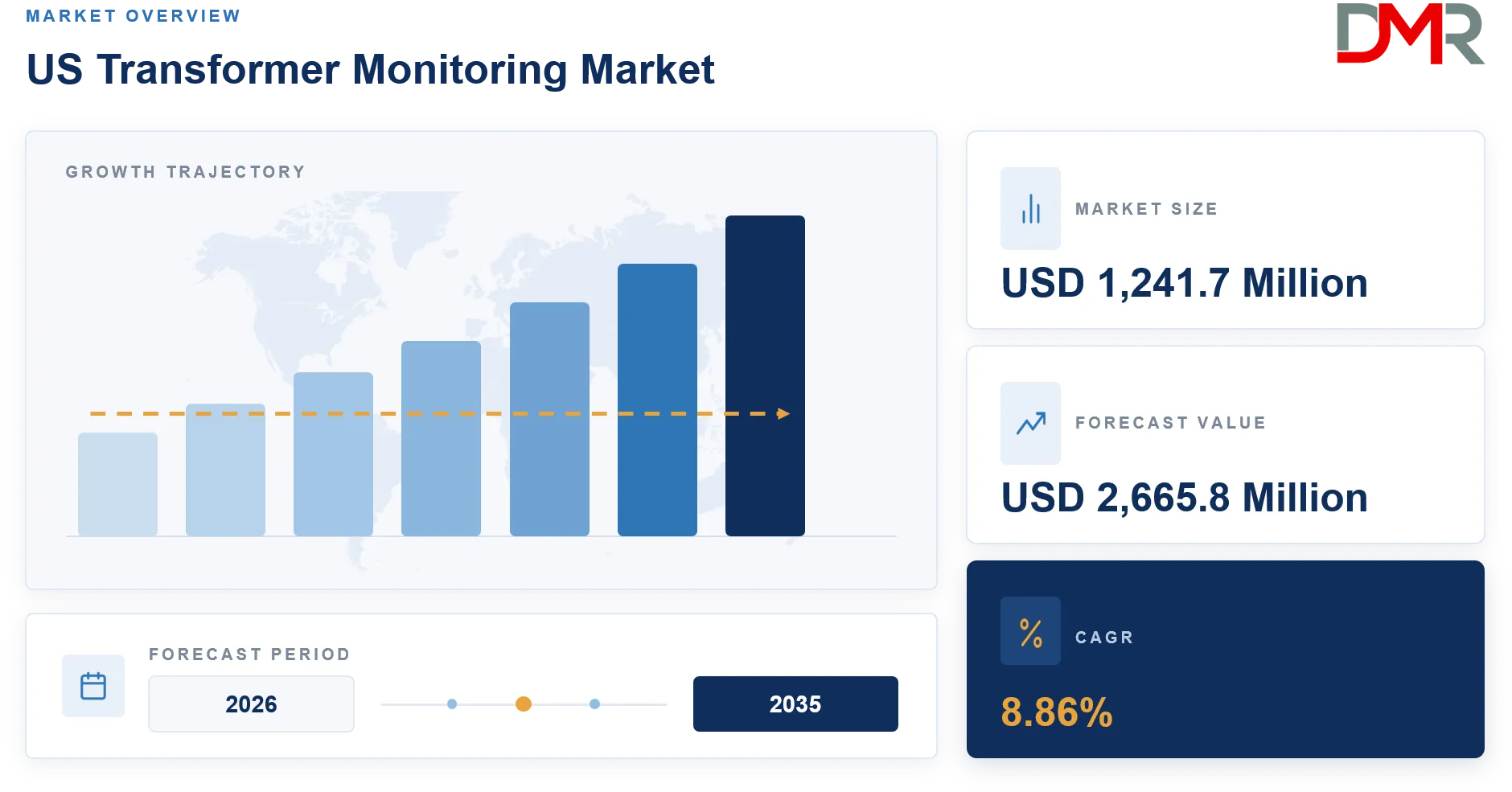
- Market Value: US Transformer Monitoring Market is valued at USD 1,241.7 million in 2026 and is expected to reach USD 2,665.8 million by 2035.
- CAGR: US Transformer Monitoring Market is expected to grow at a CAGR of 8.86% from 2026 to 2035.
- By Component Analysis: Hardware Solutions led the component segment with a 54.3% share in 2026.
- By Monitoring Type Analysis: Online Continuous Monitoring dominated monitoring type with a 53.7% share in 2026.
- By Transformer Type Analysis: Power Transformers led transformer types with a 46.8% share in 2026.
- By Installation Type Analysis: Retrofit Upgrade Projects held a 57.4% share in 2026.
- Major Players: GE Vernova, Qualitrol Company LLC, Dynamic Ratings, Doble Engineering Company, H2scan and Others.
What is the US Transformer Monitoring Market and its Market Size?
The US Transformer Monitoring Market size is projected to be valued at USD 1,241.7 million in 2026 and is expected to reach USD 2,665.8 million by 2035, expanding at a CAGR of 8.86% during the forecast period. Transformer monitoring covers sensors, intelligent electronic devices, dissolved-gas analysis systems, temperature and winding hot-spot measurement, communications gateways, diagnostic software, SCADA integration, and associated services used to assess transformer condition while equipment is operating or during planned inspections.
ℹ
To learn more about this report –
Download Your Free Sample Report Here
Demand is shifting from periodic inspection toward continuous condition visibility as utilities and large power users manage aging transformer fleets alongside rapid load growth. US electricity infrastructure investment is also creating a larger installed base that requires monitoring. EIA reported that utility capital investment in line transformers reached USD 7.5 billion in 2023, up 23% from 2022, while distribution substation spending reached USD 6.1 billion. The need to protect this capital is supporting transformer health monitoring, predictive maintenance, online DGA, thermal monitoring, and asset performance management adoption.
Use Cases
- Early Fault Detection: Online transformer monitoring identifies changes in dissolved gases, oil moisture, temperature, partial discharge, bushing condition, cooling performance, and load behavior. Utilities can investigate abnormal trends before they develop into serious insulation damage, forced outages, or transformer failure.
- Condition-Based Maintenance: Monitoring data allows asset managers to move away from fixed maintenance intervals and prioritize units according to actual condition. Continuous health information can help utilities allocate crews, testing budgets, spare transformers, and outage windows toward assets showing the highest operational risk.
- Transformer Life Extension: Winding hot-spot temperature, loading, moisture, and thermal models provide operators with information about insulation aging. The resulting data supports loading decisions, cooling optimization, refurbishment planning, and replacement prioritization for expensive power transformers operating near capacity limits.
- Grid and Substation Visibility: Transformer monitoring systems can feed operating information into SCADA, substation automation, asset management, and control platforms. This provides utilities with a more complete view of transformer status alongside voltage, current, switching, protection, and broader grid operating conditions.
- Critical Facility Protection: Data centers, industrial plants, renewable energy parks, power stations, and other electricity-intensive facilities use transformer monitoring to reduce unplanned downtime. Continuous alerts help facility teams protect critical electrical infrastructure where even a short transformer outage can disrupt operations and revenue.
How AI and Gen AI are Transforming the US Transformer Monitoring Market?
Artificial intelligence is increasing the value of transformer monitoring by converting large volumes of sensor readings into condition indicators that maintenance teams can act on. Modern systems can combine dissolved gas concentrations, temperature, load, moisture, bushing measurements, cooling-system status, and historical events to identify abnormal behavior. Predictive models can support fault classification, anomaly detection, remaining-life assessment, and maintenance prioritization. This is especially useful for utilities that operate hundreds or thousands of transformers and cannot manually analyze every parameter continuously. The commercial opportunity therefore extends beyond sensors into analytics platforms, asset performance management software, data integration, and diagnostic services.
Generative AI can further support engineering workflows by summarizing transformer alarms, maintenance histories, inspection records, DGA trends, and operating events for asset managers. Its practical role is likely to remain decision support rather than autonomous control because transformer protection and maintenance actions require validated engineering rules and reliable data. Vendors that connect advanced analytics with edge processing, SCADA systems, digital substations, and secure enterprise platforms can offer greater operational value. As more transformer data becomes available, suppliers are expected to compete on diagnostic accuracy, fleet benchmarking, explainable recommendations, interoperability, cybersecurity, and the ability to convert condition data into measurable maintenance and capital-planning decisions.
Key Drivers in the US Transformer Monitoring Market
Aging Transformer Fleets and Reliability Requirements
Aging power infrastructure is increasing the need for transformer condition monitoring across US utilities. Older transformers face insulation degradation, moisture accumulation, thermal stress, bushing deterioration, and other age-related risks. Replacement can require substantial capital and planning, which makes early condition assessment valuable. Monitoring gives asset managers better evidence for deciding whether a transformer can remain in service, requires maintenance, or should move higher in the replacement queue. This supports demand for DGA, hot-spot monitoring, intelligent sensors, and transformer health analytics.
Rapid Grid Investment and Electricity Load Growth
Grid expansion is creating new demand for monitored transformer capacity. US developers planned 86 GW of utility-scale generating capacity additions in 2026, with solar representing 51%, battery storage 28%, and wind 14%, according to EIA. New generation, data centers, manufacturing projects, electrification, and grid reinforcement require transformers at generation, transmission, distribution, and facility levels. As transformer populations expand, utilities have a stronger incentive to install digital monitoring during commissioning or retrofit high-value existing units.
Restraints in the US Transformer Monitoring Market
High Deployment Cost Across Large Transformer Fleets
Advanced monitoring can require DGA instruments, sensors, communications equipment, engineering, software integration, cybersecurity controls, and ongoing calibration or service. Installing comprehensive systems across thousands of distribution assets may not produce the same return as monitoring a critical substation or large power transformer. Utilities therefore use asset criticality, transformer value, loading, failure consequences, and replacement lead time to determine monitoring depth. This can slow full-fleet deployment and favor tiered architectures using lower-cost sensors for less critical assets.
Data Integration and Cybersecurity Complexity
Transformer monitoring becomes more difficult when utilities operate mixed fleets with equipment from different manufacturers and multiple generations of SCADA, communications, and asset management systems. Integrating protocols, alarms, historian data, and analytics can increase project complexity. Connected monitoring also adds cybersecurity requirements because operational technology environments are critical infrastructure. FERC continues to strengthen bulk-power reliability and cybersecurity safeguards, increasing the importance of secure deployment, access control, system hardening, and lifecycle software management.
Growth Opportunities in the US Transformer Monitoring Market
Large Retrofit Opportunity Across Existing Transformer Assets
Retrofit Upgrade Projects accounted for 57.4% of the market in 2026, making the installed transformer base one of the largest commercial opportunities. Instead of replacing functional equipment solely to obtain digital capabilities, utilities can install DGA monitors, temperature sensors, communications gateways, bushing monitors, and edge devices on existing units. Hitachi Energy, for example, offers transformer monitoring configurations that can be installed on new transformers or retrofitted to existing assets. Retrofit compatibility reduces modernization barriers and expands the addressable market beyond new transformer projects.
Data Centers and High-Criticality Electrical Loads
US data center expansion is creating opportunities for transformer monitoring vendors beyond traditional utilities. DOE reported that data centers consumed about 4.4% of US electricity in 2023 and projected that their share could rise to as much as 12% by 2028. Large campuses require reliable substations, transformers, backup power, and power-quality infrastructure, making transformer health visibility strategically important. Suppliers that provide dry-type transformer monitoring, thermal analytics, SCADA or building management integration, and predictive maintenance can address this expanding high-availability customer segment.
Trends in the US Transformer Monitoring Market
Movement Toward Online Continuous Monitoring
Online Continuous Monitoring captured 53.7% of the market in 2026 as asset owners seek more frequent information than periodic testing provides. Online DGA systems continuously track fault gases, while temperature, moisture, bushing, partial-discharge, and load sensors provide complementary condition data. GE Vernova offers single-gas and multi-gas DGA alongside enhanced transformer monitoring, while Qualitrol markets online DGA systems and modular transformer monitoring platforms. The trend favors integrated solutions capable of turning multiple measurements into fleet-level condition intelligence.
Edge Analytics and Connected Substation Architectures
Edge On-site Deployment held 42.8% of the market in 2026 as utilities increasingly process critical condition information close to transformer assets. Edge platforms can support faster alarms, maintain local functionality when remote connectivity is limited, and provide controlled integration with SCADA and enterprise systems. Industrial protocols such as IEC 61850, DNP3, and Modbus help connect monitoring equipment with utility environments. Qualitrol's QTMS, for example, supports IEC 61850, DNP3, Modbus, and other communications options, illustrating the industry's focus on interoperable transformer monitoring architectures.
Research Scope and Analysis
The US Transformer Monitoring Market is segmented based on Component, Monitoring Type, Transformer Type, Installation Type, Deployment Mode, End-User Industry, Application, and other relevant categories. The study analyzes major segments and sub-segments based on adoption patterns, transformer criticality, monitoring requirements, deployment environments, operational applications, demand potential, and contribution to overall US transformer monitoring market growth.
ℹ
To learn more about this report –
Download Your Free Sample Report Here
By Component
Hardware Solutions dominated the component segment with a 54.3% share in 2026. Hardware remains central because effective transformer condition monitoring requires physical measurement of parameters such as temperature, dissolved gases, moisture, current, voltage, bushing condition, and other operating characteristics. Sensors and intelligent electronic devices capture this information, while communications gateways connect field assets to SCADA, edge platforms, or remote analytics. Hardware demand is also supported by retrofit projects that add monitoring capabilities to installed transformers. Software and services are expected to gain strategic importance as utilities seek fleet analytics, alarm management, diagnostic interpretation, cloud connectivity, and condition-based maintenance programs.
By Monitoring Type
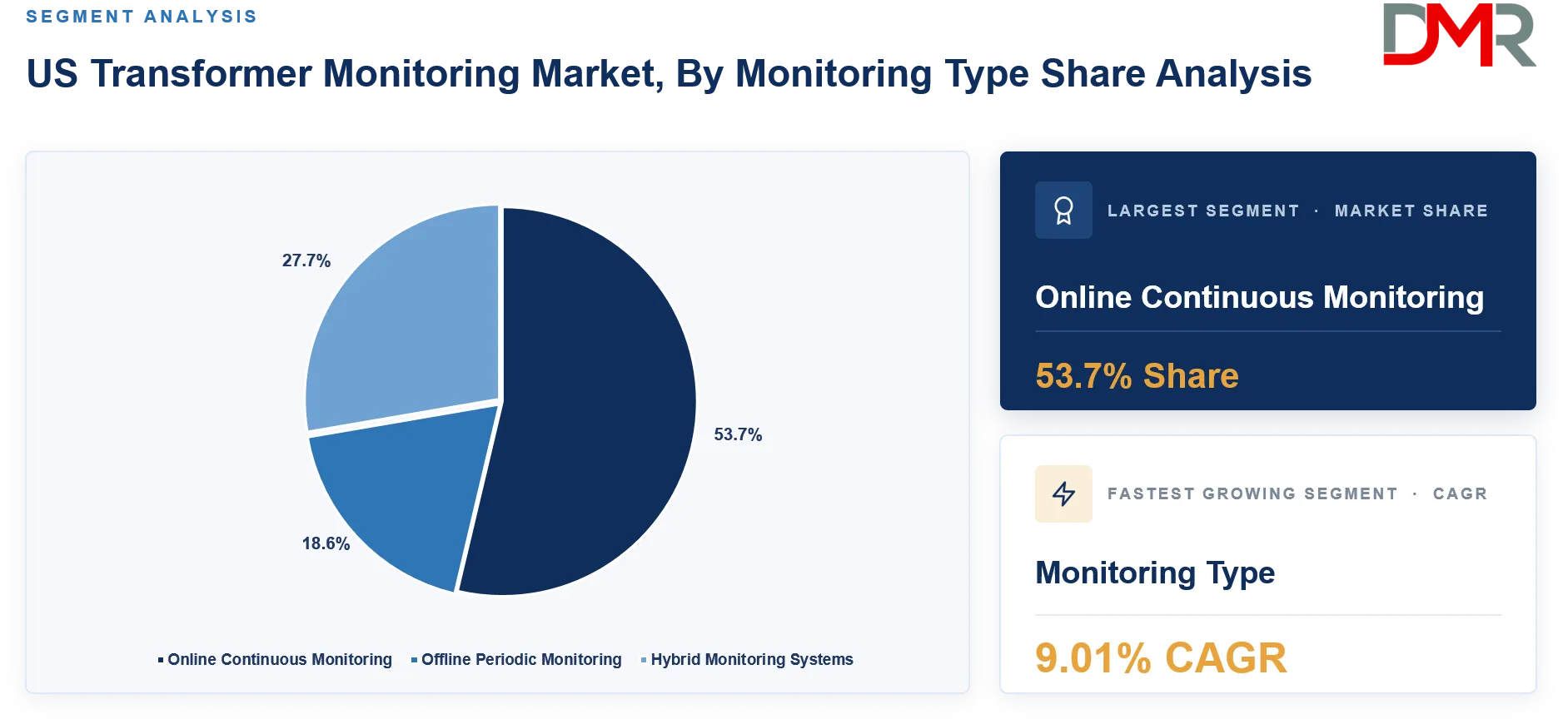
Online Continuous Monitoring held a 53.7% share in 2026 because utilities increasingly require early warning of developing transformer conditions. Periodic offline testing remains important for diagnostic confirmation and detailed inspection, but it only represents transformer condition at specific test intervals. Continuous systems can reveal trends and rate-of-change information between scheduled inspections. Online DGA is particularly important for critical oil-filled power transformers because evolving fault gases can indicate thermal or electrical problems. Hybrid Monitoring Systems provide another growth path by combining permanently installed sensors with targeted offline testing, allowing operators to balance cost, transformer criticality, and diagnostic depth.
By Transformer Type
Power Transformers led transformer types with a 46.8% share in 2026. Their high replacement cost, strategic grid role, long expected service life, and severe consequences of failure make condition monitoring economically attractive. High Voltage Class and Medium Voltage Class assets can use DGA, winding hot-spot measurement, bushing monitoring, moisture measurement, thermal models, and cooling-system analytics. Continuous monitoring is especially valuable for generator step-up and major transmission transformers where an unexpected outage can constrain significant amounts of capacity. Distribution Transformers represent a wider asset population and present a substantial future opportunity as lower-cost sensors, communications, and fleet analytics improve deployment economics.
By Installation Type
Retrofit Upgrade Projects accounted for 57.4% of market revenue in 2026. US utilities operate large installed transformer fleets, creating demand for digital condition visibility without immediate equipment replacement. Retrofit projects can add DGA monitors, intelligent sensors, communications gateways, bushing monitoring, thermal measurement, and edge analytics to transformers already in service. This supports asset-life extension and provides better evidence for capital planning. New Installation Projects are also becoming more digitally equipped as utilities and industrial customers increasingly specify monitoring capability during procurement, reducing future installation complexity and establishing condition baselines from early asset life.
The US Transformer Monitoring Market Report is segmented on the basis of the following:
By Component
- Hardware Solutions
- Sensors and IEDs
- Communications Gateways
- Software Solutions
- On-premise Suites
- Cloud-based SaaS
- Services Solutions
- Dissolved-Gas Analysis
- Winding Hot-Spot Monitoring
By Monitoring Type
- Online Continuous Monitoring
- Offline Periodic Monitoring
- Hybrid Monitoring Systems
By Transformer Type
- Power Transformers
- High Voltage Class
- Medium Voltage Class
- Distribution Transformers
- Specialty Transformers
- HVDC Converter Units
- Traction Railway Units
By Installation Type
- New Installation Projects
- Retrofit Upgrade Projects
By Deployment Mode
- Edge On-site Deployment
- Centralised SCADA Deployment
- Cloud Remote Deployment
By End-User Industry
- Power Utilities Sector
- Industrial Facilities Sector
- Commercial Buildings Sector
- Residential Complexes Sector
- Data Centers Sector
- Renewable Energy Parks
By Application
- Grid Management Utilities
- Substation Monitoring
- Power Plant Operations
- Industrial Facility Monitoring
- Smart Grid Infrastructure
- Preventing Transformer Failures
- Monitoring Transformer Health
Competitive Landscape
The US Transformer Monitoring Market features a combination of global power technology companies, specialist condition-monitoring suppliers, diagnostic service providers, and sensor developers. Competition increasingly centers on monitoring depth, diagnostic accuracy, retrofit flexibility, communications interoperability, cybersecurity, and fleet-level analytics. GE Vernova offers transformer DGA, enhanced monitoring, software, and diagnostic services, while Qualitrol competes through modular transformer monitoring, online DGA, intelligent monitors, and substation condition management.
Hitachi Energy integrates sensors, monitoring hardware, transformer expertise, and asset management capabilities through its TXpert ecosystem. Specialist companies such as Dynamic Ratings, Doble Engineering Company, H2scan, Vaisala, Camlin Group, Rugged Monitoring, and OMICRON address areas including DGA, hydrogen sensing, thermal measurement, diagnostics, testing, and online asset monitoring. Market differentiation is moving from individual instruments toward connected transformer health platforms that combine multiple condition parameters and support maintenance and capital decisions.
Some of the prominent players in the US Transformer Monitoring Industry are:
- GE Vernova
- Qualitrol Company LLC
- Dynamic Ratings
- Doble Engineering Company
- H2scan
- LumaSense Technologies
- MISTRAS Group
- Camlin Group
- Rugged Monitoring
- ZTZ Services
- Eaton Corporation
- Hitachi Energy
- Siemens Energy
- Schneider Electric
- Vaisala
- Ardry Group
- Smilics Technologies USA
- Acovis Systems
- OMICRON Electronics
- EA Technology
- Others
Technology Analysis
Technology development in the US Transformer Monitoring Market is moving toward continuous, multi-parameter condition assessment that combines dissolved-gas analysis, winding hot-spot temperature, moisture, bushing condition, partial discharge, load, and cooling-system data. Online sensors and intelligent electronic devices are increasingly connected to edge gateways, SCADA platforms, and remote asset management systems through protocols such as IEC 61850, DNP3, and Modbus. Edge On-site Deployment held 42.8% of the market in 2026, reflecting demand for rapid local alarms and reliable processing close to critical assets. Suppliers including GE Vernova, Qualitrol, Hitachi Energy, Vaisala, H2scan, Dynamic Ratings, and OMICRON are advancing condition monitoring and diagnostic capabilities. The technology direction is shifting from individual measurement devices toward integrated transformer health platforms that correlate multiple parameters, identify abnormal trends, support predictive maintenance, and help utilities prioritize inspection, refurbishment, loading, and replacement decisions across transformer fleets.
Regulatory Landscape
The US Transformer Monitoring Market operates within a reliability and cybersecurity framework shaped by the Federal Energy Regulatory Commission, North American Electric Reliability Corporation, Department of Energy, state utility commissions, and recognized technical standards. NERC Reliability Standards establish requirements affecting Bulk Electric System planning, operation, maintenance, protection, physical security, and cybersecurity, while FERC oversees mandatory reliability standards for the bulk-power system. Transformer monitoring can support compliance and operational reliability by improving equipment condition visibility, maintenance evidence, alarm management, and identification of developing asset risks. IEEE and IEC standards also influence transformer testing, communications, condition assessment, and substation interoperability, including IEC 61850-based digital communications. As utilities connect more sensors, gateways, SCADA systems, and remote monitoring platforms, cybersecurity requirements are becoming increasingly important. This environment favors monitoring solutions with secure communications, controlled access, interoperability, auditable data, and dependable lifecycle support.
Recent Developments
- June 2026: Hitachi Energy Broke ground on a $457 million South Boston transformer facility, expected to create 825 jobs and nearly double site employment, expanding U.S. grid-equipment capacity.
- April 2026: Doble Engineering Company Announced a strategic merger with Megger under ESCO Technologies, combining online monitoring, diagnostics and testing portfolios for integrated asset management.
- January 2025: Qualitrol Company LLC Launched QPDM, a continuous online UHF partial-discharge monitor offering real-time trending, fault prediction and maintenance guidance for transformers.
Report Details
| Report Characteristics |
| Market Size (2026) |
USD 1,241.7 Mn |
| Forecast Value (2035) |
USD 2,665.8 Mn |
| CAGR (2026-2035) |
8.86% |
| Historical Data |
2021 - 2025 |
| Forecast Data |
2027 - 2035 |
| Base Year |
2025 |
| Estimate Year |
2026 |
| Segments Covered |
By Component (Hardware Solutions {Sensors and IEDs, Communications Gateways}, Software Solutions {On-premise Suites, Cloud-based SaaS}, and Services Solutions {Dissolved-Gas Analysis, Winding Hot-Spot Monitoring}), By Monitoring Type (Online Continuous Monitoring, Offline Periodic Monitoring, and Hybrid Monitoring Systems), By Transformer Type (Power Transformers {High Voltage Class, Medium Voltage Class}, Distribution Transformers {Low Voltage Class}, and Specialty Transformers {HVDC Converter Units, Traction Railway Units}), By Installation Type (New Installation Projects and Retrofit Upgrade Projects), By Deployment Mode (Edge On-site Deployment, Centralised SCADA Deployment, and Cloud Remote Deployment), By End-User Industry (Power Utilities Sector, Industrial Facilities Sector, Commercial Buildings Sector, Residential Complexes Sector, Data Centers Sector, and Renewable Energy Parks), By Application (Grid Management Utilities, Substation Monitoring, Power Plant Operations, Industrial Facility Monitoring, Smart Grid Infrastructure, Preventing Transformer Failures, and Monitoring Transformer Health) |
| Regional Coverage |
United States |
Frequently Asked Questions
What is the current size of the US Transformer Monitoring Market?
▾ The US Transformer Monitoring Market size is valued at USD 1,241.7 million in 2026 and may reach USD 2,665.8 million by 2035.
What is the growth rate of the US Transformer Monitoring Market during?
▾ US Transformer Monitoring Market is projected to grow at an 8.86% CAGR during the forecast period from 2026 to 2035.
What factors are driving the growth of the US Transformer Monitoring Market?
▾ Grid modernization, aging assets, power demand, and reliability needs are driving the US Transformer Monitoring Market.
What are the major challenges restraining the US Transformer Monitoring Market?
▾ High costs, integration complexity, and cybersecurity requirements can restrain the US Transformer Monitoring Market.
Which segment holds the largest share of the US Transformer Monitoring Market?
▾ Hardware Solutions hold the largest US Transformer Monitoring Market component share, accounting for 54.3% in 2026.
Who are the leading companies in the US Transformer Monitoring Market?
▾ GE Vernova, Qualitrol Company LLC, Dynamic Ratings, Doble Engineering Company, H2scan, LumaSense Technologies, MISTRAS Group, Camlin Group, Rugged Monitoring, ZTZ Services, Eaton Corporation, Hitachi Energy, Siemens Energy, Schneider Electric, Vaisala, Ardry Group, Smilics Technologies USA, Acovis Systems, OMICRON Electronics, and EA Technology are leading companies in the US Transformer Monitoring Market.
How is AI influencing the US Transformer Monitoring Market?
▾ AI advances the US Transformer Monitoring Market through predictive diagnostics, anomaly detection, and asset analytics.
What are the future opportunities and trends in the US Transformer Monitoring Market?
▾ Retrofits, online DGA, edge analytics, smart grids, and data centers offer US Transformer Monitoring Market growth.