US Transmission Line Inspection Drone Market Snapshot
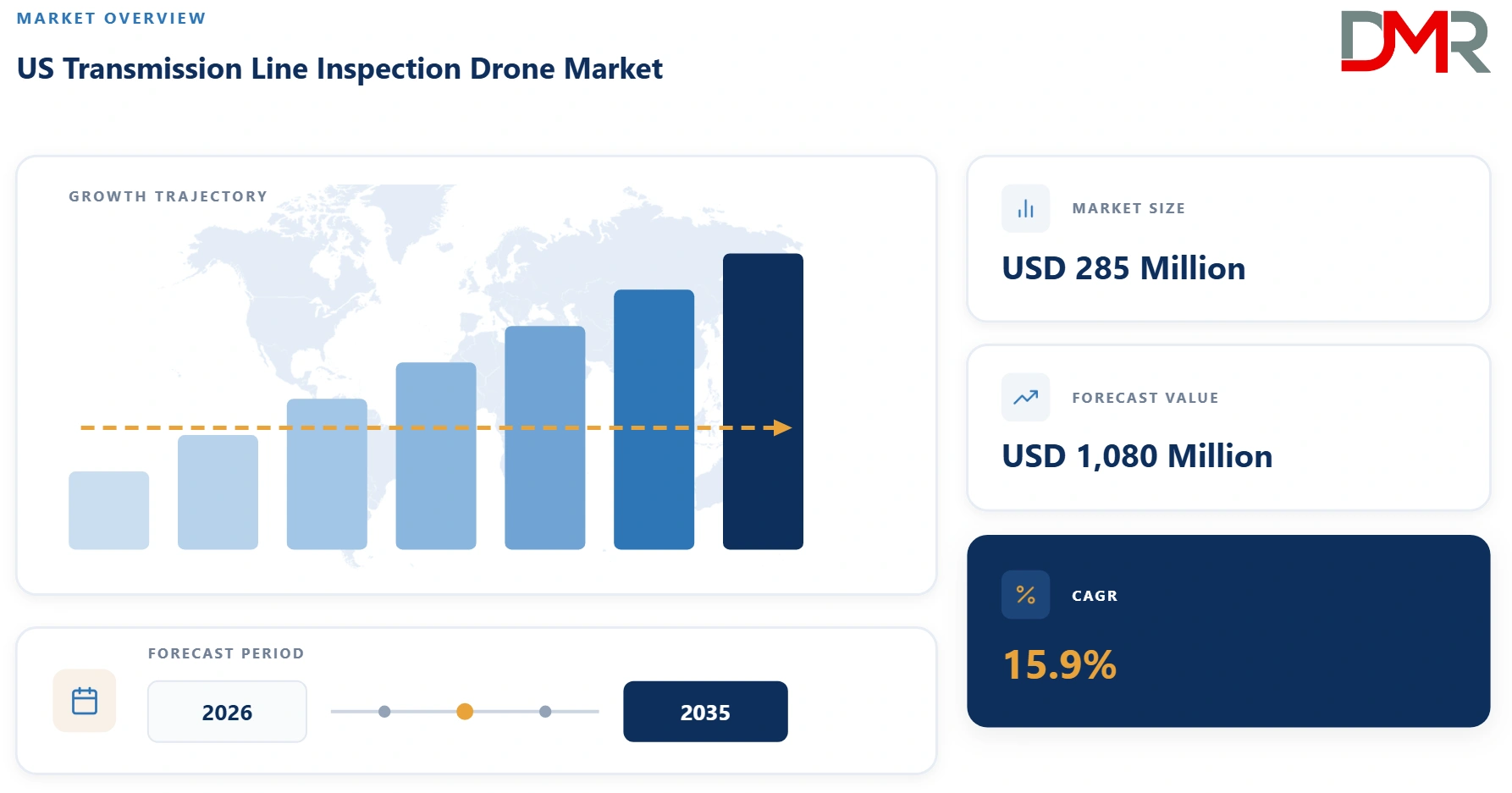
- Market Size, 2026: USD 285 million
- Market Size, 2035: USD 1,080 million
- CAGR, 2026-2035: 15.9%
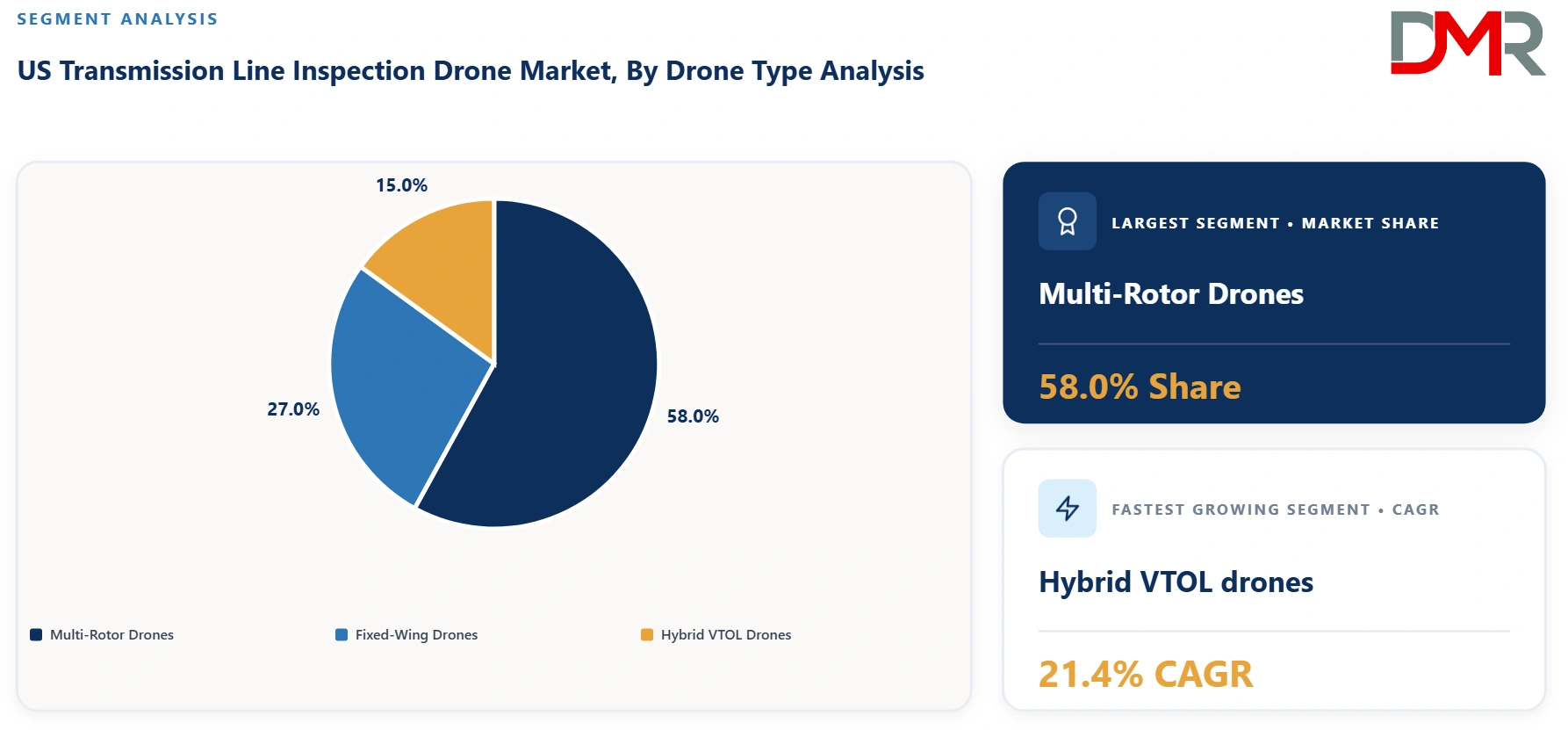
- Leading Drone Type, 2026: Multi-Rotor Drones, 58%
- Leading Application, 2026: Routine Inspection, 39%
- Leading End User, 2026: Electric Utilities, 62%
- Fastest-Growing Segment: Hybrid VTOL Drones, 21.4% CAGR
What is the US Transmission Line Inspection Drone and its Market Size?
The market is estimated at USD 285 million in 2026, rising to approximately USD 1,080 million by 2035, representing a 15.9% CAGR.
ℹ
To learn more about this report –
Download Your Free Sample Report Here
The US Transmission Line Inspection Drone Market comprises unmanned aerial vehicles, sensors, software, analytics platforms, inspection services and related solutions used to monitor overhead high-voltage transmission corridors, towers, conductors, insulators and associated right-of-way assets. Solutions range from manually piloted multi-rotor aircraft to long-endurance fixed-wing and hybrid VTOL systems capable of corridor mapping and, increasingly, beyond-visual-line-of-sight (BVLOS) operations. Typical payloads include RGB cameras, thermal/infrared sensors, LiDAR and zoom imaging systems. The market's fundamental value proposition is to obtain higher-frequency, higher-resolution infrastructure intelligence while reducing exposure to climbing, helicopter and roadside inspection risks.
Use Cases
- Routine Inspection: Capture detailed imagery of conductors, insulators, towers, hardware and structural components during scheduled patrols.
- Fault & Defect Detection: Identify corrosion, cracks, damaged components, hot spots, loose hardware and conductor abnormalities.
- Vegetation Management: Detect vegetation encroachment and right-of-way risks before they create reliability or wildfire hazards.
- Emergency & Damage Assessment: Rapidly survey storm, wildfire, ice, lightning and equipment damage without waiting for ground access.
- Thermal Monitoring: Identify abnormal thermal signatures indicating overloaded, deteriorating or electrically compromised components.
- Corridor Mapping: Generate geospatial models, digital twins and repeatable inspection records for long-term asset management.
Key Takeaways
- Market growth: The modeled market expands from USD 285 million in 2026 to USD 1,080 million in 2035, at a 15.9% CAGR.
- Primary driver: Aging grid infrastructure combined with demand for more frequent, safer and data-rich inspections.
- Segment dominance: Multi-rotor drones lead because of their maneuverability, hovering capability and ability to capture close-range component imagery.
- Application leader: Routine inspection remains the largest application because utilities require recurring condition assessment across extensive networks.
- Fastest growth: Hybrid VTOL platforms are expected to grow fastest as utilities seek longer-range corridor coverage without sacrificing vertical takeoff and close-inspection capabilities.
- Technology catalyst: AI-based defect detection, thermal analytics, LiDAR, autonomous navigation and cloud-based asset management are increasing the value of drone-generated data.
- Regulatory catalyst: The FAA's August 2025 proposed BVLOS rule is particularly important because scalable BVLOS operations could substantially improve the economics of linear infrastructure inspection.
How AI is Transforming the US Transmission Line Inspection Drone Market?
AI and computer vision are increasingly being applied to automatically classify transmission-line defects, detect vegetation encroachment, compare current imagery against historical inspections, analyze thermal anomalies and prioritize assets requiring field intervention. Utilities can combine RGB, thermal and LiDAR datasets with GIS and asset-management systems to create condition-based inspection workflows. BPA, for example, reports using drones equipped with high-resolution cameras, thermal imaging, zoom capabilities and AI-assisted flight functions for transmission infrastructure work.
AI reduces manual image-review requirements, accelerates defect identification, improves consistency and enables utilities to prioritize maintenance based on risk rather than fixed inspection schedules. Repeatable drone missions can also produce standardized datasets suitable for automated change detection.
Key Drivers in the US Transmission Line Inspection Drone Market
Aging Transmission Infrastructure
Aging transmission infrastructure is a major driver of the US Transmission Line Inspection Drone Market. Utilities are increasingly adopting drones to inspect towers, conductors, insulators, crossarms and other components without relying extensively on climbing crews, helicopters or ground patrols. Drone-based inspection provides high-resolution visual and sensor data while improving worker safety and enabling more frequent asset monitoring. The technology is particularly valuable for identifying early signs of deterioration and supporting condition-based maintenance. As utilities seek to improve reliability and extend the operating life of existing infrastructure, recurring drone inspections are becoming an increasingly important component of transmission asset-management programs.
Grid Modernization and Resilience
Increasing investment in grid modernization is accelerating demand for advanced inspection technologies. Utilities require faster methods to assess transmission infrastructure following storms, wildfires and other disruptive events while also monitoring vegetation and right-of-way conditions. Drones can rapidly access difficult or hazardous locations and provide detailed imagery and sensor data that help utilities identify damage and prioritize repair activities. The growing integration of thermal cameras, LiDAR, AI-based analytics and automated flight planning is further increasing the operational value of drone inspections. These capabilities are supporting a shift from occasional aerial surveys toward more systematic and data-driven transmission asset monitoring.
Restraints in the US Transmission Line Inspection Drone Market
Regulatory and Operational Constraints
Regulatory requirements remain a significant restraint for the US Transmission Line Inspection Drone Market, particularly for long-distance transmission corridors. Conventional visual-line-of-sight operations limit the geographic coverage that a drone crew can achieve during a single mission. BVLOS operations can substantially improve inspection efficiency, but utilities and service providers must address airspace coordination, operator qualifications, safety procedures, communications and regulatory approvals. These requirements can increase implementation complexity and slow the transition from pilot projects to large-scale autonomous inspection programs. Although the regulatory environment is evolving toward greater operational flexibility, uncertainty around approvals and compliance requirements can continue to influence investment decisions and deployment timelines.
Data Management and Integration Challenges
The increasing use of high-resolution cameras, thermal sensors and LiDAR generates large volumes of inspection data. Utilities must process, store and analyze this information before it can support maintenance decisions. Integrating drone-generated information with GIS, asset-management, work-order and maintenance systems can also be technically complex. AI-based defect detection requires reliable datasets and sufficient accuracy to gain the confidence of engineering and maintenance teams. Cybersecurity and data governance are additional concerns because transmission infrastructure is considered critical infrastructure. Consequently, utilities increasingly evaluate complete inspection workflows rather than individual drones, creating barriers for vendors that cannot provide secure data management, analytics and enterprise integration.
Growth Opportunities in the US Transmission Line Inspection Drone Market
Autonomous BVLOS Inspection
The expansion of autonomous and BVLOS operations represents one of the largest opportunities in the US Transmission Line Inspection Drone Market. Transmission networks consist of extensive linear assets that are particularly suitable for automated flight missions. BVLOS capability can allow operators to inspect longer corridors with fewer field personnel while improving inspection frequency and consistency. The development of more advanced navigation, communications and detect-and-avoid capabilities is supporting this transition. As regulatory frameworks become more established, utilities can increasingly move from limited drone pilots toward enterprise-scale inspection programs. This creates opportunities for long-endurance aircraft manufacturers, autonomous-flight providers and inspection-service companies offering managed corridor monitoring.
AI-Powered Predictive Maintenance
AI and machine learning provide significant growth opportunities by converting drone imagery into actionable asset intelligence. Automated systems can identify potential defects, vegetation encroachment, corrosion, abnormal thermal conditions and structural deterioration, reducing the amount of manual image review required. The combination of AI with historical inspection records can also support change detection and predictive maintenance. This creates opportunities for software providers to integrate drone data directly with utility asset-management and maintenance platforms. As utilities increasingly prioritize measurable operational outcomes rather than simply acquiring drone hardware, software, analytics and inspection-as-a-service models are expected to capture a growing portion of market value.
Trends in the US Transmission Line Inspection Drone Market
Shift Toward Integrated Inspection Platforms
The US Transmission Line Inspection Drone Market is shifting from standalone drone flights toward integrated inspection ecosystems combining aircraft, sensors, autonomous navigation, cloud platforms and AI analytics. Utilities increasingly want repeatable inspection workflows that can generate standardized datasets and connect directly with existing asset-management systems. This is moving competitive differentiation away from aircraft specifications alone and toward complete inspection solutions capable of producing actionable maintenance intelligence.
Growing Adoption of AI and Multi-Sensor Inspection
Another major trend is the convergence of AI with RGB cameras, thermal imaging and LiDAR. Combining multiple sensor types allows utilities to identify visible defects, thermal anomalies, vegetation risks and three-dimensional changes within the same inspection workflow. AI-based analytics can then classify findings and prioritize assets requiring further investigation. This is gradually transforming drones from data-collection tools into intelligent infrastructure-monitoring
Research Scope and Analysis
The market is segmented by Drone Type, Application, End User and Inspection Technology. The analysis distinguishes aircraft configurations according to flight characteristics, applications according to inspection objective, end users according to procurement role, and technology according to the sensing and analytics capabilities deployed.
ℹ
To learn more about this report –
Download Your Free Sample Report Here
By Drone Type Analysis
Multi-Rotor Drones are estimated to dominate the 2026 market with approximately 58% share, supported by their ability to hover, maneuver around towers and capture close-range imagery of insulators, conductors, bolts and structural components. Their relatively low acquisition cost and ease of deployment make them particularly attractive for utilities conducting localized inspections and emergency assessments. Hybrid VTOL drones are projected to be the fastest-growing sub-segment, with an estimated 21.4% CAGR, because they combine vertical takeoff and landing with longer-range fixed-wing flight, making them suitable for extensive transmission corridors. Fixed-wing drones represent the second-largest category at approximately 27% share in 2026, benefiting from longer endurance and efficient corridor mapping. However, their inability to hover as effectively as multi-rotors limits their role in close component inspection. As BVLOS rules mature, hybrid and fixed-wing platforms should gain share in large-scale autonomous corridor patrols.
By Application Analysis
Routine Inspection represents the largest application with approximately 39% share in 2026, reflecting the recurring requirement to assess towers, conductors, insulators, hardware and right-of-way conditions. Routine inspection is particularly attractive because drones can reduce exposure to climbing and helicopter operations while producing detailed photographic records. Emergency & Damage Assessment is expected to be the fastest-growing application at approximately 18.9% CAGR, driven by increasing storm, wildfire and extreme-weather risks and the need to rapidly determine infrastructure condition following an event. Fault & Defect Detection holds the second-largest share at roughly 29%, supported by AI-based image recognition and thermal inspection. Vegetation management accounts for the remaining significant share and is becoming increasingly important in wildfire-prone areas where early detection of vegetation encroachment can support preventative maintenance.
By End User Analysis
Electric Utilities dominate the market with an estimated 62% share in 2026, reflecting their ownership and operational responsibility for large transmission networks and their direct economic incentive to improve reliability and reduce inspection costs. Transmission System Operators represent approximately 23%, with demand concentrated around high-voltage corridors, regional reliability programs and grid modernization. Inspection Service Providers account for roughly 15% but are expected to record the fastest growth, at approximately 19.8% CAGR, as utilities increasingly outsource specialized drone operations, data processing and AI analytics rather than maintaining every capability internally. Service providers can aggregate equipment utilization across multiple utility customers, improving fleet economics. The increasing complexity of BVLOS operations, sensor payloads and analytics also favors specialized contractors capable of managing regulatory and technical requirements.
The US Transmission Line Inspection Drone Market Report is segmented on the basis of the following:
By Drone Type
- Multi-Rotor Drones
- Fixed-Wing Drones
- Hybrid VTOL Drones
By Application
- Routine Inspection
- Fault & Defect Detection
- Vegetation Management
- Emergency & Damage Assessment
By End User
- Electric Utilities
- Transmission System Operators
- Inspection Service Providers
Regulatory Landscape
Regulation is a decisive factor in the U.S. transmission inspection drone market because economically meaningful corridor operations increasingly require BVLOS capabilities. The FAA's proposed BVLOS rule announced in August 2025 seeks to establish a more scalable framework covering operations, aircraft, separation, authorizations, security and reporting. Southern Company's exemption for SwissDrones linear-infrastructure operations demonstrates the commercial potential of long-range utility UAVs while also illustrating the regulatory complexity surrounding larger aircraft. The regulatory opportunity is substantial: predictable BVLOS rules could reduce operator requirements, expand automated corridor inspection and support inspection-as-a-service business models. However, airspace safety, cybersecurity, detect-and-avoid capabilities and operational accountability remain important risks.
Investment and White Space Analysis
Investment opportunities are strongest at the intersection of BVLOS autonomy, AI analytics, thermal sensing and utility workflow integration. Hardware alone is becoming increasingly competitive, while recurring software and inspection-service revenue can generate stronger customer lifetime value. White space remains particularly attractive in automated defect classification, cross-year asset change detection, storm-response deployment and AI-driven maintenance prioritization. Percepto's utility offering demonstrates the direction of the market toward autonomous drones combined with AI-powered inspection software. Investors should nevertheless account for long utility procurement cycles, cybersecurity requirements, regulatory uncertainty and the need to prove measurable reductions in inspection cost or outage risk. Vendors that can demonstrate measurable asset-risk reduction rather than merely higher-quality imagery should have the strongest strategic positioning
Competitive Landscape
The U.S. transmission inspection drone market is moderately fragmented, with competition spanning drone OEMs, autonomous UAV specialists, inspection-software companies, sensor manufacturers and engineering/service providers. Differentiation increasingly centers on flight autonomy, BVLOS capability, endurance, sensor integration, AI analytics, cybersecurity and compatibility with utility asset-management systems. Players are pursuing partnerships with utilities, infrastructure operators and technology providers while expanding from aircraft sales toward recurring software and inspection-as-a-service models. Skydio emphasizes autonomous navigation and utility inspection, DroneDeploy focuses on aerial mapping and inspection workflows, while Percepto emphasizes autonomous inspection and AI-powered analytics.
Some of the prominent players in the US Transmission Line Inspection Drone Market are:
- DJI
- Skydio
- Inspired Flight Technologies
- Harris Aerial
- AeroVironment
- Parrot
- Autel Robotics
- JOUAV
- Quantum-Systems
- Wingtra
- Freefly Systems
- AgEagle Aerial Systems
- Flyability
- Delair
- American Robotics
- Airobotics
- Percepto
- Nearthlab
- Sharper Shape
- SkySpecs
- Zeitview
- Phoenix Air Unmanned
- UAV Recon
- UVT
- Powerline Technologies
- Gridline Aerial Solutions
- PinnaclX
- PraXel Line Services
- Skyelink
- FEDS
- DroneBase
- DroneDeploy
- Raptor Maps
- Terra Drone
- FlyGuys
- PrecisionHawk
- DroneView Technologies
- Unmanned Experts
- Aerial Solutions
- Aerial Patrol
- Other Key Players
Recent Developments
- August 2025 - Federal Aviation Administration (FAA): The FAA unveiled a proposed national BVLOS rule intended to establish requirements for safely scaling beyond-visual-line-of-sight drone operations, a potentially transformative development for transmission corridor inspections.
- July 2025 - Bonneville Power Administration (BPA): BPA announced expansion of its drone program for transmission inspection and repair, using high-resolution, thermal and zoom-equipped drones alongside AI-assisted flight capabilities.
- June 2025 - SwissDrones / Southern Company: SwissDrones announced its first hardware contract with Southern Company for the SDO 50, supporting the company's U.S. expansion into long-range energy infrastructure inspection.
- March 2025 -Percepto: Percepto introduced an AI-powered remote inspection solution specifically for electric utilities, combining autonomous drones and analytics to support higher-frequency grid monitoring and proactive maintenance.
- February 2025 - Southern Company / SwissDrones: Southern Company became the first U.S. utility reported to secure an FAA Part 91 BVLOS exemption for SwissDrones systems, creating an important precedent for long-range utility infrastructure inspection.
Report Details
| Report Characteristics |
| Market Size (2026) |
USD 285 Mn |
| Forecast Value (2035) |
USD 1,080 Mn |
| CAGR (2026–2035) |
15.9% |
| Historical Data |
2021 – 2025 |
| Forecast Data |
2026 – 2035 |
| Base Year |
2025 |
| Segments Covered |
By Drone Type, By Application, By End User |
| Country Coverage |
The US |
Frequently Asked Questions
What is the size of the US Transmission Line Inspection Drone Market in 2026?
▾ The US Transmission Line Inspection Drone Market is estimated at approximately USD 285 million in 2026, covering drone hardware, sensors, software, analytics and inspection services.
What will the US Transmission Line Inspection Drone Market size reach by 2035?
▾ The US Transmission Line Inspection Drone Market is projected to reach approximately USD 1,080 million by 2035, driven by increasing drone adoption and grid modernization.
What is the CAGR of the US Transmission Line Inspection Drone Market from 2026 to 2035?
▾ The US Transmission Line Inspection Drone Market is projected to expand at a 15.9% CAGR from 2026 to 2035, supported by automation and recurring inspection requirements.
What are the key drivers of the US Transmission Line Inspection Drone Market?
▾ The US Transmission Line Inspection Drone Market is driven by aging transmission infrastructure, grid expansion, extreme-weather events, wildfire risks and demand for safer inspections.
Which drone type dominates the US Transmission Line Inspection Drone Market?
▾ Multi-Rotor Drones dominate the US Transmission Line Inspection Drone Market, accounting for an estimated 58% share in 2026 due to their maneuverability and hovering capabilities.
Which application leads the US Transmission Line Inspection Drone Market?
▾ Routine Inspection leads the US Transmission Line Inspection Drone Market with an estimated 39% share in 2026, reflecting utilities' recurring asset-monitoring requirements.
Who are the key players in the US Transmission Line Inspection Drone Market?
▾ Key participants in the US Transmission Line Inspection Drone Market include Skydio, DroneDeploy, Percepto and SwissDrones, alongside specialized UAV and inspection-service providers.
How is the US Transmission Line Inspection Drone Market segmented?
▾ The US Transmission Line Inspection Drone Market is segmented by Drone Type, Application, End User and Inspection Technology, with additional regulatory and investment analysis.