U.S. Workflow Automation Market Snapshot
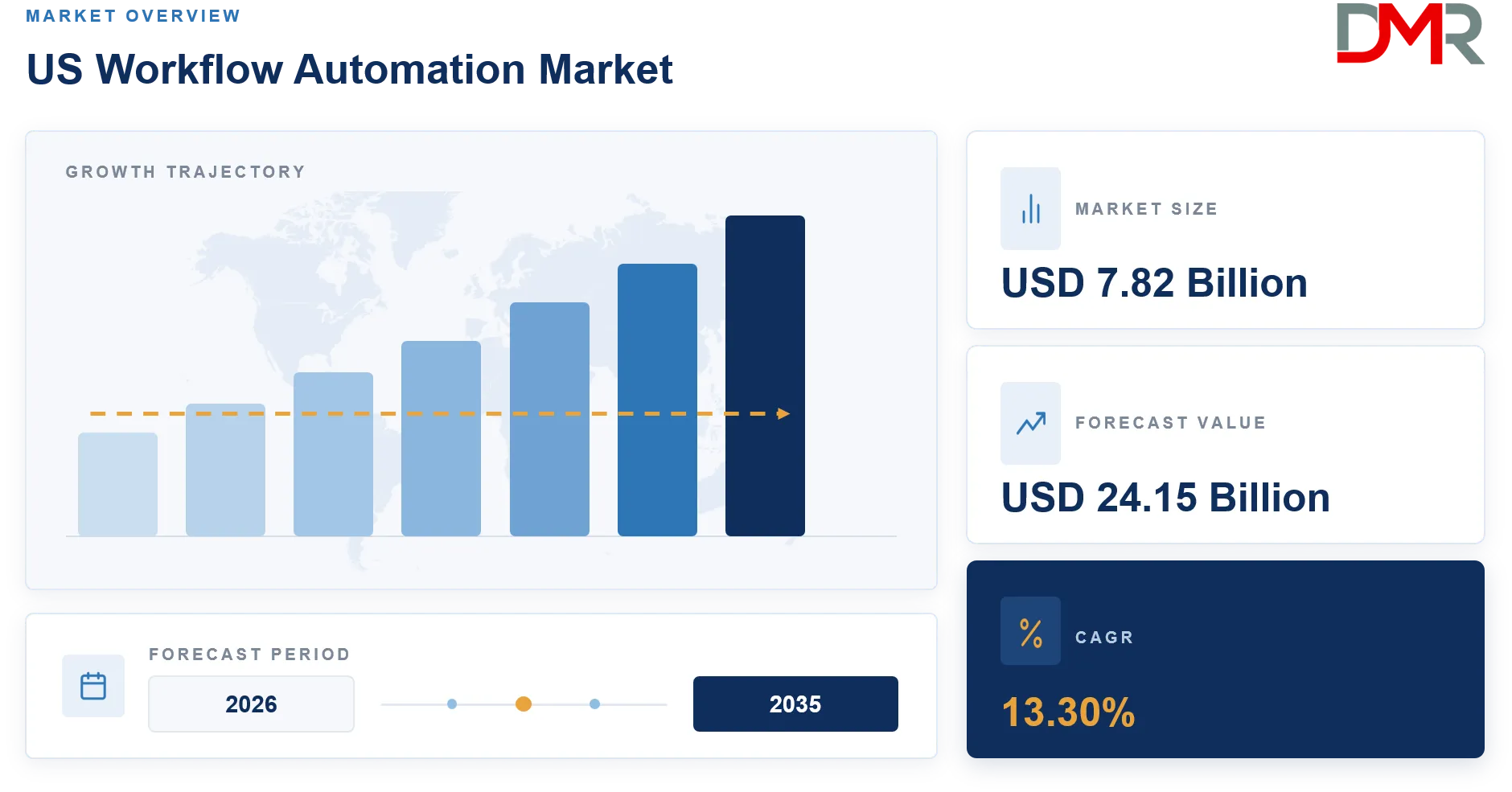
- Market Value: The U.S. Workflow Automation Market is valued at USD 7.82 billion in 2026 and is expected to reach USD 24.15 billion by 2035.
- CAGR: The U.S. Workflow Automation Market is expected to grow at a CAGR of 13.3% from 2026 to 2035.
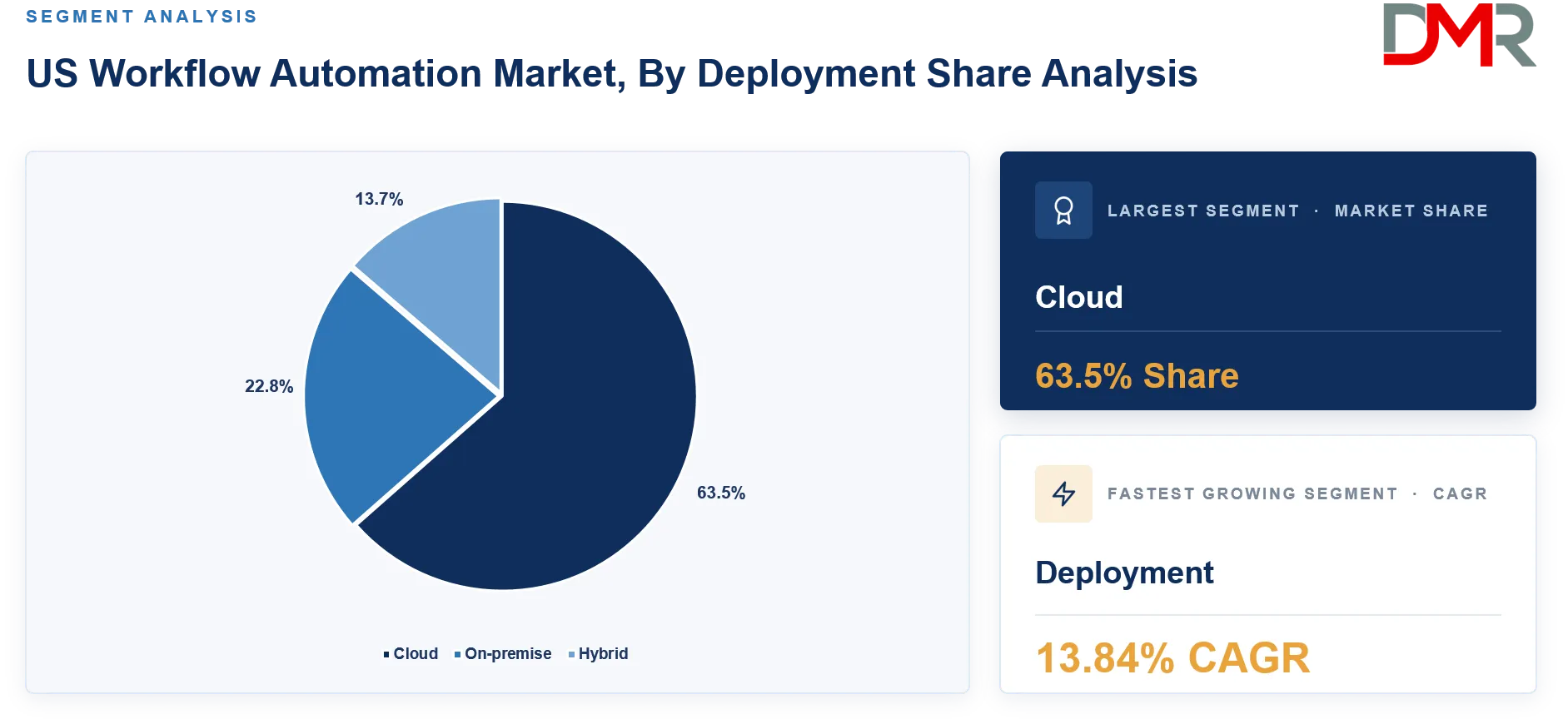
- By Deployment Analysis: Cloud deployment led the market with a 63.5% share in 2026.
- By Solution Segment Analysis: Software led the solution segment with a 68.0% share in 2026.
- By End-User Industry Segment Analysis: Banking and Financial Services held a 25.5% share in 2026.
- Major Players: Microsoft Corporation, ServiceNow Inc, UiPath Inc, IBM Corporation, and Others.
What is the U.S. Workflow Automation Market and its Market Size?
The U.S. Workflow Automation Market size is projected to be valued at USD 7.82 billion in 2026 and is projected to reach USD 24.15 billion by 2035, expanding at a CAGR of 13.3% during the forecast period. Workflow automation combines software, robotic process automation, business process management, orchestration, low-code tools, application programming interfaces, document processing, and increasingly intelligent agents to execute repeatable business processes with less manual intervention. Demand is expanding as U.S. enterprises connect workflows across finance, customer service, human resources, information technology, supply chains, healthcare administration, compliance, and revenue operations.
ℹ
To learn more about this report –
Download Your Free Sample Report Here
The U.S. workflow automation market is moving beyond task-level automation toward coordinated enterprise processes. Platforms increasingly combine cloud workflows, desktop automation, process mining, integration, decision rules, analytics, and generative capabilities in one operating environment. Microsoft Power Automate, for example, supports cloud flows, desktop RPA, process mining, orchestration, AI processing, and more than 1,000 API connectors. ServiceNow combines integrations, RPA, document intelligence, process optimization, and workflow management on its enterprise platform. This convergence is changing workflow automation from a departmental productivity tool into infrastructure used to connect systems, people, data, applications, and machine-driven actions.
Use Cases
- Finance and Banking Operations: Banks use workflow automation for customer onboarding, account servicing, loan processing, KYC reviews, payment exceptions, fraud investigation routing, reconciliation, compliance approvals, and audit trails. These workflows reduce manual handoffs while supporting tighter control over high-volume financial processes.
- IT Service Management: Enterprises automate password requests, access approvals, incident classification, service tickets, infrastructure alerts, employee provisioning, software requests, and escalation workflows. Integration between service management platforms, cloud systems, identity tools, and collaboration applications reduces resolution times.
- Customer Operations: Workflow platforms connect CRM systems, support channels, billing applications, knowledge bases, and communication tools. Automated routing, service-level tracking, case summarization, customer verification, refund approvals, and follow-up actions help companies manage growing service volumes without increasing manual processing at the same pace.
- Document and Compliance Processing: Healthcare, insurance, financial services, government, and legal teams automate document classification, data extraction, validation, approval, record creation, retention, and exception routing. Intelligent document processing expands automation into workflows that previously depended on employees reading unstructured forms, invoices, contracts, and correspondence.
- Supply Chain and Operations: Manufacturers, retailers, logistics firms, and distributors use automated workflows for procurement approvals, purchase orders, inventory alerts, supplier onboarding, shipment exceptions, maintenance requests, order processing, invoice matching, and warehouse coordination. Orchestration improves visibility across applications that often operate in separate technology environments.
How AI and Generative AI are Transforming the U.S. Workflow Automation Market?
AI is shifting U.S. workflow automation from predefined rule execution toward systems that can interpret information, recommend actions, generate content, and coordinate multiple workflow steps. Natural-language workflow design is reducing the technical effort needed to build automations, while machine learning supports document classification, process discovery, routing, exception detection, forecasting, and decision support. Generative capabilities can summarize service cases, draft responses, interpret unstructured inputs, create workflow logic, and assist employees during complex processes. U.S. Census Bureau business data collected from late 2025 through early 2026 showed that about 18% of firms used AI in a business function, while employment-weighted adoption reached 32%. Adoption was substantially higher among large firms and knowledge-intensive sectors, creating a strong installed base for AI-enabled enterprise workflow automation.
The next stage is agentic workflow automation, where software agents can reason across a defined task, invoke applications, retrieve business data, trigger workflows, and coordinate actions across systems. This raises the value of orchestration platforms because enterprises need a controlled layer for permissions, identity, monitoring, approvals, exception handling, and auditability. Microsoft, Salesforce, ServiceNow, UiPath, IBM, and other vendors are embedding AI and agent capabilities into automation portfolios. Governance is becoming equally important. NIST's AI Risk Management Framework and Generative AI Profile provide U.S. organizations with structured approaches for managing AI risks. As autonomous actions expand, buyers are placing greater weight on access controls, human approval points, logging, model governance, data protection, and traceable workflow execution.
Key Drivers in the U.S. Workflow Automation Market
Rising Enterprise Pressure to Improve Productivity
U.S. organizations are increasing automation investment as management teams seek measurable productivity gains without matching every increase in transaction volume with additional labor. High-frequency activities such as ticket routing, invoice processing, customer onboarding, employee provisioning, data entry, claims handling, and approvals are attractive targets because automation can shorten cycle times and reduce repetitive work. Large enterprises have particularly strong demand because even small efficiency improvements can produce material savings across thousands of employees and millions of annual workflow events.
Rapid Integration of Cloud Applications and Business Systems
The expansion of SaaS, cloud infrastructure, CRM, ERP, collaboration, analytics, security, and industry-specific applications has increased the number of systems involved in everyday business processes. Workflow automation provides an orchestration layer between these systems. API connectors, integration hubs, event triggers, RPA, and low-code tools enable enterprises to move information and actions between modern cloud applications and older systems. This need supports the 63.5% cloud deployment share in 2026 and strengthens demand for platforms that combine integration with automation and governance.
Restraints in the U.S. Workflow Automation Market
Complex Legacy Systems and Integration Debt
Many U.S. enterprises operate workflows across decades-old applications, custom databases, spreadsheets, email, cloud software, and industry platforms. Automating these environments can require API development, screen-level RPA, data mapping, identity configuration, process redesign, and ongoing maintenance. Automation can also become fragile when interfaces or underlying applications change. Organizations with extensive technical debt may therefore face longer implementation cycles and higher integration costs, reducing the speed at which automation programs can scale beyond isolated processes.
Governance, Security, and Process Control Risks
Workflow automation can create operational risk when automated actions have excessive permissions, weak monitoring, poor exception handling, or incomplete audit trails. The issue becomes more significant when generative models and autonomous agents can initiate actions across financial, customer, employee, or regulated data. Buyers must define access rights, approval thresholds, data handling policies, human review requirements, and accountability before expanding automation. These controls can slow deployment in banking, healthcare, government, utilities, and other environments where process failures can create financial, compliance, or service consequences.
Growth Opportunities in the U.S. Workflow Automation Market
Agentic Automation and Enterprise Orchestration
Agentic systems create a major growth opportunity by extending automation beyond deterministic workflows. Software agents can interpret requests, select tools, gather information, initiate processes, and coordinate multiple actions within controlled boundaries. Enterprises will need orchestration platforms that govern how agents interact with ERP, CRM, service management, databases, communication tools, and internal applications. Vendors that combine agent management, workflow engines, integration, identity, monitoring, and human approval capabilities are positioned to capture spending as organizations move from AI assistants toward controlled autonomous execution.
Expansion of Automation Across Midmarket Enterprises
Low-code interfaces, cloud deployment, subscription pricing, prebuilt connectors, templates, and natural-language workflow creation are reducing the technical barriers that historically limited sophisticated automation to large enterprises. Small and medium-sized businesses can increasingly automate lead routing, customer support, finance operations, inventory notifications, employee onboarding, marketing processes, and internal approvals without building large automation teams. This creates an attractive expansion opportunity for vendors such as Zapier, Workato, monday.com, Zoho, Kissflow, Pipefy, and other platforms targeting easier deployment and faster time to value.
Trends in the U.S. Workflow Automation Market
Convergence of RPA, BPM, Integration, and AI
Product boundaries are becoming less distinct as vendors combine robotic process automation, business process management, integration platform capabilities, process mining, low-code development, intelligent document processing, generative functions, and orchestration. Buyers increasingly prefer platforms that can automate complete processes instead of managing separate products for individual automation technologies. Microsoft, ServiceNow, UiPath, IBM, Pegasystems, Appian, SAP, and Oracle are competing around broader automation architectures, while integration-focused providers are expanding deeper into workflow and orchestration.
Shift from Task Automation to End-to-End Process Automation
U.S. enterprises are moving beyond automating single repetitive tasks toward redesigning entire workflows. A customer onboarding process, for example, may involve identity checks, CRM updates, document processing, risk review, account provisioning, notifications, and compliance records. End-to-end automation connects these activities with common controls and analytics. Process mining and workflow intelligence support this transition by identifying bottlenecks, rework, waiting periods, and automation candidates. The result is stronger demand for enterprise workflow orchestration platforms that can manage processes across departments and technology environments.
Research Scope and Analysis
The U.S. Workflow Automation Market is segmented based on deployment, solution, end-user industry, organization size, and other relevant categories. The study evaluates market demand, technology adoption, competitive positioning, implementation patterns, business use cases, and the contribution of major segments to overall market growth.
ℹ
To learn more about this report –
Download Your Free Sample Report Here
By Deployment
Cloud deployment dominated the U.S. Workflow Automation Market with a 63.5% share in 2026. Cloud platforms support rapid provisioning, remote administration, scalable workflow execution, centralized updates, API connectivity, and integration with widely adopted SaaS applications. Their position is reinforced by enterprise migration toward Microsoft 365, Salesforce, ServiceNow, cloud ERP, cloud data platforms, and other connected business systems. Cloud deployment also enables vendors to deliver AI features and workflow updates continuously. Hybrid deployment remains strategically important for organizations that need cloud orchestration while retaining sensitive data, legacy applications, or regulated workloads inside private environments.
By Solution
Software accounted for 68.0% of the U.S. workflow automation market in 2026, reflecting enterprise spending on RPA platforms, workflow orchestration platforms, and business process management suites. Software platforms increasingly provide visual workflow design, process mining, connectors, rules engines, document processing, analytics, governance, and AI features through integrated environments. Services remain essential because large automation programs often require process discovery, architecture design, implementation, system integration, governance, migration, and managed operations. Consulting and implementation demand is particularly strong when enterprises automate complex cross-functional processes involving ERP, CRM, financial systems, mainframes, industry applications, and custom software.
By End-User Industry
Banking and Financial Services held 25.5% of U.S. workflow automation revenue in 2026. Financial institutions operate high volumes of rule-intensive and document-heavy processes across onboarding, lending, payments, servicing, compliance, fraud operations, reconciliation, finance, and customer support. These characteristics create a large addressable base for RPA, document automation, orchestration, workflow management, and AI-assisted processing. Finance is also among the U.S. sectors showing relatively high enterprise AI adoption. Banks nevertheless require strong governance, auditability, data controls, human escalation, and operational resilience, encouraging demand for enterprise-grade platforms rather than isolated automation tools.
By Organization Size
Large enterprises represent an important revenue pool because they operate complex application estates, multiple business units, high transaction volumes, and formal governance requirements. U.S. Census Bureau analysis published in 2026 showed that 37% of firms with at least 250 employees reported using AI in business operations, compared with lower adoption among very small firms. This pattern supports demand for intelligent workflow automation in large organizations. SMEs represent a growing opportunity as low-code interfaces, templates, cloud delivery, and prebuilt integrations lower implementation barriers and enable companies with smaller technology teams to automate recurring processes.
The U.S. Workflow Automation Market Report is segmented on the basis of the following:
By Deployment
By Solution
- Services
- Managed Services
- Consulting and Advisory
- Implementation and Integration
- Software
- RPA Platforms
- Workflow Orchestration Platforms
- Business Process Management Suites
By End-user Industry
- Manufacturing
- Healthcare and Pharmaceuticals
- Banking and Financial Services
- Energy and Utilities
- Retail and E-commerce
- Telecom
- Logistics and Transportation
- Government and Public Sector
- Other End-user Industries
By Organization Size
- Small and Medium-sized Enterprises
- Large Enterprises
Competitive Landscape
The U.S. Workflow Automation Market has a broad competitive landscape spanning enterprise software companies, RPA specialists, business process management vendors, integration platforms, low-code providers, and cloud automation companies. Microsoft competes through Power Automate and the wider Power Platform ecosystem, combining cloud flows, desktop RPA, process mining, AI, orchestration, and extensive application connectivity. ServiceNow focuses on enterprise workflows supported by integration, RPA, document intelligence, process optimization, and its AI platform.
UiPath remains strongly associated with enterprise automation and RPA while expanding toward agentic automation and orchestration. IBM, Salesforce, Pegasystems, Appian, Oracle, and SAP compete through established enterprise technology relationships and integrated process capabilities. Workato, Zapier, Nintex, Kissflow, Zoho, Bizagi, Camunda, Pipefy, and monday.com address different combinations of integration, workflow development, process orchestration, and low-code automation. Competition is increasingly based on AI functionality, connector ecosystems, process intelligence, governance, security, deployment flexibility, ease of development, enterprise scalability, and the ability to automate complete processes rather than individual tasks.
Some of the prominent players in the U.S. Workflow Automation Industry are:
- Microsoft Corporation
- ServiceNow Inc
- UiPath Inc
- IBM Corporation
- Salesforce Inc
- Pegasystems Inc
- Appian Corporation
- Automation Anywhere Inc
- Oracle Corporation
- SAP SE
- Workato Inc
- Nintex Global Limited
- Kissflow Inc
- Zoho Corporation
- Bizagi
- Camunda Services GmbH
- Pipefy
- Zapier Inc
- monday.com Ltd
- Broadcom Inc
- Others
Technology Analysis
The U.S. Workflow Automation Market is evolving from rule-based task automation toward integrated platforms that combine robotic process automation, business process management, process mining, low-code development, API integration, intelligent document processing, and AI-driven orchestration. Cloud architecture is central to this shift, supported by the cloud segment's 63.5% market share in 2026. Enterprises increasingly require automation that can connect SaaS applications, ERP and CRM platforms, legacy systems, databases, collaboration tools, and custom applications within a governed workflow.
Generative AI and agentic automation are extending this technology stack by enabling natural-language workflow creation, unstructured data interpretation, contextual decision support, and autonomous task execution. Microsoft, ServiceNow, UiPath, IBM, Salesforce, Pegasystems, and Appian are expanding platform capabilities around these technologies. As adoption advances, competitive differentiation is shifting toward interoperability, security, process intelligence, human-in-the-loop controls, scalability, and centralized governance.
Investment and White Space Analysis
Investment opportunities in the U.S. Workflow Automation Market are expanding as the industry moves toward USD 24.15 billion by 2035 from USD 7.82 billion in 2026. Significant white space exists beyond mature task automation in agent orchestration, industry-specific workflows, intelligent document processing, process intelligence, legacy application integration, governance, and secure automation for regulated operations. Banking and Financial Services, which accounted for 25.5% of the market in 2026, offers opportunities around compliance, onboarding, lending, fraud operations, reconciliation, and document-intensive processes. Healthcare, manufacturing, logistics, government, energy, and midmarket enterprises provide additional underpenetrated demand. Investors and vendors can also target solutions that bridge AI agents with existing ERP, CRM, IT service management, and proprietary systems. Platforms offering measurable time-to-value, reusable industry templates, human approval controls, audit trails, secure data access, and low-code deployment are positioned to address gaps between experimental automation projects and scalable enterprise-wide adoption.
Recent Developments
- December 2025: ServiceNow Inc completed its $2.85 billion acquisition of AI firm Moveworks, combining agentic AI workflows with enterprise search to create an AI-native front door for employee engagement across IT, HR, and business operations.
- November 2025: Automation Anywhere Inc acquired Aisera, a leader in agentic AI for autonomous IT, HR, and customer service, to build a unified platform delivering conversational AI agents and Agentic Process Automation for the Autonomous Enterprise.
- October 2025: Microsoft Corporation added Copilot-driven workflow generation to Power Automate, enabling users to describe processes in natural language and receive runnable automation templates integrated with Teams, SharePoint, and Dynamics 365.
Report Details
| Report Characteristics |
| Market Size (2026) |
USD 7.82 Bn |
| Forecast Value (2035) |
USD 24.15 Bn |
| CAGR (2026-2035) |
13.3% |
| Historical Data |
2021 - 2025 |
| Forecast Data |
2027 - 2035 |
| Base Year |
2025 |
| Estimate Year |
2026 |
| Segments Covered |
By Deployment (Hybrid, On-premise, and Cloud), By Solution (Services {Managed Services, Consulting and Advisory, and Implementation and Integration}, Software {RPA Platforms, Workflow Orchestration Platforms, and Business Process Management Suites}), By End-user Industry (Manufacturing, Healthcare and Pharmaceuticals, Banking and Financial Services, Energy and Utilities, Retail and E-commerce, Telecom, Logistics and Transportation, Government and Public Sector, and Other End-user Industries), By Organization Size (Small and Medium-sized Enterprises, and Large Enterprises) |
| Regional Coverage |
United States |
Frequently Asked Questions
What is the current size of the U.S. Workflow Automation Market?
▾ The U.S. Workflow Automation Market is valued at USD 7.82 billion in 2026 and is forecast to reach USD 24.15 billion by 2035.
What is the growth rate of the U.S. Workflow Automation Market during?
▾ The U.S. Workflow Automation Market is expected to grow at a CAGR of 13.3% during the forecast period 2026-2035.
What factors are driving the growth of the U.S. Workflow Automation Market?
▾ Cloud adoption, process digitization, AI integration, and productivity needs drive U.S. Workflow Automation Market growth.
What are the major challenges restraining the U.S. Workflow Automation Market?
▾ Legacy integration, data security, governance, and implementation complexity restrain U.S. Workflow Automation Market growth.
Which segment holds the largest share of the U.S. Workflow Automation Market?
▾ Cloud deployment holds the largest U.S. Workflow Automation Market share, accounting for 63.5% of revenue in 2026.
Who are the leading companies in the U.S. Workflow Automation Market?
▾ Microsoft Corporation, ServiceNow Inc, UiPath Inc, IBM Corporation, Salesforce Inc, Pegasystems Inc, Appian Corporation, Automation Anywhere Inc, Oracle Corporation, SAP SE, Workato Inc, Nintex Global Limited, Kissflow Inc, Zoho Corporation, Bizagi, Camunda Services GmbH, Pipefy, Zapier Inc, monday.com Ltd, and Broadcom Inc are leading companies in the U.S. Workflow Automation Market.
How is AI influencing the U.S. Workflow Automation Market?
▾ AI is advancing the U.S. Workflow Automation Market through intelligent agents, process discovery, and decision automation.
What are the future opportunities and trends in the U.S. Workflow Automation Market?
▾ Agentic automation, low-code tools, cloud orchestration, and process intelligence offer strong U.S. market opportunities.