Market Snapshot
- Market Size (2026): USD 1.9 Bn
- Forecast Value (2035): USD 3.7 Bn
- CAGR (2026-2035): 7.7%
- Largest Region (2026): North America, approximately 38%
- Fastest-Growing Region: Asia-Pacific
- Leading Method (2026): Solvent Detergent Method, around 34%
- Leading Product (2026): Kits and Reagents, close to 46%
- Key Players: Merck KGaA, Sartorius AG, Thermo Fisher Scientific, and Others
What is Viral Inactivation Market and its Market Size?
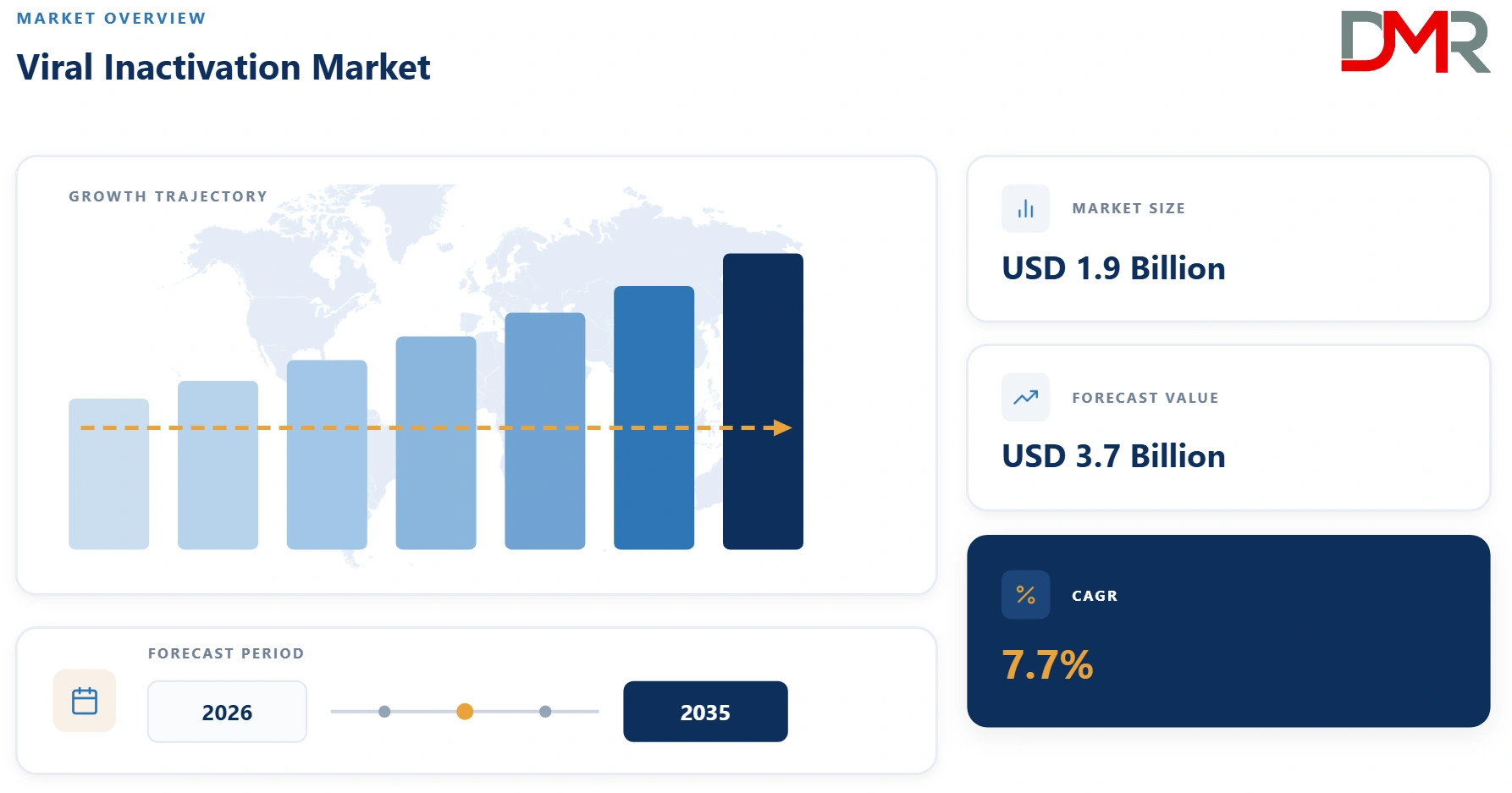
Global Viral Inactivation Market size is estimated to reach USD 1.9 Bn in 2026 and is further anticipated to reach USD 3.7 Bn by 2035, at a CAGR of 7.7%.
ℹ
To learn more about this report –
Download Your Free Sample Report Here
Viral inactivation refers to processes and products used to eliminate or neutralize viruses in biological materials, especially during the manufacturing of biopharmaceuticals, vaccines, plasma-derived therapies, and cell and gene therapies. The market encompasses chemical and physical inactivation methods, filtration systems, dedicated equipment, kits and reagents, analytical testing services, and process development support.
Demand is driven by regulatory requirements for viral safety, the expansion of biologics manufacturing, and the need to mitigate contamination risks in complex production workflows. Manufacturers evaluate inactivation strategies based on efficacy, impact on product quality, compatibility with downstream processing, and validation burden.
The market serves biopharmaceutical companies, contract development and manufacturing organizations, vaccine producers, blood and plasma processors, and research institutions. As modalities diversify and production scales increase, viral inactivation is increasingly treated as a critical control point rather than an ancillary step.
Use Cases
- Monoclonal antibody production: Biologics manufacturers apply solvent detergent treatment, low pH incubation, or nanofiltration to inactivate enveloped and non-enveloped viruses in harvest streams. This reduces the risk of viral contamination in final drug substances and supports regulatory filings with robust clearance data.
- Vaccine manufacturing: Vaccine producers use heat, chemical, or detergent-based inactivation to ensure product safety while preserving immunogenicity. Validated inactivation steps help meet stringent release specifications and reduce batch failures associated with adventitious agents.
- Plasma-derived therapies: Plasma fractionators implement multiple orthogonal inactivation and removal steps to address diverse viral threats. The approach supports consistent supply of immunoglobulins, clotting factors, and albumin while complying with pharmacopoeial standards.
- Cell and gene therapy: Developers of viral vectors and cell products incorporate inactivation or clearance strategies to manage residual virus risks from production cell lines or reagents. This supports patient safety and facilitates regulatory approval for advanced therapy medicinal products.
Key Takeaways
- Market Size & Share: The market is estimated at USD 1.9 Bn in 2026, with therapeutic proteins representing approximately 42% of application demand.
- Method Analysis: Nanofiltration is projected to expand at a CAGR of 9.2% between 2026 and 2035.
- Product Analysis: Kits and Reagents lead with an approximate 2026 revenue share of 46%.
- Regional Analysis: North America and Europe together account for approximately 65% of 2026 revenue.
- Commercial Catalyst: Regulatory expectations for viral safety can increase validation and testing expenditures by approximately 10% to 20% in biologics programs.
- Competitive Dynamics: The market remains moderately concentrated, with large life-science suppliers competing through integrated portfolios of equipment, consumables, and services.
How AI/Gen AI is Transforming the Viral Inactivation Market?
AI is being applied to viral inactivation through process modeling, anomaly detection, and predictive analytics. Machine-learning models combine process parameters, in-line sensor data, and historical virology results to estimate inactivation kinetics and identify conditions associated with incomplete clearance. This supports earlier intervention when pH, temperature, solvent concentration, or flow rates begin to drift from validated ranges.
Generative AI adds a natural-language layer to manufacturing and quality data. Scientists can query validation reports, compare inactivation runs, draft investigation summaries, and identify relationships between process settings and viral clearance outcomes. Deployment requires validated data pipelines, model governance, and human oversight because regulatory submissions cannot rely on unexplained algorithmic recommendations.
- Predictive inactivation modeling: Soft sensors estimate log reduction values from process signals and flag deviations before material advances to downstream steps.
- Predictive maintenance: Models detect pump, filter, and sensor anomalies that could compromise inactivation performance.
- Generative investigation support: Language models organize batch records, test results, and prior deviations to accelerate root-cause review while preserving quality-unit oversight.
Key Drivers in the Global Viral Inactivation Market
Regulatory Requirements for Viral Safety
Regulatory agencies expect robust viral safety strategies across biologics, vaccines, and advanced therapies. Guidelines encourage multiple orthogonal steps, validated inactivation processes, and comprehensive testing to mitigate contamination risks. This drives adoption of standardized inactivation methods, dedicated equipment, and analytical services that can generate defensible clearance data. Manufacturers invest in solvent detergent systems, nanofiltration, low pH steps, and heat treatments to meet these expectations. The requirement for consistent documentation and comparability across process changes further supports demand for qualified reagents, single-use assemblies, and automation that reduce operator variability.
Expansion of Biologics and Advanced Therapy Manufacturing
The growth of monoclonal antibodies, recombinant proteins, vaccines, and cell and gene therapies increases the volume of processes that require viral inactivation. Larger and more diverse manufacturing networks create demand for scalable, reproducible inactivation platforms that can be validated across sites. Biopharmaceutical companies and CDMOs seek solutions that integrate with existing workflows while minimizing impact on product quality and yield. This favors suppliers that offer end-to-end portfolios, from development-scale kits to commercial production systems. As modalities diversify, inactivation strategies are increasingly tailored to molecule class, production host, and regulatory pathway.
Restraints in the Global Viral Inactivation Market
Process Compatibility and Product Quality Trade-offs
Not all inactivation methods are suitable for every molecule or modality. Harsh chemical or physical conditions can affect protein structure, potency, or stability, requiring extensive comparability work. Some processes face constraints related to buffer composition, residence time, or equipment footprint. Developers may need to balance viral clearance objectives with yield, aggregation, or immunogenicity risks. This can slow adoption of newer inactivation technologies until sufficient process understanding and regulatory confidence are established. The restraint is most significant for complex or sensitive products where even minor changes require additional clinical or analytical characterization.
High Validation and Implementation Costs
Implementing or modifying inactivation steps involves substantial investment in equipment, consumables, analytical testing, and process validation. Manufacturers must generate robust data on log reduction values, scalability, and reproducibility under current Good Manufacturing Practice conditions. Smaller companies and early-stage programs may find these costs burdensome, particularly when multiple inactivation and removal steps are required. Limited internal expertise can also increase dependence on external providers and extend implementation timelines. These factors can delay adoption or lead to conservative choices that prioritize familiarity over optimization.
Growth Opportunities in the Global Viral Inactivation Market
Single-Use and Modular Inactivation Systems
Single-use assemblies and modular skids are gaining traction for inactivation steps in development and commercial manufacturing. Closed, pre-validated systems can reduce cleaning burden, lower cross-contamination risks, and accelerate technology transfer. Suppliers can differentiate through integrated fluid paths, sensors, and control logic that simplify operation and data capture. The opportunity is strongest in multiproduct facilities and CDMOs that value flexibility and rapid changeover. As single-use capacity expands, demand for compatible inactivation reagents, filters, and analytics is expected to grow in parallel.
Analytical and Testing Services for Viral Clearance
Robust viral clearance characterization requires specialized analytical capabilities, including infectivity assays, PCR-based methods, and model virus studies. Many manufacturers outsource portions of this work to qualified laboratories with established regulatory track records. Growth opportunities exist in faster, more sensitive assays, standardized study designs, and data packages that support global filings. Providers that combine method development, routine testing, and regulatory consulting can capture a larger share of program budgets. The trend toward earlier and more frequent viral safety assessments further expands the addressable market for these services.
Trends in the Global Viral Inactivation Market
Shift Toward Continuous and Intensified Processing
Bioprocessing is gradually moving toward continuous and intensified operations, including perfusion culture and integrated downstream trains. This creates demand for inactivation steps that can operate under steady-state conditions with reliable residence time control and minimal hold points. Suppliers are evaluating inline mixers, continuous reactors, and membrane-based systems compatible with uninterrupted flow. The trend favors solutions that maintain viral clearance performance while supporting higher facility utilization and smaller footprints. Adoption will depend on regulatory acceptance, process robustness, and the ability to generate comparable or superior clearance data relative to batch modes.
Greater Emphasis on Early-Stage Viral Safety Strategy
Developers are increasingly addressing viral safety during process development rather than deferring decisions to late-stage programs. Early selection of inactivation methods, model virus studies, and risk assessments can reduce downstream surprises and facilitate smoother regulatory interactions. This trend increases demand for development-scale inactivation kits, screening services, and consultative support. It also encourages platform approaches where inactivation steps are predefined for certain molecule classes or expression systems. As a result, suppliers with strong development portfolios and technical service capabilities are well positioned to capture early program spend.
Research Scope and Analysis
The report evaluates viral inactivation across method, product, application, and end-user dimensions, with regional coverage and attention to regulatory, analytical, and process-integration considerations. Growth is assessed through adoption intensity, capacity investment, regulatory readiness, and modality mix.
ℹ
To learn more about this report –
Download Your Free Sample Report Here
By Method
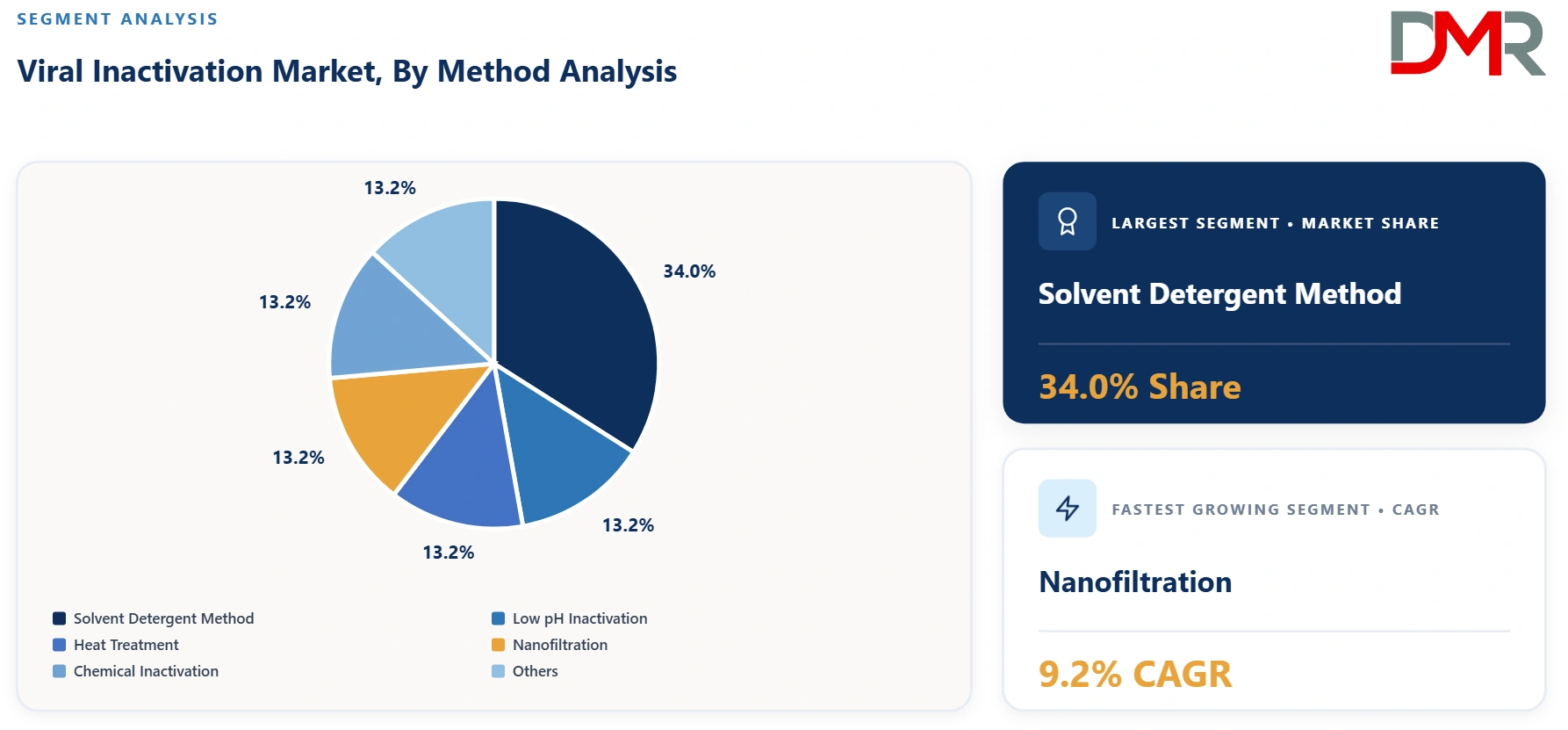
Solvent Detergent Method leads this dimension with an estimated share of around 34% in 2026, supported by established procurement patterns and broad compatibility with commercial production. Growth, however, is concentrated in Nanofiltration, projected to expand at a CAGR of 9.2% between 2026 and 2035 as manufacturers invest in tighter process control, data visibility, and more responsive production economics.
By Product
Kits and Reagents leads this dimension with an estimated share of around 34% in 2026, supported by established procurement patterns and broad compatibility with commercial production. Growth, however, is concentrated in Equipment, projected to expand at a CAGR of 9.2% between 2026 and 2035 as manufacturers invest in tighter process control, data visibility, and more responsive production economics.
By Application
Therapeutic Proteins leads this dimension with an estimated share of around 34% in 2026, supported by established procurement patterns and broad compatibility with commercial production. Growth, however, is concentrated in Vaccines, projected to expand at a CAGR of 9.2% between 2026 and 2035 as manufacturers invest in tighter process control, data visibility, and more responsive production economics.
By End User
Biopharmaceutical Companies leads this dimension with an estimated share of around 34% in 2026, supported by established procurement patterns and broad compatibility with commercial production. Growth, however, is concentrated in CROs and CMOs, projected to expand at a CAGR of 9.2% between 2026 and 2035 as manufacturers invest in tighter process control, data visibility, and more responsive production economics.
The Global Viral Inactivation Market Report is Segmented Based on the Following
By Method
- Solvent Detergent Method
- Low pH Inactivation
- Heat Treatment
- Nanofiltration
- Chemical Inactivation
- Others
By Product
- Kits and Reagents
- Filters and Membranes
- Inactivation Equipment
- Analytical Instruments
- Services
- Others
By Application
- Therapeutic Proteins
- Vaccines
- Plasma-Derived Products
- Cell and Gene Therapies
- Blood Products
- Others
By End User
- Biopharmaceutical Companies
- CROs and CMOs
- Vaccine Manufacturers
- Plasma Fractionators
- Research Institutions
- Others
Regional Analysis
Demand is concentrated in regions with advanced biopharmaceutical, vaccine, and life-science ecosystems. Adoption varies with regulatory experience, capital availability, local manufacturing policy, and the presence of qualified analytical and engineering providers.
Region with the Largest Revenue Share
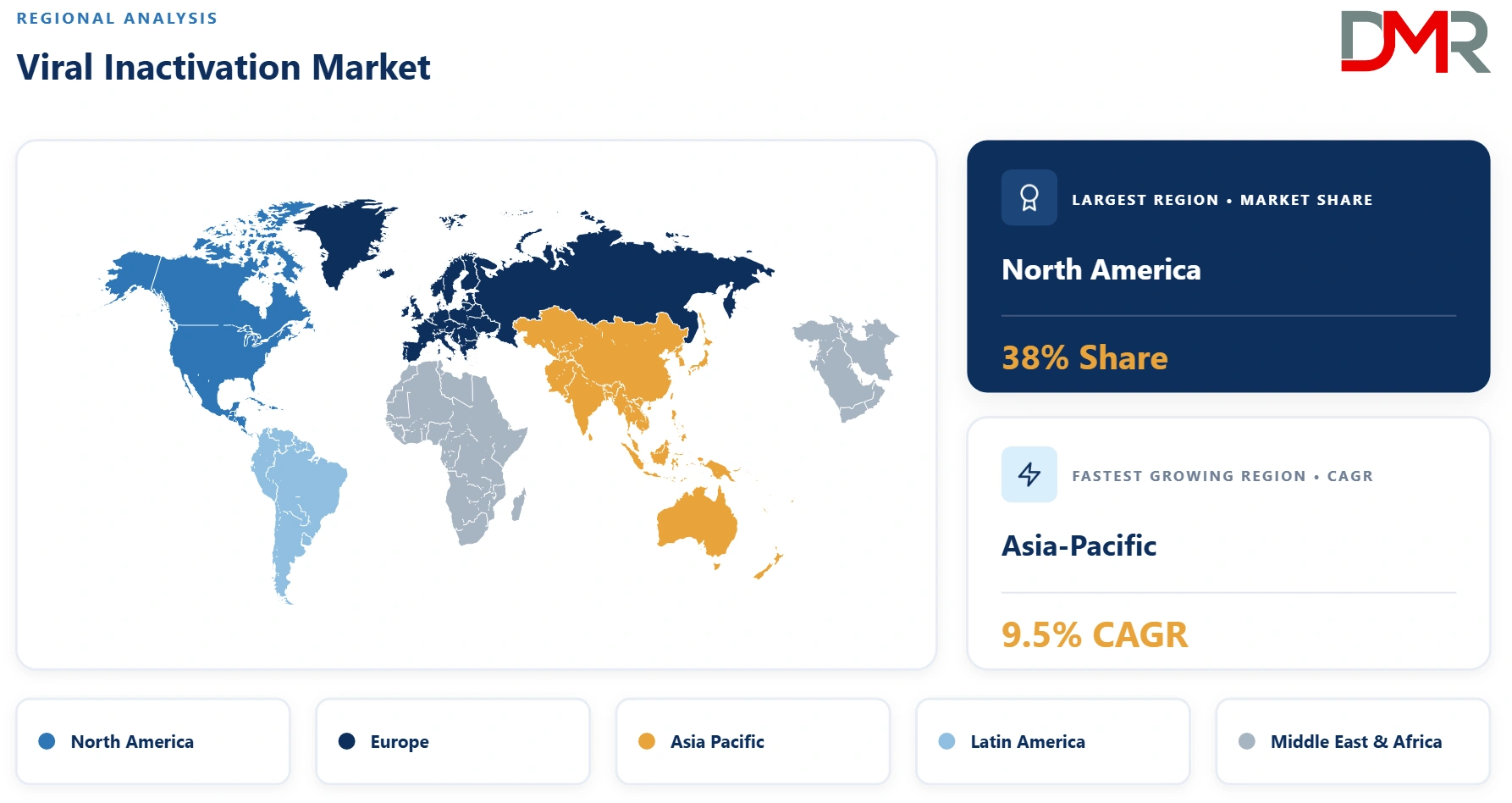
North America holds the largest share, at approximately 38% in 2026. The region benefits from major biopharmaceutical and biotechnology manufacturing bases, established analytical laboratories, strong investment in advanced therapies, and a broad network of qualified service providers. US manufacturers are also assessing inactivation platforms for supply resilience and flexible capacity. Demand includes both new facilities and targeted upgrades, particularly where real-time analytics and digital quality systems can improve release decisions. Canada contributes through biologics, vaccines, and plasma processing activity, although its market is smaller than that of the United States.
ℹ
To learn more about this report –
Download Your Free Sample Report Here
Region with the Highest CAGR
Asia-Pacific is expected to record the highest growth, with a forecast CAGR of approximately 9.5% from 2026 to 2035. Expansion is supported by pharmaceutical and biologics capacity additions, increasing vaccine manufacturing, local analytical investment, and efforts to improve production efficiency. China, India, South Korea, Japan, and Australia present different adoption profiles, ranging from large-scale generic and vaccine production to advanced biologics and cell therapy applications. Suppliers that offer modular systems, local service, training, and cost-conscious automation packages are positioned to capture incremental demand.
By Region
- North America: 38%
- Europe: 27%
- Asia-Pacific: 22%
- Latin America: 7%
- Middle East & Africa: 6%
Regulatory Landscape
Regulatory expectations for viral safety are codified in guidelines from agencies such as the FDA, EMA, and other national authorities. These documents encourage multiple orthogonal steps, validated inactivation processes, and comprehensive testing to mitigate contamination risks. Manufacturers must demonstrate consistent log reduction values, scalability, and reproducibility under current Good Manufacturing Practice conditions. The landscape continues to evolve with advanced therapies, where viral vector and cell product risks require tailored approaches. Suppliers that align portfolios with regulatory expectations and provide robust documentation and support services are better positioned to capture market share.
Technology Analysis
Technology competition is moving toward integrated platforms that combine inactivation equipment, single-use assemblies, analytical tools, and digital monitoring. Vendors with interoperable control architectures can reduce engineering friction across connected process steps. Development priorities include better mixing, residence time control, fouling-resistant designs, reliable sensors, cybersecurity, and models that translate process signals into quality decisions. Adoption is likely to remain application-specific, with hybrid systems serving as a practical bridge for manufacturers that are not ready for full process conversion.
Competitive Landscape
The market includes life-science equipment suppliers, filtration and membrane specialists, analytical instrument providers, reagent manufacturers, and service organizations. Competition is based on process performance, analytical integration, validation support, interoperability, service coverage, and the ability to scale from development to commercial production. Larger suppliers can bundle equipment and consumables, while specialists compete through application expertise and customized modules. Partnerships and acquisitions are likely to continue as vendors seek complete offerings that connect physical process steps with data, quality, and lifecycle services.
Some of the Prominent Players in the Global Viral Inactivation Market Are:
- Merck KGaA
- Sartorius AG
- Thermo Fisher Scientific
- Danaher Corporation
- Pall Corporation
- Cytiva
- Charles River Laboratories
- Lonza Group
- WuXi Biologics
- Samsung Biologics
- Agilent Technologies
- Bio-Rad Laboratories
- Corning Incorporated
- Eppendorf AG
- Fujifilm Holdings
- GE Healthcare
- Haemonetics Corporation
- Hyclone Laboratories
- Integrated DNA Technologies
- Irvine Scientific
- Kite Pharma
- Lonza Biologics
- Macopharma
- MacoPharma
- Novasep
- Novartis
- Oxford Biomedica
- PerkinElmer
- Pierce Biotechnology
- Promega Corporation
- Roche Diagnostics
- Sangamo Therapeutics
- Sanofi Pasteur
- Siemens Healthineers
- Sartorius Stedim
- Takeda Pharmaceutical
- Terumo BCT
- Valeant Pharmaceuticals
- VWR International
- Waters Corporation
- Other Key Players
Recent Developments
- In March 2026, life-science suppliers expanded demonstration and customer-support programs focused on viral inactivation, nanofiltration, and integrated analytics for biologics manufacturing.
- In November 2025, equipment and reagent providers introduced additional modular configurations for development and commercial viral clearance workflows.
- In August 2025, contract manufacturers increased evaluation of intensified and continuous bioprocessing platforms to improve capacity flexibility and reduce hold times.
- In May 2025, analytical service providers strengthened viral clearance testing offerings linking method development, routine testing, and regulatory consulting.
Report Details
| Report Characteristics |
| Market Size (2026) |
1.9 Bn |
| Forecast Value (2035) |
3.7 Bn |
| CAGR (2026–2035) |
7.7% |
| The US Market Size (2026) |
0.7 Bn |
| Historical Data |
2021 – 2025 |
| Forecast Data |
2026 – 2035 |
| Base Year |
2025 |
| Segments Covered |
By Method, By Product, By Application, By End User |
| Regional Coverage |
North America, Europe, Asia-Pacific, Latin America, Middle East & Africa |
Frequently Asked Questions
How big is the Global Viral Inactivation Market?
▾ Global Viral Inactivation Market size is estimated to reach USD 1.9 Bn in 2026 and is projected to reach USD 3.7 Bn by 2035, growing at a CAGR of 7.7%.
What is the growth rate of the Global Viral Inactivation Market?
▾ The market is expanding at an estimated CAGR of 7.7% from 2026 to 2035, supported by biologics expansion, regulatory expectations, and demand for flexible manufacturing capacity.
Which region holds the largest share in the Global Viral Inactivation Market?
▾ North America leads the market, holding approximately 38% of global revenue in 2026.
Who are the key players in the Global Viral Inactivation Market?
▾ Prominent operating companies include Merck KGaA, Sartorius AG, Thermo Fisher Scientific, and Danaher Corporation.
Which segment is leading the Global Viral Inactivation Market?
▾ The Solvent Detergent Method segment commands the highest share, accounting for roughly 34% in 2026.
Which segment is expanding fastest in the Global Viral Inactivation Market?
▾ The Nanofiltration segment is projected to record the highest growth, registering a CAGR of 9.2% through 2035.
What are the major growth drivers in the Global Viral Inactivation Market?
▾ Market expansion is primarily propelled by regulatory requirements for viral safety and the expansion of biologics and advanced therapy manufacturing.