What is the Wireless Broadband in Public Safety Market Size?
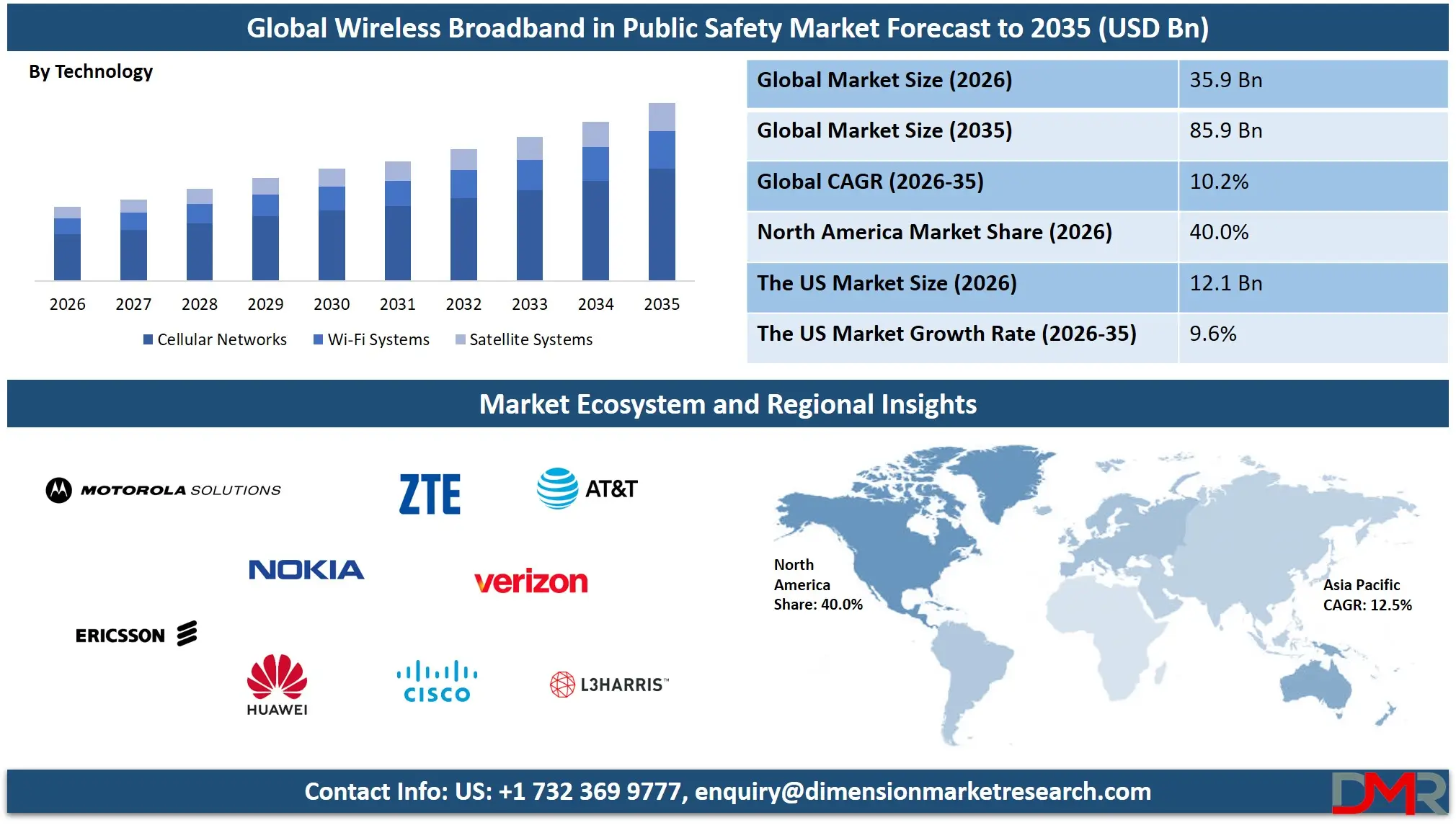
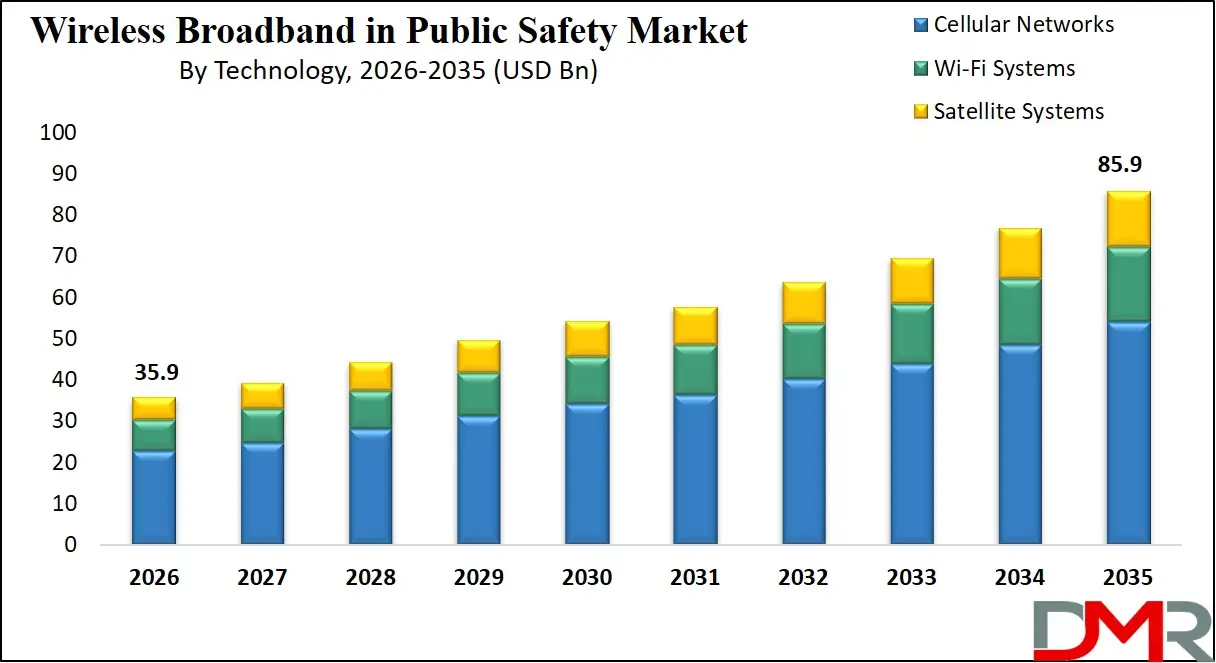
The global Wireless Broadband in Public Safety market will reach USD 35.9 billion in 2026, growing at a 10.2% CAGR to USD 85.9 billion by 2035, driven by mission-critical communication, public safety LTE, and 5G emergency networks.
ℹ
To learn more about this report –
Download Your Free Sample Report Here
The Wireless Broadband in Public Safety Market is a solution that allows real-time voice, data, and video communication of emergency services via LTE and the new 5G networks. Interoperable broadband is being deployed by governments to replace old radio systems to enhance coordination and efficiency in response. The First Responder Network Authority claims to cover almost 3 million square miles within the U.S., which promotes widespread adoption.
The increase is motivated by the increasing demand in the real-time situational awareness and secure data sharing. Public funding is also on the escalation of deployment both in urban and rural localities. Technology, such as video streaming and GIS are boosting operations. The 5G expansion, satellite integration, and AI-based analytics will help support the future growth.
ℹ
To learn more about this report –
Download Your Free Sample Report Here
US Wireless Broadband in the Public Safety Market
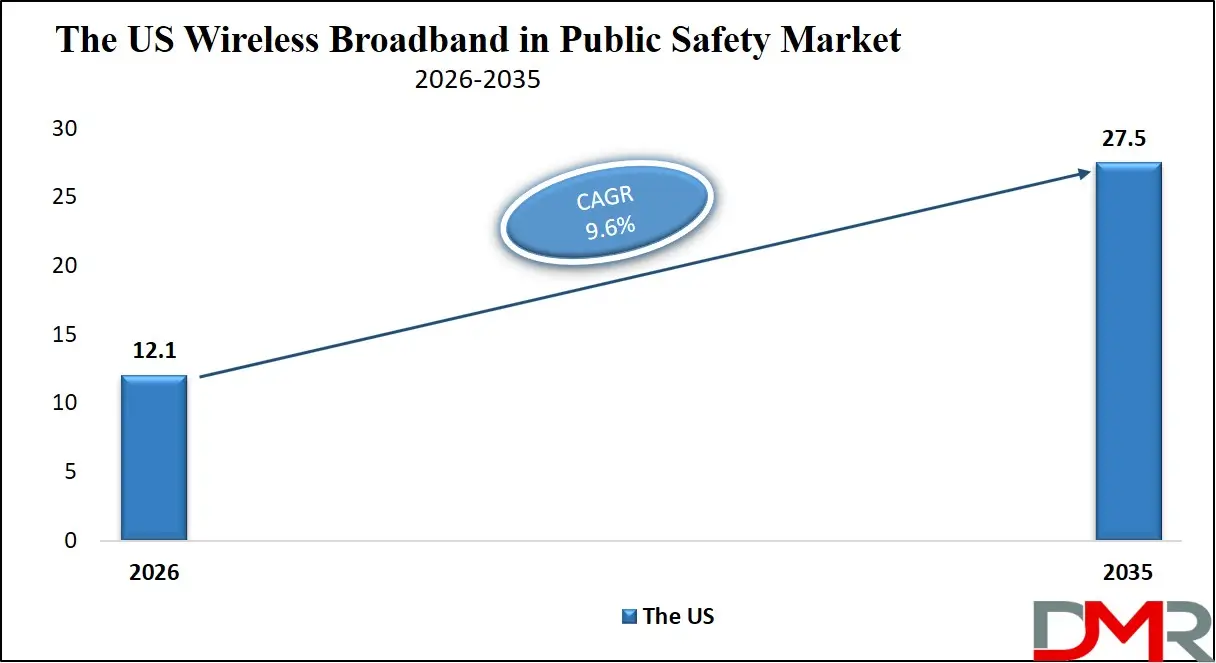
The US Wireless Broadband in Public Safety Market is projected to reach USD 12.1 billion in 2026 and grow at a compound annual growth rate of 9.6%, reaching USD 27.5 billion.
ℹ
To learn more about this report –
Download Your Free Sample Report Here
The U.S. Wireless Broadband in Public Safety Market is the world leader as the countrywide implementation of dedicated LTE infrastructure as part of the First Responder Network Authority allows the provision of secure and prioritized communication to first responders. The market, with the help of federal funding and collaboration with AT&T Inc., is growing at an alarming rate particularly in rural and disaster-prone locations. The increased use of 5G networks, mission-critical applications, real-time video, and AI-enabled analytics spurs growth and enhances efficiency and interoperability in emergency response.
Europe Wireless Broadband in Public Safety Market
Europe Wireless Broadband in Public Safety Market is anticipated to reach USD 8.9 billion in 2026, expanding with a CAGR of 10.0%. Growth is driven by strong regulatory frameworks and cross-border interoperability initiatives across EU member states. Increasing investments in LTE and 5G-based public safety networks are enhancing real-time communication capabilities. Rising focus on disaster preparedness, urban security, and integrated emergency response systems is further supporting market expansion.
Japan Wireless Broadband in the Public Safety Market
Japan Wireless Broadband in Public Safety Market is anticipated to reach USD 2.1 billion in 2026, expanding with a CAGR of 10.8%. Growth is driven by advanced disaster management systems and strong government focus on earthquake and emergency preparedness. Increasing deployment of LTE and 5G networks is enhancing real-time communication and response efficiency. Integration of smart city infrastructure and resilient communication technologies is further supporting market expansion.
Key Takeaways
- Market Size: The global Wireless Broadband in Public Safety market is projected to reach USD 35.9 billion in 2026 and hit USD 85.9 billion by 2035, reflecting strong expansion driven by next-generation communication demand.
- Growth Rate and Outlook: The market is expected to grow at a CAGR of 10.2% from 2026 to 2035, supported by continuous transition toward LTE and 5G-enabled public safety networks.
- Primary Growth Drivers: Growth is driven by rising need for mission-critical communication, real-time data sharing, interoperability across agencies, and increasing government investments in emergency response infrastructure.
- By Component Analysis: Hardware accounts for 48.0% share, driven by extensive deployment of base stations, rugged devices, and broadband network infrastructure.
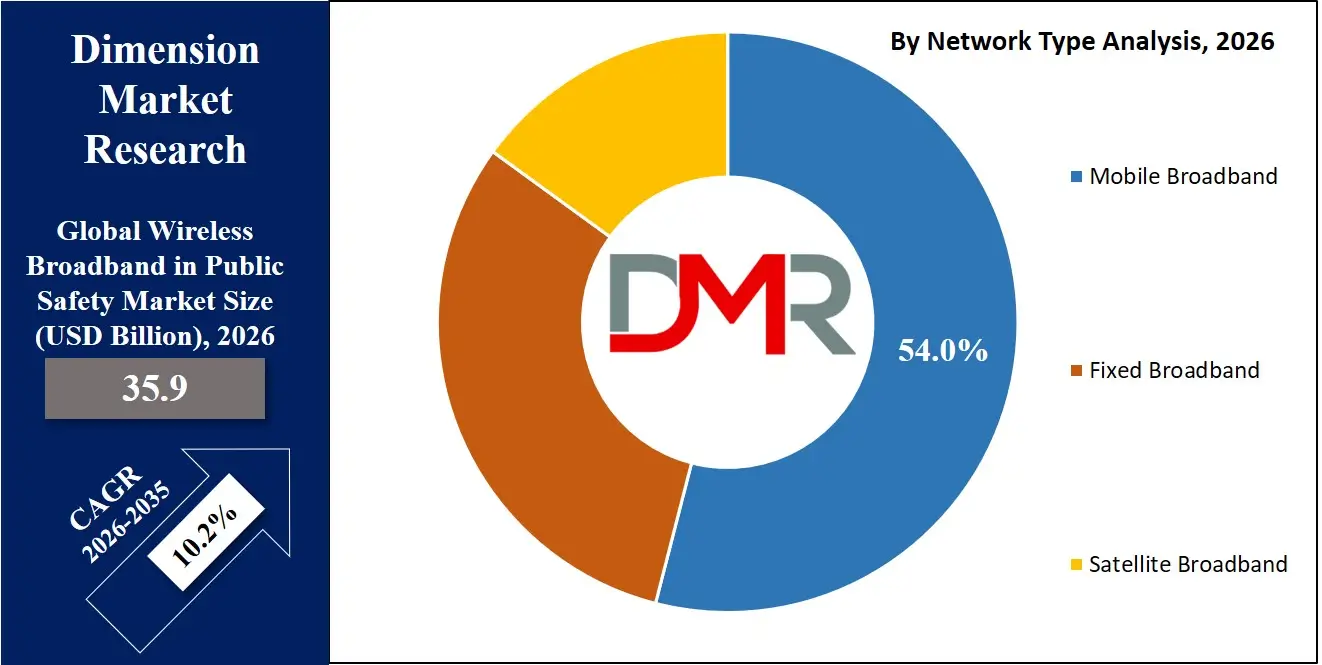
- By Network Type Analysis: Mobile broadband holds 54.0% share, supported by demand for real-time, on-the-move communication for first responders.
- By Technology Analysis: Cellular networks capture 63.0% share, due to widespread adoption of LTE and 5G for secure, wide-area connectivity.
- Regional Leadership: North America leads with 40.0% share, driven by early adoption, strong public funding, and nationwide public safety network deployment.
What is the Wireless Broadband in Public Safety?
It is a dedicated LTE and 5G communication system used by public safety, wireless broadband provides real-time voice, data, and video in emergency response (police, fire, EMS). It was created to deal with interoperability failures observed during the September 11 attacks. In the U.S., the First Responder Network Authority developed a nationwide network using dedicated spectrum of secure and priority communications. The system guarantees connectivity with some features such as preemption in cases of emergency. It helps in supporting applications like video streaming, mapping and sharing of data to improve situational awareness. The network is distributed in all states and it improves coordination between agencies. In general, it will substitute the old radio systems with new broadband-driven emergency communications.
Use Cases
- Emergency Incident Response: Wireless broadband enables seamless coordination between police, fire, and EMS during critical events through real-time voice, data, and video exchange, improving decision-making speed. It enhances response time, resource allocation, and inter-agency communication in high-pressure scenarios. This leads to more efficient and effective on-ground emergency operations.
- Live Video Surveillance: High-speed networks support continuous streaming from CCTV systems and drones directly to command centers for real-time monitoring. This improves situational awareness and enables faster threat detection and assessment. It allows authorities to take proactive measures and respond quickly to potential risks.
- Disaster Management: Wireless broadband ensures reliable communication in disaster-affected areas where traditional networks are often disrupted. It supports coordination of rescue operations, emergency services, and relief distribution in real time. This maintains continuity and efficiency in large-scale crisis response situations.
- Fleet and Personnel Tracking: Broadband-enabled GPS systems provide real-time tracking of emergency vehicles and field personnel across locations. This allows optimized routing, faster dispatch, and improved responder safety during operations. It enhances coordination, accountability, and overall mission effectiveness.
How AI is Transforming the Wireless Broadband in Public Safety Market?
The wireless broadband in public safety market is undergoing a revolution with the introduction of AI to support real-time data analysis and predictive decision-making to respond to emergencies quicker. It improves video surveillance by automated detection of threats, facial recognition, and anomaly detection.
The analytics provided by AI will streamline the performance of the network so that communications in special cases are reliable and given priority. It also aids predictive maintenance and allocation of resources and enhances overall efficiency and resilience of the public safety operations.
Market Dynamics
Key Drivers in the Global Wireless Broadband in Public Safety Market
Increasing Demand of Interoperable Communication.
The need to achieve seamless cross-jurisdictional and cross-departmental communication to effectively manage complex emergencies is on the increase in public safety agencies. Wireless broadband facilitates integrated platforms that combine voice, data and video to overcome the constraints of the old radio systems. This interoperability enhances coordination among the police, fire, EMS, and disaster response teams. Standardization of government requirements and regulations are also driving the use of standardized communication systems. With the complexity of incidents, there is an increasing need to have integrated and reliable networks.
Grants and National Programs.
Another significant growth factor is high levels of public sector spending, as governments are setting up budgets on national systems of public safety. Efforts by agencies such as First Responder Network Authority are speeding up the implementation of dedicated infrastructure. The coverage in rural areas and network improvements as well as the next-generation in communication are financed. Innovation and faster implementation is also being accelerated due to public-private partnerships. This regular financial support guarantees market growth and technological development in the long run.
Restraints in the Global Wireless Broadband in Public Safety Market
Expensive Infrastructure and Implementation.
The construction and operation of dedicated wireless broadband networks has a high capital cost in spectrum, base stations, and backhaul infrastructure. Financial burden is further increased by the cost of deploying networks in remote and rural areas. Smaller cities and emerging economies usually have limitations to budgets, and this restricts adoption. Also, the current maintenance and upgrading costs contribute to overall ownership costs. These economic constraints may delay mass adoption even though the demand is increasing.
Risks of cybersecurity and Data Privacy
Since the public safety networks deal with sensitive and mission-critical data, they are the best targets of cyber threats. Data breaches, unauthorized access, and network disruptions can have a devastating effect on emergency response operations. The continuous investment is necessary to provide end-to-end encryption and secure communication protocols. Strict data protection regulations are another factor that complicates the situation. These risks instill fear in the agencies in adopting advanced broadband technologies.
Growth Opportunities in the Global Wireless Broadband in Public Safety Market
Scale-up of 5G Public Safety Networks
The 5G deployment is a significant opportunity in terms of increased public safety communication that has ultra-low latency and high bandwidth. It will allow more innovative uses like video analytics in real-time, responder augmented reality, and autonomous emergency response systems. Governments are also focusing more on 5G as an aspect of national safety. The shift provides opportunities to new services and technology. Once adopted, it will enable it to operate more efficiently and effectively respond.
Incorporation of AI and IoT Technologies
A combination of AI and IoT with wireless broadband is introducing new growth possibilities in predictive and data-driven public safety operations. Smart devices allow real-time tracking of the environment, vehicles, and people. AI-based analytics improve decision-making, threat detection, and optimization of resources. The integration helps with smarter cities and more resilient emergency systems. The more technology is used, the more it will open up new uses and enhance the effectiveness of the system.
Trends in the Global Wireless Broadband in Public Safety Market
Mission-Critical Broadband Applications
Other mission-critical applications, including push-to-talk, video streaming, and real-time data sharing using broadband networks are increasingly being embraced by public safety agencies. Such applications improve situational awareness and allow making decisions more quickly during emergencies. Broadband conversion into narrowband is becoming a trend all over the world. The vendors are working on specialized solutions that meet the requirements of public safety. This change is transforming the way emergency communication systems work.
Implementation of Multi-Network and Hybrid Architectures
The use of a hybrid network architecture involving the integration of various communication technologies such as LTE, 5G, and satellite is increasingly becoming the trend. This keeps them constantly connected even in difficult conditions or in case of network failures. Agencies are currently placing more emphasis on the network redundancy and resilience, which will ensure continuous communication. Multi-networks are also useful in increasing coverage in remote and disaster prone regions. The future of solid and adaptable public safety communication ecosystems is being determined by this trend.
Research Scope and Analysis
By Component Analysis
Hardware will control the component market with a share of approximately 48.0% in 2026 due to huge dependency on base stations, rugged devices, antennas, and network infrastructure in the mission-critical communication. The continued development of LTE and 5G networks and rural network coverage increases the demand even more on hardware. Software is, however, critical as it facilitates command platforms, real-time analytics, video management, and GIS applications to enhance situational awareness. The growing use of AI and cloud technologies is enhancing the power of the software. Hardware forms the backbone of the infrastructure, but software is used to make the public safety operations more efficient and effective in decision-making.
By Network Type Analysis
Mobile broadband will become the leading network type segment with approximately 54.0% share in 2026 due to its capacity to deliver real time, on the move communication to first responders using LTE and 5G networks. It facilitates smooth voice, data and video transmission that enhances speed in response and coordination.
ℹ
To learn more about this report –
Download Your Free Sample Report Here
Its usage is further enhanced by the increasing use of mission-critical applications. Smaller yet important to command centers and surveillance systems, fixed broadband provides high-capacity connectivity that is stable. It facilitates the monitoring and data management that is centralized. The two together guarantee a balance between mobility and reliability in the public safety networks.
By Technology Analysis
The technology segment is predicted to be dominated by cellular networks with approximately 63.0% market share in 2026 due to LTE and 5G being widely used in mission-critical public safety communications. They also offer extensive coverage, high reliability and priority access, which facilitates the transmission of voice, data and video in times of emergency seamlessly. Well-supported government deployments and spectrum allocation also enhances their position. Wi-Fi systems, although with a smaller share, are important in supporting the localized settings like incident sites and command centers. They facilitate the rapid installation of hotspots and the rapid data connection in small spaces. Cellular and Wi-Fi technologies complement one another since they provide coverage over a wide area and a localized connection, respectively.
By Deployment Model Analysis
It is anticipated that dedicated networks will be the most commonly deployed model with a share of approximately 70.0% in 2026 as it offers secure and reliable and priority communications to public safety agencies only. Their use as mission-critical operations is supported by strong government investments and countrywide infrastructure programs. Portable systems are smaller, but needed in temporary situations such as disaster areas and mega events. They allow quick implementation in cases of unavailable fixed infrastructure. These systems provide continuity in the communication within dynamic environments. When combined, both models strike a balance between reliability and flexibility of the public safety networks.
By Application Analysis
The application segment is projected to be dominated by video surveillance with an estimated 30.0% share in 2026 due to increased adoption of real-time CCTV, drone feeds, and smart city surveillance to increase situational awareness. High-definition video can be easily relayed to command centers that are located far away with wireless broadband, enhancing the speed of threat detection and response. Incident response, though minor, is equally very important because it assists in communicating and coordinating emergency teams in real-time. It allows quicker dispatch and effective decision making on the field. The two applications work in tandem to improve the work of overall public safety.
By End User Analysis
It is anticipated that law enforcement will dominate the end user segment with approximately 36.0% market share in 2026 due to high usage of wireless broadband in real-time communication, surveillance, and field operations. These networks are used by police agencies to access data immediately, stream video, and coordinate patrols and critical incidents. The growing use of body cameras, mobile data terminals, and associated equipment adds to demand. EMS is relatively small in share, but plays a crucial role because it connects ambulances via broadband, transmits patient data, and provides remote medical assistance. It allows responding more quickly, more effectively coordinating with hospitals, and achieving improved patient outcomes. The two parts share the significance of good communication in emergency services.
The Global Wireless Broadband in Public Safety Market Report is segmented on the basis of the following:
By Component
- Hardware
- Rugged Devices
- Base Stations
- Network Units
- Software
- Command Platforms
- Analytics Tools
- Services
- Integration Services
- Managed Services
By Network Type
- Mobile Broadband
- LTE PS Networks
- 5G PS Networks
- Fixed Broadband
- Point-to-Point Links
- Point-to-Point Multipoint Links
- Satellite Broadband
By Technology
- Cellular Networks
- Wi-Fi Systems
- Satellite Systems
By Deployment Model
- Dedicated Networks
- Portable Systems
By Application
- Video Surveillance
- Incident Response
- Fleet Tracking
- GIS Mapping
- Crowd Control
- Others
By End User
- Law Enforcement
- EMS
- Fire Services
- Disaster Agencies
- Homeland Security
Regional Analysis
Leading Region by Market Share
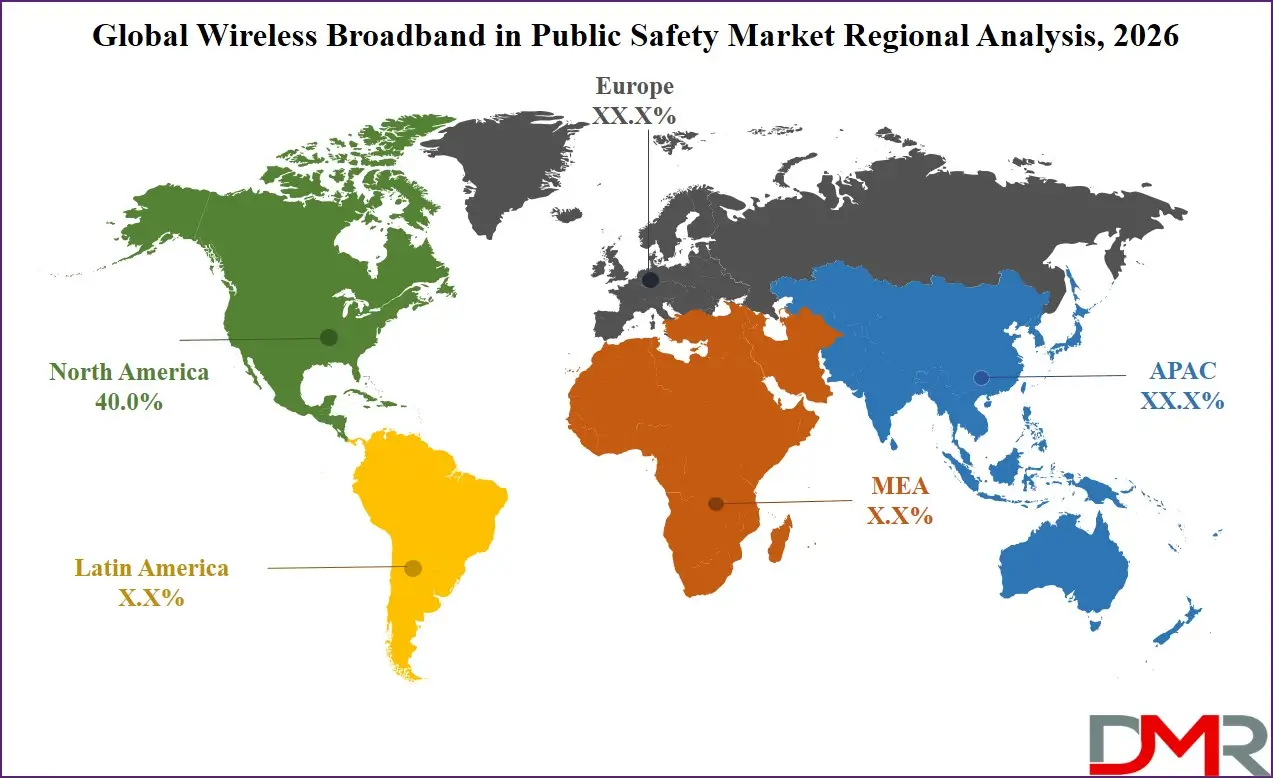
North America is expected to dominate the Wireless Broadband in Public Safety market with around 40.0% share in 2026, driven by early adoption of LTE and 5G-based public safety networks. Strong government funding and nationwide initiatives such as the First Responder Network Authority have accelerated deployment and interoperability. The region also benefits from advanced infrastructure and high investment in mission-critical communication technologies, ensuring continued market leadership.
ℹ
To learn more about this report –
Download Your Free Sample Report Here
Fastest-Growing Regional Market
Asia-Pacific is the fastest-growing regional market, driven by smart city expansion and rising government investment in public safety infrastructure. Increasing adoption of LTE and 5G networks supports real-time emergency communication. Rapid urbanization and disaster management needs are further accelerating growth.
By Region
North America
Europe
- Germany
- The U.K.
- France
- Italy
- Russia
- Spain
- Benelux
- Nordic
- Rest of Europe
Asia-Pacific
- China
- Japan
- South Korea
- India
- ANZ
- ASEAN
- Rest of Asia-Pacific
Latin America
- Brazil
- Mexico
- Argentina
- Colombia
- Rest of Latin America
Middle East & Africa
- Saudi Arabia
- UAE
- South Africa
- Israel
- Egypt
- Rest of MEA
Competitive Landscape
The market is highly competitive, driven by continuous innovation in LTE and 5G-based public safety communication solutions. Players compete on network reliability, coverage, and integration of advanced technologies such as AI and real-time analytics. Strategic partnerships with governments and public agencies play a crucial role in securing large-scale deployments. The landscape is further shaped by investments in infrastructure expansion, cybersecurity, and mission-critical application development.
Some of the prominent players in the Global Wireless Broadband in Public Safety Market are:
- Motorola Solutions
- Nokia Corporation
- Ericsson AB
- Huawei Technologies
- ZTE Corporation
- AT&T Inc.
- Verizon Communications
- Cisco Systems
- L3Harris Technologies
- Thales Group
- Airbus Defence and Space
- General Dynamics
- Samsung Electronics
- NEC Corporation
- Juniper Networks
- Qualcomm
- Sierra Wireless
- Hytera Communications
- Ceragon Networks
- Parallel Wireless
- Other Key Players
Recent Developments
- March 2026: AT&T Inc. secured a multi-billion-dollar upgrade program for public safety broadband network expansion, focusing on next-generation emergency communication infrastructure.
- July 2025: Ericsson AB and Three Ireland launched a managed 5G broadband service to enhance high-reliability connectivity and scalable wireless networks for critical applications.
- July 2025: Sinclair Broadcast Group introduced an ATSC 3.0-enabled tablet designed for resilient emergency communication and public safety data delivery.
Report Details
| Report Characteristics |
| Market Size (2026) |
USD 35.9 Bn |
| Forecast Value (2035) |
USD 85.9 Bn |
| CAGR (2026–2035) |
10.2% |
| Historical Data |
2021 – 2025 |
| Forecast Data |
2027 – 2035 |
| Base Year |
2025 |
| Estimate Year |
2026 |
| Segments Covered |
By Component (Hardware, Software, Services), By Network Type (Mobile Broadband, Fixed Broadband, Satellite Broadband), By Technology (Cellular Networks, Wi-Fi Systems, Satellite Systems), By Deployment Model (Dedicated Networks, Portable Systems), By Application (Video Surveillance, Incident Response, Fleet Tracking, GIS Mapping, Crowd Control, Others), By End User (Law Enforcement, EMS, Fire Services, Disaster Agencies, Homeland Security) |
| Regional Coverage |
North America – The US and Canada; Europe – Germany, The UK, France, Russia, Spain, Italy, Benelux, Nordic, & Rest of Europe; Asia-Pacific – China, Japan, South Korea, India, ANZ, ASEAN, Rest of APAC; Latin America – Brazil, Mexico, Argentina, Colombia, Rest of Latin America; Middle East & Africa – Saudi Arabia, UAE, South Africa, Turkey, Egypt, Israel, & Rest of MEA |
Frequently Asked Questions
How big is the Wireless Broadband in Public Safety Market?
▾ The market is projected to be valued at USD 35.9 billion in 2026 and is expected to reach USD 85.9 billion by 2035.
What is the CAGR of the Wireless Broadband in Public Safety Market from 2026 to 2035?
▾ The market is expected to grow at a CAGR of 10.2% during the forecast period.
What factors are driving the growth of the Wireless Broadband in Public Safety Market?
▾ Growth is driven by rising demand for mission-critical communication, real-time data sharing, interoperability across agencies, increasing government investments, and adoption of LTE and 5G networks.
What are the major trends in the Wireless Broadband in Public Safety Market?
▾ Key trends include 5G integration, AI-based analytics, adoption of mission-critical applications, hybrid network architectures, and expansion of nationwide public safety networks.
Which region held the largest share of the Wireless Broadband in Public Safety Market in 2026?
▾ North America held the largest share with around 40.0% in 2026.
Which region is expected to grow the fastest in the Wireless Broadband in Public Safety Market?
▾ Asia-Pacific is expected to be the fastest-growing region.
Who are the key players in the Wireless Broadband in Public Safety Market?
▾ Key players include Motorola Solutions, Nokia Corporation, Ericsson AB, Huawei Technologies, ZTE Corporation, AT&T Inc., Verizon Communications, Cisco Systems, L3Harris Technologies, Thales Group, Airbus Defence and Space, General Dynamics, Samsung Electronics, NEC Corporation, Juniper Networks, Qualcomm, Sierra Wireless, Hytera Communications, Ceragon Networks, Parallel Wireless, along with other key players.
How is the Wireless Broadband in Public Safety Market segmented?
▾ The market is segmented by Component, Network Type, Technology, Deployment Model, Application, and End User.