Market Snapshot
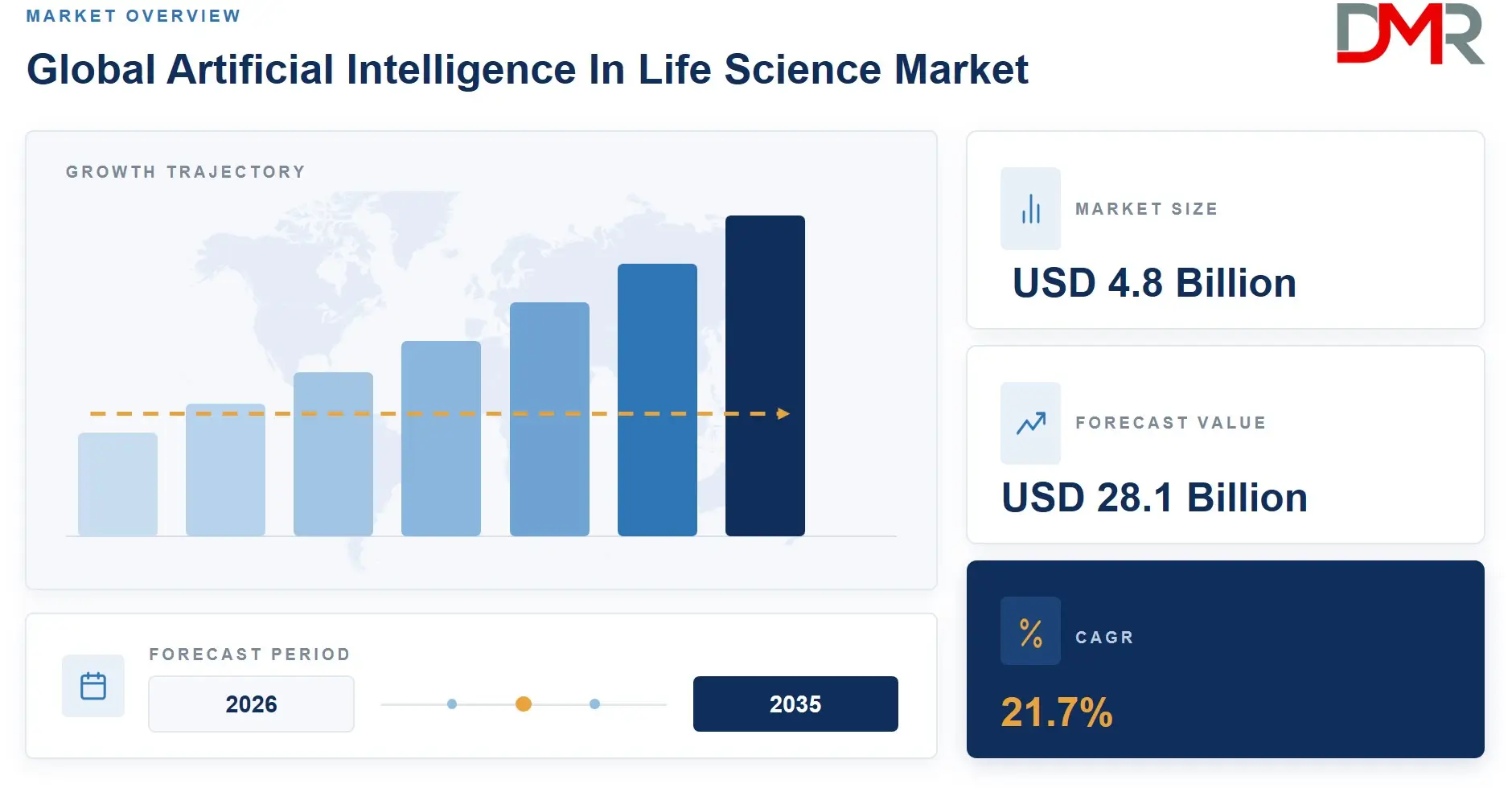
- Market Size (2026): USD 4.8 Bn
- Forecast Value (2035): USD 28.1 Bn
- CAGR (2026-2035): 21.7%
- Largest Region (2026): North America, approximately 43%
- Fastest-Growing Region: Asia-Pacific
- Leading Offering (2026): Software Platforms, around 48%
- Leading Application (2026): Drug Discovery and Development, close to 37%
- Key Players: NVIDIA Corporation, Microsoft Corporation, IQVIA Holdings Inc. and others
What is Artificial Intelligence In Life Science Market and its Market Size?
Global Artificial Intelligence In Life Science Market size is estimated to reach USD 4.8 Bn in 2026 and is further anticipated to reach USD 28.1 Bn by 2035, at a CAGR of 21.7%.
ℹ
To learn more about this report –
Download Your Free Sample Report Here
Artificial intelligence in life science covers software, models, data infrastructure and specialized services that apply machine learning to biological, chemical, clinical and healthcare data. The commercial boundary includes AI used by pharmaceutical companies, biotechnology developers, contract research organizations, diagnostics groups, research institutes and adjacent medical technology companies. It spans discovery through commercialization, but excludes general enterprise AI spending that has no direct life science workflow.
Demand is moving from isolated proof-of-concept models toward production systems embedded in medicinal chemistry, target identification, biomarker development, clinical operations and regulatory documentation. Buyers increasingly combine multimodal datasets such as molecular structures, omics, pathology images, electronic health records and trial data. This creates a need for governed data layers, foundation models, knowledge graphs, high-performance computing and domain-specific validation rather than generic analytics alone.
The market is also changing because model performance is no longer the only purchasing criterion. Life science organizations are evaluating reproducibility, explainability, data lineage, privacy, validation and integration with laboratory and clinical systems. As generative models become capable of proposing molecules, proteins, experiments and documents, the economic value shifts toward platforms that connect prediction with experimental feedback and can operate within regulated development processes.
Use Cases
- Biopharma Portfolio Research: Discovery teams use AI to rank targets, compare disease mechanisms and prioritize compounds before committing wet-lab capacity. The result is a narrower experimental funnel, better use of screening resources and faster movement from biological hypothesis to a testable development program.
- Clinical Development Operations: Sponsors and CROs apply predictive models to site selection, patient matching, enrollment risk and protocol feasibility. These systems combine historical trial performance with operational and patient data, allowing teams to identify likely bottlenecks earlier and redirect recruitment resources before timelines slip.
- Precision Diagnostics: Diagnostic laboratories and pathology networks use machine learning to interpret imaging, genomic and molecular signals alongside clinical context. AI supports triage, pattern recognition and decision support, helping specialists manage rising data volume while preserving human review for complex or uncertain cases.
- Regulatory and Medical Affairs: Life science companies deploy language models and knowledge systems to search evidence, compare labeling, assemble submission content and monitor safety information. The practical benefit is faster retrieval and drafting across large document estates, with governed review remaining necessary for regulated outputs.
Key Takeaways
- Market Size & Share: The industry is forecast to expand at 21.7% annually through 2035 as AI moves deeper into research and development workflows.
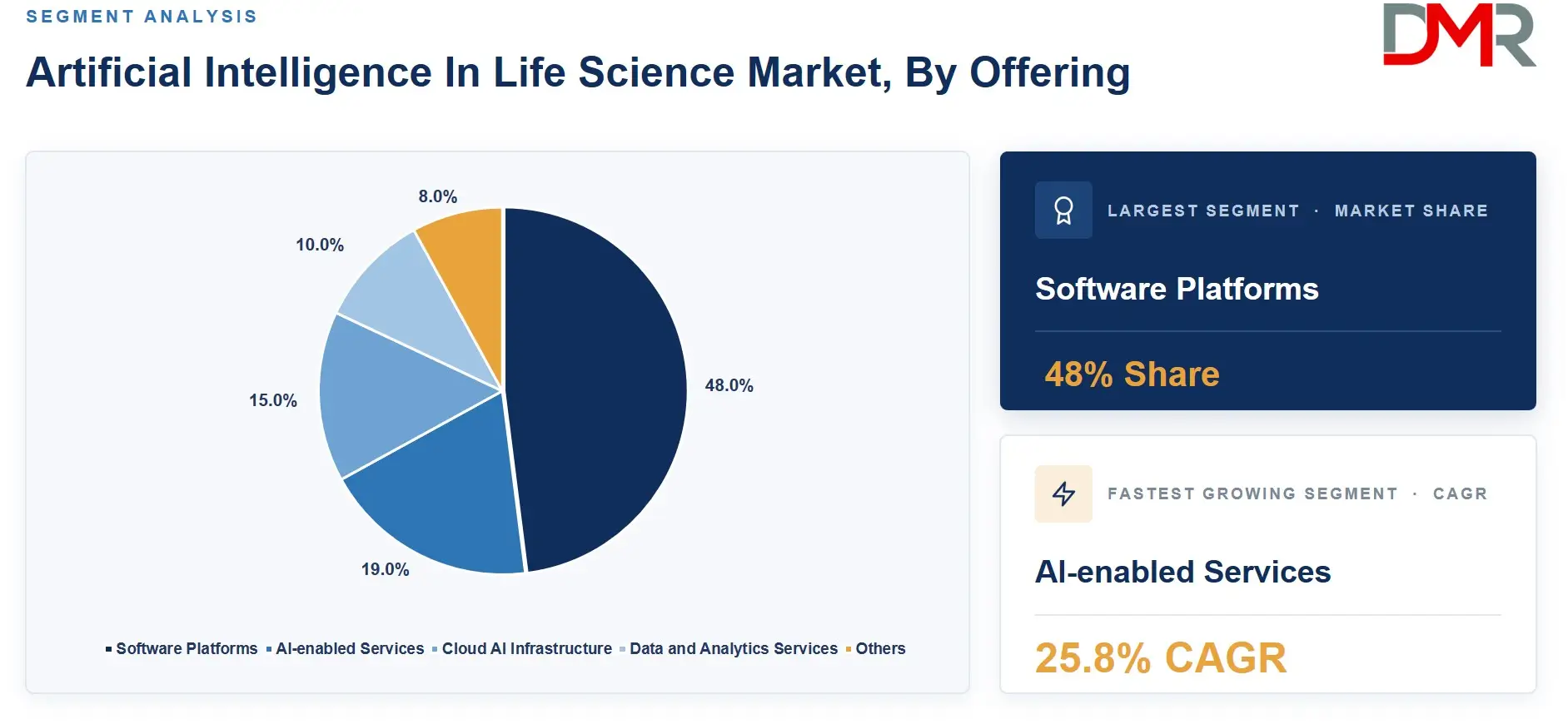
- Offering Analysis: Software Platforms are expected to account for roughly 48% of 2026 revenue because reusable model, workflow and data layers capture recurring enterprise spend.
- Regional Analysis: Asia-Pacific is projected to post the fastest regional CAGR of 24.8% through 2035, supported by expanding biopharma research capacity and digital infrastructure.
- Application Analysis: Generative AI use in molecular and protein design is expanding at a CAGR of 29.1% within the technology mix as foundation models become more domain-specific.
- Buyer Concentration: Pharmaceutical and biotechnology companies are expected to represent approximately 52% of 2026 end-use spending due to their scale of R&D budgets and proprietary datasets.
- Deployment Shift: Cloud deployment is forecast to grow at 25.4% through 2035 as compute-intensive training and inference become more elastic and collaboration becomes more distributed.
How AI/Gen AI is Transforming the Artificial Intelligence In Life Science Market?
AI is changing life science workflows by connecting computational prediction with experimental and clinical evidence. Deep learning models can extract signals from images, sequences, molecular graphs and longitudinal records, while generative systems can propose candidate structures or summarize complex evidence. The strongest commercial deployments combine these capabilities with domain constraints, curated datasets and human scientific review rather than treating a general-purpose model as a standalone decision maker.
Gen AI is extending the addressable market into knowledge-intensive work that was previously difficult to automate. Research organizations are building agentic workflows that search literature, call scientific tools, run calculations and recommend next steps. In regulated functions, language models are being used with retrieval, audit trails and controlled templates so that productivity gains do not come at the expense of traceability.
- Molecular Generation: Foundation models propose small molecules, proteins and sequences against specified biological or physicochemical objectives.
- Multimodal Evidence Synthesis: Models combine omics, imaging, clinical and literature data to support target and biomarker assessment.
- Scientific Agents: Tool-using AI systems orchestrate searches, simulations and computational experiments across research workflows.
- Document Intelligence: LLM-based systems classify, extract and draft regulated scientific content with human approval and provenance controls.
Key Drivers in the Global Artificial Intelligence In Life Science Market
Commercial adoption is being pulled by the economics of R&D and by the expanding volume of machine-readable scientific data. Two forces have the clearest effect on enterprise budgets.
- Pressure to Improve R&D Productivity: Drug developers face expensive experimental cycles, large candidate attrition and growing complexity in target biology. AI can shift screening and prioritization earlier into computational workflows, allowing teams to test more hypotheses before consuming laboratory capacity. Drug Discovery and Development is expected to hold about 37% of application revenue in 2026, reflecting where buyers see the most direct link between model output and portfolio economics. The driver is not simply faster computation. It is the ability to combine structure, sequence, assay and literature data into ranked decisions that reduce low-value experiments and improve the quality of candidates entering downstream development.
- Expansion of Multimodal Biomedical Data: Life science organizations now generate large datasets across genomics, proteomics, pathology, real-world evidence and connected laboratory instruments. Conventional analytics often treats these sources separately, while modern AI architectures can learn relationships across modalities and time. Machine Learning and Deep Learning are projected to account for nearly 42% of technology revenue in 2026 because they remain the production backbone for classification, prediction and representation learning. As data estates grow, spending follows into model operations, feature engineering, semantic layers and governed compute, creating recurring demand beyond a single algorithm or research project.
Restraints in the Global Artificial Intelligence In Life Science Market
AI adoption in life science is constrained less by model availability than by evidence standards and fragmented operating environments. These brakes can delay procurement even where technical performance is attractive.
- Validation, Explainability and Regulatory Risk: A model that performs well in development may still be difficult to use in a regulated decision if its training data, intended use or failure modes are poorly characterized. Clinical and regulatory teams need reproducibility, change control, human oversight and documented provenance. On-premise deployment is still expected to retain around 24% of 2026 deployment revenue, partly because some organizations keep sensitive workloads inside controlled infrastructure. The restraint is strongest where AI influences patient selection, diagnostic interpretation or submission evidence. Vendors therefore face longer qualification cycles and must invest in validation tooling, monitoring and governance rather than competing only on benchmark accuracy.
- Data Fragmentation and Scarcity of High-Quality Labels: Biomedical data is distributed across instruments, laboratories, trial systems, imaging archives and external partners, often with incompatible schemas and uneven annotation. Hybrid deployment is projected to represent close to 21% of 2026 revenue because many enterprises must bridge cloud compute with internal data repositories. Integration costs can exceed initial model costs, particularly when historical records lack standardized metadata or consent terms restrict reuse. This slows scale-up from a successful pilot to a portfolio-wide platform and favors suppliers that can support data harmonization, identity resolution, ontology mapping and secure collaboration alongside core AI capabilities.
Growth Opportunities in the Global Artificial Intelligence In Life Science Market
White space is opening where AI can connect previously separate research, clinical and operational systems. The most attractive opportunities pair specialized models with proprietary data access or workflow ownership.
- Agentic and Lab-in-the-Loop Discovery: The next commercial layer is emerging around AI agents that can use scientific software, interpret experimental results and recommend the next computational or laboratory action. Generative AI and Foundation Models are forecast to expand at 29.1% through 2035, faster than the overall industry. Opportunity sits with platforms that can connect molecular design, simulation, assay data and laboratory automation while preserving scientific controls. This moves AI from a point prediction tool toward an iterative discovery system. Vendors able to integrate model orchestration with instruments, electronic lab notebooks and validated scientific applications can capture higher-value workflow spend and become embedded in research operations.
- AI-enabled Clinical Trial Optimization: Clinical Trials are projected to grow at a CAGR of 24.6% through 2035 as sponsors seek better protocol feasibility, patient matching and site performance. The commercial opening is strongest in disease areas with fragmented patient populations, biomarker-driven eligibility and high recruitment costs. AI providers can combine trial history, claims, electronic records and molecular data to improve planning before enrollment begins. A second opportunity lies in continuous operational monitoring, where models flag enrollment risk, protocol deviations or data-quality issues. Suppliers that can work within sponsor and CRO systems, rather than requiring wholesale replacement, have a practical route to enterprise adoption.
Trends in the Global Artificial Intelligence In Life Science Market
Technology choices are shifting toward domain-specific foundation models and integrated platforms, while buyers are becoming more selective about evidence quality. The direction favors systems that can be evaluated in scientific terms, not just general AI capability.
- Domain Foundation Models Replace Generic Model Experiments: Life science teams are increasingly using models trained or adapted for chemistry, protein structure, sequence, pathology and biomedical language. Generative AI and Foundation Models are expected to capture approximately 18% of technology revenue in 2026, with a much steeper growth trajectory than established analytical methods. The trend changes vendor differentiation because access to curated scientific data, domain evaluation and specialized tooling becomes as important as model scale. Buyers are also combining open models with proprietary fine-tuning, which creates demand for flexible infrastructure and model management rather than a single closed application.
- Platform Consolidation Around Governed AI Workflows: Pharmaceutical and biotechnology companies are projected to contribute about 52% of end-use revenue in 2026, giving large R&D organizations significant influence over platform design. These buyers are moving away from disconnected pilots toward common environments for data access, model deployment, audit trails and collaboration. The trend favors vendors that integrate with cloud, laboratory, clinical and regulatory systems while supporting multiple model types. It also increases pressure on smaller point-solution providers to prove interoperability or partner with larger ecosystems, since enterprise buyers want fewer interfaces and clearer accountability for security and validation.
Research Scope and Analysis
Segment performance is assessed across offering, application, end use, deployment and technology. Each axis identifies where 2026 revenue is concentrated and which sub-segment is expected to expand fastest through 2035, together with the commercial mechanism behind each position.
ℹ
To learn more about this report –
Download Your Free Sample Report Here
By Offering
Software Platforms are projected to hold the largest offering share in 2026, accounting for approximately 48% of revenue, because enterprises increasingly buy reusable environments for model development, scientific search, workflow orchestration and governance rather than commission isolated algorithms. Recurring licensing and consumption-based access also concentrate value in platform layers that sit across multiple research programs. Growth, however, is concentrated in AI-enabled Services, which are forecast to expand at a CAGR of 25.8% between 2026 and 2035. Many life science organizations still lack sufficient computational biology, machine learning engineering and model validation capacity internally. Services therefore capture demand for implementation, data engineering, model customization and managed scientific workflows, especially when a buyer needs to integrate AI with legacy laboratory or clinical systems.
By Application
Drug Discovery and Development is expected to lead applications in 2026 with a share of roughly 37%, supported by direct use of AI in target identification, virtual screening, molecular design, lead optimization and translational research. The application attracts spending because computational prioritization can influence expensive experimental decisions before candidates reach later development. The steeper trajectory sits with Clinical Trials, expanding at a CAGR of 24.6% through 2035. Trial sponsors are applying AI to protocol design, site selection, patient matching, enrollment forecasting and operational risk. Growth is reinforced by rising use of real-world data and biomarker-defined cohorts, which make manual planning harder and increase the value of models that can integrate heterogeneous patient and site information.
By End Use
Pharmaceutical and Biotechnology Companies are projected to account for close to 52% of end-use revenue in 2026 because they control large research budgets, proprietary experimental data and the development portfolios where AI can affect multiple stages of value creation. Their scale supports enterprise contracts spanning discovery, clinical development and medical functions. Growth, however, is concentrated in CROs and CDMOs, which are forecast to expand at a CAGR of 24.9% through 2035. Service providers are embedding AI into trial operations, bioanalysis, manufacturing development and data services to differentiate outsourced offerings. As sponsors expect technology-enabled productivity from partners, AI capability becomes part of the service proposition rather than a separate software purchase.
By Deployment
Cloud is expected to hold the largest deployment share in 2026 at around 55%, reflecting the need for elastic GPU capacity, distributed collaboration and rapid access to managed AI services. Cloud environments are particularly attractive for computational chemistry, foundation-model training and multimodal analytics where workloads can vary sharply across projects. The same sub-segment is also projected to post the highest CAGR, at 25.4% from 2026 to 2035, as security controls and regulated cloud architectures mature. Its growth is reinforced by partnerships between cloud providers, AI infrastructure vendors and life science software companies. On-premise and hybrid environments remain important for sensitive data and instrument-connected workflows, but buyers increasingly separate protected data layers from scalable compute rather than keeping the full AI stack internally.
By Technology
Machine Learning and Deep Learning are projected to retain the largest technology share in 2026 at nearly 42%, since predictive modeling, image analysis, representation learning and classification remain embedded across established life science applications. These techniques have broad production use and mature tooling, which keeps them central even as newer architectures gain attention. Growth, however, is concentrated in Generative AI and Foundation Models, which are forecast to expand at a CAGR of 29.1% through 2035. Protein, molecule, sequence and biomedical language models can create or propose new outputs rather than only classify existing data. Their adoption is accelerating as scientific tool use, retrieval and agent orchestration make generative systems more useful inside research workflows.
The Global Artificial Intelligence In Life Science Market Report is Segmented Based on the Following
By Offering
- Software Platforms
- AI-enabled Services
- Cloud AI Infrastructure
- Data and Analytics Services
- Others
By Application
- Drug Discovery and Development
- Clinical Trials
- Precision Medicine
- Diagnostics and Imaging
- Genomics and Proteomics
- Commercial and Regulatory Operations
- Others
By End Use
- Pharmaceutical and Biotechnology Companies
- CROs and CDMOs
- Hospitals and Diagnostic Networks
- Academic and Research Institutes
- Medical Device Companies
- Others
By Deployment
- Cloud
- On-premise
- Hybrid
- Others
By Technology
- Machine Learning and Deep Learning
- Generative AI and Foundation Models
- Natural Language Processing
- Computer Vision
- Knowledge Graphs and Graph AI
- Others
Regional Analysis
Region with the Largest Revenue Share
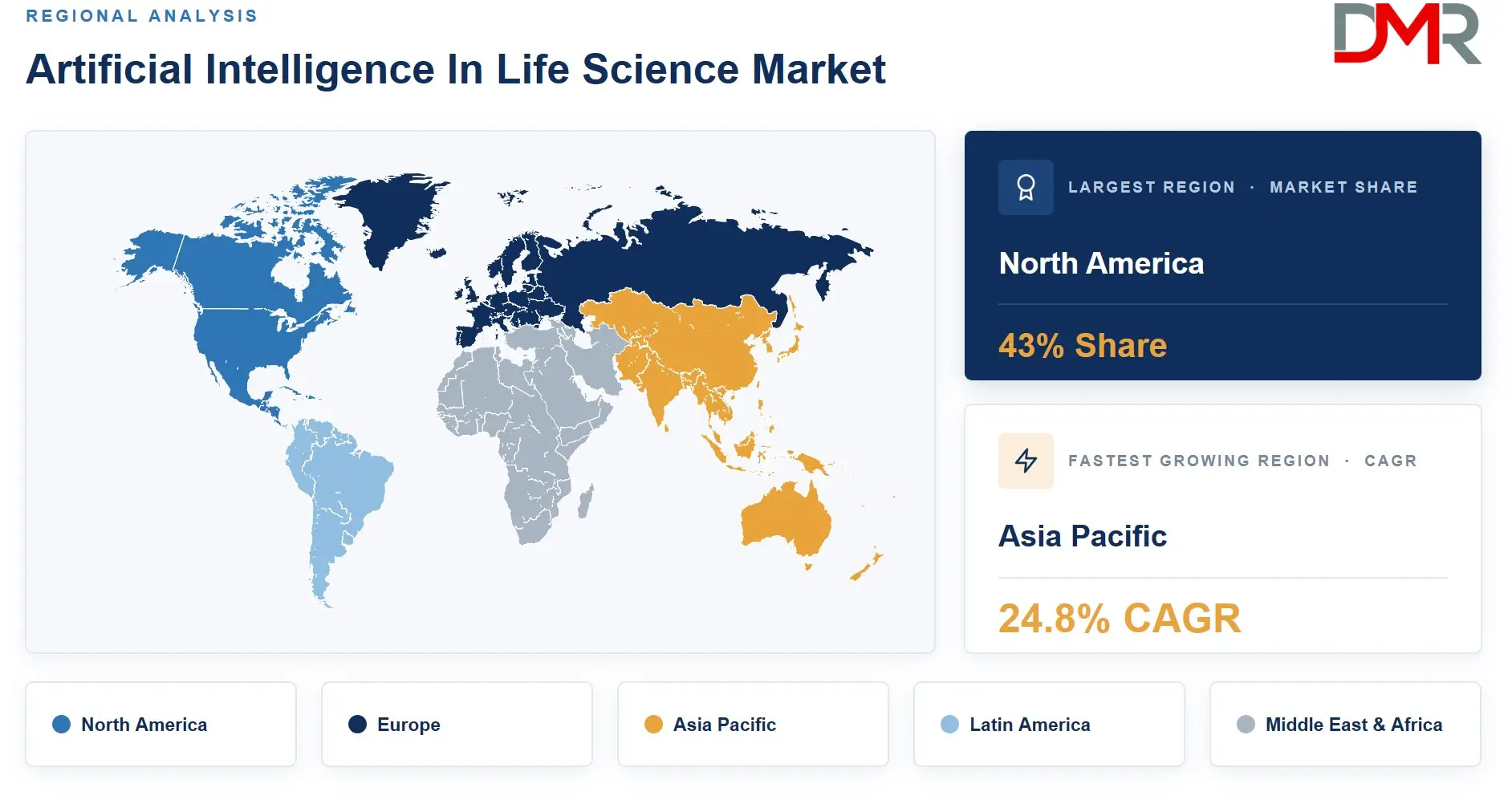
North America is expected to remain the largest regional market in 2026, accounting for approximately 43% of global revenue. The region combines major pharmaceutical and biotechnology research centers with hyperscale cloud infrastructure, specialized AI companies, leading academic institutions and extensive clinical data assets. The US contributes most of this concentration because enterprise buyers can source computing, software, scientific talent and venture-backed technology within the same ecosystem. Procurement is also supported by large R&D budgets and a dense network of CROs, diagnostics companies and research hospitals. These structural advantages make North America the primary launch market for enterprise AI platforms, although governance and validation requirements increasingly shape purchasing decisions.
ℹ
To learn more about this report –
Download Your Free Sample Report Here
Region with the Highest CAGR
Asia-Pacific is forecast to record the highest regional CAGR of 24.8% from 2026 to 2035. Growth is being pulled by expanding pharmaceutical research in China, Japan, India and South Korea, increasing availability of genomics and clinical datasets, and investment in domestic AI computing capacity. Regional technology groups are also building healthcare and drug-discovery models that reduce dependence on Western platforms. The commercial opportunity is broadening from research pilots into discovery services, precision medicine and clinical development support. Adoption remains uneven across countries because data governance, cloud access and regulatory pathways differ, but the combination of large patient populations, growing biotech ecosystems and cost-sensitive R&D creates a strong case for AI-enabled workflows.
By Region
North America
Europe
- Germany
- France
- The UK
- Italy
- Spain
- Rest of Europe
Asia-Pacific
- China
- Japan
- India
- Australia
- South Korea
- Rest of APAC
Latin America
- Mexico
- Brazil
- Colombia
- Argentina
- Rest of LATAM
Middle East & Africa
- Saudi Arabia
- The UAE
- South Africa
- Rest of MEA
Regulatory Landscape
Life science AI sits across several regulatory contexts rather than under one universal rule. Systems used in discovery may operate mainly under research governance, while models influencing diagnostics, clinical decisions or regulated submissions can trigger medical device, privacy, quality and evidence requirements. Authorities are increasing attention to transparency, human oversight, data provenance and lifecycle monitoring as adaptive and generative models become more common. Commercial opportunity therefore sits with vendors that can document intended use, validation status, model changes and audit trails without slowing scientific iteration. The main brake is jurisdictional variation, which raises compliance cost and can limit reuse of the same model across research, clinical and commercial settings.
Technology Analysis
Technology competition is shifting from single-task prediction toward multimodal foundation models, knowledge graphs, scientific agents and lab-connected AI. The current stack combines accelerated computing, domain models, retrieval systems and specialized chemistry or biology tools, with enterprise value increasingly determined by orchestration and evidence quality. Generative AI and Foundation Models are forecast to grow at 29.1% through 2035, reflecting demand for systems that can propose molecules, proteins, experiments and scientific text. White space is strongest where these models connect to proprietary experimental feedback and validated tools. Risk remains substantial around hallucination, dataset bias, reproducibility and compute intensity, so successful platforms must pair model capability with scientific evaluation and governed deployment.
Competitive Landscape
Competition spans hyperscale technology vendors, scientific software companies, AI-native drug discovery firms, clinical data specialists and enterprise service providers. Large infrastructure companies compete on compute, cloud integration and foundation-model ecosystems, while specialists differentiate through proprietary biomedical datasets, domain models and workflow depth. Life science buyers increasingly prefer platforms that can integrate with existing laboratory, clinical and data systems, which encourages partnerships between AI vendors and established industry suppliers. Competitive strategy is therefore moving toward ecosystem control, validated domain tooling and access to differentiated data. M&A and strategic collaborations remain important because few companies own the full stack from infrastructure through biological data, scientific models and regulated workflow integration.
Some of the Prominent Players in the Global {topic} Market Are
- NVIDIA Corporation
- Microsoft Corporation
- Google LLC
- Amazon Web Services, Inc.
- IBM Corporation
- Oracle Corporation
- SAP SE
- Salesforce, Inc.
- Dassault Systèmes SE
- IQVIA Holdings Inc.
- Tempus AI, Inc.
- Schrödinger, Inc.
- Recursion Pharmaceuticals, Inc.
- Exscientia plc
- Insilico Medicine
- Owkin, Inc.
- BenevolentAI
- Atomwise, Inc.
- PathAI, Inc.
- Paige AI, Inc.
- SOPHiA GENETICS SA
- ConcertAI
- C3.ai, Inc.
- Palantir Technologies Inc.
- Veeva Systems Inc.
- BenchSci
- BioSymetrics Inc.
- Deep Genomics Incorporated
- Iktos
- Valo Health, Inc.
- XtalPi Inc.
- Huawei Technologies Co., Ltd.
- Baidu, Inc.
- Tencent Holdings Limited
- Ping An Healthcare and Technology Company Limited
- NEC Corporation
- Fujitsu Limited
- Hitachi, Ltd.
- Tata Consultancy Services Limited
- Wipro Limited
- Other Key Players
Recent Developments
- In July 2026, Bristol Myers Squibb moved to adopt NVIDIA's next-generation DGX SuperPOD architecture for drug research, expanding internal AI computing capacity for evaluating more discovery candidates and supporting broader use of computational methods across R&D.
- In June 2026, NVIDIA introduced the BioNeMo Agent Toolkit for scientific agents, with life science and research organizations adopting tools that connect AI reasoning with biology, chemistry, genomics and drug-discovery software.
- In January 2026, NVIDIA expanded BioNeMo and announced collaborations including an AI co-innovation lab with Lilly and work with Thermo Fisher Scientific on increasingly autonomous laboratory infrastructure, linking model development more closely with experimental workflows.
- In June 2025, NVIDIA announced collaboration with Novo Nordisk and Denmark's AI infrastructure ecosystem to develop customized AI models and agents for early research and clinical development, illustrating growing pharma demand for sovereign high-performance computing.
- In March 2025, NVIDIA, Alphabet and Google expanded joint work spanning agentic and physical AI, including drug discovery activity involving Isomorphic Labs, reinforcing the convergence of accelerated computing, foundation models and computational biology.
Report Details
| Report Characteristics |
| Market Size (2026) |
USD 4.8 Bn |
| Forecast Value (2035) |
USD 28.1 Bn |
| CAGR (2026-2035) |
21.7% |
| The US Market Size (2026) |
USD 1.8 Bn |
| Historical Data |
2021 - 2025 |
| Forecast Data |
2026 - 2035 |
| Base Year |
2025 |
| Segments Covered |
By Offering, By Application, By End Use, By Deployment and By Technology |
| Regional Coverage |
North America - The US and Canada; Europe - Germany, France, The UK, Italy, Spain, Rest of Europe; Asia-Pacific - China, Japan, India, Australia, South Korea, Rest of APAC; Latin America - Mexico, Brazil, Colombia, Argentina, Rest of LATAM; Middle East & Africa - Saudi Arabia, The UAE, South Africa, Rest of MEA |
Frequently Asked Questions
How big is the Global Artificial Intelligence In Life Science Market?
▾ Global demand is estimated at USD 4.8 Bn in 2026. Spending includes specialized AI software, infrastructure and services used across drug discovery, clinical development, precision medicine, diagnostics, genomics and regulated life science operations. Growth is supported by expanding biomedical datasets and increasing deployment of domain-specific AI systems inside pharmaceutical, biotechnology and research organizations.
What is the growth rate of the Global Artificial Intelligence In Life Science Market?
▾ The industry is projected to grow at a CAGR of 21.7% from 2026 to 2035. Expansion is being driven by production adoption of machine learning, foundation models, scientific agents and multimodal analytics. The strongest commercial momentum is expected where AI can reduce experimental workload, improve clinical planning or automate knowledge-intensive processes while meeting validation and governance requirements.
Which region holds the largest share in the Global Artificial Intelligence In Life Science Market?
▾ North America is expected to hold approximately 43% of global revenue in 2026. Its lead reflects concentrated biopharma R&D spending, mature cloud and GPU infrastructure, extensive biomedical data assets and a dense supplier ecosystem spanning software, clinical data, research services and AI-native biotechnology companies. The US accounts for most regional demand.
Who are the key players in the Global Artificial Intelligence In Life Science Market?
▾ Key participants include NVIDIA Corporation, Microsoft Corporation, Google LLC, IQVIA Holdings Inc., Tempus AI, Inc., Schrödinger, Inc. and Recursion Pharmaceuticals, Inc. Competition also includes cloud providers, scientific software vendors, clinical data companies, AI-native drug discovery firms and systems integrators, creating a market where partnerships and interoperability are important alongside model performance.
Which application leads the market?
▾ Drug Discovery and Development is expected to lead applications with around 37% of 2026 revenue. AI is used across target identification, virtual screening, molecular design, lead optimization and translational research. The segment attracts high spending because computational prioritization can influence costly experimental choices early in the R&D process and can be reused across multiple therapeutic programs.
Which technology is growing fastest?
▾ Generative AI and Foundation Models are forecast to expand at a CAGR of 29.1% from 2026 to 2035. Growth is supported by domain models for molecules, proteins, sequences and biomedical language, together with scientific agents that can use specialized tools. Adoption depends on scientific validation, proprietary data integration and reliable control of generated outputs.
What will shape future competition in the Artificial Intelligence In Life Science Market?
▾ Future competition will be shaped by access to differentiated biomedical data, domain-specific model quality, scientific validation, compute economics and integration with laboratory and clinical systems. Vendors that can connect AI predictions with experimental feedback while preserving auditability and governance are positioned to capture larger enterprise workflows. Partnerships will remain important because infrastructure, data and scientific applications are distributed across different suppliers.