Market Overview
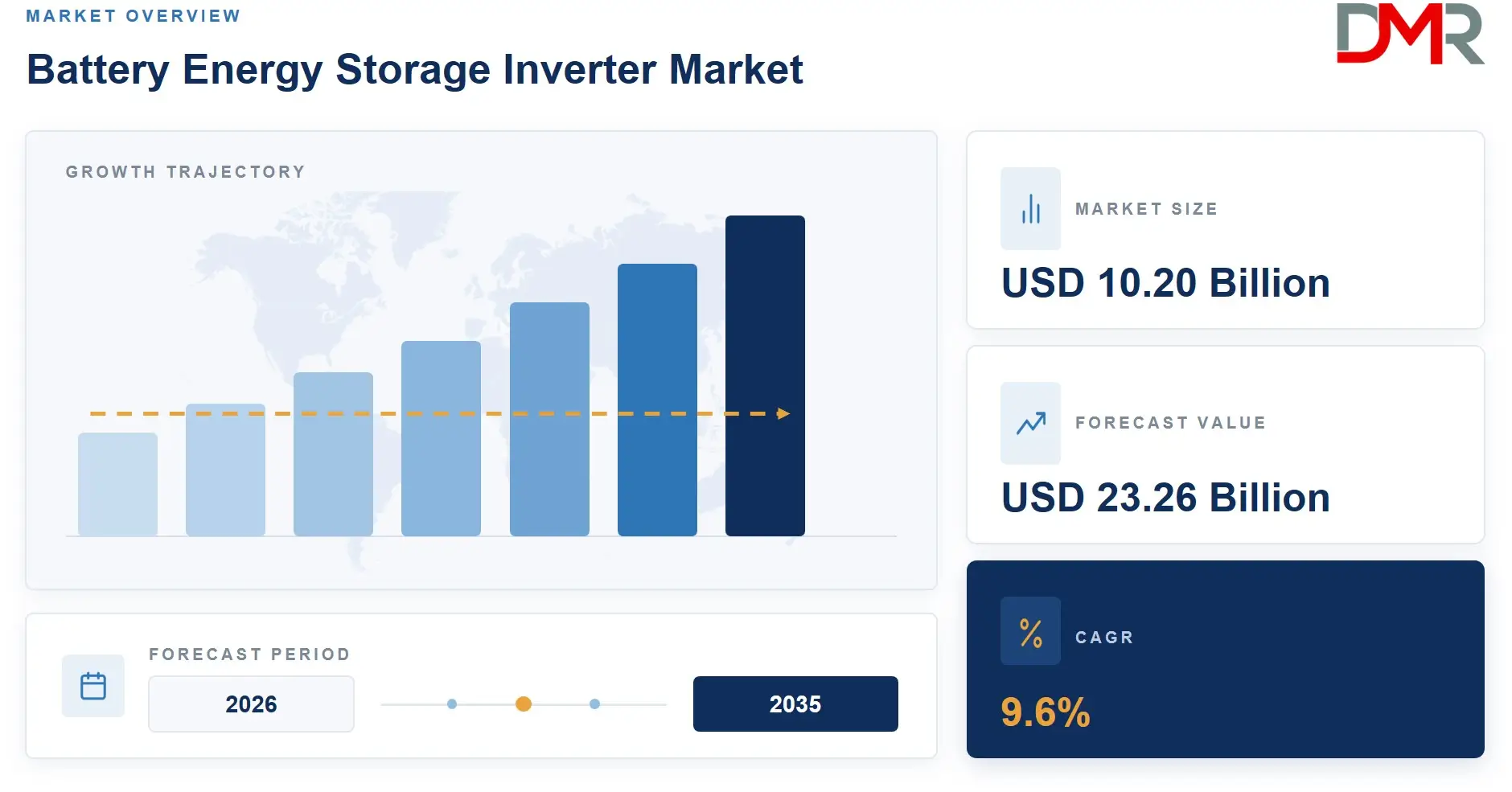
The Global Battery Energy Storage Inverter Market size is estimated at USD 10.20 Billion in 2026, and is projected to reach USD 23.26 Billion by 2035, exhibiting a CAGR of 9.6% during the forecast period. Grid Scale Energy Storage deployments at utility scale represent the single largest demand pool, and multi-gigawatt annual procurement volumes from solar-plus-storage projects across the U.S., India, and the Middle East anchor the forecast baseline.
Utility-scale battery-storage additions reached 63 GW in 2024, raising total installed capacity to 124 GW, as reported by the IEA. Separately, global renewable-power capacity reached 5,149 GW in 2025 after 692 GW of new additions, representing 15.5% annual growth per IRENA data. Both figures confirm that inverter procurement volumes are being pulled forward by a grid buildout pace that exceeds earlier analyst projections.
Tesla confirmed that Megapack 3 remained on track for 2026 volume production and listed 40 GWh of annual Megapack capacity in California. That single product ramp illustrates how large-format utility storage is compressing procurement cycles for bidirectional power conversion systems. Energy Storage Systems spanning residential, commercial, and utility tiers all require inverter-based power conversion, making this market coextensive with the broader clean-energy transition rather than a subsegment of it.
ℹ
To learn more about this report –
Download Your Free Sample Report Here
Key Takeaways
- The market size is USD 10.20 Billion in 2026, and is projected to hit USD 23.26 Billion by 2035 at a CAGR of 9.6%.
- By Electrical Configuration: Three-Phase Bidirectional Inverters led with a 61.20% share in 2026.
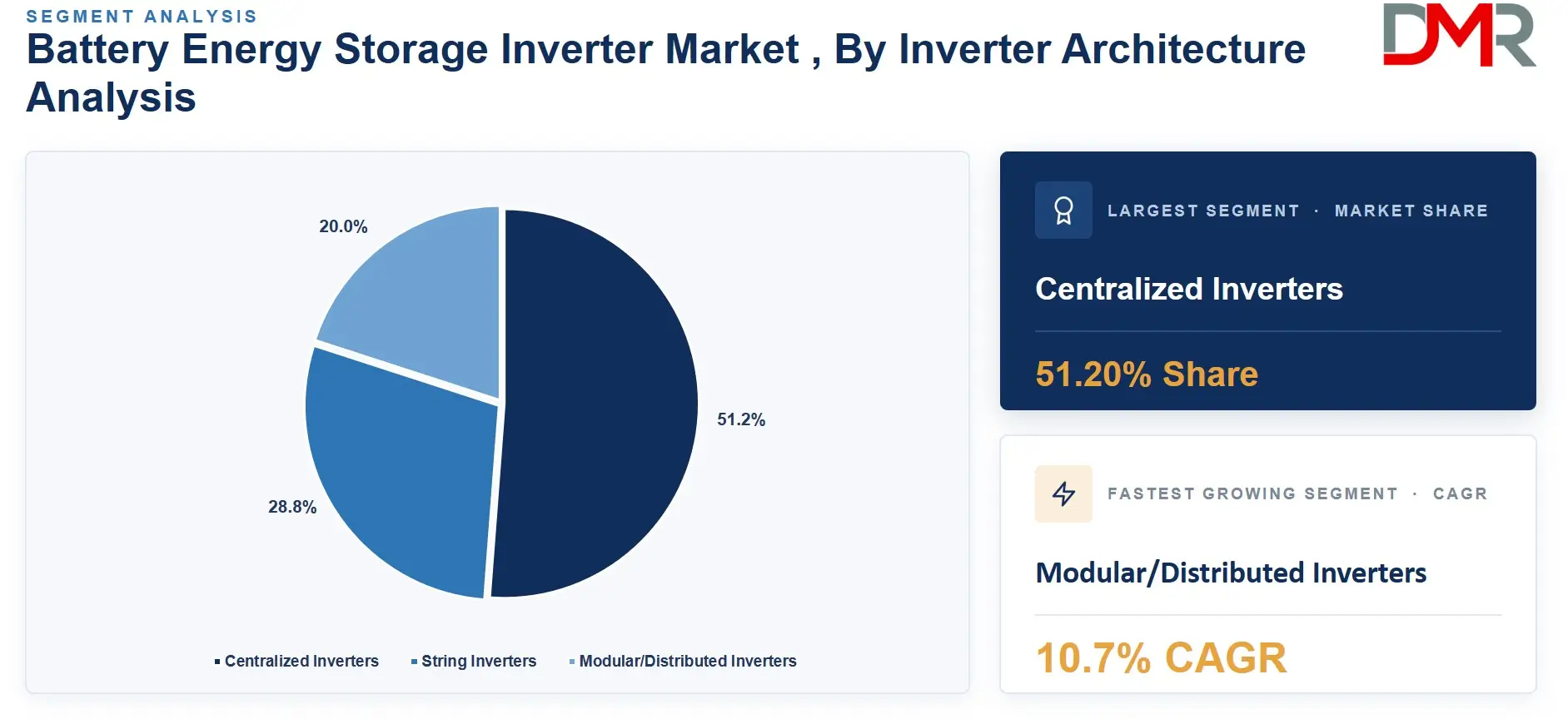
- By Inverter Architecture: Centralized Inverters led with a 51.20% share in 2026.
- By Power Range: Above 1 MW led with a 54.6% share in 2026.
- By Storage Deployment: Utility-Scale BESS led with a 58.10% share in 2026.
- By Grid Function: Energy Conversion & Grid Support led with a 62.50% share in 2026.
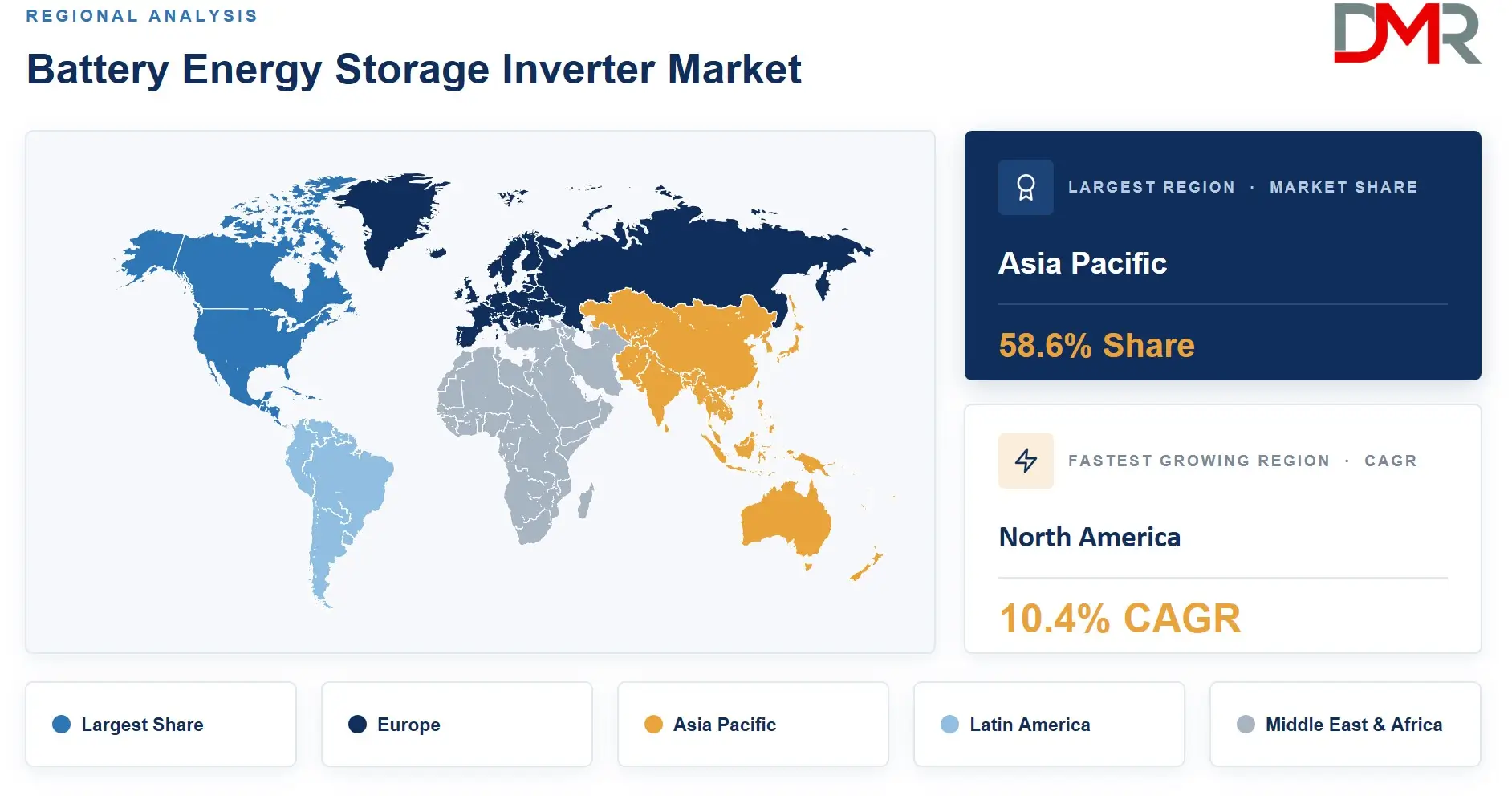
- By Region: Asia Pacific led with a 58.6% share in 2026.
- Top 5 key players: Sungrow Power Supply Co., Ltd., Huawei Digital Power, Hitachi Energy, ABB Ltd., Siemens AG.
Electrical Configuration Analysis
Three-Phase Bidirectional Inverters accounted for 61.20% of Electrical Configuration demand in 2026, the highest of any category.
Three-phase architecture dominates because utility-scale and commercial deployments require balanced load distribution across grid phases. As reported by the DOE, a representative 2025 commercial PV system specifies eight three-phase string inverters rated at 25 kWac each for 200 kWac total output, illustrating how multi-phase configurations are the engineering default for mid-to-large installations. A representative 2025 DOE utility-scale system specifies 19 centralized inverters rated at 4 MWac each, providing 76 MWac total output, which further confirms three-phase dominance at the top of the power range.
Single-phase bidirectional inverters hold the residual share, concentrated in the residential tier. GoodWe's ESA residential system, for instance, offers 3–10 kW inverter ratings with battery capacity scalable from 5 kWh to 48 kWh, reflecting the product architecture that defines the single-phase sub-segment. Residential Battery Energy Storage Systems adoption is accelerating in markets with net energy metering policy support, narrowing but not eliminating the gap between single-phase and three-phase procurement volumes.
Inverter Architecture Analysis
With a 51.20% share in 2026, Centralized Inverters outpaced all other Inverter Architecture categories.
Centralized architectures retain majority share because utility-scale project economics favor consolidating power conversion into high-capacity units. An IEEE review identified a 2.5 MW, two-hour inverter configuration as a standard utility-scale BESS unit, and the DOE's representative utility-scale storage benchmark specifies 60 battery cabinets totaling 240 MWh paired with 60 MWac of inverter capacity. Both references confirm that centralized design remains the default at scale.
Power Electronics innovation is driving the fastest growth in Modular/Distributed Inverters, where manufacturers stack smaller units for flexibility and redundancy. A DOE-supported modular GaN inverter demonstration uses 20 kW modules stackable to 100 kW, while a DOE-backed three-phase commercial string-inverter project specified a 72 kW prototype with a BESS interface, signaling that modular configurations are gaining engineering credibility beyond niche applications. String inverters occupy the middle ground, preferred in commercial rooftop and mid-scale ground-mount projects where partial shading and phased capacity additions justify distributed architectures.
ℹ
To learn more about this report –
Download Your Free Sample Report Here
Power Range Analysis
Above 1 MW captured 54.6% of the Power Range segment in 2026, ahead of all rivals.
High-capacity inverter demand is anchored by utility procurement. A DOE representative 2025 commercial PV-plus-storage system combines 250 kWdc of PV, 500 kWh of storage, and 125 kWac of bidirectional inverter capacity, illustrating how even mid-scale commercial projects now exceed the 100 kW threshold that separates the top two power bands. Projects above 1 MW set pricing benchmarks and drive supplier qualification processes, creating procurement advantages for vendors with proven large-format references.
The 100 kW to 1 MW range serves C&I buyers and campus-scale microgrids, where project economics justify dedicated inverter systems without the full engineering overhead of utility-scale procurement. Below 100 kW captures residential and small commercial demand, with growth rates outpacing the other two bands as residential storage attach rates rise in key markets.
Storage Deployment Analysis
Utility-Scale BESS led the Storage Deployment segment with a 58.10% share in 2026.
Utility-scale deployments command the largest share because grid operators and independent power producers are procuring storage at project sizes that dwarf residential and C&I volumes individually. Contract structures at multi-hundred-megawatt scale lock in inverter suppliers for multi-year delivery schedules, creating revenue visibility unavailable in shorter procurement cycles. Vendors with proven utility-scale references gain a compounding advantage as project owners prioritize risk-adjusted procurement over cost minimization alone.
Commercial & Industrial BESS is growing as C&I buyers face rising peak demand charges and seek backup power reliability. Residential Storage is the fastest-growing sub-segment, driven by net energy metering policy evolution and rising residential electricity prices. As reported by the EIA, frequency regulation was the primary application for 24% of surveyed U.S. utility-scale battery capacity, a signal that grid service revenue is now a meaningful justification for storage investment beyond pure arbitrage.
Grid Function Analysis
Energy Conversion & Grid Support accounted for 62.50% of Grid Function demand in 2026, the highest of any category.
Energy conversion remains the foundational use case because every BESS installation requires AC/DC and DC/AC conversion regardless of the additional services layered on top. Grid Support functions, bundled into this leading category, include reactive power compensation and voltage regulation that utilities increasingly mandate in interconnection agreements. Vendors able to certify their inverters for both energy conversion and ancillary services in a single product capture a disproportionate share of utility tenders.
Frequency & Voltage Support holds the second-largest share, reflecting regulatory frameworks that compensate storage assets for grid stabilization services. Grid-Forming Operation is the fastest-growing sub-segment, as isolated grids and microgrids in developing economies require synthetic inertia that only grid-forming inverters can provide. Buyers in this sub-segment pay premium prices for certified grid-forming capability, making it the highest-margin category in the Grid Function segment.
Key Market Segments
By Electrical Configuration
- Three-Phase Bidirectional Inverters
- Single-Phase Bidirectional Inverters
By Inverter Architecture
- Centralized Inverters
- String Inverters
- Modular/Distributed Inverters
By Power Range
- Below 100 kW
- 100 kW–1 MW
- Above 1 MW
By Storage Deployment
- Utility-Scale BESS
- Commercial & Industrial BESS
- Residential Storage
By Grid Function
- Energy Conversion & Grid Support
- Frequency & Voltage Support
- Grid-Forming Operation
Regional Analysis
Asia Pacific led the Battery Energy Storage Inverter Market with a 58.6% share in 2026, the dominant region by a substantial margin.
Asia Pacific
Asia added 513.3 GW of renewable capacity in 2025, representing 74.2% of worldwide additions and 21.6% regional growth, as confirmed by IRENA. China drives the bulk of this volume through state-directed grid modernization programs and the world's largest domestic battery manufacturing base. Japan, South Korea, India, and Australia each contribute growing procurement volumes, making Asia Pacific structurally different from other regions: demand is both policy-driven at scale and competitively supplied by regional manufacturers.
China accounted for over 80% of global battery output in 2025, and LFP chemistry represented over 90% of stationary battery-storage installations, per IEA data. Sungrow connected Saudi Arabia's 7.8 GWh energy-storage project in December 2025 using more than 1,500 PowerTitan 2.0 systems, a milestone that illustrates how Chinese inverter manufacturers are exporting Asia-proven technology to adjacent high-growth markets at a scale no Western competitor has matched.
North America
North America is the fastest-growing region in the Battery Energy Storage Inverter Market, powered by the U.S. grid buildout. U.S. operational utility-scale battery capacity reached 43.6 GW at the end of 2025 and climbed to nearly 52 GW by mid-2026 after 8.3 GW of first-half additions, as reported by the EIA. Policy mandates, IRA incentives, and grid reliability requirements are compressing project timelines and pulling inverter procurement forward into current budget cycles.
ℹ
To learn more about this report –
Download Your Free Sample Report Here
Key Regions and Countries
North America
Europe
- Germany
- France
- The UK
- Spain
- Italy
- Rest of Europe
Asia Pacific
- China
- Japan
- South Korea
- India
- Australia
- Rest of APAC
Latin America
- Brazil
- Mexico
- Rest of Latin America
Middle East & Africa
- GCC
- South Africa
- Rest of MEA
Macroeconomic Impact
The global lithium-ion battery market exceeded USD 150 billion in 2025 and expanded sixfold from 2020, as reported by the WTO. That cost deflation trajectory underpins inverter market growth by making co-located battery storage economically viable across more project types and geographies. Rising inflation in Western markets elevates installed project costs but has not reversed procurement momentum because storage revenue streams from grid services partially offset financing cost increases.
Interest rate levels in North America and Europe affect project IRR calculations for long-duration storage. Higher rates compress developer margins and occasionally delay financial close on large projects, creating uneven quarterly procurement patterns for inverter suppliers. Currency depreciation in emerging markets raises the effective USD cost of imported inverters, pushing buyers in Brazil, India, and South Africa toward local assembly partnerships as a cost management strategy.
Market Dynamics
Driver: Utility-Scale Storage Pipeline Pulls Forward Inverter Volumes
Global battery-storage capacity additions reached 108 GW in 2025, up approximately 40% from 2024, as reported by the IEA. Annual energy-storage installations reached 92 GW/247 GWh in 2025, up 23% from 2024, per World Bank data. These volumes confirm that utility-scale solar-plus-storage project pipelines across the U.S., India, and the Middle East are generating multi-gigawatt annual inverter procurement that vendors had not anticipated at current timescales.
Net energy metering policy evolution is lifting residential demand in parallel. More than 50% of new California residential solar installations included battery storage in April 2024, up from just over 20% in October 2023, as reported by the EIA. Delta Electronics agreed in January 2026 to supply 100 domestically manufactured 1.1 MW bidirectional PCS units totaling 110 MW for Prostarm BESS projects in India, demonstrating that Power Management IC and inverter supply chains are localizing rapidly to serve policy-driven demand in key emerging markets.
Restraint: Component Shortages and Certification Overhead Slow Deployment
Silicon Carbide and wide-bandgap semiconductor shortages constrain high-efficiency inverter production capacity precisely when BESS demand is highest. Sub-Saharan Africa holds approximately 30% of proven global critical-mineral reserves, yet projected demand through 2050 requires lithium supply to rise tenfold, as noted by the IMF. The structural gap between mineral supply expansion timelines and inverter demand growth rates creates a ceiling on how quickly manufacturers can scale premium-efficiency product lines.
IEEE 1547-2018 grid interconnection standard variation across U.S. utility territories forces inverter manufacturers to carry multiple certified configurations for the same product family. Multi-state deployers absorb reconfiguration and re-certification costs that can reach six figures per project, creating a hidden procurement overhead that disadvantages challengers lacking established utility relationships.
Opportunity: Grid-Forming and V2G Infrastructure Opens High-Margin Niches
Offshore wind-coupled storage and V2G infrastructure represent two high-margin niches with no established dominant supplier. An IEC case study specified a 250 kW battery inverter paired with a 1 MWh BESS for an islanded grid application, illustrating the configuration requirements that rural electrification programs in developing economies generate. The DOE-backed UNIFI program received USD 25 million and plans a 20 MW grid-forming inverter demonstration, signaling that public capital is de-risking the technology for private procurement. Huawei and SchneiTec commissioned a 12 MWh grid-forming storage project in Cambodia in June 2025, the first TÜV SÜD-certified project of its kind, establishing a referenceable benchmark that accelerates buyer confidence in grid-forming inverter procurement.
Porter's Five Forces
Competitive rivalry in the Battery Energy Storage Inverter Market is high among the top tier, where Chinese manufacturers led by Sungrow and Huawei hold cost and scale advantages over European and Japanese incumbents. New entrant threats are moderate: capital requirements for inverter R&D, testing, and utility certification create meaningful barriers, but the modular and string inverter sub-segments attract software-capable challengers with lower fixed-cost structures. Supplier power is elevated for Silicon Carbide and GaN semiconductors, where a small number of qualified fabs control pricing for high-efficiency power devices critical to premium inverter lines. Buyer power is strong at utility scale, where multi-hundred-megawatt procurement volumes give project developers and grid operators significant leverage over inverter pricing and delivery terms. Substitute threats are low within the AC-coupled storage architecture, as no viable technology replaces bidirectional power conversion in grid-connected BESS, though DC-coupled configurations create internal substitution pressure within the product category itself.
AI and Gen AI Impact
Artificial intelligence is reshaping the Battery Energy Storage Inverter Market most visibly at the energy management software layer. Inverter manufacturers are vertically integrating AI-powered energy management platforms to optimize battery dispatch, grid export timing, and ancillary service bidding in real time. Early movers with proprietary AI dispatch software generate recurring software revenue streams that extend customer lifetime value well beyond the one-time hardware sale. The DOE-backed UNIFI grid-forming inverter program frames grid-forming capability as an AI-addressable control problem, where software-defined inverter behavior can be updated remotely to adapt to changing grid conditions without hardware replacement. Laggards that deliver inverters as passive hardware risk commoditization as buyers consolidate procurement around vendors offering integrated hardware-software platforms with measurable grid performance guarantees.
Market Trends
GaN and SiC Adoption Redefines Efficiency Benchmarks for Premium Procurement
GaN and SiC power device adoption is shifting inverter efficiency benchmarks above 99%, redefining the competitive baseline for premium-segment procurement. GoodWe launched a liquid-cooled C&I storage system in August 2025 delivering 125 kW output and 261 kWh of capacity from a 1.47-square-meter cabinet, a form-factor compression that reflects SiC-enabled switching efficiency gains. Hybrid inverter platforms consolidating solar MPPT, battery charge control, and grid export management into single-unit residential installations are narrowing the bill-of-materials for installers, reducing truck-roll complexity and driving attach-rate growth in rooftop-plus-storage deployments.
Market Competition Overview
The Battery Energy Storage Inverter Market is moderately consolidated at the top, with Chinese manufacturers Sungrow and Huawei holding the largest global share by shipped capacity. European players including ABB, Siemens, Schneider Electric, and SMA Solar compete on certification depth, service network breadth, and long-term maintenance contracts rather than unit price alone. Hitachi Energy generates approximately USD 20 billion in annual revenue, employs more than 56,000 people, and holds an installed base across more than 140 countries, giving it a service-led competitive position that smaller rivals cannot replicate at comparable cost. Modular and residential inverter segments are more fragmented, with SolarEdge, Enphase, GoodWe, and Growatt each pursuing distinct architecture and channel strategies that prevent any single player from consolidating the sub-scale tier.
Pricing Analysis
Fully installed battery-storage project costs declined 93% between 2010 and 2024, falling from USD 2,571/kWh to USD 192/kWh, as reported by IRENA. Inverter pricing followed a similar deflationary curve, driven by component cost reduction, manufacturing scale, and competitive pressure from Chinese suppliers. Eaton launched the xStorage BESS in November 2024 with 250–1,000 kWh of usable stored energy and parallelable units, a product architecture that competes on total installed cost rather than per-unit inverter price, reflecting the buyer shift toward system-level value assessment.
Utility-scale buyers negotiate volume pricing that sits well below published list prices, while C&I and residential buyers pay premiums for certified, fully integrated systems with warranty coverage. Premium pricing holds in the grid-forming and marine-grade inverter niches where certification requirements and product scarcity limit competitive bidding. Regional price variation is significant: local content requirements in Brazil, India, and South Africa compress margins for global OEMs that must invest in in-country assembly to remain eligible for government-backed tenders.
Company Profiles
Sungrow Power Supply Co., Ltd. generated CNY 89.184 billion in operating revenue in 2025, up 14.55% year over year, confirming its position as the highest-volume inverter manufacturer globally. Sungrow's strategic advantage rests on vertical integration from power conversion hardware through cloud-based energy management, combined with a manufacturing scale that allows it to price aggressively for utility tenders while sustaining R&D investment. In January 2026, Sungrow launched PowerTitan 3.0, integrating 1.78 MW of PCS and 7.14 MWh of batteries per 20-foot container, a product density increase that reduces balance-of-plant costs for utility buyers and raises the engineering bar for competitors.
Huawei Digital Power operates within Huawei's broader CNY 880.9 billion revenue base, with CNY 68 billion in net profit in 2025, giving it access to R&D capital that standalone inverter manufacturers cannot match. Huawei's LUTERRA smart-string ESS platform, launched in June 2026, supports 1,000 Vac operation and a 12.5 MW/50 MWh array configuration, a technical specification that competes directly with centralized inverter architectures at multi-megawatt scale. The LUTERRA launch signals Huawei's intent to displace centralized inverter incumbents in the 10–50 MW project bracket by delivering string-architecture flexibility at utility-grade power density.
Key Players
- Sungrow Power Supply Co., Ltd.
- Huawei Digital Power
- Hitachi Energy
- ABB Ltd.
- Siemens AG
- Schneider Electric SE
- Power Electronics S.L.
- SMA Solar Technology AG
- Tesla
- Delta Electronics
- Eaton Corporation
- Sineng Electric
- Kehua Tech
- Dynapower
- SolarEdge Technologies Inc.
- Fronius International GmbH
- Enphase Energy, Inc.
- GoodWe Technologies Co., Ltd.
- Growatt New Energy Technology Co., Ltd.
- Mitsubishi Electric Corporation
Supply Chain and Value Chain Analysis
The Battery Energy Storage Inverter value chain begins with critical mineral extraction, proceeds through cell and battery pack manufacturing, and culminates in power conversion hardware assembly and software integration. Maximum value concentration sits at the inverter firmware and energy management software layer, where proprietary algorithms command margin premiums that commodity hardware cannot sustain. Red Sea disruptions increased dry-bulk trade measured in ton-miles, as reported by UNCTAD, extending lead times for components shipped from Asian manufacturers to European and North American project sites and compressing delivery windows for time-sensitive grid connection milestones.
Silicon Carbide wafer supply represents the most acute bottleneck in the upstream chain. A small number of qualified SiC fabs globally control pricing for high-efficiency power devices, creating supply risk for inverter manufacturers that have not secured multi-year offtake agreements. Downstream, EPC contractors and grid operators exert increasing influence over inverter specification, shifting competitive dynamics toward vendors that can provide bankable performance guarantees alongside the hardware itself.
Regulatory Landscape
IEEE 1547-2018 governs grid interconnection standards for distributed energy resources across the United States, but utility-by-utility implementation variation forces inverter manufacturers to certify multiple configurations for the same product. Multi-state project developers absorb recertification costs that create a hidden barrier favoring incumbents with established utility relationships over new entrants. The European Union's Battery Regulation and Grid Code requirements impose lifecycle data tracking and minimum performance standards that raise compliance costs for non-EU manufacturers seeking market access.
India's Approved List of Models and Manufacturers framework and local content requirements for government-backed storage tenders compel global inverter OEMs to establish in-country manufacturing or assembly partnerships. Brazil and South Africa operate similar frameworks. Compliance with these regimes is now a prerequisite for participation in the largest government-procured storage projects, reshaping global supply chain strategy for every major inverter manufacturer.
Investment and White Space Analysis
Investment is concentrating in utility-scale grid-forming inverter development, offshore wind-coupled storage systems, and V2G infrastructure, three niches where no single supplier holds dominant share. The sub-50 MW offshore wind-storage segment in particular lacks an established dominant inverter supplier, presenting an entry window for players with marine-grade certification and high-capacity product lines. Modular inverter block architecture for data center backup power replacing aging UPS infrastructure is a white-space opportunity where lithium-coupled, software-defined power conversion systems carry premium pricing and long service contract value.
Developing economy rural electrification programs represent a distinct investment vector. Islanded microgrid projects in Sub-Saharan Africa, Southeast Asia, and South Asia require grid-forming inverter capability and accept higher per-unit pricing for certified, off-grid-capable systems. Vendors that establish early references in these markets gain procurement credibility that compounds across successive project pipelines where buyer networks are concentrated and referrals carry significant commercial weight.
Recent Developments
- May 2026: Hitachi Energy entered a 20-year service agreement covering Akaysha Energy's 155 MW/298 MWh Ulinda Park BESS in Australia, the longest publicly disclosed service contract for a utility-scale storage asset.
- April 2026: Re:cap agreed to acquire SMA Altenso's 95 MW/220 MWh Alapitkä battery project in Finland, scheduled to begin operating in 2027, marking SMA's first large-scale storage asset transaction in the Nordic market.
- August 2025: SMA Altenso and MEAG agreed to develop a German battery-storage project with 130 MW output and 354 MWh capacity, one of the largest utility-scale storage commitments announced in Europe that year.
- August 2025: Enphase launched the IQ Battery 5P with FlexPhase in Australia, scalable from 5 kWh to 70 kWh, extending the company's modular residential storage architecture to a high-growth Pacific market.
- June 2025: Dynapower launched its MV Integrated PowerSkid in a 20-foot ISO high-cube enclosure with two parallel CPS-2500 inverters, targeting C&I and utility-scale buyers seeking containerized power conversion with minimal site preparation.
- May 2025: Zelestra signed an agreement with Sungrow for approximately 1 GWh of storage and a 220 MWdc solar plant at Chile's Aurora hybrid project, one of the largest combined solar-plus-storage contracts awarded in Latin America.
- April 2024: Schneider Electric launched an all-in-one microgrid BESS available from 250 kW to 2 MW in two-hour and four-hour configurations, targeting C&I buyers seeking turnkey behind-the-meter storage with integrated power management.
- October 2024: Hitachi Energy secured contracts for three Danish battery-storage facilities totaling 36 MW/72 MWh, expanding the company's European grid-stability portfolio across Nordic markets.
- September 2024: Sungrow signed a 1.4 GWh storage-supply agreement with Penso Power and BW ESS covering 280 PowerTitan 2.0 systems, one of the largest single-supplier agreements recorded in the European storage market at that date.
- September 2024: SolarEdge unveiled a residential platform scalable to 17.6 kWh per battery, 70.4 kWh per inverter, and three inverters per site, raising the ceiling for AC-coupled residential storage capacity in a single installation.
Report Scope
| Report Characteristics |
| Market Value (2026) |
USD 10.20 Billion |
| Forecast Revenue (2035) |
USD 23.26 Billion |
| CAGR (2026 to 2035) |
9.6% |
| Base Year for Estimation |
2025 |
| Historic Period |
2020 to 2024 |
| Forecast Period |
2026 to 2035 |
| Report Coverage |
Revenue Forecast, Market Dynamics, Competitive Landscape, Recent Developments |
| Segments Covered |
By Electrical Configuration (Three-Phase Bidirectional Inverters, Single-Phase Bidirectional Inverters), By Inverter Architecture (Centralized Inverters, String Inverters, Modular/Distributed Inverters), By Power Range (Below 100 kW, 100 kW–1 MW, Above 1 MW), By Storage Deployment (Utility-Scale BESS, Commercial & Industrial BESS, Residential Storage), By Grid Function (Energy Conversion & Grid Support, Frequency & Voltage Support, Grid-Forming Operation) |
| Regional Analysis |
North America (US and Canada), Europe (Germany, France, The UK, Spain, Italy, and Rest of Europe), Asia Pacific (China, Japan, South Korea, India, Australia, and Rest of APAC), Latin America (Brazil, Mexico, and Rest of Latin America), Middle East & Africa (GCC, South Africa, and Rest of MEA) |
| Competitive Landscape |
Sungrow Power Supply Co., Ltd., Huawei Digital Power, Hitachi Energy, ABB Ltd., Siemens AG, Schneider Electric SE, Power Electronics S.L., SMA Solar Technology AG, Tesla, Delta Electronics, Eaton Corporation, Sineng Electric, Kehua Tech, Dynapower, SolarEdge Technologies Inc., Fronius International GmbH, Enphase Energy, Inc., GoodWe Technologies Co., Ltd., Growatt New Energy Technology Co., Ltd., Mitsubishi Electric Corporation |
| Customization Scope |
Customization for segments and region or country level will be provided. Additional customization can be done based on requirements. |
| Purchase Options |
Three license options: Single User License, Multi-User License (Up to 5 Users), Corporate Use License (Unlimited Users and Printable PDF) |
Frequently Asked Questions
What is the biggest investment opportunity in the Battery Energy Storage Inverter Market?
▾ Grid-forming inverter capability for islanded microgrids and offshore wind-coupled storage represents the highest-margin white space, with no dominant supplier established in either niche. The DOE-backed UNIFI program has committed USD 25 million to a 20 MW grid-forming demonstration, signaling that public capital is de-risking the technology for private procurement. Vendors that build referenceable grid-forming projects now will set the qualification bar that subsequent buyers rely on.
Who are the top companies in the Battery Energy Storage Inverter Market?
▾ Sungrow Power Supply Co., Ltd., Huawei Digital Power, Hitachi Energy, ABB Ltd., and Siemens AG are the five leading players by global presence and installed capacity. Sungrow holds the largest shipped-volume position, supported by CNY 89.184 billion in 2025 operating revenue. Huawei, ABB, and Siemens compete on technology depth and service network breadth in markets where price alone does not determine supplier selection.
Which segment is growing fastest in the Battery Energy Storage Inverter Market and why?
▾ Residential Storage is the fastest-growing deployment sub-segment, driven by net energy metering policy evolution and rising residential electricity costs in key markets. Grid-Forming Operation is the fastest-growing Grid Function sub-segment because isolated grids and microgrids require synthetic inertia that only grid-forming inverters provide. Both sub-segments command premium pricing relative to their larger but more commoditized adjacent categories.
Which region is growing fastest in the Battery Energy Storage Inverter Market and why?
▾ North America is the fastest-growing region, with U.S. operational utility-scale battery capacity climbing to nearly 52 GW by mid-2026 from 43.6 GW at end-2025. IRA incentives, grid reliability mandates, and a deep project pipeline of solar-plus-storage assets are accelerating inverter procurement at a pace that exceeds all other geographies on an incremental-volume basis. Policy certainty in the U.S. gives suppliers the confidence to invest in domestic inventory and service infrastructure.
What is the biggest challenge holding in the Battery Energy Storage Inverter Market back?
▾ Silicon Carbide and wide-bandgap semiconductor component shortages are the most binding near-term constraint on high-efficiency inverter production capacity. A small number of qualified SiC fabs globally control pricing and allocation, leaving inverter manufacturers unable to fully capitalize on surging BESS demand without multi-year supply agreements. IEEE 1547-2018 certification variation across U.S. utility territories compounds the constraint by adding reconfiguration and recertification costs that slow multi-state project deployment.