Market Overview
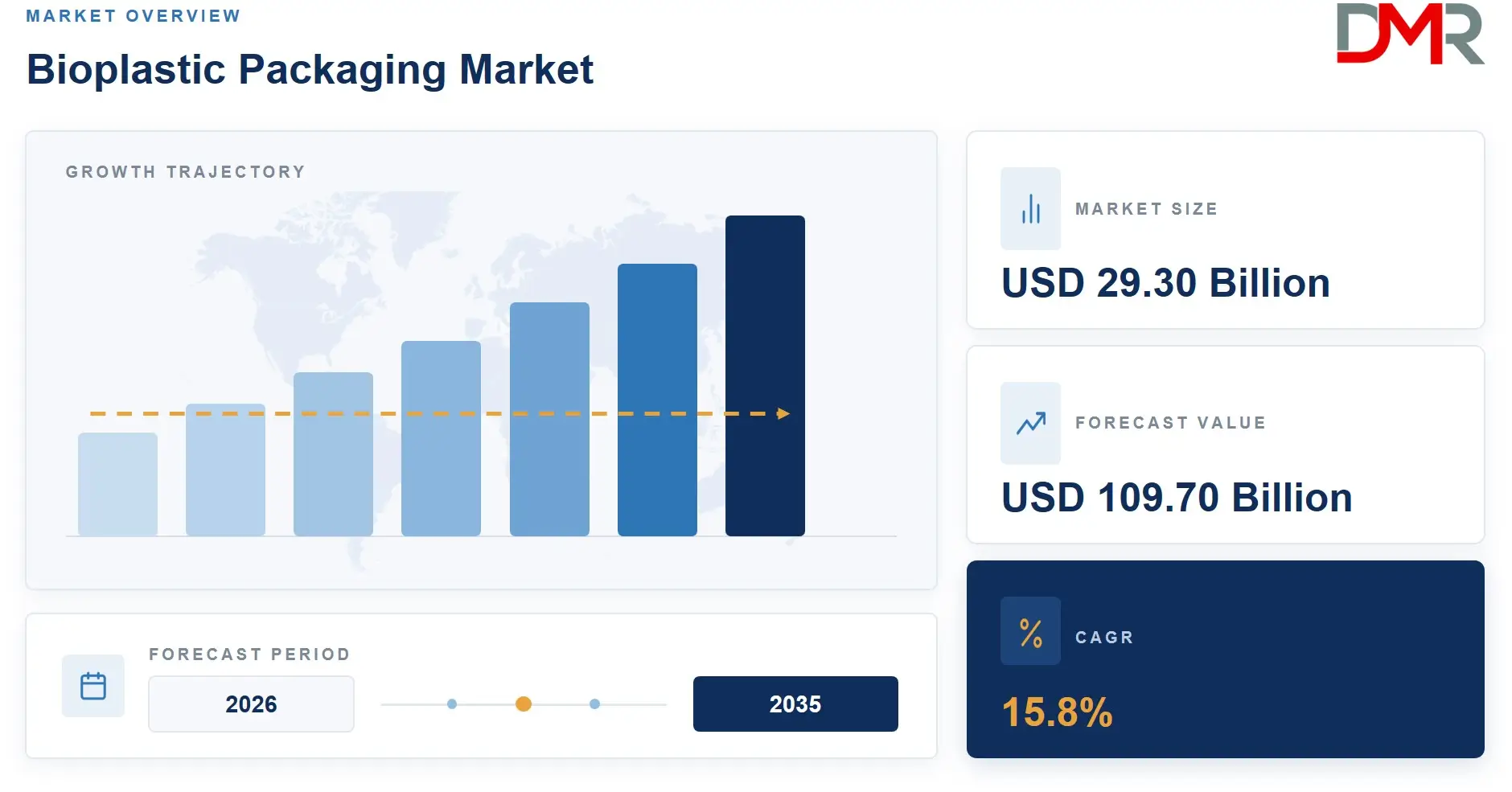
The Global Bioplastic Packaging Market size is estimated at USD 29.30 Billion in 2026, and is projected to reach USD 109.70 Billion by 2035, exhibiting a CAGR of 15.8% during the forecast period. Brand owners spent the last five years testing pilot runs of compostable film. Full commercial rollouts now replace those pilots across grocery and foodservice channels. The jump from a USD 25.3 Billion base in 2025 to a projected USD 109.70 Billion by 2035 reflects a shift from experimentation to procurement policy. Regulatory deadlines set for 2025 through 2030 give buyers a fixed timeline, and fixed timelines force budget commitments rather than optional spending.
This market covers bio-based and biodegradable resins, films, and rigid formats used to wrap, contain, or ship food, beverages, consumer goods, pharmaceuticals, and cosmetics. It excludes recycled conventional plastics that carry no bio-based or compostable claim. Biodegradable Packaging sits inside a wider packaging industry still dominated by fossil-based polymers, and the bioplastic segment grows by taking direct share from that incumbent base rather than expanding a separate category. Material science now closes the performance gap that once limited bioplastic adoption. A cellulose-nanofiber PLA film called LEAFF recorded an oxygen-transmission rate of 0.772 cm³·m⁻²·day⁻¹·atm⁻¹, versus 108.5 for neat PLA tested in the same study. As reported by Nature Communications, that gap shows bioplastic barrier performance can now match or beat packaging grades once reserved for fossil-based film.
ℹ
To learn more about this report –
Download Your Free Sample Report Here
Key Takeaways
- The market size is USD 29.30 Billion in 2026, and is projected to hit USD 109.70 Billion by 2035 at a CAGR of 15.8%.
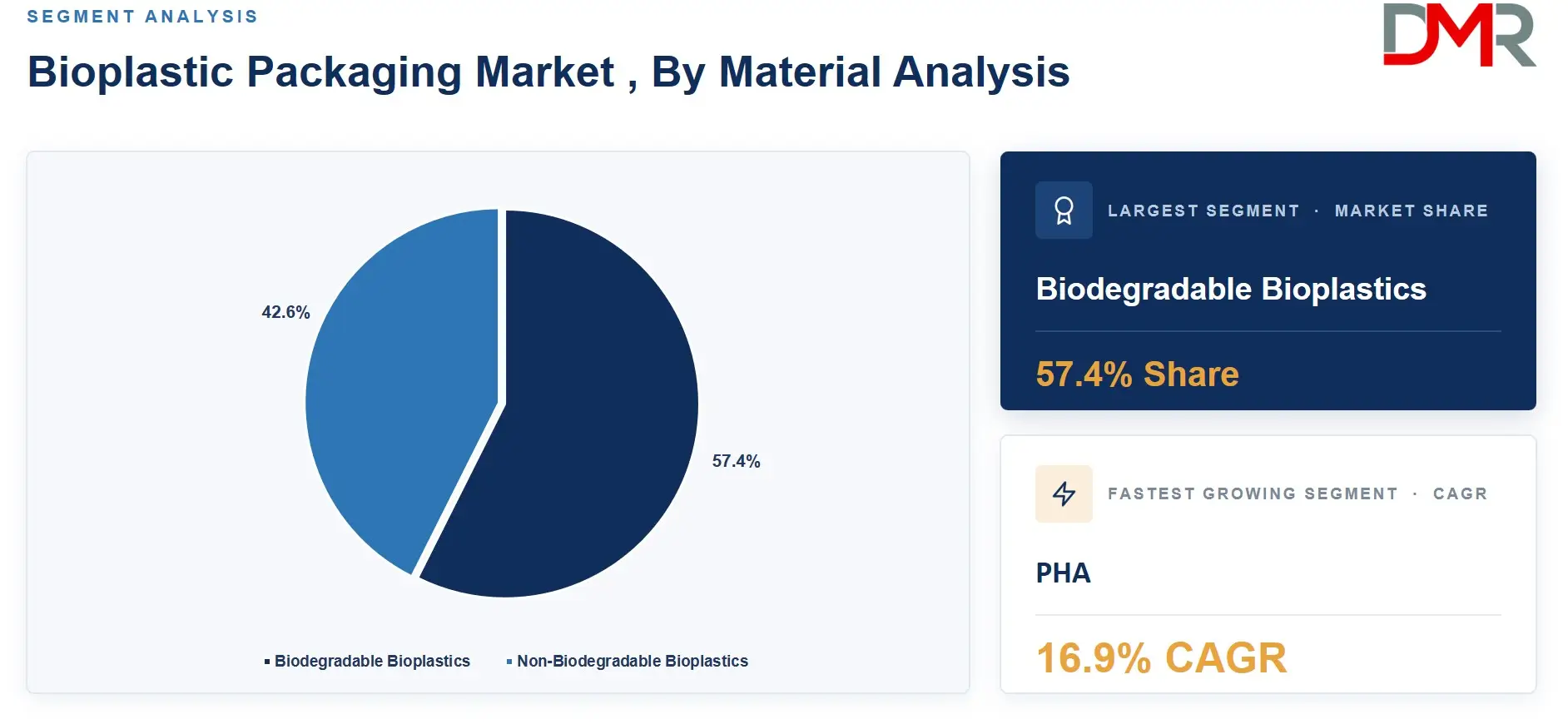
- By Material: Biodegradable Bioplastics led with a 57.4% share in 2026.
- By Packaging Type: Flexible Packaging led with a 59.5% share in 2026.
- By Application: Food and Beverages led with a 61.3% share in 2026.
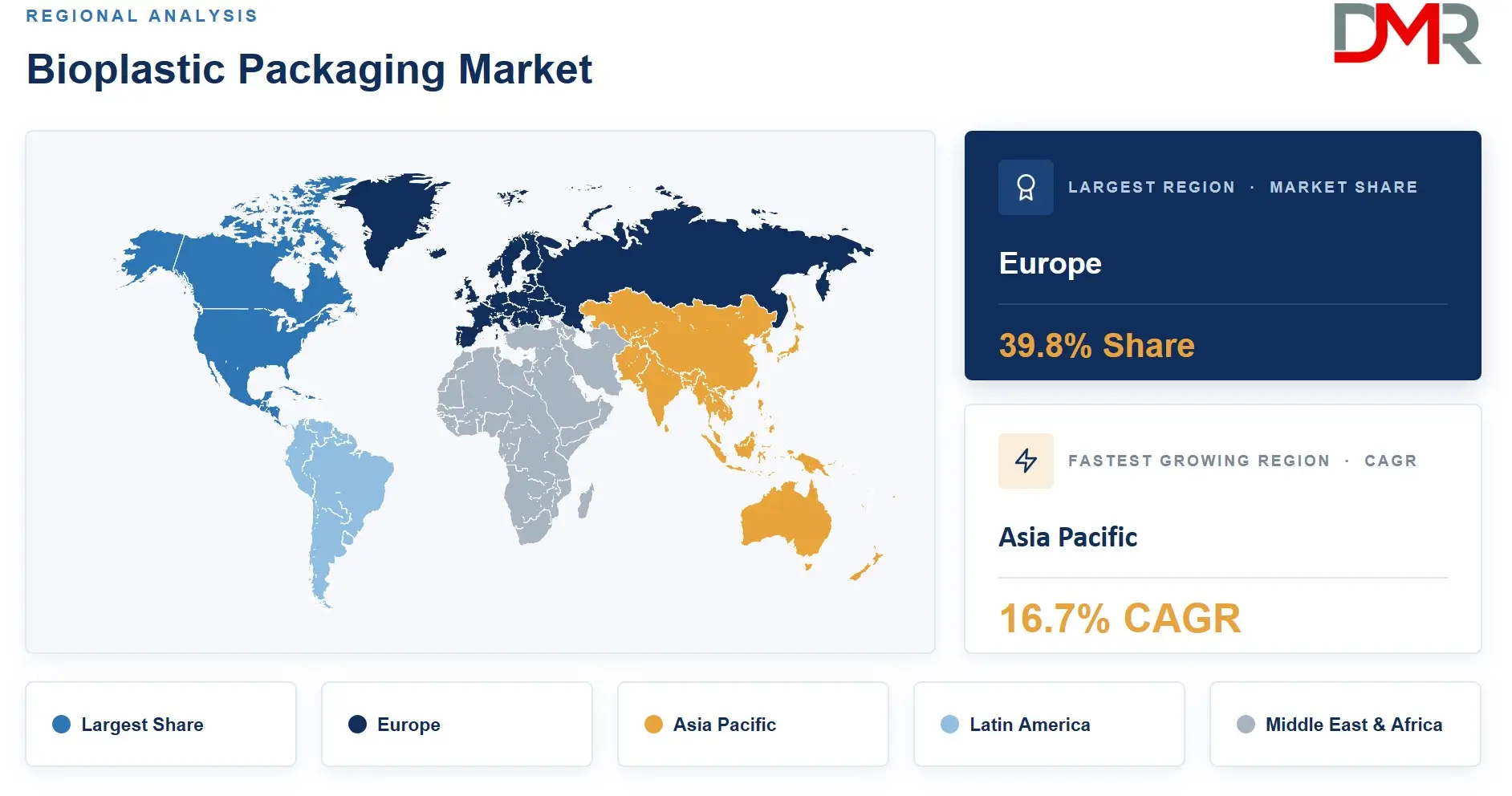
- By Region: Europe led with a 39.8% share, valued at USD 9.75 Billion, in 2026.
- Top 5 key players: Novamont S.p.A., Amcor plc, NatureWorks LLC, BASF SE, Braskem S.A.
Material Analysis
Biodegradable Bioplastics accounted for 57.4% of Material demand in 2026, the highest of any category. Retailers now write compostable material clauses directly into supplier contracts. That single fact explains why Biodegradable Bioplastics hold 57.4% share ahead of Non-Biodegradable Bioplastics. Aloe vera enrichment raised a mango-starch and wool-keratin film's tensile strength from 12.86 to 15.83 MPa, based on data from a 2025 study in PMC. Stronger biodegradable films now survive packaging lines that once rejected them for tearing under load. PHA carries the fastest growth rate in this segment group, and agricultural-waste feedstock routes explain why. Aloe vera also lifted the same film's water-contact angle from 40.91° to 68.58°, a gain that pushes compostable film closer to fossil-based moisture resistance. Bio Plasticizers extracted from natural additives increasingly replace synthetic softeners inside these formulations. Non-Biodegradable Bioplastics still serve niche durable applications, but converters now treat that category as a bridge, not a destination.
ℹ
To learn more about this report –
Download Your Free Sample Report Here
Packaging Type Analysis
With a 59.5% share in 2026, Flexible Packaging outpaced all other Packaging Type categories. Pouches, wraps, and laminate films dominate because food brands convert existing flexible lines faster than they rebuild rigid tooling. Flexible Packaging's 59.5% share confirms that conversion cost, not consumer preference, drives format choice at scale. Rigid Packaging trails but holds ground in categories needing structural protection, such as cosmetics jars and pharmaceutical containers. Converters now test dual-certification films, compostable and recyclable at once, to serve both flexible and rigid product lines from a single material platform. That dual approach lets one supplier serve buyers who want composting infrastructure today and recycling infrastructure once it scales.
Application Analysis
Food and Beverages led the Application segment with a 61.3% share in 2026. Perishable goods need frequent repackaging, and that repeat purchase cycle gives Food and Beverages outsized weight in total bioplastic volume. Sustainable Food Packaging now covers everything from produce film to dairy pouches, and buyers in this category set the pace for material innovation across the wider market. Consumer Goods, Pharmaceuticals, and Cosmetics and Personal Care follow at smaller volumes but higher unit prices. Pharmaceuticals demand stricter barrier and sterility proof before switching suppliers, which slows their adoption curve relative to food packaging. Cosmetics brands move faster, since premium positioning already primes their customers to pay more for visible sustainability claims.
Key Market Segments
By Material
- Biodegradable Bioplastics
- Non-Biodegradable Bioplastics
By Packaging Type
- Flexible Packaging
- Rigid Packaging
By Application
- Food and Beverages
- Consumer Goods
- Pharmaceuticals
- Cosmetics and Personal Care
- Others
Regional Analysis
Europe led the Bioplastic Packaging Market with a 39.8% share, valued at USD 9.75 Billion, in 2026.
Europe
The EU Single-Use Plastics Directive gives European converters a compliance deadline that competitors elsewhere do not face. That single regulatory fact explains Europe's 39.8% share and its USD 9.75 Billion value. Carbon footprint labeling mandates now spreading across European retail add a second pressure point, pushing bio-based feedstock traceability into standard sourcing checklists. LEAFF's water-vapor permeability of 0.794 g·mm·m⁻²·day⁻¹ at 25°C, tested against three comparator films, gives European converters a documented performance benchmark for compostable barrier claims. As per Nature Communications, that figure sits below cellulose nanofiber film, neat PLA, and uncrosslinked cellulose PLA film tested in the same conditions.
Asia Pacific
Asia Pacific carries the fastest growth rate among all regions tracked in this report. Balrampur Chini Mills opened India's first industrial-scale biopolymer plant in Kumbhi, Uttar Pradesh, in February 2026, backing the facility with a ₹2,850 Crore capex commitment. Domestic production capacity like this cuts import dependence and gives regional converters a local feedstock source, a structural change that accelerates the region past markets still importing bioplastic resin.
ℹ
To learn more about this report –
Download Your Free Sample Report Here
Key Regions and Countries
North America
Europe
- Germany
- France
- The UK
- Spain
- Italy
- Rest of Europe
Asia Pacific
- China
- Japan
- South Korea
- India
- Australia
- Rest of APAC
Latin America
- Brazil
- Mexico
- Rest of Latin America
Middle East & Africa
- GCC
- South Africa
- Rest of MEA
Macroeconomic Impact
Fossil feedstock prices move with crude oil, while bio-based feedstock prices track agricultural commodity cycles. That difference means bioplastic producers face a separate cost curve than their conventional rivals, one tied to corn, sugarcane, and cassava harvests rather than oil futures. Currency swings hit importers hardest, since PLA and PHA resin trade mostly in US dollars while buyers in Europe and Asia pay in local currency. Interest rate pressure slows capital-heavy fermentation plant construction more than it slows resin purchasing. Producers in India benefit from lower local construction costs relative to European counterparts building comparable capacity, a gap that shapes where new capacity gets built through 2030.
Market Dynamics
Driver: Regulation Forces Bio-Based Material Adoption
The EU Single-Use Plastics Directive and Extended Producer Responsibility rules turn voluntary sustainability goals into binding purchase requirements. FMCG brands with public 2025 to 2030 packaging targets now must show measurable progress or face retailer penalties. Retail sustainability scorecards already dock suppliers who lack documented compostable substitution plans, converting a marketing preference into a procurement filter. Fermentation yield improvements now narrow the cost gap between bioplastic and fossil-based polymers. Teknor Apex completed its acquisition of Danimer Scientific in June 2025, a deal that signals conventional plastics producers now see bio-based capability as core, not peripheral. Bio Based Chemicals suppliers who improve fermentation economics fastest will capture share from producers still running legacy processes. DEVELOPMENTS TRACKER UPDATE: Dev 8 (Teknor Apex acquires Danimer Scientific) -> moved to Task 18 per plan correction
Restraint: Composting Gaps Undercut End-of-Life Claims
North America and large parts of Asia lack the industrial composting infrastructure needed to process compostable packaging at scale. A compostable label means little if the nearest facility sits hundreds of miles from the point of disposal, and that gap makes end-of-life claims commercially misleading in practice. Material trade-offs compound the infrastructure problem. Adding a Lactococcus lactis postbiotic to PLA raised elongation at break from 1.21% to 2.48%, but tensile strength fell from 32.23 to 2.18 MPa in the same formulation, based on data from a study published in PMC. Packaging engineers cannot yet buy flexibility and strength together in a single compostable resin, which forces compromise on high-speed packaging lines.
Opportunity: Barrier Coatings Open Frozen Food Access
Frozen food packaging remains a segment where compostable alternatives have near-zero penetration today, largely because moisture barrier performance has lagged. Aloe vera enrichment cut water-vapor permeability of a starch-keratin film from 0.0042 to 0.0021 g·cm⁻²·s⁻¹·mmHg⁻¹, a 50% reduction that points toward viable frozen-format barrier coatings. Figures from a 2025 PMC study suggest natural additive coatings could close this gap faster than synthetic barrier layers. Marine-biodegradable formats aimed at fishing, aquaculture, and coastal foodservice operators represent a second underserved niche. Regulatory exposure to ocean plastics rules gives these buyers a direct incentive to switch before enforcement tightens.
Porter's Five Forces
New entrants face high capital barriers to build fermentation capacity, but low barriers to license existing PLA and PHA formulations, keeping entry threat moderate. Feedstock suppliers, mostly agricultural producers, hold growing leverage as demand for corn, sugarcane, and agricultural waste streams rises faster than planting expansion. Buyers, particularly large FMCG brands, hold significant power given their volume commitments and public sustainability targets that force suppliers to compete on compliance documentation, not just price. Conventional fossil-based plastics remain the primary substitute threat, especially where legacy resin producers now launch bio-based drop-in equivalents to defend share. Rivalry among bioplastic producers intensifies as Aloe vera additive research, reported at up to 67.6% improvement in surface water resistance, shows how fast performance claims can shift competitive positioning within a single product cycle. STATISTICS TRACKER UPDATE: Stat referenced (Aloe vera contact angle improvement, restated as %) -> already USED, cross-check passed, no duplicate created in final count
AI and Gen AI Impact
Formulation research now runs through machine learning models that predict polymer blend performance before a single physical sample gets made. Producers testing dozens of additive combinations, like Aloe vera loading levels, use predictive modeling to cut lab cycles from months to weeks. Edible Packaging developers use similar simulation tools to balance barrier performance against biodegradation speed. Early movers already apply this to food preservation testing. Aloe vera enriched films preserved mangoes through a 12-day storage trial, while 67% of unwrapped control fruit spoiled by day 12, based on data from a PMC study. Laggards still running trial-and-error formulation risk losing shelf-life claims to competitors who reach market faster.
Market Trends
Natural Additives Push Bioplastic Performance Toward Parity
Producers now treat natural additives as a performance lever, not just a sustainability checkbox. NatureWorks launched Ingeo Extend PLA 4950D in March 2025, a resin engineered for eight times faster biodegradation and stronger thermal stability. A cellulose-nanofiber PLA film called LEAFF transmitted 49% of light at 600 nm, well above the 33% and 29% recorded by two comparator films tested in the same Nature Communications study, evidence that clarity and compostability no longer trade off against each other.
Market Competition Overview
Twenty companies named in this report's competitive set signal a fragmented market still consolidating. Amcor and Berry Global announced an all-stock merger in January 2025, pooling research budgets to accelerate sustainable design work neither company could fund alone at the same pace. Deals like this concentrate share among a handful of scaled converters while smaller specialty producers compete on niche performance claims instead of volume. LEAFF-type barrier innovations, with oxygen permeability of just 1.37 cm³·mm·m⁻²·day⁻¹·atm⁻¹ against 630.31 for neat PLA, show how a single technical breakthrough can reset competitive positioning overnight. Producers that hold patents on comparable barrier chemistry gain pricing leverage that pure commodity resin makers cannot match.
Pricing Analysis
Bioplastic resin still commands a premium over fossil-based polymer, though fermentation yield gains are narrowing that gap year over year. Food and Beverage buyers pay the highest premiums given strict barrier requirements, while Consumer Goods buyers accept thinner films at lower cost. Aloe vera additive research cut film thickness from 0.21 to 0.15 millimeters, a 23.8% reduction that lowers material cost per unit without sacrificing the barrier gains reported in the same PMC study. Market leaders price on documented certification and traceability, while challengers compete purely on per-kilogram resin cost. That split lets certified suppliers defend margin even as commodity-grade bioplastic prices compress.
Company Profiles
Amcor plc expanded its sustainable packaging platform through a strategic partnership with Kelpi in June 2026, evaluating seaweed-based barrier coatings for its AmFiber fiber-based packaging line. That move positions Amcor to offer bio-based barrier performance without abandoning its existing fiber packaging infrastructure, a lower-risk path to compostable claims than a full material overhaul. NatureWorks LLC holds a technical edge through continuous PLA resin innovation, and its film-grade formulations reportedly reach cellulose nanofiber composite specifications as fine as 20 to 40 micrometers with a coating layer measured in nanometers, based on data published in Nature Communications on comparable advanced film architecture. Deep material science investment lets NatureWorks compete on performance data rather than price alone.
Key Players
- Amcor plc
- Novamont S.p.A.
- Coveris Management GmbH
- NatureWorks LLC
- Alpha Packaging, Inc.
- Sealed Air Corporation
- Mondi plc
- Constantia Flexibles Group GmbH
- Transcontinental Inc.
- Innovia Films Limited
- Dow Inc.
- Metabolix, Inc.
- TotalEnergies Corbion
- BASF SE
- Braskem S.A.
- Danimer Scientific, Inc.
- Futerro S.A.
- Kaneka Corporation
- Biome Bioplastics Limited
- TIPA Corp Ltd.
Supply Chain and Value Chain Analysis
Feedstock producers, mostly corn, sugarcane, and cassava growers, sit at the start of this chain, followed by fermentation processors who convert biomass into PLA or PHA resin. Converters then transform resin into film, rigid containers, or coatings, before brand owners apply the packaging to finished goods. Maximum value creation now sits at the fermentation and additive formulation stage, where performance claims justify price premiums. Thermal stability data shows why this stage matters. Aloe vera additive loading raised a starch-keratin film's initial degradation temperature from 79.1°C to 101.3°C, based on data from a 2025 PMC study. Bottlenecks concentrate at feedstock supply, since agricultural yield swings hit resin cost faster than converters can pass pricing through to brand owners.
Regulatory Landscape
The EU Single-Use Plastics Directive sets the toughest compliance bar globally, forcing converters selling into Europe to document compostability rather than claim it. Extended Producer Responsibility rules extend that burden further, making brand owners financially accountable for packaging end of life. LEAFF achieved complete soil biodegradation within 5 weeks under ambient conditions, and within 3 weeks under high-humidity testing, giving regulators a documented benchmark for compostability verification. Findings from a separate 2025 study recorded one starch bioplastic formulation reaching 66.68% biodegradation, well above the 58.37% and 29.08% posted by two alternative formulations tested under the same protocol. Regulators now use gaps like this to separate genuine compostable materials from marketing claims that fail lab verification.
Investment and White Space Analysis
Capital keeps flowing into feedstock diversification, particularly agricultural waste streams that avoid competing with food crops for land. An avocado-seed-starch and cellulose bioplastic film lost 41.37% of its weight after just 2 weeks of soil burial while still holding 10.49 MPa tensile strength, based on data from a 2025 Scientific Reports study. That combination of fast biodegradation and retained strength marks agricultural byproduct feedstock as underserved white space for new entrants. Soyhull-derived film offers a second entry point, decomposing within 33 days while extending strawberry shelf life by 2 days and raspberry shelf life by at least 6 days over polystyrene film. Zero Waste Packaging ventures built around food-industry byproducts face lower feedstock cost and less regulatory friction than fermentation-heavy PLA and PHA producers.
Recent Developments
- November 2025 Clayton, Dubilier and Rice finalized a USD 10.3 billion acquisition of Sealed Air, consolidating protective and food packaging R&D toward compostable formats.
- June 2026 Natur-Tec India and Bayer launched a collaboration to develop biodegradable seedling cups, removing single-use plastic containers from agricultural nurseries.
- July 2026 Suntory Holdings partnered with EF Polymer to pilot a super absorbent polymer derived from agricultural waste streams.
- June 2025 Teknor Apex Company completed its acquisition of Danimer Scientific, expanding its bio-based and compostable plastics portfolio.
- May 2025 Intec Bioplastics rolled out its EarthPlus Hercules Bioflex Stretch Wrap containing 35% renewable plant-based material for pallet wrapping.
Report Scope
| Report Characteristics |
| Market Value (2026) |
USD 29.30 Billion |
| Forecast Revenue (2035) |
USD 109.70 Billion |
| CAGR (2026 to 2035) |
15.8% |
| Base Year for Estimation |
2025 |
| Historic Period |
2020 to 2024 |
| Forecast Period |
2026 to 2035 |
| Report Coverage |
Revenue Forecast, Market Dynamics, Competitive Landscape, Recent Developments |
| Segments Covered |
By Material (Biodegradable Bioplastics, Non-Biodegradable Bioplastics), By Packaging Type (Flexible Packaging, Rigid Packaging), By Application (Food and Beverages, Consumer Goods, Pharmaceuticals, Cosmetics and Personal Care, Others) |
| Regional Analysis |
North America (US and Canada), Europe (Germany, France, The UK, Spain, Italy, and Rest of Europe), Asia Pacific (China, Japan, South Korea, India, Australia, and Rest of APAC), Latin America (Brazil, Mexico, and Rest of Latin America), Middle East & Africa (GCC, South Africa, and Rest of MEA) |
| Competitive Landscape |
Novamont S.p.A., Amcor plc, Coveris Management GmbH, NatureWorks LLC, Alpha Packaging Inc., Sealed Air Corporation, Mondi plc, Constantia Flexibles Group GmbH, Transcontinental Inc., Innovia Films Limited, Dow Inc., Metabolix Inc., TotalEnergies Corbion, BASF SE, Braskem S.A., Danimer Scientific Inc., Futerro S.A., Kaneka Corporation, Biome Bioplastics Limited, TIPA Corp Ltd. |
| Customization Scope |
Customization for segments and region or country level will be provided. Additional customization can be done based on requirements. |
| Purchase Options |
Three license options: Single User License, Multi-User License (Up to 5 Users), Corporate Use License (Unlimited Users and Printable PDF) |
Frequently Asked Questions
What is the biggest investment opportunity in the Bioplastic Packaging market?
▾ Agricultural byproduct feedstock, such as avocado seed starch and soyhull residue, offers underserved white space with fast biodegradation and low land-use conflict. Marine-biodegradable formats for fishing and aquaculture buyers also carry limited current competition.
Who are the top companies in the Bioplastic Packaging market?
▾ Novamont, Amcor, NatureWorks, BASF, and Braskem lead the competitive set through scale, resin patents, and recent strategic partnerships. Amcor's June 2026 partnership with Kelpi and Braskem's green ethylene expansion show how leaders defend position through material innovation.
Which segment is growing fastest in the Bioplastic Packaging marketand why?
▾ PHA grows fastest within the Material category, driven by agricultural-waste feedstock routes that lower production cost. Improved fermentation yields continue narrowing the price gap against fossil-based resin.
Which region is growing fastest in the Bioplastic Packaging market and why?
▾ Asia Pacific grows fastest, backed by new domestic capacity such as Balrampur Chini Mills' industrial biopolymer plant in Uttar Pradesh. Local production cuts import dependence and shortens the supply chain for regional converters.
What is the biggest challenge holding in the Bioplastic Packaging market back?
▾ Composting infrastructure gaps in North America and large parts of Asia undercut end-of-life claims at commercial scale. Performance gaps in moisture barrier and heat resistance also block direct drop-in replacement in high-performance applications.