Brazil Food Ingredients Market Snapshot
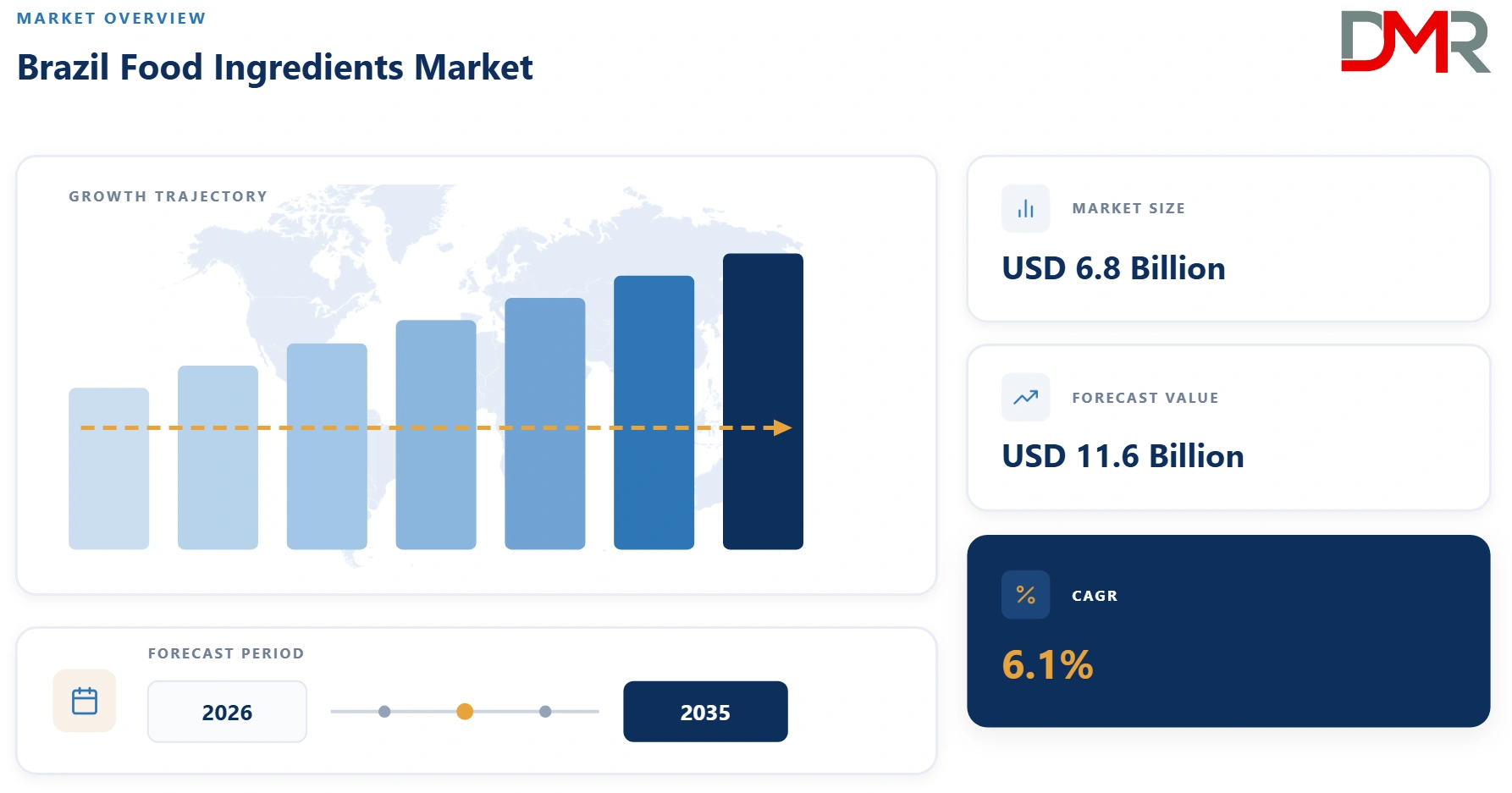
- Brazil Food Ingredients Market Size in 2026: USD 6.8 Billion
- Brazil Food Ingredients Market Size in 2035: USD 11.6 Billion
- Brazil CAGR from 2026 to 2035: 6.1%
- Flavors and Fragrances is the leading ingredient type segment in 2026: 23.6%
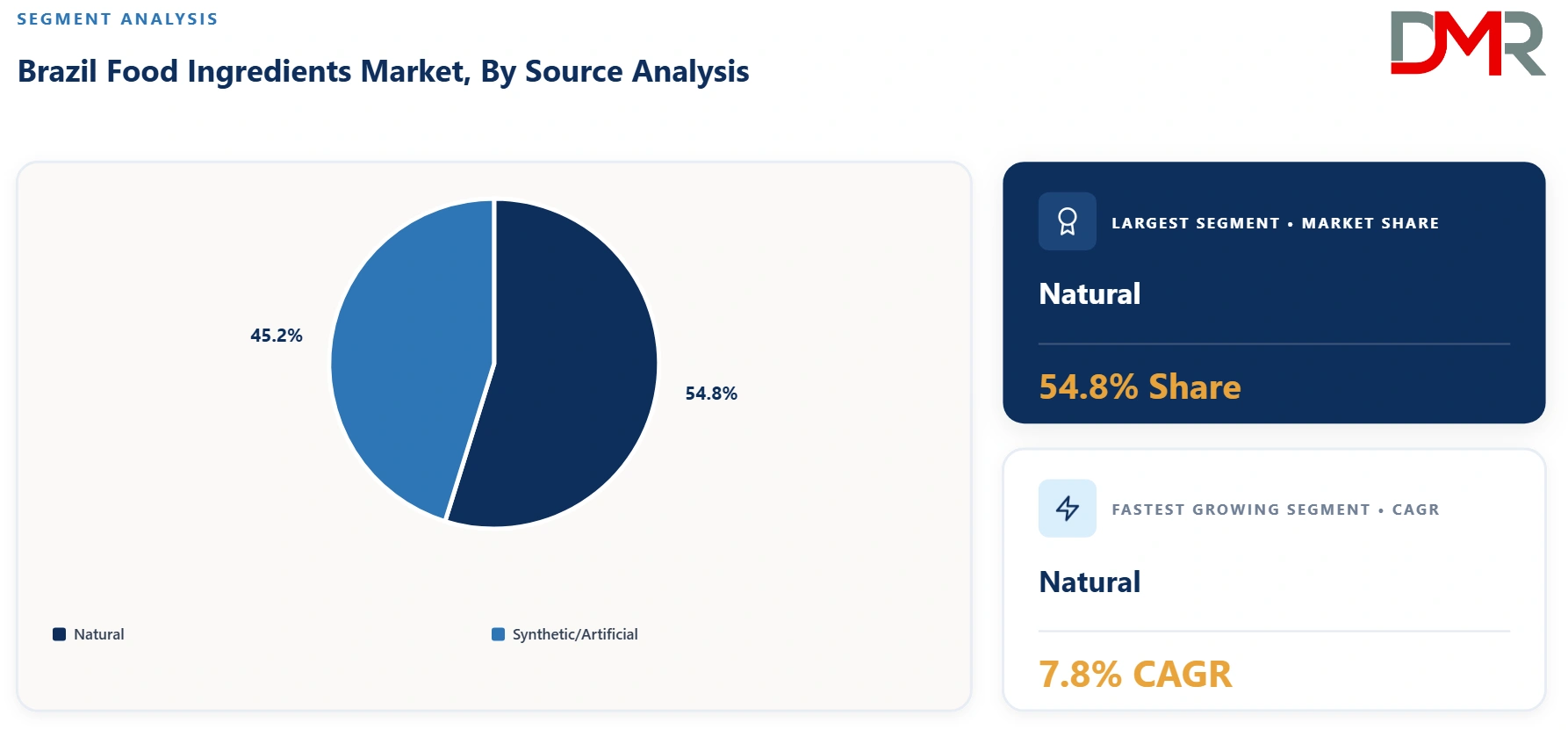
- Natural is the leading source segment in 2026: 54.8%
- Dry is the leading form segment in 2026: 58.9%
- Meat, Poultry and Seafood is the leading application segment in 2026: 24.2%
- Food and Beverage Manufacturers is the leading end user segment in 2026: 76.4%
What is the Brazil Food Ingredients Market and its Market Size?
The Brazil Food Ingredients Market is projected to be valued at USD 6.8 Billion in 2026 and is projected to reach USD 11.6 Billion by 2035, expanding at a CAGR of 6.1% during the forecast period.
ℹ
To learn more about this report –
Download Your Free Sample Report Here
Growth is being propelled by Brazil's position as one of the world's largest agricultural raw material producers, providing abundant domestic sourcing for sugar, soy protein, and other key ingredient inputs, sustained demand for functional ingredients supporting Brazil's substantial and globally significant meat, poultry, and processed food export industries, and continued innovation in natural and plant-based ingredient technologies leveraging the country's exceptional agricultural biodiversity. The maturing of domestic soy and other plant protein fractionation capacity reducing reliance on imported functional protein ingredients, growing food manufacturer investment in natural and clean-label ingredient sourcing aligned with both domestic consumer preferences and international export market requirements, and Brazil's position as a significant natural flavor and colorant source given the country's exceptional tropical fruit and botanical biodiversity are reshaping the market from a primarily commodity raw material supply base into an increasingly value-added, technically sophisticated ingredient manufacturing industry. Investment is accelerating as Brazilian ingredient companies expand natural, functional, and protein ingredient production while serving both substantial domestic food manufacturing demand and growing export opportunities.
Use Cases
- Functional Ingredient Development for Meat and Poultry Export Processing: Brazilian meat and poultry processors, among the world's largest exporters in these categories, rely on functional ingredients including phosphates, marinades, and preservation systems to meet the quality, shelf-life, and food safety requirements of diverse international export markets.
- Soy Protein Ingredient Manufacturing Leveraging Domestic Soybean Production: Brazilian ingredient companies develop soy protein concentrates and isolates leveraging the country's position as one of the world's largest soybean producers, supplying both domestic food manufacturers and growing plant-based protein product development.
- Natural Flavor and Colorant Development from Tropical Fruit and Botanical Sources: Ingredient developers leverage Brazil's exceptional biodiversity and tropical fruit production, including açaí, guaraná, and passion fruit, to develop natural flavor and colorant ingredients serving both domestic beverage and food manufacturers and international export demand for authentic Brazilian botanical ingredients.
- Sugar and Sweetener Ingredient Supply Leveraging Domestic Sugarcane Industry: Food and beverage manufacturers source sugar and sugar-derived sweetener ingredients from Brazil's substantial domestic sugarcane processing industry, one of the largest in the world, supporting both domestic consumption and ingredient export opportunities.
Key Takeaways
- Market Size: The Brazil Food Ingredients Market is anticipated to be valued at USD 6.8 Billion in 2026 and is forecast to reach USD 11.6 Billion by 2035, expanding at a CAGR of 6.1%.
- Growth Outlook: Market expansion is sustained by Brazil's position as a leading global agricultural raw material producer, sustained demand for functional ingredients supporting the country's substantial meat and processed food export industries, and continued innovation in natural ingredient technology leveraging Brazil's exceptional biodiversity.
- Primary Growth Drivers: Brazil's global leadership in soybean, sugar, and tropical fruit production supporting domestic ingredient manufacturing, sustained demand for functional ingredients supporting meat and poultry export processing, growing natural and clean-label ingredient innovation, and expanding plant-based protein ingredient development are accelerating market growth.
- By Ingredient Type Analysis: Flavors and Fragrances is projected to lead the ingredient type segment with a 23.6% share in 2026, reflecting broad application across Brazil's diverse food and beverage manufacturing sector. Proteins is the fastest-growing ingredient type segment at 8.9% CAGR, driven by sustained investment in soy and other plant protein ingredient innovation.
- By Source Analysis: Natural is expected to dominate with a 54.8% share in 2026, reflecting Brazil's exceptional biodiversity supporting natural flavor and colorant ingredient development. Natural is also the fastest-growing source segment at 7.8% CAGR, as clean-label trends and Brazil's natural ingredient sourcing advantages continue driving adoption.
- By Form Analysis: Dry ingredients are poised to lead with a 58.9% share in 2026, supported by favorable shelf stability and distribution logistics economics across Brazil's vast geography. Liquid is the fastest-growing form segment at 7.1% CAGR, driven by rising demand for ready-to-use flavor and functional ingredient systems in beverage manufacturing.
- By Application Analysis: Meat, Poultry and Seafood is expected to command a 24.2% share in 2026, underpinned by Brazil's position as one of the world's largest meat and poultry exporters requiring substantial functional ingredient volumes. Nutritional and Functional Foods is the fastest-growing application segment at 8.9% CAGR, fuelled by rising domestic and export demand for fortified and health-positioned food products.
- By End User Analysis: Food and Beverage Manufacturers are projected to dominate with a 76.4% share in 2026, reflecting their position as the primary purchasers of bulk ingredient volumes. Nutraceutical and Supplement Companies is the fastest-growing end user segment at 9.1% CAGR, driven by expanding functional and fortified nutrition product development.
Key Drivers in the Brazil Food Ingredients Market
Brazil's Global Leadership in Agricultural Raw Material Production
Brazil's position as one of the world's largest producers of soybeans, sugarcane, and numerous tropical fruit and botanical crops provides a structural foundation for domestic food ingredient manufacturing that few other markets can match. This agricultural production strength has attracted significant investment in domestic ingredient processing infrastructure aimed at capturing greater value from raw agricultural production by processing crops into higher-value functional ingredients domestically. This structural agricultural advantage is expected to continue supporting sustained investment in Brazilian food ingredient manufacturing capacity across protein, sweetener, and natural flavor and colorant categories.
Sustained Demand for Functional Ingredients Supporting Meat and Poultry Export Processing
Brazil's position as one of the world's largest beef and poultry exporters generates substantial and sustained demand for the functional ingredients required to meet the quality, shelf-life, and food safety standards of diverse international export markets, including phosphates, marinades, preservation systems, and other processing aids. This export-driven functional ingredient demand provides a durable foundation for Brazil's food ingredients market, as continued growth in Brazil's meat and poultry export volumes translates directly into corresponding functional ingredient consumption growth.
Restraints in the Brazil Food Ingredients Market
Currency Volatility and Import Dependency for Certain Specialty Ingredients
Brazil's exposure to currency volatility, combined with continued import dependency for certain specialty and technically sophisticated ingredients not yet produced at scale domestically, represents a meaningful restraint on the Brazil Food Ingredients Market. Food and beverage manufacturers and ingredient companies must navigate exchange rate fluctuations affecting the cost of imported specialty ingredients and equipment, creating cost management challenges and pricing unpredictability that can complicate long-term ingredient sourcing and formulation planning decisions.
Growth Opportunities in the Brazil Food Ingredients Market
Natural Flavor and Colorant Development from Brazil's Exceptional Biodiversity
Brazil's exceptional agricultural and botanical biodiversity, including tropical fruits, native plants, and other natural sources found in few other global markets, presents a substantial opportunity for ingredient companies to develop distinctive natural flavor and colorant ingredients with strong export market appeal. Companies investing in sustainable sourcing and processing technology for these distinctive Brazilian natural ingredients can capture premium positioning both domestically and among international food and beverage manufacturers seeking authentic, differentiated natural ingredient sourcing.
Plant-Based Protein Ingredient Innovation Leveraging Domestic Soybean Production
Brazil's position as one of the world's largest soybean producers presents a substantial opportunity for ingredient companies to develop advanced soy protein isolate and concentrate ingredients serving both domestic food manufacturing and Brazil's growing plant-based food product development. Companies capable of applying advanced fractionation and functionality-enhancement technology to Brazil's abundant domestic soybean supply can reduce reliance on imported protein ingredients while capturing growing global demand for plant-based protein products.
Trends in the Brazil Food Ingredients Market
Growing Investment in Sustainable and Traceable Ingredient Sourcing
Brazilian food ingredient companies are increasingly investing in sustainable sourcing practices and digital traceability systems, responding to growing international buyer and regulatory scrutiny of Brazilian agricultural supply chain environmental impact, particularly regarding deforestation-free sourcing requirements for soy and other commodity ingredients. This trend reflects the increasing importance of sustainability credentials in maintaining and expanding international market access for Brazilian ingredient exports.
Consolidation and Strategic Partnership Activity Among Brazilian Ingredient Companies
The Brazil Food Ingredients Market is experiencing continued consolidation and strategic partnership activity as larger global ingredient companies acquire or partner with Brazilian domestic ingredient producers to access the country's substantial agricultural raw material base and natural ingredient sourcing capabilities. This activity reflects both the attractiveness of Brazil's agricultural resource base to global ingredient companies and Brazilian domestic producers' interest in accessing broader international distribution networks and technical capabilities.
Research Scope and Analysis
The Brazil Food Ingredients Market is segmented by ingredient type, source, form, application, and end user, covering flavors, sweeteners, emulsifiers, enzymes, proteins, preservatives, colorants, natural and synthetic sourcing, dry and liquid formats, and food and beverage manufacturing, foodservice, and nutraceutical end users.
ℹ
To learn more about this report –
Download Your Free Sample Report Here
By Ingredient Type Analysis
Flavors and Fragrances is projected to dominate the Brazil Food Ingredients Market with 23.6% share in 2026, reflecting broad application across Brazil's diverse food and beverage manufacturing sector, including substantial use of natural flavors derived from the country's tropical fruit production. Proteins is expected to register the highest CAGR of 8.9% during 2026-2035, driven by sustained investment in soy and other plant protein ingredient innovation leveraging Brazil's substantial domestic soybean production base.
By Source Analysis
Natural ingredients are anticipated to dominate the Brazil Food Ingredients Market by source, accounting for 54.8% share in 2026, reflecting Brazil's exceptional biodiversity supporting natural flavor and colorant ingredient development from tropical fruit and botanical sources. Natural is also projected to register the highest CAGR of 7.8% between 2026 and 2035, as continued clean-label trends and Brazil's inherent natural ingredient sourcing advantages continue driving adoption across both domestic and export-oriented food manufacturing.
By Form Analysis
Dry ingredients are projected to dominate the Brazil Food Ingredients Market with an estimated 58.9% share in 2026, supported by favorable shelf stability and distribution logistics economics important given Brazil's vast geographic distances between production and consumption centers. Liquid ingredients are expected to register the fastest CAGR of 7.1% through 2035, driven by growing demand for ready-to-use flavor and functional ingredient systems within beverage manufacturing applications.
By Application Analysis
Meat, Poultry and Seafood is expected to lead the Brazil Food Ingredients Market by application, accounting for 24.2% share in 2026, supported by Brazil's position as one of the world's largest meat and poultry exporters requiring substantial functional ingredient volumes to meet diverse international market quality and safety standards. Nutritional and Functional Foods is projected to achieve the fastest CAGR of 8.9% during 2026-2035, driven by rising domestic and export demand for fortified and health-positioned food and beverage products.
By End User Analysis
Food and Beverage Manufacturers are projected to dominate the Brazil Food Ingredients Market with 76.4% share in 2026, reflecting their position as the primary bulk purchasers of ingredient volumes across all food categories. Nutraceutical and Supplement Companies are expected to register the fastest CAGR of 9.1% through 2035, driven by expanding development of functional and fortified nutrition products leveraging Brazil's natural ingredient sourcing advantages.
The Brazil Food Ingredients Market Report is segmented based on the following:
By Ingredient Type
- Flavors and Fragrances
- Sweeteners
- Emulsifiers
- Enzymes
- Hydrocolloids and Stabilizers
- Proteins
- Preservatives
- Colorants
- Others
By Source
- Natural
- Synthetic/Artificial
By Form
By Application
- Bakery and Confectionery
- Beverages
- Meat, Poultry and Seafood
- Dairy Products
- Sauces, Dressings and Condiments
- Nutritional and Functional Foods
- Others
By End User
- Food and Beverage Manufacturers
- Foodservice Operators
- Nutraceutical and Supplement Companies
Technology Analysis
Technology development is increasingly shaping competitiveness in the Brazil Food Ingredients Market as companies invest in advanced natural extraction technology for tropical fruit and botanical ingredients, soy protein fractionation and functionality-enhancement technology, and digital traceability systems supporting sustainable and deforestation-free sourcing verification. Growing use of AI-assisted formulation modeling is helping ingredient companies develop natural ingredient solutions matching the performance of synthetic alternatives for both domestic and export-oriented food manufacturer customers. Opportunities are expanding for companies developing sustainable extraction technology for Brazil's distinctive natural ingredients, advanced plant protein fractionation capacity, and digital sustainability documentation systems supporting international market access requirements. However, achieving cost-competitive, large-scale commercialization of specialty natural ingredient extraction technology while managing currency volatility and logistics costs across Brazil's vast geography remain ongoing challenges.
Investment and White Space Analysis
Investment opportunities in the Brazil Food Ingredients Market are expanding alongside the country's global leadership in agricultural raw material production, sustained functional ingredient demand supporting meat and poultry export processing, and continued natural ingredient innovation leveraging exceptional biodiversity. Significant white space exists in natural flavor and colorant development from distinctive Brazilian botanical sources, plant-based protein ingredient innovation leveraging domestic soybean production, and sustainable and traceable ingredient sourcing technology supporting international market access. Companies with strong domestic agricultural sourcing relationships, natural ingredient extraction technology, and sustainability certification capability are positioned to capture premium, longer-duration ingredient supply contracts. However, currency volatility and import dependency for certain specialty ingredients, along with logistics costs across Brazil's vast geography, can constrain margins for some domestic ingredient companies.
Competitive Landscape
The Brazil Food Ingredients Market is moderately consolidated and increasingly competitive, comprising large diversified global ingredient companies with substantial Brazilian operations, specialized domestic natural ingredient and protein processors, and companies focused on Brazil's distinctive tropical fruit and botanical ingredient categories. Competition centers on domestic agricultural raw material sourcing relationships, natural ingredient extraction and functionality technology, sustainability and traceability credentials, and export market development capability. Large diversified global companies benefit from broad research and development resources and established international customer relationships, while specialized domestic processors compete on Brazilian agricultural sourcing advantages and deep expertise in the country's distinctive natural ingredient categories. Companies increasingly differentiate through natural ingredient innovation, sustainability certification, and formulation support services rather than commodity ingredient supply alone.
Some of the prominent players in the Brazil Food Ingredients Market are:
- Kerry Group plc
- Cargill Incorporated
- Tate & Lyle plc
- Ingredion Incorporated
- Archer Daniels Midland Company (ADM)
- DSM-Firmenich AG
- Bunge Limited
- Olam Food Ingredients (ofi)
- Sensient Technologies Corporation
- Givaudan SA
- International Flavors & Fragrances Inc. (IFF)
- Symrise AG
- BASF SE
- Novonesis A/S
- AAK AB
- Puratos Group
- Corbion N.V.
- BRF Ingredients
- Döhler GmbH
- Lallemand Inc.
- GNT Group
- Synthite Industries Pvt. Ltd.
- Kemin Industries, Inc.
- Ajinomoto Co., Inc.
- Biorigin
- Duas Rodas Industrial Ltda.
- Vogler Ingredients Ltda.
- Gelnex
- JBS S.A.
- Marfrig Global Foods S.A.
- Minerva S.A.
- Amaggi
- Louis Dreyfus Company
- Raízen S.A.
- Tereos S.A.
- Copersucar S.A.
- Granol S.A.
- Camil Alimentos S.A.
- M. Dias Branco S.A.
- Other Key Players
Recent Developments
- May 2026: International Flavors & Fragrances (IFF) signed a definitive agreement to sell 90% of its Food Ingredients division to funds managed by CVC Capital Partners for USD 4.3 billion. IFF will retain a 10% minority equity interest in the carved-out entity. The transaction is expected to close by the end of Q2 2027, pending standard regulatory clearances.
- February 2026: Brazil’s health authority, ANVISA, officially enacted its Regulatory Agenda 2026–2027, incorporating a comprehensive evaluation process for the quantitative labeling of ingredients, authorized novel components, and novel food safety criteria. This shifts compliance obligations for commercial developers operating across the Brazilian market.
- June 2026: Brazil's National Health Surveillance Agency (ANVISA) officially enacted Normative Instruction No. 452/2026. This major update directly modifies the positive lists of authorized food additives and processing aids across several core sectors, including bakery products, dietary foods, and food supplements.
Report Details
| Report Characteristics |
| Market Size (2026) |
USD 6.8 Bn |
| Forecast Value (2035) |
USD 11.6 Bn |
| CAGR (2026–2035) |
6.1% |
| Historical Data |
2021 – 2025 |
| Forecast Data |
2026 – 2035 |
| Base Year |
2025 |
| Segments Covered |
By Ingredient Type, By Source, By Form, By Application, and By End User |
| Country Coverage |
Brazil |
Frequently Asked Questions
How big is the Brazil Food Ingredients Market?
▾ The Brazil Food Ingredients Market is valued at USD 6.8 Billion in 2026 and is projected to reach USD 11.6 Billion by 2035, reflecting Brazil's global leadership in agricultural raw material production and sustained functional ingredient demand supporting the country's meat and processed food export industries.
What is the CAGR of the Brazil Food Ingredients Market from 2026 to 2035?
▾ The market is projected to expand at a compound annual growth rate (CAGR) of 6.1% between 2026 and 2035, supported by sustained agricultural production strength, functional ingredient demand for export processing, and continued natural ingredient innovation.
What factors are driving the growth of the Brazil Food Ingredients Market?
▾ Growth is driven by Brazil's global leadership in soybean, sugar, and tropical fruit production supporting domestic ingredient manufacturing, sustained demand for functional ingredients supporting meat and poultry export processing, growing natural and clean-label ingredient innovation, and expanding plant-based protein ingredient development.
What are the major trends in the Brazil Food Ingredients Market?
▾ Major trends include growing investment in sustainable and traceable ingredient sourcing, continued consolidation and strategic partnership activity among Brazilian ingredient companies, and rising innovation in natural flavor and colorant development from Brazil's distinctive biodiversity.
Who are the key players in the Brazil Food Ingredients Market?
▾ Key market participants include Ingredion Brazil, Cargill Brazil, ADM Brazil, Kerry Group Brazil, and Duas Rodas Industrial, among other diversified global and specialized domestic Brazilian ingredient companies.
How is the Brazil Food Ingredients Market segmented?
▾ The market is segmented by ingredient type, source, form, application, and end user, with demand analysis concentrated across São Paulo, Minas Gerais, Paraná, and the broader Amazon and Cerrado agricultural regions.