Canada Commercial Insurance Market Snapshot
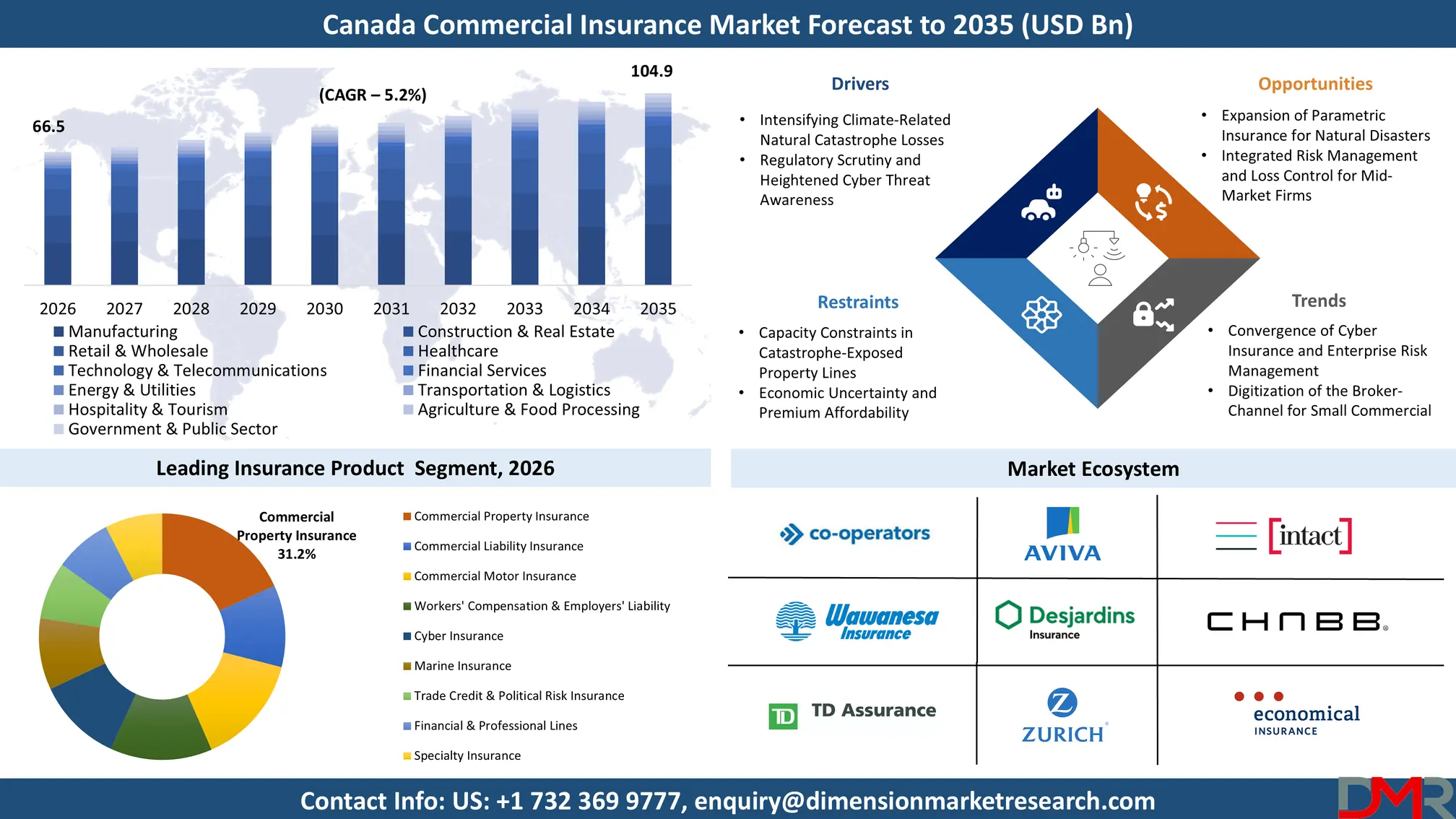
- Canada Commercial Insurance Market Size in 2026: USD 66.5 Billion
- Canada Commercial Insurance Market Size in 2035: USD 104.9 Billion
- Canada CAGR from 2026 to 2035: 5.2%
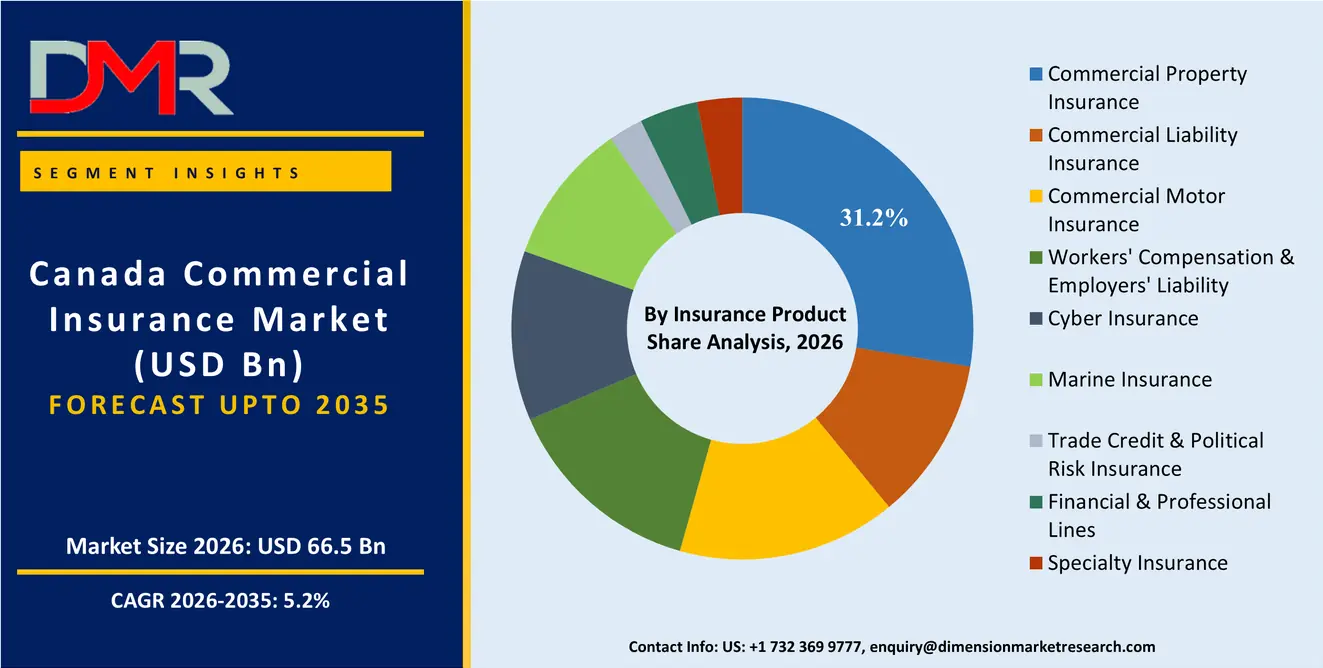
- Commercial Property Insurance is the leading insurance product segment in 2026: 31.2%
- Large Enterprises is the leading business size segment in 2026: 64.3%
- Manufacturing is the leading industry vertical segment in 2026: 24.1%
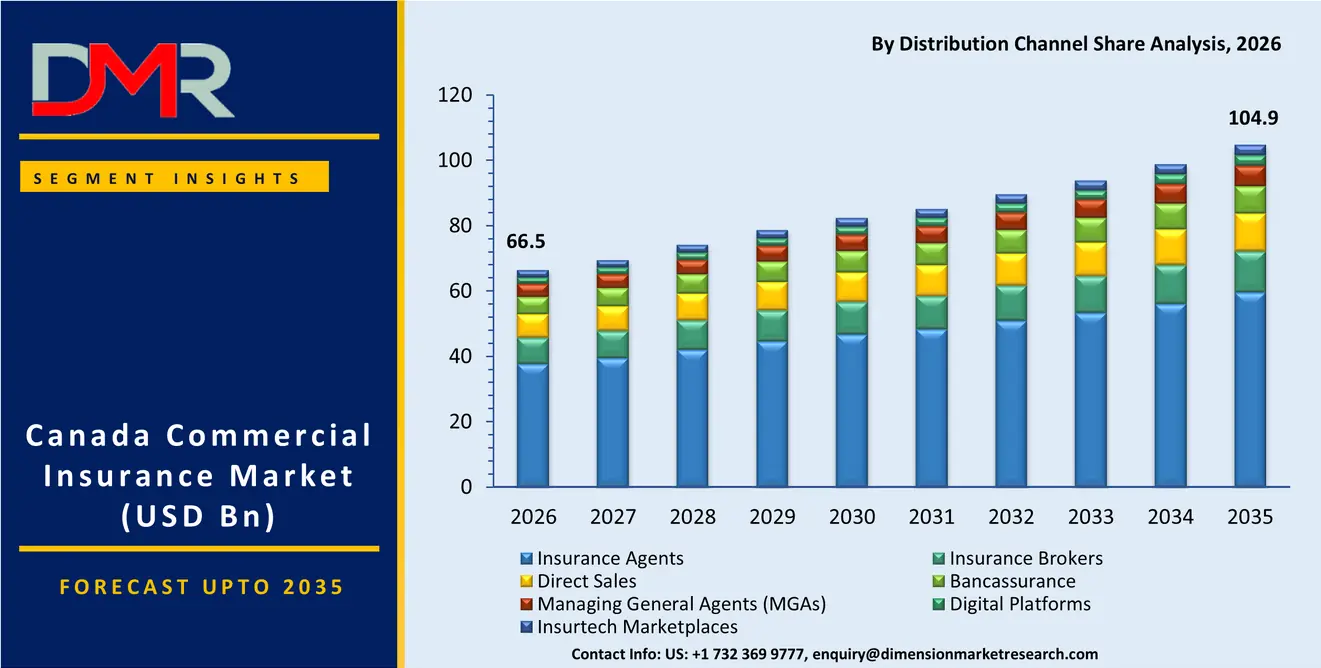
- Insurance Brokers is the leading distribution channel segment in 2026: 61.4%
What is Canada Commercial Insurance and its Market Size?
The Canada Commercial Insurance Market is projected to be valued at USD 66.5 billion in 2026 and is projected to reach USD 104.9 billion by 2035, expanding at a CAGR of 5.2% during the forecast period.
ℹ
To learn more about this report –
Download Your Free Sample Report Here
Growth is being propelled by the escalating severity of NatCat events impacting commercial property exposures, mandatory statutory requirements for workers’ compensation and commercial auto liability, and the complexifying risk landscape tied to digital transformation and supply chain interdependencies. The hardening of premium rates in property and cyber lines, coupled with risk mitigation mandates from lenders and contractual counterparties, is reshaping purchasing behaviors. Investment is accelerating as legacy insurers and InsurTech disruptors pivot from transactional underwriting toward data-driven risk engineering, loss control analytics, and parametric solutions to close the climate and cyber protection gaps for Canadian businesses.
Use Cases
- Safeguarding Manufacturing Assets and Supply Chains: Manufacturers combine property, equipment breakdown, and business interruption insurance to protect facilities, machinery, and revenue against operational disruptions, ensuring faster recovery from equipment failures and supply chain interruptions.
- Cyber Risk Mitigation for Technology Firms: Technology companies deploy cyber insurance covering ransomware, data breaches, incident response, forensic investigations, and third-party liability while strengthening cybersecurity through proactive monitoring and risk management services.
- Construction Project Risk Wrapping: Construction firms utilize wrap-up liability policies covering project owners, contractors, and subcontractors under one program, simplifying claims management and reducing financial exposure from onsite accidents and liabilities.
- Fleet Telematics and Commercial Auto Management: Logistics companies integrate telematics with commercial motor insurance to monitor driving behavior, improve fleet safety, optimize premiums, and reduce accident frequency through usage-based insurance programs.
Key Takeaways
- Market Size: The Canada Commercial Insurance Market is projected to reach USD 66.5 billion in 2026 and USD 104.9 billion by 2035, growing at a 5.2% CAGR, supported by increasing commercial risk exposure and insurance penetration.
- Growth Outlook: Market growth is driven by rising cyber threats, climate-related property losses, regulatory compliance requirements, digital underwriting, and growing demand for comprehensive commercial risk management solutions.
- Primary Growth Drivers: Increasing natural catastrophes, expanding SME insurance adoption, accelerating business digitalization, stricter regulatory standards, and rising demand for cyber, liability, and property insurance continue driving premium growth.
- By Insurance Product Analysis: Commercial Property Insurance leads with a 31.2% market share, while Cyber Insurance records the fastest growth at 8.5% CAGR, driven by increasing property values and cyber risk exposure.
- By Business Size Analysis: Large Enterprises account for 64.3% of the market, whereas Medium Enterprises are expected to register the fastest 7.2% CAGR due to expanding insurance awareness and business growth.
- By Industry Vertical Analysis: Manufacturing dominates with a 24.1% market share, while Technology & Telecommunications records the highest 8.9% CAGR, supported by digital transformation and increasing cyber liability requirements.
- By Distribution Channel Analysis: Insurance Brokers lead with a 61.4% market share, while Digital Platforms and InsurTech Marketplaces register the highest 9.8% CAGR, driven by digital policy distribution and automated underwriting.
How AI/Gen AI is Transforming the Commercial Insurance Market ?
Artificial intelligence and digital technologies are fundamentally reshaping Canadian commercial insurance by enabling predictive risk selection, automated claims adjudication, and dynamic underwriting. Machine learning algorithms trained on satellite imagery and historical weather data can now dynamically underwrite property flood and wildfire risk with granular precision, moving beyond generalized postal-code-based rating. Generative AI is being deployed within broker management systems to analyze complex submission documents, extracting unstructured data from risk engineering reports to summarize exposures for underwriters instantly. On the claims side, AI-powered image recognition assesses commercial auto damage photos in seconds, accelerating repair estimates and reducing loss adjustment expenses. This technological shift is moving the Canadian market from static annual contracts toward continuous risk monitoring and integrated loss prevention ecosystems.
Key Drivers in the Canada Commercial Insurance Market
Intensifying Climate-Related Natural Catastrophe Losses
The escalating frequency and severity of insurable NatCat events spanning Fort McMurray-style wildfires, Calgary hailstorms, and British Columbia atmospheric rivers are fundamentally hardening the Canadian property insurance cycle. Commercial policyholders in high-risk zones face significant premium adjustments and capacity constrictions, driving demand for alternative risk transfer and parametric triggers. This volatile landscape compels insurers to refine their accumulation management and deploy advanced climate modeling, directly fueling the uptake of reinsurance solutions and carving out a premium-rich specialty property segment. The necessity for comprehensive flood and earthquake coverage is restructuring the asset protection strategies of Canadian manufacturers and real estate investment trusts.
Regulatory Scrutiny and Heightened Cyber Threat Awareness
The mandatory breach notification regime under the Personal Information Protection and Electronic Documents Act (PIPEDA) and the critical infrastructure operational technology vulnerabilities have thrust cyber insurance from a niche purchase to a boardroom necessity. High-profile ransomware attacks targeting Canadian energy infrastructure and healthcare conglomerates have demonstrated the systemic correlation between digital perils and business interruption. Regulatory pressure from the Office of the Superintendent of Financial Institutions (OSFI) on operational resilience further mandates robust incident response capabilities. This environment sustains a hard cyber market, driving double-digit premium growth as insurers mandate multi-factor authentication and endpoint detection as preconditions for quoting.
Restraints in the Canada Commercial Insurance Market
Capacity Constraints in Catastrophe-Exposed Property Lines
Despite a growing demand for comprehensive all-risks commercial property coverage, insurers and global reinsurers are restricting capacity deployment in wildfire-urban interface zones and earthquake-prone regions like British Columbia. Strict underwriting discipline and withdrawal from highly exposed areas limit insurance availability and affordability for essential industries such as forestry, remote hospitality, and resource extraction. This capital constriction forces some commercial policyholders into the residual market or necessitates significantly higher deductibles and self-insured retentions, limiting total addressable premiums for standard admitted carriers.
Economic Uncertainty and Premium Affordability
Persistent inflationary pressures and the Bank of Canada’s monetary policy impact on borrowing costs create significant balance sheet strain for small and medium enterprises. When faced with soaring operational costs, business owners often view sophisticated optional coverages such as cyber insurance or directors’ and officers’ liability as discretionary expenses rather than critical risk transfer tools. This affordability barrier can lead to underinsurance, where firms inadvertently retain substantial legal and operational exposures, ultimately capping market penetration growth in non-mandatory commercial lines despite the evolving threat landscape.
Growth Opportunities in the Canada Commercial Insurance Market
Expansion of Parametric Insurance for Natural Disasters
A transformative opportunity lies in bridging the protection gap for Canadian businesses through parametric insurance products designed for extreme weather and seismic events. Unlike traditional indemnity contracts that adjust physical damage, parametric solutions trigger an instant predefined payout when objective third-party data parameters (e.g., specific earthquake magnitude at a mining site or millimeter rainfall threshold for a construction project) are met. This innovation addresses the liquidity crunch enterprises face during the days waiting for a claims adjuster, offering immediate funds for debris removal and payroll. Brokers and InsurTech platforms that integrate parametric riders with traditional property damage policies will unlock high-value commercial real estate, agriculture, and public sector verticals seeking certainty in a volatile climate.
Integrated Risk Management and Loss Control for Mid-Market Firms
The medium enterprise segment presents a massive growth runway for carriers moving beyond pure premium collection toward risk advisory partnerships. By bundling sophisticated IoT sensor networks monitoring water leaks, equipment vibration, and fire panel status into insurance contracts, providers can offer premium discounts linked to real-time risk mitigation. This value-added approach reduces loss ratios for the carrier while lowering the total cost of risk for the policyholder. Insurers that successfully monetize risk engineering platforms for construction and manufacturing verticals can capture dominant market share in the fastest-growing business-size segment.
Trends in the Canada Commercial Insurance Market
Convergence of Cyber Insurance and Enterprise Risk Management
A defining trend is the dissolution of silos between IT security and corporate insurance procurement. The application process for cyber insurance has evolved into a de facto security audit, where obtaining coverage is contingent upon passing strict hygiene checks on privileged access management and off-site backups. Canadian carriers are now bundling pre-breach vendor panels and incident response tabletop exercises directly into the policy offering. This convergence transforms the insurer from a passive payer of ransomware extortion demands into an active resilience partner, a significant shift in enterprise-level commercial lines service delivery.
Digitization of the Broker-Channel for Small Commercial
While complex large enterprise placements remain highly intermediated, the “digital intermediary” model is disrupting how micro and small business insurance is distributed. Rather than a disintermediation threat, AI-driven marketplaces and quote-comparison tools are empowering Canadian brokers to instantly bind off-the-shelf business owner’s policies. This trend automates the low-margin administrative friction in placing small commercial packages, freeing brokers to focus on complex intangibles risk and advisory. The integration of API connectivity between major carriers and broker management systems signals a permanent shift toward fluid digital distribution complementing, rather than replacing, professional advice.
Research Scope and Analysis
The Canada Commercial Insurance Market is segmented by insurance product, business size, distribution channel, and industry vertical. Products span property, liability, motor, cyber, marine, credit, financial lines, and specialty coverages. Distribution includes agents, brokers, direct, bancassurance, MGAs, and digital platforms. Industry verticals cover manufacturing, construction, technology, healthcare, and other key sectors.
ℹ
To learn more about this report –
Download Your Free Sample Report Here
By Insurance Product Analysis
Commercial Property Insurance is the projected to be the leading insurance product segment in the Canada Commercial Insurance Market, accounting for 31.2% of the market in 2026. The segment benefits from strong demand for coverage of commercial buildings, industrial facilities, inventory, equipment, and business interruption risks across manufacturing, retail, and commercial real estate sectors. Increasing replacement costs, climate-related property losses, and stricter lender requirements continue to support market leadership. Meanwhile, Cyber Insurance is projected to register the highest CAGR of 8.5% through 2035, driven by rising ransomware attacks, data privacy regulations, and growing cyber risk awareness among Canadian businesses.
By Business Size Analysis
Large Enterprises is expected to be the dominate the business size segment, representing 64.3% of the Canada Commercial Insurance Market in 2026. Large corporations maintain extensive physical assets, nationwide operations, complex supply chains, and higher liability exposures, driving demand for comprehensive multi-line insurance programs. Their insurance portfolios typically include property, liability, cyber, marine, and specialty coverages. Meanwhile, Medium Enterprises are expected to witness the highest CAGR of 7.2% through 2035, supported by business expansion, increasing regulatory compliance, and rising adoption of digital commercial insurance solutions.
By Industry Vertical Analysis
Manufacturing is anticipated to hold the largest share of the Canada Commercial Insurance Market, accounting for 24.1% in 2026. The sector requires broad insurance protection for production facilities, machinery, inventories, employee safety, product liability, and supply chain risks. Canada's strong industrial base and export-oriented manufacturing activities continue to sustain demand for commercial insurance. Meanwhile, Technology & Telecommunications is anticipated to record the highest CAGR of 8.9% through 2035, fueled by increasing cyber risks, digital transformation, cloud adoption, and expanding professional liability requirements.
By Distribution Channel Analysis
Insurance Brokers is expected to dominate the distribution channel segment, accounting for 61.4% of the Canada Commercial Insurance Market in 2026. Canadian businesses, particularly SMEs and large enterprises, rely heavily on brokers for independent advice, customized policy placement, and claims support across multiple insurers. The complexity of commercial risks continues to reinforce broker dominance.
ℹ
To learn more about this report –
Download Your Free Sample Report Here
Meanwhile, Digital Platforms are expected to register the highest CAGR of 9.8% through 2035, driven by digital policy issuance, AI-enabled underwriting, online comparison tools, and growing adoption of insurtech solutions by small and medium-sized businesses.
The Canada Commercial Insurance Market Report is segmented based on the following:
By Insurance Product
- Commercial Property Insurance
- Buildings
- Equipment & Machinery
- Inventory
- Business Interruption
- Commercial Liability Insurance
- General Liability
- Product Liability
- Professional Indemnity
- Directors & Officers (D&O)
- Commercial Motor Insurance
- Fleet Insurance
- Commercial Auto Liability
- Workers' Compensation & Employers' Liability
- Cyber Insurance
- Cyber Liability
- Data Breach & Incident Response
- Marine Insurance
- Marine Cargo
- Inland Transit
- Trade Credit & Political Risk Insurance
- Financial & Professional Lines
- Specialty Insurance
- Aviation
- Energy
- Construction
- Agriculture
- Environmental
- Surety
By Business Size
- Micro Enterprises
- Small Enterprises
- Medium Enterprises
- Large Enterprises
- Multinational Corporations
By Distribution Channel
- Insurance Agents
- Insurance Brokers
- Direct Sales
- Bancassurance
- Managing General Agents (MGAs)
- Digital Platforms
- Insurtech Marketplaces
By Industry Vertical
- Manufacturing
- Construction & Real Estate
- Retail & Wholesale
- Healthcare
- Technology & Telecommunications
- Financial Services
- Energy & Utilities
- Transportation & Logistics
- Hospitality & Tourism
- Agriculture & Food Processing
- Government & Public Sector
Regulatory Landscape
Canada's commercial insurance market is regulated by the Office of the Superintendent of Financial Institutions (OSFI) for federally regulated insurers, while provincial regulators oversee market conduct and licensing. OSFI's Life Insurance Capital Adequacy Test (LICAT) and Minimum Capital Test (MCT) establish risk-based capital requirements, ensuring insurers maintain adequate solvency for underwriting commercial property, liability, cyber, and specialty risks. In addition, evolving cybersecurity, climate-risk disclosure, and operational resilience guidelines are encouraging insurers to strengthen enterprise risk management, catastrophe modeling, and digital risk assessment capabilities.
White Space Analysis
A significant growth opportunity exists in the underinsured SME segment, particularly among micro and small businesses that remain inadequately protected against cyberattacks, business interruption, professional liability, and climate-related losses. Many SMEs still rely on basic insurance packages despite increasing operational risks. Expanding embedded insurance, AI-enabled underwriting, digital distribution platforms, and industry-specific insurance solutions presents insurers with an opportunity to improve penetration and address Canada's widening commercial protection gap.
Competitive Landscape
The Canada Commercial Insurance Market is highly competitive, led by domestic insurers, global insurance carriers, international reinsurers, and commercial insurance brokers. Intact Financial Corporation, Aviva Canada, Zurich Insurance Group, Chubb, AIG, and Travelers maintain strong positions through broad commercial product portfolios, risk engineering services, and nationwide broker networks. Digital underwriting, cyber insurance capabilities, climate risk analytics, and strategic partnerships with brokers and insurtech firms continue to shape competitive differentiation.
Some of the prominent players in the Canada Commercial Insurance Market are:
- Intact Financial Corporation
- Aviva Canada
- Northbridge Financial Corporation
- Travelers Canada
- Zurich Canada
- Chubb Insurance Company of Canada
- CNA Canada
- AIG Canada
- AXA XL
- Liberty Mutual Canada
- Wawanesa Insurance
- Co-operators General Insurance Company
- Definity Financial Corporation
- Economical Insurance
- Gore Mutual Insurance Company
- CAA Insurance Company
- SGI Canada
- Peace Hills Insurance
- Tokio Marine Canada
- Everest Insurance Canada
- Swiss Re Corporate Solutions
- FM Insurance Company
- Munich Re Specialty Insurance
- HDI Global SE Canada
- Berkshire Hathaway Specialty Insurance
- Markel Canada Limited
- Victor Canada
- Echelon Insurance
- Trisura Guarantee Insurance Company
- Ecclesiastical Insurance
- Allianz Global Corporate and Specialty (AGCS)
- Lloyd's Canada
- RSA Canada
- Western Financial Group
- Totten Insurance Group
- CapriCMW Insurance Services
- BFL CANADA
- HUB International Canada
- Acera Insurance
- Gallagher Canada
- Other Key Players
Recent Developments
- May 2026: Allianz Commercial announced a strategic partnership with Coalition to transition its commercial cyber insurance business, strengthening its cyber risk protection capabilities for business customers.
- May 2026: Probitas Canada, part of Aviva plc, integrated the Canadian team of Volante Global to strengthen underwriting capabilities in Canada, expanding expertise across professional lines, construction, auto, casualty, cyber, and property insurance segments.
- May 2026: Zurich Insurance Group reported that its Commercial Insurance gross written premiums increased by 9% in Q1 2026, driven by strong performance in Canada Specialty and Middle Market businesses.
Report Details
| Report Characteristics |
| Market Size (2026) |
USD 66.5 Bn |
| Forecast Value (2035) |
USD 104.9 Bn |
| CAGR (2026–2035) |
5.2% |
| Historical Data |
2021 – 2025 |
| Forecast Data |
2027 – 2035 |
| Base Year |
2025 |
| Estimate Year |
2026 |
| Segments Covered |
By Insurance Product, By Business Size, By Distribution Channel, and By Industry Vertical |
| Country Coverage |
Canada |
Frequently Asked Questions
How big is the Canada Commercial Insurance Market?
▾ The Canada Commercial Insurance Market is projected to be valued at approximately USD 66.5 billion in 2026 and is projected to reach USD 104.9 billion by 2035, growing at a CAGR of 5.2%.
What is the CAGR of the Canada Commercial Insurance Market from 2026 to 2035?
▾ The market is expected to expand at a CAGR of 5.2% during the forecast period, driven by increasing cyber risks, climate-related insurance demand, regulatory compliance, and digital transformation.
What factors are driving the growth of the Canada Commercial Insurance Market?
▾ Key growth drivers include rising cyberattacks, increasing natural catastrophe losses, growing SME insurance adoption, stricter regulatory requirements, expanding commercial property values, and digital insurance innovation.
What are the major trends in the Canada Commercial Insurance Market?
▾ Major trends include AI-powered underwriting, digital commercial insurance platforms, embedded insurance, parametric insurance solutions, climate risk modeling, and increasing adoption of cyber insurance.
Who are the key players in the Canada Commercial Insurance Market?
▾ Major companies include Intact Financial Corporation, Aviva Canada, Zurich Insurance Group, Chubb Limited, AIG, Travelers, Allianz SE, AXA SA, Marsh McLennan, Aon plc, WTW, Liberty Mutual, Munich Re, Swiss Re, Tokio Marine, Sompo Holdings, Fairfax Financial Holdings, FM Global, and Berkshire Hathaway Specialty Insurance.