Market Overview
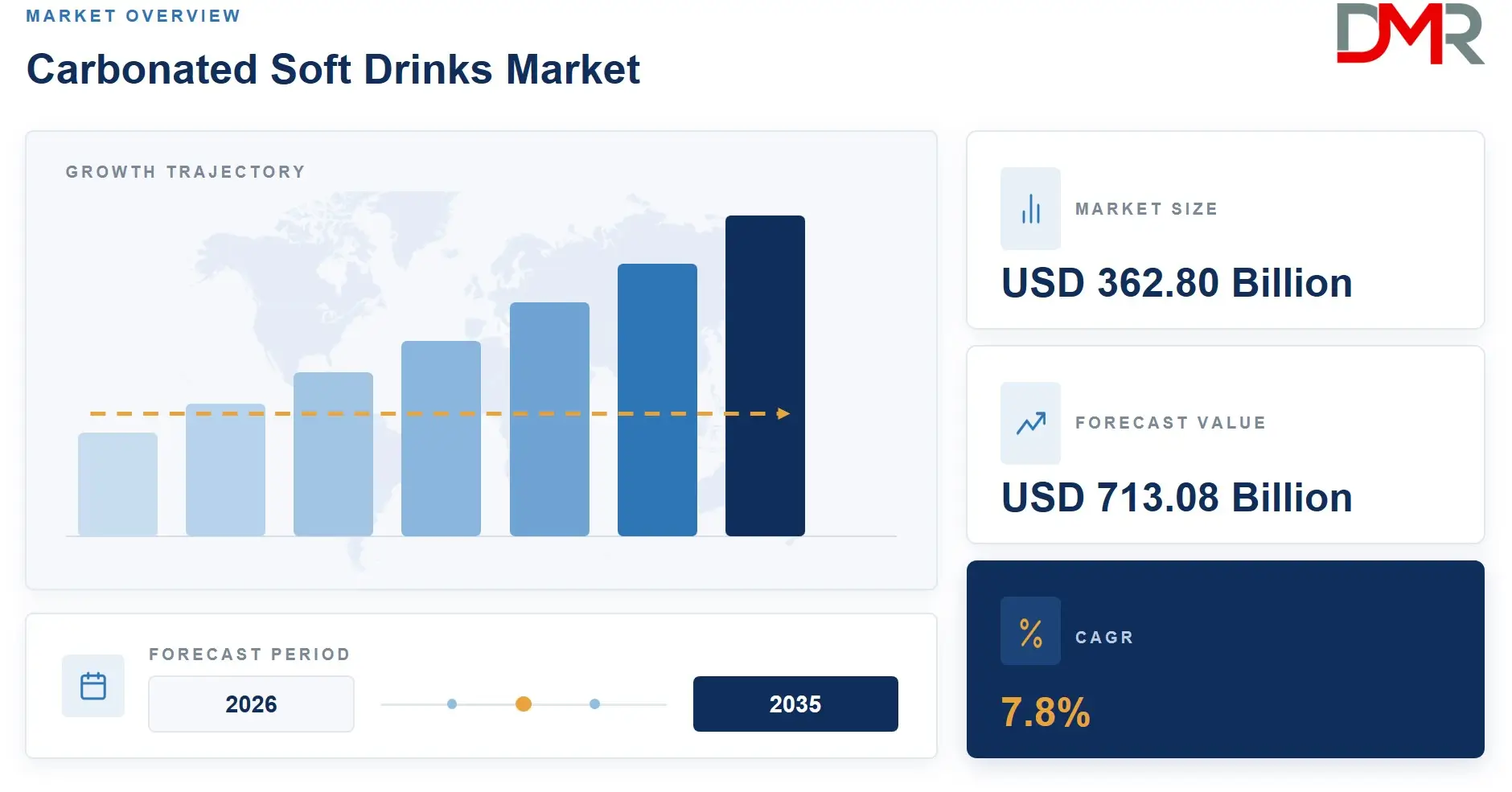
The Global Carbonated Soft Drinks Market size is estimated at USD 362.80 Billion in 2026, and is projected to reach USD 713.08 Billion by 2035, exhibiting a CAGR of 7.8% during the forecast period.
Coca-Cola's investor filings confirm that global sparkling-soft-drink unit-case volume grew 2% year over year in the first quarter of 2026, signaling that category-wide demand has stabilized after a softening period in mid-2025. Manufacturers who adjusted their portfolio mix toward zero-sugar and premium formats during that softer period are now capturing the recovery disproportionately. Post-SMED implementation, one studied carbonated-beverage bottling line stabilized average setup time at 21.988 minutes, illustrating how operational discipline is compressing the cost-per-unit gap between large and mid-scale bottlers.
In February 2026, The Coca-Cola Company launched Coca-Cola Cherry Float and Diet Coke Cherry across North America, reflecting how limited-edition SKU strategies are accelerating consumer trial and driving incremental volume beyond core cola formats. Beverage Processing Equipment sits at the intersection of this capacity story, as bottler capital expenditure on modern filling and packaging lines directly enables the speed-to-shelf agility that the current innovation cadence demands.
ℹ
To learn more about this report –
Download Your Free Sample Report Here
Key Takeaways
- The market size is USD 362.80 Billion in 2026, and is projected to hit USD 713.08 Billion by 2035 at a CAGR of 7.8%.
- By Product Type: Regular Carbonated Soft Drinks led with a 58.10% share in 2026.
- By Flavor: Cola led with a 48.20% share in 2026.
- By Packaging Type: PET Bottles led with a 56.10% share in 2026.
- By Distribution Channel: Retail led with a 68.30% share in 2026.
- By Region: North America led with a 39.20% share in 2026.
- Top 5 key players: The Coca-Cola Company, PepsiCo Inc., Keurig Dr Pepper Inc., Monster Beverage Corporation, Suntory Beverage and Food Limited.
Product Type Analysis
Regular Carbonated Soft Drinks led the product type segment with a 58.10% share in 2026.
Regular CSD retains its dominant position because cola and citrus formats remain deeply embedded in foodservice menus and household consumption routines across price-sensitive emerging markets. Coca-Cola investor filings report that Coca-Cola Zero Sugar unit-case volume rose 13% globally in the first quarter of 2026, while Diet Coke and Coca-Cola Light posted a 6% gain over the same period. Food and Beverage Contract Manufacturing capacity is expanding in parallel, as co-manufacturers add zero-sugar-compatible production lines to serve smaller challenger brands that cannot justify dedicated assets.
Zero-Sugar Carbonated Soft Drinks are the fastest-growing sub-segment, driven by sweetener blending advances that have resolved the aftertaste barriers that historically suppressed trial among non-diet drinkers. Diet variants follow closely, supported by brand loyalty among older consumer cohorts. Functional CSDs represent the smallest share today but command the highest price premiums, attracting investment from both incumbent majors and venture-backed startups targeting health-seeking consumers who refuse to fully leave the carbonated format.
.webp)
ℹ
To learn more about this report –
Download Your Free Sample Report Here
Flavor Analysis
Cola accounted for 48.20% of flavor demand in 2026, the highest of any category.
Cola's near-half share reflects decades of brand infrastructure, including franchise bottler networks, marketing budgets, and retail shelf dominance that challenger flavors cannot replicate quickly. Coca-Cola investor data shows that sparkling-flavor unit-case volume grew 3% globally in Q1 2026, pointing to an accelerating consumer shift toward non-cola varieties that is gradually compressing cola's structural lead.
Lemon and lime is the fastest-growing flavor category, benefiting from its natural association with mixer occasions, health positioning, and a platform for zero-sugar reformulation. Berry variants are capturing interest from Gen Z consumers driven by social media virality, while other flavors including tropical, cherry, and botanical blends are gaining incremental distribution through limited-edition strategies that test demand before permanent ranging decisions.
Packaging Type Analysis
PET Bottles captured 56.10% of the packaging type segment in 2026, ahead of all rivals.
PET dominates because its light weight, reseal functionality, and established cold-chain compatibility make it the default format across both retail and foodservice. Sidel's 2025 EvoFILL Can Compact specifications show a filling accuracy of ±1 milliliter standard deviation for formats up to 500 milliliters, and automated height adjustment enables changeovers in less than 25 minutes. Food Packaging innovation is reshaping the economics of the can segment specifically, as precision-fill technology reduces product giveaway and changeover downtime simultaneously.
Cans are the fastest-growing packaging sub-segment, supported by sustainability preferences among younger consumers and the format's premium perception in on-premise and convenience settings. Sidel's EvoFILL Can Compact is rated for production speeds of up to 40,000 cans per hour, a capacity threshold that makes the format viable for mid-scale regional bottlers who previously viewed canning as a large-scale-only investment. Other packaging types, including glass and refillable formats, remain niche but are gaining traction in premium and environmentally regulated markets.
Distribution Channel Analysis
With a 68.30% share in 2026, Retail outpaced all other distribution channel categories.
Retail's dominance reflects CSD's status as a planned-purchase category in grocery, hypermarket, and convenience formats, where shelf visibility, promotional pricing, and multi-pack formats drive volume. Quick Commerce is reshaping the channel calculus at the margin, as sub-30-minute delivery platforms extend impulse purchase behavior from in-store to at-home occasions, particularly in dense urban markets across South Asia and Southeast Asia.
Foodservice is the fastest-growing distribution channel, driven by QSR expansion in Africa and South Asia where branded fountain CSD penetration is still relatively underdeveloped. Fountain contracts between major QSR chains and incumbent bottlers create high-value, long-duration supply relationships that smaller brands struggle to access. Private label CSD development for discount retail is also gaining share as value-seeking consumers trade down under sustained inflationary pressure.
Key Market Segments
By Product Type
- Regular Carbonated Soft Drinks
- Diet Carbonated Soft Drinks
- Zero-Sugar Carbonated Soft Drinks
- Functional Carbonated Soft Drinks
By Flavor
- Cola
- Lemon and Lime
- Berry
- Other Flavors
By Packaging Type
- PET Bottles
- Cans
- Other Packaging Types
By Distribution Channel
Regional Analysis
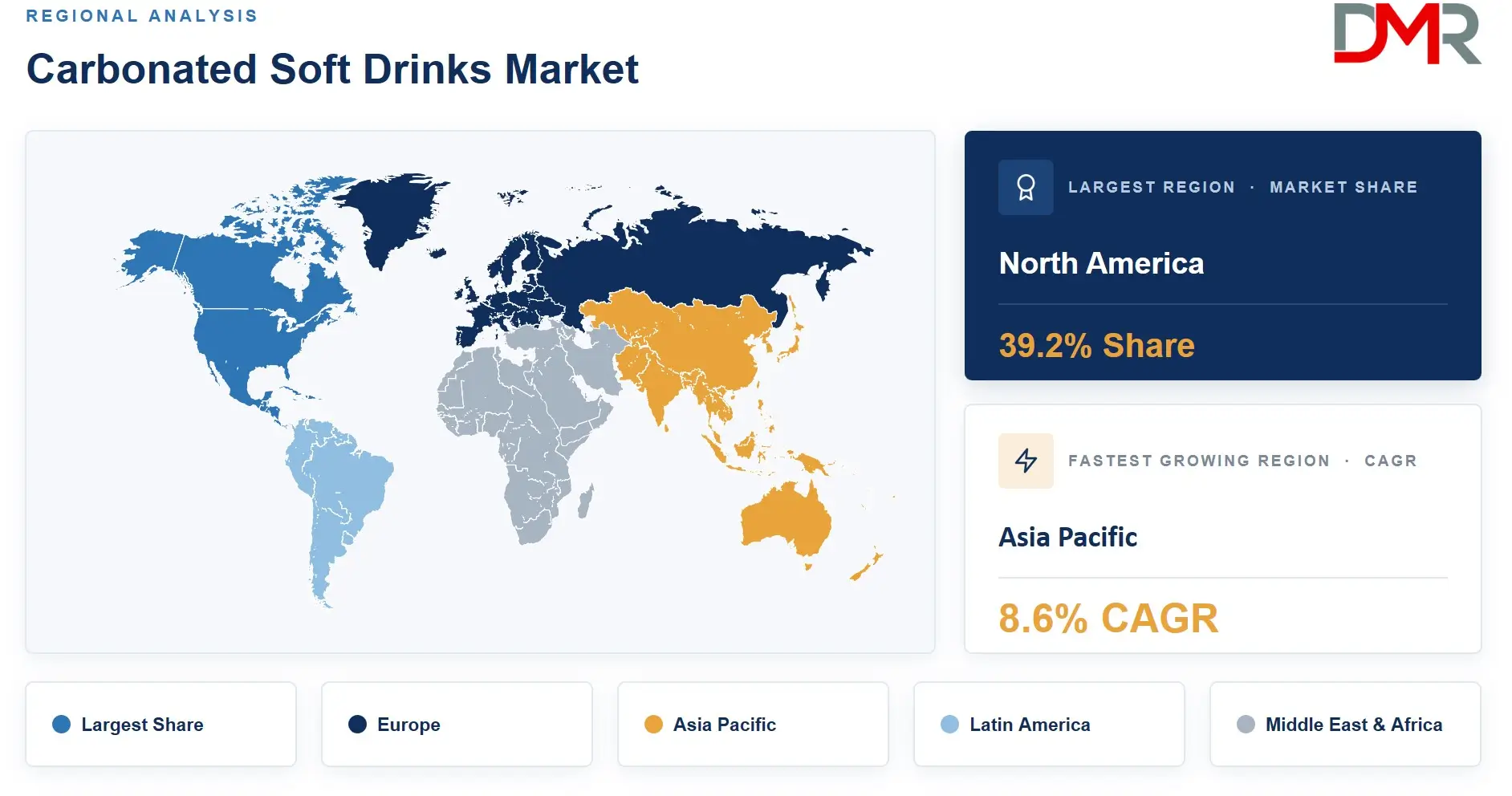
North America led the carbonated soft drinks market with a 39.20% share, valued at USD 142.22 Billion, in 2026.
North America
North America's lead position reflects per-capita consumption rates that remain among the highest globally, anchored by deeply entrenched cola consumption habits, extensive cold-chain infrastructure, and fountain CSD integration across QSR chains. Full-year 2025 Coca-Cola EMEA data points to 2% Trademark Coca-Cola volume growth and 3% sparkling-flavor growth, a contrast that highlights how EMEA is recovering while North America sustains baseline volume through product diversification rather than category expansion.
Asia Pacific
Asia Pacific is the fastest-growing region, driven by youth-skewed demographics, rising disposable incomes, and cold chain expansion across secondary cities in India, Vietnam, and Indonesia. Krones reported that Watercom's CSD line in Tanzania began operations at 82,500 bottles per hour for 300-milliliter bottles in May 2025. While that installation is in Africa, it reflects the broader investment logic playing out across high-growth markets where greenfield bottling capacity is being built ahead of demand rather than in response to it.
ℹ
To learn more about this report –
Download Your Free Sample Report Here
Key Regions and Countries
North America
Europe
- Germany
- France
- The UK
- Spain
- Italy
- Rest of Europe
Asia Pacific
- China
- Japan
- South Korea
- India
- Australia
- Rest of APAC
Latin America
- Brazil
- Mexico
- Rest of Latin America
Middle East & Africa
- GCC
- South Africa
- Rest of MEA
Macroeconomic Impact
Inflationary pressure across Western markets has split the CSD consumer base between premium-seeking and value-seeking segments simultaneously. Consumers with stable disposable income are trading into craft, functional, and botanical CSDs that carry 2–4x price premiums over legacy cola formats. Consumers under financial strain are migrating toward private-label alternatives, compressing branded volume at the mid-tier.
Sustainability-related capital expenditure is an emerging macroeconomic cost factor for bottlers. Sidel data shows that Coca-Cola FEMSA's 2025 Super Combi installation cut water consumption per cleaning cycle by 15%, illustrating how green capex is beginning to translate into measurable operating cost reductions that offset the upfront investment burden.
Market Dynamics
Driver: Reformulation Velocity and Portfolio Proliferation Expand Consumption Occasions
Advances in high-intensity sweetener blending have resolved historical aftertaste barriers, allowing PepsiCo and Coca-Cola to reformulate zero-sugar variants that convert former diet-skeptic consumers. In May 2025, PepsiCo finalized its acquisition of Poppi for USD 1.65 Billion, accelerating its repositioning toward the functional and prebiotic CSD space that commands a structural price premium over conventional cola formats.
On the production side, a 2026 carbonated-beverage bottling case study found that SMED implementation reduced average format-change downtime by 84.6%, from 136 minutes to 21 minutes. A studied bottling line's theoretical weekly capacity increased by 2.64%, from 13,500 to 13,856 unit cases, confirming that manufacturing agility is now a direct enabler of SKU proliferation at commercial scale. Process efficiency on the same line improved from 93.47% to 96.61%, a 3.4 percentage-point gain that directly compresses cost per unit across an expanded product range. Food Ingredients suppliers are responding in parallel, with sweetener and botanical extract manufacturers expanding contract supply to beverage companies reformulating legacy recipes.
Restraint: Sugar Tax Legislation and Structural Volume Decline in Western Markets
Sugar and sweetened-beverage excise taxes in the UK, Mexico, South Africa, and several Southeast Asian markets are compressing manufacturer margins at the point of production. Coca-Cola's Q2 2025 filings confirm that global sparkling-soft-drink unit-case volume declined 1% year over year in that period, with sparkling flavors contracting 2%. Health-conscious Millennial consumers in Western markets are substituting CSDs with functional waters, kombucha, and RTD adaptogen beverages at a structural level rather than a cyclical one.
Sidel specifications show that EvoFILL Can Compact limits CO2 losses to no more than 0.2 volume during ambient-temperature filling. A 2025 peer-reviewed packaging study found that replacing virgin bottles and shrink film with recycled materials reduced modeled harm to human health and ecosystems by more than 80% and resource impacts by more than 90%. Regulatory tightening around packaging waste in the EU and UK is converting sustainability investment from a reputational play into a compliance requirement that smaller bottlers without capital may struggle to meet.
Opportunity: Functional CSD and Sustainable Packaging Open New Value Pools
Prebiotic, electrolyte-fortified, and nootropic CSD variants are capturing health-seeking consumers unwilling to exit the carbonated format entirely. Coca-Cola FEMSA's 2025 CSD installation reported CO2 savings of 14% during production, 27% during startup, and 48% during end-of-production. Super Combi integration of five process units reduces equipment footprint by up to 30% versus standalone machinery, enabling bottlers to build functional CSD capacity without proportional floor-space investment.
Monthly output on one studied bottling line increased by approximately 1,400 unit cases of the 3,030-milliliter format after SMED implementation, demonstrating that operational upgrades — not just greenfield construction — can unlock volume headroom for new SKU introductions. On-premise and fountain channel expansion across Africa and South Asia represents a second high-value opportunity, particularly where branded CSD penetration remains limited and QSR growth is structural rather than cyclical.
Porter's Five Forces
The competitive structure of the global CSD market is defined by high rivalry at the top, moderate new-entrant threat at the premium periphery, and asymmetric supplier and buyer dynamics. Coca-Cola and PepsiCo's franchise bottler networks create distribution barriers that make national-scale entry prohibitively expensive for challengers. Supplier power is moderate overall, but precision-fill equipment manufacturers like Sidel hold meaningful leverage, as process effectiveness on studied bottling lines rose from 92.82% to 96.28%, a 3.7 percentage-point gain that few bottlers can replicate without vendor-specific technology. Buyer power is bifurcating, with QSR chains and grocery retailers extracting volume commitments and promotional support from incumbents, while direct-to-consumer and e-commerce channels give smaller brands a bypass route. Substitutes from functional waters, kombucha, and RTD adaptogen beverages are a credible and growing threat in Western markets, though they lack the price accessibility and distribution depth to displace mainstream CSD at scale in emerging economies. Barriers to new entrants are high at the mass-market tier but selectively permeable in the premium and functional sub-segments where smaller capital bases suffice.
AI and Gen AI Impact
Artificial intelligence is reshaping the CSD value chain at two primary nodes: demand forecasting and manufacturing quality control. AI-driven demand sensing tools allow major bottlers to reduce overproduction of seasonal SKUs, directly lowering waste and cold-chain costs. Generative AI is accelerating flavor ideation, compressing the period from consumer trend signal to formulation prototype from months to weeks, which matters acutely in a market where social-media-driven flavor virality on platforms like TikTok is shortening trend-to-shelf timelines.
On the production floor, AI-enabled vision systems are reducing defect rates in filling and packaging. Sidel's 2025 EvoFILL Can Compact limits product losses to less than 0.1%, a performance threshold that AI quality inspection systems help sustain consistently across high-speed lines without proportional human inspection labor. Bottlers who embed AI in quality control gain a cost advantage that compounds at scale, while laggards absorb avoidable giveaway losses on every high-volume run.
Market Trends
Sustainability and Precision Manufacturing Reshape Bottler Economics
Sidel's EvoFILL Can Compact delivers a stated monoblock efficiency of 98.5%, setting a new operational benchmark that is pulling mid-scale bottlers toward can format investment. Coca-Cola FEMSA's Super Combi line uses preforms made from 100% recycled PET, converting a compliance-driven sustainability requirement into a supply chain design principle. Early movers who align capital expenditure with both precision filling and recycled material sourcing are building a cost and regulatory compliance advantage that will compound as packaging legislation tightens across the EU, UK, and emerging market jurisdictions.
Market Competition Overview
The global CSD market sits at a structural duopoly in mainstream cola, with Coca-Cola and PepsiCo controlling the majority of global branded volume through franchise bottler networks, long-term retail contracts, and QSR exclusivity agreements. Overall productivity in advanced CSD bottling operations has risen to 93.02% from 86.76% following lean manufacturing interventions, illustrating that operational excellence is becoming a competitive differentiator at the bottler tier rather than just at the brand tier. Smaller regional players and craft entrants compete on flavor novelty and premium positioning, not on cost or distribution breadth.
Challenger brands are gaining visibility through social-media virality and direct-to-consumer channels but rarely achieve the shelf presence required for category-scale volume. Private-label CSD development at discount and grocery retailers is eroding the mid-tier branded segment. Functional and prebiotic CSD entrants are attracting acquisition interest from incumbents, as PepsiCo's USD 1.65 billion Poppi transaction confirmed, signaling that the most credible competitive threat to legacy volume is being absorbed rather than defeated organically.
Pricing Analysis
CSD pricing operates on three distinct tiers. Mass-market cola commands the lowest shelf price per liter, heavily influenced by promotional mechanics, multi-pack discounts, and retailer margin compression. Premium, craft, and botanical CSDs occupy a mid-to-high tier at 2–4x the per-unit price of legacy formats, with pricing power sustained by smaller SKU counts and limited distribution. Functional and prebiotic CSDs command the highest shelf price, justified by ingredient cost and health-claim positioning.
Bottling line efficiency directly shapes the floor price that producers can defend. A 2026 case study found that processing time declined from 0.75 to 0.72 minutes per unit case after SMED implementation, a 4% reduction that flows directly into variable cost per unit. Producers with modern, lean filling operations can absorb sugar tax and input cost inflation without passing the full burden to retail price, giving them a structural advantage over legacy operations running pre-optimization equipment.
Company Profiles
The Coca-Cola Company maintains its competitive position through franchise bottler scale, brand portfolio breadth, and accelerating zero-sugar reformulation across its trademark lineup. Coca-Cola FEMSA's Jundiaí, Brazil facility reached an operating speed of 39,000 bottles per hour after installing Sidel's Super Combi in 2025, with the line handling up to 10 bottle formats ranging from 0.2 to 2 liters. That capital investment reflects a broader strategy of embedding operational precision into the franchise system, ensuring that volume recovery — confirmed by the 2% global sparkling unit-case growth in Q1 2026 — is supported by bottler-level capacity and efficiency that smaller competitors cannot match.
PepsiCo, Inc. is executing a deliberate portfolio transformation that repositions it away from legacy cola dependence. The USD 1.65 billion Poppi acquisition in May 2025 placed the company directly in the prebiotic CSD segment where unit economics, health-claim positioning, and Gen Z consumer alignment are structurally favorable. PepsiCo's challenge is to integrate Poppi's brand authenticity into its distribution infrastructure without diluting the challenger positioning that makes the brand valuable in the first place.
Key Players
- The Coca-Cola Company
- PepsiCo, Inc.
- Keurig Dr Pepper Inc.
- Monster Beverage Corporation
- Suntory Beverage and Food Limited
- Britvic plc
- Refresco Group B.V.
- Arca Continental, S.A.B. de C.V.
- Coca-Cola FEMSA
- Parle Agro Private Limited
- Danone
- National Beverage Corp.
- Jones Soda Co.
- SodaStream International Ltd.
- Anadolu Grubu A.S.
- AG Barr plc
- Fever-Tree
- Fentimans
- Reed's
- Bundaberg Brewed Drinks
Supply Chain and Value Chain Analysis
The CSD value chain runs from agricultural commodity inputs — sugar, HFCS, and high-intensity sweeteners — through concentrate manufacturing, bottler filling, packaging, and final distribution to retail or foodservice. Maximum value capture occurs at the concentrate and brand tier, where Coca-Cola and PepsiCo license formulas to franchise bottlers rather than owning filling assets directly. Bottler-tier efficiency gains are now measurable at the minute level. Converting 8 setup activities from internal to external operations during a format change saved 24.03 minutes, while a further redesign of external setup activities reduced the process by another 16.47 minutes. Together, these interventions demonstrate that value-chain optimization at the filling node is as commercially significant as raw material cost management.
Regulatory Landscape
Sugar and sweetened-beverage excise taxes represent the most operationally disruptive regulatory force in the CSD market today. The UK Soft Drinks Industry Levy, Mexico's sugar tax, South Africa's Health Promotion Levy, and analogous measures across Thailand and the Philippines are compressing net realized prices for regular CSD at the manufacturer level. Regulatory pressure is simultaneously shifting investment toward reformulation, packaging compliance, and sustainability reporting in the EU, where extended producer responsibility legislation is tightening recycled content mandates for plastic packaging. Bottlers operating in multiple regulated jurisdictions face a compound compliance burden that smaller players without dedicated regulatory affairs capacity struggle to absorb without margin sacrifice.
Investment and White Space Analysis
Capital is concentrating in three areas: functional and prebiotic CSD brands, sustainable packaging infrastructure, and high-growth emerging market bottling capacity. PepsiCo's USD 1.65 billion Poppi acquisition set a valuation benchmark for prebiotic CSD that will attract further M and A activity in the functional segment. White space exists specifically in the on-premise fountain channel across Sub-Saharan Africa and South Asia, where QSR growth is outpacing branded CSD infrastructure. Investors targeting those geographies can enter at lower valuations, with a longer runway before competitive intensity from the Coca-Cola and PepsiCo franchise systems fully arrives. Private-label CSD development for discount retail chains represents a lower-capital white space where mid-scale regional manufacturers can capture share without building brand equity from scratch.
Recent Developments
- March 2025: PepsiCo announced the acquisition of Poppi, a Dallas-based prebiotic soda brand, for a headline price of USD 1.95 Billion, marking one of the largest functional beverage M and A transactions in recent years.
- December 2024: The Coca-Cola Company acquired Billson's, a heritage beer, cider, and traditional beverage brand based in Beechworth, Australia, extending its presence in premium and craft adjacent beverage formats.
- February 2025: Keurig Dr Pepper expanded its U.S. CSD lineup by launching Dr Pepper Blackberry and 7UP Tropical, adding fruit-inspired and sugar-free variants distributed through nationwide retail networks.
- August 2024: National Beverage Corp. launched LaCroix Strawberry Peach, introducing a new flavored sparkling water variety to select retailers before a full national rollout.
- September 2026: The Coca-Cola Company and its major bottling partners announced a USD 10 Billion infrastructure investment plan covering 2026 to 2030, targeting production facility expansion, warehouse upgrades, and distribution network development across multiple U.S. states.
Report Scope
| Report Characteristics |
| Market Value (2026) |
USD 362.80 Billion |
| Forecast Revenue (2035) |
USD 713.08 Billion |
| CAGR (2026 to 2035) |
7.8% |
| Base Year for Estimation |
2025 |
| Historic Period |
2020 to 2024 |
| Forecast Period |
2026 to 2035 |
| Report Coverage |
Revenue Forecast, Market Dynamics, Competitive Landscape, Recent Developments |
| Segments Covered |
By Product Type (Regular, Diet, Zero-Sugar, Functional), By Flavor (Cola, Lemon and Lime, Berry, Other Flavors), By Packaging Type (PET Bottles, Cans, Other Packaging Types), By Distribution Channel (Retail, Foodservice) |
| Regional Analysis |
North America (US and Canada), Europe (Germany, France, The UK, Spain, Italy, and Rest of Europe), Asia Pacific (China, Japan, South Korea, India, Australia, and Rest of APAC), Latin America (Brazil, Mexico, and Rest of Latin America), Middle East & Africa (GCC, South Africa, and Rest of MEA) |
| Competitive Landscape |
The Coca-Cola Company, PepsiCo Inc., Keurig Dr Pepper Inc., Monster Beverage Corporation, Suntory Beverage and Food Limited, Britvic plc, Refresco Group B.V., Arca Continental, Coca-Cola FEMSA, Parle Agro Private Limited, Danone, National Beverage Corp., Jones Soda Co., SodaStream International Ltd., Anadolu Grubu A.S., AG Barr plc, Fever-Tree, Fentimans, Reed's, Bundaberg Brewed Drinks |
| Customization Scope |
Customization for segments and region or country level will be provided. Additional customization can be done based on requirements. |
| Purchase Options |
Three license options: Single User License, Multi-User License (Up to 5 Users), Corporate Use License (Unlimited Users and Printable PDF) |
Frequently Asked Questions
What is the biggest investment opportunity in the Carbonated Soft Drinks market?
▾ The functional and prebiotic CSD segment represents the highest-return investment opportunity, combining premium price positioning with structural consumer demand from health-seeking buyers who will not exit the carbonated format. PepsiCo's USD 1.65 billion Poppi acquisition validated the valuation ceiling for this sub-segment and signals that M and A activity will intensify. On-premise fountain expansion in Sub-Saharan Africa and South Asia offers a parallel greenfield opportunity with low competitive saturation.
Who are the top companies in the Carbonated Soft Drinks market?
▾ The Coca-Cola Company, PepsiCo Inc., Keurig Dr Pepper Inc., Monster Beverage Corporation, and Suntory Beverage and Food Limited are the five leading players in the global CSD market. Coca-Cola and PepsiCo hold the largest volume shares through franchise bottler networks and global brand infrastructure. Keurig Dr Pepper leads in North American flavored CSD distribution, while Monster and Suntory anchor energy and premium positioning respectively.
Which segment is growing fastest in the Carbonated Soft Drinks market and why?
▾ Zero-Sugar Carbonated Soft Drinks are the fastest-growing product type, with Coca-Cola Zero Sugar posting a 13% unit-case volume increase globally in Q1 2026. Advances in high-intensity sweetener blending have resolved aftertaste barriers that previously limited conversion among non-diet drinkers. Cans are the fastest-growing packaging format, while lemon and lime leads flavor growth and foodservice leads distribution channel expansion.
Which region is growing fastest in the Carbonated Soft Drinks market and why?
▾ Asia Pacific is the fastest-growing region, propelled by rising disposable income, expanding cold-chain infrastructure, and youth-skewed demographics across India, Indonesia, and Vietnam. Greenfield bottling investment is being deployed ahead of demand in the region, mirroring the approach Krones deployed for Watercom's Tanzania installation at 82,500 bottles per hour. This supply-side investment posture signals that operators view Asia Pacific volume growth as structural rather than speculative.
What is the biggest challenge holding in the Carbonated Soft Drinks market back?
▾ Sugar and sweetened-beverage excise tax expansion across the UK, Mexico, South Africa, and Southeast Asian markets is the most direct structural challenge, compressing manufacturer margins and forcing reformulation investment. Coca-Cola's Q2 2025 filings confirm a 1% global sparkling-soft-drink unit-case volume decline in that period, reflecting the measurable demand impact of sustained health-consciousness among Western consumers. Smaller bottlers without the capital to absorb tax-driven reformulation costs face disproportionate pressure relative to integrated majors.