China Smart Factory Software Market Snapshot
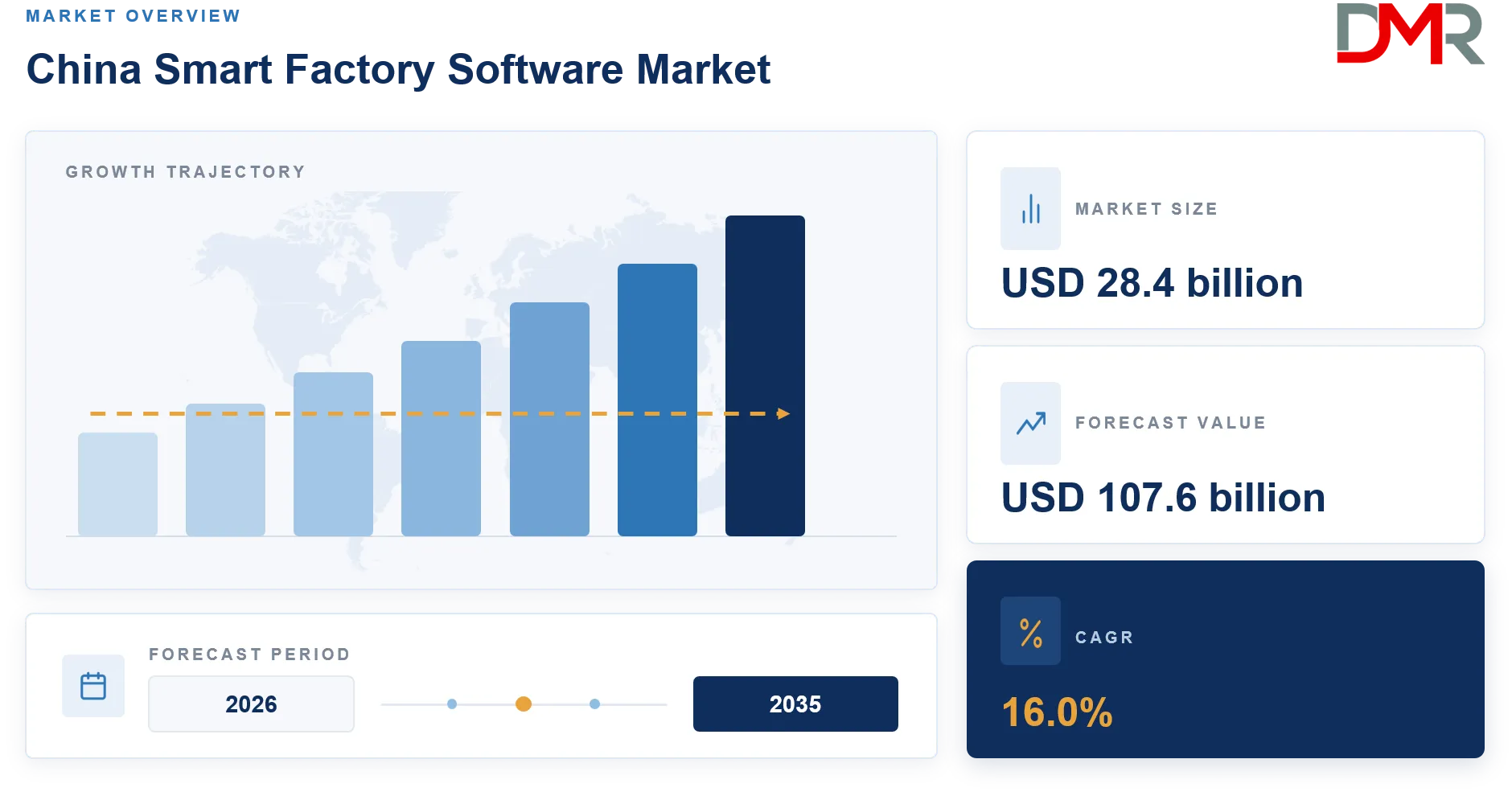
- Market Value: China Smart Factory Software market is valued at USD 28.4 billion in 2026 and is projected to reach USD 107.6 billion by 2035.
- CAGR: China Smart Factory Software market is expected to grow at a CAGR of 16.0% from 2026 to 2035.
- By Software Type Segment Analysis: Manufacturing Execution Systems (MES) led the software type segment with a 24.5% share in 2026.
- By Deployment Model Segment Analysis: Cloud / SaaS Platforms led deployment models with a 46.5% share in 2026.
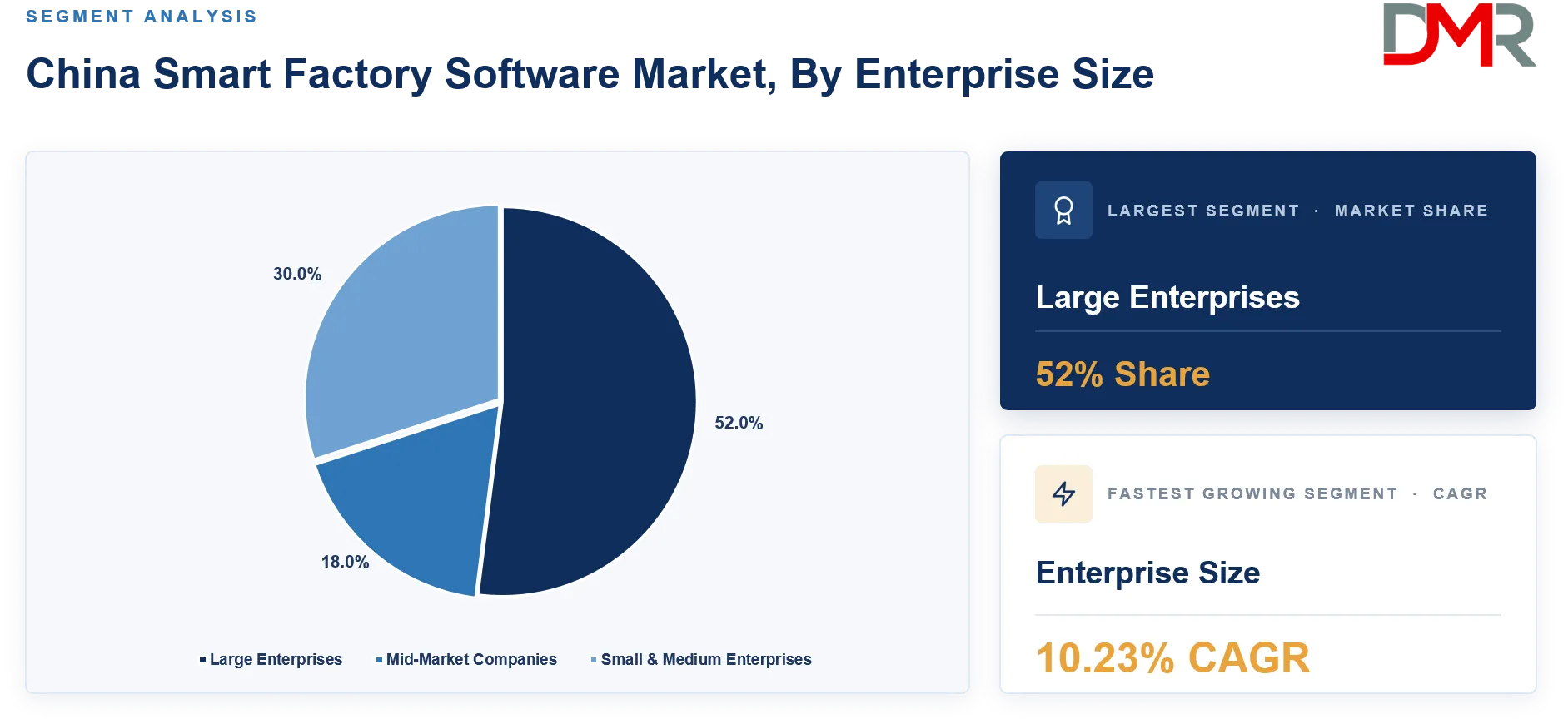
- By Enterprise Size Segment Analysis: Large Enterprises held a 52.0% share in 2026.
- Major Players: Huawei, Baosight Software, Rootcloud, Yonyou, Kingdee and Others.
What is the China Smart Factory Software Market and its Market Size?
The China Smart Factory Software Market size is projected to be valued at USD 28.4 billion in 2026 and is projected to reach USD 107.6 billion by 2035, expanding at a CAGR of 16.0% during the forecast period. Smart factory software covers digital platforms used to monitor, coordinate, analyze, optimize, and secure manufacturing operations. Core categories include MES, industrial IoT platforms, process automation software, PLM, ERP, APM, quality management systems, supply chain platforms, and industrial cybersecurity software.
ℹ
To learn more about this report –
Download Your Free Sample Report Here
China provides a large addressable base for these platforms because manufacturers are moving from isolated automation projects toward connected production environments. By the end of 2025, China had built more than 35,000 basic-level smart factories, over 8,200 advanced-level smart factories, more than 500 excellence-level smart factories, and 15 leading-level smart factories. This expanding installed base increases demand for software that connects machines, production schedules, quality data, maintenance systems, energy management, and enterprise planning.
Use Cases
- Real-Time Production Management: MES platforms connect shop-floor equipment, operators, work orders, and production schedules. Chinese manufacturers use these systems to track cycle times, work-in-progress, machine status, material movement, and order execution. The software gives plant managers a single operational view and supports faster corrective action when production deviates from planned output.
- Predictive Asset Maintenance: Asset performance management and industrial IoT software collect vibration, temperature, power consumption, operating hours, and equipment condition data. Manufacturers can identify abnormal operating patterns before breakdowns occur, schedule service during planned production windows, and reduce losses linked to unplanned downtime in automated production lines.
- Digital Quality Management: Quality management software links inspection records, machine data, process parameters, traceability information, and defect analysis. Automotive, electronics, pharmaceutical, and machinery manufacturers can detect quality deviations earlier, trace affected batches or components, automate inspection workflows, and use production data to identify recurring sources of defects.
- Connected Supply Chain Operations: Smart factory platforms integrate procurement, inventory, production scheduling, warehousing, and supplier data. This helps manufacturers coordinate material availability with factory requirements, improve inventory visibility, and respond more quickly to changing order volumes. Integration is especially valuable for electronics and automotive supply networks involving large supplier ecosystems.
- Energy and Process Optimization: Industrial analytics software combines equipment, utility, process, and production data to identify inefficient operating conditions. Energy-intensive manufacturers can compare consumption by line, product, shift, or machine and adjust production parameters. Such capabilities support cost control while helping factories meet energy efficiency and carbon reduction objectives.
How AI/Gen AI is Transforming the China Smart Factory Software Market?
AI is moving smart factory software from monitoring toward automated decision support. Chinese manufacturers are applying machine learning to equipment failure prediction, computer vision inspection, production scheduling, energy optimization, anomaly detection, and process control. Industrial software platforms can analyze machine histories and live sensor data to identify patterns that rule-based systems may miss. In quality operations, vision models can classify defects and connect inspection results with production parameters. In maintenance, models can prioritize equipment risks and recommend intervention before failure affects production. China's policy direction supports wider adoption, with the Ministry of Industry and Information Technology promoting AI integration across design, simulation, fault warning, production, and intelligent manufacturing workflows.
Generative AI is creating another software layer around factory data and engineering knowledge. Industrial assistants can help engineers search maintenance manuals, summarize alarm histories, retrieve standard operating procedures, generate troubleshooting steps, and interpret production dashboards using natural language. More advanced deployments combine large models with MES, PLM, ERP, industrial knowledge graphs, digital twins, and IoT platforms. This can shorten the time required to investigate production issues while making operational knowledge available to less experienced employees. The commercial opportunity is strongest for vendors that can combine models with secure industrial data, domain-specific workflows, private deployment options, and controls that prevent incorrect recommendations from entering critical production processes.
Key Drivers in the China Smart Factory Software Market
Large-Scale Expansion of Smart Manufacturing Infrastructure
China's expanding smart factory base is creating sustained demand for production software. By the end of 2025, the country had more than 35,000 basic-level, 8,200 advanced-level, and 500 excellence-level smart factories. As facilities move to higher maturity levels, software requirements extend beyond machine connectivity into MES, advanced scheduling, quality analytics, asset management, digital twins, and cross-factory coordination. This transition increases both the number of potential software users and average software spending per factory.
Industrial Internet and Connected Equipment Adoption
China's industrial internet infrastructure provides a technical foundation for smart factory software growth. MIIT reported more than 340 influential industrial internet platforms, with major platforms connecting over 100 million devices and serving nearly four million enterprise instances. Industrial internet coverage has expanded across all 41 major industrial categories. Greater machine connectivity creates usable operational data, increasing demand for IIoT platforms, MES integration, analytics, remote monitoring, asset performance management, and industrial cybersecurity.
Restraints in the China Smart Factory Software Market
Complex Integration with Legacy Production Systems
Many Chinese factories operate equipment installed across different investment cycles, resulting in mixed PLCs, proprietary machine interfaces, older control systems, and disconnected databases. Integrating these assets with modern MES, IIoT, ERP, or cloud platforms can require protocol conversion, edge gateways, customized interfaces, and production-line testing. Manufacturers must complete integration without disrupting output. These technical requirements raise project costs and can slow adoption among plants that lack standardized equipment architectures or experienced industrial IT teams.
Industrial Cybersecurity and Data Governance Requirements
Connected factories expose more production assets to networks, APIs, cloud services, remote access tools, and third-party software. This increases the importance of identity controls, network segmentation, device security, access logging, vulnerability management, and data governance. Manufacturers operating sensitive production environments may limit cloud migration when plant data, product designs, or process information require tighter control. Vendors therefore face longer security assessments and must support private cloud, hybrid architectures, local deployment, and compliance-oriented data management.
Growth Opportunities in the China Smart Factory Software Market
Digital Transformation of Mid-Market Manufacturers
Large enterprises currently account for 52.0% of the market, leaving a substantial expansion opportunity among mid-market companies and SMEs. Smaller manufacturers increasingly need production visibility, traceability, quality control, equipment monitoring, and digital scheduling but often cannot support large customized deployments. Modular SaaS, low-code configuration, standardized industry templates, edge-cloud architectures, and subscription pricing can reduce implementation barriers. Vendors that package MES, IoT, maintenance, and analytics around specific manufacturing processes can address this underserved customer base.
Industry-Specific AI and Industrial Software Platforms
China's shift toward AI-enabled manufacturing creates opportunities for software suppliers that build models around real production processes rather than general enterprise tasks. Applications include semiconductor yield analysis, automotive weld inspection, battery production optimization, equipment fault diagnosis, pharmaceutical process monitoring, and machine-tool maintenance. MIIT's AI plus manufacturing policy direction supports deeper integration of AI into production workflows. Vendors with strong industrial datasets, domain models, equipment connectivity, and secure deployment capabilities are positioned to capture higher-value projects.
Trends in the China Smart Factory Software Market
Cloud and SaaS Platforms Becoming the Leading Deployment Model
Cloud / SaaS Platforms held 46.5% of the China Smart Factory Software market in 2026. Manufacturers are using cloud environments for multi-site analytics, supply chain coordination, application management, AI workloads, and centralized data services while retaining latency-sensitive control functions at the plant edge. This is encouraging hybrid edge-cloud architectures rather than complete movement of production systems to public cloud. Huawei Cloud, Alibaba Cloud, Tencent Cloud, Baidu Intelligent Cloud, and industrial platform providers are expanding manufacturing-focused cloud capabilities around this model.
Convergence of MES, IIoT, Digital Twins, and Enterprise Applications
Manufacturers increasingly want software platforms to exchange information across production, engineering, maintenance, quality, inventory, and planning systems. MES remains central to shop-floor execution, but its value rises when connected with IIoT data, ERP orders, PLM product definitions, APM alerts, quality systems, and digital twins. This convergence is changing vendor competition. Buyers are evaluating integration depth, interoperability, industrial data models, APIs, edge connectivity, analytics, and application ecosystems rather than selecting products only for an isolated factory function.
Research Scope and Analysis
The China Smart Factory Software Market is segmented based on Software Type, Deployment Model, Enterprise Size, End-User Industry, Application Domain, and other relevant categories. The study provides an in-depth analysis of key segments and sub-segments, covering their applications, industry adoption, demand patterns, and contribution to overall market growth.
ℹ
To learn more about this report –
Download Your Free Sample Report Here
By Software Type
Manufacturing Execution Systems dominated the software type segment with a 24.5% share in 2026. MES occupies a central position between enterprise planning systems and factory equipment, making it important for production scheduling, dispatching, work-in-progress monitoring, traceability, quality control, operator workflows, and performance measurement. Demand is particularly strong where manufacturers operate high-volume or highly automated lines and require real-time synchronization between production orders and shop-floor execution. As Chinese plants integrate IoT devices, machine vision, robots, and analytics, MES increasingly acts as an operational data layer that connects these technologies with ERP, PLM, warehouse, and quality systems.
By Deployment Model
Cloud / SaaS Platforms led deployment models with a 46.5% share in 2026. Cloud adoption is supported by demand for centralized factory analytics, scalable computing capacity, faster software deployment, remote management, and multi-site collaboration. Large manufacturers can aggregate data from several plants while using edge computing for time-sensitive workloads. SaaS also lowers infrastructure requirements for mid-market manufacturers adopting digital production tools. Security requirements and production continuity concerns are supporting hybrid architectures in which critical applications remain within factories while analytics, AI, collaboration, and enterprise services operate through cloud environments.
By Enterprise Size
Large Enterprises held 52.0% share in 2026 because major automotive, electronics, machinery, energy, pharmaceutical, and industrial groups have greater capital budgets and more complex production networks. These organizations require software that can connect multiple plants, suppliers, warehouses, engineering teams, and corporate systems. Their projects often involve MES, industrial IoT, ERP, PLM, cybersecurity, analytics, and digital twins within a common architecture. Large manufacturers also have stronger incentives to standardize production data and operating processes across sites, generating demand for enterprise-wide software licenses and long-term integration services.
The China Smart Factory Software Market Report is segmented on the basis of the following:
By Software Type
- Manufacturing Execution Systems
- Industrial IoT Platforms
- Process Automation Software
- Product Lifecycle Management
- Enterprise Resource Planning
- Asset Performance Management
- Quality Management Systems
- Supply Chain Management Software
- Industrial Cybersecurity Software
By Deployment Model
- On-Premises Software
- Cloud / SaaS Platforms
- Hybrid Deployment Solutions
By Enterprise Size
- Large Enterprises
- Mid-Market Companies
- Small & Medium Enterprises
By End-User Industry
- Automotive Manufacturing
- Electronics & Semiconductors
- Pharmaceuticals & Biotech
- Food & Beverage Processing
- Aerospace & Defense
- Industrial Machinery
- Energy & Power Generation
By Application Domain
- Discrete Manufacturing
- Process Manufacturing
- Hybrid Manufacturing
Competitive Landscape
The China Smart Factory Software market has a diverse competitive structure involving industrial software specialists, enterprise application vendors, cloud providers, industrial internet platforms, equipment-linked software companies, and large technology groups. Huawei competes through cloud, connectivity, computing, and industrial digitalization capabilities, while Alibaba Cloud, Tencent, Baidu Intelligent Cloud, and China Mobile provide cloud and data infrastructure for manufacturing workloads. Baosight Software has strong exposure to industrial software and heavy industry, while Yonyou, Kingdee, Inspur, and Digiwin Software connect manufacturing operations with ERP and enterprise management applications.
Rootcloud, COSMOPlat, XCMG Hanyun, and Aerospace Cloud Network compete in industrial internet and connected equipment platforms. Black Lake Technologies focuses on cloud-based manufacturing collaboration and production management. Competition is increasingly determined by industry expertise, implementation speed, equipment connectivity, application ecosystems, AI capabilities, data security, localization, and the ability to integrate MES, IoT, ERP, PLM, quality, maintenance, and supply chain workflows. Vendors able to deliver measurable production improvements rather than stand-alone software functions are expected to gain stronger positions as Chinese factories move toward higher levels of smart manufacturing maturity.
Some of the prominent players in the China Smart Factory Software Industry are:
- Huawei
- Baosight Software
- Rootcloud
- Yonyou
- Kingdee
- Inspur
- Aerospace Cloud Network
- COSMOPlat
- XCMG Hanyun
- Baidu Intelligent Cloud
- Alibaba Cloud
- Tencent
- China Mobile
- Langkun Intelligence
- Digiwin Software
- Zhongwang Software
- Black Lake Technologies
- Devotek
- Fangdee Software
- Getech
- Others
Technology Analysis
The China Smart Factory Software market is being reshaped by the convergence of MES, industrial IoT, edge computing, cloud platforms, digital twins, AI, machine vision, industrial 5G, and cybersecurity software. Manufacturers are moving away from isolated production applications toward connected architectures that link shop-floor equipment with ERP, PLM, quality, maintenance, and supply chain systems. Edge computing is gaining importance for low-latency machine data processing, while cloud platforms support multi-site analytics, centralized application management, model training, and remote collaboration. Digital twins are increasingly used to simulate production lines, equipment behavior, and process changes before physical implementation. AI is expanding into predictive maintenance, defect detection, scheduling, energy optimization, and anomaly detection. Industrial 5G supports higher device density and reliable connectivity for mobile robots, sensors, and flexible production cells. The strongest software platforms are those that combine interoperability, real-time data integration, scalable analytics, secure deployment, and industry-specific applications across automotive, electronics, machinery, pharmaceuticals, and energy manufacturing.
Regulatory Landscape
China's regulatory environment for smart factory software is shaped by industrial modernization policy, data security rules, cybersecurity requirements, and national standards for intelligent manufacturing. The Ministry of Industry and Information Technology continues to promote smart factory development through graded factory programs, industrial internet expansion, and deeper integration of AI with manufacturing. At the same time, software vendors and manufacturers must account for the Cybersecurity Law, Data Security Law, Personal Information Protection Law, and rules governing important data, cross-border transfers, and critical information infrastructure where applicable. These requirements influence cloud architecture, industrial data storage, access control, encryption, auditability, and vendor risk management. Manufacturers handling sensitive production, engineering, or operational data may favor private cloud, hybrid deployment, or localized infrastructure. Compliance therefore affects platform selection as directly as functionality. Vendors with strong data governance, secure industrial connectivity, localized hosting options, and alignment with Chinese technical standards are better positioned to win projects in regulated and strategically important manufacturing sectors.
Recent Developments
- August 2026: COSMOPlat partnered with Fibocom to launch dual smart manufacturing base projects in Shenzhen and Jiangxi, delivering end-to-end intelligent manufacturing design and data integration for flexible production.
- July 2026: COSMOPlat filed for a Hong Kong IPO, marking its second attempt after an earlier submission expired, as it seeks capital to expand its industrial digitalization platform and reduce reliance on parent Haier Group.
- June 2026: Baosight Software advanced its AI-driven industrial solutions, operating China's largest steel-industry AI computing center with over 1,000 intelligent agents deployed across production, maintenance, and quality monitoring scenarios.
Report Details
| Report Characteristics |
| Market Size (2026) |
USD 28.4 Bn |
| Forecast Value (2035) |
USD 107.6 Bn |
| CAGR (2026–2035) |
16.0% |
| Historical Data |
2021 – 2025 |
| Forecast Data |
2027 – 2035 |
| Base Year |
2025 |
| Estimate Year |
2026 |
| Segments Covered |
By Software Type (Manufacturing Execution Systems, Industrial IoT Platforms, Process Automation Software, Product Lifecycle Management, Enterprise Resource Planning, Asset Performance Management, Quality Management Systems, Supply Chain Management Software, and Industrial Cybersecurity Software), By Deployment Model (On-Premises Software, Cloud / SaaS Platforms, and Hybrid Deployment Solutions), By Enterprise Size (Large Enterprises, Mid-Market Companies, and Small & Medium Enterprises), By End-User Industry (Automotive Manufacturing, Electronics & Semiconductors, Pharmaceuticals & Biotech, Food & Beverage Processing, Aerospace & Defense, Industrial Machinery, and Energy & Power Generation), By Application Domain (Discrete Manufacturing, Process Manufacturing, and Hybrid Manufacturing) |
| Regional Coverage |
China |
Frequently Asked Questions
What is the current size of the China Smart Factory Software Market?
▾ The China Smart Factory Software Market size is valued at USD 28.4 billion in 2026 and may reach USD 107.6 billion by 2035.
What is the growth rate of the China Smart Factory Software Market during?
▾ The China Smart Factory Software Market is expected to expand at a 16.0% CAGR during the 2026 to 2035 forecast period.
What factors are driving the growth of the China Smart Factory Software Market?
▾ Smart factory expansion, industrial IoT, cloud, and automation drive China Smart Factory Software Market growth.
What are the major challenges restraining the China Smart Factory Software Market?
▾ Legacy integration, cybersecurity, and data governance constrain China Smart Factory Software Market adoption.
Which segment holds the largest share of the China Smart Factory Software Market?
▾ Manufacturing Execution Systems lead the China Smart Factory Software Market with a 24.5% share in 2026.
Who are the leading companies in the China Smart Factory Software Market?
▾ Huawei, Baosight Software, Rootcloud, Yonyou, Kingdee, Inspur, Aerospace Cloud Network, COSMOPlat, XCMG Hanyun, Baidu Intelligent Cloud, Alibaba Cloud, Tencent, China Mobile, Langkun Intelligence, Digiwin Software, Zhongwang Software, Black Lake Technologies, Devotek, Fangdee Software, and Getech are leading companies in the China Smart Factory Software Market.
How is AI influencing the China Smart Factory Software Market?
▾ AI improves predictive maintenance, quality inspection, scheduling and analytics in China Smart Factory Software Market.
Cloud SaaS, digital twins, industrial AI, and SME adoption offer growth in China Smart Factory Software Market.
▾ What are the future opportunities and trends in the China Smart Factory Software Market?