China Substation Automation Market Snapshot
- Market Size 2026: USD 8.2 billion
- Market Size 2035: USD 14.3 billion
- CAGR, 2026–2035: 6.4%
- Leading Offering Segment: Hardware, 56%
- Leading Substation Type: Transmission, 48%
- Leading End-User Segment: Electric Utilities, 76%
- Fastest-Growing Segment: Renewable Energy End User, 9.4% CAGR
What is the China Substation Automation and its Market Size?
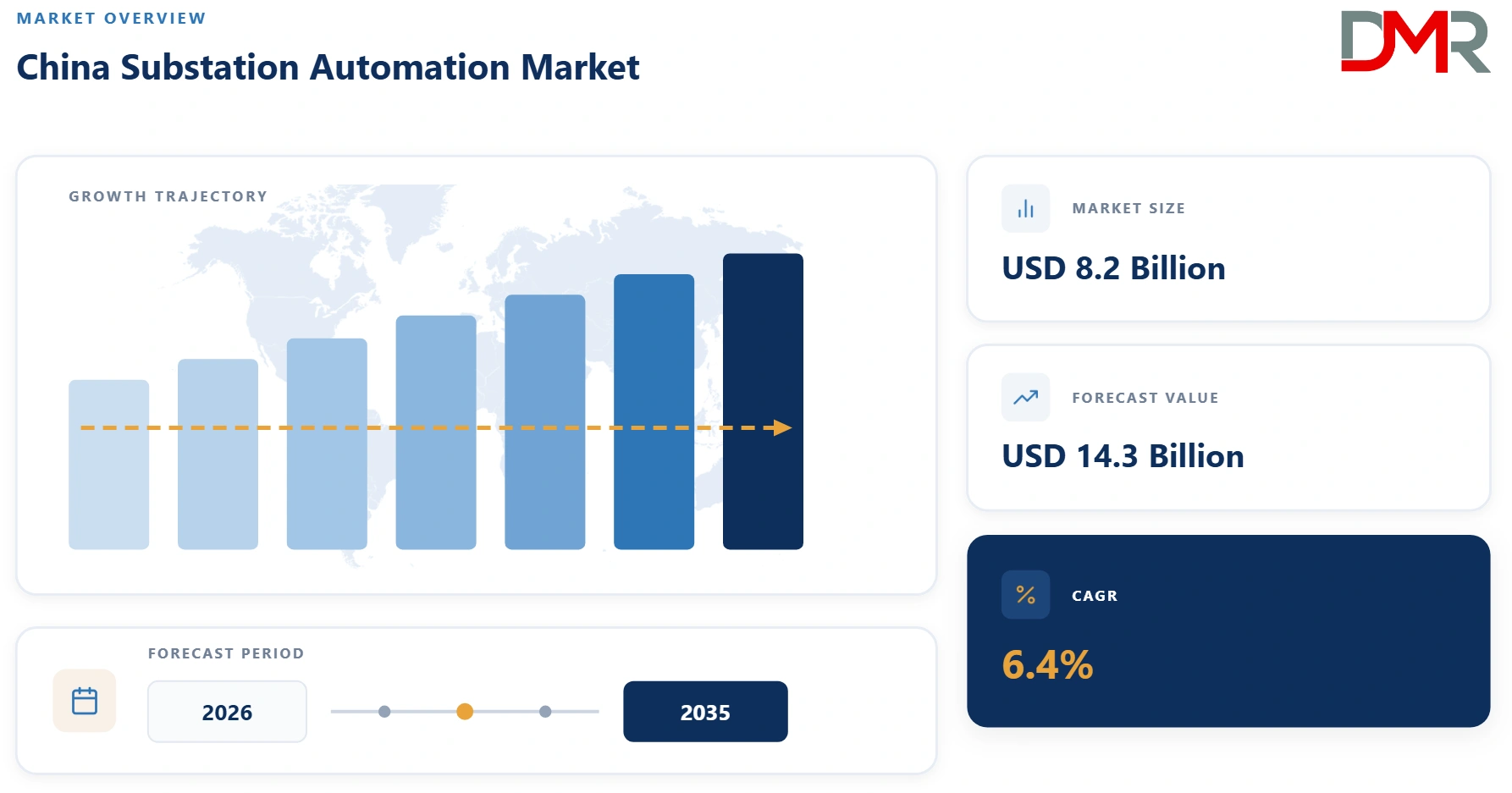
The China substation automation market is estimated at USD 8.2 billion in 2026, increasing to approximately USD 14.3 billion by 2035, representing a 6.4% CAGR.
ℹ
To learn more about this report –
Download Your Free Sample Report Here
China's substation automation market comprises hardware, software, communications infrastructure and professional services used to monitor, protect, control, automate and optimize electrical substations. Core technologies include intelligent electronic devices (IEDs), protection relays, SCADA, human-machine interfaces, remote terminal units, communication networks, merging units, automation controllers and digital-substation platforms. The market enables utilities and industrial power users to transition from conventional electromechanical systems toward interconnected, data-driven substations using protocols such as IEC 61850. Its principal value proposition is improved grid reliability, faster fault isolation, lower operating costs, enhanced asset visibility and greater ability to integrate variable renewable generation. China's standards framework is increasingly aligned with IEC 61850-based architectures.
Use Cases
- Grid Protection and Fault Isolation: Automated protection detects abnormal conditions and rapidly isolates faults to minimize outages and equipment damage.
- Remote Substation Monitoring: Operators remotely monitor voltage, current, breaker status, transformer condition and other critical parameters.
- Renewable-Energy Integration: Automation systems coordinate variable wind and solar generation with transmission and distribution networks.
- Predictive Asset Maintenance: Sensor and operational data identify equipment degradation before failures occur, reducing unplanned maintenance.
- UHV Transmission Management: Advanced automation coordinates complex high-voltage networks transferring electricity over long distances.
- Industrial Power Management: Large industrial facilities use automation to improve power reliability, protection and operational visibility.
Key Takeaways
- Market Size: China's substation automation market is estimated at USD 8.2 billion in 2026, reaching approximately USD 14.3 billion by 2035.
- Growth Rate: The market is forecast to expand at approximately 6.4% CAGR during 2026–2035.
- Key Drivers: Major drivers include grid modernization, UHV construction, renewable-energy integration, digitalization and replacement of legacy automation equipment.
- Segment Dominance: Hardware is expected to remain the largest offering category, while transmission substations and electric utilities dominate their respective categories.
- Fastest Growth: Renewable-energy users are expected to record the fastest growth as solar, wind, storage and distributed resources increase grid-control requirements.
- Technology Direction: AI, advanced analytics, IEC 61850 communications, edge computing and digital twins are shifting substations toward predictive and autonomous operations.
How AI is Transforming China's Substation Automation Market?
AI is increasingly being applied to equipment-condition monitoring, fault diagnosis, anomaly detection, load forecasting, predictive maintenance, network optimization and operator decision support. State Grid has deployed its large-scale “Guangming Power” model across headquarters and provincial power companies, with applications including equipment assessment, grid operation and renewable-energy management.
AI reduces diagnostic time, improves asset utilization and enables earlier identification of equipment abnormalities. State Grid reports that AI-supported UHV DC equipment condition assessment can be reduced from approximately one week to minutes in relevant applications.
Key Drivers in the China Substation Automation Market
Grid Modernization and Expansion
China's ongoing modernization of its electricity infrastructure is a major driver for substation automation adoption. Utilities are upgrading conventional substations with intelligent electronic devices, digital protection systems, advanced communication networks, SCADA platforms, and automated monitoring capabilities to improve grid reliability and operational efficiency. The continued development of transmission and distribution infrastructure is also creating demand for modern automation systems across new substations. Replacement of aging equipment provides an additional recurring demand stream as utilities progressively transition from conventional control architectures to digital and interconnected systems. The increasing complexity of China's power network further encourages automation because utilities require faster fault detection, remote supervision, coordinated protection, and improved visibility across substations.
Renewable-Energy Integration
The rapid expansion of wind, solar, and other renewable-energy resources is increasing the need for sophisticated substation automation. Variable renewable generation creates greater fluctuations in power flows and voltage conditions, requiring faster monitoring, protection, control, and communication capabilities. Renewable projects also require automated collector and grid-interconnection substations capable of coordinating generation with transmission and distribution networks. Digital substations enable real-time monitoring and more flexible grid management, supporting the integration of distributed and utility-scale renewable resources. The broader transition toward a more flexible electricity system is also increasing the importance of storage, demand response, and distributed energy resources, further expanding the role of automated substations.
Restraints in the China Substation Automation Market
High Investment and Integration Complexity
The implementation of advanced substation automation requires significant investment in protection equipment, intelligent electronic devices, communication infrastructure, control systems, software, cybersecurity, engineering, and commissioning. Costs can be particularly challenging for brownfield projects because modern automation equipment must be integrated with existing transformers, switchgear, protection systems, and legacy communication architectures. Interoperability between equipment from different generations and manufacturers can increase engineering requirements and project complexity. Utilities must also carefully plan modernization activities to avoid service interruptions during installation and commissioning. These factors can extend project timelines and increase the technical resources required for deployment. As a result, customers often prioritize solutions that provide modular modernization, compatibility with existing infrastructure, and measurable improvements in reliability and operational efficiency.
Cybersecurity and Skilled Workforce Requirements
Greater digital connectivity creates cybersecurity challenges for automated substations. Modern systems connect protection devices, sensors, communication networks, SCADA platforms, remote-monitoring systems, and enterprise applications, increasing the potential exposure of critical electricity infrastructure. Utilities therefore require stronger cybersecurity controls, secure communications, continuous monitoring, and specialized testing. At the same time, the transition toward IEC 61850-based architectures, AI-enabled monitoring, cloud-connected systems, and advanced analytics requires engineers with specialized digital-substation expertise. Shortages of personnel familiar with both power-system engineering and modern information technologies can make implementation and maintenance more difficult. Utilities and vendors consequently need continuous workforce development, cybersecurity training, and technical support to operate increasingly sophisticated automation environments.
Growth Opportunities in the China Substation Automation Market
AI-Enabled Predictive Maintenance
The integration of artificial intelligence, machine learning, and advanced analytics represents a major opportunity for China's substation automation market. Automated systems generate large quantities of operational data from protection devices, transformers, circuit breakers, sensors, and communication networks. AI can analyze these data streams to identify abnormal operating conditions, detect early signs of equipment deterioration, predict potential failures, and support maintenance decisions. This can shift utilities from scheduled or reactive maintenance toward condition-based and predictive maintenance. AI-enabled systems can also improve fault diagnosis and operator decision-making. As digital-substation adoption expands, vendors that combine automation hardware with analytics, AI, asset management, and remote monitoring capabilities can develop higher-value solutions and recurring software and service opportunities.
Brownfield Modernization and Renewable Interconnection
Modernization of existing substations presents a significant opportunity because many installed facilities continue operating with conventional protection, control, and communication technologies. Retrofit solutions can introduce digital relays, intelligent sensors, IEC 61850 communication, remote monitoring, and advanced analytics without requiring complete replacement of primary electrical equipment. At the same time, continued renewable-energy development is generating demand for new collector substations and grid-interconnection systems. Vendors offering modular solutions that can be deployed with limited outages and integrated with existing infrastructure can address both requirements. The growing deployment of distributed energy resources also creates opportunities for automation systems capable of coordinating renewable generation, storage, flexible loads, and grid operations.
Trends in the China Substation Automation Market
Shift Toward Digital Substations
China's substation industry is gradually moving from conventional hardwired architectures toward digital substations based on intelligent electronic devices, high-speed communications, and standardized protocols. IEC 61850-based architectures enable greater interoperability, reduce conventional wiring requirements, improve information sharing, and support centralized monitoring and advanced protection. Digitalization also creates a foundation for integrating AI, asset-management platforms, remote diagnostics, and predictive maintenance. As utilities seek greater operational visibility and flexibility, digital substations are increasingly becoming an important component of modern grid infrastructure.
Convergence of Automation, AI, and Smart-Grid Technologies
Substation automation is increasingly converging with artificial intelligence, IoT, edge computing, advanced analytics, and smart-grid platforms. Rather than functioning primarily as protection and control equipment, modern substations are evolving into data-intensive operational nodes that provide continuous information about equipment and grid conditions. This enables remote operation, predictive maintenance, automated fault analysis, and improved coordination with renewable generation and distributed energy resources. The trend is also expanding the competitive landscape from traditional automation hardware toward integrated hardware, software, communications, analytics, and lifecycle-service offerings.
Research Scope and Analysis
The China substation automation market is analyzed by Offering, Substation Type, Voltage, Installation and End User. The scope covers automation hardware, software and services deployed across transmission, distribution and generation/collector substations at medium-, high-, extra-high- and ultra-high-voltage levels.
ℹ
To learn more about this report –
Download Your Free Sample Report Here
By Offering Analysis
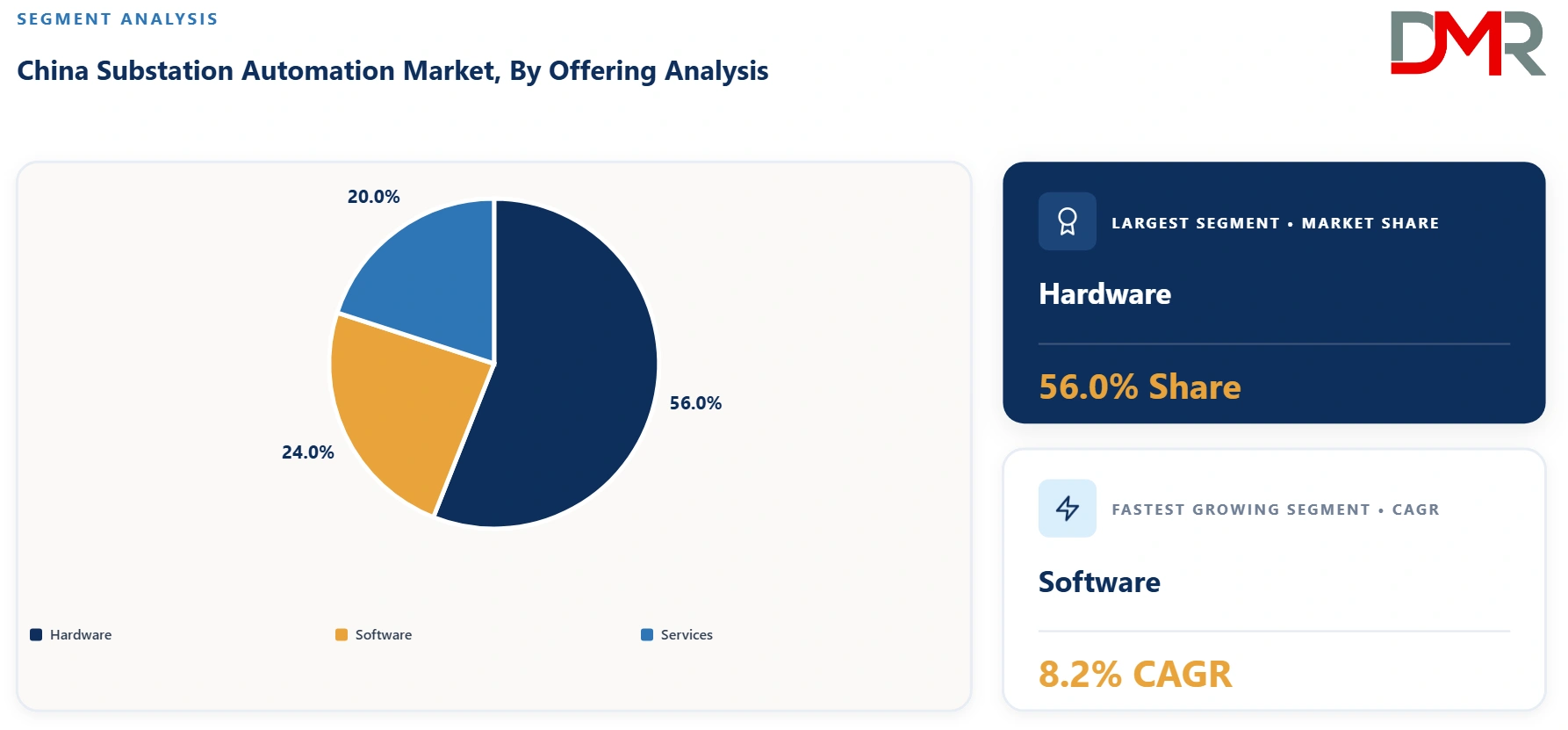
Hardware is estimated to dominate China's substation automation market with approximately 56% share in 2026, supported by continuing procurement of protection relays, IEDs, RTUs, communication equipment, control panels, merging units and monitoring devices for new and upgraded substations. Hardware remains essential even as software content increases because utility projects require extensive field-level equipment and replacement of aging electromechanical systems. Software represents approximately 24%, encompassing SCADA, HMI, analytics, asset-management and automation applications, and is expected to be the fastest-growing offering at around 8.2% CAGR, driven by AI, centralized protection and digital-twin adoption. Services, with roughly 20% share, include engineering, system integration, commissioning, maintenance and cybersecurity. Services should expand steadily as increasingly complex digital systems require lifecycle support, although hardware will remain the largest revenue pool through 2035.
By Substation Type Analysis
Transmission substations account for an estimated 48% share in 2026, making them the largest substation-type segment. China's extensive UHV and EHV transmission construction, long-distance renewable-energy transfers and regional balancing requirements create significant demand for high-performance protection, control and communications systems. Distribution substations represent approximately 39%, supported by urbanization, electrification and increasing distribution-grid intelligence. Distribution automation is likely to remain highly attractive because China's distribution-automation market is projected to expand substantially through 2030. Generation/collector substations account for around 13%, but are expected to be the fastest-growing at approximately 8.8% CAGR, reflecting rapid solar, wind and battery-storage deployment. Their growth will be reinforced by the need for sophisticated grid-interconnection controls and renewable forecasting.
By Voltage Analysis
High-voltage (HV) applications are estimated to hold the largest share at approximately 42% in 2026, reflecting the extensive installed base of conventional transmission and sub-transmission substations and continued replacement of protection and control equipment. Extra-high voltage (EHV) follows with roughly 30%, benefiting from long-distance transmission investment and increasing renewable-power transfers. Medium voltage (MV) accounts for approximately 20%, with demand driven by distribution automation, industrial facilities and smart-grid modernization. Ultra-high voltage (UHV) represents approximately 8%, but is expected to record the fastest growth at about 8.5% CAGR because China's UHV network remains a strategic infrastructure priority. State Grid reported 41 operational UHV projects and continues to target additional transmission capacity under its 2026–2030 investment program.
By Installation Analysis
Greenfield installations are estimated to represent approximately 62% of the market in 2026, reflecting China's large pipeline of new substations associated with UHV projects, renewable-energy zones, industrial development and grid expansion. New-build projects allow utilities to implement complete digital architectures from the design stage, including fiber-optic communications, IEC 61850 networks, centralized control and integrated monitoring. Brownfield/retrofit installations account for around 38% and are expected to grow faster, at approximately 7.4% CAGR, as installed substations require replacement of aging relays, communications and control systems. Retrofit projects are particularly attractive where utilities seek higher reliability without rebuilding primary equipment. The increasing availability of modular digital-substation technology is lowering the technical barriers to brownfield modernization.
By End User Analysis
Electric utilities dominate the market with an estimated 76% share in 2026, reflecting the enormous scale of State Grid and China Southern Power Grid infrastructure and their continuing investment in transmission and distribution modernization. Utilities require automation across virtually every stage of electricity delivery, making them the primary customer base. Industrial users account for approximately 15%, particularly in energy-intensive industries requiring reliable internal substations, process continuity and power-quality monitoring. Renewable-energy users represent about 9%, but are forecast to be the fastest-growing segment at approximately 9.4% CAGR because wind, solar, storage and hybrid renewable facilities increasingly require sophisticated collector and grid-interconnection substations. The expansion of renewable generation therefore provides a structural growth engine beyond conventional utility procurement.
The China Substation Automation Market Report is segmented on the basis of the following:
By Offering
- Hardware
- Software
- Services
By Substation Type
- Transmission
- Distribution
- Generation / Collector
By Voltage
- Medium Voltage
- High Voltage
- Extra-High Voltage
- Ultra-High Voltage
By Installation
- Greenfield
- Brownfield / Retrofit
By End User
- Electric Utilities
- Industrial
- Renewable Energy
Regulatory Landscape
China's regulatory environment is increasingly supportive of standardized, digital substation architectures. GB/T 42151.3-2024, effective May 2025, establishes general requirements for power-automation communication systems and adopts IEC 61850 principles. In addition, GB/T 45906.6-2025 and GB/T 45906.7-2025 establish requirements for substation monitoring/control and centralized monitoring systems, effective February 2026. The regulatory trajectory favors interoperable, secure and software-intensive systems, creating opportunities for qualified domestic vendors and global suppliers with localized engineering. However, compliance, cybersecurity testing, qualification and utility-specific specifications can raise entry barriers and lengthen sales cycles.
Technology Analysis
The principal technology shift is from conventional relay-centric automation toward digital substations combining IEC 61850 communications, intelligent sensors, centralized protection, edge computing, AI and predictive analytics. State Grid's AI initiatives demonstrate how automation is moving from data collection toward decision support and autonomous optimization. ABB has similarly demonstrated centralized protection, digital-substation and AI-enabled solutions. The market impact is a gradual shift in value toward software, communications and lifecycle services. Vendors with integrated hardware-software portfolios, cybersecurity capabilities and large installed bases are likely to gain share, while standalone hardware providers face increasing commoditization.
Competitive Landscape
China's substation automation market is moderately consolidated at the utility-grade level but highly competitive across equipment and integration niches. Domestic suppliers such as NARI Technology, NR Electric, China Electric Power Research Institute-linked entities, XJ Electric, Guodian Nanjing Automation and Sifang compete alongside multinational vendors including ABB, Siemens Energy, Schneider Electric and Hitachi Energy. Domestic companies benefit from utility relationships, localization, procurement qualification and knowledge of Chinese grid specifications, while international vendors differentiate through advanced digital architectures, specialized protection technology, software and global R&D. Competition increasingly centers on system integration, cybersecurity, AI capabilities, lifecycle services and interoperability rather than individual relays or control devices. China's IEC 61850 standardization work further encourages vendors to compete on complete interoperable solutions.
Some of the prominent players in the China Substation Automation Market are:
- NARI Technology
- NR Electric
- Beijing Sifang Automation
- XJ Electric
- Guodian Nanjing Automation
- TBEA
- Dongfang Electronics
- CYG SUNRI
- Sieyuan Electric
- China XD Group
- Pinggao Group
- Shanghai Electric
- Schneider Electric
- Siemens
- Hitachi Energy
- ABB
- GE Vernova
- Eaton
- Mitsubishi Electric
- Toshiba Energy Systems & Solutions
- LS Electric
- Huawei
- Cisco Systems
- Schweitzer Engineering Laboratories
- Honeywell
- Yokogawa Electric
- Ingeteam
- Arteche
- Trilliant
- NovaTech Automation
- Belden
- TAKAOKA TOKO
- Power Automation
- Integrated Electronic Systems
- Wiscom System
- Shanghai Siyuan Hongrui Automation
- Luneng Intelligence Technology
- Henan Senyuan Electric
- CHINT Group
- Delixi Electric
- Other Key Players
Recent Developments
- In January 2026, State Grid announced plans to invest up to RMB 4 trillion during 2026–2030, including further UHV development and digital/AI infrastructure, substantially expanding the addressable market for grid automation and intelligent-substation suppliers.
- In November 2025, ABB presented its “AI+Power” solutions in China, including predictive-failure capabilities and intelligent protection and control technologies designed for smart-substation modernization and renewable-energy integration.
- In July 2025, State Grid highlighted its “Guangming Power” large-scale AI model, reporting deployment across headquarters and 27 provincial power companies for grid planning, operations, equipment management, and other applications.
- In April 2025, Siemens China announced successful commissioning of an integrated photovoltaic-storage project at its Nanjing facility using Smart ECX energy-management software and the SICAM A8000 microgrid controller, illustrating the convergence of automation, distributed energy, and digital energy management.
- In March 2025, Schneider Electric launched its AI-powered One Digital Grid Platform, integrating planning, asset management, operations, resilience, and flexibility functions to support digital grid modernization.
Report Details
| Report Characteristics |
| Market Size (2026) |
USD 8.2 Bn |
| Forecast Value (2035) |
USD 14.3 Bn |
| CAGR (2026–2035) |
6.4% |
| Historical Data |
2021 – 2025 |
| Forecast Data |
2026 – 2035 |
| Base Year |
2025 |
| Segments Covered |
By Offering, By Substation Type, By Voltage, By Installation, By End User |
| Country Coverage |
China |
Frequently Asked Questions
What is the size of the China Substation Automation Market in 2026?
▾ The China Substation Automation Market is estimated at approximately USD 8.2 billion in 2026, covering hardware, software, services, and system integration.
What will the China Substation Automation Market size reach by 2035?
▾ The China Substation Automation Market is projected to reach approximately USD 14.3 billion by 2035, supported by grid modernization, digitalization, and renewable-energy integration.
What is the CAGR of the China Substation Automation Market?
▾ The China Substation Automation Market is expected to expand at a 6.4% CAGR from 2026 to 2035, driven by sustained investment in intelligent grid infrastructure.
What are the key drivers of the China Substation Automation Market?
▾ The China Substation Automation Market is driven by UHV expansion, grid modernization, renewable-energy integration, aging infrastructure replacement, and increasing adoption of digital technologies.
What are the major trends in the China Substation Automation Market?
▾ Major trends in the China Substation Automation Market include digital substations, IEC 61850 adoption, AI-enabled predictive maintenance, IoT connectivity, edge computing, and smart-grid integration.
Which segment dominates the China Substation Automation Market?
▾ Hardware dominates the China Substation Automation Market, accounting for an estimated 56% share in 2026, supported by demand for protection, control, communication, and monitoring equipment.
Which segment is growing fastest in the China Substation Automation Market?
▾ The renewable-energy end-user segment is expected to be the fastest-growing segment in the China Substation Automation Market, supported by increasing wind, solar, and energy-storage deployment.
Who are the key players in the China Substation Automation Market?
▾ Key players in the China Substation Automation Market include NARI Technology, NR Electric, XJ Electric, Sifang, ABB, Siemens Energy, Schneider Electric, and Hitachi Energy.