China Supply Chain Resilience Automation Market Snapshot
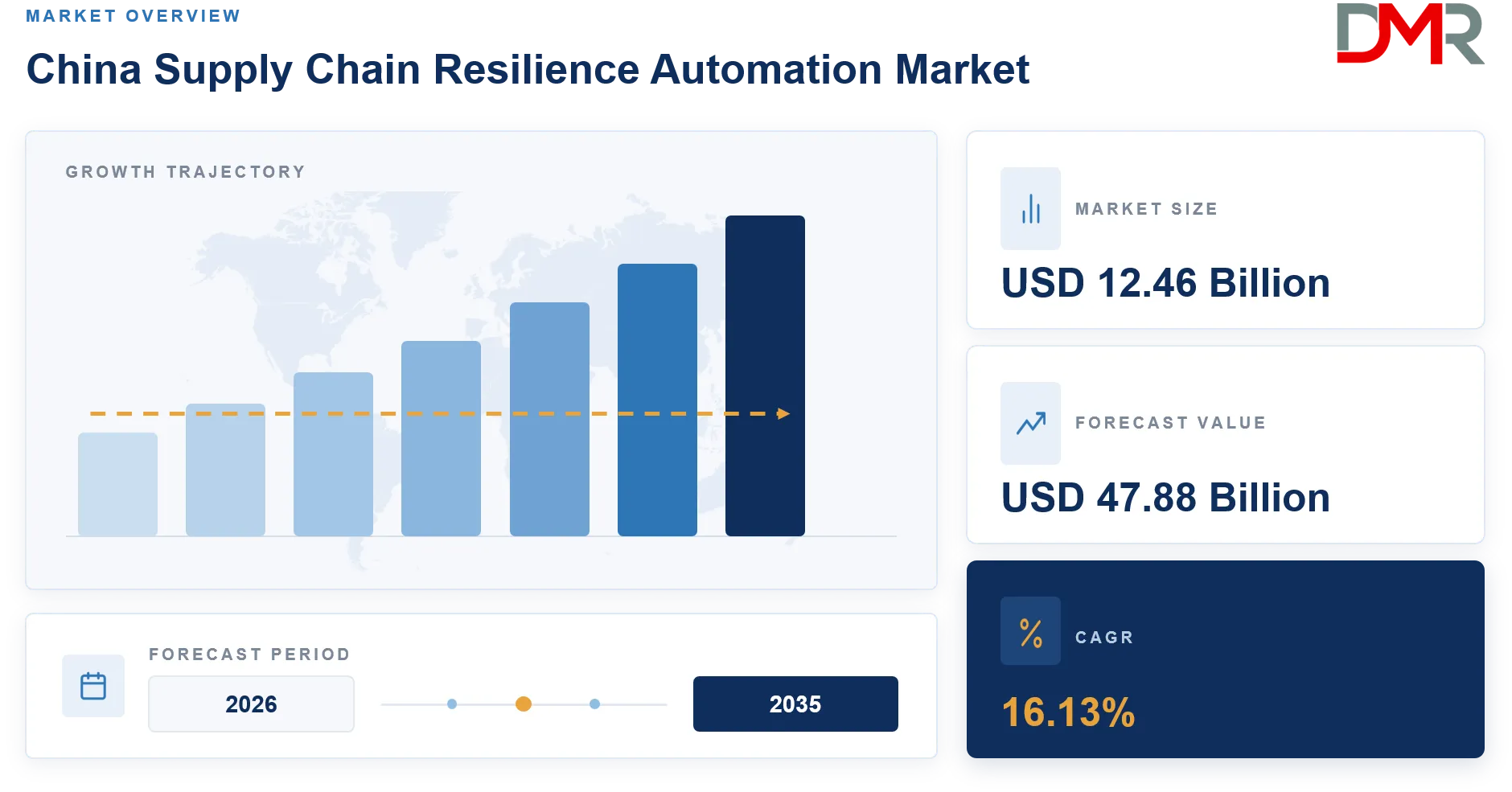
- Market Value: The China Supply Chain Resilience Automation Market size is expected to reach USD 47.88 billion by 2035 from USD 12.46 billion in 2026.
- CAGR: The China Supply Chain Resilience Automation Market is expected to grow at a CAGR of 16.13% from 2026 to 2035.
- By Type Segment Analysis: Inventory and warehouse management dominated the type segment with a 20.61% share in 2026.
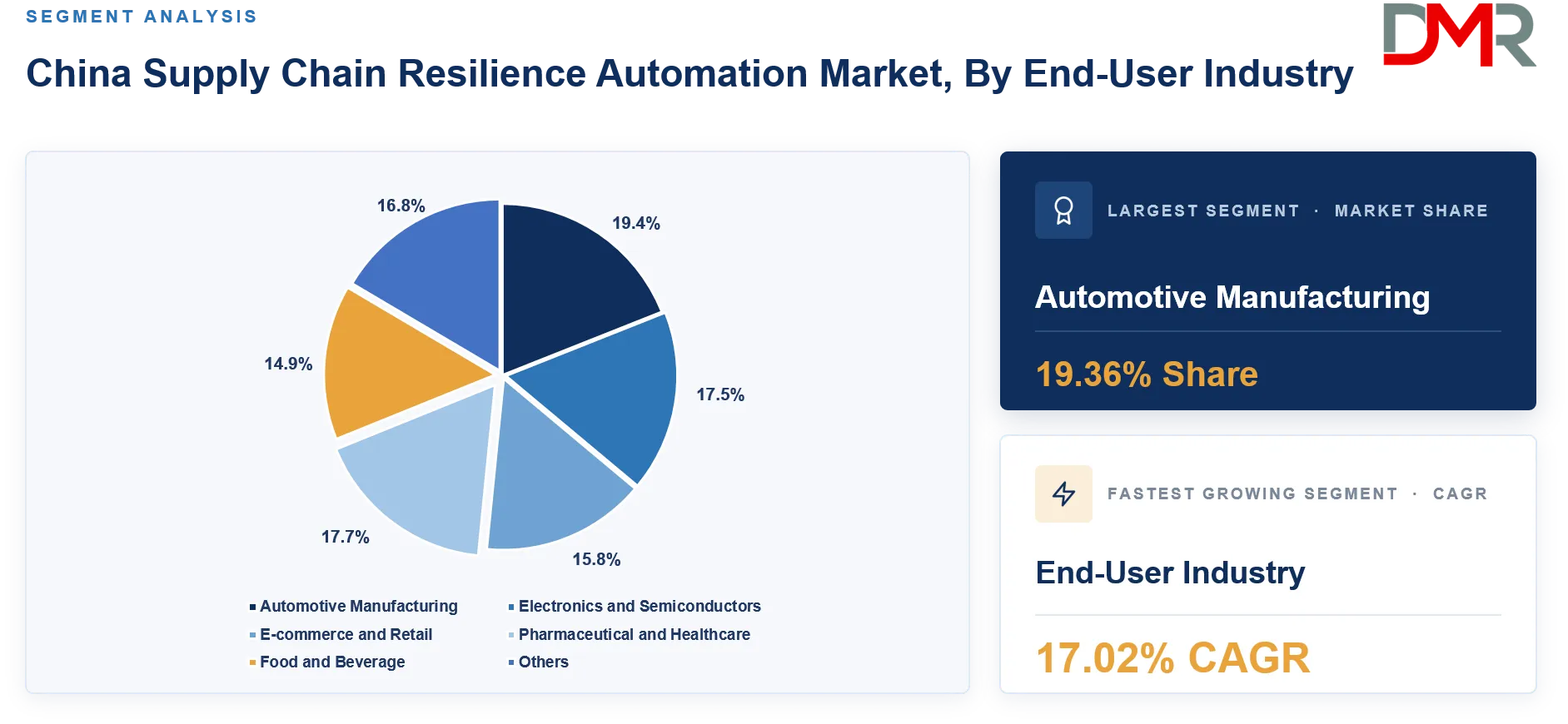
- By End User Industry Segment Analysis: Automotive manufacturing led end-user industries with a 19.36% share in 2026.
- By Region Segment Analysis: East China held a 34.62% share of the market in 2026.
- Major Players: Inovance Technology, Estun Automation, HollySys, SUPCON Technology, and Others.
What is the China Supply Chain Resilience Automation Market and its Market Size?
The China Supply Chain Resilience Automation Market size is projected to reach USD 47.88 billion by 2035 from USD 12.46 billion in 2026, expanding at a CAGR of 16.13% during the forecast period. The market covers technologies that help companies detect disruptions, automate material movement, improve inventory control, forecast demand, monitor suppliers, and simulate supply network risks. Its commercial value is linked to the growing need to make supply networks more visible, responsive, and less dependent on manual intervention.
ℹ
To learn more about this report –
Download Your Free Sample Report Here
Automation is moving beyond individual warehouse or factory tasks toward connected supply chain decision-making. Inventory systems, robotics, predictive analytics, supplier platforms, transportation software, and digital twins can work together to provide faster responses to demand changes and operational disruptions. Research on Chinese listed companies has found that AI adoption can improve supply chain resilience through better efficiency, transparency, operational coordination, and resource allocation.
The business case is especially relevant for manufacturers with complex supplier networks and high inventory exposure. Automotive, electronics, industrial manufacturing, e-commerce, healthcare, and logistics companies can use automation to shorten response times and improve the flow of materials and information. For senior decision-makers, the market therefore represents a combination of operational automation, risk management, supply chain visibility, and digital transformation investment.
Use Cases
- Automated Inventory Control: Smart inventory systems track stock levels, identify shortages, and support replenishment decisions.
- Warehouse Resilience: Automated storage, retrieval systems, and mobile robots help maintain warehouse throughput during labor or demand disruptions.
- Risk Monitoring: Predictive analytics can identify supply, demand, and logistics signals that may indicate an emerging disruption.
- Demand Planning: AI-supported forecasting helps companies adjust production, purchasing, and inventory plans as demand patterns change.
- Supply Network Simulation: Digital twin platforms allow companies to test disruption scenarios and evaluate alternative sourcing or logistics strategies.
How AI/Gen AI is Transforming the China Supply Chain Resilience Automation Market?
AI is changing supply chain automation from rule-based execution toward predictive and adaptive operations. Machine learning models can process demand, inventory, supplier, logistics, and production signals to identify patterns before they become operational problems. This supports earlier intervention in procurement, inventory allocation, production scheduling, and transportation planning. Research covering 4,319 Chinese A-share listed firms found that higher AI adoption was associated with lower supply chain risk, with efficiency and resilience acting as important channels. The effect was stronger among manufacturing firms and companies in eastern China.
Generative AI adds another layer by allowing managers to interact with complex supply chain data through natural language interfaces. It can support scenario analysis, exception management, supplier communication, planning documentation, and decision preparation. Chinese research also indicates that AI can strengthen resilience by supporting supply chain diversification, improving operational efficiency, and reducing inefficient investment. Government AI initiatives are also relevant because research using 4,144 Chinese A-share listed companies found stronger resilience outcomes in areas covered by AI pilot policies, with particularly notable effects in eastern regions and technology-intensive industries.
Key Drivers in the China Supply Chain Resilience Automation Market
Growing Need for Real-Time Supply Chain Visibility
Complex supplier networks create a growing need for continuous visibility across inventory, production, transportation, and supplier performance. Manual reporting can delay the detection of shortages, delivery failures, and demand changes. Automation connects operational data and turns it into usable alerts, dashboards, and planning signals. This encourages companies to invest in visibility platforms, predictive analytics, automated tracking, and supplier monitoring. For large manufacturers, improved visibility also supports faster escalation and more informed decisions when disruptions affect critical materials or production schedules.
Expansion of Robotics and Intelligent Warehouse Operations
Warehouse automation is becoming an important resilience investment because companies need consistent throughput while managing labor availability, order volatility, and growing fulfillment complexity. Automated storage systems, autonomous mobile robots, robotic picking, machine vision, and fleet management software can reduce manual handling and improve process consistency. China has a large industrial automation ecosystem, creating a broad base for warehouse and factory automation. The resulting demand supports integration between robotics, warehouse management systems, inventory optimization, and broader supply chain planning platforms.
Restraints in the China Supply Chain Resilience Automation Market
High Integration and Implementation Requirements
Supply chain automation often requires integration across enterprise resource planning, warehouse management, manufacturing execution, transportation, procurement, and supplier systems. Companies with fragmented legacy infrastructure may face lengthy implementation cycles and high integration costs. Data quality can also limit the effectiveness of predictive models and automated decisions. These challenges can delay adoption among smaller companies and encourage large enterprises to deploy automation in stages rather than replacing existing systems at once.
Shortage of Advanced Automation and AI Skills
Resilience automation requires more than purchasing software or robots. Companies need engineers, data specialists, operational planners, cybersecurity professionals, and managers who understand how automated systems affect supply chain decisions. Skills gaps can increase deployment risk and reduce the expected return from advanced platforms. AI-enabled systems also require continuous monitoring, model validation, data governance, and process redesign. As automation becomes more interconnected, companies must invest in both technical capabilities and workforce training to achieve sustainable adoption.
Growth Opportunities in the China Supply Chain Resilience Automation Market
Integration of AI With End-to-End Supply Chain Platforms
A major opportunity lies in connecting AI forecasting, inventory optimization, supplier monitoring, logistics automation, and production planning within unified decision environments. Instead of automating isolated activities, companies can build systems that link demand changes to purchasing, inventory, production, and transportation decisions. This can create stronger operational coordination and improve the speed of response to disruptions. Research on Chinese firms supports this direction, showing that AI can strengthen resilience through improved information transparency, operational efficiency, and organizational capabilities.
Digital Twins for Supply Network Stress Testing
Digital twin and simulation platforms offer another opportunity because they allow companies to test supply chain changes before making costly operational decisions. Businesses can model supplier failures, transportation delays, demand spikes, capacity constraints, and inventory shortages. This creates a practical environment for comparing alternative sourcing, production, and logistics strategies. Adoption can be particularly valuable for automotive, electronics, pharmaceutical, and industrial manufacturers where a disruption at one point in the network can affect multiple downstream operations.
Trends in the China Supply Chain Resilience Automation Market
Shift From Task Automation to Autonomous Decision Support
The market is moving from isolated task automation toward systems that combine sensing, prediction, and automated execution. Robotics can move materials while AI models evaluate demand and inventory signals, and software can recommend changes to purchasing or transportation plans. This creates a more connected operating model in which physical automation and digital intelligence work together. The trend is particularly relevant to large manufacturers and logistics operators seeking faster responses without expanding manual planning teams at the same rate as network complexity.
Growth of AI-Enabled Resilience Planning
Companies are increasingly using AI to strengthen resilience before disruptions occur rather than responding only after an event. Predictive risk monitoring, supplier scoring, demand sensing, and scenario planning allow management teams to identify vulnerable points and prepare alternative actions. Research involving Chinese manufacturing companies has found that AI adoption can strengthen supply chain resilience through organizational and operational improvements.
Research Scope and Analysis
The China Supply Chain Resilience Automation Market study evaluates the technologies, applications, industries, and regional markets supporting automated supply chain resilience across China. The analysis covers demand drivers, technology adoption, market trends, growth opportunities, restraints, competitive dynamics, and emerging automation applications relevant to corporate decision-makers.
ℹ
To learn more about this report –
Download Your Free Sample Report Here
By Type;
Inventory and warehouse management represented the leading type segment in 2026 with a 20.61% market share. Its position reflects the direct business value of automating stock control, storage, retrieval, replenishment, and warehouse movement. Automated storage systems and smart inventory optimization tools can help companies respond faster to demand changes while reducing manual handling. The segment also connects naturally with autonomous mobile robots, warehouse management software, machine vision, and real-time inventory data. As companies seek greater supply continuity, warehouse automation is increasingly viewed as part of resilience planning rather than only as a productivity investment. Future growth is likely to come from deeper integration between inventory systems, robotics, demand forecasting, supplier data, and transportation planning.
By End-User Industry;
Automotive manufacturing led the end-user industry segment with a 19.36% share in 2026. Automotive production depends on coordinated flows of components, electronics, raw materials, and finished vehicles, making production highly sensitive to supplier interruptions and logistics delays. Automation can improve material tracking, line-side inventory management, supplier visibility, warehouse operations, and production planning. The sector is also well suited to robotics and machine vision because factories already operate with substantial levels of industrial automation. AI-based forecasting and scenario planning can further support production decisions when demand or component availability changes. Continued investment in smart factories and connected manufacturing systems creates additional demand for resilience automation across the automotive supply chain.
The China Supply Chain Resilience Automation Market Report is segmented on the basis of the following:
By Type
- Supply Chain Visibility Solutions
- Real-time Tracking Systems
- Supplier Monitoring Platforms
- Risk Management and Monitoring
- Disruption Detection Tools
- Predictive Analytics Engines
- Inventory and Warehouse Management
- Automated Storage Systems
- Smart Inventory Optimization
- Logistics and Transportation Automation
- Autonomous Mobile Robots
- Fleet Management Software
- Demand Forecasting and Planning
- AI-driven Demand Sensors
- Scenario Planning Tools
- Supplier Relationship Management
- Performance Dashboards
- Compliance Tracking Systems
- Digital Twin and Simulation
- Supply Network Modeling
- Stress Testing Platforms
By End-User Industry
- Automotive Manufacturing
- Electronics and Semiconductors
- E-commerce and Retail
- Pharmaceutical and Healthcare
- Food and Beverage
- Industrial Manufacturing
- Logistics and Third-Party Providers
Competitive Landscape
The competitive landscape is highly fragmented across industrial automation, warehouse robotics, machine vision, software, intelligent logistics, and supply chain analytics. Companies such as Inovance Technology, Estun Automation, HollySys, SUPCON Technology, SIASUN Robot & Automation, Hikrobot, Geek+, Hai Robotics, Quicktron Robotics, ForwardX Robotics, Mushiny Intelligence, Multiway Robotics, VisionNav Robotics, SEER Robotics, Standard Robots, Mech-Mind Robotics, XYZ Robotics, JAKA Robotics, AUBO Robotics, EFORT Intelligent Equipment, and other technology providers participate across different layers of the ecosystem.
Competition increasingly centers on integration capability rather than hardware alone. Vendors that combine robotics, software, sensing, analytics, fleet orchestration, and enterprise connectivity can address broader resilience requirements. The competitive environment also favors providers with strong manufacturing references, scalable deployment models, local service capabilities, and the ability to integrate with existing enterprise systems. AI is becoming an important differentiator because it allows automation platforms to move from fixed workflows toward predictive planning and adaptive execution. Research on Chinese firms supports the growing strategic link between AI adoption, operational efficiency, and supply chain resilience.
Some of the prominent players in the China Supply Chain Resilience Automation Industry are:
- Inovance Technology
- Estun Automation
- HollySys
- SUPCON Technology
- SIASUN Robot & Automation
- Hikrobot
- Geek+
- Hai Robotics
- Quicktron Robotics
- ForwardX Robotics
- Mushiny Intelligence
- Multiway Robotics
- VisionNav Robotics
- SEER Robotics
- Standard Robots
- Mech-Mind Robotics
- XYZ Robotics
- JAKA Robotics
- AUBO Robotics
- EFORT Intelligent Equipment
- Others
Geopolitical Analysis
Geopolitical conditions are reshaping supply chain resilience priorities across China, particularly for manufacturers that depend on imported components, advanced technologies, and international logistics networks. Trade restrictions, tariff changes, export controls, technology access rules, and shifting sourcing strategies are encouraging companies to improve visibility beyond tier-one suppliers. Automation is becoming a practical response because real-time tracking, predictive risk monitoring, automated inventory control, and digital supply network models can help management teams identify exposure earlier and adjust operations faster. The impact is particularly relevant for electronics, semiconductors, automotive, pharmaceutical, and industrial manufacturing, where disruptions involving critical components can affect production schedules.
Companies are also increasing attention to supplier diversification, regional production capacity, safety-stock optimization, and alternative transportation routes. China’s large domestic manufacturing base provides a strong foundation for localized automation deployment, while regional industrial clusters create demand for connected warehouse, factory, and logistics systems. For technology vendors, geopolitical uncertainty creates demand for platforms that can support multi-source procurement, scenario planning, supplier risk scoring, and network stress testing. The resulting market opportunity extends beyond basic automation, positioning resilience technology as a strategic investment for enterprises managing cross-border supply exposure.
Investment and White Space Analysis
Investment opportunities in the China Supply Chain Resilience Automation Market are expanding from traditional warehouse and factory automation toward integrated systems that connect physical operations with predictive intelligence. A major white space exists in combining supplier risk monitoring, demand sensing, inventory optimization, transportation visibility, and digital twin capabilities within a single decision environment. Many enterprises still operate these functions through separate systems, creating gaps between risk detection and operational response. Vendors that can bridge these data and workflow gaps can address a significant unmet requirement among large manufacturers and logistics providers. Investment potential is also emerging in AI-enabled planning, autonomous mobile robots, machine vision, robotic picking, intelligent fleet management, and automated storage systems.
Mid-sized manufacturers represent another opportunity because scalable, modular automation can help them adopt resilience technologies without the cost of a full network transformation. Regional expansion beyond established industrial centers also creates room for deployment as inland manufacturing and logistics infrastructure develops. Investors and technology providers can further target sector-specific solutions for automotive, electronics, semiconductors, healthcare, food processing, and industrial manufacturing. The strongest opportunities are likely to favor solutions that demonstrate measurable reductions in inventory exposure, downtime, labor dependence, planning delays, and disruption recovery time.
Recent Developments
- June 2026: ForwardX Robotics expanded brownfield automation at Chery's Dalian factory to 484 AMRs, scaling intelligent material movement without stopping live vehicle production.
- May 2026: Geek+ deployed its Robot Arm Picking Station at Schneider Electric's Shanghai warehouse, doubling picking efficiency with over 99.99% accuracy and 48-hour deployment.
- March 2026: Hai Robotics partnered with TGW Logistics to integrate its case-handling robots into modular warehouse automation solutions for global fulfillment operations.
Report Details
| Report Characteristics |
| Market Size (2026) |
USD 12.46 Bn |
| Forecast Value (2035) |
USD 47.88 Bn |
| CAGR (2026–2035) |
16.13% |
| Historical Data |
2021 – 2025 |
| Forecast Data |
2027 – 2035 |
| Base Year |
2025 |
| Estimate Year |
2026 |
| Segments Covered |
By Type (Supply Chain Visibility Solutions {Real-time Tracking Systems and Supplier Monitoring Platforms}, Risk Management and Monitoring {Disruption Detection Tools and Predictive Analytics Engines}, Inventory and Warehouse Management {Automated Storage Systems and Smart Inventory Optimization}, Logistics and Transportation Automation {Autonomous Mobile Robots and Fleet Management Software}, Demand Forecasting and Planning {AI-driven Demand Sensors and Scenario Planning Tools}, Supplier Relationship Management {Performance Dashboards and Compliance Tracking Systems}, and Digital Twin and Simulation {Supply Network Modeling and Stress Testing Platforms}), By End-User Industry (Automotive Manufacturing, Electronics and Semiconductors, E-commerce and Retail, Pharmaceutical and Healthcare, Food and Beverage, Industrial Manufacturing, and Logistics and Third-Party Providers) |
| Regional Coverage |
China |
Frequently Asked Questions
What is the current size of the China Supply Chain Resilience Automation Market?
▾ The China Supply Chain Resilience Automation Market size is USD 12.46B in 2026, reaching USD 47.88B by 2035 globally.
What is the growth rate of the China Supply Chain Resilience Automation Market during?
▾ The China Supply Chain Resilience Automation Market will grow at 16.13% CAGR during the 2026-2035 forecast period.
What factors are driving the growth of the China Supply Chain Resilience Automation Market?
▾ AI, visibility, and warehouse automation are key factors driving the China Supply Chain Resilience Automation Market.
What are the major challenges restraining the China Supply Chain Resilience Automation Market?
▾ Integration costs and legacy systems constrain adoption across China Supply Chain Resilience Automation Market growth.
Which segment holds the largest share of the China Supply Chain Resilience Automation Market?
▾ Inventory and warehouse management leads China Supply Chain Resilience Automation Market with a 20.61% share in 2026.
Who are the leading companies in the China Supply Chain Resilience Automation Market?
▾ Inovance Technology, Estun Automation, HollySys, SUPCON Technology, SIASUN Robot & Automation, Hikrobot, Geek+, Hai Robotics, Quicktron Robotics, ForwardX Robotics, Mushiny Intelligence, Multiway Robotics, VisionNav Robotics, SEER Robotics, Standard Robots, Mech-Mind Robotics, XYZ Robotics, JAKA Robotics, AUBO Robotics, EFORT Intelligent Equipment, and Others are prominent companies in the China Supply Chain Resilience Automation Market.
How is AI influencing the China Supply Chain Resilience Automation Market?
▾ AI improves forecasting, risk detection, and inventory optimization in China Supply Chain Resilience Automation Market.
What are the future opportunities and trends in the China Supply Chain Resilience Automation Market?
▾ AI planning, robotics, digital twins, and warehouses drive growth in China Supply Chain Resilience Automation Market.