Market Overview
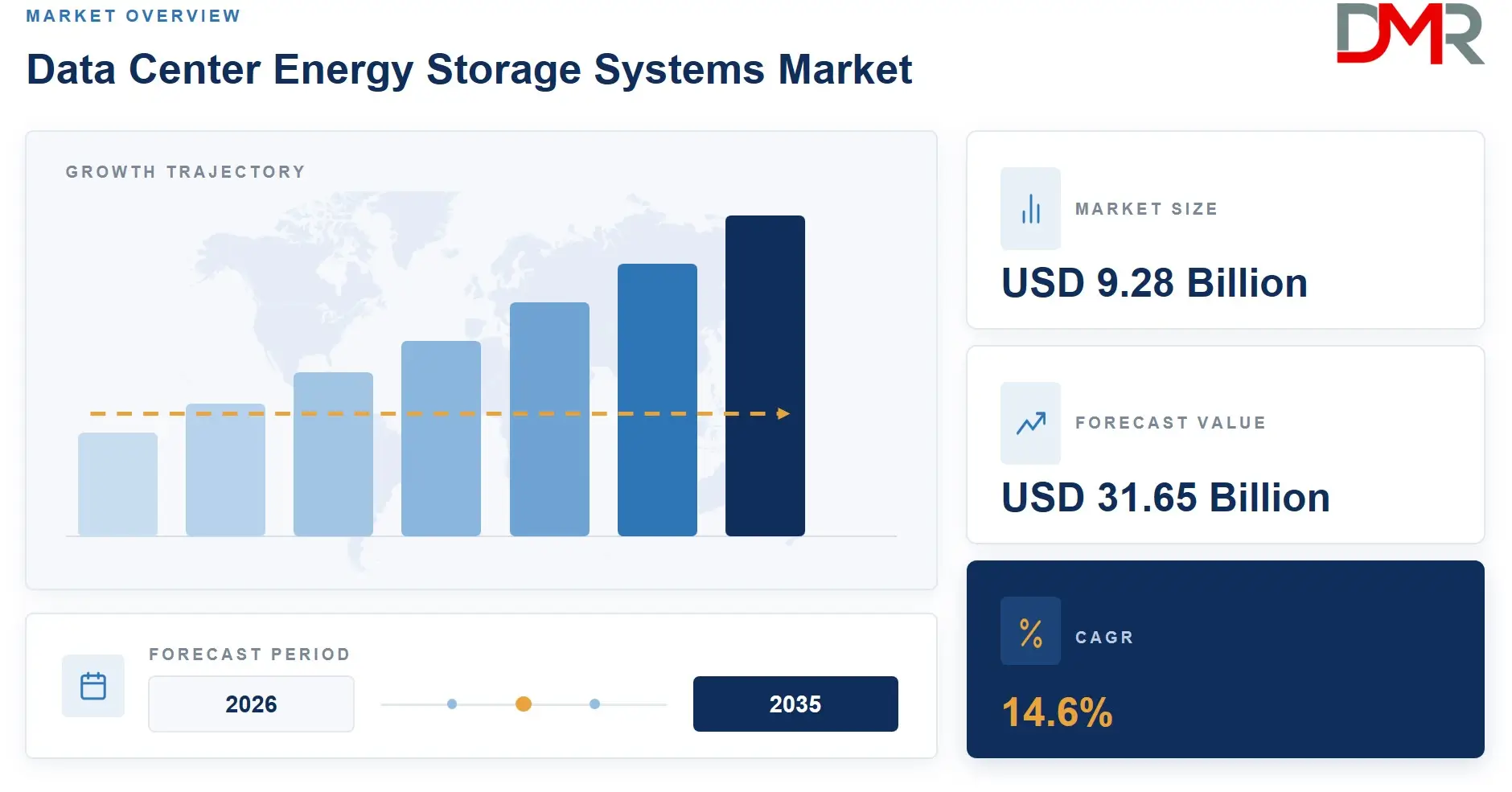
The Global Data Center Energy Storage Systems Market size is estimated at USD 9.28 Billion in 2026, and is projected to reach USD 31.65 Billion by 2035, exhibiting a CAGR of 14.6% during the forecast period. Hyperscale operators built most of today's backup capacity around lead-acid UPS systems designed for short outages, not sustained grid gaps. That model breaks under AI workloads. Rack densities have climbed past what utility interconnects can reliably deliver on demand, forcing operators to treat storage as core infrastructure rather than insurance. Redwood Energy proved the shift is already operational. In June 2025, the company commissioned a 12 MW/63 MWh second-life battery microgrid to power four Crusoe Spark modular data centers in Nevada, and by 2026 that installation had grown to 24 modules with nearly 7 times its original compute capacity.
Redwood Energy reports the microgrid held 99.2% operational availability across its first seven months. This market covers battery, flywheel, supercapacitor, hydrogen, superconducting magnetic, and compressed air storage systems built specifically for data center backup, power quality, and grid-service functions. It excludes generator-based backup and grid-scale storage unconnected to a data center campus.
Grid Scale Energy Storage deployments intersect with this market only where a facility co-locates storage to defer transmission upgrades, a pattern grid operators now formalize into interconnection agreements. Vendors increasingly market storage as a revenue tool, not just a backup layer, stacking demand-response payments on top of resilience value.
ℹ
To learn more about this report –
Download Your Free Sample Report Here
Key Takeaways
- The market size is USD 9.28 Billion in 2026, and is projected to hit USD 31.65 Billion by 2035 at a CAGR of 14.6%.
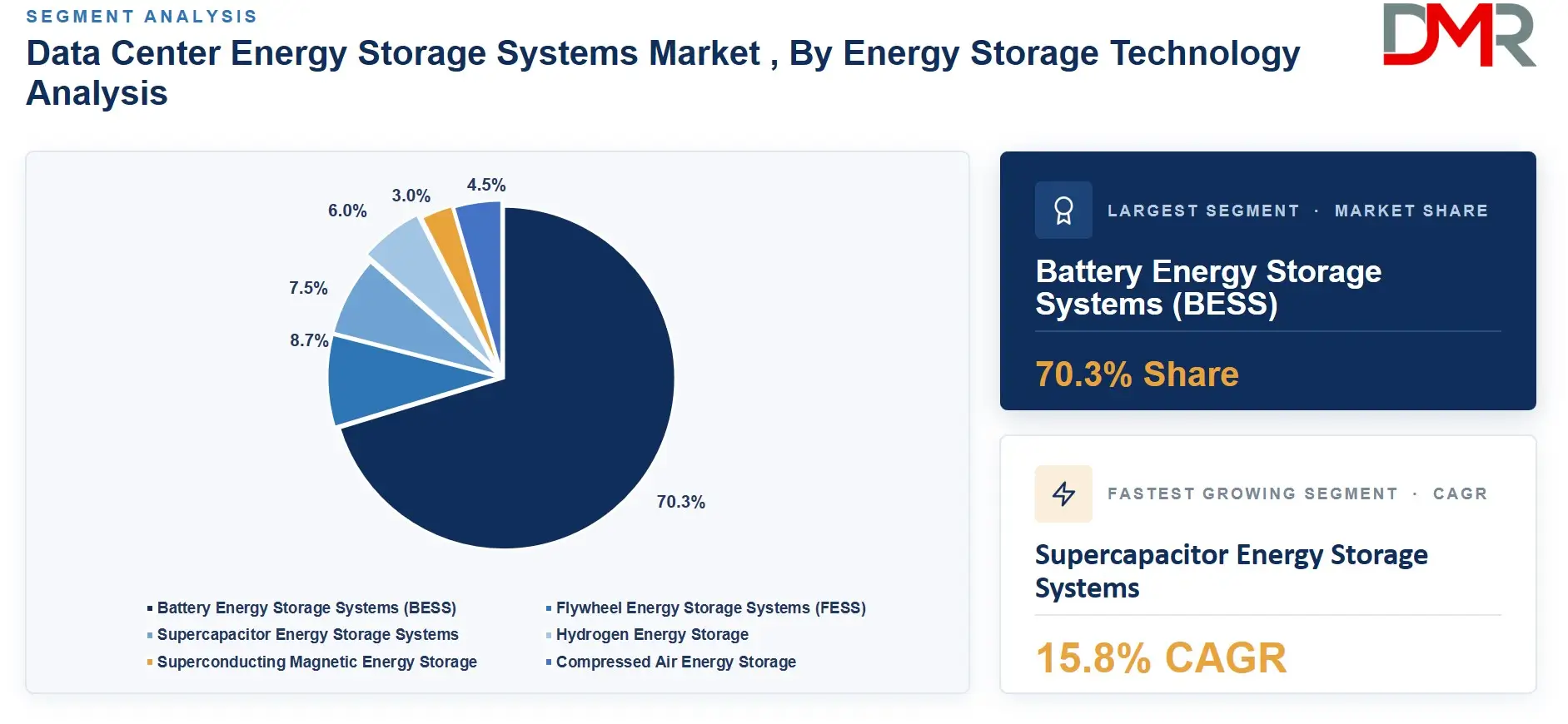
- By Energy Storage Technology: Battery Energy Storage Systems (BESS) led with a 70.3% share in 2026.
- By Data Center Type: Cloud & Hyperscale Data Centers led with a 51.3% share in 2026.
- By Application: Extended Backup Power/UPS Companion led with a 40.6% share in 2026.
- By Power Capacity: 5-20 MW led with a 39.8% share in 2026.
- By Component & Management System: Energy Storage Device led with a 58.1% share in 2026.
- By Enterprise Vertical: IT & Telecommunications led with a 39.2% share in 2026.
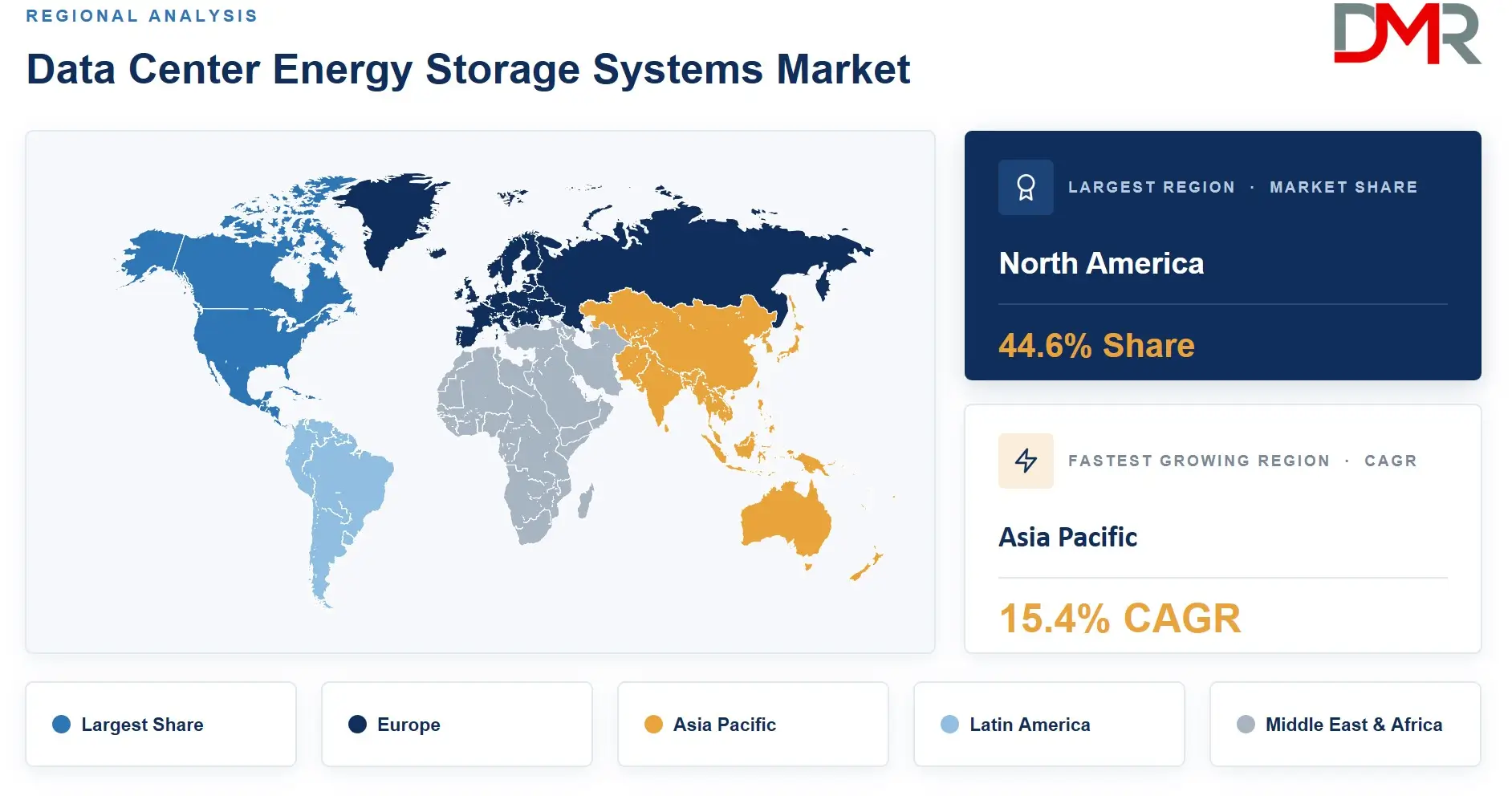
- By Region: North America led with a 44.6% share, valued at USD 3.6 Billion, in 2026.
- Top 5 key players: Tesla, Inc., Contemporary Amperex Technology Co., Limited (CATL), LG Energy Solution, Samsung SDI Co., Ltd., and Vertiv Group Corp.
Energy Storage Technology Analysis
Battery Energy Storage Systems (BESS) captured 70.3% of the energy storage technology segment in 2026, ahead of all rivals. Lithium-ion chemistry dominates because it fits the physical constraints data centers face today. Operators need dense, fast-responding storage that slots into existing UPS rooms without a facility redesign. Huawei's June 2025 rack-mounted battery specification packs 100 Ah at 48V DC into a form factor built for exactly this retrofit pattern. A 2026 survey of 150 data-center professionals found 54% already run lithium batteries in centralized UPS systems, against 36% still on lead-acid. Supercapacitor systems trail badly in share but grow fastest, filling a niche BESS cannot serve well: millisecond-scale power quality events where cycle life matters more than energy density. Flywheel systems hold a similar niche role in high-cycling applications. Hydrogen and compressed air storage remain early-stage, aimed at operators chasing multi-day resilience beyond lithium-ion's discharge limits. Vendors betting on chemistry diversity, not just lithium scale, are positioning for the multi-day backup segment before hyperscalers standardize a single answer.
ℹ
To learn more about this report –
Download Your Free Sample Report Here
Data Center Type Analysis
With a 51.3% share in 2026, Cloud & Hyperscale Data Centers outpaced all other data center type categories. Hyperscalers buy storage at a scale enterprise and colocation operators cannot match, and their AI workloads justify it. Microsoft, Google, and Amazon have made 24/7 carbon-free energy commitments that create binding internal demand for on-site storage to manage clean energy matching, independent of any grid incentive. That demand pulls forward capital spending years ahead of typical enterprise IT budget cycles. Enterprise data centers move more slowly, often waiting for UPS refresh cycles to justify a lithium-ion switch, while colocation operators face a different pressure entirely. Space-constrained urban sites push colocation providers toward compact, high-reliability systems rather than the sprawling battery halls hyperscalers can afford to build. Storage vendors targeting colocation campuses now design around footprint first and capacity second, a reversal of the hyperscale approach.
Application Analysis
Extended Backup Power/UPS Companion accounted for 40.6% of application demand in 2026, the highest of any category. Facility operators buy storage first to solve outage risk, and that priority explains why backup power still commands the largest application share despite growing interest in revenue-generating use cases. A 2025 Vertiv lithium-ion UPS specification delivers 9 minutes of runtime at full load, enough to bridge a generator start without oversizing the battery bank. Peak shaving and load management follow as facilities look to cut demand charges, while renewable integration and grid services attract operators chasing incentive revenue rather than pure resilience. Power quality conditioning protects sensitive AI hardware from voltage sags that batteries alone can smooth out faster than generators. Black start capability remains a smaller category, reserved for facilities that need to restart from a complete outage without external grid support.
Power Capacity Analysis
A 39.8% share made 5-20 MW the clear leader across power capacity categories in 2026. This band matches the typical load profile of a single hyperscale data hall or a mid-size colocation campus, which explains why it outsizes both smaller and larger capacity tiers. Systems below 5 MW serve edge and smaller enterprise sites where footprint and budget constraints rule out anything larger. Demand above 20 MW is growing fastest in absolute terms as AI training clusters push single-site power draw higher, but deployments in that range still require custom engineering that slows adoption relative to the standardized 5-20 MW tier. Systems above 50 MW remain rare, limited to the largest hyperscale campuses running multiple co-located AI clusters off one shared storage asset.
Component & Management System Analysis
Energy Storage Device led the component and management system segment as the largest category in 2026. Battery cells and modules absorb most of the capital spend in any deployment, so this category leads by default even before software and controls are added. Power conversion systems rank second, converting stored DC power into usable AC for critical IT loads, a function every deployment needs regardless of chemistry choice. Energy management and battery management software are growing faster than the hardware categories around them, since operators now expect a single platform to coordinate backup, demand response, and cell health monitoring together. Controls and monitoring systems round out the segment, increasingly bundled into AI-driven platforms rather than sold as standalone components.
Enterprise Vertical Analysis
IT & Telecommunications led the enterprise vertical segment with a 39.2% share in 2026. Cloud service providers and telecom carriers operate the AI training and inference infrastructure driving this entire market, so their storage spend naturally outpaces every other vertical. BFSI and healthcare follow at a distance, both running data centers where uptime requirements justify storage investment but without the AI-driven power density growth reshaping IT and telecom facilities. Manufacturing, e-commerce, and government sectors run smaller data center footprints tied to internal operations rather than public cloud delivery, which caps their storage demand well below the hyperscale-adjacent verticals. Vendors chasing volume are concentrating sales efforts on IT and telecom accounts first, leaving other verticals as a slower-growing but steadier revenue base.
Key Market Segments
By Energy Storage Technology
- Battery Energy Storage Systems (BESS)
- Flywheel Energy Storage Systems (FESS)
- Supercapacitor Energy Storage Systems
- Hydrogen Energy Storage
- Superconducting Magnetic Energy Storage
- Compressed Air Energy Storage
By Data Center Type
- Cloud & Hyperscale Data Centers
- Enterprise Data Centers
- Colocation Data Centers
By Application
- Extended Backup Power/UPS Companion
- Power Quality Conditioning
- Peak Shaving & Load Management
- Renewable Integration & Grid Services
- Black Start
By Power Capacity
- 5-20 MW
- Below 5 MW
- 20-50 MW
- Above 50 MW
By Component & Management System
- Energy Storage Device
- Power Conversion System
- Energy Management System
- Battery Management System
- Controls & Monitoring
By Enterprise Vertical
- IT & Telecommunications
- Cloud service providers
- Telecom carriers
- BFSI
- Healthcare & Life Sciences
- Manufacturing
- E-commerce & Retail
- Government & Public Sector
- Other Verticals
Regional Analysis
North America led the market with a 44.6% share, valued at USD 3.6 Billion, in 2026.
North America
US hyperscalers concentrate more AI training capacity here than anywhere else, and that concentration explains the region's lead better than any policy factor. Meta's May 2026 expansion with Enbridge under the Cowboy Project in Wyoming, a 200 MW / 1,600 MWh solar-paired BESS, shows operators securing dedicated generation and storage rather than waiting on utility queues. Interconnection delays across major US grid operators have made on-site storage a scheduling tool as much as a resilience one.
Asia Pacific
Asia Pacific carries the fastest growth rate in the market despite trailing North America on absolute share. Data center buildouts across China, Japan, South Korea, and India are landing on grids with less spare capacity than the US, so storage adoption follows construction almost immediately rather than arriving as a retrofit years later. Battery cell manufacturers headquartered in the region, including CATL, LG Energy Solution, and Samsung SDI, hold a home-market cost advantage that shortens the payback period for local operators.
ℹ
To learn more about this report –
Download Your Free Sample Report Here
Key Regions and Countries
North America
Europe
- Germany
- France
- The UK
- Spain
- Italy
- Rest of Europe
Asia Pacific
- China
- Japan
- South Korea
- India
- Australia
- Rest of APAC
Latin America
- Brazil
- Mexico
- Rest of Latin America
Middle East & Africa
- GCC
- South Africa
- Rest of MEA
Macroeconomic Impact
Capital costs for battery cells still move with lithium and nickel commodity cycles, and interest rate policy shapes how fast operators can finance gigawatt-hour-scale projects. Frontier Power USA's August 2026 raise of $263 million, backed by Eos Energy and Cerberus, targeted deployment pipelines above 16 GWh, showing private credit markets now treat data center storage as bankable infrastructure rather than a technology bet. Trade policy adds a second variable. Tariff exposure on Chinese battery cells pushes North American and European buyers toward domestic cell manufacturing, a shift Samsung SDI's March 2026 StarPlus Energy plant expansion in the US directly answers.
Market Dynamics
Driver: AI Load Growth Outpaces Grid Capacity
Hyperscaler AI training clusters now demand power densities that exceed what many regional grids can commit to on a fixed interconnection timeline. Operators cannot wait years for a substation upgrade when a training cluster needs power in months, so on-site storage becomes the fastest path to reliable capacity. UPS modernization compounds this driver. Facilities running Tier-3 and Tier-4 infrastructure are replacing lead-acid VRLA systems with lithium-ion, a shift ABB's 2026 PowerValue 11RT G3 UPS reflects directly. ABB reports the unit reaches 96% online-mode efficiency and needs 70% less installation space than the VRLA systems it replaces.
Restraint: Thermal Risk Raises Deployment Cost
Dense lithium-ion installations inside enclosed data center halls raise fire suppression and thermal management costs well above what a comparable lead-acid system required. Facility operators now budget for liquid cooling and fire safety infrastructure as a fixed cost of battery adoption, not an optional upgrade. Mission-critical facilities requiring multi-day backup face a second constraint. Long-duration load requirements exceed the economic viability of pure lithium-ion configurations without pairing in a second chemistry, which raises system complexity and slows deployment decisions.
Opportunity: Hybrid Chemistry Unlocks Multi-Day Resilience
Meta's April 2026 agreement with Noon Energy to reserve up to 1 GW / 100 GWh of ultra-long-duration reversible solid-oxide storage signals where the next wave of capital is heading. Operators chasing resilience beyond lithium-ion's typical discharge window are pairing battery storage with fuel cells or hydrogen systems rather than replacing it outright. Emerging markets present a parallel opening. Grid instability across Africa, Southeast Asia, and the Middle East makes on-site storage a requirement rather than an enhancement for any new hyperscale buildout in those regions, giving vendors with modular, fast-deploy systems an early foothold before local competitors scale.
Porter's Five Forces
New entrants face a steep barrier because hyperscale contracts demand proven megawatt-hour track records, but modular BESS platforms are lowering that bar for smaller specialists targeting colocation and edge sites. Battery cell suppliers, dominated by CATL, LG Energy Solution, and Samsung SDI, hold strong bargaining power given constrained global cell manufacturing capacity, though Samsung SDI's 2026 US plant expansion signals buyers pushing back through geographic diversification. Buyer power concentrates heavily with hyperscalers like Meta and Google, whose gigawatt-scale orders let them dictate chemistry, financing terms, and delivery schedules to vendors. Substitutes remain limited since generator-only backup cannot meet carbon-free energy commitments or grid-service revenue goals, though fuel cell systems from providers like Bloom Energy compete directly with battery storage for multi-day resilience budgets. Competitive rivalry runs high across established players such as Tesla, Vertiv, and Eaton, intensified by consolidation moves like T1 Energy's June 2026 acquisition of KORE Power to scale AI data center infrastructure exposure quickly.
AI and Gen AI Impact
AI workloads created this market's growth curve directly, and AI now also manages the storage systems built to serve it. AI-optimized battery management systems let operators run simultaneous UPS backup, demand charge reduction, and grid service revenue stacking from a single asset, a function manual control systems could not coordinate at this speed. A 2026 UCLA simulation found that coordinating data center UPS storage with workload modulation produced a power response in 0.15 seconds, reducing frequency-nadir deviation by 57% under a simulated 200 MW generation loss. Early movers deploying this coordination capture grid-service revenue that laggards running static, uncoordinated storage cannot access.
Market Trends
Modular Storage Shifts From CapEx to OpEx
Containerized BESS platforms let operators expand capacity in phases tied to actual load growth rather than overbuilding upfront. Battery-as-a-Service financing models are accelerating this shift, converting storage from a capital expense into an operating cost that lowers the entry barrier for owner-operators with constrained budgets. Vertiv's March 2026 partnership with Generate Capital, bundling microgrids and BESS under a combined power and cooling model, shows financing structure becoming as important a competitive lever as the hardware itself.
Market Competition Overview
The market stays fragmented across battery cell manufacturers, UPS integrators, and pure-play storage specialists, none of which control enough share to set pricing unilaterally. Cell manufacturers hold the deepest structural advantage because they control the input costs every downstream integrator depends on, letting them expand into finished systems from a position of cost leadership. Consolidation is accelerating faster than share data alone suggests. Acquisitions like T1 Energy's purchase of a private BESS and software provider signal established players buying their way into AI data center exposure rather than building it organically, a faster but costlier path to scale. Vendors bundling storage with grid-service software, rather than selling hardware alone, are pulling ahead of pure hardware suppliers on contract value.
Pricing Analysis
Pricing varies sharply by chemistry and duration requirement, with standard lithium-ion BESS priced on a straightforward dollar-per-kWh basis while hybrid and long-duration systems command a premium tied to their resilience guarantee. A 2025 MIT techno-economic assessment calculated levelized electricity costs for data center renewable-and-storage configurations ranging from $27.50/MWh to over $100/MWh, depending on system design and grid interaction assumptions. Market leaders with vertical integration into cell manufacturing, such as CATL and LG Energy Solution, can undercut challengers who buy cells on the open market. Financing innovation, not just unit cost, increasingly separates competitive pricing strategies, as Battery-as-a-Service models let vendors compete on total cost of ownership rather than sticker price alone.
Company Profiles
Tesla, Inc. leverages its Megapack manufacturing scale to win the largest single deployments in the market, evidenced by its June 2026 launch with NatPower of a $5 billion project to deploy 25 GWh of Megapacks across Italy and the UK for data center load. That scale gives Tesla cost leadership on standard lithium-ion BESS but leaves it less positioned in emerging hybrid chemistry niches where smaller specialists compete on technical differentiation rather than volume. Vertiv Group Corp. built its position around UPS integration rather than cell manufacturing, launching EnergyCore Grid in December 2025 as a utility-grade modular BESS using lithium iron phosphate chemistry engineered for rapid AI thermal workloads. Vertiv's April 2026 integration of EnergyCore Grid with CPower's virtual power plant platform extends that hardware into a grid-service revenue product, a strategy that locks in recurring software revenue beyond the initial hardware sale.
Key Players
- Tesla, Inc.
- Contemporary Amperex Technology Co., Limited (CATL)
- LG Energy Solution
- Samsung SDI Co., Ltd.
- Panasonic Holdings Corporation
- BYD Company Ltd.
- Schneider Electric SE
- Vertiv Group Corp.
- Eaton Corporation
- ABB Ltd.
- Siemens Energy AG
- Delta Electronics, Inc.
- Hitachi Energy Ltd.
- Fluence Energy, Inc.
- Saft
- ZincFive, Inc.
- Active Power, Inc.
- Skeleton Technologies
- Piller Power Systems (Langley Holdings)
- Caterpillar Inc.
Supply Chain and Value Chain Analysis
Raw material extraction for lithium, nickel, and cobalt feeds cell manufacturers like CATL and Samsung SDI, who supply modules to system integrators such as Vertiv and Schneider Electric. Those integrators pair cells with power conversion systems and battery management software before deploying complete systems into hyperscale, enterprise, and colocation facilities. Maximum value concentrates at the cell manufacturing stage, where control over chemistry and cost sets the ceiling for everyone downstream. The biggest bottleneck sits at the same point. Global cell manufacturing capacity has not scaled as fast as data center demand, forcing buyers like Samsung SDI's US customers to fund domestic plant expansions rather than rely on import supply alone.
Regulatory Landscape
Insufficient data provided for this section.
Investment and White Space Analysis
Capital is concentrating in hybrid and long-duration chemistry, evidenced by Meta's reservation of gigawatt-scale reversible solid-oxide storage from Noon Energy and Bloom Energy's $5 billion fuel cell partnership. Standard lithium-ion BESS increasingly looks commoditized next to these bets. Edge and colocation facilities remain underserved because most vendor engineering still targets hyperscale-scale deployments, leaving compact, space-constrained storage systems as a gap smaller specialists can fill. Emerging markets in Africa, Southeast Asia, and the Middle East offer the clearest high-growth, low-competition entry point, since grid instability there makes on-site storage a requirement from day one of any hyperscale buildout rather than a later retrofit decision.
Recent Developments
- April 2026 Vertiv integrated its EnergyCore Grid with CPower's virtual power plant platform, letting data center BESS assets dynamically participate in demand-response grid services.
- March 2026 Vertiv partnered with Generate Capital to introduce a combined microgrid and BESS model for grid-constrained data centers.
- October 2025 Bloom Energy secured a $5 billion strategic partnership to deploy off-grid fuel cell technology for high-density AI data center workloads.
- July 2025 Eaton Corporation plc signed an agreement to acquire Resilient Power Systems Inc., expanding into solid-state transformer technology.
- September 2026 Google, MN8 Energy, and Eos Energy Enterprises co-invested in a hybrid zinc-lithium storage project in West Virginia for planned digital infrastructure.
- June 2026 Tesla, Inc. and NatPower launched the first phase of a project to deploy 25 GWh of Megapacks across Italy and the UK for data center load.
- June 2026 Schneider Electric debuted the ASCO 300 Series Multi-Voltage Transfer Switch to streamline backup configurations across battery-based UPS frameworks.
- March 2026 Panasonic Energy announced an expansion in lithium-ion manufacturing output to address global supply gaps for data center backup systems.
- December 2025 Vertiv launched EnergyCore Grid, a utility-grade modular BESS using lithium iron phosphate chemistry for rapid AI thermal workloads.
- July 2024 LG Energy Solution introduced a high-efficiency lithium-ion UPS battery solution to displace lead-acid architecture in critical IT infrastructure.
Report Details
| Report Characteristics |
| Market Value (2026) |
USD 9.28 Billion |
| Forecast Revenue (2035) |
USD 31.65 Billion |
| CAGR (2026–2035) |
14.6% |
| Base Year for Estimation |
2025 |
| Historic Period |
2020 – 2024 |
| Forecast Period |
2026 – 2035 |
| Report Coverage |
Revenue Forecast, Market Dynamics, Competitive Landscape, Recent Developments |
| Segments Covered |
By Energy Storage Technology (BESS, FESS, Supercapacitor, Hydrogen, Superconducting Magnetic, Compressed Air), By Data Center Type (Cloud & Hyperscale, Enterprise, Colocation), By Application (Extended Backup Power/UPS Companion, Power Quality Conditioning, Peak Shaving & Load Management, Renewable Integration & Grid Services, Black Start), By Power Capacity (Below 5 MW, 5-20 MW, 20-50 MW, Above 50 MW), By Component & Management System (Energy Storage Device, Power Conversion System, Energy Management System, Battery Management System, Controls & Monitoring), By Enterprise Vertical (IT & Telecommunications, BFSI, Healthcare & Life Sciences, Manufacturing, E-commerce & Retail, Government & Public Sector, Other Verticals) |
| Regional Analysis |
North America – US and Canada; Europe – Germany, France, The UK, Spain, Italy, and Rest of Europe; Asia Pacific – China, Japan, South Korea, India, Australia, and Rest of APAC; Latin America – Brazil, Mexico, and Rest of Latin America; Middle East & Africa – GCC, South Africa, and Rest of MEA |
| Competitive Landscape |
Tesla Inc., CATL, LG Energy Solution, Samsung SDI, Panasonic Holdings, BYD, Schneider Electric, Vertiv, Eaton, ABB, Siemens Energy, Delta Electronics, Hitachi Energy, Fluence Energy, Saft, ZincFive, Active Power, Skeleton Technologies, Piller Power Systems, Caterpillar |
| Customization Scope |
Customization for segments and region or country level will be provided. Additional customization can be done based on requirements. |
| Purchase Options |
Three license options: Single User License, Multi-User License (Up to 5 Users), and Corporate Use License (Unlimited Users and Printable PDF) |
Frequently Asked Questions
What is the biggest investment opportunity in the Data Center Energy Storage Systems market?
▾ Hybrid and long-duration chemistry paired with battery storage offers the clearest opening, backed by commitments like Meta's 1 GW / 100 GWh Noon Energy reservation for multi-day resilience. Edge and colocation deployments also remain underserved relative to hyperscale demand.
Who are the top companies in the Data Center Energy Storage Systems market?
▾ Tesla, Inc., CATL, LG Energy Solution, Samsung SDI, and Vertiv Group Corp. lead the market on scale and integration depth. Vertiv differentiates through UPS integration and grid-service software rather than cell manufacturing.
Which segment is growing fastest in the Data Center Energy Storage Systems market and why?
▾ Supercapacitor Energy Storage Systems grow fastest within technology segments, filling millisecond-response power quality gaps that battery systems handle less efficiently. IT & Telecommunications leads enterprise vertical growth at a 39.2% share, driven by cloud provider AI workload expansion.
Which region is growing fastest in the Data Center Energy Storage Systems market and why?
▾ Asia Pacific grows fastest as hyperscale buildouts in China, India, and South Korea land on grids with less spare capacity than North America. Local cell manufacturing from CATL, LG Energy Solution, and Samsung SDI shortens payback periods for regional operators.
What is the biggest challenge holding in the Data Center Energy Storage Systems market back?
▾ Thermal management complexity in dense lithium-ion deployments raises fire suppression and safety costs well above prior lead-acid systems. Long-duration critical load requirements also exceed standard lithium-ion economic viability without added hybrid chemistry investment.