Market Overview
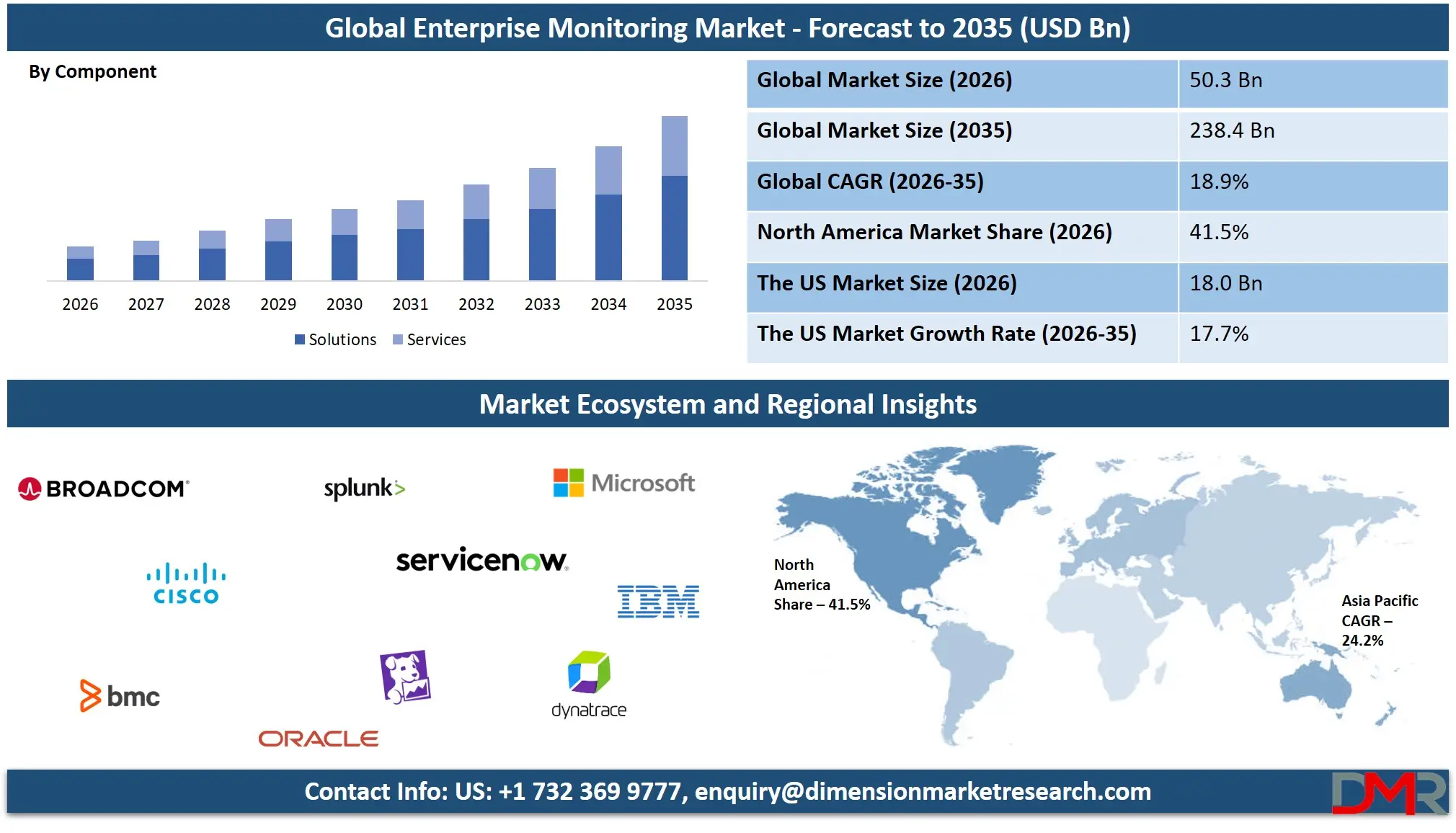
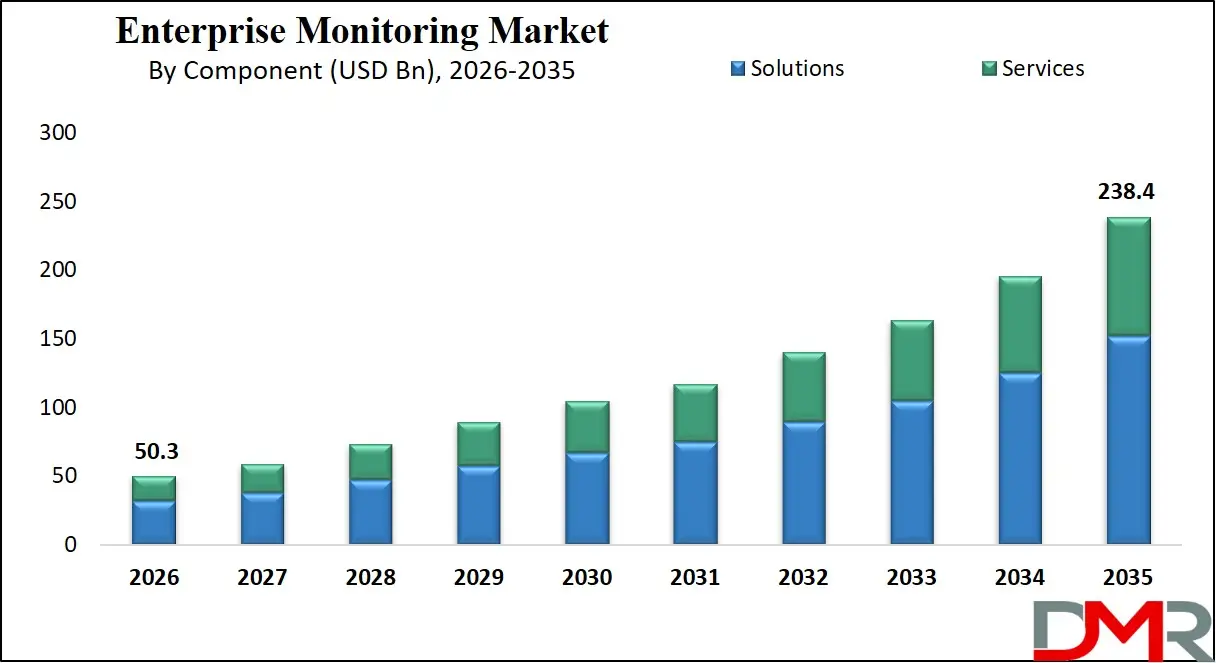
The Global Enterprise Monitoring Market size is projected to reach USD 50.3 billion in 2026 and grow at a compound annual growth rate of 18.9% to reach a value of USD 238.4 billion in 2035.
ℹ
To learn more about this report –
Download Your Free Sample Report Here
Enterprise monitoring refers to the integrated process of tracking, analyzing, and managing the performance, availability, and security of IT infrastructure, applications, networks, and digital services across an organization. It involves the use of advanced software platforms, analytics tools, and automated monitoring systems that collect data from multiple endpoints, including servers, cloud environments, databases, and user interfaces. These systems help organizations detect anomalies, maintain operational continuity, and ensure that digital services function efficiently across complex enterprise ecosystems.
The concept has become increasingly important as enterprises adopt cloud computing, hybrid IT infrastructures, and distributed applications. Modern monitoring frameworks rely on technologies such as artificial intelligence, machine learning, predictive analytics, and automation to provide real-time visibility and faster incident resolution. Organizations are increasingly shifting toward unified monitoring platforms that integrate infrastructure monitoring, application performance monitoring, and user experience monitoring into a single environment to enhance operational intelligence and system resilience.
ℹ
To learn more about this report –
Download Your Free Sample Report Here
Growing digital transformation initiatives, expanding cloud deployments, and rising demand for proactive IT management have accelerated the adoption of enterprise monitoring capabilities. Organizations across industries are focusing on improving system uptime, reducing downtime costs, and ensuring cybersecurity compliance. As businesses depend more on digital platforms for operations and customer engagement, the need for scalable and intelligent monitoring frameworks continues to expand, shaping the evolution of enterprise IT management strategies.
The US Enterprise Monitoring Market
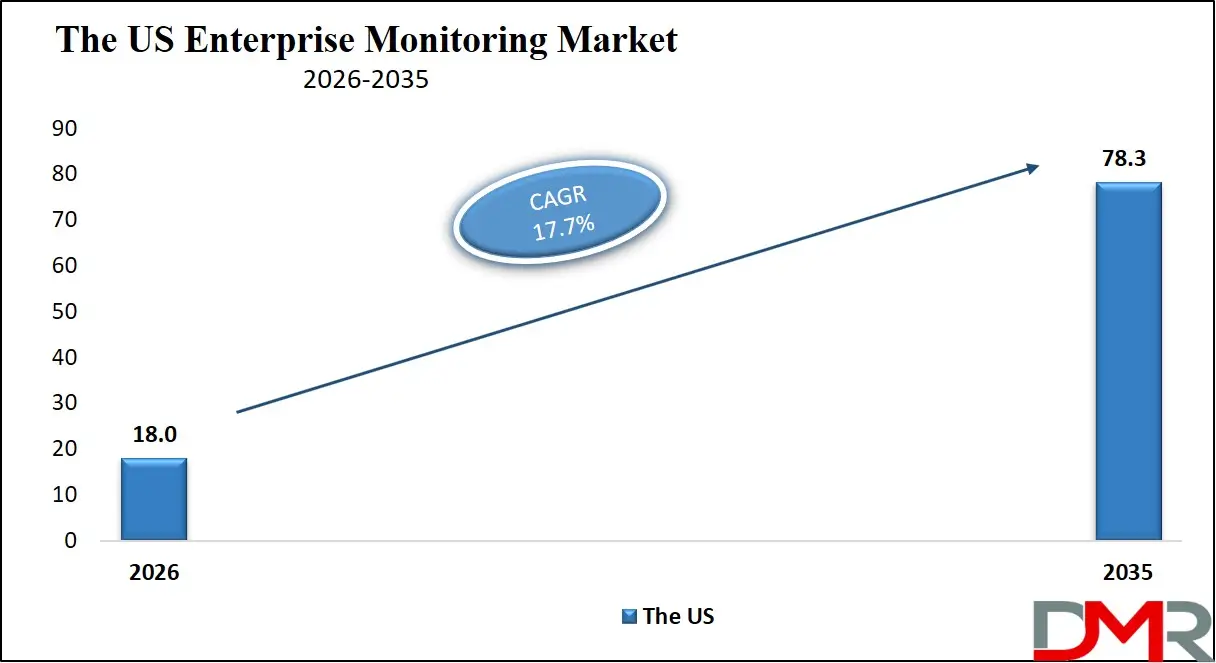
The US Enterprise Monitoring Market size is projected to reach USD 18.0 billion in 2026 at a compound annual growth rate of 17.7% over its forecast period.
ℹ
To learn more about this report –
Download Your Free Sample Report Here
The US represents one of the most advanced environments for enterprise monitoring adoption due to its highly developed digital infrastructure and strong presence of technology-driven enterprises. Organizations in sectors such as IT services, financial institutions, healthcare systems, and e-commerce platforms rely heavily on monitoring tools to maintain service reliability and cybersecurity resilience. Rapid adoption of cloud computing, microservices architecture, and hybrid IT environments has increased the need for integrated monitoring platforms capable of analyzing vast amounts of operational data in real time. Regulatory requirements related to data protection and system security also encourage enterprises to invest in robust monitoring frameworks. Additionally, large-scale investments in AI-driven observability tools and automation technologies are accelerating the deployment of intelligent monitoring solutions across enterprises.
Europe Enterprise Monitoring Market
Europe Enterprise Monitoring Market size is projected to reach USD 11.1 billion in 2026 at a compound annual growth rate of 17.5% over its forecast period.
Europe's enterprise monitoring ecosystem is influenced strongly by regulatory frameworks, digital transformation initiatives, and sustainability-focused policies across the region. Strict data protection laws and compliance frameworks have encouraged organizations to implement advanced monitoring tools that provide transparency, traceability, and real-time system insights. Enterprises across industries such as banking, telecommunications, manufacturing, and public sector services are adopting integrated monitoring platforms to manage increasingly complex digital infrastructures. Regional initiatives aimed at digital innovation and cloud adoption are also driving demand for scalable monitoring systems that support hybrid and multi-cloud architectures. The growing emphasis on cybersecurity resilience and operational efficiency has further encouraged organizations to deploy unified observability platforms capable of monitoring applications, networks, and user experiences simultaneously.
Japan Enterprise Monitoring Market
Japan Enterprise Monitoring Market size is projected to reach USD 2.3 billion in 2026 at a compound annual growth rate of 18.7% over its forecast period.
Japan's enterprise monitoring ecosystem is evolving rapidly due to the country's strong technological foundation and continuous digital transformation across industrial sectors. Businesses are increasingly adopting monitoring platforms to support large-scale automation, smart manufacturing, and digital services. The country's emphasis on technological innovation and operational efficiency has driven demand for real-time infrastructure monitoring, application performance tracking, and network visibility solutions. Organizations are investing in intelligent monitoring systems that leverage analytics and automation to reduce downtime and improve service reliability. At the same time, expanding cloud adoption and modernization of legacy IT systems are creating opportunities for advanced monitoring frameworks capable of supporting hybrid infrastructures. The focus on high-quality digital services and operational precision continues to accelerate enterprise monitoring adoption across Japan.
Enterprise Monitoring Market: Key Takeaways
- Market Growth: The Enterprise Monitoring Market size is expected to grow by USD 179.6 billion, at a CAGR of 18.9%, during the forecasted period of 2027 to 2035.
- By Component: The solutions segment is anticipated to get the majority share of the Enterprise Monitoring market in 2026.
- By Deployment Mode: The cloud segment is expected to get the largest revenue share in 2026 in the Enterprise Monitoring market.
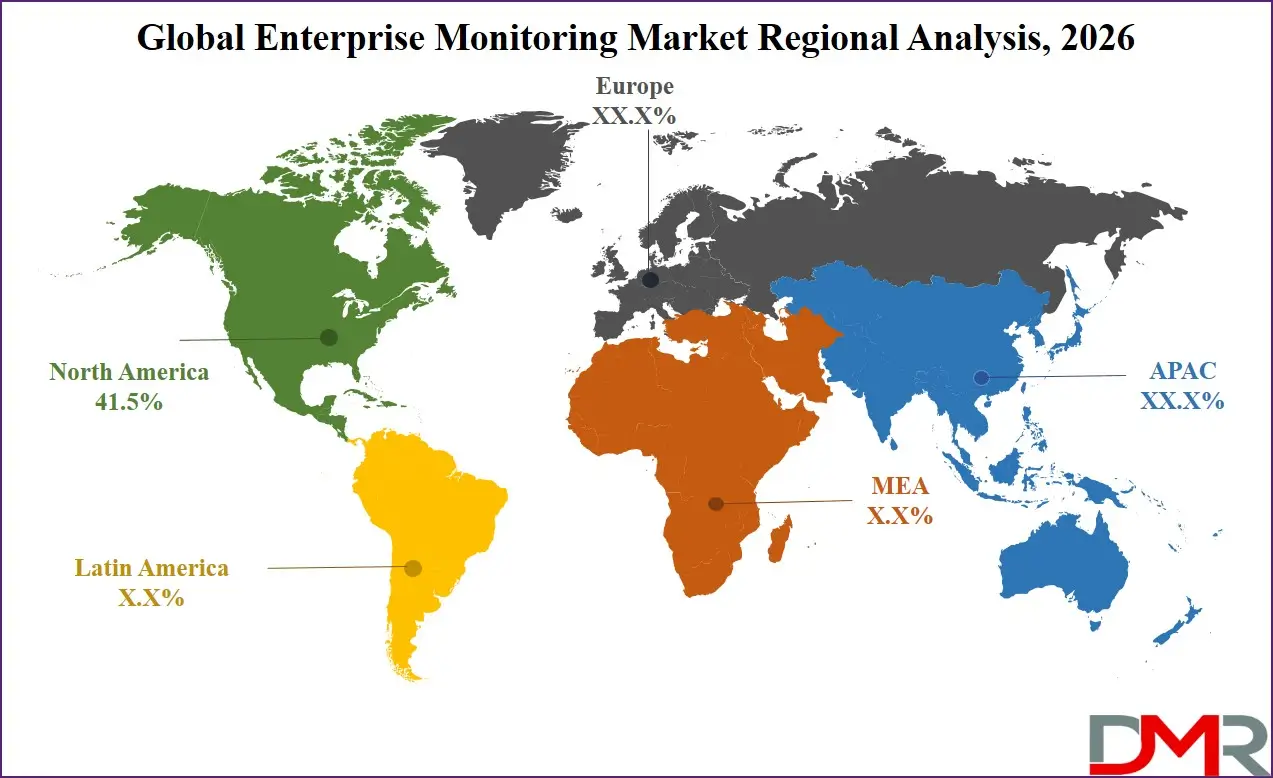
- Regional Insight: North America is expected to hold a 41.5% share of revenue in the global Enterprise Monitoring market in 2026.
- Use Cases: Some of the use cases of Enterprise Monitoring include IT infrastructure management, application performance optimization, and more.
Enterprise Monitoring Market: Use Cases
- IT Infrastructure Management: Organizations deploy monitoring tools to track servers, storage systems, virtualization environments, and data center operations. This enables real-time visibility into system performance and ensures high availability of enterprise infrastructure.
- Application Performance Optimization: Enterprises monitor application behavior, response time, and transaction flows to identify bottlenecks. This helps maintain application stability and improves digital service delivery for customers and internal users.
- Cybersecurity and Threat Detection: Monitoring systems analyze network traffic, access patterns, and system anomalies to detect potential security threats. This enhances an organization's ability to respond quickly to cyber incidents.
- Cloud Environment Management: Enterprises use monitoring platforms to oversee workloads across public, private, and hybrid cloud environments. This ensures optimal resource utilization and supports cloud infrastructure scalability.
- Digital Experience Monitoring: Organizations monitor end-user interactions with digital platforms such as websites, applications, and online services to ensure seamless user experiences and improve customer satisfaction.
- Network Performance Monitoring: Monitoring solutions track bandwidth usage, latency, packet loss, and network device performance to ensure reliable connectivity across enterprise networks.
- Compliance and Regulatory Reporting: Monitoring tools collect operational data required for regulatory audits, helping enterprises maintain compliance with industry standards and data protection policies.
Stats & Facts
- U.S. Bureau of Labor Statistics reported that the United States employed over 1.6 million software developers in 2024, reflecting expanding enterprise software ecosystems.
- International Telecommunication Union estimated that 5.5 billion people globally used the internet in 2024, driving the need for reliable digital infrastructure monitoring.
- Eurostat stated that 45% of European enterprises used cloud computing services in 2024, increasing the need for integrated monitoring solutions.
- U.S. National Institute of Standards and Technology reported that over 70% of federal IT systems required continuous monitoring frameworks in 2025 for cybersecurity compliance.
- Japan Ministry of Internal Affairs and Communications reported that over 74% of Japanese enterprises adopted cloud services in 2024.
- OECD indicated that more than 60% of large enterprises globally implemented advanced data analytics platforms by 2025.
- World Bank stated that global digital economy activities contributed over 15% to global GDP in 2024.
- European Commission reported that over 80% of EU enterprises used digital technologies for operations in 2025.
- U.S. Cybersecurity and Infrastructure Security Agency noted that cyber incident monitoring programs expanded across critical sectors in 2025.
- International Data Corporation estimated that global data creation exceeded 180 zettabytes in 2025, increasing demand for monitoring and observability platforms.
- United Nations Conference on Trade and Development reported that global e-commerce sales surpassed USD 30 trillion in 2024, increasing reliance on digital infrastructure monitoring.
- World Economic Forum stated that over 85% of enterprises accelerated digital transformation initiatives by 2025.
Market Dynamic
Driving Factors in the Enterprise Monitoring Market
Expansion of Cloud and Hybrid IT Infrastructure
The widespread adoption of cloud computing and hybrid IT environments is a major factor accelerating enterprise monitoring adoption. Organizations are increasingly migrating workloads to cloud platforms while maintaining some infrastructure on-premises, creating complex distributed environments that require real-time visibility. Monitoring tools help track application performance, resource utilization, and network activity across multiple environments. Enterprises rely on these solutions to ensure system availability, detect performance bottlenecks, and maintain operational efficiency. Additionally, the growth of containerization technologies and microservices architectures has increased the need for advanced monitoring frameworks capable of analyzing dynamic workloads across cloud-native environments.
Growing Demand for Operational Visibility and Business Continuity
Enterprises are placing greater emphasis on maintaining uninterrupted digital operations as businesses become more dependent on online services and data-driven systems. Monitoring platforms allow organizations to track system health, detect anomalies, and prevent potential outages before they impact operations. Proactive monitoring reduces downtime costs and ensures continuous availability of mission-critical applications. As enterprises expand digital platforms and customer-facing services, monitoring tools provide the operational intelligence needed to maintain performance standards, improve customer experiences, and support long-term business continuity strategies.
Restraints in the Enterprise Monitoring Market
High Implementation Complexity and Integration Challenges
Enterprise monitoring systems often require integration with multiple IT environments, legacy systems, and cloud platforms, which can make implementation complex. Organizations may need specialized expertise to configure monitoring tools, establish data pipelines, and ensure compatibility with existing infrastructure. The complexity increases when enterprises operate across hybrid or multi-cloud environments, where monitoring solutions must collect data from numerous sources. Integration challenges can slow deployment timelines and increase operational costs, especially for organizations that lack dedicated IT resources or experience in advanced monitoring frameworks.
Data Overload and Alert Fatigue
Modern enterprise monitoring platforms generate large volumes of performance data and alerts. Without effective filtering and prioritization mechanisms, IT teams may experience alert fatigue, where frequent notifications reduce the ability to identify critical issues quickly. Excessive alerts can lead to delayed responses, inefficient incident management, and reduced productivity among IT staff. Organizations must implement intelligent monitoring strategies that use automation, analytics, and machine learning to categorize alerts and highlight the most critical system events. Failure to manage this data effectively can limit the value of enterprise monitoring solutions.
Opportunities in the Enterprise Monitoring Market
Integration of Observability and Advanced Analytics
The shift from traditional monitoring toward full observability platforms presents a major opportunity for market expansion. Observability integrates metrics, logs, and traces to provide deeper insights into system behavior. By combining monitoring tools with advanced analytics and machine learning capabilities, organizations can detect anomalies faster, predict failures, and optimize infrastructure performance. Enterprises adopting modern DevOps and continuous deployment practices are increasingly seeking observability platforms that support rapid software development while maintaining operational stability.
Growth of Digital Transformation Across Industries
Digital transformation initiatives across sectors such as healthcare, banking, manufacturing, and retail are generating new demand for enterprise monitoring solutions. As organizations modernize their IT systems and adopt digital platforms for operations and customer engagement, maintaining system performance becomes critical. Monitoring solutions enable enterprises to manage complex IT ecosystems while ensuring reliability, security, and scalability. Expanding adoption of smart technologies, connected devices, and real-time analytics platforms is expected to create significant opportunities for monitoring solution providers.
Trends in the Enterprise Monitoring Market
Rise of AI-Driven Observability Platforms
Artificial intelligence is becoming an essential component of enterprise monitoring platforms. AI-driven systems can analyze vast amounts of operational data to identify patterns, predict potential failures, and automate incident response processes. These platforms reduce manual intervention while improving the speed and accuracy of system diagnostics. Organizations are increasingly adopting intelligent monitoring tools that integrate AI algorithms to enhance visibility across complex IT infrastructures.
Increasing Adoption of Unified Monitoring Platforms
Enterprises are moving toward unified monitoring solutions that combine infrastructure monitoring, application performance monitoring, network monitoring, and digital experience monitoring within a single platform. This trend reduces the need for multiple monitoring tools and simplifies IT management. Unified platforms allow organizations to correlate data across different systems, improving the ability to diagnose performance issues and optimize operations. As enterprise IT environments become more complex, integrated monitoring platforms are becoming essential for efficient system management.
Impact of Artificial Intelligence in Enterprise Monitoring Market
- Predictive System Failure Detection: AI analyzes historical performance data to predict potential system failures before they occur, helping organizations prevent downtime and maintain operational continuity.
- Automated Incident Response: AI-driven monitoring platforms can automatically trigger corrective actions, reducing manual intervention and accelerating problem resolution.
- Anomaly Detection: Machine learning algorithms detect unusual patterns in network traffic, system performance, or application behavior, improving threat detection and operational stability.
- Intelligent Alert Management: AI helps prioritize alerts by analyzing severity and impact, reducing alert fatigue and enabling IT teams to focus on critical incidents.
- Root Cause Analysis: AI systems can trace performance issues across infrastructure layers to identify the exact source of problems faster than manual analysis.
- Capacity Planning Optimization: AI-driven insights help organizations forecast infrastructure demand and optimize resource allocation across cloud and on-premises environments.
- Enhanced Security Monitoring: AI improves security monitoring by detecting suspicious behavior and identifying potential cyber threats in real time.
- Operational Efficiency Improvement: Automation and predictive analytics reduce operational workload for IT teams and improve infrastructure management efficiency.
- User Experience Optimization: AI analyzes user interaction data to identify performance issues affecting digital services and enhance overall customer experience.
Research Scope and Analysis
By Component Analysis
Solutions are expected to hold the dominant position in the enterprise monitoring ecosystem, accounting for 63.8% of the total share in 2026. Enterprises increasingly rely on integrated monitoring platforms that provide real-time visibility across infrastructure, applications, networks, and databases. These platforms offer centralized dashboards, analytics tools, automated alerts, and performance diagnostics that help IT teams maintain operational stability. The growth of hybrid and multi-cloud environments has further increased the need for comprehensive monitoring solutions capable of managing distributed workloads and dynamic infrastructures. Additionally, organizations adopting DevOps and continuous integration practices require monitoring tools that support rapid software deployment and system optimization. The demand for advanced monitoring solutions is also driven by the need to improve cybersecurity resilience, ensure regulatory compliance, and maintain high service availability across digital platforms.
Services are expected to experience rapid expansion as organizations seek expert support for implementing and managing monitoring frameworks. Many enterprises lack the internal expertise required to configure complex monitoring systems and integrate them with existing IT environments. Professional services assist organizations in designing monitoring architectures, customizing dashboards, and optimizing performance tracking processes. Managed services are also gaining traction as companies outsource monitoring operations to specialized providers. This allows enterprises to focus on core business activities while ensuring continuous infrastructure monitoring and incident management. The growing complexity of hybrid IT environments and increasing reliance on cloud infrastructure are key factors driving the adoption of enterprise monitoring services.
By Deployment Mode Analysis
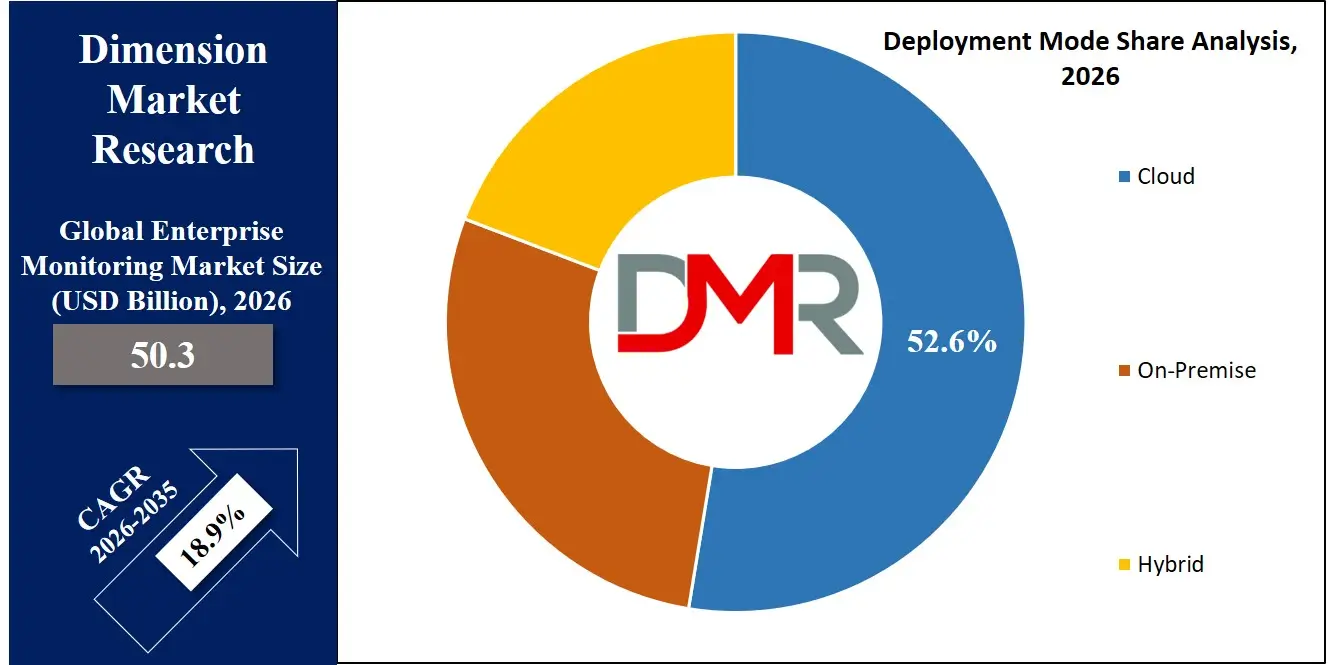
Cloud deployment is projected to dominate the enterprise monitoring ecosystem with 52.6% share in 2026. The increasing shift toward cloud infrastructure has encouraged enterprises to adopt monitoring platforms designed specifically for cloud environments. Cloud-based monitoring solutions provide scalability, remote accessibility, and real-time analytics capabilities that enable organizations to monitor distributed workloads across multiple locations. These platforms support dynamic cloud environments where applications and services frequently scale up or down based on demand. Additionally, cloud monitoring tools offer advanced features such as automated performance analysis, predictive analytics, and centralized data visualization dashboards. The rapid expansion of public and private cloud services, along with growing adoption of hybrid IT architectures, continues to strengthen the demand for cloud-based enterprise monitoring solutions.
ℹ
To learn more about this report –
Download Your Free Sample Report Here
Hybrid deployment models are witnessing strong growth as enterprises seek flexibility in managing both on-premises infrastructure and cloud environments. Hybrid monitoring platforms enable organizations to maintain visibility across legacy systems while leveraging the scalability and analytics capabilities of cloud-based monitoring tools. Many large enterprises prefer hybrid deployment strategies to maintain control over sensitive data while benefiting from modern monitoring technologies. As businesses continue modernizing their IT environments, hybrid monitoring frameworks allow seamless integration between traditional infrastructure and cloud-native applications. The need to manage complex, multi-platform IT ecosystems is expected to accelerate the adoption of hybrid deployment models.
By Monitoring Type Analysis
Infrastructure monitoring is expected to account for 27.4% share in 2026, making it the largest monitoring category. Enterprises rely heavily on infrastructure monitoring to track the performance of servers, storage systems, virtualization environments, and data centers. These tools provide real-time insights into hardware performance, system utilization, and resource allocation. Infrastructure monitoring platforms enable organizations to detect hardware failures, manage capacity planning, and maintain operational continuity. As digital services become critical to business operations, ensuring the reliability of underlying infrastructure has become a top priority. The growth of data centers, virtualization technologies, and cloud-based infrastructure is further driving demand for advanced infrastructure monitoring solutions.
Application performance monitoring (APM) is emerging as one of the fastest-growing monitoring categories due to the increasing importance of digital applications in enterprise operations. APM tools track application response time, transaction flows, and system dependencies to ensure optimal performance. With businesses relying on web applications, mobile platforms, and digital services to engage customers, maintaining application stability is essential. The adoption of microservices architectures and containerized applications has also increased the need for advanced APM solutions capable of tracking performance across complex software environments.
By Organization Size Analysis
Large enterprises are expected to account for 68.9% of the enterprise monitoring ecosystem in 2026 due to their extensive IT infrastructures and complex operational environments. These organizations typically operate multiple data centers, cloud platforms, and enterprise applications that require continuous monitoring to maintain performance and security. Enterprise monitoring solutions enable large organizations to manage large volumes of operational data, detect performance anomalies, and ensure uninterrupted business operations. Large enterprises also invest heavily in advanced monitoring technologies such as AI-driven observability platforms and automated incident response systems. The need to maintain regulatory compliance, protect sensitive data, and ensure high service availability further strengthens the adoption of monitoring platforms among large organizations.
Small and medium enterprises are gradually increasing their adoption of enterprise monitoring tools as digital technologies become more accessible and affordable. SMEs are adopting cloud-based monitoring platforms that offer cost-effective deployment and simplified system management. These solutions allow smaller organizations to monitor applications, infrastructure, and network performance without investing heavily in complex IT infrastructure. As SMEs expand their digital operations and adopt cloud services, the need for monitoring tools to maintain operational stability and cybersecurity resilience continues to grow.
By End-User Industry Analysis
The IT and telecommunications sector is projected to hold 31.7% share in 2026, making it the leading end-user industry. Companies in this sector operate highly complex networks, large-scale data centers, and digital service platforms that require constant monitoring to ensure performance and reliability. Enterprise monitoring platforms enable telecom providers and IT service companies to track network traffic, detect service disruptions, and optimize infrastructure utilization. The rapid expansion of cloud services, mobile networks, and digital communication platforms has increased the need for advanced monitoring capabilities. Additionally, telecom companies must ensure high service uptime and quality of service to maintain customer satisfaction, further driving the adoption of enterprise monitoring solutions.
Healthcare and life sciences organizations are increasingly adopting enterprise monitoring systems to ensure the reliability and security of digital healthcare infrastructure. Hospitals, research institutions, and healthcare service providers rely on complex IT systems for patient data management, telemedicine platforms, and clinical applications. Monitoring tools help maintain system availability, protect sensitive health data, and ensure compliance with healthcare regulations. The rapid growth of digital healthcare technologies and connected medical devices is expected to accelerate monitoring solution adoption across the healthcare sector.
The Enterprise Monitoring Market Report is segmented on the basis of the following:
By Component
- Solutions
- Services
- Professional Services
- Managed Services
By Deployment Mode
- On-Premises
- Cloud
- Public Cloud
- Private Cloud
- Hybrid
By Monitoring Type
- Infrastructure Monitoring
- Server Monitoring
- Storage Monitoring
- Virtualization Monitoring
- Application Performance Monitoring (APM)
- Network Monitoring
- Database Monitoring
- Security Monitoring
- Digital Experience Monitoring
By Organization Size
- Large Enterprises
- Small & Medium Enterprises (SMEs)
By End-User Industry
- IT & Telecommunications
- BFSI
- Healthcare & Life Sciences
- Manufacturing
- Retail & E-Commerce
- Government & Public Sector
- Transportation & Logistics
- Energy & Utilities
Regional Analysis
Leading Region in the Enterprise Monitoring Market
North America is expected to maintain its leadership position in the enterprise monitoring ecosystem with 41.5% share in 2026. The region benefits from a highly developed digital infrastructure, widespread adoption of cloud technologies, and strong presence of technology-driven enterprises. Organizations across industries such as finance, healthcare, telecommunications, and e-commerce rely on monitoring platforms to ensure the performance and security of digital systems. Additionally, North America hosts many leading technology innovators and software developers that continuously invest in advanced monitoring technologies. Government regulations related to cybersecurity and data protection also encourage enterprises to adopt sophisticated monitoring frameworks. The region's strong investment in artificial intelligence, automation technologies, and cloud computing continues to support the expansion of enterprise monitoring solutions.
ℹ
To learn more about this report –
Download Your Free Sample Report Here
Fastest Growing Region in the Enterprise Monitoring Market
Asia-Pacific is projected to be the fastest-growing region in the enterprise monitoring ecosystem due to rapid digitalization, expanding internet infrastructure, and increasing cloud adoption. Countries across the region are investing heavily in digital transformation initiatives, smart city development, and advanced IT infrastructure. Enterprises in industries such as manufacturing, financial services, telecommunications, and e-commerce are increasingly deploying monitoring platforms to manage complex digital ecosystems. Additionally, the rapid growth of technology startups and cloud service providers is accelerating the adoption of enterprise monitoring tools. Government initiatives supporting digital innovation and cybersecurity resilience are also expected to contribute to the region's strong growth trajectory.
By Region
North America
Europe
- Germany
- The U.K.
- France
- Italy
- Russia
- Spain
- Benelux
- Nordic
- Rest of Europe
Asia-Pacific
- China
- Japan
- South Korea
- India
- ANZ
- ASEAN
- Rest of Asia-Pacific
Latin America
- Brazil
- Mexico
- Argentina
- Colombia
- Rest of Latin America
Middle East & Africa
- Saudi Arabia
- UAE
- South Africa
- Israel
- Egypt
- Rest of MEA
Competitive Landscape
The enterprise monitoring ecosystem is characterized by intense competition and continuous technological innovation. Market participants focus on developing advanced monitoring platforms that integrate artificial intelligence, predictive analytics, and automation capabilities to enhance operational visibility. Companies invest heavily in research and development to create scalable monitoring solutions capable of supporting hybrid and multi-cloud environments. Strategic partnerships with cloud service providers, technology vendors, and system integrators are commonly used to expand product capabilities and market reach. High entry barriers exist due to the complexity of enterprise IT environments and the need for specialized expertise in monitoring technologies. Organizations also differentiate their offerings through integrated observability platforms, enhanced analytics capabilities, and strong customer support services.
Some of the prominent players in the global Enterprise Monitoring are:
- IBM
- Microsoft
- Cisco
- Oracle
- Dynatrace
- Datadog
- Splunk
- ServiceNow
- BMC Software
- Broadcom (CA Technologies)
- SolarWinds
- Elastic
- New Relic
- VMware
- Google
- Amazon Web Services
- NetScout Systems
- Zoho Corporation (ManageEngine)
- Nagios Enterprises
- Zabbix
- Other Key Players
Recent Developments
- In March 2025, IBM Corporation announced the acquisition of a cloud observability technology provider to strengthen its enterprise monitoring portfolio. The acquisition was aimed at enhancing IBM's ability to provide AI-driven monitoring solutions for hybrid cloud environments. The newly integrated technology enables real-time monitoring of distributed applications, microservices, and infrastructure components while improving predictive analytics capabilities. IBM also plans to integrate the acquired technology with its automation and AI platforms to offer unified observability solutions for large enterprises.
- In January 2025, Microsoft Corporation announced significant enhancements to its Azure Monitor platform to improve enterprise monitoring and observability capabilities. The update introduced advanced AI-driven analytics, automated anomaly detection, and improved integration with containerized workloads running on Kubernetes. The new features allow enterprises to gain deeper insights into application performance and infrastructure health across hybrid cloud environments.
Report Details
| Report Characteristics |
| Market Size (2026) |
USD 50.3 Bn |
| Forecast Value (2035) |
USD 238.4 Bn |
| CAGR (2026–2035) |
18.9% |
| The US Market Size (2026) |
USD 18.0 Bn |
| Historical Data |
2021 – 2025 |
| Forecast Data |
2027 – 2035 |
| Base Year |
2025 |
| Estimate Year |
2026 |
| Report Coverage |
Market Revenue Estimation, Market Dynamics, Competitive Landscape, Growth Factors and etc. |
| Segments Covered |
By Component (Solutions, Services), By Deployment Mode (On-Premises, Cloud, Hybrid), By Monitoring Type (Infrastructure Monitoring, Application Performance Monitoring (APM), Network Monitoring, Database Monitoring, Security Monitoring, Digital Experience Monitoring), By Organization Size (Large Enterprises, Small & Medium Enterprises (SMEs)), By End-User Industry (IT & Telecommunications, BFSI, Healthcare & Life Sciences, Manufacturing, Retail & E-Commerce, Government & Public Sector, Transportation & Logistics, Energy & Utilities) |
| Regional Coverage |
North America – The US and Canada; Europe – Germany, The UK, France, Russia, Spain, Italy, Benelux, Nordic, & Rest of Europe; Asia-Pacific – China, Japan, South Korea, India, ANZ, ASEAN, Rest of APAC; Latin America – Brazil, Mexico, Argentina, Colombia, Rest of Latin America; Middle East & Africa – Saudi Arabia, UAE, South Africa, Turkey, Egypt, Israel, & Rest of MEA |
| Prominent Players |
IBM, Microsoft, Cisco, Oracle, Dynatrace, Datadog, Splunk, ServiceNow, BMC Software, Broadcom (CA Technologies), SolarWinds, Elastic, New Relic, VMware, Google, Amazon Web Services, NetScout Systems, Zoho Corporation (ManageEngine), Nagios Enterprises, Zabbix, and Other Key Players |
| Purchase Options |
We have three licenses to opt for: Single User License (Limited to 1 user), Multi-User License (Up to 5 Users) and Corporate Use License (Unlimited User) along with free report customization equivalent to 0 analyst working days, 3 analysts working days and 5 analysts working days respectively. |
Frequently Asked Questions
How big is the Global Enterprise Monitoring Market?
▾ The Global Enterprise Monitoring Market size is expected to reach USD 50.3 billion by 2026 and is projected to reach USD 238.4 billion by the end of 2035.
Which region accounted for the largest Global Enterprise Monitoring Market?
▾ North America is expected to have the largest market share in the Global Enterprise Monitoring Market, with a share of about 41.5% in 2026.
How big is the Enterprise Monitoring Market in the US?
▾ The US Enterprise Monitoring market is expected to reach USD 18.0 billion by 2026.
Who are the key players in the Enterprise Monitoring Market?
▾ Some of the major key players in the Global Enterprise Monitoring Market include IBM, Microsoft, Cisco, and others.
What is the growth rate in the Global Enterprise Monitoring Market?
▾ The market is growing at a CAGR of 18.9 percent over the forecasted period.