Market Snapshot
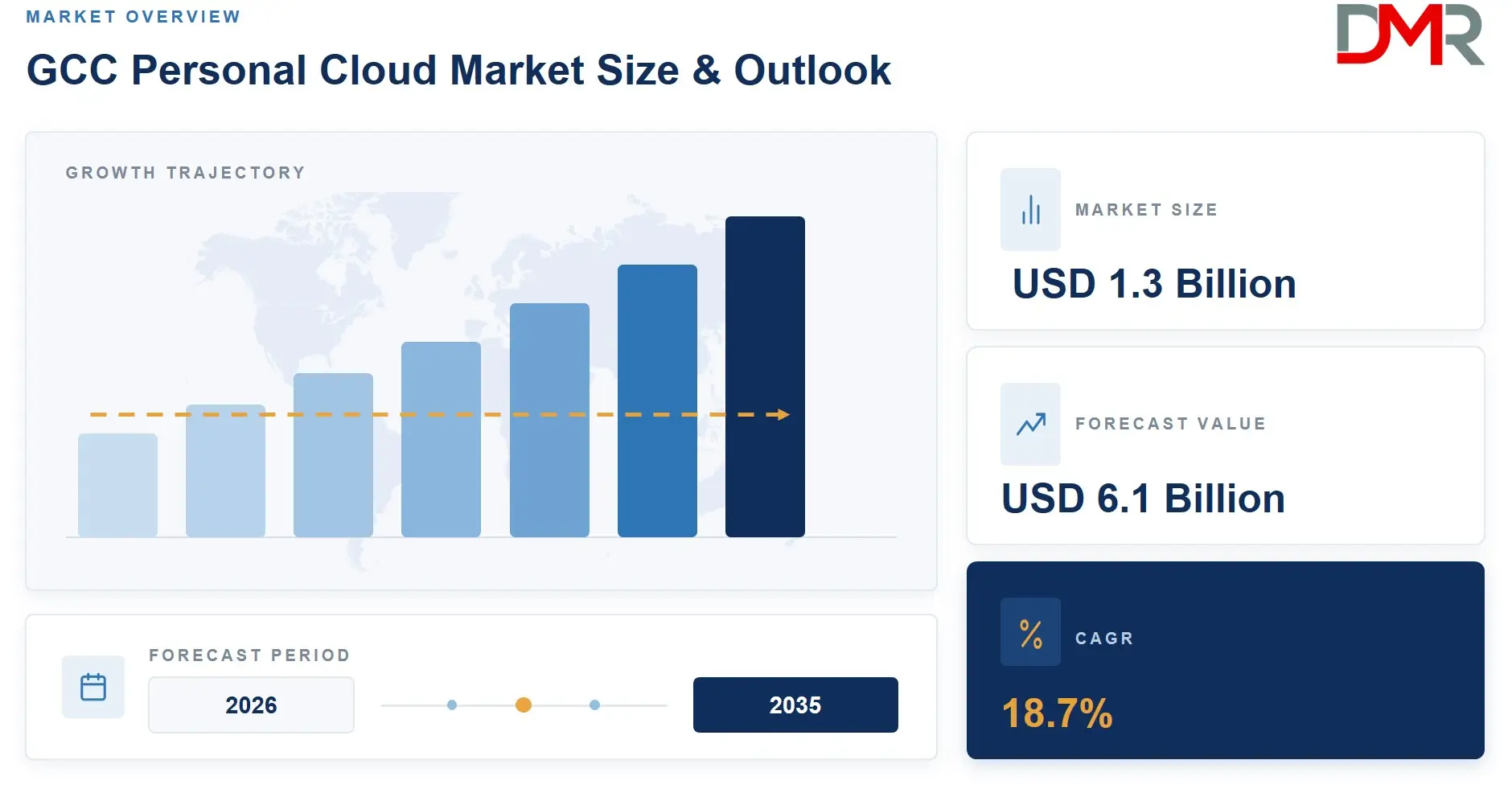
- Market Size (2026): USD 1.3 Bn
- Forecast Value (2035): USD 6.1 Bn
- CAGR (2026-2035): 18.7%
- Leading Offering (2026): Cloud Storage & File Hosting, close to 44%
- Leading Deployment Mode (2026): Public Cloud, around 61%
- Key Players: stc, e&, and Synology, among others
What is GCC Personal Cloud Market and its Market Size?
The GCC Personal Cloud Market size is estimated to reach USD 1.3 Bn in 2026 and is further anticipated to reach USD 6.1 Bn by 2035, at a CAGR of 18.7%.
ℹ
To learn more about this report –
Download Your Free Sample Report Here
The market captures consumer-facing storage, synchronisation, backup and personal-device management services purchased by individuals, households and small offices across Saudi Arabia, the UAE, Qatar, Kuwait, Oman and Bahrain. Coverage is limited to demand generated inside these six states; it excludes worldwide subscription revenue booked by multinational providers whose products are consumed elsewhere, and it excludes enterprise cloud infrastructure, colocation and hyperscaler compute sold to businesses rather than individuals.
Personal cloud spans three linked product forms: software subscriptions covering file sync and automated photo and video backup; storage hardware covering personal network-attached devices bought for local backup; and value-added services layering family sharing plans, ransomware protection and privacy tooling on top of either. A resident running three or four connected devices, common across the bloc's high smartphone-penetration population, typically buys into more than one form at once, which is why offering and deployment mode are analysed as separate axes here.
Buyers cluster around two profiles. Younger, urban residents in Riyadh, Jeddah, Dubai, Abu Dhabi and Doha generate the bulk of paid subscriptions, drawn by high-resolution photography and multi-device households; a smaller, faster-growing base of freelancers and home-based traders buys hybrid and on-premise capacity to keep working files close and compliant. Expatriate residents, who make up a large share of the bloc's population, add demand tied to remittance-linked digital identity apps and cross-border document storage.
What is changing structurally is where the data sits. Data protection statutes enacted or tightened across Saudi Arabia, the UAE, Qatar and Bahrain since 2023 are pushing providers to store resident data on servers physically located in-country, and the build-out of hyperscaler and sovereign cloud regions across Riyadh, Dammam, Abu Dhabi and Doha is what makes that shift commercially viable rather than merely mandated.
Use Cases
- Multi-Device Household Backup: A family running phones, tablets and a shared laptop across Dubai, Riyadh or Doha syncs photo and video capture automatically to one shared plan, replacing manual cable transfers and cutting the risk that a lost device erases years of family images.
- Freelance and SOHO Document Continuity: A home-based consultant in Kuwait or Manama keeps invoices, contracts and project files mirrored between a local network drive and a hosted account, so a hardware failure or a laptop theft no longer stalls client work.
- Government Digital Identity Linkage: A resident renewing a visa or professional licence stores scanned certificates and identity documents in a personal cloud folder tied to a national digital-services app, cutting repeat trips to in-person service centres.
- Cross-Border Family Sharing: An expatriate worker in Abu Dhabi or Doha sets up a shared family plan so relatives abroad can view new photos and video-call archives without relying on messaging-app compression that degrades quality over time.
Key Takeaways
- Market Size & Share: The market is valued at USD 1.3 Bn in 2026 and is set to reach USD 6.1 Bn by 2035, expanding at 18.7% CAGR.
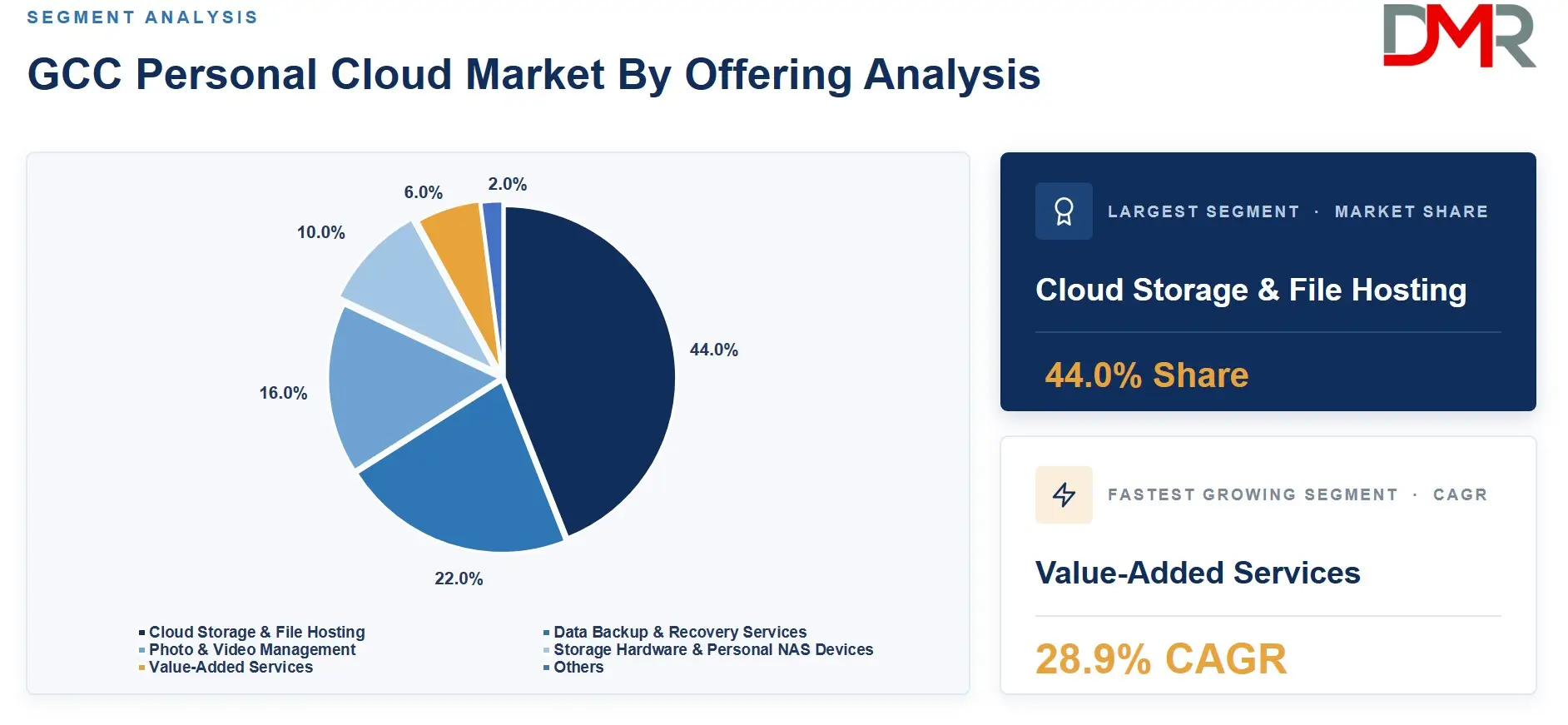
- Offering Analysis: Cloud Storage & File Hosting is expected to account for approximately 44% of 2026 revenue, while Value-Added Services is projected to grow at 28.9% CAGR through 2035.
- Demand Concentration: Saudi Arabia and the UAE anchor bloc-wide demand, with Qatar close behind and the remaining three states contributing smaller, rising shares.
- Deployment Shift: Public Cloud models are estimated to hold around 61% of 2026 demand, while Hybrid Cloud is the fastest-expanding path at 25.3% CAGR as data residency rules push storage back on-shore.
- Application Mix: File Sync & Sharing represents close to 38% of 2026 demand, with Media Streaming & Entertainment climbing at 26.1% CAGR through 2035.
- End User Composition: Individual and retail consumers make up approximately 52% of 2026 spend, while Small Office and Home Office users are the fastest-growing buyer group at 24.7% CAGR.
How AI/Gen AI is Transforming the GCC Personal Cloud Market?
Artificial intelligence in this market shows up mostly as an organisation and retrieval layer rather than as a content-generation feature. Providers are embedding computer vision to tag faces, objects and locations across a growing photo library, plus natural-language search that lets a user ask for a specific document instead of scrolling folders. On-device processing is gaining ground for privacy-sensitive households, since a model that indexes photos locally before syncing an encrypted result avoids sending raw images through a third-party server, a choice that also eases compliance with the bloc's data protection statutes.
Bilingual, Arabic-and-English support is becoming a differentiator, as voice and text search built for English-only corpora perform poorly against Arabic file names, spoken commands and mixed-language households. Providers that invest in Arabic-first natural-language models are better placed to win the telecom-bundled channel, where the subscriber base skews toward Arabic as a first language.
- Computer Vision Photo Organisation: automatic face, object and scene tagging across a household's combined photo and video library.
- Natural Language File Search: LLM-based search that answers a plain-language query such as a contract from a specific month rather than requiring exact file names.
- Predictive Storage Tiering: models that predict which files stay frequently accessed and which can move to cheaper archive tiers, controlling cost as libraries grow.
- Ransomware and Anomaly Detection: machine-learning models that flag abnormal mass-encryption patterns and pause backups before a compromised device overwrites clean copies.
Key Drivers in the GCC Personal Cloud Market
Two forces are lifting the GCC Personal Cloud Market faster than population growth alone would predict.
- Government Digital Transformation and E-Service Mandates: Saudi Arabia, the UAE and Qatar have pushed residents toward digital-first government interactions, from visa renewals to vehicle registration, and each transaction now expects a scanned document or certificate attached from a personal account rather than a physical file. Data Backup & Recovery Services already account for close to 22% of 2026 offering revenue as households build a permanent digital record to meet these requirements, and telecom operators are bundling storage allowances into postpaid plans to capture that demand before a foreign-headquartered provider does. The effect compounds each year, since a resident who has already digitised one document set rarely reverts to paper for the next.
- Camera-Centric Device Habits and Multi-Device Households: High smartphone replacement rates and premium-device ownership across the bloc mean the average connected household generates more photo and video volume per person than many comparable markets, and Photo & Video Storage and Editing already represents close to 19% of 2026 application demand. Multi-device households, often spanning two or three phones, a tablet and a shared laptop, need a single account that reconciles capture across all of them rather than a device-bound gallery. That reconciliation need converts a free storage tier into a paid upgrade once a household crosses its first device's capacity ceiling, and the trigger repeats every time a new device joins the network.
Restraints in the GCC Personal Cloud Market
Two brakes keep the market from converting its addressable population as quickly as its adoption drivers would suggest.
- Fragmented National Data Rules Raising Compliance Cost: Saudi Arabia's Personal Data Protection Law, the UAE's federal statute, Qatar's data privacy law and Bahrain's equivalent framework each set their own consent, storage-location and breach-notification requirements, and a provider serving all six states runs parallel compliance tracks rather than one regional model. That overhead falls hardest on smaller providers without a local legal presence, part of why On-Premise & Local Storage still holds close to 11% of 2026 deployment demand among buyers who would rather keep data off any provider's servers than track six separate regimes.
- Free-Tier Bundling Suppressing Paid Conversion: Device ecosystems from Apple, Google and Samsung ship meaningful free storage allowances by default, and residents who already own a recent flagship phone frequently see no immediate reason to pay for a separate account. Storage Hardware & Personal NAS Devices still command only close to 10% of 2026 offering spend, since a one-time hardware purchase competes against an allowance a buyer already believes is free. Conversion typically waits until a household's photo and video library outgrows every free tier at once.
Growth Opportunities in the GCC Personal Cloud Market
Two white-space pockets stand out for providers willing to build a GCC-specific go-to-market rather than porting a worldwide product unchanged.
- Telecom Channel Bundling for SOHO Retention: Small Office and Home Office Users already represent close to 13% of 2026 end-user spend, and national telecom operators have the billing relationship and retention incentive to bundle a business-grade storage tier into existing postpaid SME plans rather than leave that spend to a foreign-headquartered specialist. A provider that partners with even one or two of the bloc's dominant carriers gains distribution few standalone apps can match, since the carrier already owns the billing relationship.
- Family-Plan Upsell Among Multi-Generational Households: Households & Families account for close to 31% of 2026 end-user spend, reflecting larger average household sizes across the bloc compared with many other markets. A single family plan that covers grandparents, parents and children under one storage pool, with separate access controls per member, addresses a buying unit that most worldwide personal cloud products still price around a single adult user rather than an extended household.
Trends in the GCC Personal Cloud Market
Two shifts are reshaping how the market is bought and used, distinct from the demand drivers already covered above.
- Entertainment and Storage Convergence: Media Streaming & Entertainment is climbing at 26.1% CAGR through 2035 as personal cloud accounts increasingly double as private media libraries for gaming clips, drone footage and long-form video on premium smartphones, rather than serving purely as a backup destination. Providers are responding by adding built-in playback and light editing tools directly inside the storage app, closing the gap between a backup product and a media platform. That shift is pulling storage-tier pricing upward for households that once treated the service as a photo archive.
- Usage-Based and Bundled Pricing Replacing Flat Tiers: As Small Office and Home Office demand expands at 24.7% CAGR, providers are moving away from a single flat monthly tier toward usage-based add-ons and telecom-bundled family plans priced per connected device rather than per account. This lets a provider capture more revenue from a heavy-usage household without forcing every light user onto the same tier, and it aligns pricing with the multi-device buying pattern that defines the bloc's households.
Research Scope and Analysis
Segment performance across the GCC Personal Cloud Market is assessed along four axes: offering, deployment mode, application and end user. Each axis identifies the sub-segment carrying the largest share of 2026 revenue and the one expanding fastest through 2035, together with the commercial reason behind each position.
ℹ
To learn more about this report –
Download Your Free Sample Report Here
By Offering
Cloud Storage & File Hosting is projected to hold the largest share by offering in 2026, accounting for close to 44% of revenue, since it is the entry point through which most residents first adopt a personal cloud account and the layer every other offering depends on for file access. Photo, document and contact syncing across phones and laptops keeps this category anchored as buyers add other services on top. Growth, however, is concentrated in Value-Added Services, expanding at a CAGR of 28.9% between 2026 and 2035, as family sharing plans, ransomware protection and privacy add-ons move from optional extras to standard inclusions that providers use to differentiate an otherwise commoditised product. Telecom-bundled plans are accelerating this shift by packaging value-added tiers directly into postpaid subscriptions.
By Deployment Mode
Public Cloud deployment is expected to account for around 61% of 2026 demand, reflecting the convenience and low upfront cost of subscription storage that needs no local hardware and updates automatically across every registered device. Most first-time buyers default to this model because it matches how their devices already prompt them to back up photos and files. The steeper trajectory, though, sits with Hybrid Cloud, forecast to grow at a CAGR of 25.3% through 2035, as data residency rules push a portion of storage back onto local devices or personal servers while sync and remote access keep running through a cloud layer. Newly opened in-country hyperscaler and sovereign cloud regions make hybrid configurations easier to deploy without sacrificing performance.
By Application
File Sync & Sharing leads application-level demand in 2026, holding close to 38% of revenue, because keeping documents, photos and work files current across multiple devices is the baseline function nearly every buyer expects, regardless of which offering they ultimately choose. Data Backup & Recovery follows closely behind it as a related but distinct need. The fastest-growing application, however, is Media Streaming & Entertainment, projected at a CAGR of 26.1% between 2026 and 2035, pulled by rising video and gaming-clip volumes on premium smartphones and a growing appetite for private, ad-free media libraries outside public social platforms. Providers are adding lightweight playback and editing tools to capture this shift before third-party apps do.
By End User
Individual & Retail Consumers make up approximately 52% of 2026 end-user spend, the natural result of a market whose products are still priced and onboarded primarily around a single adult subscriber rather than a household or a business account. Households & Families form the next-largest group, reflecting the bloc's larger average family sizes. Growth, however, is concentrated among Small Office & Home Office Users, expanding at a CAGR of 24.7% through 2035, as freelancing, home-based trading and small consultancies expand alongside government initiatives that support self-employment across the bloc. This buyer group increasingly demands access logging and multi-user permissions that consumer-tier products were not originally built to offer.
The GCC Personal Cloud Market Report is Segmented Based on the Following
By Offering
- Cloud Storage & File Hosting
- Data Backup & Recovery Services
- Photo & Video Management
- Storage Hardware & Personal NAS Devices
- Value-Added Services
- Others
By Deployment Mode
- Public Cloud
- Hybrid Cloud
- On-Premise & Local Storage
- Others
By Application
- File Sync & Sharing
- Data Backup & Recovery
- Photo & Video Storage and Editing
- Media Streaming & Entertainment
- Others
By End User
- Individual & Retail Consumers
- Households & Families
- Small Office & Home Office (SOHO) Users
- Others
Regulatory Landscape
Data protection enforcement remains fragmented across the six states, with Saudi Arabia's Personal Data Protection Law, the UAE's federal statute, Qatar's data privacy law and Bahrain's equivalent framework each setting distinct consent and storage-location rules, and Saudi Arabia and the UAE furthest along in enforcement. What is shifting now is a tightening bias toward in-country hosting, reinforced by sovereign cloud regions opening in Riyadh, Abu Dhabi and Doha. The commercial opening sits with providers willing to certify in-country storage explicitly, since that certification is becoming a purchase criterion for government-linked and SOHO buyers. The risk is compliance cost, which falls hardest on providers without local legal presence and helps keep On-Premise & Local Storage near 11% of 2026 deployment demand, tilting competitive position toward telecom-partnered platforms with local hosting.
Technology Analysis
Technology is shifting from pure public-cloud storage toward hybrid architectures that pair a local device or personal server with cloud-based sync, reinforced by the AI-ready data centre capacity now being built across Abu Dhabi, Riyadh and Doha under initiatives such as Stargate UAE and Saudi Arabia's HUMAIN programme. The commercial opening sits with providers that can plug into that local infrastructure to offer lower-latency sync and in-country AI features such as photo search, with Hybrid Cloud demand already expanding at a 25.3% CAGR through 2035. The brake is capacity itself: power availability and construction timelines constrain how fast new regions come online, keeping distribution weighted toward telecom-backed platforms.
Competitive Landscape
Competitive intensity in the GCC Personal Cloud Market sits at a moderate concentration level, with a handful of multinational device ecosystems capturing the bulk of free-tier attach while specialist apps, telecom-bundled offerings and regional distributors compete for the paid upgrade. Basis of competition centres on device-ecosystem lock-in, local hosting credibility under the bloc's data protection statutes and, increasingly, telecom-channel distribution through postpaid bundling. National operators such as stc, e& and Ooredoo Group are positioning themselves as trusted local alternatives to foreign-headquartered providers by pairing storage allowances with existing billing relationships and in-country data centres. Specialist privacy-first providers compete on encryption and data sovereignty rather than price, while hardware vendors defend a shrinking but durable niche among buyers who prefer to keep data off any provider's servers.
Some of the Prominent Players in the GCC Personal Cloud Market Are
- Google LLC
- Apple Inc.
- Microsoft Corporation
- Amazon.com, Inc.
- Samsung Electronics Co., Ltd.
- Western Digital Corporation
- Seagate Technology Holdings plc
- Dropbox, Inc.
- Synology Inc.
- QNAP Systems, Inc.
- pCloud AG
- Sync.com Inc.
- Tresorit
- Internxt S.L.
- Icedrive Limited
- MEGA Limited
- Degoo Backup AB
- SpiderOak, Inc.
- Proton AG
- Nord Security (NordLocker)
- Filen Cloud Dienste UG
- IDrive Inc.
- Backblaze, Inc.
- Livedrive Internet Limited
- OpenText Corporation (Carbonite)
- OpenDrive, LLC
- stc Group
- Mobily (Etihad Etisalat Company)
- Zain Group
- e& (Emirates Telecommunications Group)
- du (Emirates Integrated Telecommunications Company)
- Ooredoo Group
- Batelco (Bahrain Telecommunications Company)
- Omantel (Oman Telecommunications Company)
- Khazna Data Centers
- Redington Gulf FZE
- AlJammaz Distribution Company
- Almoayed Technologies
- NEXTGEN Group
- Toshiba Electronic Devices & Storage Corporation
- Other Key Players
Recent Developments
- In May 2026, Ooredoo Qatar launched an AI cloud platform built on Nvidia GPU infrastructure and hosted entirely within Qatari data centres, giving the country's consumers and small businesses a locally hosted alternative to offshore storage and search tools.
- In January 2026, a GCC colocation portfolio review confirmed Khazna Data Centers among the operators anchoring more than 400 megawatts of operational capacity in the UAE, reinforcing the domestic hosting base that Emirati personal cloud and backup providers increasingly lease against.
- In October 2025, du launched a sovereign cloud offering for the UAE built on Oracle Alloy, extending in-country hosting options that consumer storage and backup services distributed through the operator's channels can run on.
- In June 2025, Ooredoo Group expanded its collaboration with Google Cloud to adopt the Apigee API management platform, opening programmable network access that consumer digital-services and storage apps distributed through the telecom's channels can build on.
- In May 2025, G42 and partners including OpenAI, Oracle, NVIDIA, Cisco and SoftBank Group launched the Stargate UAE initiative to build a multi-gigawatt AI-ready data centre campus in Abu Dhabi, adding sovereign capacity that regional consumer cloud services can draw on as data residency rules tighten.
Report Details
| Report Characteristics |
| Market Size (2026) |
USD 1.3 Bn |
| Forecast Value (2035) |
USD 6.1 Bn |
| CAGR (2026-2035) |
18.7% |
| Historical Data |
2021 - 2025 |
| Forecast Data |
2026 - 2035 |
| Base Year |
2025 |
| Segments Covered |
By Offering, By Deployment Mode, By Application, and By End User |
| Regional Coverage |
GCC - Saudi Arabia, The UAE, Qatar, Kuwait, Oman, Bahrain |
Frequently Asked Questions
How big is the GCC Personal Cloud Market?
▾ The GCC Personal Cloud Market size is estimated at USD 1.3 Bn in 2026 and is anticipated to reach USD 6.1 Bn by 2035, reflecting sustained demand from a young, high-smartphone-penetration population across Saudi Arabia, the UAE, Qatar, Kuwait, Oman and Bahrain, supported by in-country hosting capacity and government-driven digital-service adoption.
What is the growth rate of the GCC Personal Cloud Market?
▾ The market is projected to expand at a CAGR of 18.7% between 2026 and 2035, outpacing many mature personal cloud markets as smartphone penetration, telecom bundling and in-country hosting capacity widen the addressable buyer base, with Value-Added Services and Media Streaming contributing disproportionately to that trajectory.
Which country holds the largest share in the GCC Personal Cloud Market?
▾ Saudi Arabia holds the largest share of demand within the bloc in 2026, supported by its larger population and Vision 2030-linked digital-service adoption, with the UAE close behind on the strength of its higher per-capita device spend, and Qatar ranking third among the six member states.
Who are the key players in the GCC Personal Cloud Market?
▾ Key players include Google, Apple, Microsoft, Samsung, Synology, stc, e&, du, Ooredoo Group and Khazna Data Centers, alongside a wider base of specialist storage apps, hardware vendors and regional telecom-backed platforms competing on device-ecosystem reach, local hosting credibility and bundled distribution across the six-state bloc.
Which offering leads the GCC Personal Cloud Market in 2026?
▾ Cloud Storage & File Hosting leads the offering axis, accounting for close to 44% of 2026 revenue, as it remains the primary entry point through which residents first adopt a paid account before layering on backup, media management or value-added services over time.
What deployment mode is growing fastest in the GCC Personal Cloud Market?
▾ Hybrid Cloud is the fastest-growing deployment mode, forecast to expand at a CAGR of 25.3% through 2035, as data residency expectations and newly opened in-country hyperscaler regions make it easier to pair local storage with cloud-based sync without sacrificing performance or convenience.
How is data protection regulation shaping the GCC Personal Cloud Market?
▾ National statutes such as Saudi Arabia's Personal Data Protection Law and the UAE's federal data protection framework are pushing providers toward in-country hosting, and that shift is becoming a genuine purchase criterion for buyers in the GCC Personal Cloud Market, favouring platforms with an established local hosting relationship over offshore-only alternatives.