GCC Radiopharmaceuticals Market Snapshot
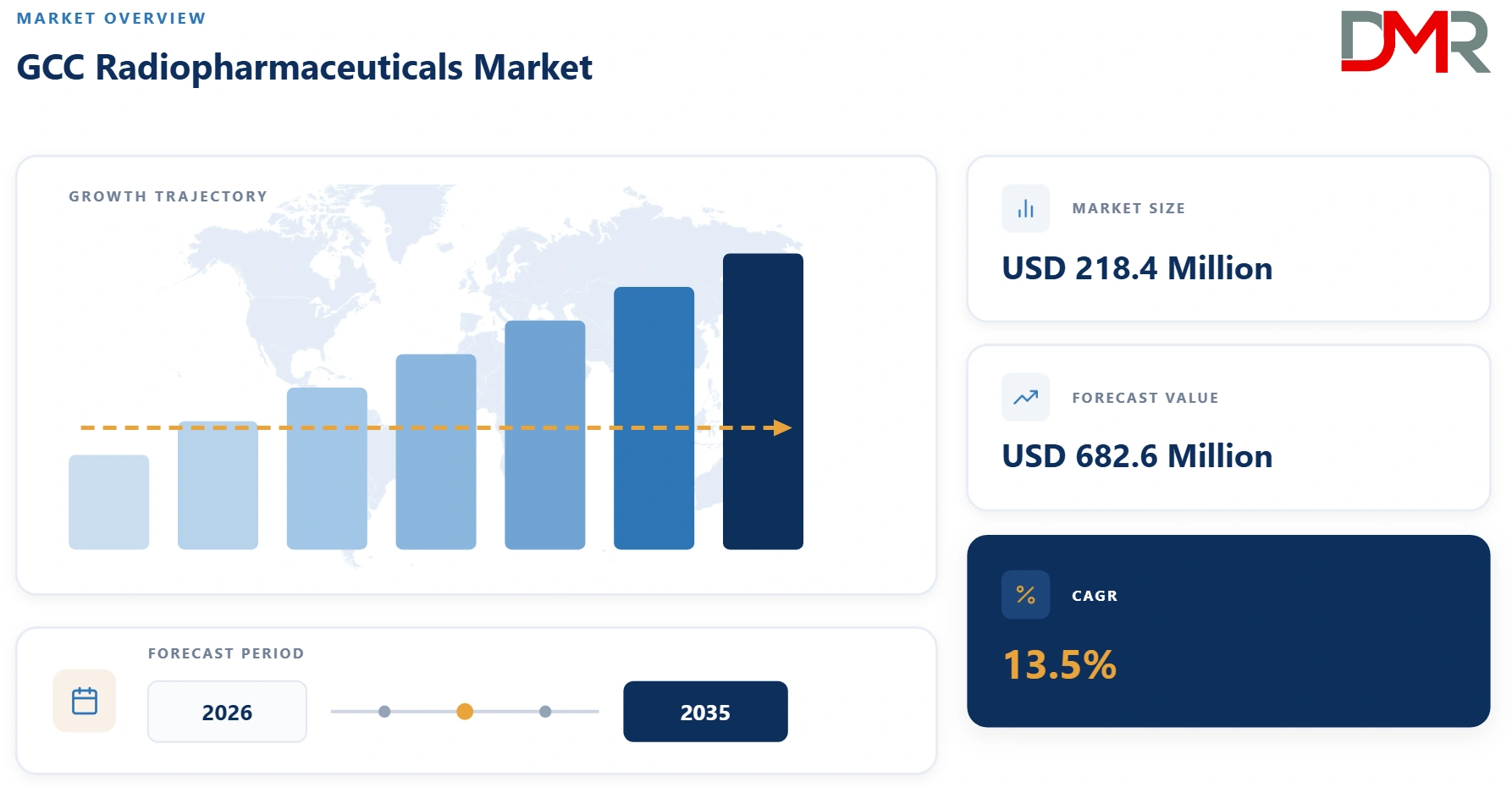
- GCC Radiopharmaceuticals Market Size in 2026: USD 218.4 Million
- GCC Radiopharmaceuticals Market Size in 2035: USD 682.6 Million
- GCC CAGR from 2026 to 2035: 13.5%
- Fluorine-18 Derivatives is the leading radioisotope segment in 2026: 42.6%
- Diagnostic Radiopharmaceuticals is the leading type segment in 2026: 68.9%
- Cyclotrons is the leading source segment in 2026: 54.3%
- Oncology is the leading application segment in 2026: 51.8%
- Hospitals is the leading end user segment in 2026: 57.4%
What is the GCC Radiopharmaceuticals Market and its Market Size?
The GCC Radiopharmaceuticals Market is projected to be valued at USD 218.4 Million in 2026 and is projected to reach USD 682.6 Million by 2035, expanding at a CAGR of 13.5% during the forecast period.
ℹ
To learn more about this report –
Download Your Free Sample Report Here
Growth is being propelled by substantial government investment in advanced oncology and diagnostic imaging infrastructure across the UAE and Saudi Arabia as part of broader national healthcare transformation strategies, rising cancer incidence and cardiovascular disease prevalence across GCC populations driving demand for advanced diagnostic and therapeutic nuclear medicine, and continued expansion of PET/CT and hybrid imaging infrastructure across leading hospitals and dedicated cancer centers in the region. The maturing of regional cyclotron and radiopharmacy infrastructure reducing reliance on imported short-half-life isotopes such as Fluorine-18 FDG, growing adoption of Lutetium-177 and Gallium-68-based theranostic approaches supporting both diagnosis and targeted therapy for neuroendocrine tumors and prostate cancer, and continued positioning of the UAE and Saudi Arabia as regional medical hubs attracting both domestic and cross-border GCC patients are reshaping the market from a historically import-dependent, diagnostic-imaging-focused nuclear medicine sector into an increasingly self-sufficient, therapeutically diversified regional radiopharmaceutical industry. Investment is accelerating as GCC governments and private hospital groups expand cyclotron and radiopharmacy capacity while building specialized oncology and nuclear medicine clinical capability.
Use Cases
- Fluorine-18 FDG PET/CT Imaging for Cancer Diagnosis and Staging: Hospitals and dedicated cancer centers across the UAE and Saudi Arabia use Fluorine-18 Fludeoxyglucose PET/CT imaging to diagnose, stage, and monitor treatment response across a broad range of cancer types, representing the most widely used diagnostic radiopharmaceutical application in the region.
- Gallium-68 Dotatate PET Imaging for Neuroendocrine Tumor Diagnosis: Oncology centers use Gallium-68 Dotatate-based PET imaging to diagnose and stage neuroendocrine tumors, often as a companion diagnostic supporting subsequent Lutetium-177-based targeted radioligand therapy for eligible patients.
- Lutetium-177 Targeted Radioligand Therapy for Neuroendocrine Tumors and Prostate Cancer: Leading GCC cancer centers, particularly in the UAE and Saudi Arabia, increasingly offer Lutetium-177-based targeted radioligand therapy for neuroendocrine tumors and prostate cancer, reflecting global clinical advances in precision radiopharmaceutical cancer treatment and the region's growing investment in advanced oncology capability.
- Technetium-99-Based Cardiac and Bone Scintigraphy: Hospitals and medical imaging centers across the GCC rely on Technetium-99-based radiopharmaceuticals for widely used diagnostic applications including myocardial perfusion studies supporting cardiovascular disease diagnosis and bone scintigraphy.
Key Takeaways
- Market Size: The GCC Radiopharmaceuticals Market is anticipated to be valued at USD 218.4 Million in 2026 and is forecast to reach USD 682.6 Million by 2035, expanding at a CAGR of 13.5%.
- Growth Outlook: Market expansion is sustained by substantial government investment in oncology and diagnostic imaging infrastructure, rising cancer and cardiovascular disease prevalence across GCC populations, and continued regional cyclotron and radiopharmacy capacity expansion.
- Primary Growth Drivers: Government investment in advanced oncology infrastructure under national healthcare transformation strategies, rising cancer incidence and diagnostic imaging demand, growing regional cyclotron and radiopharmacy self-sufficiency investment, and expanding theranostic adoption pairing Gallium-68 diagnostics with Lutetium-177 therapy are accelerating market growth.
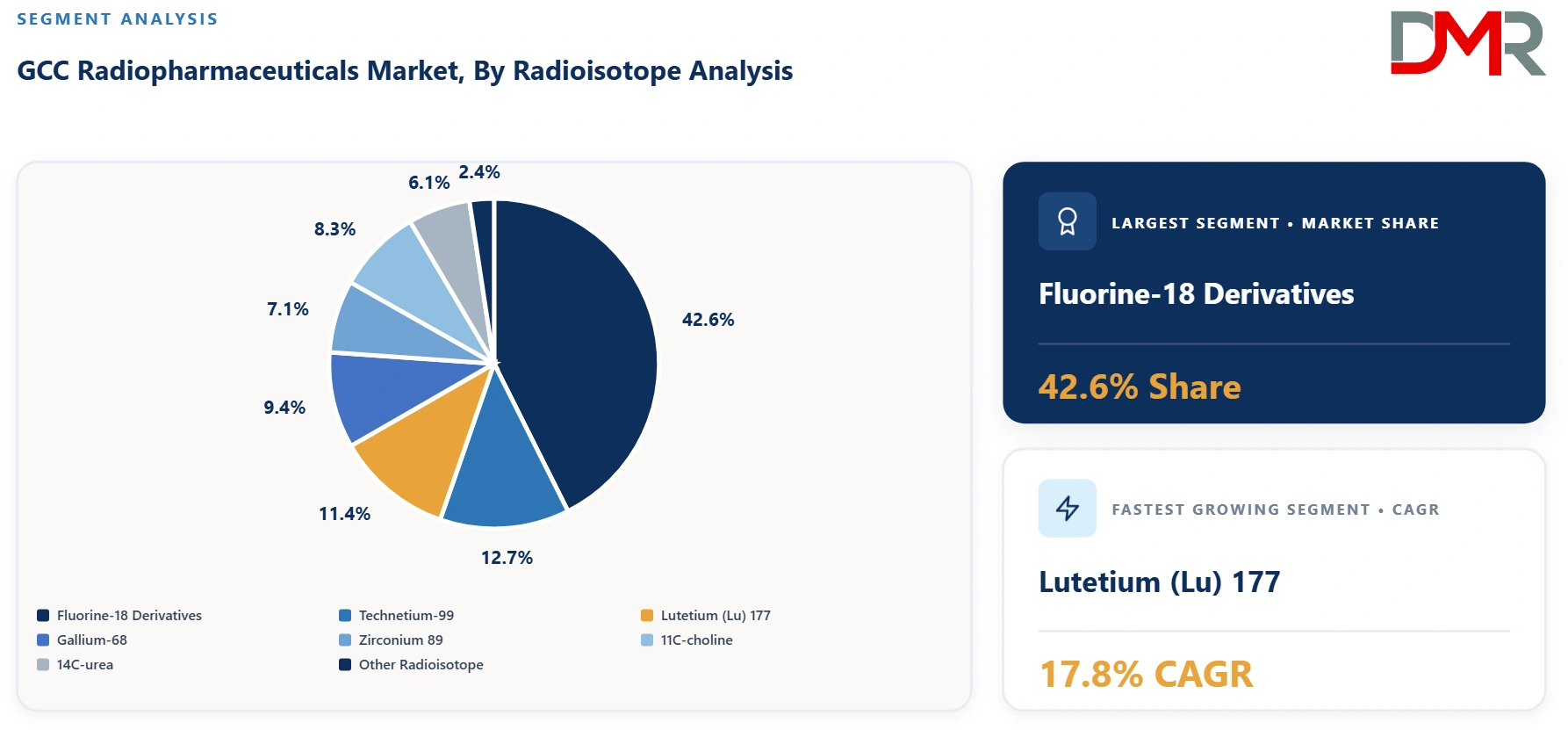
- By Radioisotope Analysis: Fluorine-18 Derivatives is projected to lead the radioisotope segment with a 42.6% share in 2026, reflecting FDG's central role in oncology PET imaging across the region. Lutetium (Lu) 177 is the fastest-growing radioisotope segment at 17.8% CAGR, driven by expanding targeted radioligand therapy adoption.
- By Type Analysis: Diagnostic Radiopharmaceuticals is expected to dominate with a 68.9% share in 2026, supported by well-established PET and SPECT imaging infrastructure across GCC hospitals. Therapeutic Radiopharmaceuticals is the fastest-growing type segment at 18.4% CAGR, driven by rapid adoption of targeted radioligand therapy following global clinical successes.
- By Source Analysis: Cyclotrons is poised to lead with a 54.3% share in 2026, reflecting their central role in producing Fluorine-18 and other short-half-life PET isotopes regionally. Generators is the fastest-growing source segment at 13.6% CAGR, driven by expanding Gallium-68 generator-based radiopharmacy adoption supporting theranostic applications.
- By Application Analysis: Oncology is expected to command a 51.8% share in 2026, underpinned by rising regional cancer incidence and expanding diagnostic and therapeutic nuclear medicine capability. Oncology is also the fastest-growing application segment given the significant expansion of theranostic and targeted therapy adoption.
- By End User Analysis: Hospitals are projected to dominate with a 57.4% share in 2026, reflecting their central role in both diagnostic imaging and radiopharmaceutical therapy administration. Cancer Research Institute is the fastest-growing end user segment at 15.2% CAGR, driven by growing regional investment in dedicated oncology research and specialized cancer treatment capacity.
Key Drivers in the GCC Radiopharmaceuticals Market
Government Investment in Advanced Oncology Infrastructure Under National Healthcare Transformation Strategies
GCC governments, particularly the UAE and Saudi Arabia, have made substantial investment in advanced oncology and nuclear medicine infrastructure as part of broader national healthcare transformation strategies under Vision 2030 and comparable national development plans. This government-backed investment has supported the establishment of dedicated cancer centers, expanded PET/CT and hybrid imaging capacity, and growing cyclotron and radiopharmacy infrastructure, positioning the region's leading healthcare systems to offer increasingly advanced diagnostic and therapeutic nuclear medicine services that were historically available only through medical travel to international destinations.
Rising Cancer Incidence and Cardiovascular Disease Prevalence Across GCC Populations
Rising cancer incidence and cardiovascular disease prevalence across GCC populations, reflecting demographic aging trends, lifestyle factors, and improved disease detection and reporting, is driving substantial growth in demand for both diagnostic and therapeutic radiopharmaceutical products. As regional healthcare systems continue expanding their capability to detect and treat these conditions using nuclear medicine approaches, sustained demand growth for radiopharmaceutical products across oncology, cardiology, and related application areas is expected to continue throughout the forecast period.
Restraints in the GCC Radiopharmaceuticals Market
Radioisotope Supply Chain Dependency on Imported Materials and Short Half-Life Logistics Challenges
The GCC region's continued reliance on imported radioisotopes for certain radiopharmaceutical products, combined with the inherent logistics challenges associated with short-half-life isotopes requiring rapid production-to-patient delivery timelines, represents a significant restraint on the GCC Radiopharmaceuticals Market. While regional cyclotron and radiopharmacy capacity continues to expand, the specialized nuclear infrastructure required for full domestic isotope production self-sufficiency requires substantial capital investment and specialized technical expertise, creating ongoing supply chain vulnerability for radiopharmaceutical products not yet produced at scale within the region.
Growth Opportunities in the GCC Radiopharmaceuticals Market
Regional Cyclotron and Radiopharmacy Capacity Expansion Supporting Supply Chain Self-Sufficiency
Growing recognition of radioisotope supply chain vulnerability presents a substantial opportunity for GCC governments and private healthcare investors to expand domestic cyclotron and radiopharmacy production capacity, reducing reliance on imported isotopes and improving supply chain resilience for both diagnostic and therapeutic radiopharmaceutical products. Companies and institutions capable of establishing reliable regional production capability, particularly for growing therapeutic isotope categories such as Lutetium-177, can capture significant strategic value and government support.
Theranostic Platform Development Pairing Diagnostic and Therapeutic Radiopharmaceuticals
Growing global and regional clinical interest in theranostic approaches, pairing diagnostic radiopharmaceuticals such as Gallium-68 Dotatate with therapeutic counterparts such as Lutetium-177-based radioligand therapy targeting the same biological pathway, presents a substantial opportunity for GCC healthcare providers and radiopharmaceutical companies. Providers capable of offering comprehensive theranostic care pathways can differentiate their oncology service offerings and capture growing patient demand for precision, targeted cancer treatment approaches within the region.
Trends in the GCC Radiopharmaceuticals Market
Continued Positioning of the UAE and Saudi Arabia as Regional Nuclear Medicine Hubs
The UAE and Saudi Arabia continue to invest in positioning their leading hospitals and cancer centers as regional nuclear medicine and oncology hubs capable of serving not only domestic patients but also cross-border GCC and broader Middle East patients seeking advanced diagnostic and therapeutic radiopharmaceutical services. This hub positioning trend reflects both national healthcare transformation strategic objectives and growing recognition of medical travel revenue potential associated with advanced nuclear medicine service capability.
Growing Government and Private Sector Collaboration on Radiopharmacy Infrastructure Investment
GCC government health authorities and private hospital groups are increasingly collaborating on radiopharmacy and cyclotron infrastructure investment, reflecting shared interest in expanding regional radiopharmaceutical production capability and reducing supply chain dependency on imported isotopes. This collaborative investment approach is supporting more coordinated infrastructure development planning across the region's leading healthcare markets.
Research Scope and Analysis
The GCC Radiopharmaceuticals Market is segmented by radioisotope, type, source, application, and end user, covering Fluorine-18 derivatives, Technetium-99, Lutetium-177, Gallium-68, Zirconium-89, diagnostic and therapeutic radiopharmaceuticals, cyclotron, reactor, and generator sources, and oncology, cardiology, neurology, and endocrinology applications.
ℹ
To learn more about this report –
Download Your Free Sample Report Here
By Radioisotope Analysis
Fluorine-18 Derivatives is projected to dominate the GCC Radiopharmaceuticals Market with 42.6% share in 2026, reflecting Fluorine-18 Fludeoxyglucose's central and well-established role in oncology PET imaging across the region's hospitals and dedicated cancer centers. Lutetium (Lu) 177 is expected to register the highest CAGR of 17.8% during 2026-2035, driven by rapidly expanding targeted radioligand therapy adoption for neuroendocrine tumors and prostate cancer across leading GCC oncology centers.
By Type Analysis
Diagnostic Radiopharmaceuticals are anticipated to dominate the GCC Radiopharmaceuticals Market by type, accounting for 68.9% share in 2026, supported by well-established and continuously expanding PET and SPECT imaging infrastructure across GCC hospitals and medical imaging centers. Therapeutic Radiopharmaceuticals are projected to register the highest CAGR of 18.4% between 2026 and 2035, driven by rapid clinical adoption of targeted radioligand therapy following substantial global clinical successes in neuroendocrine tumor and prostate cancer treatment.
By Source Analysis
Cyclotrons are projected to lead the GCC Radiopharmaceuticals Market by source with an estimated 54.3% share in 2026, reflecting their central role in regional production of Fluorine-18 and other short-half-life PET isotopes supporting the region's substantial oncology PET imaging volume. Generators are expected to register the fastest CAGR of 13.6% through 2035, driven by expanding Gallium-68 generator-based radiopharmacy adoption supporting growing theranostic diagnostic and therapy pairing applications.
By Application Analysis
Oncology is projected to lead the GCC Radiopharmaceuticals Market with an estimated 51.8% share in 2026, reflecting both substantial diagnostic imaging demand for cancer detection and staging and rapidly growing therapeutic radioligand therapy adoption. Oncology also represents the fastest-growing application segment overall, given the significant expansion occurring within both diagnostic and therapeutic nuclear medicine cancer care across the region.
By End User Analysis
Hospitals are projected to dominate the GCC Radiopharmaceuticals Market with 57.4% share in 2026, reflecting their central role in both diagnostic imaging service delivery and radiopharmaceutical therapy administration requiring specialized nuclear medicine facilities. Cancer Research Institute is expected to register the fastest CAGR of 15.2% through 2035, driven by growing regional investment in dedicated oncology research infrastructure and specialized cancer treatment capacity across the UAE and Saudi Arabia.
The GCC Radiopharmaceuticals Market Report is segmented based on the following:
By Radioisotope
- Fluorine-18 Derivatives
- Fluorine-18 Fludeoxyglucose (FDG)
- Fluorine-18 Sodium Fluoride
- Fluorine-18 Sodium Flucicovine
- Fluorine-18 Sodium Florbetapir
- Fluorine-18 Sodium Flurbetaben
- Others
- Technetium-99
- Lutetium (Lu) 177
- Gallium-68
- Zirconium 89
- 11C-choline
- 14C-urea
- Other Radioisotope
By Type
- Diagnostic Radiopharmaceuticals
- SPECT Radiopharmaceuticals
- PET Radiopharmaceuticals
- Standalone PET Systems
- Hybrid PET/CT
- Hybrid PET/MRI
- Therapeutic Radiopharmaceuticals
- Alpha Emitters
- Beta Emitters
- Others
By Source
- Cyclotrons
- Nuclear Reactors
- Generators
By Application
- Oncology
- Cardiology
- Neurology
- Endocrinology
- Other Application
By End User
- Hospitals
- Medical Imaging Centers
- Cancer Research Institute
- Other End User
Country Analysis
The GCC Radiopharmaceuticals Market is led by Saudi Arabia, supported by extensive healthcare infrastructure, expanding nuclear medicine capabilities, rising oncology cases, and investments in PET/CT and SPECT facilities. Saudi Arabia accounts for a significant regional share and continues to strengthen diagnostic and therapeutic nuclear medicine services. The United Arab Emirates represents a rapidly expanding market, driven by specialized nuclear medicine centers, advanced imaging infrastructure, and growing adoption of targeted radionuclide therapies such as Lutetium-177. Qatar is strengthening radiopharmaceutical demand through advanced cancer centers, radiopharmacy laboratories, PET/CT systems, and nuclear medicine therapy services. Kuwait is witnessing gradual growth as healthcare modernization and chronic disease management increase demand, although dependence on imported radiopharmaceuticals remains significant. Oman is expanding nuclear medicine capabilities through hospital modernization and quality improvements, while Bahrain represents a smaller but developing market supported by healthcare investment and increasing access to specialized diagnostic imaging services. Overall, GCC countries are progressively expanding nuclear medicine infrastructure and radiopharmaceutical utilization.
By Country
- Saudi Arabia
- United Arab Emirates
- Qatar
- Kuwait
- Oman
- Bahrain
Technology Analysis
Technology development is central to the trajectory of the GCC Radiopharmaceuticals Market as governments and hospital groups invest in advanced cyclotron production technology, hybrid PET/CT and PET/MRI imaging systems offering improved diagnostic resolution, and radiochemistry capability supporting production of an expanding range of Fluorine-18 derivative tracers beyond standard FDG, including amyloid and prostate-specific imaging agents. Growing adoption of Gallium-68 generator technology is supporting more accessible theranostic diagnostic capability without requiring on-site cyclotron infrastructure. Opportunities are expanding for institutions developing regional Lutetium-177 and other therapeutic isotope production capability, as well as advanced radiochemistry supporting novel targeting ligand development for both diagnostic and therapeutic applications. However, the specialized nuclear infrastructure, radiation safety, and technical expertise requirements inherent to radiopharmaceutical production present persistent capital investment and workforce development challenges across the region.
Investment and White Space Analysis
Investment opportunities in the GCC Radiopharmaceuticals Market are expanding alongside substantial government investment in oncology infrastructure, rising regional cancer and cardiovascular disease prevalence, and growing positioning of the UAE and Saudi Arabia as regional nuclear medicine hubs. Significant white space exists in regional cyclotron and radiopharmacy capacity expansion supporting supply chain self-sufficiency, therapeutic isotope production capability for Lutetium-177 and emerging alpha emitters, and theranostic platform development pairing diagnostic and therapeutic radiopharmaceutical products. Institutions and companies with strong government relationship capability, technical radiochemistry expertise, and established hospital and cancer center partnerships are positioned to capture premium, longer-duration growth opportunities. However, radioisotope supply chain dependency and short-half-life logistics challenges, combined with the substantial capital investment required for nuclear production infrastructure, can constrain the pace of market expansion for smaller or newly entering participants.
Competitive Landscape
The GCC Radiopharmaceuticals Market is moderately consolidated and increasingly competitive, comprising large diversified global radiopharmaceutical and pharmaceutical companies supplying the region, government-backed regional radiopharmacy and cyclotron facilities, and leading GCC hospital groups with in-house or closely partnered nuclear medicine capability. Competition centers on radioisotope production capability and supply reliability, breadth of diagnostic and therapeutic radiopharmaceutical portfolio, established relationships with leading GCC hospitals and cancer centers, and regional regulatory and distribution expertise. Large global companies benefit from substantial research and development resources and established international radiopharmaceutical supply relationships, while regional and government-backed facilities compete through local production reliability and closer integration with national healthcare transformation strategic priorities. Companies increasingly differentiate through regional production self-sufficiency and theranostic platform capability rather than diagnostic imaging product breadth alone.
Some of the prominent players in the GCC Radiopharmaceuticals Market are:
- GE HealthCare
- Jubilant Radiopharma
- Curium Pharma
- Lantheus Holdings
- Bracco Imaging
- Eckert & Ziegler
- Nordion
- Institute for Radioelements (IRE)
- NTP Radioisotopes
- ANSTO
- Eczacıbaşı-Monrol
- Cardinal Health
- Telix Pharmaceuticals
- Novartis
- Bayer AG
- Siemens Healthineers
- Advanced Accelerator Applications
- POINT Biopharma
- Blue Earth Diagnostics
- ITM Isotope Technologies Munich
- NorthStar Medical Radioisotopes
- SHINE Technologies
- BWXT Medical
- IBA Radiopharma Solutions
- SOFIE Biosciences
- PETNET Solutions
- Isotopia Molecular Imaging
- Oryx Isotopes
- Monrol UAE
- Cyclomedical International
- King Faisal Specialist Hospital & Research Centre
- Isotopes Trading Company
- Arabian Advanced Systems / AFMS
- Saudi Pharmaceutical Industries & Medical Appliances Corporation (SPIMACO)
- Julphar
- Gulf Medical Company
- Abdullah Fouad Holding Company
- Almoosa Health
- Rotem Industries
- International Isotopes Inc.
- Other Key Players
Recent Developments
- April 2026: Monrol-UAE and Zahrawi Group showcased an expanded radiopharmaceutical portfolio in Abu Dhabi, including F-18 and non-carrier-added Lutetium-177 products for precision imaging and targeted radionuclide therapy.
- January 2026: King Faisal Specialist Hospital & Research Centre launched air transportation of short half-life radiopharmaceuticals between Riyadh and Jeddah, strengthening Saudi Arabia's nationwide radiopharmaceutical distribution infrastructure.
- June 2026: Hamad Medical Corporation in Qatar received SNMMI accreditation as a Radiopharmaceutical Therapy Centre of Excellence, supporting the country's expanding capabilities in targeted radiopharmaceutical therapies.
- April 2025: SHINE Technologies partnered with Modawina Medical Company to distribute Ilumira, its non-carrier-added Lutetium-177 isotope, to radiopharmaceutical manufacturers and nuclear medicine centers across the UAE.
Report Details
| Report Characteristics |
| Market Size (2026) |
USD 218.4 Mn |
| Forecast Value (2035) |
USD 682.6 Mn |
| CAGR (2026–2035) |
13.5% |
| Historical Data |
2021 – 2025 |
| Forecast Data |
2026 – 2035 |
| Base Year |
2025 |
| Segments Covered |
By Radioisotope, By Type, By Source, By Application , By End User |
| Country Coverage |
Saudi Arabia, United Arab Emirates, Qatar, Kuwait, Oman, Bahrain |
Frequently Asked Questions
How big is the GCC Radiopharmaceuticals Market?
▾ The GCC Radiopharmaceuticals Market is poised to valued at USD 218.4 Million in 2026 and is projected to reach USD 682.6 Million by 2035, reflecting substantial government investment in oncology infrastructure and rising regional cancer and cardiovascular disease prevalence.
What is the CAGR of the GCC Radiopharmaceuticals Market from 2026 to 2035?
▾ The market is projected to expand at a compound annual growth rate (CAGR) of 13.5% between 2026 and 2035, supported by expanding diagnostic and therapeutic nuclear medicine capability and continued regional radiopharmacy infrastructure investment.
What factors are driving the growth of the GCC Radiopharmaceuticals Market?
▾ Growth is driven by government investment in advanced oncology infrastructure under national healthcare transformation strategies, rising cancer incidence and diagnostic imaging demand, growing regional cyclotron and radiopharmacy self-sufficiency investment, and expanding theranostic adoption pairing Gallium-68 diagnostics with Lutetium-177 therapy.
What are the major trends in the GCC Radiopharmaceuticals Market?
▾ Major trends include continued positioning of the UAE and Saudi Arabia as regional nuclear medicine hubs, growing government and private sector collaboration on radiopharmacy infrastructure investment, and rising adoption of theranostic platforms pairing diagnostic and therapeutic radiopharmaceuticals.
Who are the key players in the GCC Radiopharmaceuticals Market?
▾ Key market participants include Curium Pharma, Novartis (Advanced Accelerator Applications), Lantheus Holdings, GE HealthCare, and Siemens Healthineers, among other global suppliers and leading regional hospital and cancer center nuclear medicine programs.
How is the GCC Radiopharmaceuticals Market segmented?
▾ The market is segmented by radioisotope, type, source, application, and end user, with demand analysis concentrated across the UAE, Saudi Arabia, and Qatar.