Germany Industry 4.0 Automation Market Snapshot
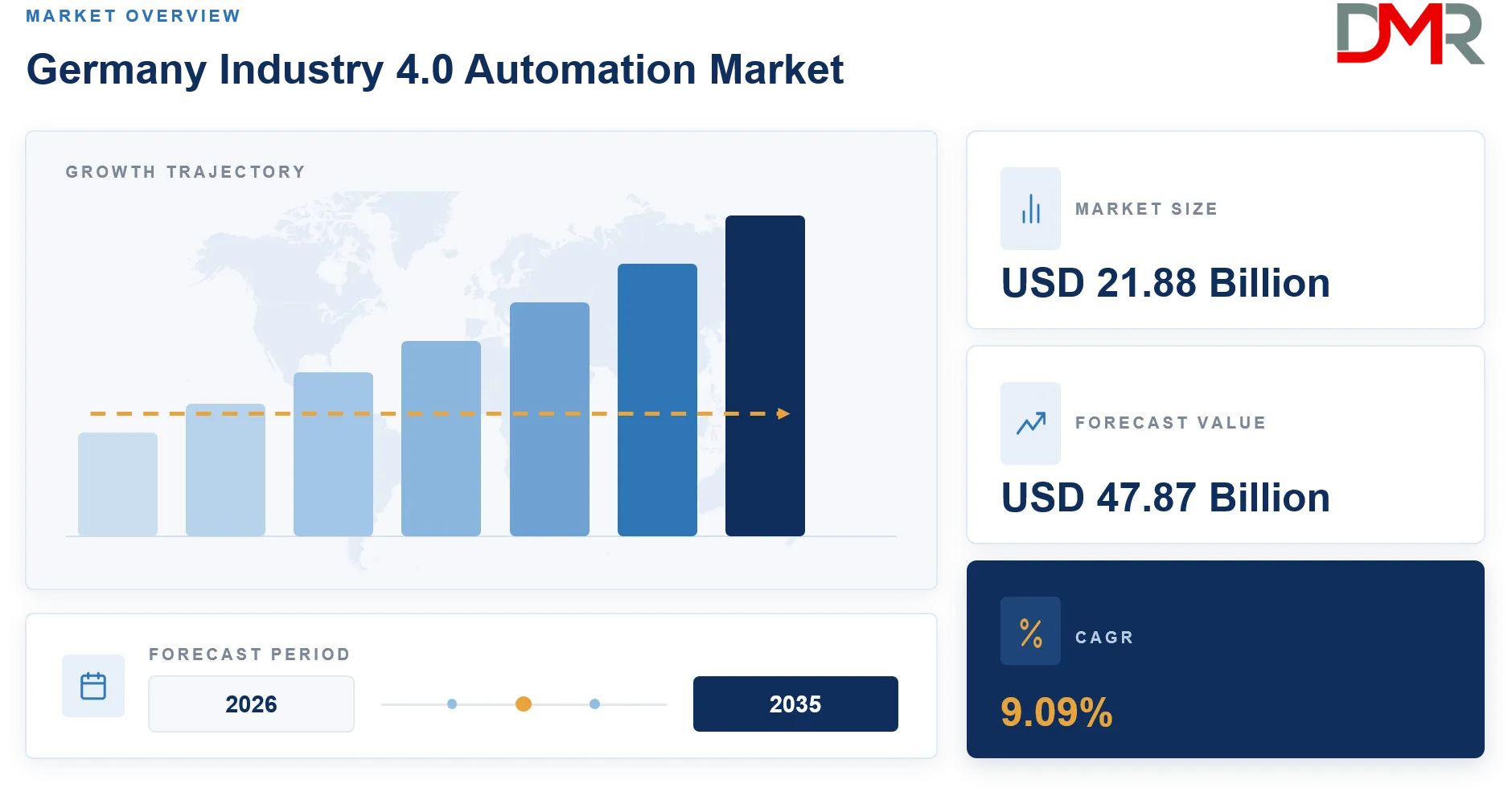
- Market Value: The Germany Industry 4.0 Automation Market is valued at USD 21.88 billion in 2026 and is projected to reach USD 47.87 billion by 2035.
- CAGR: The Germany Industry 4.0 Automation Market is expected to grow at a CAGR of 9.09% from 2026 to 2035.
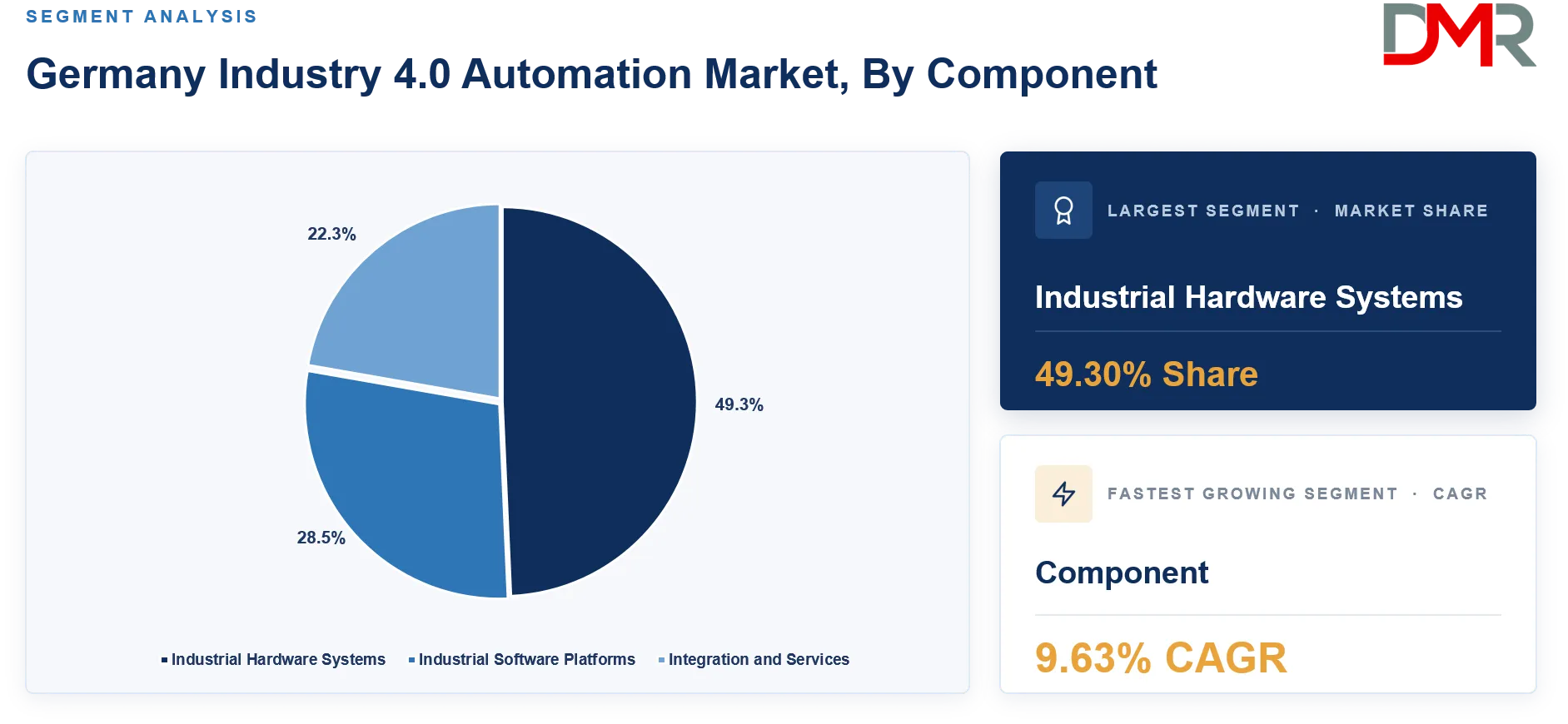
- By Component Segment Analysis: Industrial hardware systems dominated the component segment with a 49.3% share in 2026.
- By Deployment Mode Segment Analysis: On-premise automation led deployment modes with a 48.6% share in 2026.
- By End-Use Industry Segment Analysis: Automotive and auto components held the largest end-use industry share at 24.2% in 2026.
- Major Players: Siemens, Bosch Rexroth, Beckhoff Automation, Festo, Phoenix Contact and Others.
What is the Germany Industry 4.0 Automation Market and its Market Size?
The Germany Industry 4.0 Automation Market size is projected to be valued at USD 21.88 billion in 2026 and reach USD 47.87 billion by 2035, expanding at a CAGR of 9.09% during the forecast period. The market covers industrial hardware, software platforms, integration services, connected production systems, robotics, control technologies, industrial connectivity, analytics, and automation solutions used to digitalize German manufacturing operations. Germany's strong industrial base gives the market a broad addressable customer pool across automotive, machinery, chemicals, electronics, food processing, pharmaceuticals, metals, and aerospace.
ℹ
To learn more about this report –
Download Your Free Sample Report Here
Germany already has a mature automation ecosystem that supports further Industry 4.0 investment. Germany operated 278,881 industrial robots in 2024 and recorded 26,982 new industrial robot installations, making it the largest robot market in Europe and the fifth largest globally. Its robot density reached 449 units per 10,000 manufacturing employees, ranking among the world's highest. Germany also accounted for about 32% of Europe's annual industrial robot installations in 2024.
The market opportunity is moving beyond basic factory automation toward connected, software-defined, and data-driven production. Germany's Federal Ministry for Economic Affairs and Energy reports that 95% of companies see Industry 4.0 as an opportunity, while six out of ten businesses already use Industry 4.0 applications. The same source reports that 91% of companies view Industry 4.0 as important for maintaining the competitiveness of German industry.
Use Cases
- Production Monitoring: Real-time OEE monitoring helps plants identify bottlenecks, downtime, and throughput losses.
- Predictive Maintenance: Sensors and analytics detect equipment issues before failures disrupt production.
- Quality Traceability: Connected systems link production data with inspection records for faster root-cause analysis.
- Energy Optimization: Industrial automation tracks machine-level energy use and supports lower-cost production.
- Virtual Commissioning: Digital twins allow manufacturers to test automation sequences before physical deployment.
How AI/Gen AI is Transforming the Germany Industry 4.0 Automation Market?
Artificial intelligence is shifting German factory automation from rule-based control toward predictive and adaptive operations. Machine learning can analyze equipment signals, production histories, quality data, and energy patterns to identify abnormal conditions and recommend actions. Generative AI adds a new interface layer by allowing engineers and operators to query industrial data using natural language. Siemens, for example, is deploying Industrial Copilot capabilities for engineering, production planning, and operations, while its newer AI agent strategy targets more autonomous industrial workflows.
AI adoption also creates demand for better industrial data infrastructure. Digital twins, edge computing, industrial connectivity, secure cloud platforms, and high-quality machine data are becoming important building blocks for AI-enabled automation. Siemens has demonstrated digital twins and AI at its Erlangen facility, while its Bad Neustadt electric motor factory is progressing toward automated data collection, IT and OT convergence, autonomous material movement, and AI applications. Germany's SME base is also becoming more relevant to this shift. KfW reported that 20% of German SMEs used AI during 2022 to 2024, equivalent to almost 780,000 businesses, although adoption remains much higher among larger companies.
Key Drivers in the Germany Industry 4.0 Automation Market
High Industrial Robot Adoption and Factory Modernization
Germany's unusually high level of industrial robot adoption creates a strong installed base for Industry 4.0 automation upgrades. The country had 278,881 operational industrial robots in 2024 and a robot density of 449 units per 10,000 manufacturing employees. This installed base increases demand for controllers, sensors, drives, machine vision, safety systems, industrial networking, software, and maintenance services. Automotive manufacturers remain the largest robot users, while electrical and electronics manufacturing and machinery companies are expanding automation to improve flexibility and output.
Pressure to Improve Productivity and Manufacturing Competitiveness
German manufacturers are under pressure to increase productivity while managing energy costs, skilled labor shortages, quality requirements, and shorter product cycles. Automation provides a practical route to address these issues through continuous monitoring, robotics, predictive maintenance, digital work instructions, and automated quality control. The business case is expanding from labor substitution toward higher asset utilization and faster decision-making. This supports investment in connected automation platforms that combine industrial hardware with software analytics and real-time production intelligence.
Restraints in the Germany Industry 4.0 Automation Market
High Integration Cost and Legacy Equipment Complexity
Large-scale Industry 4.0 projects can require significant spending on sensors, controllers, industrial networks, cybersecurity, software licenses, system integration, employee training, and data infrastructure. Many German plants also operate equipment from different generations and vendors, making interoperability a major implementation issue. KfW reported that only 30% of German businesses completed digitalization projects during its latest review period, with digitalization spending also declining and a persistent gap between larger and smaller SMEs. This limits the pace of adoption among cost-sensitive manufacturers.
Cybersecurity, Data Governance, and Skilled Workforce Requirements
Connected factories increase the number of systems that must be protected from cyber threats. Industrial organizations must secure PLCs, SCADA systems, production networks, cloud connections, remote access points, and industrial data platforms without affecting plant availability. At the same time, manufacturers need engineers who understand automation, software, data analytics, and cybersecurity. These requirements can extend project timelines and raise implementation costs, particularly for smaller manufacturers with limited internal digital teams.
Growth Opportunities in the Germany Industry 4.0 Automation Market
AI-Enabled Automation and Autonomous Production
Industrial AI offers a significant expansion opportunity because German manufacturers already have large volumes of operational data generated by automated equipment. AI can turn this data into predictive maintenance alerts, process recommendations, automated quality decisions, and production planning insights. Siemens is developing industrial AI agents capable of executing more complex engineering and operational workflows, while its collaboration with Audi has demonstrated virtual PLC technology for production control. These developments create opportunities for suppliers of AI software, industrial data platforms, edge computing, digital twins, and intelligent automation.
Automation Expansion Across the German Mittelstand
Germany's Mittelstand provides a large opportunity for scalable automation solutions. Smaller manufacturers increasingly need flexible systems that can be introduced without replacing complete production lines. Modular robotics, cloud-connected monitoring, retrofit sensors, low-code automation, machine vision, and subscription-based software can reduce the entry barrier. Government-backed financing also supports this opportunity. In 2025, Germany's federal government and KfW introduced new financing programs for digitalization and innovation, including digitalization checks for SMEs.
Trends in the Germany Industry 4.0 Automation Market
Convergence of Industrial Automation, AI, and Digital Twins
German automation is moving toward integrated systems in which control hardware, industrial software, digital twins, and AI operate as connected layers. Digital twins can simulate production changes before physical implementation, while AI can analyze the resulting operational data and support optimization. Siemens is advancing software-defined automation, industrial AI, and digital twin technologies, including virtual PLC applications developed with Audi. This trend increases demand for automation architectures that can be updated through software rather than relying only on fixed hardware configurations.
Flexible Automation for Smaller Production Batches
German manufacturers are increasingly balancing automation with product customization and shorter production runs. This favors flexible robots, cobots, programmable automation, machine vision, modular controllers, and simulation tools that can be reconfigured quickly. The trend is particularly important for machinery, automotive components, electronics, and specialized industrial equipment. Germany's strong robotics base provides an established platform for this transition, while new AI tools can further reduce engineering time and make advanced automation more accessible to smaller production sites.
Research Scope and Analysis
The Germany Industry 4.0 Automation Market analysis evaluates the technologies, deployment structures, automation modes, applications, and end-use industries shaping industrial automation demand in Germany. The study considers the adoption of connected automation systems across discrete and process manufacturing, with emphasis on industrial hardware, software platforms, integration services, robotics, industrial connectivity, analytics, predictive maintenance, and digital manufacturing technologies.
ℹ
To learn more about this report –
Download Your Free Sample Report Here
By Component;
Industrial hardware systems represented the leading component category with a 49.3% share in 2026. This position reflects the essential role of physical automation infrastructure in German factories, where sensors, controllers, PLC units, robots, motors, drives, valves, and actuators provide the foundation for connected production. Demand is being supported by factory modernization, robot integration, equipment retrofits, and the need for higher machine-level data availability. The expansion of software-defined automation does not eliminate hardware demand. Instead, it increases the need for more capable controllers, industrial networking, edge devices, safety systems, and intelligent field equipment. Germany's 278,881 operational industrial robots in 2024 further demonstrate the depth of the country's automation installed base.
By Deployment Mode;
On-premise automation led deployment modes with a 48.6% share in 2026. German manufacturers continue to value local control because production environments require predictable response times, operational continuity, data control, and direct integration with plant equipment. On-premise architectures are particularly relevant for PLC, SCADA, HMI, safety, motion control, and production-critical systems. Cloud and hybrid models are gaining ground for analytics, remote monitoring, digital twins, fleet management, and enterprise-level data integration. The resulting market structure is likely to favor hybrid architectures that retain time-sensitive control locally while extending selected workloads to cloud platforms and centralized analytics environments.
The Germany Industry 4.0 Automation Market Report is segmented on the basis of the following:
By Component
- Industrial Hardware Systems
- Sensors and Field Devices
- Controllers and PLC Units
- Industrial Robots and Cobots
- Motors and Drive Systems
- Valves and Actuators
- Industrial Software Platforms
- SCADA and HMI Systems
- MES and APS Solutions
- DCS and Safety Systems
- IIoT Connectivity Middleware
- Analytics and AI Software
- Digital Twin Simulation Tools
- Integration and Services
- Consulting and Strategy Services
- System Integration Deployment
- Support and Maintenance Contracts
By Deployment Mode
- On-Premise Automation
- Cloud-Based Automation
- Hybrid Deployment Models
By Mode of Automation
- Fixed Automation Systems
- Flexible Automation Systems
- Programmable Automation Units
- Integrated Automation Solutions
By Application
- Production Monitoring and OEE
- Predictive Maintenance Systems
- Quality Management and Traceability
- Production Planning and Scheduling
- Energy Monitoring and Optimization
- Connected Workforce Instructions
- Simulation and Virtual Commissioning
By End-Use Industry
- Automotive and Auto Components
- Machinery and Equipment Makers
- Chemicals and Process Industries
- Electrical and Electronics Manufacturing
- Food and Beverage Processing
- Pharmaceuticals and Life Sciences
- Metals Fabrication and Heavy Industry
- Aerospace and Defense Manufacturing
Competitive Landscape
The Germany Industry 4.0 Automation Market has a broad competitive structure spanning automation platforms, PLCs, industrial networking, robotics, drives, sensors, safety systems, software, and integration services. Siemens has a particularly broad position across automation hardware, industrial software, digital twins, industrial AI, and connected manufacturing. Bosch Rexroth competes strongly in motion control, factory automation, and hydraulics, while Beckhoff Automation is prominent in PC-based control and integrated automation. Festo has a strong position in pneumatic and electric automation, and Phoenix Contact is active in industrial connectivity, control, and electrification.
Other important participants address specialized areas such as safety, sensing, robotics, motion systems, industrial communication, and machine automation. Germany's installed automation base creates opportunities for both large full-stack vendors and specialized technology suppliers. VDMA projected German robotics and automation sector turnover of approximately EUR 14.3 billion in 2024 and forecast EUR 14.5 billion for 2025, highlighting the scale of the country's supplier ecosystem.
Some of the prominent players in the Germany Industry 4.0 Automation Industry are:
- Siemens
- Bosch Rexroth
- Beckhoff Automation
- Festo
- Phoenix Contact
- WAGO
- ifm electronic
- KUKA
- Pilz
- SEW-EURODRIVE
- Lenze
- Pepperl+Fuchs
- SICK
- Balluff
- TURCK
- Weidmüller
- Hilscher
- SCHUNK
- ABB
- FANUC
- Others
Technology Analysis
The technology landscape of the Germany Industry 4.0 Automation Market is shifting from isolated automation equipment toward connected, software-enabled production systems. Industrial hardware remains the foundation, with PLCs, sensors, drives, robots, cobots, machine vision, safety devices, and industrial communication equipment linking production assets with digital platforms. Germany's 278,881 operational industrial robots in 2024 highlight the maturity of this installed base and create a large upgrade opportunity for intelligent controllers, predictive maintenance, and connected robotics. On the software side, SCADA, MES, IIoT middleware, analytics, AI, and digital twin tools are becoming more closely integrated.
Edge computing is gaining importance where manufacturers require low-latency processing while keeping critical control functions close to machines. AI is also moving into engineering, quality inspection, maintenance, production scheduling, and operator support. Siemens' development of industrial AI agents and virtual PLC technology illustrates the transition toward software-defined automation. For manufacturers, the technology priority is increasingly interoperability, scalable data architecture, cybersecurity, and measurable production gains rather than automation hardware alone.
Regulatory Landscape
Germany's Industry 4.0 Automation Market operates within a regulatory environment shaped by European Union product safety, machinery, cybersecurity, data, and digital technology requirements. The EU Machinery Regulation 2023/1230 will apply from January 20, 2027, replacing the Machinery Directive and introducing updated requirements relevant to connected machinery, safety, and emerging technologies. The EU Cyber Resilience Act also establishes cybersecurity requirements for products with digital elements, creating additional obligations for manufacturers and suppliers of connected industrial equipment.
The AI Act adds requirements based on the risk level of AI applications, which can affect industrial AI deployments used in safety-sensitive or workplace settings. Germany's implementation environment is further influenced by the Federal Office for Information Security and national cybersecurity frameworks. For automation vendors and industrial operators, compliance increasingly requires secure product design, documented risk assessment, software lifecycle controls, traceability, and stronger protection of operational technology. Regulatory readiness can therefore become a competitive factor as factories connect more machines, software platforms, and AI systems.
Recent Developments
- July 2026: Siemens invested €300 million in Germany to expand production for data centers, e-mobility and industrial automation, including its Frankfurt factory and a new supplier facility in Offenbach.
- June 2026: Siemens expanded its AI-driven automation portfolio with new Eigen Engineering Agent capabilities and broader Simatic AX access, advancing software-defined automation for industrial engineering.
- December 2025: KUKA committed high double-digit million-euro investments to automate production and logistics at its Augsburg headquarters, while strengthening R&D and securing the site through 2029.
Report Details
| Report Characteristics |
| Market Size (2026) |
USD 21.88 Bn |
| Forecast Value (2035) |
USD 47.87 Bn |
| CAGR (2026–2035) |
9.09% |
| Historical Data |
2021 – 2025 |
| Forecast Data |
2027 – 2035 |
| Base Year |
2025 |
| Estimate Year |
2026 |
| Segments Covered |
By Component (Industrial Hardware Systems {Sensors And Field Devices, Controllers And PLC Units, Industrial Robots And Cobots, Motors And Drive Systems, and Valves And Actuators}, Industrial Software Platforms {SCADA And HMI Systems, MES And APS Solutions, DCS And Safety Systems, IIoT Connectivity Middleware, Analytics And AI Software, and Digital Twin Simulation Tools}, and Integration And Services {Consulting And Strategy Services, System Integration Deployment, and Support And Maintenance Contracts}), By Deployment Mode (On-Premise Automation, Cloud-Based Automation, and Hybrid Deployment Models), By Mode Of Automation (Fixed Automation Systems, Flexible Automation Systems, Programmable Automation Units, and Integrated Automation Solutions), By Application (Production Monitoring OEE, Predictive Maintenance Systems, Quality Management Traceability, Production Planning Scheduling, Energy Monitoring Optimization, Connected Workforce Instructions, and Simulation Virtual Commissioning), By End-Use Industry (Automotive And Auto Components, Machinery And Equipment Makers, Chemicals And Process Industries, Electrical And Electronics Manufacturing, Food And Beverage Processing, Pharmaceuticals And Life Sciences, Metals Fabrication Heavy Industry, and Aerospace And Defense Manufacturing) |
| Regional Coverage |
Germany |
Frequently Asked Questions
What is the current size of the Germany Industry 4.0 Automation Market?
▾ Germany Industry 4.0 Automation Market size is USD 21.88 billion in 2026 and forecast to reach USD 47.87 billion by 2035.
What is the growth rate of the Germany Industry 4.0 Automation Market during?
▾ Germany Industry 4.0 Automation Market is expected to grow at a 9.09% CAGR during the forecast period from 2026 to 2035.
What factors are driving the growth of the Germany Industry 4.0 Automation Market?
▾ Robotics, smart factories, industrial IoT, and digitalization drive Germany Industry 4.0 Automation Market growth.
What are the major challenges restraining the Germany Industry 4.0 Automation Market?
▾ Integration costs, legacy machinery, cyber risks, and skill gaps restrain Germany Industry 4.0 Automation Market growth.
Which segment holds the largest share of the Germany Industry 4.0 Automation Market?
▾ Industrial hardware systems lead the Germany Industry 4.0 Automation Market, holding a 49.3% share in 2026.
Who are the leading companies in the Germany Industry 4.0 Automation Market?
▾ Siemens, Bosch Rexroth, Beckhoff Automation, Festo, Phoenix Contact, WAGO, ifm electronic, KUKA, Pilz, SEW-EURODRIVE, Lenze, Pepperl+Fuchs, SICK, Balluff, TURCK, Weidmüller, Hilscher, SCHUNK, ABB, and FANUC are leading companies in the Germany Industry 4.0 Automation Market.
How is AI influencing the Germany Industry 4.0 Automation Market?
▾ AI enables predictive maintenance, digital twins, and smarter production in Germany Industry 4.0 Automation Market.
What are the future opportunities and trends in the Germany Industry 4.0 Automation Market?
▾ Industrial AI, digital twins, flexible robotics, and IIoT create Germany Industry 4.0 Automation Market opportunities.