What is the High Bandwidth Memory (HBM) Market Size?
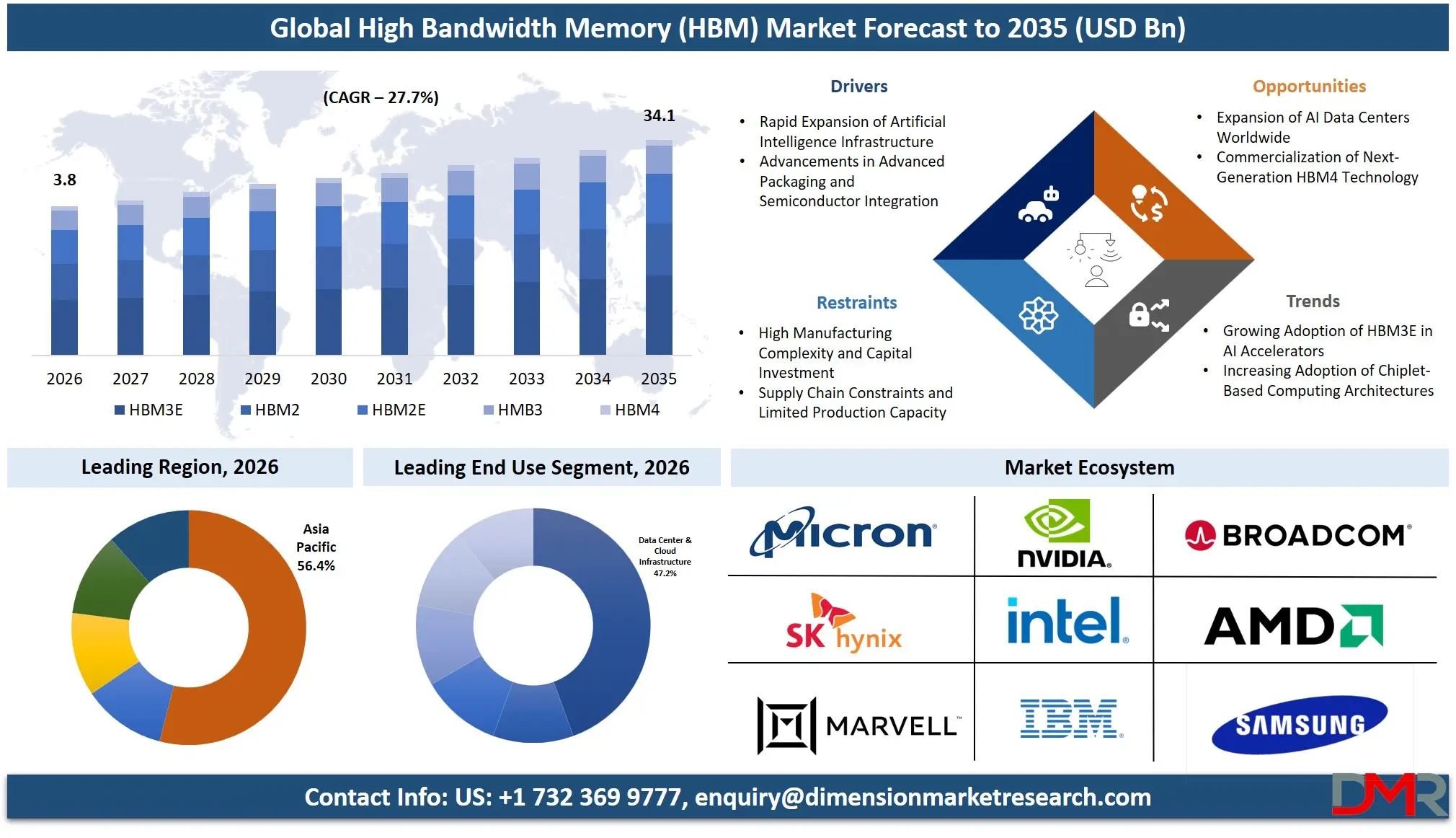
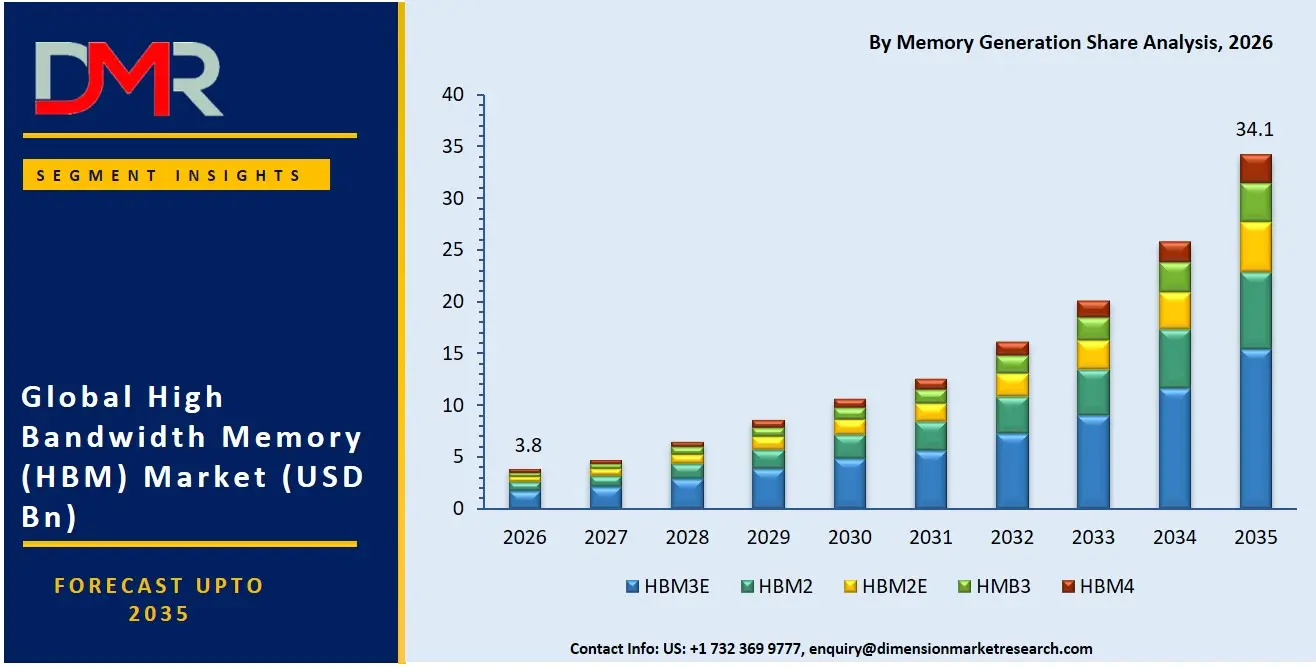
The High Bandwidth Memory (HBM) Market size is expected to be USD 3.8 billion in 2026 and increase at a compound annual growth rate of 27.7% to USD 34.1 billion in 2035 due to fast growth of the infrastructure of artificial intelligence.
ℹ
To learn more about this report –
Download Your Free Sample Report Here
The market for High Bandwidth Memory (HBM) is witnessing healthy growth owing to the rising need for fast data processing and energy-efficient memory solutions in the areas of artificial intelligence, high-performance computing, cloud computing, and graphic processing applications. HBM allows for improved memory bandwidth along with reduced power consumption using vertically-stacked memory chips and through-silicon vias (TSVs). Continued use of AI accelerators, GPUs, and processors in data centers is aiding the growth of the market. Investments in semiconductor fabrication, advanced packaging technologies, and memory solutions are aiding the adoption of HBM3E and upcoming HBM4 solutions in the market.
The US High Bandwidth Memory (HBM) Market
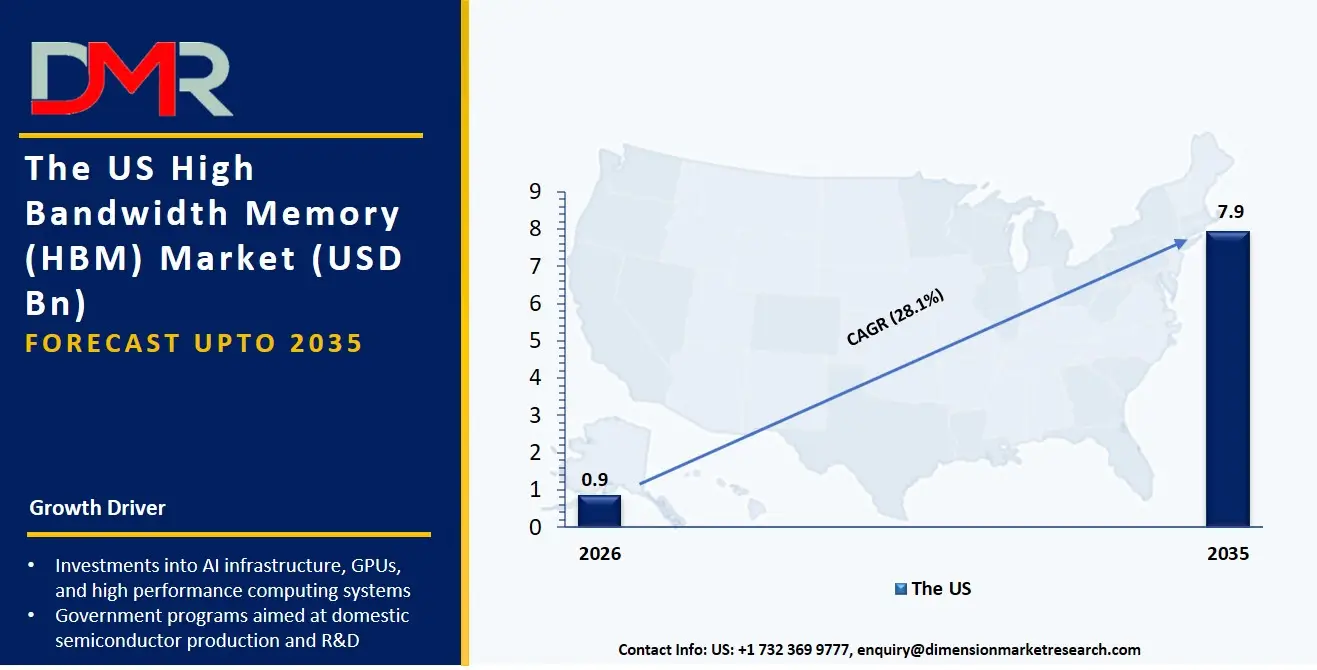
The US High Bandwidth Memory (HBM) Market size is estimated to be USD 900 million in 2026 and is expected to increase at a CAGR of 28.1% over the forecast period.
ℹ
To learn more about this report –
Download Your Free Sample Report Here
High Bandwidth Memory (HBM) is one of the most prominent markets in the world because of the significant role that the US plays when it comes to the field of artificial intelligence, cloud computing, semiconductors design, and hyper-scale data centers. Investments into AI infrastructure, GPUs, and high performance computing systems keep stimulating the market growth. Moreover, various government programs aimed at domestic semiconductor production and R&D increase the rate of market growth. Close cooperation between chip designers, foundry houses, packagers, and cloud computing providers helps to speed up the process of HBM adoption.
Europe High Bandwidth Memory (HBM) Market
The Europe High Bandwidth Memory (HBM) Market size is estimated to be USD 570 million in 2026 and is expected to increase at a CAGR of 26.3% over the forecast period.
Investments in semiconductors, automobiles, industrial automation, and supercomputers have resulted in the development of the High Bandwidth Memory market in Europe at a constant pace. Initiatives like digital sovereignty, semiconductor production capabilities, and packaging technology advancements contribute to an enhanced ecosystem. Objectives related to sustainability, in accordance with the European Green Deal, focus on energy-efficient computing platforms, thereby resulting in greater requirements of advanced memory technologies. Factors contributing to growth include research organizations, high-performance computing programs, automobiles, aerospace applications, and Artificial Intelligence adoption.
Japan High Bandwidth Memory (HBM) Market
The market size of Japan High Bandwidth Memory (HBM) will be USD 342 million in 2026 and at a CAGR of 26.0% in the forecast period.
The reason why Japan continues to be strategically important is due to its well-developed know-how in the manufacturing of semiconductors, materials industry and its electronics industry. Constant investments in the capacity for the manufacturing of semiconductors, innovations in packaging as well as developments in memory technology continue to drive the market. The government backed programs for revitalization of the domestic semiconductor manufacturing have been leading to the use of advanced HBM technology.
Key Takeaways
- Market Size & Forecast: The High Bandwidth Memory (HBM) Market size is projected to reach USD 3.8 billion in 2026 and is anticipated to have a value of USD 34.1 billion in 2035.
- Growth Rate & Outlook: The High Bandwidth Memory (HBM) Market size is set to grow at a compound annual growth rate of 27.7% during the forecast period of 2026 to 2035.
- Primary Growth Drivers: Some of the major growth drivers in the market are Fast Growth of the Infrastructure of Artificial Intelligence and more.
- Key Market Trends: Some of the major trends in the market are Rise of HBM3E for Next-Generation AI Chips and more.
- By Memory Generation Type: HBM3E segment is anticipated to get the majority share of the High Bandwidth Memory (HBM) Market in 2026.
- By Application Type: AI Accelerator is expected to get the largest revenue share in 2026 in the High Bandwidth Memory (HBM) Market.
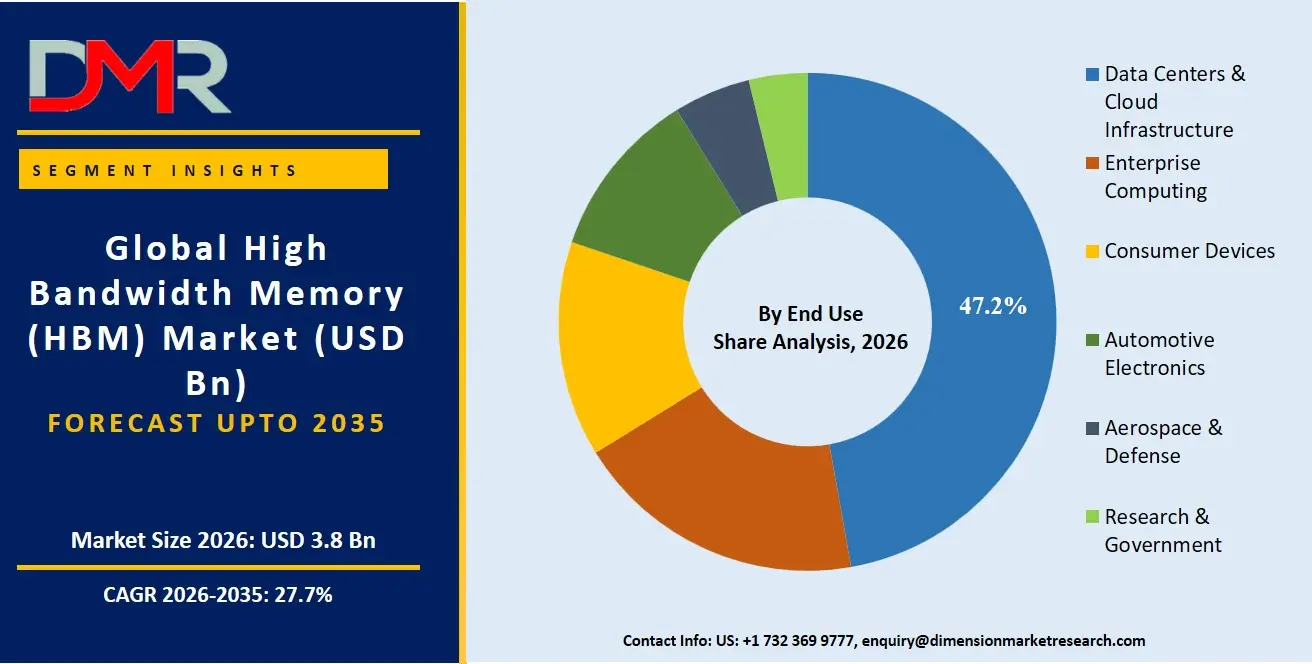
- By End Use Type: Data Centers & Cloud Infrastructure segment is expected to get the largest revenue share in 2026 in the High Bandwidth Memory (HBM) Market.
- Regional Leadership: Asia Pacific is set to lead the High Bandwidth Memory (HBM) Market with an estimated 56.4% share in 2026.
What is the High Bandwidth Memory (HBM)?
HBM is a cutting-edge memory architecture which vertically stacks multiple dynamic random access memory (DRAM) dies via through silicon vias (TSVs) and micro bump interfaces in order to achieve extraordinarily high data transfer rates compared to existing memory technologies at lower power consumption. This memory architecture allows positioning the memory stacks near processors using advanced packaging technology, thus reducing the latency and increasing bandwidth. HBM is used extensively in artificial intelligence processors, graphics processing units, high-performance computing systems, networking devices, and advanced data center hardware. Further development of stacking density, thermal management, packaging technologies, and interface speeds will make HBM more versatile and support more complex computing applications.
Use Cases
- Training of Artificial Intelligence: The use of HBM allows AI accelerators to handle huge volumes of data through improved memory bandwidth and reduced latency. This helps increase the efficiency of training of language models, computer vision, recommendation engines, and generative AI applications.
- High-Performance Computing: Supercomputers rely on HBM to run simulations, weather forecasting, molecular modeling, defense computing, and finance computing. The high bandwidth provides better access to large volumes of data, making the computations more efficient and reducing their processing time.
- Graphics Processing: Current graphic processing units leverage HBM to handle tasks like real-time rendering, gaming, professional visualization, animation, virtual reality, and content creation. This allows them to deliver outstanding graphics performance while consuming less power than other memory solutions.
- Cloud Data Centers: Many cloud computing companies rely on HBM-enabled processors to perform tasks like AI inference, virtualization, analytics, databases processing, and enterprise computing. This helps improve the performance and energy efficiency of servers while meeting rising processing needs.
How AI Is Transforming the High Bandwidth Memory (HBM) Market
The artificial intelligence technology is revolutionizing the High Bandwidth Memory (HBM) industry through increasing the demand for extremely fast memory designs that can handle the increased complexity of computations. The AI training clusters have very high memory bandwidth requirements when training the trillion-parameter models, which necessitates the use of HBM in the hardware used for AI. The uses of machine learning, cloud computing, and other enterprise AI solutions further drive the adoption of HBM globally.
AI is applied in manufacturing of HBMs to help in predictive maintenance, automated inspection of products, production optimization, identification of defects, yield improvement, and forecast the supply chain. The semiconductor companies are now using artificial intelligence in their operations to optimize production, reduce the costs of production, increase precision in packaging, and shorten the development cycles.
Market Dynamic
Driving Factors in the High Bandwidth Memory (HBM) Market
Fast Growth of the Infrastructure of Artificial Intelligence
High Bandwidth Memory is becoming the main factor in the growth of the market. Training and inference workloads and generative AI use cases need super-fast memory transfer from processor to memory. The architecture of the standard DRAM cannot provide such performance, and therefore HBM is becoming more desirable. Investments into AI servers, hyperscale cloud infrastructure, advanced accelerators, and enterprise AI platforms stimulate the growth of the market further. With the expansion of AI usage in various industries, the growth of the market will be even faster.
Restraints in the High Bandwidth Memory (HBM) Market
Complexity of Production Process and Large Amount of Capital Investments
In order to produce HBM, high-end fabrication process is required that includes complicated wafer processing, stacking, package integration, bonding, and testing. The complexity of manufacturing processes is much higher than in case of traditional memory chips and this, consequently, raises the cost of the production. Large amount of investments into the production facility and testing systems becomes another barrier to entry into the market.
Opportunities in the High Bandwidth Memory (HBM) Market
Worldwide Expansion of AI Data Centers
The development of hyperscale AI data centers around the world offers great potential for HBM makers. More organizations are using AI systems that need memory bandwidths higher than those provided by conventional processors. Increased usage of AI-based cloud computing, analytics, autonomous technologies, and machine learning applications is creating a need for high-performance HBM products on an ongoing basis. Companies that can ramp up production levels and enhance performance can take advantage of this market trend.
Trends in the High Bandwidth Memory (HBM) Market
Rise of HBM3E for Next-Generation AI Chips
Next-generation AI chips have increasingly opted to use HBM3E technology because of higher bandwidth, greater capacity, and more efficient power usage compared to other types of memory. This has led to an increasing trend among chipmakers to incorporate HBM3E memory technology within their AI chips, which have been used to power generative AI, deep learning, and inference workloads.
Research Scope and Analysis
This report on High Bandwidth Memory (HBM) Market Research is an analysis of trends, technology development, competition, region-wise performance, and growth opportunities within the overall semiconductor industry. This research study also segments the market in terms of memory generation, applications, and end uses. Further, it examines various factors that drive demand, innovation, supply chain, adoption, and strategic moves for market growth.
ℹ
To learn more about this report –
Download Your Free Sample Report Here
By Memory Generation Analysis
Of all the memory generation segments, HBM3E will have a significant lead within the HBM market by 2026 and would hold a market share of around 44.8%. The reason behind the market leadership of HBM3E is due to extensive usage of the technology in AI accelerators, next-generation graphics processing units, and hyperscale cloud infrastructure, where there is a necessity for greater bandwidths, memory capacity, and energy efficiency.
ℹ
To learn more about this report –
Download Your Free Sample Report Here
There is an emphasis on integrating HBM3E into AI platforms by semiconductor firms since it provides better performance than its predecessors and can manage complicated generative AI use cases. Improvement in packaging technology, stack capacity, and thermal properties will ensure that HBM3E remains at the forefront of the market. On the other hand, HBM4 will be the fastest-growing segment since there will be commercialization within premium AI processors and high-performance computing systems in the future. Even though it does not have much market share compared to HBM3E within 2026, increased investment in advanced semiconductor manufacturing, chiplet architecture, and heterogeneous integration will increase its adoption rate significantly.
By Application Analysis
Considering the applications of AI Accelerators, it can be stated that it is predicted to be the dominant segment of the High Bandwidth Memory (HBM) market, with a projected market share of around 41.6% by 2026. The rapid rise in applications such as generative artificial intelligence, foundation models, enterprise-level implementation of AI, and machine learning infrastructure in the cloud is driving an unprecedented demand for high-bandwidth memory. AI accelerators need highly efficient memory bandwidth in order to address any bottlenecking issues during processing and increase computational efficiency. This makes HBM the optimal choice. In addition to this, continuous investments made by cloud providers and semiconductor companies have helped this segment maintain its dominance. High-Performance Computing (HPC) is predicted to become the fastest-growing application segment due to growing scientific research, engineering simulations, weather prediction, pharmaceutical modeling, defense computations, and financial analyses.
By End Use Analysis
From the end-use perspective, the Data Centers & Cloud Infrastructure industry is forecasted to dominate the HBM market, holding about 47.2% of the market share in 2026. The fast-paced growth of hyperscale cloud data centers, enterprise AI infrastructure, high-performance servers, and machine learning clusters is expected to drive the demand for HBM. AI-enabled processors using HBM technology have been deployed by cloud service providers to boost computation capacity, decrease latency, and manage data-intensive use cases. Digital transformation and cloud-native solutions will further drive the prominence of this segment. Enterprise Computing is predicted to be the fastest-growing segment due to the increasing deployment of artificial intelligence, analytics, cybersecurity, and digital business solutions that need higher memory bandwidths.
The High Bandwidth Memory (HBM) Market Report is segmented on the basis of the following:
By Memory Generation
- HBM2
- HBM2E
- HBM3
- HBM3E
- HBM4 (Emerging)
By Application
- AI Accelerators
- Graphics Processing Units (GPUs)
- High-Performance Computing (HPC)
- Networking & Telecommunications
- Automotive
- Consumer Electronics
By End Use
- Data Centers & Cloud Infrastructure
- Enterprise Computing
- Consumer Devices
- Automotive Electronics
- Aerospace & Defense
- Research & Government
Regional Analysis
Leading Region in the High Bandwidth Memory (HBM) Market
ℹ
To learn more about this report –
Download Your Free Sample Report Here
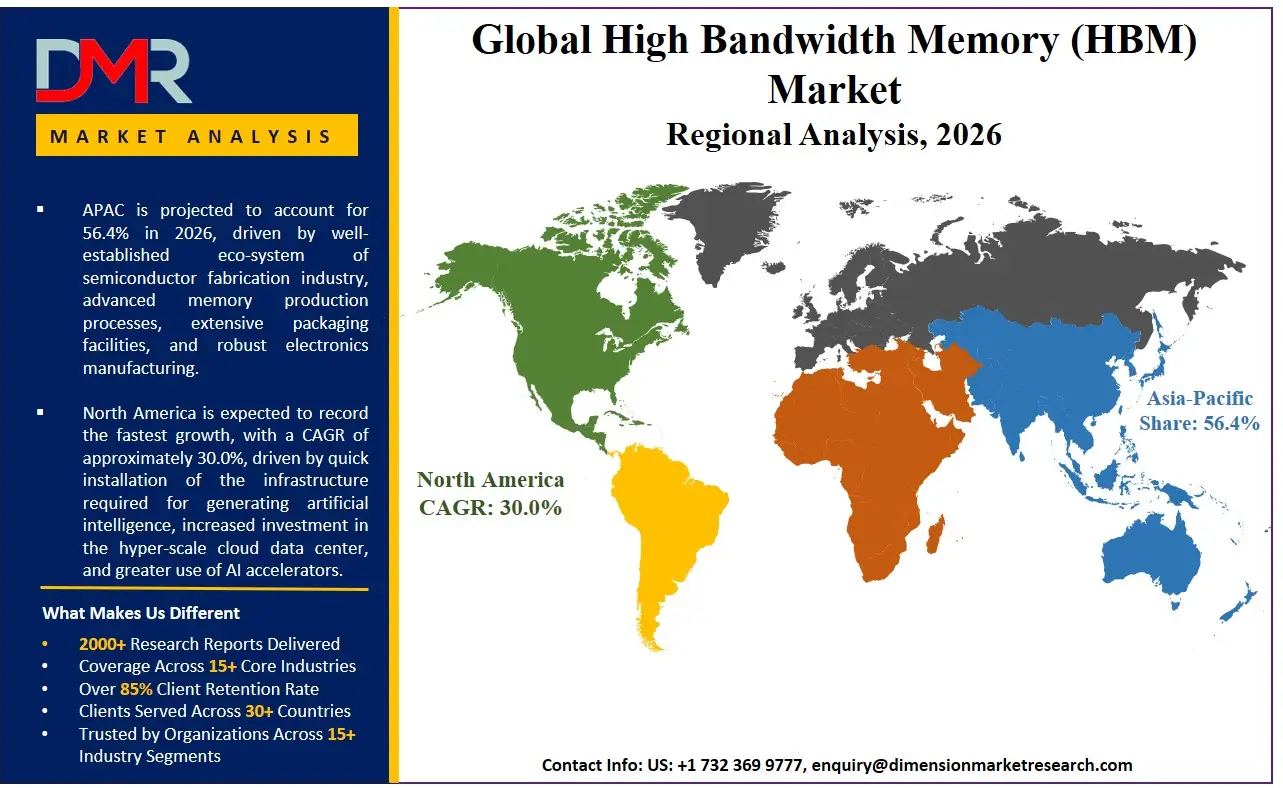
Asia-Pacific is likely to hold its supremacy as the top region in terms of High Bandwidth Memory Market Share in the year 2026, capturing around 56.4%. This is due to its well-established eco-system of semiconductor fabrication industry, advanced memory production processes, extensive packaging facilities, and robust electronics manufacturing. Investments in artificial intelligence infrastructure, cloud computing, advanced graphics processor technology, and research on semiconductors will further improve the competitiveness of the region. Availability of many memory manufacturers, foundries, packaging solutions providers, and electronics manufacturers will facilitate commercialization of next generation HBM technologies. Government efforts in making semiconductor self-sufficient and rising investments in AI and high performance computing will strengthen Asia-Pacific's supremacy in the HBM market globally.
Fastest Growing Region in the High Bandwidth Memory (HBM) Market
The North American region is estimated to witness the highest growth rate among all regional markets during the forecast period in the High Bandwidth Memory market. The quick installation of the infrastructure required for generating artificial intelligence, increased investment in the hyperscale cloud data center, and greater use of AI accelerators are driving the market towards growth in demand. Excellent semiconductor designing skills and innovations in advanced processor designs along with favorable government regulations for semiconductor manufacturing add to the growth in the High Bandwidth Memory market. Growth will also be driven by investments in high-performance computing, defense technology, research work, and enterprise-level AI usage.
By Region
North America
Europe
- Germany
- The U.K.
- France
- Italy
- Russia
- Spain
- Benelux
- Nordic
- Rest of Europe
Asia-Pacific
- China
- Japan
- South Korea
- India
- ANZ
- ASEAN
- Rest of Asia-Pacific
Latin America
- Brazil
- Mexico
- Argentina
- Colombia
- Rest of Latin America
Middle East & Africa
- Saudi Arabia
- UAE
- South Africa
- Israel
- Egypt
- Rest of MEA
Competitive Landscape
There is a considerable amount of high entry barriers that occur due to the necessity of high capital investments, highly sophisticated fabrication technology, protection of intellectual property, and highly sophisticated packaging technology. The competition in the High Bandwidth Memory (HBM) market is mainly based on the innovation of products, greater memory bandwidth, better energy efficiency, greater density of stacking, and research and development. Players of the market increase their production capacity, create long-term contracts with suppliers of artificial intelligence processors, implement advanced packaging technologies, and make strategic partnerships throughout the entire semiconductor supply chain.
Some of the prominent players in the global High Bandwidth Memory (HBM) are:
- SK hynix
- Samsung Electronics
- Micron Technology
- NVIDIA
- Advanced Micro Devices (AMD)
- Intel
- Broadcom
- Marvell Technology
- Qualcomm
- IBM
- Amazon Web Services
- Google
- Microsoft
- Meta Platforms
- Tesla
- TSMC
- ASE Technology Holding
- Amkor Technology
- JCET Group
- Powertech Technology Inc. (PTI)
- Other Key Players
Recent Developments
- In March 2026, Applied Materials and SK hynix have formed a strategic alliance in order to hasten the development of next-generation DRAM as well as HBM memory for artificial intelligence and high-performance computing applications. Through the use of EPIC Center at Applied Materials, both firms plan to make advancements in materials engineering, process integration, as well as 3D advanced packaging.
- In February 2026, Samsung has revealed that the mass production and shipment of its HBM4 memory are beginning, thus becoming the first company to launch the advanced generation high bandwidth memory. Using Samsung's sixth-generation 10-nanometer class DRAM process technology along with 4 nanometers logic technology, the newly launched HBM4 promises improved performance, efficiency, and yield. This innovation makes Samsung even more prominent in AI memory solutions, as it allows for faster processing of data.
- In August 2025, NEO Semiconductor unveiled the X-HBM (Extreme High Bandwidth Memory) architecture, which is a next-generation memory architecture tailored for AI chips and HPC systems. Based on the NEO semiconductor's 3D X-DRAM architecture, the X-HBM provides greater bandwidth and memory density compared to existing HBM architectures, making it possible for the efficient processing of AI workloads. The objective is to provide a remedy to the problem faced by AI chip designers in regard to memory limitations.
Report Details
| Report Characteristics |
| Market Size (2026) |
USD 3.8 Bn |
| Forecast Value (2035) |
USD 34.1 Bn |
| CAGR (2026–2035) |
27.7% |
| Historical Period |
2021 – 2025 |
| Forecast Period |
2027 – 2035 |
| Base Year |
2025 |
| Estimate Year |
2026 |
| Segments Covered |
By Memory Generation, By Application, By End Use |
| Regional Coverage |
North America – The US and Canada; Europe – Germany, The UK, France, Russia, Spain, Italy, Benelux, Nordic, & Rest of Europe; Asia-Pacific – China, Japan, South Korea, India, ANZ, ASEAN, Rest of APAC; Latin America – Brazil, Mexico, Argentina, Colombia, Rest of Latin America; Middle East & Africa – Saudi Arabia, UAE, South Africa, Turkey, Egypt, Israel, & Rest of MEA |
Frequently Asked Questions
How big is the High Bandwidth Memory (HBM) Market?
▾ The High Bandwidth Memory (HBM) Market size is expected to reach USD 3.8 billion by 2026 and is projected to reach USD 34.1 billion by the end of 2035.
What is the CAGR of the High Bandwidth Memory (HBM) Market from 2026 to 2035?
▾ The market is growing at a CAGR of 27.7 percent over the forecasted period.
What factors are driving the growth of the High Bandwidth Memory (HBM) Market?
▾ Fast Growth of the Infrastructure of Artificial Intelligence, and more are the factors driving the growth of the High Bandwidth Memory (HBM) Market.
What are the major trends in the High Bandwidth Memory (HBM) Market?
▾ Rise of HBM3E for Next-Generation AI Chips, and more are some of the major trends in the market.
Who are the key players in the High Bandwidth Memory (HBM) Market?
▾ Some of the key players in the High Bandwidth Memory (HBM) Market include Micron, Intel, IBM, and more.
How is the High Bandwidth Memory (HBM) Market segmented?
▾ The High Bandwidth Memory (HBM) Market is segmented by memory generation, application, end use.
Which region held the largest share of the High Bandwidth Memory (HBM) Market in 2026?
▾ Asia Pacific is set to lead the High Bandwidth Memory (HBM) Market with an estimated 56.4% share in 2026.
Which region is expected to grow the fastest in the High Bandwidth Memory (HBM) Market?
▾ North America is the fastest-growing region in the High Bandwidth Memory (HBM) Market during the forecast period.