What is the Hospital Management Software Market Size?
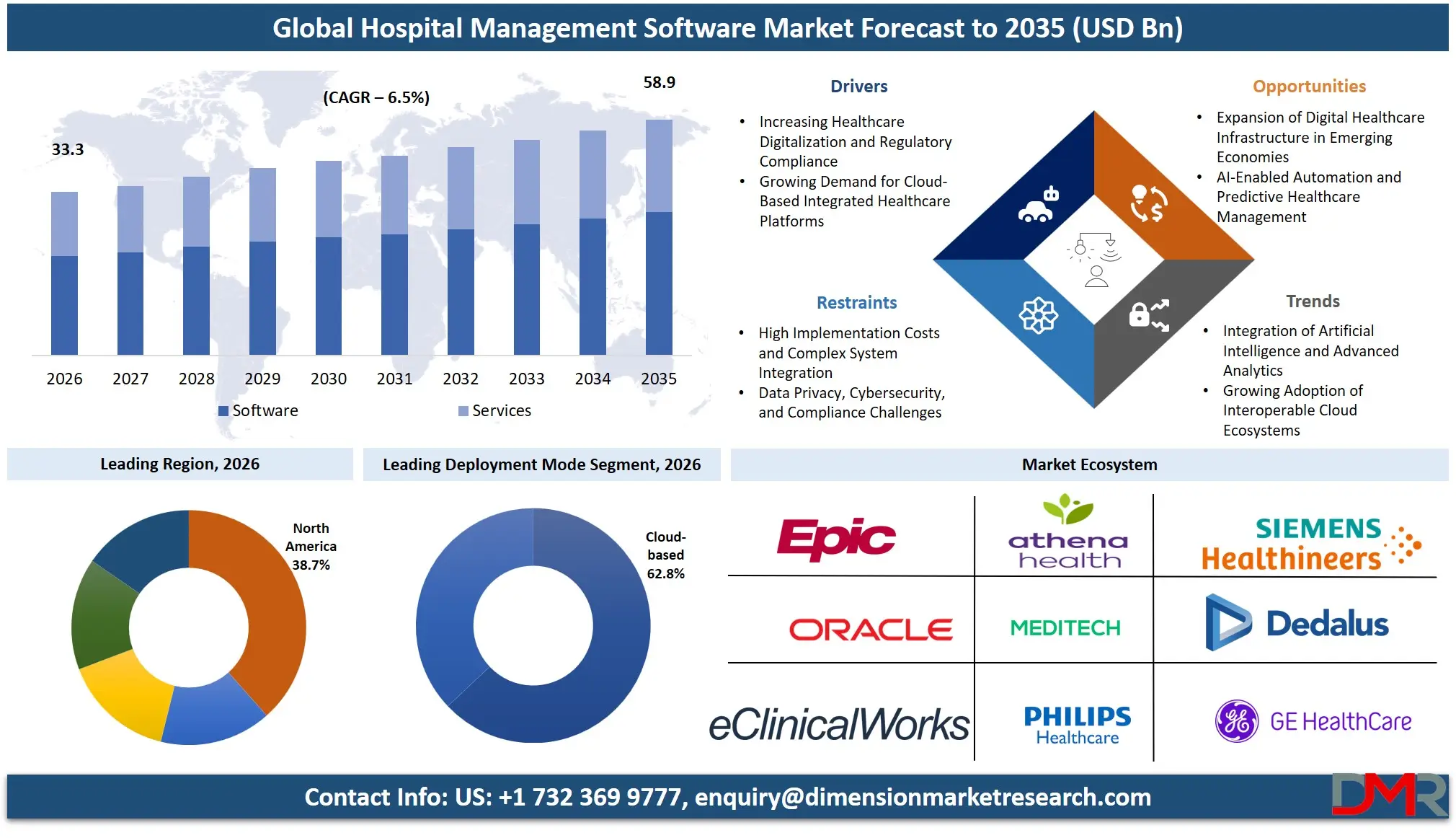
The Hospital Management Software Market size is expected to be USD 33.3 billion in 2026 and increase at a compound annual growth rate of 6.5% to USD 58.9 billion in 2035 due to increasing healthcare digitalization and regulatory compliance.
ℹ
To learn more about this report –
Download Your Free Sample Report Here
Hospital management software comprises integrated digital platforms designed to streamline clinical, administrative, financial, and operational functions across healthcare facilities. The market includes software applications, implementation services, consulting, training, maintenance, and cloud- or on-premises-based deployment models supporting patient registration, electronic medical records, billing, scheduling, pharmacy, laboratory, and inventory management. Growing digital transformation across healthcare, increasing emphasis on patient-centric care, expanding interoperability requirements, and rising adoption of cloud computing and artificial intelligence are accelerating market growth. Healthcare providers are increasingly investing in intelligent, scalable platforms that enhance operational efficiency, regulatory compliance, data-driven decision-making, and overall quality of patient care.
The US Hospital Management Software Market
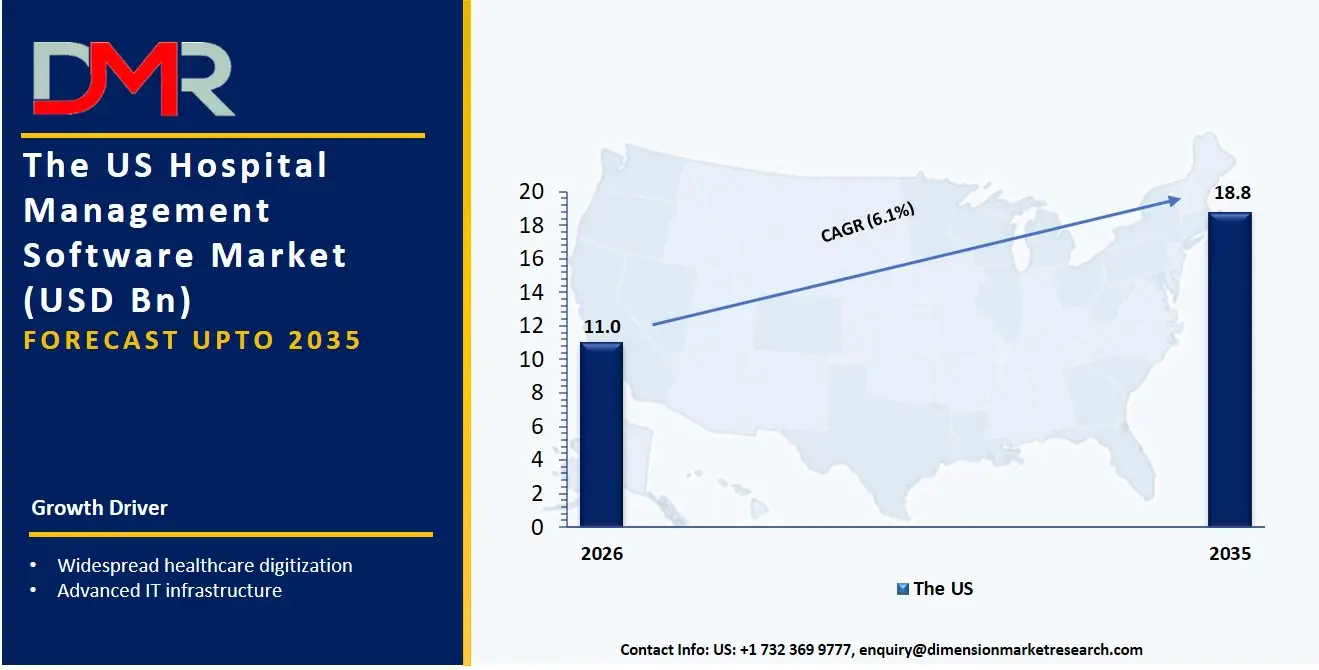
The US Hospital Management Software Market size is estimated to be USD 11.0 billion in 2026 and is expected to increase at a CAGR of 6.1% over the forecast period.
ℹ
To learn more about this report –
Download Your Free Sample Report Here
The US Hospital Management Software Market is driven by widespread healthcare digitization, advanced IT infrastructure, and strong investments in digital health technologies. Large healthcare systems continue to modernize clinical and administrative workflows through integrated software platforms that improve operational efficiency and patient outcomes. Regulatory initiatives promoting interoperability, electronic health records, cybersecurity, and value-based care further encourage software adoption. Continuous innovation by established technology vendors and increasing demand for cloud-based healthcare solutions reinforce the country's leading position within the global market.
Europe Hospital Management Software Market
The Europe Hospital Management Software Market size is estimated to be USD 7.3 billion in 2026 and is expected to increase at a CAGR of 6.2% over the forecast period.
The Europe Hospital Management Software Market benefits from robust healthcare infrastructure, expanding digital health initiatives, and supportive regulatory frameworks encouraging electronic health records and secure data exchange. Regional strategies promoting healthcare modernization and sustainable digital transformation accelerate software implementation across public and private hospitals. The European Green Deal indirectly encourages resource-efficient healthcare operations through digital optimization, while increasing investments in AI-enabled healthcare systems, interoperability, and cybersecurity continue supporting innovation and market expansion throughout the region.
Japan Hospital Management Software Market
The market size of Japan Hospital Management Software will be USD 1.7 billion in 2026 and at a CAGR of 6.4% in the forecast period.
The Japan Hospital Management Software Market is expanding due to an aging population, increasing healthcare expenditure, and continuous modernization of medical infrastructure. Healthcare providers are adopting advanced software platforms to improve workflow automation, patient management, and operational efficiency while addressing workforce shortages. Government initiatives supporting digital healthcare transformation, combined with growing implementation of cloud technologies, artificial intelligence, and integrated healthcare information systems, create significant growth opportunities despite challenges associated with legacy infrastructure integration and stringent data privacy requirements.
Key Takeaways
- Market Size & Forecast: The Hospital Management Software Market size is projected to reach USD 33.3 billion in 2026 and is anticipated to have a value of USD 58.9 billion in 2035.
- Growth Rate & Outlook: The Hospital Management Software Market size is set to grow at a compound annual growth rate of 6.5% during the forecast period of 2026 to 2035.
- Primary Growth Drivers: Some of the major growth drivers in the market are Increasing Healthcare Digitalization and Regulatory Compliance, and more.
- Key Market Trends: Some of the major trends in the market are Integration of Artificial Intelligence and Advanced Analytic, and more.
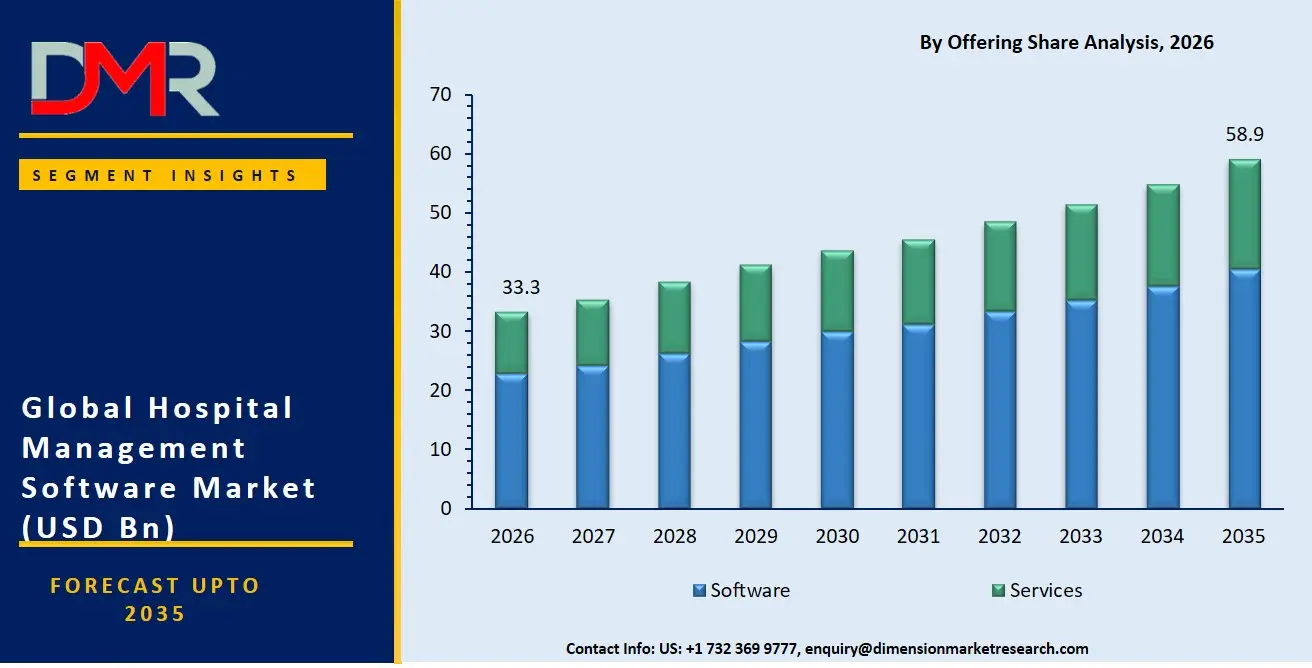
- By Offering Type: Software is anticipated to get the majority share of the Hospital Management Software Market in 2026.
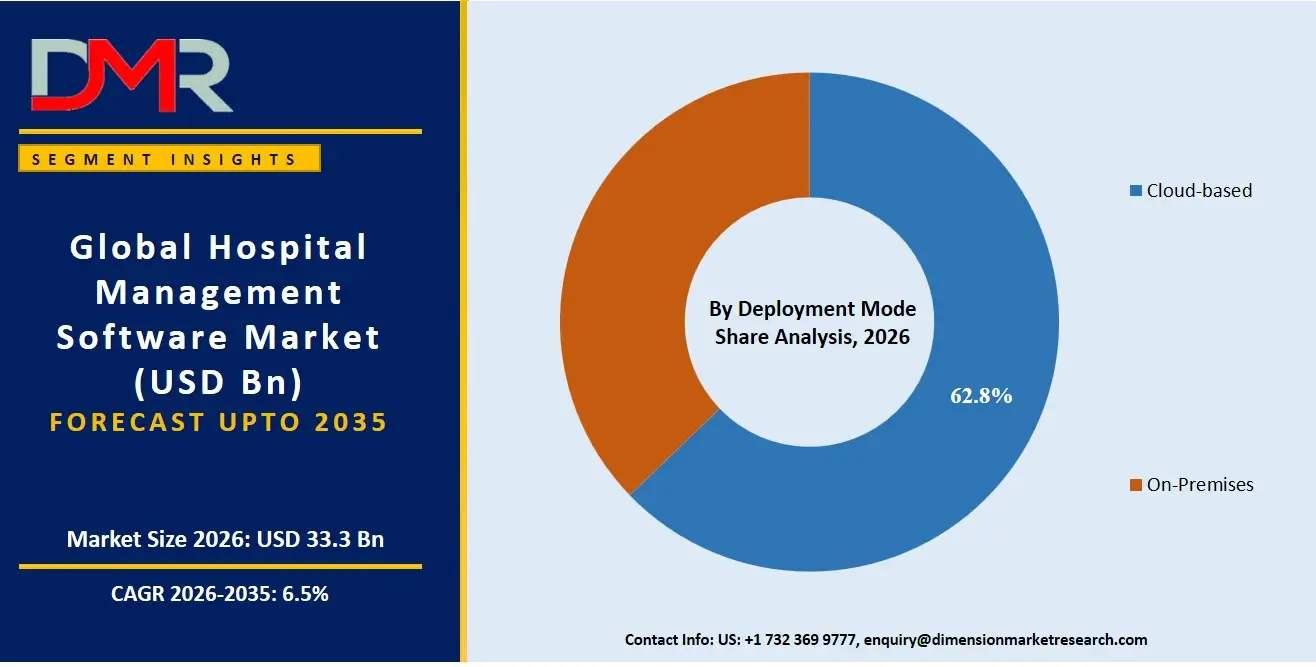
- By Deployment Mode Type: Cloud-based are expected to get the largest revenue share in 2026 in the Hospital Management Software Market.
- Regional Leadership: North America is set to lead the Hospital Management Software Market with an estimated 38.7% share in 2026.
What is the Hospital Management Software?
Hospital management software is an integrated digital solution that automates and manages clinical, administrative, financial, and operational activities within healthcare facilities. It enables patient registration, appointment scheduling, electronic medical record management, billing, pharmacy, laboratory, inventory, workforce, and reporting functions through a centralized platform. The software improves workflow efficiency, enhances patient care quality, minimizes administrative errors, supports regulatory compliance, and facilitates informed decision-making through real-time data access and analytics.
Use Cases
- Patient Administration and Clinical Workflow Management: Hospital management software centralizes patient registration, appointment scheduling, admissions, discharge planning, and electronic medical records within a unified platform. This improves coordination among departments, minimizes administrative errors, reduces patient waiting times, and enables healthcare professionals to deliver more efficient and personalized medical care.
- Financial and Revenue Cycle Management: Healthcare organizations utilize hospital management software to automate billing, insurance claim processing, payment collection, accounting, and financial reporting. Automated revenue cycle management minimizes claim denials, improves reimbursement accuracy, enhances financial transparency, and supports sustainable hospital operations through optimized cash flow management.
- Pharmacy, Laboratory, and Inventory Management: The software integrates pharmacy operations, laboratory information systems, and inventory management into a centralized environment. Hospitals can monitor medicine availability, laboratory workflows, diagnostic results, equipment utilization, and procurement activities, reducing stock shortages, operational costs, and medication-related errors while improving service quality.
- Healthcare Analytics and Decision Support: Hospital management software enables administrators and clinicians to access real-time dashboards, predictive analytics, operational reports, and performance indicators. Data-driven insights support resource allocation, workforce planning, quality improvement initiatives, regulatory compliance, and strategic decision-making for improved healthcare delivery.
How AI Is Transforming the Hospital Management Software Market
Artificial intelligence is transforming hospital management software by automating administrative functions, improving patient scheduling, optimizing staff allocation, enhancing revenue cycle management, and enabling predictive healthcare analytics. AI-powered clinical decision support systems assist physicians in identifying treatment recommendations, analyzing medical records, and reducing diagnostic delays. Intelligent automation also minimizes documentation burdens, allowing healthcare professionals to devote greater attention to patient care.
AI additionally strengthens operational efficiency through predictive maintenance of medical equipment, demand forecasting for hospital inventories, fraud detection in insurance claims, and personalized patient communication. Machine learning algorithms continuously analyze healthcare data to identify operational bottlenecks, improve resource utilization, enhance patient outcomes, and support evidence-based management decisions. As AI capabilities mature, hospital management software is expected to become increasingly autonomous, intelligent, and data-driven across the healthcare ecosystem.
Market Dynamic
Driving Factors in the Hospital Management Software Market
Increasing Healthcare Digitalization and Regulatory Compliance
Rapid digital transformation across healthcare systems remains one of the strongest drivers of the hospital management software market. Hospitals increasingly require integrated digital platforms that improve operational efficiency, ensure secure patient information management, and support regulatory compliance. Government initiatives promoting electronic health records, interoperability standards, and digital healthcare infrastructure continue encouraging software adoption while improving healthcare quality, workflow automation, patient safety, and institutional productivity across healthcare organizations.
Restraints in the Hospital Management Software Market
High Implementation Costs and Complex System Integration
Although hospital management software delivers substantial long-term operational benefits, implementation requires considerable investment in software licensing, infrastructure upgrades, customization, cybersecurity, and employee training. Integrating modern platforms with existing legacy hospital information systems often creates technical complexities, prolongs deployment timelines, and increases implementation costs. These challenges may discourage adoption, particularly among small hospitals and resource-constrained healthcare providers.
Opportunities in the Hospital Management Software Market
Expansion of Digital Healthcare Infrastructure in Emerging Economies
Rapid healthcare infrastructure development across emerging economies presents substantial opportunities for hospital management software providers. Governments and private healthcare organizations are investing in hospital modernization, digital transformation, and healthcare accessibility. Increasing adoption of electronic medical records, telehealth services, and integrated healthcare information systems creates favorable conditions for software vendors to expand their presence in previously underserved healthcare markets.
Trends in the Hospital Management Software Market
Integration of Artificial Intelligence and Advanced Analytics
Healthcare organizations are increasingly integrating artificial intelligence, predictive analytics, and machine learning into hospital management software to automate repetitive administrative processes, optimize clinical workflows, forecast patient admissions, and improve treatment planning. Intelligent analytics enable hospitals to make evidence-based operational decisions while improving resource utilization, financial performance, and patient satisfaction through proactive healthcare management.
Research Scope and Analysis
The Hospital Management Software Market analysis evaluates key segments including offering, deployment mode, hospital type, and end users. It examines market trends, adoption patterns, growth drivers, challenges, technological advancements, and regional dynamics influencing software implementation across healthcare organizations globally.
ℹ
To learn more about this report –
Download Your Free Sample Report Here
By Offering Analysis
The Hospital Management Software Market by offering is segmented into software and services. The software segment is expected to remain the leading segment, accounting for an estimated 68.5% market share in 2026, due to increasing demand for integrated platforms that automate clinical, administrative, financial, and operational processes.
ℹ
To learn more about this report –
Download Your Free Sample Report Here
Within software, clinical management solutions are expected to maintain strong adoption as hospitals prioritize electronic medical records, patient monitoring, and workflow optimization. The services segment, including implementation and integration, support and maintenance, and consulting and training, is projected to be the fastest-growing segment due to increasing complexity in software deployment, customization requirements, cybersecurity needs, and demand for continuous technical support. Healthcare organizations are increasingly relying on service providers to ensure seamless implementation, interoperability, and long-term system performance.
By Deployment Mode Analysis
The Hospital Management Software Market by deployment mode is categorized into cloud-based and on-premises solutions. The cloud-based segment is projected to dominate the market with an estimated 62.8% share in 2026, supported by lower infrastructure requirements, scalability, remote accessibility, automatic software updates, and enhanced collaboration across healthcare networks. Cloud solutions are increasingly preferred by hospitals seeking cost-effective digital transformation without extensive investment in hardware infrastructure. The cloud-based segment is also expected to experience the fastest growth as healthcare providers adopt software-as-a-service models and prioritize flexible, secure, and interoperable healthcare platforms. On-premises solutions continue to maintain demand among large hospitals requiring complete control over data storage, customization, and internal IT management, particularly in regions with strict healthcare data regulations.
By Hospital Type Analysis
Based on hospital type, the Hospital Management Software Market is segmented into public hospitals, private hospitals, and specialty hospitals. Private hospitals are anticipated to represent the largest segment, capturing an estimated 49.6% market share in 2026, driven by increasing investments in healthcare technology, competitive pressure to improve patient experiences, and the need for efficient operational management. Private healthcare providers are rapidly adopting advanced software solutions to streamline workflows, enhance profitability, and deliver personalized services. Specialty hospitals are expected to be the fastest-growing segment due to increasing demand for focused healthcare services, advanced patient management capabilities, and specialized workflow solutions. Public hospitals are also adopting hospital management software through government-supported healthcare digitization programs aimed at improving accessibility, transparency, and healthcare delivery efficiency.
By End User Analysis
The Hospital Management Software Market by end user includes hospitals, ambulatory surgery centers (ASCs), specialty clinics, and diagnostic centers. Hospitals are expected to remain the dominant end-user segment with an estimated 71.2% market share in 2026, owing to their complex operational requirements, large patient volumes, and need for comprehensive solutions integrating multiple departments. Hospitals continue investing in enterprise-level platforms to manage electronic records, billing, inventory, workforce operations, and analytics. Ambulatory surgery centers and specialty clinics are projected to be among the fastest-growing users due to increasing demand for outpatient healthcare services, minimally invasive procedures, and efficient patient management systems. Diagnostic centers are also adopting specialized software to improve laboratory integration, reporting accuracy, and digital connectivity with healthcare networks.
The Hospital Management Software Market Report is segmented on the basis of the following:
By Offering
- Software
- Clinical Management
- Administrative Management
- Financial Management
- Services
- Implementation & Integration
- Support & Maintenance
- Consulting & Training
By Deployment Mode
By Hospital Type
- Public Hospitals
- Private Hospitals
- Specialty Hospitals
By End User
- Hospitals
- Ambulatory Surgery Centers (ASCs)
- Specialty Clinics
- Diagnostic Centers
Regional Analysis
Leading Region in the Hospital Management Software Market
ℹ
To learn more about this report –
Download Your Free Sample Report Here
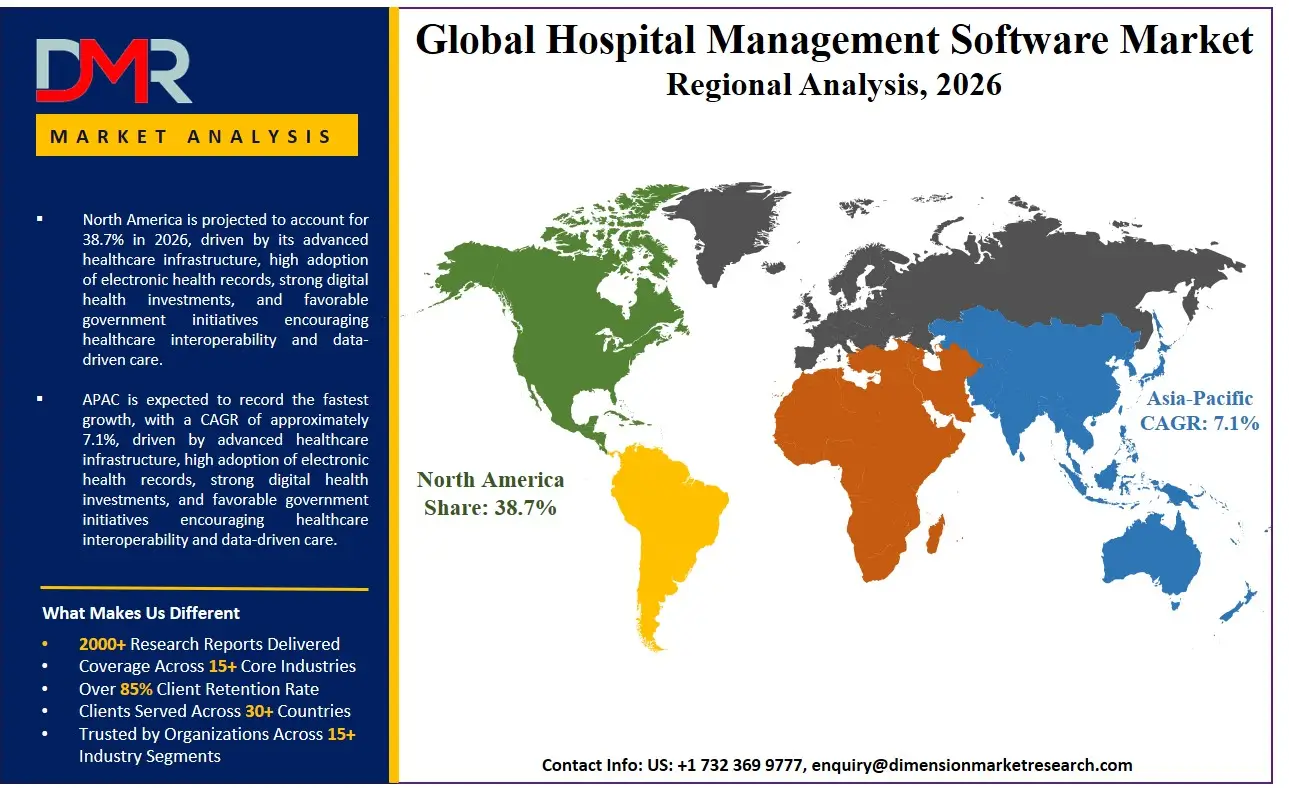
North America is expected to remain the leading region in the Hospital Management Software Market, accounting for an estimated 38.7% market share in 2026. The region's dominance is supported by advanced healthcare infrastructure, high adoption of electronic health records, strong digital health investments, and favorable government initiatives encouraging healthcare interoperability and data-driven care. The presence of technologically advanced healthcare institutions, increasing demand for cloud-based healthcare platforms, and growing integration of artificial intelligence strengthen regional market leadership. Additionally, strong cybersecurity investments, healthcare IT spending, and the adoption of value-based care models continue accelerating hospital management software implementation across hospitals and healthcare networks.
Fastest Growing Region in the Hospital Management Software Market
Asia-Pacific is projected to be the fastest-growing region in the Hospital Management Software Market due to rapid healthcare infrastructure expansion, increasing government-led digital healthcare initiatives, rising healthcare expenditure, and growing demand for efficient patient management systems. Countries across the region are investing heavily in hospital modernization, electronic health records, telemedicine platforms, and cloud-based healthcare solutions. Expanding private healthcare networks, increasing urbanization, and rising awareness of healthcare technology are creating significant opportunities for software providers. Emerging economies are particularly contributing to growth as hospitals seek affordable, scalable solutions to improve healthcare accessibility, operational efficiency, and patient service delivery.
By Region
North America
Europe
- Germany
- The U.K.
- France
- Italy
- Russia
- Spain
- Benelux
- Nordic
- Rest of Europe
Asia-Pacific
- China
- Japan
- South Korea
- India
- ANZ
- ASEAN
- Rest of Asia-Pacific
Latin America
- Brazil
- Mexico
- Argentina
- Colombia
- Rest of Latin America
Middle East & Africa
- Saudi Arabia
- UAE
- South Africa
- Israel
- Egypt
- Rest of MEA
Competitive Landscape
The Hospital Management Software Market is characterized by strong competition driven by technological innovation, product integration capabilities, and strategic expansion initiatives. Market participants focus on developing scalable platforms with advanced analytics, artificial intelligence, cloud capabilities, and interoperability features to differentiate their offerings. Competitive advantages are created through strong healthcare domain expertise, cybersecurity capabilities, customer support networks, and partnerships with healthcare institutions. High entry barriers exist due to complex regulatory requirements, integration challenges, and the need for reliable healthcare data management. Companies are increasingly investing in research and development, strategic collaborations, and customized solutions to strengthen market presence and address evolving healthcare provider requirements.
Some of the prominent players in the global Hospital Management Software are:
- Oracle Health (Cerner)
- Epic Systems Corporation
- MEDITECH
- Veradigm (Allscripts Healthcare)
- GE HealthCare
- Philips Healthcare
- Siemens Healthineers
- Dedalus Group
- CompuGroup Medical SE & Co. KGaA
- NextGen Healthcare
- eClinicalWorks
- Athenahealth
- CPSI (Computer Programs and Systems, Inc.)
- Harris Healthcare
- InterSystems Corporation
- NTT DATA Healthcare
- Altera Digital Health
- Infor Healthcare
- Carestream Health
- AdvancedMD
- Other Key Players
Recent Developments
- In June 2025, Microsoft expanded its healthcare technology initiatives through partnerships focused on artificial intelligence, cloud computing, and digital healthcare transformation. The company continued supporting healthcare organizations in adopting intelligent platforms that improve operational efficiency, data management, and clinical decision support. These initiatives emphasized the growing role of cloud infrastructure and AI technologies in hospital management software development.
- In April 2025, Oracle Health strengthened its cloud-based healthcare technology portfolio by enhancing digital healthcare management solutions designed to improve data accessibility, interoperability, and operational efficiency. The company continued investing in cloud infrastructure and healthcare analytics capabilities to support hospitals transitioning from traditional systems to scalable digital platforms.
- In February 2025, Epic Systems announced further expansion of its artificial intelligence capabilities within its healthcare software ecosystem to improve clinical workflows and administrative efficiency. The company focused on integrating AI-powered tools designed to assist healthcare professionals with documentation, patient data analysis, and operational decision-making. The development reflects the increasing industry shift toward intelligent hospital management platforms capable of reducing administrative workload and improving healthcare delivery.
Report Details
| Report Characteristics |
| Market Size (2026) |
USD 33.3 Bn |
| Forecast Value (2035) |
USD 58.9 Bn |
| CAGR (2026–2035) |
6.5% |
| Historical Period |
2021 – 2025 |
| Forecast Period |
2027 – 2035 |
| Base Year |
2025 |
| Estimate Year |
2026 |
| Segments Covered |
By Offering (Software, Services), By Deployment Mode, By Hospital Type, By End User |
| Regional Coverage |
North America – The US and Canada; Europe – Germany, The UK, France, Russia, Spain, Italy, Benelux, Nordic, & Rest of Europe; Asia-Pacific – China, Japan, South Korea, India, ANZ, ASEAN, Rest of APAC; Latin America – Brazil, Mexico, Argentina, Colombia, Rest of Latin America; Middle East & Africa – Saudi Arabia, UAE, South Africa, Turkey, Egypt, Israel, & Rest of MEA |
Frequently Asked Questions
How big is the Hospital Management Software Market?
▾ The Hospital Management Software Market size is expected to reach USD 33.3 billion by 2026 and is projected to reach USD 58.9 billion by the end of 2035.
What is the CAGR of the Hospital Management Software Market from 2026 to 2035?
▾ The market is growing at a CAGR of 6.5 percent over the forecasted period.
What factors are driving the growth of the Hospital Management Software Market?
▾ Increasing Healthcare Digitalization and Regulatory Compliance, and more are the factors driving the growth of the Hospital Management Software Market.
What are the major trends in the Hospital Management Software Market?
▾ Increasing Adoption of Combination Therapies, and more are some of the major trends in the market.
Who are the key players in the Hospital Management Software Market?
▾ Some of the key players in the Hospital Management Software Market include Oracle, Siemens, Epic, and more
How is the Hospital Management Software Market segmented?
▾ The Hospital Management Software Market is segmented by offering, deployment mode, hospital type, end user.
Which region held the largest share of the Hospital Management Software Market in 2026?
▾ North America is set to lead the Hospital Management Software Market with an estimated 38.7% share in 2026.
Which region is expected to grow the fastest in the Hospital Management Software Market?
▾ Asia Pacific is the fastest-growing region in the Hospital Management Software Market during the forecast period.