Market Snapshot
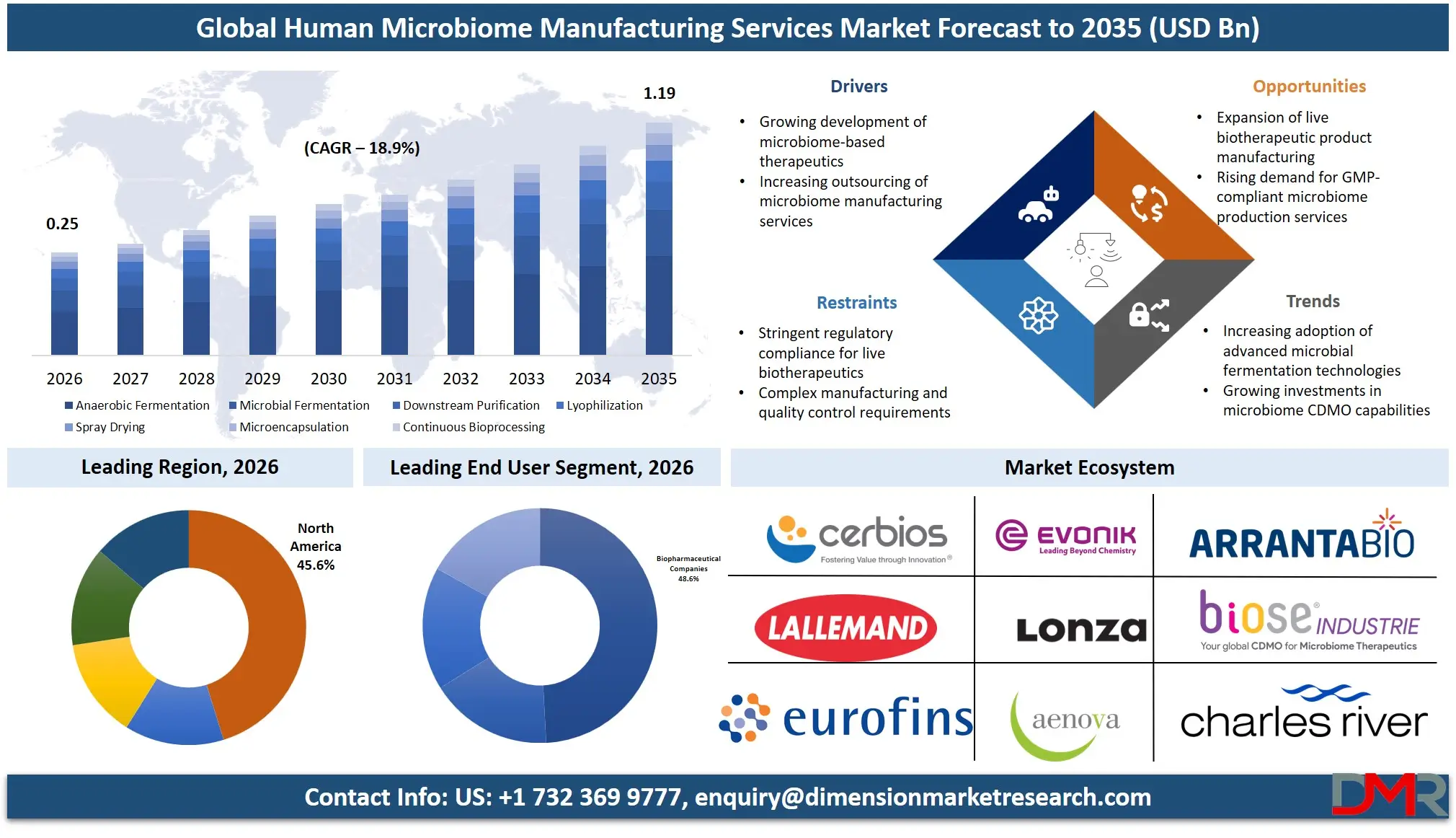
- The market size is USD 0.21 Billion in 2025, reached USD 0.25 billion in 2026, and is projected to hit USD 1.19 billion by 2035 at a CAGR of 18.9%.
- Gastrointestinal Disease leads all application segments with a 40.3% share in 2026.
- North America holds the dominant regional position with a 45.6% revenue share in 2026.
- Biopharmaceutical Companies lead the end-user segment with a 48.6% share in 2026.
- Anaerobic Fermentation leads the technology segment with a 42.63% share in 2026.
- Live Biotherapeutic Products lead the product type segment with a 50.3% share in 2026.
- Europe holds the second-largest regional position with a 29.2% revenue share in 2026.
- Fermentation and Downstream Processing holds the largest share within the service type segment.
- Vials hold the largest share within the packaging type segment.
- Liquid Formulations hold the largest share within the formulation type segment.
Market Overview
Human microbiome manufacturing services cover the contract production of microbiome-derived therapeutics and related biologics on behalf of biopharmaceutical developers, biotechs, and research organizations. The scope includes fermentation and downstream processing, strain development, lyophilization, formulation and fill/finish, and microencapsulation of live biotherapeutic products, probiotics, postbiotics, synbiotics, and microbiome-targeted therapeutics. General pharmaceutical contract manufacturing without microbiome-specific anaerobic capability, and standard probiotic supplement production without therapeutic claims, fall outside Human Microbiome Manufacturing Services Market.
ℹ
To learn more about this report –
Download Your Free Sample Report Here
Contract development and manufacturing organizations with specialized anaerobic fermentation infrastructure sit at the commercial center of Human Microbiome Manufacturing Services Market. Biopharmaceutical sponsors lack the in-house expertise and certified anaerobic capacity to manufacture live biotherapeutic products at clinical or commercial scale. Outsourcing to specialized CDMOs is therefore a structural necessity rather than a cost optimization. List Labs integrated a 500-liter single-use Stedim bioreactor into its California GMP drug production facility to support Phase 1 and Phase 2 clinical manufacturing, as reported by List Labs in January 2023. Investments at this scale reflect how rapidly clinical pipelines are pulling capital into manufacturing infrastructure ahead of commercial readiness.
The regulatory environment is reshaping how CDMOs position their capabilities. Live biotherapeutic products occupy a distinct regulatory category that requires GMP compliance frameworks different from standard biologics. Sponsors advancing late-stage assets toward approval need manufacturing partners already operating under validated processes. CDMOs that have built GMP-compliant anaerobic production capacity ahead of regulatory finalization hold a qualification advantage that new entrants cannot replicate quickly.
Microbiome therapeutics are advancing from single-strain products toward multi-strain consortia with co-cultivation manufacturing requirements. This shift demands a new class of production platform that few CDMOs currently operate at commercial scale. Manufacturers that secure co-cultivation expertise now are positioning themselves as essential partners for the next generation of pipeline assets, before the broader market recognizes the capability gap.
Market Size and Forecast
The Global Human Microbiome Manufacturing Services Market size is estimated at USD 0.25 Billion in 2026 from USD 0.21 Billion in 2025, and is projected to reach USD 1.19 Billion by 2035, exhibiting a CAGR of 18.9% during the forecast period.
List Biotherapeutics invested more than USD 125 Million in a 110,000-square-foot contract manufacturing facility in Fishers, Indiana dedicated to advanced biologics and human microbiome drug substance processing, as reported by List Labs in November 2023. Capital commitments at this scale signal that leading manufacturers are building for commercial-stage demand rather than clinical supply alone. The upside scenario holds if late-stage LBP assets achieve regulatory approval on current timelines and trigger multi-year commercial manufacturing contracts. Nestlé's acquisition of the VOWST microbiome business from Seres Therapeutics for USD 100 Million in August 2024 introduced a major consumer health company into the commercial microbiome supply chain, validating LBP commercial viability for broader investor audiences.
The 18.9% CAGR reflects pipeline maturation rather than speculative demand. Multiple LBP assets are in late-stage clinical development across gastrointestinal, oncology, and immunological indications. Each asset advancing toward a regulatory submission triggers a manufacturing readiness requirement that CDMOs are actively building capacity to meet. The downside risk centers on regulatory heterogeneity across the EU, U.S., and Asia-Pacific, where divergent LBP classification frameworks create compliance uncertainty that can delay commercial launch timelines and defer manufacturing contract activation.
Application Analysis
Gastrointestinal Disease led the application segment with a 40.3% share in 2026.
Gastrointestinal Disease dominates because it contains the most clinically advanced and commercially approved LBP assets. The FDA approval of VOWST for recurrent Clostridioides difficile infection established a commercial manufacturing blueprint for subsequent GI-indication products. CDMOs with validated GI-indication LBP production experience hold a qualification advantage as additional GI assets advance through Phase 2 and Phase 3 development pipelines.
Infectious Disease, Endocrine and Metabolic Disease, and Oncology represent the next tier of application demand. Oncology is attracting the most venture and pharma partnership investment, driven by evidence linking gut microbiome composition to immunotherapy response rates. Immunological Disorders and Neurological Disorders remain earlier-stage application areas, but both are generating clinical data that will pull manufacturing demand forward as trials progress. CDMOs that establish production protocols for neurological microbiome therapeutics today are building a qualification record that will matter when these assets reach late-stage development.
End User Analysis
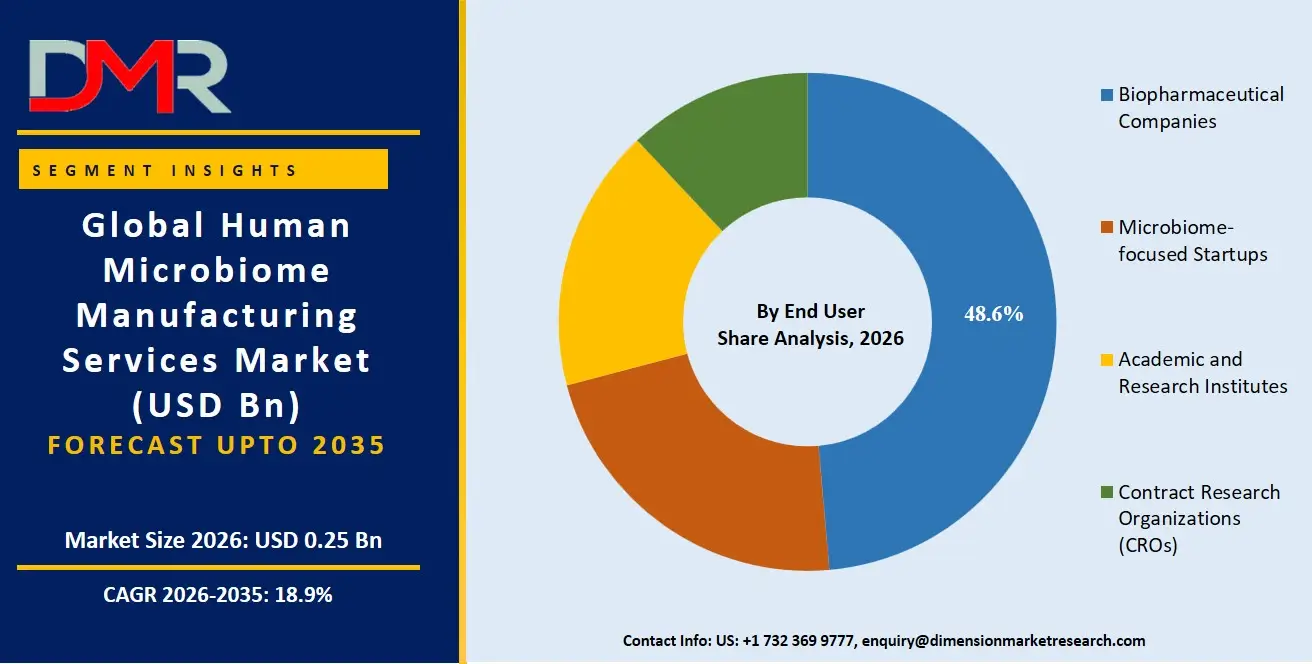
With a 48.6% share in 2026, Biopharmaceutical Companies accounted for the largest portion of end-user demand.
ℹ
To learn more about this report –
Download Your Free Sample Report Here
Biopharmaceutical companies drive market volume because they hold the majority of clinical-stage LBP assets and carry the procurement authority for contract manufacturing relationships. Large pharma sponsors require CDMOs with validated GMP anaerobic capacity, regulatory filing support, and scalability from clinical to commercial production within a single partner relationship. CDMOs that cannot demonstrate end-to-end capability from strain development through fill/finish are excluded from these accounts at the qualification stage.
Microbiome-focused startups are the fastest-growing end-user category by new contract volume. Early-stage biotechs with single-asset pipelines lack the internal manufacturing infrastructure to produce clinical trial material. They rely entirely on CDMO partners for process development, tech transfer, and GMP production. Academic and Research Institutes generate demand for smaller-scale fermentation and strain development services tied to preclinical and early Phase 1 programs. Contract Research Organizations procure manufacturing services on behalf of sponsor clients, adding an intermediary layer that rewards CDMOs with strong regulatory documentation practices and audit readiness.
Technology Analysis
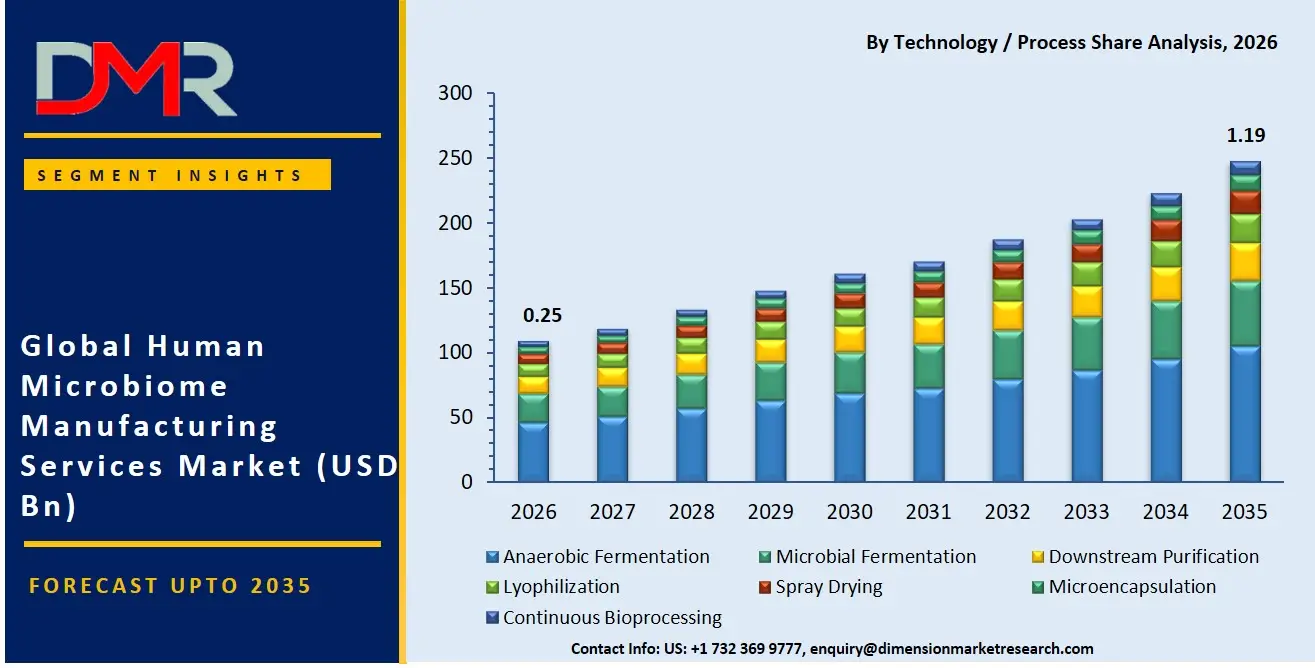
Anaerobic Fermentation captured 42.63% of the technology segment in 2026, ahead of all rivals.
ℹ
To learn more about this report –
Download Your Free Sample Report Here
Anaerobic Fermentation dominates because live biotherapeutic products require oxygen-free production environments that standard aerobic fermentation infrastructure cannot provide. Most pharmaceutical CDMOs do not operate certified anaerobic suites. The CDMOs that do hold a durable competitive barrier rooted in capital investment, validated processes, and trained workforce rather than proprietary intellectual property alone.
Microbial Fermentation supports non-anaerobic microbial production and serves a broader range of probiotic and postbiotic product types. Downstream Purification is a critical value-added service layer where CDMOs differentiate on yield, purity, and regulatory documentation quality. Lyophilization and Spray Drying address formulation stability for LBPs that require long shelf life in solid form.
Microencapsulation protects viable organisms through gastrointestinal transit and is increasingly specified in commercial product development briefs. Continuous Bioprocessing is an emerging capability that promises higher throughput and more consistent batch quality, but adoption remains limited to CDMOs with advanced process engineering teams.
Product Type Analysis
Live Biotherapeutic Products accounted for 50.3% of product type demand in 2026, the highest of any category.
LBPs command market leadership because they represent the therapeutic-grade tier of microbiome products, carrying FDA and EMA regulatory designation and attracting the largest manufacturing investment per unit of production. The commercial approval of VOWST and advancing LBP pipelines across CDiff, oncology, and inflammatory bowel disease have established LBPs as the primary revenue driver for specialized microbiome CDMOs. Sponsors pay premium contract manufacturing rates for validated GMP-compliant LBP production, making this the highest-margin segment for qualified CDMOs.
Probiotics represent a volume-driven segment with lower per-unit contract value than LBPs but broader customer access across nutraceutical and functional food manufacturers. Postbiotics and Synbiotics are growing categories with increasing pharmaceutical-grade production demand as clinical evidence accumulates. Microbiome-targeted Therapeutics is an emerging product type encompassing phage therapies, metabolite-based drugs, and microbiome modulation platforms that require new production process development beyond current fermentation standards.
Key Market Segments
By Application
- Gastrointestinal Disease
- Infectious Disease
- Endocrine and Metabolic Disease
- Oncology
- Immunological Disorders
- Neurological Disorders
By End User
- Biopharmaceutical Companies
- Microbiome-focused Startups
- Academic and Research Institutes
- Contract Research Organizations (CROs)
By Technology / Process
- Anaerobic Fermentation
- Microbial Fermentation
- Downstream Purification
- Lyophilization
- Spray Drying
- Microencapsulation
- Continuous Bioprocessing
By Type
- Fermentation and Downstream Processing
- Strain Development and Optimization
- Formulation and Fill/Finish
- Other Services
By Product Type
- Live Biotherapeutic Products (LBPs)
- Probiotics
- Postbiotics
- Synbiotics
- Microbiome-targeted Therapeutics
By Packaging Type
- Vials
- Ampoules
- Pre-filled Syringes
- Capsules
By Formulation Type
- Liquid Formulations
- Solid Formulations
- Lyophilized Formulations
Regional Analysis
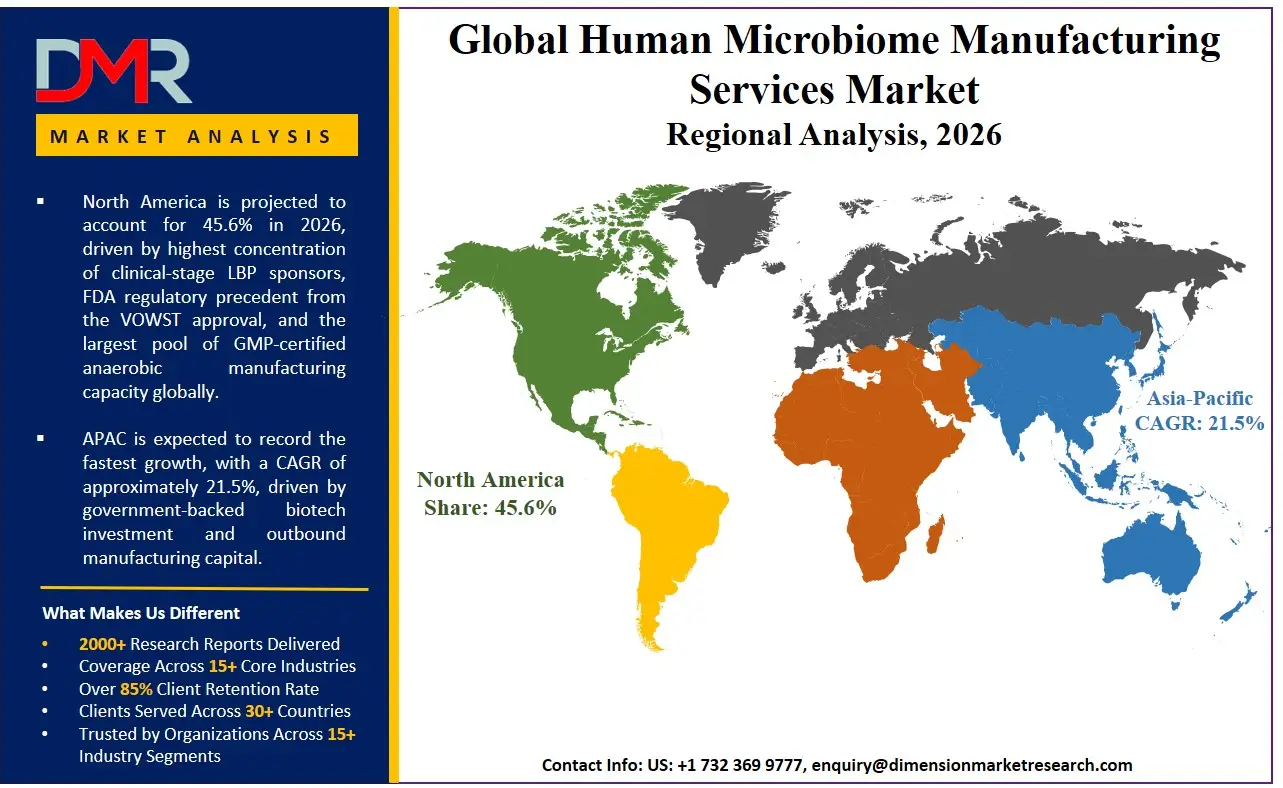
North America held a 45.6% share in 2026, the largest of any region in Human Microbiome Manufacturing Services Market.
ℹ
To learn more about this report –
Download Your Free Sample Report Here
The U.S. anchors North America's dominant position through the highest concentration of clinical-stage LBP sponsors, FDA regulatory precedent from the VOWST approval, and the largest pool of GMP-certified anaerobic manufacturing capacity globally. Cerbios-Pharma's infrastructure expansions at its Lugano site for high-potency and specialized microbial integration, reported by Cerbios in February 2025, illustrate how European manufacturers are also investing to serve U.S.-origin sponsor pipelines. Bacthera's licensed clinical supply facility in Hørsholm, Denmark, confirmed by Lonza's Annual Report in March 2024, further establishes Northern Europe as an active node in cross-Atlantic LBP supply networks serving North American sponsors.
Europe holds a 29.2% revenue share in 2026, supported by strong CDMO infrastructure in Switzerland, France, Spain, and Denmark and a growing cluster of microbiome biotech sponsors. The EU SoHO regulation, when fully applied, will harmonize LBP classification across member states and reduce the compliance fragmentation that currently adds cost and timeline risk to pan-European manufacturing programs. Asia-Pacific is an emerging region where government-backed biotech investment and outbound manufacturing capital are building production infrastructure ahead of domestic clinical pipeline maturation. Latin America and the Middle East and Africa remain early-stage, with procurement driven primarily by academic and research institute demand rather than commercial manufacturing contracts.
Key Regions and Countries
North America
Europe
- Germany
- France
- The UK
- Spain
- Italy
- Rest of Europe
Asia Pacific
- China
- Japan
- South Korea
- India
- Australia
- Rest of APAC
Latin America
- Brazil
- Mexico
- Rest of Latin America
Middle East & Africa
- GCC
- South Africa
- Rest of MEA
Market Dynamics
LBP Pipeline Growth Pulls Capital Into Specialized CDMO Infrastructure
Bacthera expanded its GMP-certified microbial drug substance facility in León, Spain, installing bioreactors with capacities reaching up to 3,500 liters for live biotherapeutic product manufacturing, as confirmed by Lonza's Annual Report in March 2024. Facility investments at this scale are not speculative. They are responses to confirmed sponsor demand from biopharmaceutical clients advancing LBP assets through Phase 2 and Phase 3 trials. CDMOs that build validated anaerobic capacity ahead of commercial launch windows capture long-term supply agreements that competitors without equivalent infrastructure cannot compete for.
EXPERT'Biome, the CDMO division of Lallemand Health Solutions, acquired a pool of anaerobic production equipment directly from the dissolved BacThera AG joint venture in September 2025. Equipment acquisitions from dissolved partnerships compress the capital and timeline cost of capacity expansion. CDMOs that move quickly to absorb stranded infrastructure gain production scale without the multi-year lead time of greenfield facility construction, strengthening their positioning for new sponsor mandates in a pipeline environment where clinical timelines are accelerating.
Regulatory Divergence and Anaerobic Scale Complexity Constrain Market Pace
Regulatory heterogeneity across the U.S., EU, and Asia-Pacific creates compliance barriers that slow commercial manufacturing activation for LBP sponsors. The EU SoHO regulation has not yet reached full application, leaving pan-European manufacturing programs subject to member-state-level classification ambiguity. Sponsors and their CDMO partners must file regulatory documentation under frameworks that may shift before commercial approval, adding legal and technical risk to manufacturing investment decisions.
Scalable anaerobic processing presents distinct technical challenges beyond standard biologics manufacturing. Oxygen exclusion must be maintained across every production step from inoculation through fill/finish. Batch consistency in multi-strain consortia is harder to control than in single-strain products because co-cultivation ratios shift across fermentation cycles. CDMOs without validated process controls for multi-strain anaerobic production cannot reliably pass sponsor batch record audits at Phase 3 scale, restricting the number of qualified manufacturing partners available for the most complex pipeline assets.
End-to-End CDMO Demand and Oncology Investment Open High-Value Pathways
South Korea's Genome and Company invested over USD 125 Million to build an overseas contract manufacturing site, as reported by List Labs in November 2023. Cross-border capital commitments of this scale reflect how sponsors and investors are treating manufacturing infrastructure as a strategic asset rather than a commodity service. MaaT Pharma drew down an initial €3.5 Million tranche of a €37.5 Million European Investment Bank financing agreement in October 2025, directing institutional capital toward microbiome pipeline scaling in the EU. Structured public financing entering Human Microbiome Manufacturing Services Market signals that European policymakers view LBP manufacturing capacity as a strategic industrial priority.
Oncology applications are attracting the highest concentration of new partnership investment. Evidence connecting gut microbiome composition to checkpoint inhibitor response rates has elevated microbiome manufacturing from a GI-niche service into an immuno-oncology supply chain requirement. CDMOs that develop validated production protocols for oncology-indication LBPs now are building a qualification record that will determine which manufacturers receive commercial mandates when these assets achieve regulatory approval.
Market Trends
Co-Cultivation Platforms and Commercial-Grade Readiness Redefine CDMO Qualification Standards
Biose Industrie launched its automated multi-strain co-culture commercial manufacturing service platform in May 2026, establishing one of the first production-ready co-cultivation services for complex microbiome consortia at commercial grade. Multi-strain co-culture manufacturing requires simultaneous growth optimization of multiple microbial species under anaerobic conditions, a process control challenge that single-strain fermentation infrastructure cannot address. CDMOs that achieve validated co-culture capability at commercial scale are entering a capability category where sponsor demand already exists but supply is severely limited. Strategic collaborations between CDMOs and late-stage biotechs are accelerating as sponsors require manufacturing partners with commercial-grade readiness before submission, not after approval.
Market Competition Overview
The Human Microbiome Manufacturing Services Market is fragmented, with no single CDMO holding dominant share across all service categories and therapeutic indications. Competitive positioning is determined by anaerobic fermentation infrastructure depth, GMP validation status, and demonstrated experience with LBP-specific regulatory filings. Sponsors with late-stage assets apply qualification criteria that exclude most general-purpose CDMOs before commercial evaluation begins.
Recipharm integrated Arranta Bio into its advanced therapeutics division in April 2022, establishing a U.S. manufacturing presence specifically focused on microbiome drug substance, as reported by Recipharm in April 2022. Nestlé Enterprises signed a Transition Services Agreement with Seres Therapeutics in September 2024 to absorb operational oversight of its microbiome processing site, demonstrating how commercial-scale manufacturing assets are changing ownership as early-stage partnerships restructure around approved product economics. Vendors with the broadest anaerobic fermentation scale, validated multi-strain production capability, and established sponsor relationships across multiple clinical indications are accumulating a competitive position that smaller or more narrowly focused CDMOs cannot match on infrastructure alone.
Company Profiles
Lonza operates through its joint venture infrastructure, including the BioAtrium AG partnership with Sanofi in Visp, Switzerland, which deployed large-scale manufacturing systems equipped with 20,000-liter bioreactors, as confirmed by Lonza's Annual Report in March 2024. Lonza reported total corporate revenues of CHF 6.6 Billion in FY2024, per its 2024 Annual Report, providing the financial liquidity to sustain joint-venture manufacturing partnerships across novel biological platforms. Its strategic advantage in Human Microbiome Manufacturing Services Market is the combination of financial scale, established regulatory relationships, and multi-platform biologics infrastructure that smaller specialist CDMOs cannot replicate.
Lallemand Inc. competes through EXPERT'Biome, its dedicated CDMO division with accumulated anaerobic fermentation expertise and direct access to expanded production equipment following the BacThera AG dissolution. The acquisition of anaerobic production assets in September 2025 strengthens EXPERT'Biome's capacity for clinical and commercial-scale LBP manufacturing at a moment when sponsor demand for qualified anaerobic CDMOs is outpacing supply. Lallemand's risk is converting expanded equipment capacity into validated GMP production processes at the pace required by sponsor clinical timelines.
Key Players
- Lonza
- Evonik
- Lallemand Inc.
- Cerbios-Pharma SA
- Eurofins Scientific
- Charles River Laboratories
- Arranta Bio
- Biose Industrie
- Quay Pharmaceuticals
- Aenova Group
- Bacthera
- List Biological Laboratories
- Enterome
- Vedanta Biosciences
- Seres Therapeutics
Supply Chain and Value Chain Analysis
The value chain begins with strain sourcing and development, where CDMOs or their sponsor clients identify, characterize, and optimize microbial strains for therapeutic use. Strain quality and stability at this stage directly determine downstream production consistency. CDMOs with proprietary strain banks or exclusive co-development agreements hold a starting-point advantage that competitors cannot replicate without access to equivalent biological material.
Fermentation scale-up is the most capital-intensive layer and the primary bottleneck in the current supply chain. Anaerobic bioreactor capacity is scarce globally. Recipharm expanded its advanced therapeutic facility in Watertown, Massachusetts by 50% to support expanding biological platform pipelines, as reported by Recipharm in March 2023. Recipharm Advanced Bio fully deployed its Portugal 2.0 multi-product advanced therapy facility block in late 2024, adding further production capacity to its European network. CDMOs investing in parallel capacity expansion across multiple geographies are reducing single-site concentration risk while building the redundancy that large pharma sponsors require in commercial manufacturing supply agreements.
Downstream purification, formulation, and fill/finish represent the value-added service layers where CDMOs differentiate on yield, purity, and regulatory documentation quality. Lyophilization and microencapsulation capability is increasingly required for commercial LBP products requiring ambient temperature storage and gastrointestinal viability. CDMOs that have qualified lyophilization lines specifically for live organisms, not standard biologics, command premium contract rates. Distribution and cold chain management form the final chain layer, where product stability during transit determines whether the clinical or commercial viability promise of the manufacturing process is preserved to the point of administration.
Regulatory Landscape
Live biotherapeutic products occupy a distinct regulatory category in both the U.S. and EU. The FDA classifies LBPs as biological drug products subject to BLA filing requirements, meaning CDMOs producing LBPs must operate under biologics GMP standards rather than standard pharmaceutical GMP. FDA inspections of LBP manufacturing facilities have increased as the commercial pipeline matures. CDMOs without a history of successful FDA biologics GMP inspections face disqualification from late-stage sponsor manufacturing programs regardless of fermentation capability.
The EU SoHO regulation, not yet fully applied as of the forecast base year, will harmonize the classification of substances of human origin including microbiome-derived therapeutics across member states. Before full application, pan-European LBP programs must navigate divergent national frameworks, adding compliance cost and timeline risk to manufacturing programs spanning multiple EU markets. European CDMOs investing in regulatory affairs expertise and pre-submission manufacturing documentation ahead of SoHO implementation are building a qualification advantage over competitors waiting for regulatory clarity before committing to process validation.
Asia-Pacific regulatory frameworks for LBPs vary significantly by country. Japan's PMDA, China's NMPA, and South Korea's MFDS each apply different classification criteria for microbiome therapeutics. CDMOs supporting sponsors seeking multi-regional approval for LBP assets must maintain manufacturing documentation and process validation records that satisfy multiple regulatory bodies simultaneously. Vendors with established regulatory submission experience across FDA, EMA, and at least one Asian regulatory authority are positioned to serve the growing number of sponsors pursuing global LBP development programs.
Investment and White Space Analysis
Investment is concentrating in anaerobic fermentation capacity expansion and end-to-end LBP service platforms. List Biotherapeutics' USD 125 Million Indiana facility, Bacthera's León bioreactor expansion, and EXPERT'Biome's equipment acquisition from BacThera AG all occurred within a 30-month window, reflecting coordinated market-wide capacity building. Sponsors advancing assets toward commercialization are pre-selecting manufacturing partners two to three years before approval, meaning CDMOs that have not established GMP-validated anaerobic capacity by 2026 risk being locked out of the first commercial manufacturing mandate wave.
Oncology-indication LBP manufacturing represents the clearest white space by therapeutic area. GI-indication manufacturing infrastructure is more developed following the VOWST approval pathway. Oncology assets targeting microbiome-immunotherapy interactions require manufacturing protocols that do not yet exist at commercial scale. CDMOs that invest in oncology-specific LBP process development now are building an exclusive qualification record in the highest-growth therapeutic application category.
Co-cultivation manufacturing for multi-strain consortia is the most underserved technical capability in the current CDMO landscape. Most CDMOs operate validated single-strain anaerobic production. Multi-strain co-cultivation at commercial scale requires simultaneous fermentation optimization of two or more species, which demands process engineering investment beyond what single-strain operations require. Asia-Pacific manufacturing infrastructure, particularly in South Korea and China, is receiving outbound capital investment that positions the region as a future competitive alternative to European and U.S. CDMOs for sponsors seeking cost-competitive commercial manufacturing partnerships.
Recent Developments
- January 2026: MaaT Pharma. Commercial Transition. MaaT Pharma finalized an agreement transitioning its European early access operations to Clinigen's commercial supply infrastructure, extending the commercial reach of its microbiome therapeutic pipeline through an established European pharmaceutical distribution network.
- August 2024: Seres Therapeutics, Nestlé Enterprises S.A., and BacThera AG. Contract Restructuring. The three parties formally signed a tripartite contract assignment and termination framework for SER-109, marking a structural transition in commercial manufacturing responsibility for the VOWST product line.
- August 2024: Nestlé S.A. and BacThera AG. Liability Settlement. Nestlé S.A. agreed to settle contract manufacturing liabilities with BacThera AG on behalf of Seres Therapeutics, resolving outstanding financial obligations tied to the VOWST manufacturing supply agreement.
- March 2024: List Biotherapeutics and Sacco System Australia. Strategic Partnership. List Biotherapeutics established a global client referral and lead-share agreement with Sacco System Australia, expanding its commercial reach into Asia-Pacific microbiome manufacturing markets.
- August 2024: List Biological Laboratories and SZABO-SCANDIC. Distribution Agreement. List Biological Laboratories secured an international product distribution agreement with European medical trading vendor SZABO-SCANDIC, extending its commercial manufacturing product access across European markets.
Report Details
| Report Characteristics |
| Market Value (2025) |
USD 0.21 Billion |
| Market Value (2026) |
USD 0.25 Billion |
| Forecast Revenue (2035) |
USD 1.19 Billion |
| CAGR (2026 to 2035) |
18.9% |
| Base Year for Estimation |
2025 |
| Historic Period |
2020 to 2024 |
| Forecast Period |
2026 to 2035 |
| Report Coverage |
Revenue Forecast, Market Dynamics, Competitive Landscape, Recent Developments |
| Segments Covered |
By Application (Gastrointestinal Disease, Infectious Disease, Endocrine and Metabolic Disease, Oncology, Immunological Disorders, Neurological Disorders), By End User (Biopharmaceutical Companies, Microbiome-focused Startups, Academic and Research Institutes, Contract Research Organizations), By Technology / Process (Anaerobic Fermentation, Microbial Fermentation, Downstream Purification, Lyophilization, Spray Drying, Microencapsulation, Continuous Bioprocessing), By Type (Fermentation and Downstream Processing, Strain Development and Optimization, Formulation and Fill/Finish, Other Services), By Product Type (Live Biotherapeutic Products, Probiotics, Postbiotics, Synbiotics, Microbiome-targeted Therapeutics), By Packaging Type (Vials, Ampoules, Pre-filled Syringes, Capsules), By Formulation Type (Liquid Formulations, Solid Formulations, Lyophilized Formulations) |
| Regional Analysis |
North America – US and Canada; Europe – Germany, France, The UK, Spain, Italy, and Rest of Europe; Asia Pacific – China, Japan, South Korea, India, Australia, and Rest of APAC; Latin America – Brazil, Mexico, and Rest of Latin America; Middle East & Africa – GCC, South Africa, and Rest of MEA |
| Competitive Landscape |
Lonza, Evonik, Lallemand Inc., Cerbios-Pharma SA, Eurofins Scientific, Charles River Laboratories, Arranta Bio, Biose Industrie, Quay Pharmaceuticals, Aenova Group, Bacthera, List Biological Laboratories, Enterome, Vedanta Biosciences, Seres Therapeutics |
| Customization Scope |
Customization for segments and region or country level will be provided. Additional customization can be done based on requirements. |
| Purchase Options |
Three license options: Single User License, Multi-User License (Up to 5 Users), Corporate Use License (Unlimited Users and Printable PDF) |
Frequently Asked Questions
What is the biggest investment opportunity in Human Microbiome Manufacturing Services Market?
▾ The market reaches USD 1.19 Billion by 2035 from USD 0.21 Billion in 2025. Oncology-indication LBP manufacturing and co-cultivation platform development for multi-strain consortia represent the most underserved high-growth entry points. Asia-Pacific, with lower CDMO competitive density than North America or Europe, offers the highest regional upside for vendors with validated anaerobic production and localized regulatory compliance capability.
Who are the top companies in Human Microbiome Manufacturing Services Market?
▾ Leading companies include Lonza, Lallemand Inc., Cerbios-Pharma SA, Eurofins Scientific, Charles River Laboratories, Arranta Bio, Biose Industrie, Bacthera, List Biological Laboratories, Enterome, Vedanta Biosciences, Seres Therapeutics, Evonik, Quay Pharmaceuticals, and Aenova Group. Lonza reported CHF 6.6 Billion in total corporate revenues in FY2024, confirming it as the largest player by financial scale in the broader biologics manufacturing landscape that encompasses Human Microbiome Manufacturing Services Market.
Which segment is growing fastest in Human Microbiome Manufacturing Services Market and why?
▾ Oncology is the fastest-growing application segment by new investment and partnership activity. Evidence linking gut microbiome composition to immunotherapy response rates has elevated microbiome manufacturing into an immuno-oncology supply chain priority. CDMOs building oncology-specific LBP production protocols now are positioning for commercial mandates before the segment reaches the pipeline maturity that GI-indication manufacturing already reflects.
Which region is growing fastest in Human Microbiome Manufacturing Services Market and why?
▾ Asia-Pacific is the fastest-growing region, driven by government-backed biotech investment and outbound manufacturing capital from South Korea and China. South Korea's Genome and Company invested over USD 125 Million to build an overseas CMO site, signaling that Asian manufacturers are building production infrastructure ahead of domestic pipeline maturation rather than waiting for local clinical demand to justify the capital commitment.
What is the biggest challenge holding Human Microbiome Manufacturing Services Market back?
▾ Regulatory heterogeneity across the U.S., EU, and Asia-Pacific is the primary structural constraint. Divergent LBP classification frameworks in different jurisdictions force sponsors and CDMOs to maintain parallel compliance documentation for the same manufacturing process. Until the EU SoHO regulation reaches full application and Asian regulatory bodies align on LBP classification standards, multi-regional commercial manufacturing programs will carry higher compliance cost and timeline risk than single-jurisdiction programs.