Humanoid Robot Actuators Market Snapshot
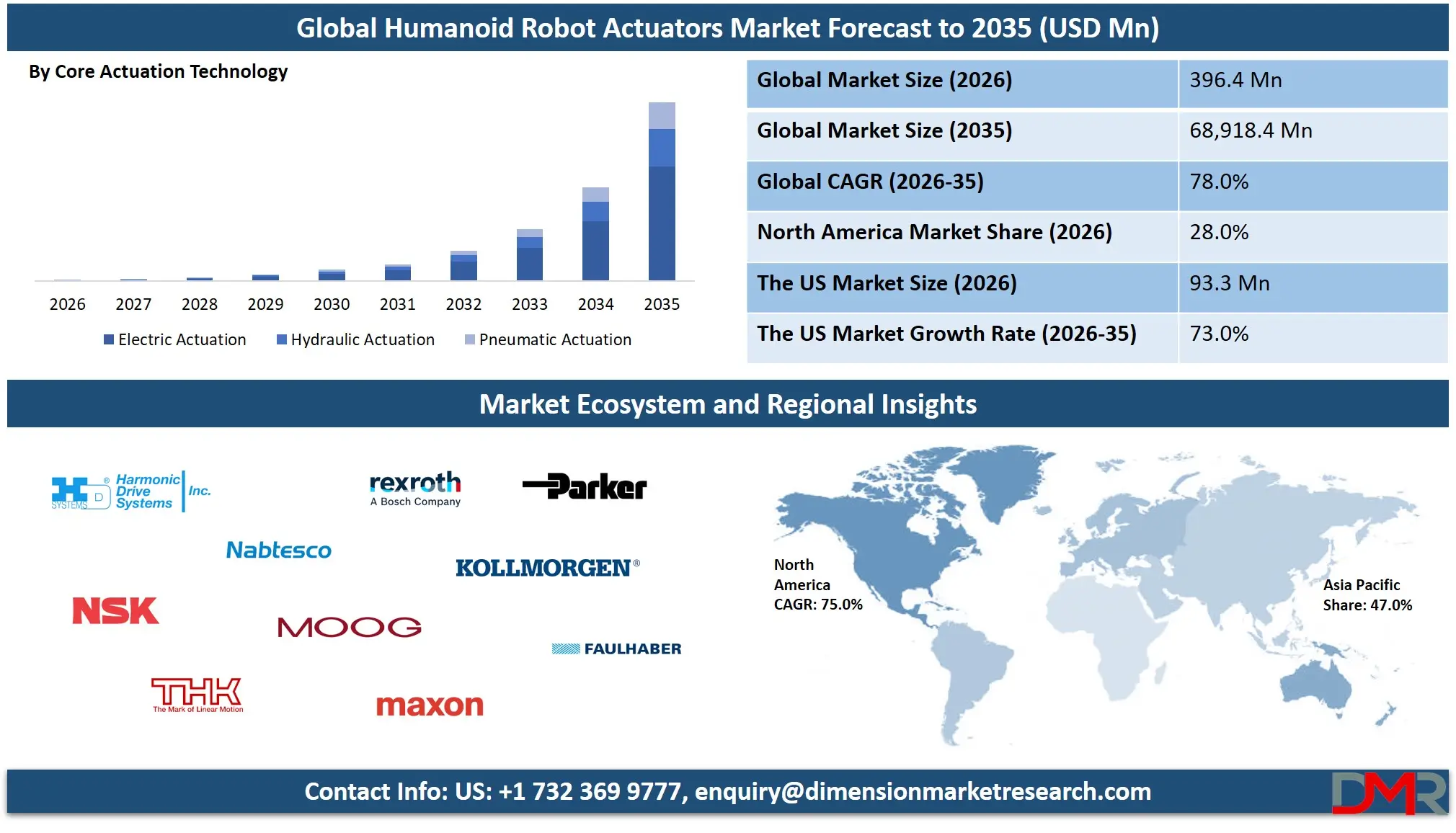
- Market Value: Humanoid Robot Actuators Market size is valued at USD 396.4 million in 2026 and is expected to reach USD 68,918.4 million by 2035.
- CAGR: Humanoid Robot Actuators Market is expected to grow at a CAGR of 78.0% from 2026 to 2035.
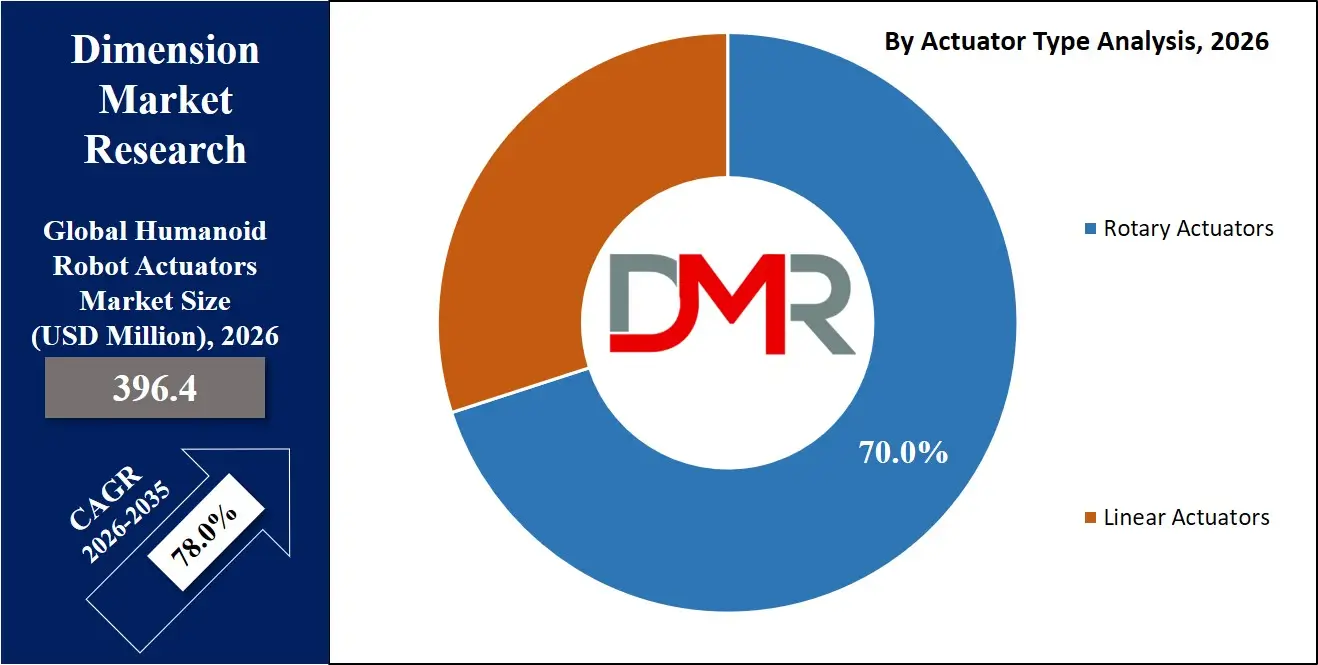
- By Actuator Type Segment Analysis: Rotary Actuators segment dominated with a 70.0% share in 2026.
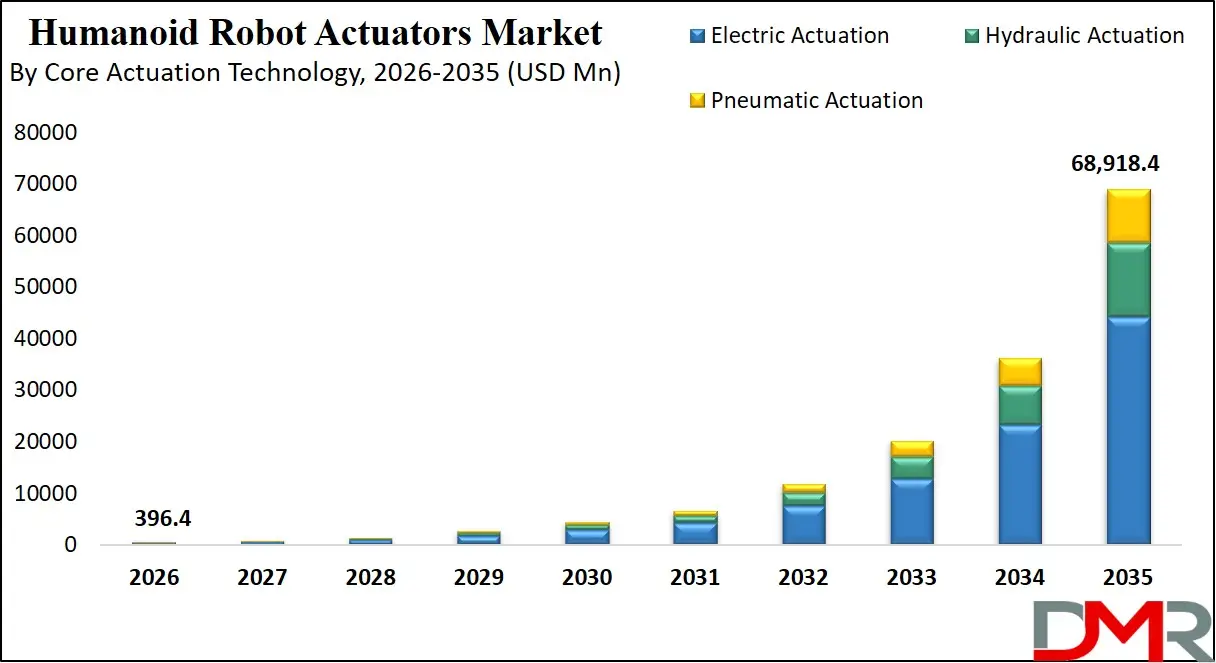
- By Core Actuation Technology Segment Analysis: Electric Actuation segment led product types with a 64.0% share in 2026.
- By Degree of Freedom Configuration Segment Analysis: Multi-Axis Integrated Actuators segment held a 46.0% share in 2026.
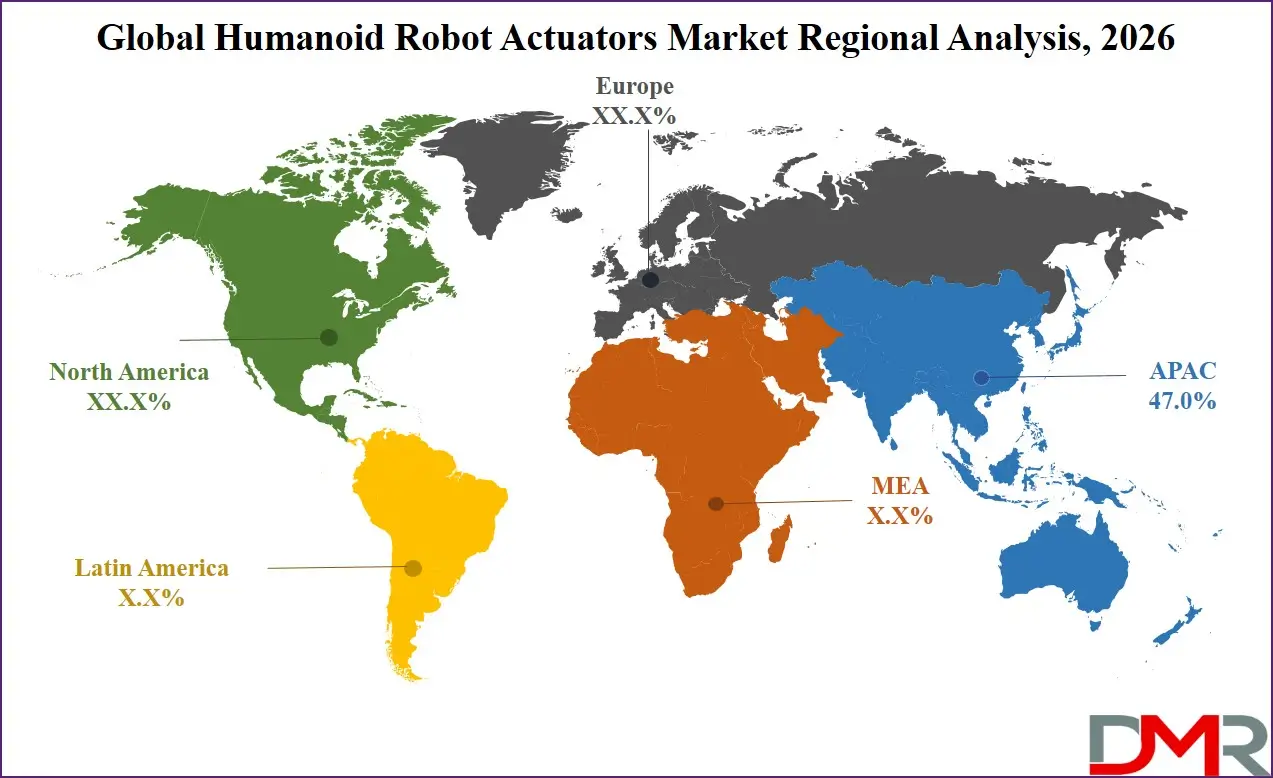
- Regional Analysis: Asia Pacific led the Humanoid Robot Actuators Market with a 47.0% revenue share in 2026.
- Major Players: Harmonic Drive Systems, Nabtesco Corporation, NSK Ltd., THK Co., Ltd., and Bosch Rexroth AG.
What is the Humanoid Robot Actuators Market Size?
The Global Humanoid Robot Actuators Market size is projected to be valued at USD 396.4 million in 2026 and is projected to reach USD 68,918.4 million by 2035, expanding at a CAGR of 78.0% during the forecast period. Humanoid robot actuators are motion systems that convert electrical, hydraulic, or pneumatic energy into controlled mechanical movement. They support walking, balancing, lifting, gripping, joint rotation, fine manipulation, and other human-like motions.
ℹ
To learn more about this report –
Download Your Free Sample Report Here
Market demand is rising as humanoid developers move from research prototypes toward industrial pilots and commercial production. Higher torque density, lower weight, precise motion control, energy efficiency, compact joint architecture, and improved durability are becoming important design requirements. Rotary and linear actuator architectures are being combined with frameless motors, precision reducers, encoders, sensors, brakes, and servo drives to create compact robotic joints. Growing investment in humanoid robots for manufacturing, logistics, services, inspection, and human-machine collaboration is supporting the long-term Humanoid Robot Actuators Market growth.
How AI is Transforming the Humanoid Robot Actuators Market
AI is changing actuator requirements by allowing humanoid robots to make continuous motion decisions from vision, force, torque, position, and environmental data. Instead of following only fixed trajectories, advanced robots can adjust joint position, speed, force, and balance as operating conditions change. This increases demand for smart actuators with high-resolution encoders, torque sensing, low-latency control, servo electronics, and communication interfaces. Actuator manufacturers are consequently moving toward integrated modules that combine motors, reducers, bearings, brakes, sensors, encoders, and control electronics. These architectures can simplify robot assembly while improving synchronization between the hip, knee, ankle, shoulder, elbow, and wrist.
Generative and learning-based robotics systems are also expanding the range of physical tasks that humanoids can be trained to perform. Robots designed for adaptable manipulation require actuators that can repeatedly reproduce learned movements while responding safely to unexpected contact. Force feedback, backdrivability, thermal management, and torque density therefore become increasingly important. Data collected from actuator sensors can also support condition monitoring, motion optimization, and fault detection. As humanoid fleets expand, software-driven performance improvements can place greater demands on the mechanical layer, encouraging actuator suppliers to develop modular, energy-efficient, sensor-rich systems capable of supporting changing motion policies without redesigning the entire joint.
Major Countries Analysis
US Humanoid Robot Actuators Market
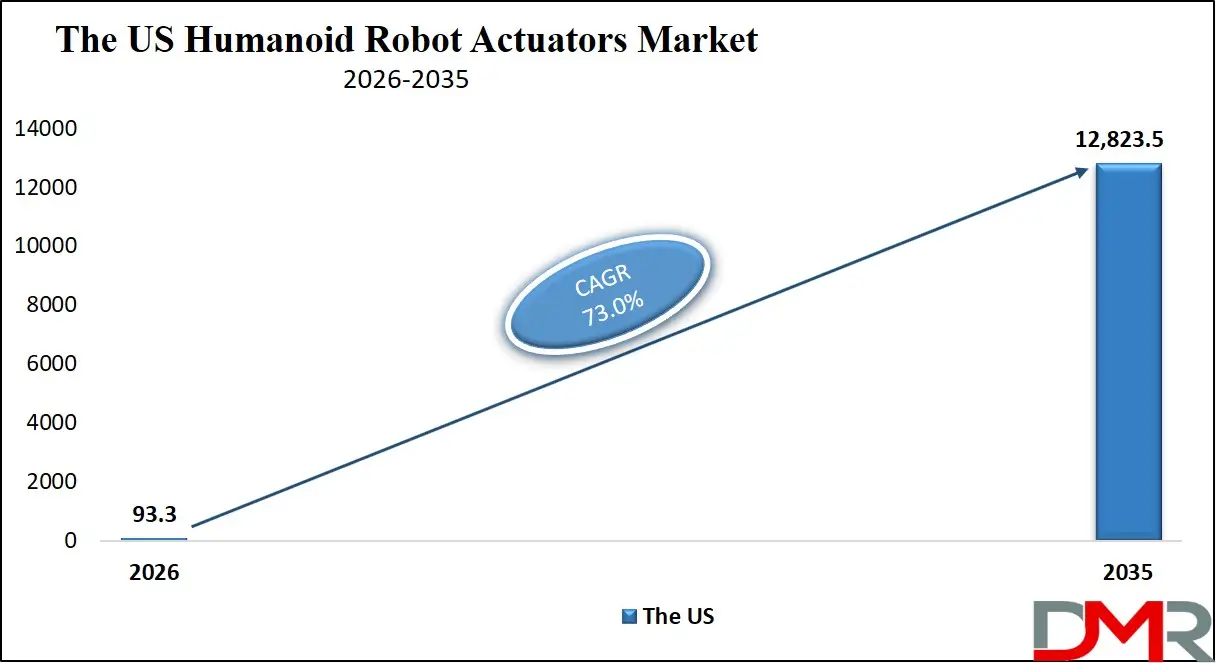
The US Humanoid Robot Actuators Market is projected to reach at USD 93.3 million in 2026 and is expected to grow at a CAGR of 73.0%, reaching 12,823.5 million by 2035 driven by AI-enabled robotics, advanced motion control systems, and high-precision electric and servo actuators.
ℹ
To learn more about this report –
Download Your Free Sample Report Here
The US Humanoid Robot Actuators Market is driven by advancements in AI-enabled robotics, precision motion control, and electric and servo actuator technologies enabling human-like movement. Growth is supported by strong adoption in manufacturing, healthcare, logistics, and defense, along with rising automation demand and labor shortages. Continuous innovation is leading to smarter, more compact, and highly efficient actuator systems, positioning the U.S. as a key hub for humanoid robotics development.
Europe Humanoid Robot Actuators Market
The Europe Humanoid Robot Actuators Market is anticipated to reach USD 75.3 million in 2026, growing at a CAGR of 74.0%, in the humanoid robot actuators market. The region's growth is supported by strong advancements in precision engineering and automation technologies across industrial robotics applications. Increasing adoption of AI-enabled humanoid systems in manufacturing, healthcare, and service sectors is further accelerating actuator demand. Additionally, rising investments in robotics R&D and smart manufacturing initiatives across major European economies are strengthening market expansion.
Japan Humanoid Robot Actuators Market
Japan Humanoid Robot Actuators Market is anticipated to reach USD 47.5 million in 2026, growing at a CAGR of 75.0%, in the humanoid robot actuators market. The country's growth is strongly supported by its advanced robotics manufacturing ecosystem and leadership in precision motion control technologies. Rising deployment of humanoid robots in industrial automation, elderly care, and service applications is significantly boosting actuator demand. Additionally, continuous innovation in compact, high-efficiency actuator systems is reinforcing Japan's position as a key robotics hub.
South Korea Humanoid Robot Actuators Market
South Korea is developing a stronger humanoid robotics ecosystem supported by its automotive, electronics, semiconductor, battery, and advanced manufacturing industries. Companies including Hyundai Mobis and LG Electronics provide engineering capabilities relevant to motors, electronics, sensing, controls, and intelligent machines. Demand for automation in manufacturing and logistics can create commercial opportunities for humanoid systems and their actuator suppliers. Strong domestic expertise in high-volume electronics production also provides advantages for integrated smart actuators that require compact power electronics, sensors, communication hardware, controllers, and efficient electric drive systems.
Germany Humanoid Robot Actuators Market
Germany benefits from a mature industrial automation sector and deep capabilities in mechanical engineering, motion control, automotive manufacturing, factory automation, and precision components. Bosch Rexroth, Siemens, Festo, and other technology suppliers provide relevant expertise across drives, controls, electric motion, pneumatics, and industrial systems. Humanoid adoption in manufacturing could create new demand for actuators designed for machine tending, material movement, inspection, and flexible production. Germany's emphasis on engineering quality and industrial integration provides opportunities for smart actuators that combine precise motion, sensing, communication, safety functions, and condition monitoring.
China Humanoid Robot Actuators Market
China represents an important growth center for humanoid robot actuator production and consumption due to its large electronics, electric motor, precision manufacturing, automation, and robotics supply chains. Domestic manufacturers are expanding capabilities across frameless motors, harmonic reducers, planetary systems, encoders, bearings, and integrated joint modules. Growing humanoid programs are creating opportunities for local suppliers to improve torque density, precision, durability, and cost efficiency. China's manufacturing scale can also accelerate component standardization and lower unit costs as production moves from prototypes toward larger commercial batches.
Use Cases
- Industrial Manufacturing: Humanoid robot actuators enable controlled joint movement for material handling, machine tending, assembly, inspection, and repetitive production tasks. High-torque rotary joints support the hips and shoulders, while compact actuators provide precise movement for arms and wrists.
- Warehouse and Logistics: Actuators allow humanoid robots to walk through human-designed facilities, lift packages, move containers, pick goods, and perform loading activities. Integrated motion systems can reduce joint weight while supporting the balance and dynamic movement needed in warehouses.
- Service Robotics: Service humanoids require smooth and quiet actuators for reception, assistance, delivery, guidance, and customer interaction. Compact electric systems improve motion accuracy and allow robots to operate around people without the infrastructure associated with hydraulic systems.
- Hazardous Operations: Humanoid robots can support inspection and material-handling activities in environments that expose workers to heat, chemicals, radiation, unstable structures, or other hazards. Durable actuators help robots climb, manipulate equipment, open doors, and operate tools remotely.
- Research and Human Interaction: Universities and robotics developers use advanced actuators to study locomotion, manipulation, balance, teleoperation, and physical human-robot interaction. Multi-axis joints and sensor-integrated actuators enable more natural movement and faster development of new humanoid platforms.
Key Drivers in the Humanoid Robot Actuators Market
Rapid Commercialization of Humanoid Robotics
The movement of humanoid robots from laboratory prototypes toward industrial pilots is creating direct demand for reliable joint actuators. Manufacturing, logistics, material handling, inspection, and service applications require robots capable of walking, balancing, lifting, and manipulating objects for extended periods. These tasks can require dozens of controlled axes within one platform. As robot manufacturers prepare designs for higher production volumes, demand is increasing for standardized rotary and linear actuator modules that combine compact dimensions, high torque density, durability, precision, and repeatable performance.
Demand for High Torque Density and Precision Motion
Human-like movement places demanding performance requirements on robotic joints. Hip and knee systems need substantial torque for locomotion and load support, while wrists, arms, and manipulation systems need precision and responsiveness. These requirements are supporting investment in frameless torque motors, harmonic reducers, planetary systems, high-resolution encoders, and advanced bearings. Higher torque-to-weight ratios can reduce total robot mass and battery consumption. As developers target longer operating times and greater payload capacity, actuator efficiency and compact integration are becoming central factors in humanoid platform design.
Restraints in the Humanoid Robot Actuators Market
High Cost of Precision Actuation Systems
Advanced actuators remain a major cost center in humanoid robot hardware because each joint can require a motor, reducer, encoder, bearing, brake, controller, and sensing system. Precision components must also meet demanding requirements for backlash, torque, thermal performance, service life, and weight. A humanoid platform may use numerous actuator sizes across its body, adding manufacturing and qualification complexity. High component costs can limit deployment economics during early commercialization, particularly in service applications where humanoids must compete against lower-cost fixed automation or specialized mobile robots.
Reliability and Thermal Management Challenges
Humanoid actuators experience repeated acceleration, impact, variable loads, and continuous changes in direction. Compact joints must handle these stresses while remaining lightweight and energy efficient. High torque operation can produce heat in motors, bearings, electronics, and transmission systems, which may reduce performance or component life if thermal control is inadequate. Mechanical wear, backlash, shock loading, and lubricant performance create additional engineering challenges. Suppliers must therefore balance torque, speed, weight, efficiency, durability, and cost, making actuator optimization more complex as robots move into long-duration commercial operation.
Growth Opportunities in the Humanoid Robot Actuators Market
Integrated Smart Actuator Platforms
Fully integrated smart actuators offer a major opportunity as humanoid manufacturers seek fewer components, simpler assembly, and faster production. A single joint module can combine a frameless motor, precision reducer, encoder, bearing, brake, torque sensing, servo drive, and communication interface. Integration can reduce wiring, installation time, joint volume, and system-level engineering requirements. It also creates opportunities for suppliers to deliver complete motion subsystems rather than individual components. Modular product families covering different torque ranges can further help humanoid manufacturers reuse validated actuator designs across the body.
Expansion of Humanoid Robot Production in Asia Pacific
Asia Pacific presents substantial opportunities due to its established robotics, electronics, motors, bearings, precision gears, and industrial automation supply chains. China, Japan, and South Korea are supporting humanoid development through manufacturing capabilities, technology investment, and growing automation demand. Local production of motors, reducers, sensors, and integrated joints can shorten supply chains and support cost reduction as volumes increase. The emergence of specialized actuator manufacturers alongside established motion-control suppliers is also broadening sourcing options and accelerating competition in high-performance humanoid components.
Trends in the Humanoid Robot Actuators Market
Shift Toward Fully Integrated Joint Modules
Humanoid developers are increasingly adopting joint modules that package multiple motion components into a compact assembly. Current integrated architectures can combine frameless torque motors, harmonic or planetary reducers, encoders, brakes, bearings, servo electronics, and communication systems. This approach reduces the number of interfaces robot manufacturers must engineer and can improve joint-level packaging. Integration also supports scalable manufacturing because validated modules can be deployed across multiple robot designs. Suppliers are responding with actuator families optimized for different torque, diameter, weight, speed, and joint-position requirements.
Growth of Electric and Quasi-Direct Drive Architectures
Electric actuation is gaining importance because battery-powered humanoids require efficient, compact, and controllable motion systems. Developers are evaluating harmonic-drive systems, planetary gearing, direct-drive motors, and quasi-direct-drive architectures according to joint requirements. Quasi-direct-drive configurations use lower reduction ratios with torque-dense motors to improve backdrivability and dynamic response, while precision reducers remain important where compact high torque is required. This diversification is creating opportunities across frameless motors, gear systems, encoders, bearings, power electronics, and thermal-management technologies.
Research Scope and Analysis
The Humanoid Robot Actuators Market is segmented based on Actuator Type, Core Actuation Technology, Degree of Freedom Configuration, Torque Capacity, Functional Deployment, Integration Level, Material Architecture, End-Use Humanoid Category, and other relevant categories. The study provides an in-depth analysis of key segments and sub-segments, covering their applications, industry adoption, demand patterns, and contribution to overall market growth.
ℹ
To learn more about this report –
Download Your Free Sample Report Here
By Actuator Type
Rotary Actuators dominated the Humanoid Robot Actuators Market with a 70.0% share in 2026. Their strong position is supported by extensive use across rotational joints such as shoulders, elbows, wrists, hips, knees, ankles, neck assemblies, and torso mechanisms. Humanoid locomotion requires controlled angular movement, high torque density, low backlash, and rapid response within limited joint space. Rotary architectures based on precision servo systems, harmonic drives, planetary transmissions, and direct-drive torque motors address these requirements across different load ranges. Integrated rotary modules can combine motors, reducers, encoders, bearings, brakes, and controllers in one package. Linear actuators remain important for force-intensive motion, leg mechanisms, and selected structural movements, creating additional opportunities as humanoid architectures diversify.
By Core Actuation Technology
Electric Actuation held a 64.0% share in 2026, supported by the growing development of battery-powered humanoid robots. Electric systems offer precise control, relatively clean operation, compact packaging, and compatibility with digital motion-control architectures. Frameless servo and torque motors can be integrated directly into robotic joints and paired with harmonic drives, planetary reducers, encoders, and force sensors. Electric actuation is particularly attractive for commercial humanoids expected to operate in factories, warehouses, service locations, and other human environments. Hydraulic actuation remains relevant where very high force density is required, while pneumatic systems can serve specialized lightweight movements. Continued improvements in motor efficiency, magnets, power electronics, sensing, and thermal management are expected to reinforce electric technology adoption.
By Degree of Freedom Configuration
Multi-Axis Integrated Actuators accounted for 46.0% of the market in 2026. Humanoid robots require complex coordinated movement, particularly across shoulders, hips, wrists, ankles, and torso assemblies where motion can occur across multiple axes. Integrated configurations can reduce mechanical complexity while supporting compact packaging and synchronized movement. They can also decrease the number of separate housings, cables, and mechanical interfaces required in a robot. Single-axis actuators remain widely applicable to joints requiring straightforward rotational or linear motion, while dual-axis systems provide an intermediate option. Increasing demand for dexterity, balance, natural gait, and compact joint structures is expected to support further development of multi-axis architectures.
ℹ
To learn more about this report –
Download Your Free Sample Report Here
The Global Humanoid Robot Actuators Market Report is segmented on the basis of the following:
By Actuator Type
- Rotary Actuators
- Precision Servo Rotary Actuators
- Harmonic Drive-Based Rotary Units
- Direct Drive Torque Motors
- Linear Actuators
- Electric Linear Actuators
- Hydraulic Linear Actuators
- Pneumatic Linear Actuators
By Core Actuation Technology
- Electric Actuation
- Hydraulic Actuation
- Pneumatic Actuation
By Degree of Freedom Configuration
- Multi-Axis Integrated Actuators
- Single-Axis Actuators
- Dual-Axis Actuators
By Torque Capacity
- Medium Torque Actuators (10–100 Nm)
- High Torque Actuators (>100 Nm)
- Low Torque Actuators (<10 Nm)
By Functional Deployment
- Locomotion Systems
- Lower Body Motion Actuation
- Manipulation Systems
- Upper Limb Motion Actuation
- Micro-Motion & Expression Systems
- Fine Motion and Interaction Actuation
By Integration Level
- Fully Integrated Smart Actuators
- Modular Actuator Units
- Discrete Actuators
By Material Architecture
- Lightweight Metal Actuators
- High-Strength Metal Actuators
- Composite-Based Actuators
By End-Use Humanoid Category
- Industrial Humanoids
- Service Humanoids
Regional Analysis
Asia Pacific is the Leading Region in the Humanoid Robot Actuators Market
Asia Pacific dominated the Humanoid Robot Actuators Market with a 47.0% revenue share in 2026. China, Japan, and South Korea have strong ecosystems spanning industrial robots, servo motors, precision reducers, bearings, electronics, sensors, and automation equipment. The region also benefits from expanding humanoid development programs and established high-volume manufacturing capabilities. Japan has deep expertise in precision motion components, while China is rapidly expanding production of motors, reducers, joint modules, and complete humanoid platforms. South Korea's electronics, automotive, and robotics industries add further momentum. These capabilities support regional actuator demand and provide a foundation for cost reduction as humanoid production volumes increase.
ℹ
To learn more about this report –
Download Your Free Sample Report Here
Asia Pacific is the Fastest-Growing Region in the Humanoid Robot Actuators Market
Asia Pacific is expected to record rapid growth as humanoid manufacturers expand pilot production and suppliers invest in localized component capacity. China's large manufacturing base provides potential deployment environments in automotive, electronics, warehousing, and general industry, while Japan continues to advance precision robotics and motion technologies. South Korea combines electronics expertise with automotive and intelligent robotics development. Increasing competition among actuator, motor, reducer, bearing, and sensor suppliers is encouraging improvements in price and performance. Growing investment in smart factories and embodied robotics is expected to strengthen regional demand through 2035.
By Region
North America
Europe
- Germany
- The U.K.
- France
- Italy
- Russia
- Spain
- Benelux
- Nordic
- Rest of Europe
Asia-Pacific
- China
- Japan
- South Korea
- India
- ANZ
- ASEAN
- Rest of Asia-Pacific
Latin America
- Brazil
- Mexico
- Argentina
- Colombia
- Rest of Latin America
Middle East & Africa
- Saudi Arabia
- UAE
- South Africa
- Israel
- Egypt
- Rest of MEA
Competitive Landscape
The competitive landscape of the humanoid robot actuators market is highly concentrated with strong emphasis on precision engineering, energy efficiency, and AI-integrated motion control technologies. Companies are focusing on developing compact, high-torque, and smart actuator systems to meet the evolving requirements of humanoid robotics. Continuous innovation in electric actuation and multi-axis integration is intensifying technological competition across key players. Strategic collaborations, R&D investments, and vertical integration are shaping market positioning and long-term competitiveness.
Some of the prominent players in the Global Humanoid Robot Actuators Market are:
- Harmonic Drive Systems
- Nabtesco Corporation
- NSK Ltd.
- THK Co., Ltd.
- Bosch Rexroth AG
- Moog Inc.
- Parker Hannifin Corporation
- Kollmorgen Corporation
- Maxon Group
- Faulhaber Group
- Festo AG
- ABB Ltd.
- Yaskawa Electric Corporation
- Mitsubishi Electric Corporation
- Siemens AG
- Hyundai Mobis
- LG Electronics
- CubeMars
- ZeroErr
- Techrobots
- Other Key Players
Technology Analysis
Technology development in the Humanoid Robot Actuators Market is focused on improving torque density, motion precision, energy efficiency, compactness, backdrivability, and operating life. Electric actuation is central to this shift as developers combine frameless torque motors, brushless DC motors, harmonic drives, planetary reducers, encoders, bearings, brakes, force sensors, and servo electronics within compact joint modules. Rotary actuators are particularly important for shoulders, elbows, hips, knees, and ankles, while linear actuators support selected high-force and translational movements. Multi-axis integrated actuators are gaining attention because they can reduce joint volume, wiring, component count, and assembly complexity. Advances in thermal management, lightweight metals, composite structures, high-resolution sensing, and real-time motion control are further improving actuator performance. The technology trend is moving toward modular smart joints that integrate mechanical transmission, sensing, control, and communication functions, supporting scalable production of industrial and service humanoids.
Patent Analysis
Patent activity related to humanoid robot actuators reflects growing competition around compact joint mechanisms, precision transmissions, motor integration, force sensing, control systems, and energy-efficient motion. Intellectual property development spans harmonic and strain-wave gearing, cycloidal and planetary reducers, frameless motors, linear actuators, integrated servo modules, torque sensors, joint cooling, braking systems, and multi-axis mechanisms. Patent strategies are increasingly important as manufacturers seek to protect improvements in torque-to-weight ratio, backlash reduction, shock resistance, thermal performance, actuator packaging, and human-safe movement. Established robotics and motion-control companies hold portfolios across motors, reducers, drives, bearings, and industrial control, while newer robotics companies are filing inventions around integrated humanoid joints and specialized actuator architectures. Future patent activity is expected to concentrate on lighter smart actuators, modular joint platforms, embedded sensing, predictive condition monitoring, and designs that reduce manufacturing cost while maintaining precision and durability for high-volume humanoid deployment.
Recent Developments
- March 2026: Figure AI secured a major funding round to accelerate commercialization of its humanoid robotics platform, focusing on scaling actuator-driven mobility systems for industrial and logistics applications.
- February 2026: Harmonic Drive Systems launched next-generation integrated actuator modules featuring EtherCAT and CANopen communication interfaces, enhancing precision motion control for humanoid robot joints and improving real-time torque responsiveness in bipedal systems.
- January 2026: AgiBot introduced its A2 Series humanoid robots designed for service and logistics automation, integrating advanced actuator systems for autonomous navigation, manipulation, and human-robot interaction in commercial environments.
Report Details
| Report Characteristics |
| Market Size (2026) |
USD 396.4 Mn |
| Forecast Value (2035) |
USD 68,918.4 Mn |
| CAGR (2026–2035) |
78.0% |
| Historical Data |
2021 – 2025 |
| Forecast Data |
2027 – 2035 |
| Base Year |
2025 |
| Estimate Year |
2026 |
| Segments Covered |
By Actuator Type (Rotary Actuators, Linear Actuators), By Core Actuation Technology (Electric Actuation, Hydraulic Actuation, Pneumatic Actuation), By Degree of Freedom Configuration (Multi-Axis Integrated Actuators, Single-Axis Actuators, Dual-Axis Actuators), By Torque Capacity (Medium Torque Actuators 10–100 Nm, High Torque Actuators above 100 Nm, Low Torque Actuators below 10 Nm), By Functional Deployment (Locomotion Systems, Manipulation Systems, Micro-Motion & Expression Systems), By Integration Level (Fully Integrated Smart Actuators, Modular Actuator Units, Discrete Actuators), By Material Architecture (Lightweight Metal Actuators, High-Strength Metal Actuators, Composite-Based Actuators), and By End-Use Humanoid Category (Industrial Humanoids, Service Humanoids) |
| Regional Coverage |
North America – The US and Canada; Europe – Germany, The UK, France, Russia, Spain, Italy, Benelux, Nordic, & Rest of Europe; Asia-Pacific – China, Japan, South Korea, India, ANZ, ASEAN, Rest of APAC; Latin America – Brazil, Mexico, Argentina, Colombia, Rest of Latin America; Middle East & Africa – Saudi Arabia, UAE, South Africa, Turkey, Egypt, Israel, & Rest of MEA |
Frequently Asked Questions
What is the current size of the Humanoid Robot Actuators Market?
▾ The Humanoid Robot Actuators Market size is valued at USD 396.4 million in 2026 and is forecast to reach USD 68,918.4 million by 2035.
What is the growth rate of the Humanoid Robot Actuators Market during?
▾ The Humanoid Robot Actuators Market is expected to grow at a CAGR of 78.0% during the forecast period from 2026 to 2035.
Which region dominates the global Humanoid Robot Actuators Market?
▾ Asia Pacific leads the global Humanoid Robot Actuators Market, accounting for a significant 47.0% revenue share in 2026.
Which segment holds the largest share of the Humanoid Robot Actuators Market?
▾ Rotary Actuators dominate the Humanoid Robot Actuators Market, accounting for a substantial 70.0% market share in 2026.
Who are the leading companies in the global Humanoid Robot Actuators Market?
▾ Harmonic Drive Systems, Nabtesco Corporation, NSK Ltd., THK Co., Ltd., Bosch Rexroth AG, Moog Inc., Parker Hannifin Corporation, Kollmorgen Corporation, Maxon Group, Faulhaber Group, Festo AG, ABB Ltd., Yaskawa Electric Corporation, Mitsubishi Electric Corporation, Siemens AG, Hyundai Mobis, LG Electronics, CubeMars, ZeroErr, and Techrobots are leading companies in the Humanoid Robot Actuators Market.
How is AI influencing the Humanoid Robot Actuators Market?
▾ AI supports Humanoid Robot Actuators Market growth through adaptive motion, torque control, sensing, and predictive maintenance.
What are the future opportunities and trends in the Humanoid Robot Actuators Market?
▾ Smart joints, electric actuation, compact designs, and multi-axis systems create Humanoid Robot Actuators Market opportunities.