US Industrial Automation Market Snapshot
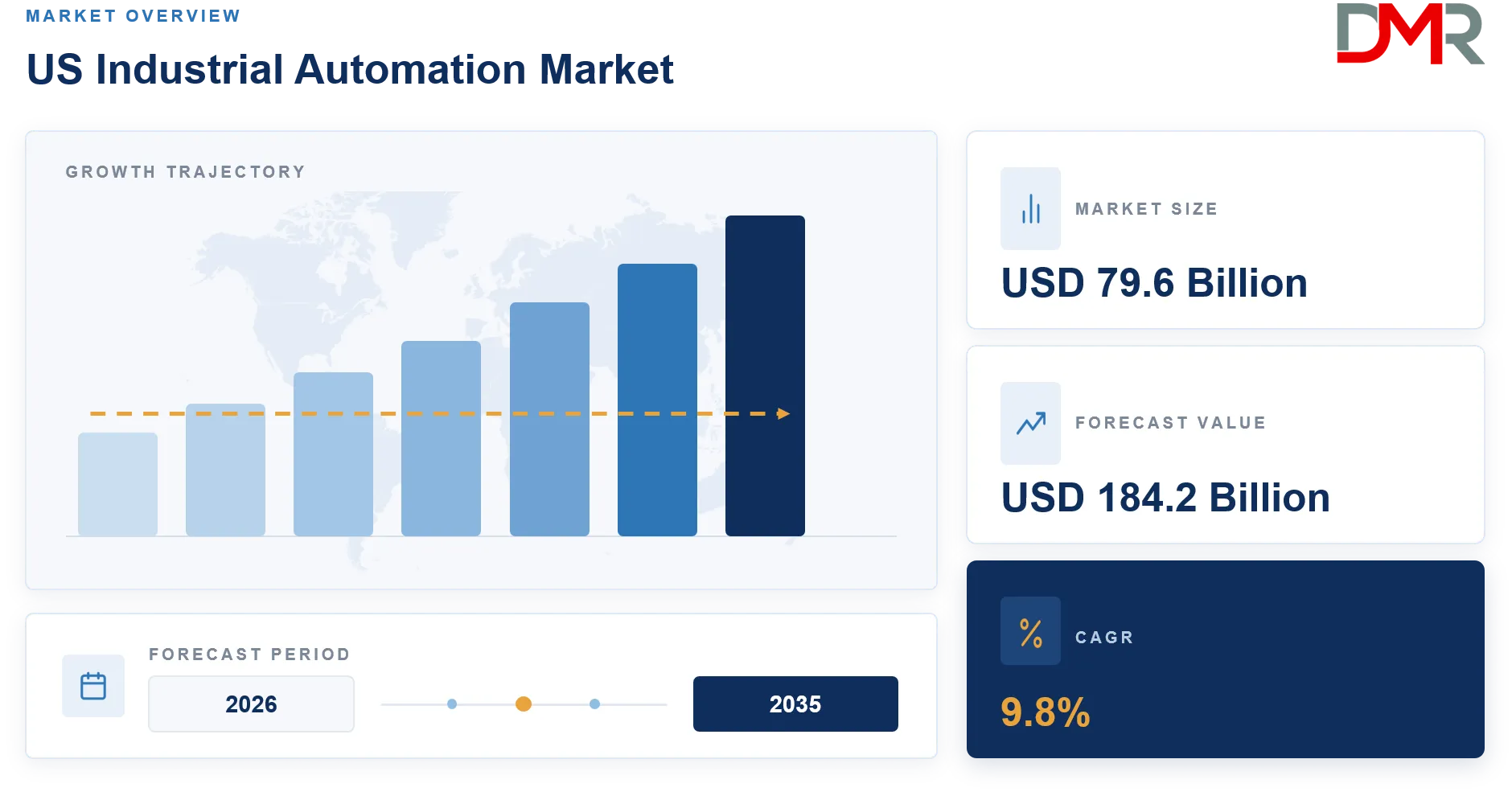
- Market Value: The US Industrial Automation Market is valued at USD 79.6 billion in 2026 and is projected to reach USD 184.2 billion by 2035.
- CAGR: The US Industrial Automation Market is expected to grow at a CAGR of 9.8% from 2026 to 2035.
- By Solution Analysis: Robotics led the solution landscape with a 14.2% share in 2026.
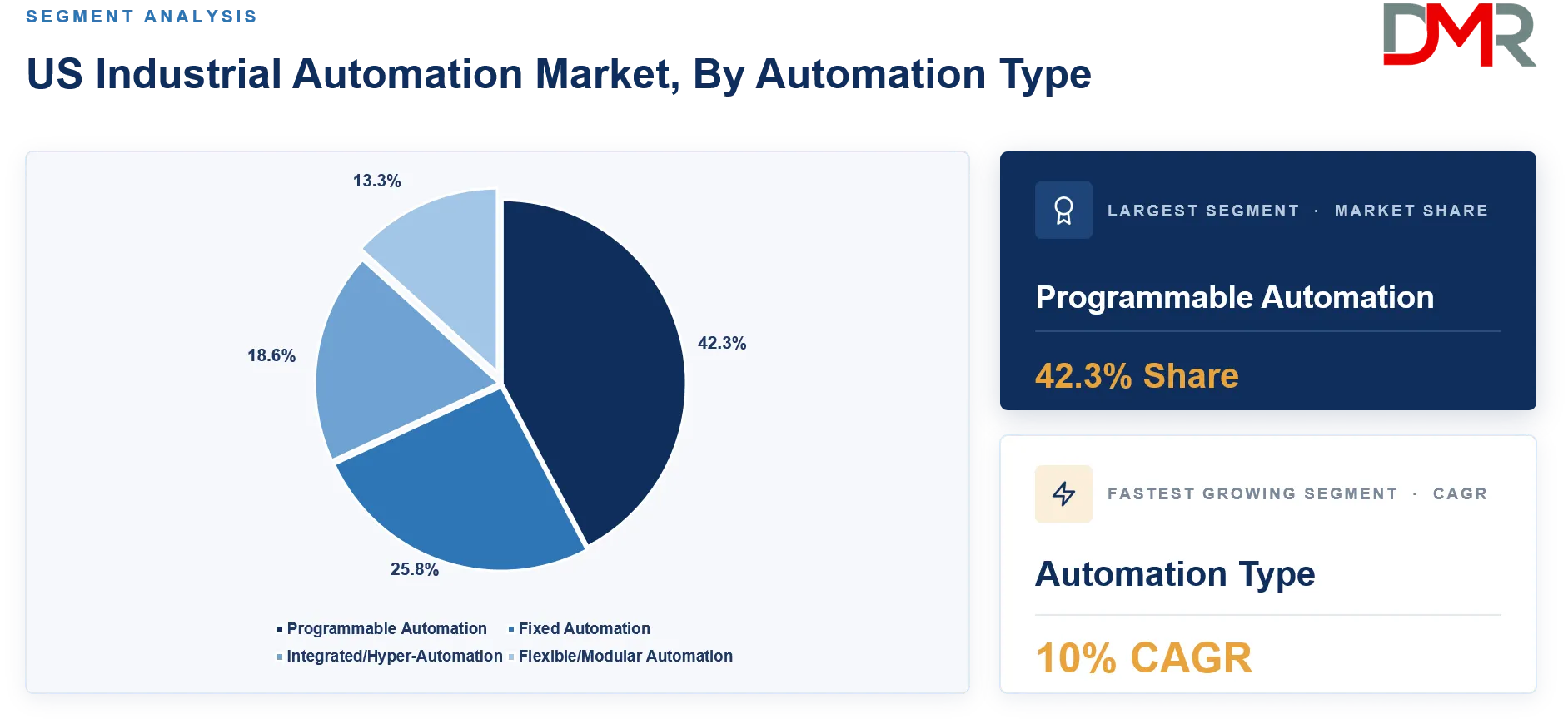
- By Automation Type Analysis: Programmable Automation led automation types with a 42.3% share in 2026.
- By End-User Industry Analysis: Electronics and Semiconductors held a 21.4% share in 2026.
- Major Players: Rockwell Automation, Siemens, Honeywell Process Solutions, and Others.
What is the US Industrial Automation Market and its Market Size?
The US Industrial Automation Market size is projected to be valued at USD 79.6 billion in 2026 and is forecast to reach USD 184.2 billion by 2035, expanding at a CAGR of 9.8% during the forecast period. Industrial automation covers the technologies used to monitor, control, coordinate, and optimize manufacturing and industrial processes with limited manual intervention. The ecosystem includes industrial robots, sensors, motors and drives, PLCs, DCS, SCADA, HMI, manufacturing software, integration services, edge systems, and plant-level data platforms.
ℹ
To learn more about this report –
Download Your Free Sample Report Here
The US industrial automation market growth is increasingly connected with capital spending on semiconductor fabrication, advanced electronics, automotive manufacturing, warehousing, pharmaceuticals, food processing, energy infrastructure, and high-value production. Industrial automation investment is moving beyond isolated equipment replacement toward connected architectures in which robots, controllers, sensors, MES platforms, machine data, and enterprise systems work together. This shift increases both hardware demand and recurring opportunities for software, engineering, cybersecurity, maintenance, and lifecycle services.
Robotics remains a visible indicator of automation demand. The International Federation of Robotics reported about 393,700 industrial robots operating in US factories in 2024, while 34,200 new units were installed during the year. The country maintained the third-largest operational industrial robot stock worldwide. The installed base highlights the maturity of automation in large manufacturers while also indicating room for wider adoption among smaller factories and non-automotive industries.
Use Cases
- Automated Production and Assembly: Industrial robots, PLCs, servo drives, machine vision, and integrated control systems automate repetitive production activities such as welding, assembly, material handling, fastening, dispensing, and packaging. Manufacturers use these systems to increase throughput, maintain process consistency, improve worker safety, and support production environments where product quality must remain stable across high-volume operations.
- Semiconductor Manufacturing: Semiconductor fabs depend on high-precision automation for wafer handling, process control, inspection, contamination management, material movement, and equipment monitoring. New US semiconductor manufacturing capacity increases opportunities for robotics, motion control, sensors, industrial software, cleanroom automation, and advanced process-control suppliers because fabrication requires highly repeatable operations and tightly controlled production conditions.
- Predictive Maintenance: Connected sensors, drives, industrial controllers, edge devices, and analytics platforms monitor vibration, temperature, pressure, energy use, equipment cycles, and other operating variables. Maintenance teams can identify abnormal equipment behavior before a major failure occurs, allowing plants to schedule service more effectively, reduce unplanned downtime, protect expensive production assets, and improve overall equipment availability.
- Warehouse and Material Flow Automation: Autonomous mobile robots, robotic picking systems, conveyors, machine vision, warehouse software, and automated storage technologies improve movement of raw materials, components, work-in-progress goods, and finished products. Automation supports faster fulfillment and more predictable material flow while helping manufacturers connect factory operations with distribution centers and increasingly data-driven supply chains.
- Quality Inspection and Traceability: Machine vision, sensors, industrial software, MES platforms, and automated inspection systems detect production defects and maintain digital records across manufacturing processes. Manufacturers in electronics, pharmaceuticals, automotive, food, and other regulated or quality-sensitive industries use these systems to reduce inspection variability, strengthen traceability, identify process deviations, and support continuous quality improvement.
How AI and Generative AI are Transforming the US Industrial Automation Market?
Artificial intelligence is extending industrial automation from programmed execution toward systems capable of detecting patterns, identifying abnormal conditions, and improving decisions from production data. Manufacturers are applying machine learning to predictive maintenance, machine vision, quality inspection, energy optimization, process control, and production scheduling. When combined with PLC, SCADA, MES, sensors, robotics, and edge computing, these applications can help plants identify equipment degradation, detect defects earlier, and improve operating consistency.
Generative AI is also emerging as an interface between industrial data and plant personnel. Potential applications include maintenance assistance, engineering documentation, troubleshooting guidance, code support, operator knowledge retrieval, and summarization of alarms or production events. Adoption in operational technology environments requires strong controls around data access, cybersecurity, validation, and human oversight. As a result, industrial vendors are increasingly embedding intelligent functions within established automation platforms instead of positioning AI as a separate plant system.
Key Drivers in the US Industrial Automation Market
Expansion of Advanced US Manufacturing Capacity
Investment in semiconductor, electronics, electric vehicle, battery, energy, and other advanced manufacturing facilities is creating a larger addressable base for automation suppliers. Semiconductor projects are particularly automation intensive because fabrication requires precise motion, automated material handling, environmental control, equipment monitoring, and continuous process optimization. Intel has outlined more than USD 100 billion of US investment across Arizona, New Mexico, Oregon, and Ohio, supported in part by CHIPS Act incentives.
Productivity, Labor, and Production Reliability Requirements
US manufacturers are increasing automation investment to produce more reliably while managing workforce availability, higher technical skill requirements, quality targets, and downtime costs. Robotics, PLCs, motion systems, machine vision, MES, and industrial software can reduce manual handling and standardize processes while allowing skilled employees to focus on programming, engineering, maintenance, and supervision. North American companies ordered 36,766 robots worth USD 2.25 billion in 2025, with unit demand increasing 6.6% from 2024.
Restraints in the US Industrial Automation Market
High Integration and Modernization Costs
The cost of automation extends beyond purchasing robots or controllers. Companies may need engineering services, safety equipment, electrical upgrades, industrial networks, software licenses, employee training, cybersecurity controls, system validation, and production-line modifications. Brownfield plants create additional complexity because older machinery may use proprietary protocols or unsupported controls. These costs can lengthen investment payback periods, particularly for smaller manufacturers operating short production runs or frequently changing product mixes.
Operational Technology Cybersecurity and System Complexity
Connecting industrial equipment to plant networks, cloud platforms, remote services, and enterprise applications increases the number of digital interfaces that manufacturers must protect. Production environments also contain equipment with long operating lives, making patching and security upgrades more difficult than in conventional IT systems. Buyers therefore evaluate automation platforms not only for performance but also for network segmentation, access control, lifecycle support, secure remote connectivity, backup capability, and compatibility with existing operational technology infrastructure.
Growth Opportunities in the US Industrial Automation Market
Automation Adoption Among Small and Medium-Sized Manufacturers
Small and medium-sized manufacturers represent an important growth opportunity because many still operate partially manual production environments. Lower-cost collaborative robots, modular automation cells, cloud-connected software, machine vision, and easier programming tools can reduce historical adoption barriers. The US Department of Energy has also supported programs intended to expand access to smart manufacturing technologies for smaller manufacturers, including funding directed toward data-driven production tools and modernization.
Semiconductor and Electronics Manufacturing Ecosystem
Domestic semiconductor capacity creates opportunities extending beyond fabrication equipment to robotics, sensors, process controls, cleanroom automation, material handling, MES, edge computing, and equipment-service providers. In July 2026, the US Department of Commerce announced a USD 225 million CHIPS Program direct funding agreement supporting Bosch's silicon carbide semiconductor production project. Continued fab construction and supplier localization can generate automation demand throughout upstream materials, wafer processing, packaging, testing, and supporting infrastructure.
Trends in the US Industrial Automation Market
Automation Demand Expanding Beyond Automotive
Automotive manufacturing remains a major robotics customer, but automation demand is becoming more diversified. A3 reported that general industries represented the majority of North American robot units ordered during 2025, supported by food and consumer goods, semiconductors and electronics, and life sciences. This broader customer base reduces dependence on traditional automotive investment cycles and creates new demand for flexible robots, machine vision, compact controls, safety systems, and application-specific integration services.
Growing Adoption of Collaborative and Flexible Robotics
Collaborative robots are gaining attention where manufacturers need adaptable automation rather than permanently engineered high-volume production cells. A3 recorded 1,052 collaborative robots ordered in North America during the first quarter of 2025, representing 11.6% of total robot units ordered. Their use is expanding in machine tending, packaging, inspection, laboratory operations, assembly, and material handling, particularly where manufacturers require quicker deployment, smaller footprints, and frequent production changeovers.
Research Scope and Analysis
The US Industrial Automation Market is segmented based on Solution, Automation Type, End-User Industry, and Deployment Mode. The study evaluates automation technologies used across discrete and process industries and examines their contribution to manufacturing productivity, process reliability, plant connectivity, quality improvement, equipment utilization, and digital operations.
ℹ
To learn more about this report –
Download Your Free Sample Report Here
By Solution
Robotics dominated the solution category with a 14.2% share in 2026. The segment benefits from demand for automated assembly, welding, material handling, machine tending, packaging, palletizing, inspection, and semiconductor operations. The US also maintains one of the world's largest installed industrial robot bases. Demand is expanding beyond conventional automotive plants as electronics, food production, life sciences, logistics, metals, and consumer-goods manufacturers pursue flexible production. Robotics growth also supports adjacent revenue for machine vision, safety devices, drives, controls, software, tooling, integration, and maintenance services. North American robot orders reached 36,766 units in 2025, indicating sustained automation investment across a widening set of applications.
By Automation Type
Programmable Automation led automation types with a 42.3% share in 2026. The segment is well suited to production environments where manufacturers run multiple products, modify operating sequences, or require controlled batch changes. PLCs, programmable robots, motion controllers, and software-defined production systems allow equipment behavior to be altered without replacing an entire manufacturing line. This flexibility is valuable in electronics, automotive components, machinery, packaging, food processing, and other industries facing shorter product cycles. Continued movement toward configurable machinery and digital production recipes is expected to support programmable automation demand through 2035.
By End-User Industry
Electronics and Semiconductors held a 21.4% share of the US industrial automation market in 2026. Semiconductor and electronics manufacturing requires high levels of accuracy, repeatability, contamination control, traceability, automated inspection, and equipment coordination. Expansion of domestic semiconductor capacity is strengthening demand for robotic wafer handling, precision motion, sensing, machine vision, industrial software, manufacturing execution systems, and automated material movement. Federal incentives and large private manufacturing commitments are reinforcing the US semiconductor investment pipeline, creating opportunities for both automation equipment manufacturers and specialized systems integrators.
By Deployment Mode
Deployment strategies are evolving toward hybrid and edge architectures because factories need both local control and broader access to operational data. On-premise systems remain important for latency-sensitive control, plant security, and legacy infrastructure, while cloud-based platforms support centralized analytics, multi-site monitoring, software delivery, and enterprise integration. Hybrid and edge environments allow data to be processed close to machinery while selected information is transferred to plant or cloud platforms. This structure is particularly relevant for predictive maintenance, condition monitoring, machine vision, energy analytics, and connected production across multiple facilities.
The US Industrial Automation Market Report is Segmented on the Basis of the Following:
By Solution
- Services
- Maintenance and Training
- Integration
- Software
- Manufacturing Execution System (MES)
- Product Lifecycle Management (PLM)
- Enterprise Resource and Planning (ERP)
- Other Software
- Field Devices
- Robotics
- Motors and Drives
- Sensors & Transmitters
- Valves and Actuators
- Other Field Devices
- Industrial Control Systems
- Programmable Logic Controller (PLC)
- Human Machine Interface (HMI)
- Distributed Control System (DCS)
- Supervisory Control and Data Acquisition (SCADA)
- Other Control Systems
By Automation Type
- Flexible/Modular Automation
- Fixed Automation
- Integrated/Hyper-Automation
- Programmable Automation
By End-User Industry
- Electronics and Semiconductors
- Metals and Mining
- Automotive and Transportation
- Chemicals and Petrochemicals
- Food and Beverage
- Power and Utilities
- Oil and Gas
- Pharmaceuticals and Life Sciences
- Other End-User Industries
By Deployment Mode
- Hybrid / Edge
- Cloud-Based
- On-Premise
Competitive Landscape
The US industrial automation market features global diversified automation suppliers, specialized robotics companies, industrial software providers, control-system vendors, and systems integrators. Rockwell Automation has a strong US industrial footprint across PLCs, controls, drives, software, and connected production systems, while Siemens competes through factory automation, digital industries software, motion systems, and industrial controls. Honeywell Process Solutions, Emerson Automation Solutions, ABB, Schneider Electric, and Yokogawa maintain strong positions in process automation, instrumentation, control platforms, electrification, and industrial software.
Robotics competition includes FANUC America, Yaskawa America, KUKA Robotics, Universal Robots, ABB, and other specialists. Keyence and Omron compete strongly in sensing, machine vision, controls, and factory automation, while Beckhoff and Bosch Rexroth target advanced control and motion applications. Competition increasingly depends on installed base, interoperability, cybersecurity, engineering expertise, software integration, edge connectivity, lifecycle services, and the ability to connect plant-floor equipment with MES and enterprise systems. Market consolidation and platform expansion are also influencing purchasing decisions as manufacturers seek fewer technology layers and more integrated automation architectures.
Some of the prominent players in the US Industrial Automation Industry are:
- Rockwell Automation
- Siemens
- Honeywell Process Solutions
- Emerson Automation Solutions
- Schneider Electric
- ABB
- Mitsubishi Electric Automation
- Omron Industrial Automation
- Keyence
- Beckhoff Automation
- FANUC America
- Yaskawa America
- KUKA Robotics
- Universal Robots
- Bosch Rexroth
- Yokogawa
- General Electric
- National Instruments
- Symbotic
- Locus Robotics
- Others
Technology Analysis
The US industrial automation market is moving toward connected, software-defined production architectures that combine robotics, PLCs, SCADA, MES, machine vision, edge computing, industrial IoT, digital twins, and AI-assisted analytics. Manufacturers are increasingly linking field devices with plant and enterprise systems so production data can support predictive maintenance, quality control, energy optimization, and faster changeovers. Robotics is becoming more flexible through cobots, advanced vision, and easier programming, while edge platforms allow low-latency processing close to equipment without sending every workload to the cloud. Digital twins are also gaining relevance for virtual commissioning, line simulation, and process optimization before physical changes are made. For buyers, technology selection is therefore shifting from isolated hardware performance toward interoperability, cybersecurity, lifecycle support, data integration, and the ability to scale automation across multiple US facilities.
Investment and White Space Analysis
Investment opportunities in the US industrial automation market are expanding around semiconductor fabs, advanced electronics, battery plants, smart warehouses, food production, life sciences, and modernized mid-sized factories. Semiconductor manufacturing is a particularly strong demand catalyst because new fabs require robotics, precision motion, sensors, cleanroom automation, process controls, MES, and automated material handling. In July 2026, TSMC's planned US investment reached USD 265 billion, while Bosch's Roseville silicon carbide project was backed by a USD 2 billion facility investment and up to USD 225 million in CHIPS incentives. White space remains strongest among small and medium-sized manufacturers that need modular automation, lower-cost cobots, retrofit controls, edge analytics, and integration services without rebuilding entire production lines. Suppliers that can combine hardware, software, cybersecurity, financing, and lifecycle support have room to capture underserved brownfield and multi-site modernization demand.
Recent Developments
- August 2026: Emerson completed acquisition of all outstanding shares of Aspen Technology, strengthening its industrial automation software portfolio for process optimization and digital twin capabilities in the US market.
- June 2026: Schneider Electric announced definitive agreement to acquire Cognite for $3.1 billion, integrating industrial AI and data operations platform into AVEVA to expand US industrial automation software offerings.
- April 2026: Rockwell Automation and SLB completed dissolution of Sensia joint venture, with Rockwell assuming full ownership of Process Automation business to strengthen US process automation capabilities.
Report Details
| Report Characteristics |
| Market Size (2026) |
USD 79.6 Bn |
| Forecast Value (2035) |
USD 184.2 Bn |
| CAGR (2026-2035) |
9.8% |
| Historical Data |
2021 - 2025 |
| Forecast Data |
2027 - 2035 |
| Base Year |
2025 |
| Estimate Year |
2026 |
| Segments Covered |
By Solution (Services {Maintenance and Training, and Integration}, Software {Manufacturing Execution System (MES), Product Lifecycle Management (PLM), Enterprise Resource and Planning (ERP), and Other Software}, Field Devices {Robotics, Motors and Drives, Sensors & Transmitters, Valves and Actuators, and Other Field Devices}, Industrial Control Systems {Programmable Logic Controller (PLC), Human Machine Interface (HMI), Distributed Control System (DCS), Supervisory Control and Data Acquisition (SCADA), and Other Control Systems}), By Automation Type (Flexible/Modular Automation, Fixed Automation, Integrated/Hyper-Automation, and Programmable Automation), By End-User Industry (Electronics and Semiconductors, Metals and Mining, Automotive and Transportation, Chemicals and Petrochemicals, Food and Beverage, Power and Utilities, Oil and Gas, Pharmaceuticals and Life Sciences, and Other End-User Industries), By Deployment Mode (Hybrid / Edge, Cloud-Based, and On-Premise) |
| Regional Coverage |
United States |
Frequently Asked Questions
What is the current size of the US Industrial Automation Market?
▾ The US Industrial Automation Market size is valued at USD 79.6 billion in 2026 and is forecast to reach USD 184.2 billion by 2035.
What is the growth rate of the US Industrial Automation Market during?
▾ The US Industrial Automation Market is expected to grow at a CAGR of 9.8% during the forecast period from 2026 to 2035.
What factors are driving the growth of the US Industrial Automation Market?
▾ US Industrial Automation Market growth is driven by smart factories, robotics, semiconductor investment, reshoring, and productivity needs.
What are the major challenges restraining the US Industrial Automation Market?
▾ High integration costs, legacy equipment, OT cybersecurity risks, and skilled labor gaps restrain US Industrial Automation Market growth.
Which segment holds the largest share of the US Industrial Automation Market?
▾ Programmable Automation holds a 42.3% share of the US Industrial Automation Market by automation type, making it the leading segment.
Who are the leading companies in the US Industrial Automation Market?
▾ Leading US Industrial Automation Market companies include Rockwell Automation, Siemens, Honeywell Process Solutions, Emerson Automation Solutions, Schneider Electric, ABB, Mitsubishi Electric Automation, Omron Industrial Automation, Keyence, Beckhoff Automation, FANUC America, Yaskawa America, KUKA Robotics, Universal Robots, Bosch Rexroth, Yokogawa, General Electric, National Instruments, Symbotic, and Locus Robotics.
How is AI influencing the US Industrial Automation Market?
▾ AI is influencing the US Industrial Automation Market through predictive maintenance, machine vision, process optimization, and quality control.
What are the future opportunities and trends in the US Industrial Automation Market?
▾ US Industrial Automation Market opportunities include cobots, edge systems, smart factories, semiconductor fabs, digital twins, and flexible robotics.