India Automotive Robotics Market Snapshot
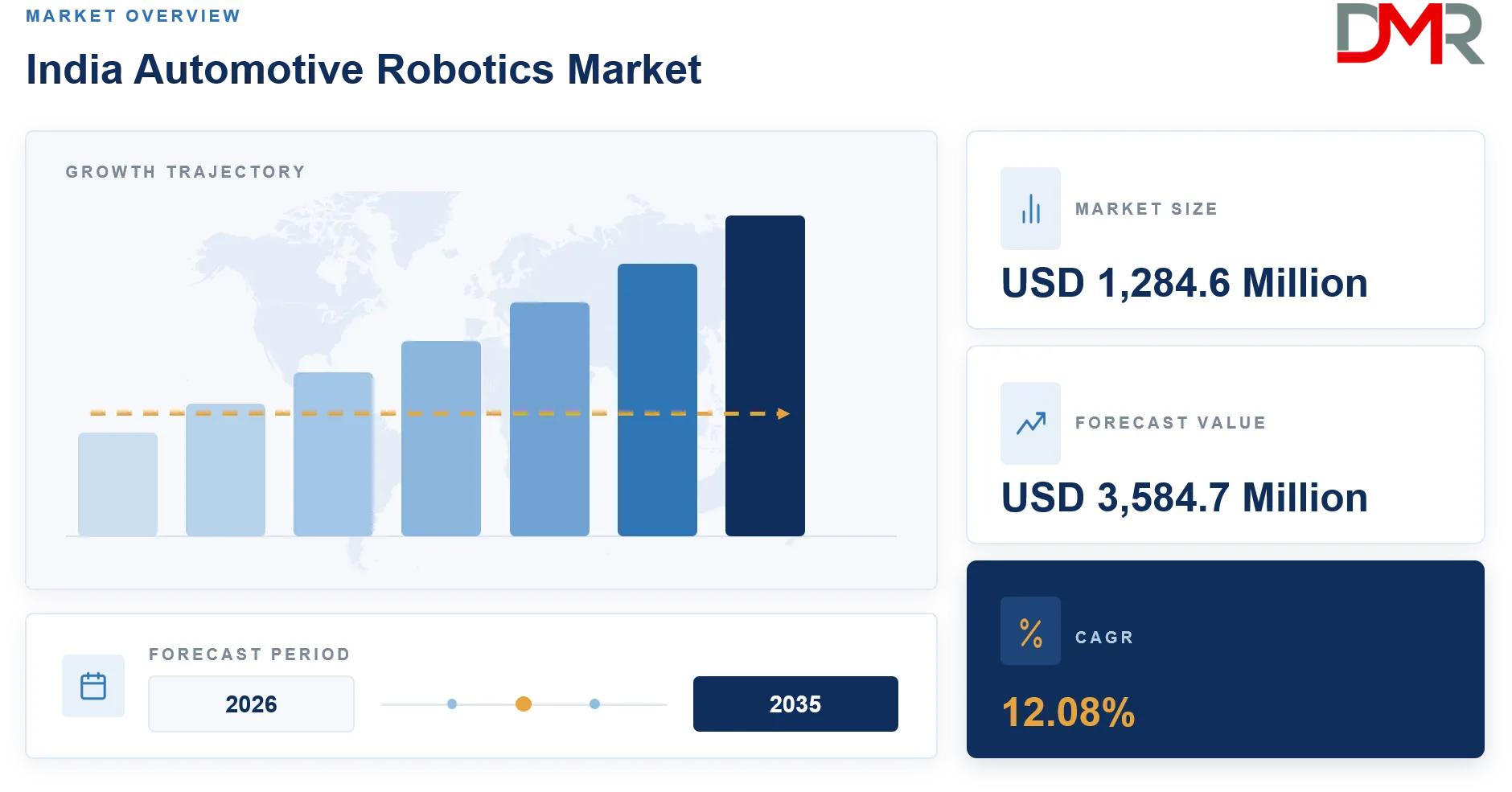
- Market Value: The India Automotive Robotics Market is valued at USD 1,284.6 Million in 2026 and is projected to reach USD 3,584.7 Million by 2035.
- CAGR: The India Automotive Robotics Market is expected to grow at a CAGR of 12.08% from 2026 to 2035.
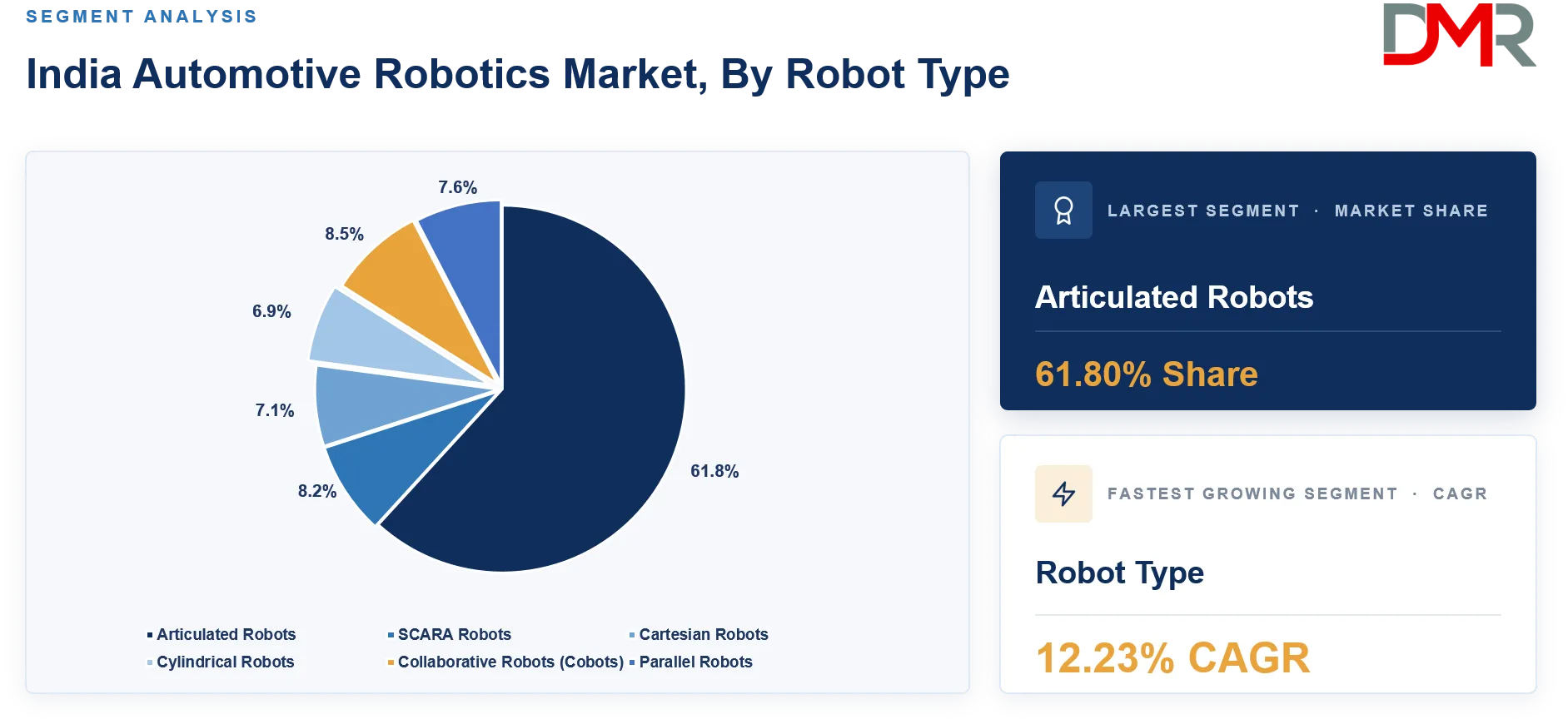
- By Robot Type Analysis: Articulated Robots led the robot type segment with a 61.8% share in 2026.
- By Component Analysis: Robotic Arms led the component segment with a 38.9% share in 2026.
- By Application Analysis: Welding Robots held the leading application position with a 29.6% share in 2026.
- Regional Analysis: West India led the market with a 32.6% revenue share in 2026.
- Major Players: ABB India Ltd, FANUC India Pvt. Ltd., KUKA Robotics India Pvt. Ltd., and Others.
What is the India Automotive Robotics Market and its Market Size?
The India Automotive Robotics Market size is projected to grow from USD 1,284.6 Million in 2026 to USD 3,584.7 Million by 2035, expanding at a CAGR of 12.08%. The market covers robotic systems used across vehicle production, component manufacturing, inspection, welding, painting, assembly, material handling, cutting, and other factory operations. Demand is supported by India's expanding vehicle production base and greater investment in automated manufacturing. SIAM reports that total automobile production reached 347.1 lakh units in FY2025-26, while passenger vehicle production reached 55.4 lakh units.
Industrial robot adoption is also accelerating. The International Federation of Robotics reported 9,100 industrial robot installations in India in 2024, up 7% year over year, with automotive accounting for 45% of installations. This makes vehicle manufacturing a central demand engine for robotics suppliers, system integrators, and automation technology providers.
Use Cases
- Welding: Robotic welding improves repeatability, cycle times, and weld quality in body production.
- Painting: Robots deliver consistent coating thickness while reducing material exposure.
- Assembly: Automated systems support precision assembly of vehicle and component parts.
- Material Handling: Robots move components between production stages with greater consistency.
- Inspection: Vision-enabled robots help identify dimensional, surface, and assembly defects.
How AI/Gen AI is Transforming the India Automotive Robotics Market?
AI is moving automotive robotics beyond fixed, repetitive automation toward systems that can sense production conditions and adjust operations. Machine vision can support defect detection, robotic inspection, predictive maintenance, and adaptive handling. In automotive plants, these capabilities can reduce unplanned downtime and improve process consistency. The commercial value is strongest where manufacturers operate high-volume lines and need tighter quality control without slowing production.
ℹ
To learn more about this report –
Download Your Free Sample Report Here
Generative AI is adding a new layer through natural-language interaction, production data analysis, simulation support, and faster robot programming. Engineers can use AI-assisted tools to interpret machine data, identify process anomalies, and optimize production parameters. India's manufacturing sector is increasingly focused on connecting factory equipment with data systems, creating opportunities for robotics suppliers that combine industrial robots, sensors, software, analytics, and cloud connectivity. This shift supports demand for smarter robotic cells rather than standalone mechanical equipment.
Key Drivers in the India Automotive Robotics Market
Expansion of Automotive Manufacturing
India's rising vehicle production is increasing the need for scalable automation across OEM and component plants. FY2025-26 automobile production reached 347.1 lakh units, including 55.4 lakh passenger vehicles and 26.7 crore two-wheelers. Higher production volumes create strong use cases for welding, assembly, handling, and inspection robots. As manufacturers expand capacity, robotics can help maintain throughput and repeatability while addressing production complexity and quality requirements.
Rising Factory Automation Adoption
Robot deployment is becoming an important part of India's manufacturing modernization. Industrial robot installations reached a record 9,100 units in 2024, while automotive represented 45% of installations. The increase reflects investment by vehicle manufacturers and component suppliers in automated production lines. Greater use of robotic cells, machine vision, connected controllers, and automated material movement is widening the addressable market for robotics hardware, integration, software, and lifecycle services.
Restraints in the India Automotive Robotics Market
High Initial Investment
Automotive robotics requires more than purchasing a robot. Manufacturers may need system integration, tooling, safety equipment, programming, sensors, maintenance, and plant-level connectivity. These costs can lengthen payback periods, particularly for smaller Tier-2 suppliers. The investment challenge can slow automation decisions when production volumes are uncertain. Suppliers that offer modular deployment, retrofit solutions, financing options, and measurable productivity gains can reduce this barrier and improve adoption among cost-sensitive manufacturers.
Integration and Skills Constraints
Advanced robotic systems require engineering skills covering controls, programming, machine vision, safety, data connectivity, and maintenance. Smaller factories may have limited access to specialists capable of integrating complex automation into existing production environments. This creates additional implementation risk and can increase dependence on system integrators. Training, standardized interfaces, remote support, and simpler programming platforms can help reduce the skills gap and improve the economics of robotics deployment.
Growth Opportunities in the India Automotive Robotics Market
Retrofit Automation
Retrofit automation provides a major opportunity because many Indian factories operate established production equipment that cannot be replaced immediately. Robotic arms, vision systems, controllers, and automated handling units can be added to existing lines to improve productivity without rebuilding entire facilities. This approach can make automation more accessible to Tier-1 and Tier-2 suppliers and create recurring demand for integration, programming, maintenance, and replacement components.
Connected and Intelligent Robotics
Connected robotics offers suppliers an opportunity to move from equipment sales toward higher-value software and service models. Cloud-connected systems can collect operational data for maintenance, performance monitoring, energy analysis, and production optimization. Combining robotics with AI, machine vision, digital twins, and factory analytics can increase the value of each installation. This is particularly relevant as Indian manufacturers seek greater visibility across increasingly automated production environments.
Trends in the India Automotive Robotics Market
Growth of Collaborative Automation
Collaborative robots are gaining relevance where manufacturers need flexible automation around workers or for lower-volume production tasks. Their smaller footprint and programming flexibility can support component handling, inspection, machine tending, and light assembly. Cobots are unlikely to replace high-payload articulated robots across demanding automotive operations, but they can expand automation into processes where traditional robotic cells may be difficult to justify.
Shift Toward Data-Driven Robotics
Automotive robotics is increasingly linked with sensors, machine vision, predictive analytics, and connected factory platforms. This trend changes the value proposition from mechanical automation alone to measurable production intelligence. Manufacturers can use operational data to identify downtime, quality deviations, and maintenance requirements. The combination of robotics and industrial software is therefore becoming an important differentiator for suppliers competing for large automotive automation projects.
Research Scope and Analysis
The India Automotive Robotics Market is segmented based on robot type, component, application, end-user type, fitment type, payload capacity, mobility, and region. The study evaluates adoption patterns, production applications, technology requirements, demand drivers, competitive positioning, and growth opportunities across automotive manufacturing and component production.
ℹ
To learn more about this report –
Download Your Free Sample Report Here
By Robot Type;
Articulated Robots accounted for 61.8% of the market in 2026, making them the dominant robot type. Their multi-axis movement, payload flexibility, reach, and suitability for demanding production environments support widespread automotive use. Welding, painting, material handling, machine tending, and assembly are key applications. Automotive manufacturers favor articulated systems because one robotic platform can be configured for different production tasks. Continued vehicle model diversification, plant automation, and demand for repeatable high-speed operations should sustain the segment's leading position.
By Component;
Robotic Arms led the component segment with a 38.9% share in 2026. The component remains central to robotic cells because arm configuration directly affects reach, payload, speed, and application suitability. Demand is supported by new production lines as well as replacement and retrofit projects. Controllers, sensors, end effectors, drive units, and software add value around the robotic arm, creating opportunities for integrated automation suppliers. Future adoption will increasingly depend on connectivity, safety functions, vision integration, and simplified programming.
The India Automotive Robotics Market Report is segmented on the basis of the following:
By Robot Type
- Articulated Robots
- SCARA Robots
- Cartesian Robots
- Cylindrical Robots
- Collaborative Robots (Cobots)
- Parallel Robots
By Component
- Robotic Arms
- Controllers
- End Effectors
- Drive Units
- Sensors
- Software and Services
By Application
- Welding Robots
- Painting Robots
- Assembly Robots
- Material-Handling Robots
- Inspection and Testing Robots
- Cutting and Milling Robots
- Dispensing Robots
By End-User Type
- Vehicle Manufacturers (OEMs)
- Tier-1 Component Manufacturers
- Tier-2 Component Manufacturers
- After-market Service Centers
By Fitment Type
- New System Integration
- Retrofit Automation Solutions
- Modular Robotics Deployment
- Cloud-Connected Robotics Systems
By Payload Capacity
- Light Payload Robots
- Medium Payload Robots
- Heavy Payload Robots
By Mobility
- Stationary Industrial Robots
- Autonomous Mobile Robots (AMRs)
- Automated Guided Vehicles (AGVs)
Competitive Landscape
The India Automotive Robotics Market is competitive, with global robotics manufacturers competing alongside domestic system integrators and automation specialists. ABB, FANUC, KUKA, Yaskawa, Comau, Kawasaki, and other established suppliers compete through robot performance, application expertise, installed base, service coverage, and integration capabilities. Local companies add value through customized engineering, retrofit projects, software integration, and support for Indian manufacturing plants.
Competition is shifting beyond robot hardware toward complete automation cells, machine vision, connected systems, predictive maintenance, and AI-enabled production analytics. The market's growth also creates opportunities for specialized providers serving Tier-1 and Tier-2 suppliers, where flexible and cost-efficient automation can be more important than large-scale greenfield installations. India's record 9,100 industrial robot installations in 2024 underline the expanding competitive opportunity.
Some of the prominent players in the India Automotive Robotics Industry are:
- ABB India Ltd
- FANUC India Pvt. Ltd.
- KUKA Robotics India Pvt. Ltd.
- Yaskawa India Pvt. Ltd.
- Comau India Pvt. Ltd.
- Kawasaki Robotics India Pvt. Ltd.
- NACHI-FUJIKOSHI India Pvt. Ltd.
- DENSO WAVE / DENSO Robotics
- Epson India Pvt. Ltd.
- OMRON Automation India
- Mitsubishi Electric India
- Stäubli India Pvt. Ltd.
- Panasonic Connect India
- Universal Robots India
- TAL Manufacturing Solutions Ltd.
- Systemantics India Pvt. Ltd.
- DiFACTO Robotics and Automation
- Hi-Tech Robotic Systemz Ltd.
- ATI Motors / ATI Robotics
- Addverb Technologies
- Others
Technology Analysis
Technology adoption in the India Automotive Robotics Market is shifting from standalone industrial robots toward integrated automation cells that combine robotic arms, controllers, machine vision, sensors, end effectors, industrial software, and connected factory systems. Articulated robots remain the leading technology class because their multi-axis movement and payload flexibility suit welding, painting, handling, machine tending, and assembly. Collaborative robots are expanding the addressable market by supporting flexible production, smaller work areas, and human-machine collaboration. AI-enabled vision is also improving inspection, defect detection, part identification, and adaptive process control. Autonomous mobile robots and automated guided vehicles are extending automation beyond fixed production cells into intralogistics and material movement.
Cloud connectivity is creating another layer of value by enabling remote monitoring, performance tracking, predictive maintenance, and production analytics. India's automotive manufacturers are increasingly evaluating technology based on total production impact rather than robot specifications alone. Integration capability, programming simplicity, uptime, safety, energy efficiency, interoperability, and after-sales support are becoming important purchasing criteria. The technology opportunity is therefore moving toward complete robotic ecosystems that can connect production equipment with manufacturing execution, analytics, and quality systems. Suppliers capable of combining hardware with software and local engineering support are well positioned to capture higher-value projects as Indian plants modernize existing lines and deploy automation in new facilities.
Investment and White Space Analysis
The India Automotive Robotics Market presents investment opportunities across both large-scale factory automation and underserved mid-market manufacturing applications. Greenfield automotive plants remain an important opportunity for complete robotic production cells, while brownfield facilities create demand for retrofit automation that can improve existing equipment without requiring full line replacement. A significant white space exists among Tier-2 component manufacturers and smaller production facilities where automation adoption can be limited by capital requirements, integration complexity, and shortage of specialized engineering talent. Modular robotic cells, leasing or robotics-as-a-service models, standardized integration packages, and lower-cost collaborative systems can help address this gap.
Investment potential is also emerging in machine vision, robotic inspection, end-of-line testing, automated material handling, and software that connects robots with factory data platforms. Electric vehicle manufacturing creates additional opportunities because battery, motor, power electronics, and lightweight component production require new combinations of precision handling, assembly, dispensing, inspection, and traceability. Regional expansion provides another white-space opportunity, particularly where industrial clusters are developing beyond established automotive centers. For investors and technology providers, the strongest opportunities are likely to come from businesses that combine robotics hardware with system integration, software, lifecycle services, and application-specific engineering. This model can generate recurring revenue while reducing customer adoption barriers and creating deeper relationships with automotive OEMs and component manufacturers.
Recent Developments
- May 2026: FANUC India completed a new 5,000 sq m service building in Bengaluru, adding a call center, spare-parts warehouse and service offices to support rising robot demand.
- January 2026: KUKA launched the KR AGILUS ultra, a 16 kg small robot designed for automotive handling, loading, testing and inspection, expanding its flexible automation portfolio.
- May 2025: DiFACTO Robotics acquired RoboFinish IPR from Grind Master, adding robotic grinding, finishing, deburring and machining technologies serving automotive and engineering applications.
Report Details
| Report Characteristics |
| Market Size (2026) |
USD 1,284.6 Million |
| Forecast Value (2035) |
USD 3,584.7 Million |
| CAGR (2026–2035) |
12.08% |
| Historical Data |
2021 – 2025 |
| Forecast Data |
2027 – 2035 |
| Base Year |
2025 |
| Estimate Year |
2026 |
| Segments Covered |
By Robot Type (Articulated Robots, SCARA Robots, Cartesian Robots, Cylindrical Robots, Collaborative Robots (Cobots), and Parallel Robots), By Component (Robotic Arms, Controllers, End Effectors, Drive Units, Sensors, and Software and Services), By Application (Welding Robots, Painting Robots, Assembly Robots, Material-Handling Robots, Inspection and Testing Robots, Cutting and Milling Robots, and Dispensing Robots), By End-User Type (Vehicle Manufacturers (OEMs), Tier-1 Component Manufacturers, Tier-2 Component Manufacturers, and After-market Service Centers), By Fitment Type (New System Integration, Retrofit Automation Solutions, Modular Robotics Deployment, and Cloud-Connected Robotics Systems), By Payload Capacity (Light Payload Robots, Medium Payload Robots, and Heavy Payload Robots), By Mobility (Stationary Industrial Robots, Autonomous Mobile Robots (AMRs), and Automated Guided Vehicles (AGVs)) |
| Regional Coverage |
India |
Frequently Asked Questions
What is the current size of the India Automotive Robotics Market?
▾ The India Automotive Robotics Market size is valued at USD 1,284.6 million in 2026 and is forecast to reach USD 3,584.7 million by 2035.
What is the growth rate of the India Automotive Robotics Market during?
▾ The India Automotive Robotics Market is expected to grow at a CAGR of 12.08% during the forecast period 2026-2035.
What factors are driving the growth of the India Automotive Robotics Market?
▾ Rising vehicle production, factory automation, manufacturing investment, and demand for efficient robotic production are driving growth.
What are the major challenges restraining the India Automotive Robotics Market?
▾ High initial investment, integration complexity, maintenance costs, and shortages of skilled robotics professionals constrain adoption.
Which segment holds the largest share of the India Automotive Robotics Market?
▾ Articulated Robots hold the largest share of the India Automotive Robotics Market, accounting for 61.8% in 2026.
Who are the leading companies in the India Automotive Robotics Market?
▾ ABB India, FANUC India, KUKA Robotics India, Yaskawa India, Comau India, Kawasaki Robotics India, NACHI-FUJIKOSHI India, DENSO WAVE, Epson India, OMRON Automation India, Mitsubishi Electric India, Stäubli India, Panasonic Connect India, Universal Robots India, TAL Manufacturing Solutions, Systemantics India, DiFACTO Robotics and Automation, Hi-Tech Robotic Systemz, ATI Motors, Addverb Technologies, and Others.
How is AI influencing the India Automotive Robotics Market?
▾ AI is improving machine vision, predictive maintenance, robotic inspection, adaptive automation, production analytics, and process optimization.
What are the future opportunities and trends in the India Automotive Robotics Market?
▾ Future opportunities include retrofit automation, collaborative robots, AI-enabled systems, connected robotics, AMRs, and smart manufacturing.