China Industrial Robot Retrofit and Upgrade Market Snapshot
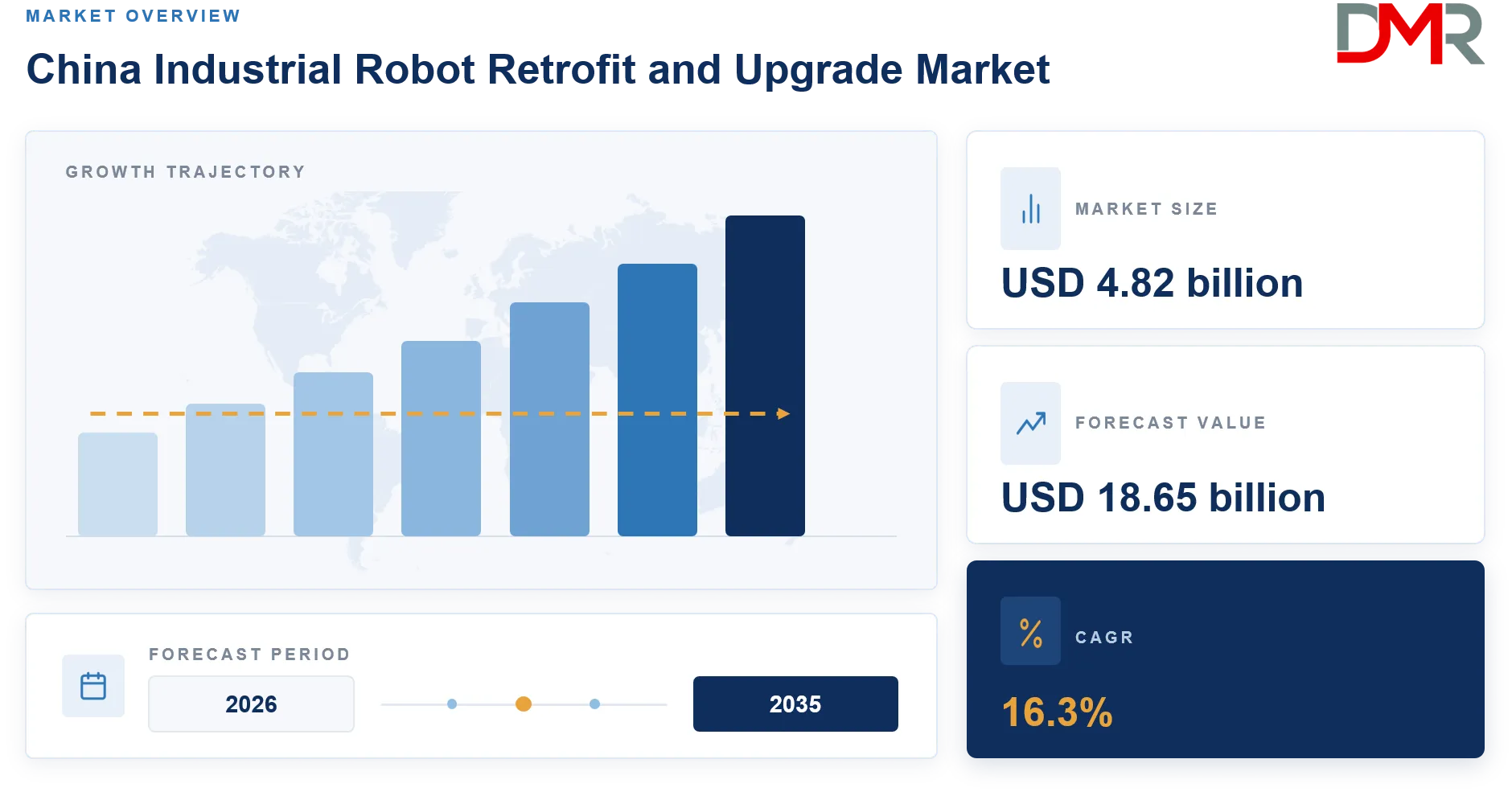
- Market Value: China Industrial Robot Retrofit and Upgrade Market is valued at USD 4.82 billion in 2026 and is projected to reach USD 18.65 billion by 2035.
- CAGR: China Industrial Robot Retrofit and Upgrade Market is expected to grow at a CAGR of 16.3% from 2026 to 2035.
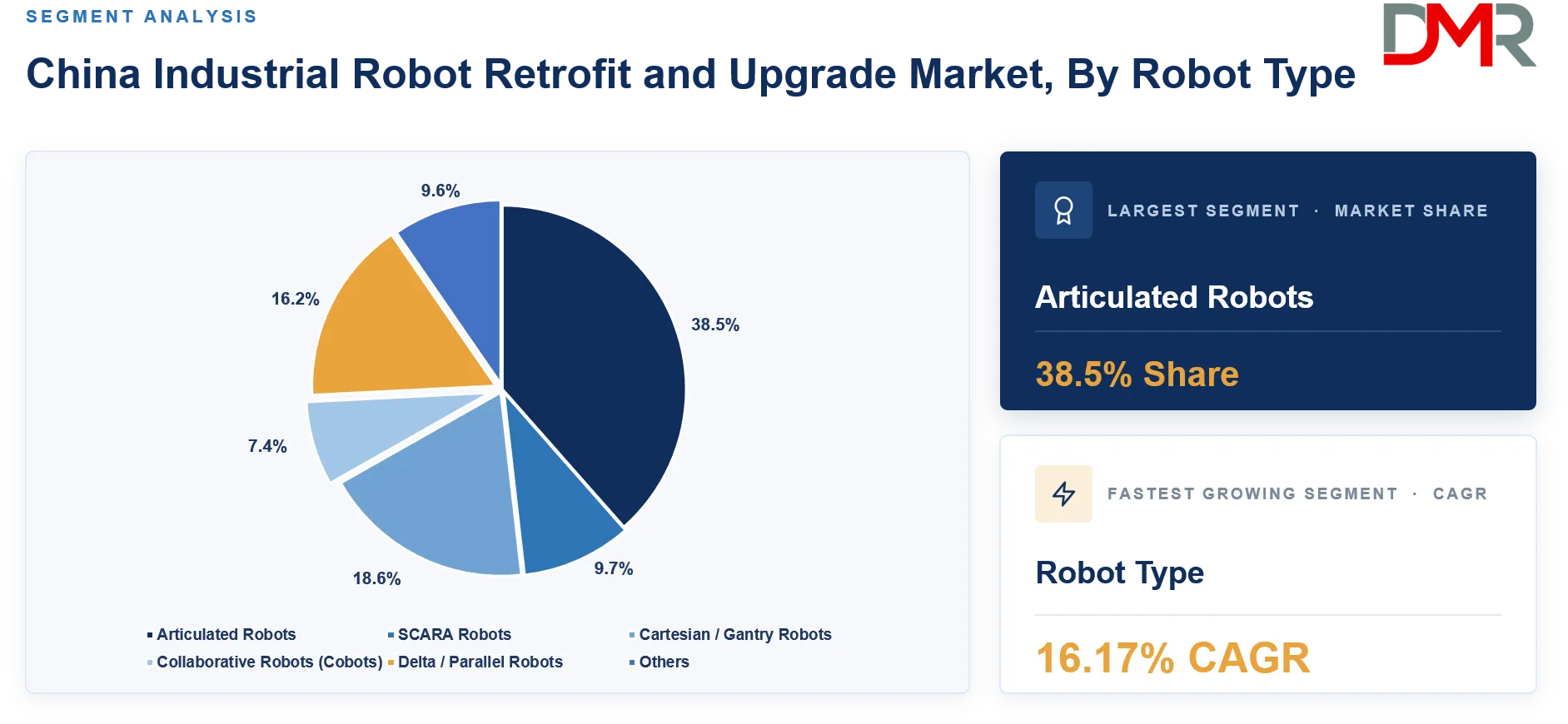
- By Robot Type Segment Analysis: Articulated Robots led the segment with a 38.5% share in 2026.
- By Retrofit Service Segment Analysis: Controller Upgrades led retrofit services with a 22.4% share in 2026.
- By End User Industry Segment Analysis: Automotive Manufacturing held a 26.3% share in 2026.
- By Application Segment Analysis: Welding & Soldering Cells led applications with a 21.5% share in 2026.
- Major Players: ESTUN, Inovance, Siasun, GSK, STEP Electric, and Others.
What is the China Industrial Robot Retrofit and Upgrade Market and its Market Size?
The China Industrial Robot Retrofit and Upgrade Market size is projected to be valued at USD 4.82 billion in 2026 and is projected to reach USD 18.65 billion by 2035, expanding at a CAGR of 16.3% during the forecast period. Industrial robot retrofit and upgrade services extend the productive life of installed robots through controller replacement, servo and drive modernization, machine vision integration, safety improvements, mechanical refurbishment, connectivity modules, and complete cell upgrades. These services allow factories to improve accuracy, cycle time, data visibility, safety, and compatibility with modern production systems without replacing every robotic asset.
ℹ
To learn more about this report –
Download Your Free Sample Report Here
China provides an unusually large addressable base for robot modernization. More than 2 million industrial robots were operating in Chinese factories in 2024, while 295,000 additional units were installed during the year. China accounted for 54% of global industrial robot installations, creating a broad installed base that will require maintenance, component refresh, software migration, safety upgrades, and connectivity improvements throughout its lifecycle. Chinese robot manufacturers also captured 57% of domestic installations in 2024, increasing the role of local controller, servo, motion control, integration, and aftermarket suppliers.
Use Cases
- Legacy Robot Life Extension: Automotive, metalworking, and electronics factories can retain mechanically sound robot arms while replacing aging controllers, servo drives, encoders, cables, and control interfaces. This lowers capital requirements compared with complete robot replacement and helps maintain production continuity across established manufacturing lines.
- Welding Cell Modernization: Retrofit packages improve welding robots through updated controllers, seam tracking, machine vision, torch monitoring, safety devices, and digital process control. Automotive body shops and fabrication plants use these upgrades to improve weld consistency, reduce rework, and support changing vehicle or component designs.
- Smart Factory Connectivity: Connectivity and IoT modules can link older industrial robots with manufacturing execution systems, production dashboards, condition monitoring platforms, and plant networks. This gives operators access to robot status, alarms, cycle data, energy use, maintenance records, and asset performance without replacing the complete cell.
- Safety and Compliance Upgrades: Manufacturers retrofit fencing, scanners, light curtains, interlocks, safety PLCs, emergency circuits, and monitored work zones as production layouts change. These upgrades are particularly relevant when existing robots are reassigned to flexible lines or operate closer to technicians and material handling systems.
- Flexible Production Conversion: Robot cells originally designed for one product can be upgraded with new grippers, vision systems, software, sensors, and motion programs. This allows manufacturers to handle new model variants, smaller batches, mixed production, and shorter product cycles while preserving valuable installed robotic equipment.
How AI/Gen AI is Transforming the China Industrial Robot Retrofit and Upgrade Market?
Intelligent software is shifting robot retrofit projects from simple component replacement toward performance optimization. Vision models can improve part recognition, defect detection, positioning, and path adjustment in older robotic cells when combined with new cameras, processors, sensors, and controllers. Predictive analytics can also use servo load, temperature, vibration, cycle count, and alarm history to identify abnormal behavior before a breakdown interrupts production. This expands demand for sensor kits, edge computing, connectivity modules, and controller upgrades.
Generative systems are also beginning to support programming, diagnostics, maintenance documentation, and production changeovers. Engineers can use natural language interfaces to interpret fault histories, retrieve maintenance procedures, prepare robot programs, and compare operating parameters across cells. The strongest near-term opportunity remains the integration of intelligent software with traditional industrial robots rather than wholesale replacement by general-purpose machines. China's 2026 to 2030 industrial strategy places robotics and physical automation at the center of manufacturing modernization, supporting further adoption of intelligent industrial systems.
Key Drivers in the China Industrial Robot Retrofit and Upgrade Market
Large Installed Base Creates Recurring Modernization Demand
China's industrial robot stock creates a structural aftermarket opportunity because every deployed robot eventually requires controller support, servo replacement, calibration, sensor renewal, safety modernization, or mechanical repair. The country's operational stock exceeded 2 million units in 2024, the world's largest installed base. As factories retain productive robot arms beyond the original control hardware lifecycle, retrofit spending becomes an alternative to complete replacement, supporting recurring demand for components, engineering services, software migration, and turnkey upgrades.
Manufacturing Modernization and Flexible Automation
Chinese manufacturers are moving from fixed, high-volume automation toward connected production cells that can support more product variants and faster changeovers. Existing robots often have sufficient mechanical capability but lack modern vision, networking, safety, and computing functions. Retrofit projects allow factories to add these capabilities while protecting earlier capital investment. This is particularly valuable in automotive, electronics, machinery, plastics, logistics, and consumer manufacturing, where production schedules and product specifications change frequently.
Restraints in the China Industrial Robot Retrofit and Upgrade Market
Integration Complexity Across Mixed Robot Fleets
Factories frequently operate robots from several generations and suppliers, creating compatibility problems for retrofit providers. Older controllers may use proprietary communication protocols, obsolete fieldbus standards, discontinued software, and undocumented interfaces. A controller or servo upgrade can therefore require electrical redesign, software conversion, tooling validation, and production testing. These engineering requirements increase project cost and downtime risk, particularly for plants that cannot stop high-utilization lines for extended commissioning periods.
Replacement Economics for Older Equipment
Retrofit is not financially attractive for every robotic asset. Robots with severe gearbox wear, structural damage, poor repeatability, limited payload capability, or unavailable spare parts may require extensive mechanical and electronic work. In such cases, the total retrofit cost can approach the price of a newer robot with better efficiency, warranty coverage, and native connectivity. Falling prices from domestic robot manufacturers can further narrow the economic gap between modernization and replacement, requiring retrofit suppliers to demonstrate clear lifecycle savings.
Growth Opportunities in the China Industrial Robot Retrofit and Upgrade Market
Controller, Servo, and Motion Platform Migration
Controller upgrades represent a major opportunity as factories seek faster processing, better motion accuracy, updated interfaces, and continued technical support. The segment held 22.4% of retrofit service revenue in 2026. Suppliers that combine controllers with servo drives, motors, encoders, industrial networks, and engineering services can capture larger project values. Migration platforms that preserve existing robot mechanics while introducing current control architecture are especially attractive for high-value articulated robots used in welding, handling, and machine tending.
Expansion Beyond Automotive into New Manufacturing Verticals
China's robot demand is extending beyond traditional automotive applications into electronics, food processing, machinery, logistics, plastics, and other production sectors. Domestic suppliers have increased their presence across these applications, while new installations continue to expand the future aftermarket pool. Retrofit vendors can develop industry-specific packages for vision inspection, hygienic handling, palletizing, machine loading, warehouse movement, and flexible assembly. Standardized upgrade kits can also make modernization more accessible to mid-sized manufacturers.
Trends in the China Industrial Robot Retrofit and Upgrade Market
Shift Toward Connected Retrofit Packages
Robot modernization is increasingly bundled with connectivity rather than treated as isolated hardware repair. Manufacturers are adding industrial Ethernet, edge gateways, condition monitoring, remote diagnostics, energy monitoring, and manufacturing execution system interfaces during controller or drive replacement. This approach converts older robots into visible production assets that can be measured at cell and factory level. Demand for connectivity and IoT modules is therefore developing alongside traditional servo, controller, sensor, and mechanical retrofit services.
Growing Role of Domestic Automation Suppliers
Chinese suppliers are gaining a larger role in robot control, servo systems, motion platforms, complete robots, and integration. Domestic manufacturers represented 57% of industrial robots sold in China in 2024, compared with 47% in 2023. This change supports a broader local ecosystem for compatible controllers, drives, motors, software, spare parts, and technical services. Retrofit buyers can increasingly source modernization solutions from domestic vendors, which can improve component availability, technical response times, and customization for local production requirements.
Research Scope and Analysis
The China Industrial Robot Retrofit and Upgrade Market is segmented based on Robot Type, Retrofit Service, End User Industry, Application, and other relevant categories. The study provides an in-depth analysis of key segments and sub-segments, covering their applications, industry adoption, demand patterns, and contribution to overall market growth.
ℹ
To learn more about this report –
Download Your Free Sample Report Here
By Robot Type;
Articulated Robots dominated the Robot Type segment with a 38.5% share in 2026. Their leading position reflects the large installed population of multi-axis robots across automotive welding, material handling, assembly, machine tending, coating, and metal fabrication. Articulated robots are also strong retrofit candidates because the mechanical arm can remain productive after control electronics become outdated. Manufacturers can replace controllers, servo drives, cables, sensors, safety systems, and end-of-arm tooling while retaining the core robot structure. High replacement costs for larger payload robots further strengthen the economic case for refurbishment. Demand is also supported by production line reconfiguration, where existing articulated robots are redeployed and reprogrammed for new models or manufacturing tasks.
By Retrofit Service;
Controller Upgrades led the Retrofit Service segment with a 22.4% share in 2026. The controller acts as the central platform for motion execution, programming, communications, diagnostics, safety integration, and coordination with peripheral equipment. Older controllers can restrict network compatibility, processing speed, software support, memory, vision integration, and access to spare parts even when the robot arm remains mechanically reliable. Modern controller migration allows plants to connect legacy robots with newer servo systems, industrial networks, sensors, cameras, production databases, and supervisory platforms. The service category also creates related revenue for electrical engineering, software conversion, commissioning, operator training, safety validation, and ongoing support, making controller modernization a high-value entry point for broader cell retrofit projects.
The China Industrial Robot Retrofit and Upgrade Market Report is segmented on the basis of the following:
By Robot Type
- Articulated Robots
- SCARA Robots
- Cartesian / Gantry Robots
- Collaborative Robots (Cobots)
- Delta / Parallel Robots
- Cylindrical Robots
- Mobile Robots (AMR/AGV Retrofits)
By Retrofit Service
- Controller Upgrades
- Drive & Servo Retrofits
- Sensor & Vision Kits
- Safety System Upgrades
- Connectivity & IoT Modules
- Mechanical Component Refresh
- Full Turnkey Retrofit Packages
By End User Industry
- Automotive Manufacturing
- Electronics & Semiconductor
- Metal & Machinery Fabrication
- Food & Beverage Processing
- Pharmaceuticals & Medical Devices
- Logistics & Warehousing
- Plastics & Rubber Products
By Application
- Welding & Soldering Cells
- Material Handling Tasks
- Assembly & Disassembly Lines
- Machine Tending Operations
- Pick & Place Stations
- Dispensing & Coating Tasks
- Inspection & Quality Checks
Competitive Landscape
The China Industrial Robot Retrofit and Upgrade Market is fragmented across robot manufacturers, motion-control suppliers, system integrators, independent retrofit specialists, component vendors, and factory automation engineering companies. Competitive advantage depends less on supplying a single replacement component and more on integrating controllers, servo systems, sensors, safety equipment, software, tooling, networking, and commissioning into a reliable production upgrade. ESTUN, Inovance, Siasun, GSK, Huazhong CNC, STEP Electric, EFORT, ROKAE, and other domestic automation companies benefit from China's expanding local robotics ecosystem.
Specialized integrators compete through multi-brand support and the ability to modernize installed robots without requiring full replacement. Vendors serving automotive and welding applications must provide high uptime, motion accuracy, process validation, and rapid technical response, while electronics and flexible manufacturing customers increasingly demand vision, connectivity, traceability, and fast changeovers. As domestic robot suppliers gain market share, competition is expected to move further toward lifecycle services, software compatibility, preventive maintenance, component availability, and complete retrofit packages rather than standalone hardware sales.
Some of the prominent players in the China Industrial Robot Retrofit and Upgrade Industry are:
- Henghuan Robotics
- ESTUN
- Inovance
- Siasun
- GSK
- Huazhong CNC
- STEP Electric
- EFORT
- ROKAE
- Aubo Robotics
- ATOMROBOT
- Pengju Robot
- Chaz Industry
- Join Industrial
- SZGH Technology
- Haiyi Robotics
- Gongboshi Robot
- Kunrui Robot
- Benson Intelligent Equipment
- Simons Technology
- Others
Technology Analysis
The China Industrial Robot Retrofit and Upgrade Market is moving toward modular modernization that combines new controllers, servo drives, machine vision, safety systems, edge computing, and industrial connectivity with existing robot hardware. Controller migration remains central because it enables older articulated, SCARA, Cartesian, and other robot platforms to support faster motion control, modern programming environments, digital diagnostics, and plant-level communication. Machine vision and sensor retrofits are expanding in welding, assembly, inspection, and pick-and-place cells where factories need greater precision and product flexibility. Connectivity modules are also gaining importance as manufacturers link legacy robots with MES, SCADA, condition monitoring, and predictive maintenance systems. At the same time, safety PLCs, scanners, interlocks, and collaborative work-zone technologies are being added to existing cells to support changing production layouts. The technology shift is creating demand for retrofit platforms that extend asset life while improving data visibility, cycle performance, accuracy, and interoperability.
Investment and White Space Analysis
Investment opportunities in the China Industrial Robot Retrofit and Upgrade Market are strongest where large installed robot fleets intersect with aging control systems, high replacement costs, and pressure to improve factory flexibility. Controller upgrades, servo and drive retrofits, sensor and vision kits, and full turnkey modernization packages represent attractive areas because they address recurring lifecycle needs across automotive, electronics, machinery, and logistics operations. White space remains in multi-brand retrofit platforms that can modernize robots from different generations without forcing customers into full system replacement. Smaller and mid-sized manufacturers also create an underserved opportunity for standardized retrofit kits, remote diagnostics, subscription-based maintenance, and financing models that reduce upfront modernization costs. Further investment potential exists in AMR and AGV retrofits, edge analytics, predictive maintenance, and cybersecurity for connected robot cells. Suppliers that combine hardware, software, field engineering, and lifecycle support can capture higher-value projects and build recurring service revenue.
Recent Developments
- August 2026: ESTUN expanded retrofit and upgrade services for legacy robot lines, promoting cost-effective modernization over new equipment purchases to optimize customer budgets amid rising replacement cycles.
- June 2026: ROKAE Robotics signed a strategic partnership with SHANTUI Construction Machinery to deliver intelligent production line upgrades and customized integrated solutions for heavy equipment manufacturing smart factory retrofits.
- March 2026: Inovance and China Unicom launched the Universe Ecosystem Co-Creation Platform to enable end-to-end intelligent upgrading services across industries, supporting seamless data flow and scenario-based retrofit decisions.
Report Details
| Report Characteristics |
| Market Size (2026) |
USD 4.82 Bn |
| Forecast Value (2035) |
USD 18.65 Bn |
| CAGR (2026–2035) |
16.3% |
| Historical Data |
2021 – 2025 |
| Forecast Data |
2027 – 2035 |
| Base Year |
2025 |
| Estimate Year |
2026 |
| Segments Covered |
By Robot Type (Articulated Robots, SCARA Robots, Cartesian / Gantry Robots, Collaborative Robots (Cobots), Delta / Parallel Robots, Cylindrical Robots, and Mobile Robots (AMR/AGV Retrofits)), By Retrofit Service (Controller Upgrades, Drive & Servo Retrofits, Sensor & Vision Kits, Safety System Upgrades, Connectivity & IoT Modules, Mechanical Component Refresh, and Full Turnkey Retrofit Packages), By End User Industry (Automotive Manufacturing, Electronics & Semiconductor, Metal & Machinery Fabrication, Food & Beverage Processing, Pharmaceuticals & Medical Devices, Logistics & Warehousing, and Plastics & Rubber Products), By Application (Welding & Soldering Cells, Material Handling Tasks, Assembly & Disassembly Lines, Machine Tending Operations, Pick & Place Stations, Dispensing & Coating Tasks, and Inspection & Quality Checks) |
| Regional Coverage |
China |
Frequently Asked Questions
What is the current size of the China Industrial Robot Retrofit and Upgrade Market?
▾ China Industrial Robot Retrofit and Upgrade Market size is USD 4.82 billion in 2026 and may reach USD 18.65 billion by 2035.
What is the growth rate of the China Industrial Robot Retrofit and Upgrade Market during?
▾ China Industrial Robot Retrofit and Upgrade Market is projected to grow at a 16.3% CAGR during 2026 to 2035.
What factors are driving the growth of the China Industrial Robot Retrofit and Upgrade Market?
▾ China Industrial Robot Retrofit and Upgrade Market growth is driven by aging robot fleets and smart factory upgrades.
What are the major challenges restraining the China Industrial Robot Retrofit and Upgrade Market?
▾ China Industrial Robot Retrofit and Upgrade Market faces legacy compatibility, integration issues, and downtime risks.
Which segment holds the largest share of the China Industrial Robot Retrofit and Upgrade Market?
▾ Articulated Robots lead the China Industrial Robot Retrofit and Upgrade Market with a 38.5% share in 2026.
Who are the leading companies in the China Industrial Robot Retrofit and Upgrade Market?
▾ Henghuan Robotics, ESTUN, Inovance, Siasun, GSK, Huazhong CNC, STEP Electric, EFORT, ROKAE, Aubo Robotics, ATOMROBOT, Pengju Robot, Chaz Industry, Join Industrial, SZGH Technology, Haiyi Robotics, Gongboshi Robot, Kunrui Robot, Benson Intelligent Equipment, and Simons Technology are leading companies in the China Industrial Robot Retrofit and Upgrade Market.
How is AI influencing the China Industrial Robot Retrofit and Upgrade Market?
▾ AI supports the China Industrial Robot Retrofit and Upgrade Market with vision, diagnostics, and predictive maintenance.
What are the future opportunities and trends in the China Industrial Robot Retrofit and Upgrade Market?
▾ China Industrial Robot Retrofit and Upgrade Market opportunities include connected retrofits, vision, and AMR upgrades.