India Ethanol Fuel Dispensing Infrastructure Market Snapshot
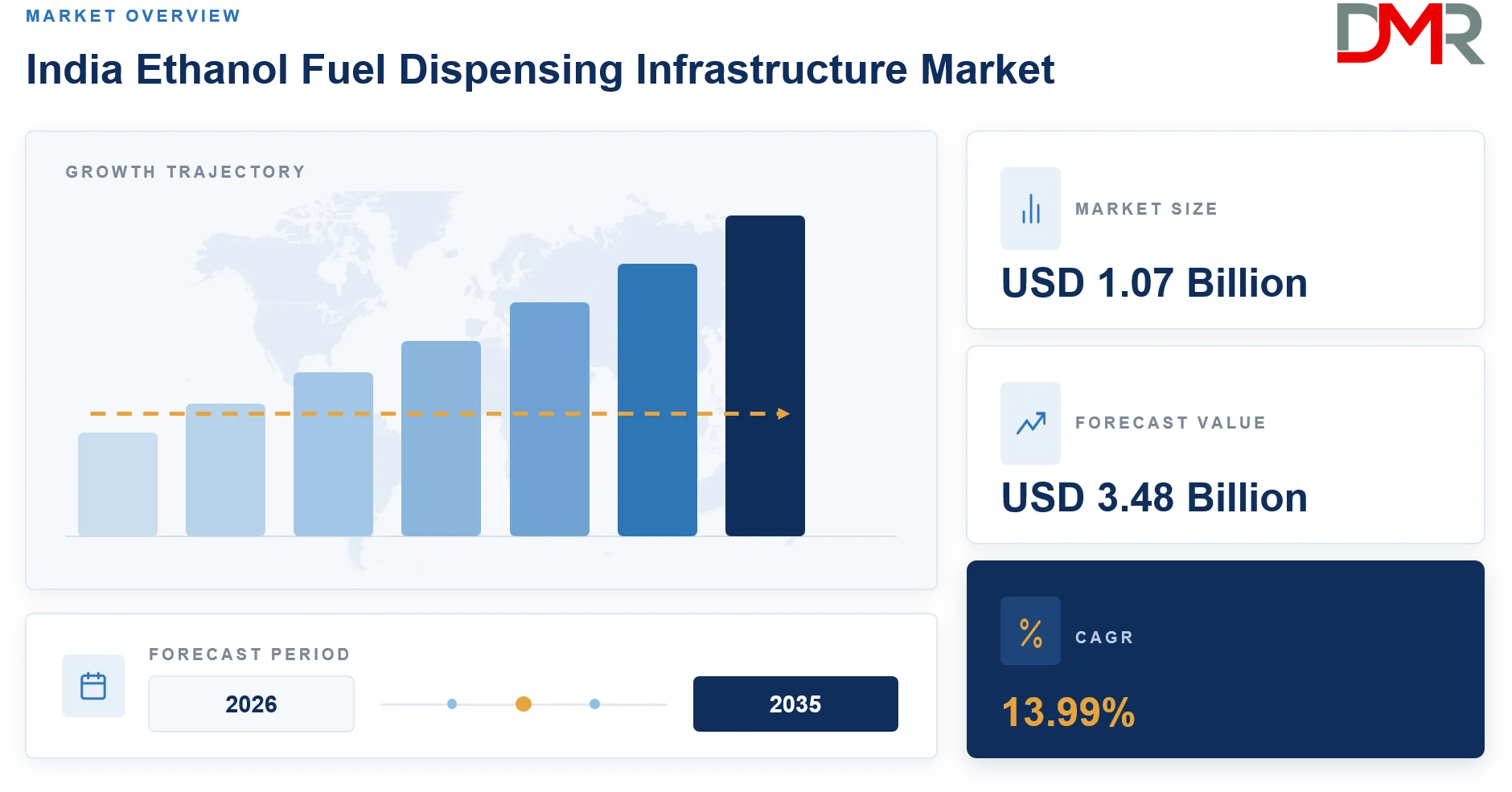
- Market Value: The India ethanol fuel dispensing infrastructure market size is valued at USD 1,071.42 million in 2026 and is expected to reach USD 3,489.76 million by 2035.
- CAGR: The India ethanol fuel dispensing infrastructure market is projected to grow at a CAGR of 13.99% from 2026 to 2035.
- By Infrastructure Segment Analysis: Fuel dispensing equipment dominated the market with a 28.6% share in 2026.
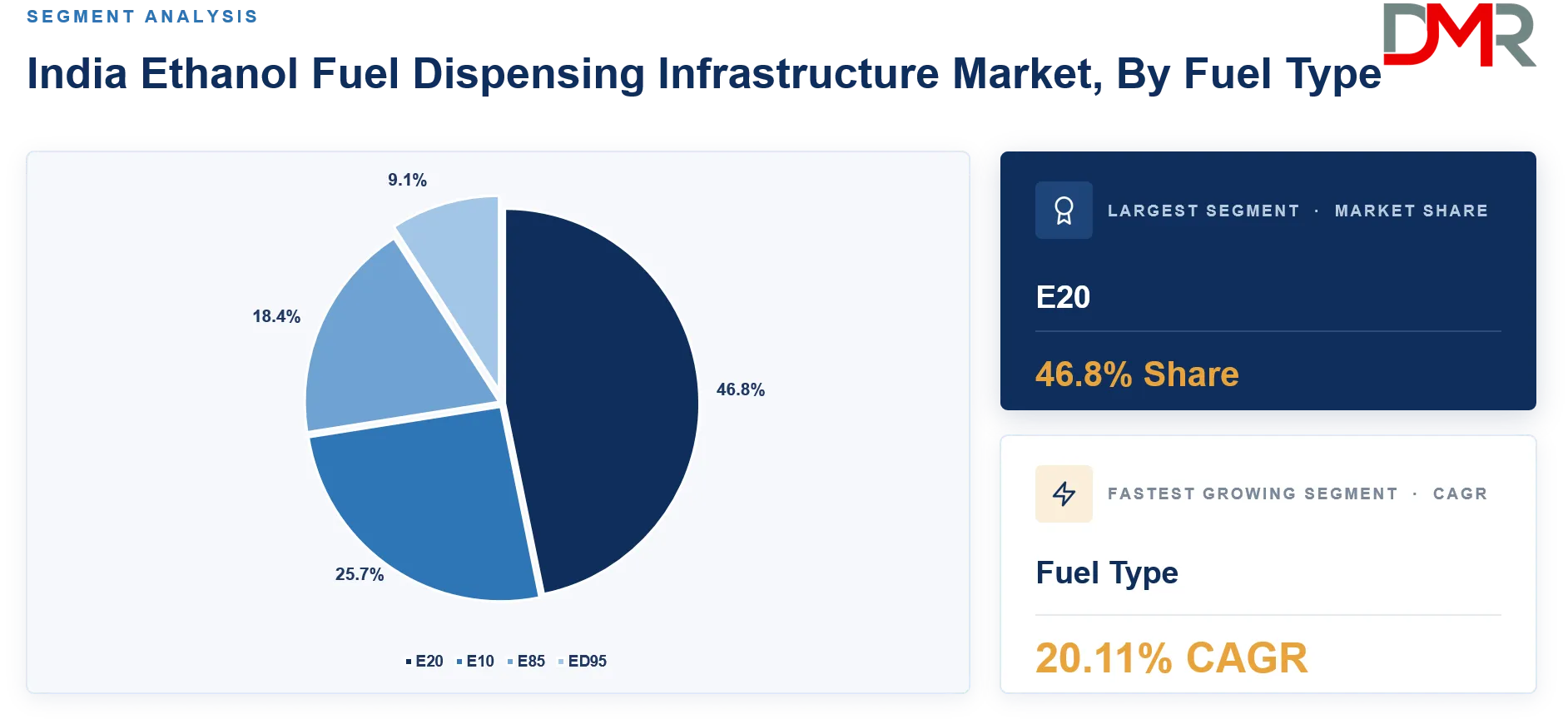
- By Fuel Type Segment Analysis: E20 led the fuel type segment with a 46.8% share in 2026.
- By Fuel Station Type Segment Analysis: Public retail fuel stations accounted for a 52.6% share in 2026.
- By Storage Capacity Segment Analysis: Medium-capacity storage facilities, ranging from 50 to 200 KL, led with a 38.2% share in 2026.
- Major Players: Praj Industries Limited, Bharat Petroleum Corporation Limited, Indian Oil Corporation Limited, and Others.
What is the India Ethanol Fuel Dispensing Infrastructure Market and its Market Size?
The India ethanol fuel dispensing infrastructure market size is projected to be valued at USD 1,071.42 million in 2026 and is expected to reach USD 3,489.76 million by 2035, expanding at a CAGR of 13.99% during the forecast period. The market covers the physical and digital systems required to store, transport, blend, monitor, manage, and dispense ethanol-blended automotive fuels. It includes E20 dispensers, ethanol-compatible multi-product dispensers, tanks, blending systems, road and rail logistics, fuel management platforms, SCADA systems, leak detection equipment, and associated installation and maintenance services.
ℹ
To learn more about this report –
Download Your Free Sample Report Here
India's transition toward higher ethanol blending is changing fuel-retailing requirements across public outlets, terminals, depots, private stations, and fleet facilities. Infrastructure investment is increasingly linked to material compatibility, accurate blending, water management, tank monitoring, calibration, and safe fuel handling. NITI Aayog's ethanol blending roadmap identified storage, handling, blending, transportation, and dispensing capacity as essential parts of nationwide ethanol adoption. India subsequently achieved approximately 20% ethanol blending by mid-2025, according to NITI Aayog's 2026 transport-sector assessment.
Use Cases
- E20 Retail Dispensing: Public fuel retailers use ethanol-compatible dispensers, seals, hoses, meters, tanks, and fuel-management systems to handle E20 petrol at high-volume retail sites. The application requires accurate metering and materials able to withstand prolonged ethanol exposure while allowing operators to use much of their existing forecourt infrastructure.
- Terminal and Depot Blending: Oil marketing companies use automated and inline blending systems at terminals and depots to achieve controlled ethanol-petrol ratios before distribution. Metering, flow control, storage tanks, loading racks, SCADA platforms, and quality-monitoring equipment form an integrated system that improves consistency across large fuel-distribution networks.
- Bulk Ethanol Storage: Intermediate storage facilities and terminals require above-ground or underground tanks designed for ethanol handling. Tank gauging, leak detection, inventory monitoring, moisture management, compatible piping, and safety equipment help protect product quality while supporting continuous supply to blending facilities and retail distribution points.
- Fleet Fueling: Logistics companies, commercial fleets, agricultural users, and industrial operators can deploy dedicated or private ethanol-compatible fueling stations where vehicle utilization supports centralized fuel procurement. Such facilities combine storage, dispensing, access control, transaction tracking, fleet-management software, and preventive maintenance infrastructure.
- Higher-Ethanol Fuel Deployment: Dedicated dispensers can support E85, ED95, or higher-ethanol mobility applications where vehicle compatibility and local fuel availability are established. IndianOil's earlier deployment of ETHANOL 100 at hundreds of selected stations demonstrates how targeted retail networks can be used to introduce higher-concentration ethanol fuels.
How AI/Gen AI is Transforming the India Ethanol Fuel Dispensing Infrastructure Market?
Artificial intelligence is becoming relevant to ethanol dispensing infrastructure through predictive maintenance, inventory forecasting, anomaly detection, and fuel-quality monitoring. Modern retail and terminal systems generate continuous data from tank gauges, dispenser meters, flow sensors, pumps, valves, leak detectors, and SCADA platforms. Analytical models can compare operating patterns across sites and identify unusual losses, declining pump performance, calibration drift, abnormal tank-level movements, or equipment conditions that require maintenance. For oil marketing companies managing large station networks, these capabilities can reduce unplanned downtime and improve maintenance scheduling.
Generative systems can also support technicians and managers by turning maintenance logs, inspection records, alarm histories, and equipment manuals into faster diagnostic guidance. At the network level, demand forecasting can help operators plan ethanol replenishment according to retail throughput, storage limits, seasonal consumption, and tanker availability. The strongest commercial opportunity is therefore connected to integrated hardware and software rather than standalone analytics. Vendors combining dispensers, gauges, automation, remote monitoring, cybersecurity, and service support can provide operators with better visibility across the full ethanol fuel distribution chain.
Key Drivers in the India Ethanol Fuel Dispensing Infrastructure Market
Expansion of E20 Fuel Availability
The nationwide move toward E20 is increasing the need for compatible storage, blending, transport, and dispensing assets. IndianOil reported that E20 availability had expanded to 12,000 outlets within a relatively short period following its introduction, illustrating the scale at which retail infrastructure can be upgraded. As higher ethanol blends become embedded in mainstream fuel distribution, oil marketing companies require compliant dispensers, seals, tanks, meters, monitoring systems, and dependable maintenance networks.
Investment by Oil Marketing Companies
Oil marketing companies control a large part of India's fuel distribution network, making their investment programs a central driver of ethanol infrastructure demand. Their requirements extend from terminal storage and automated blending to road tanker handling, retail dispensers, tank gauging, and leak detection. This explains why oil marketing companies held a 42.8% market share in 2026. Large networks also favor standardized hardware and centralized monitoring, creating recurring opportunities for equipment suppliers and service providers.
Restraints in the India Ethanol Fuel Dispensing Infrastructure Market
Compatibility and Retrofit Complexity
Ethanol can place different technical demands on seals, elastomers, storage systems, piping, pumps, and fuel-handling processes compared with conventional petrol. Operators therefore need to assess whether existing assets are suitable for higher ethanol blends or require replacement. Retrofitting thousands of active stations can involve site inspections, equipment certification, downtime, calibration, tank preparation, and technician training. These requirements can raise deployment costs, particularly for smaller private retailers.
Fuel Quality and Water Management Requirements
Ethanol is hygroscopic, which makes water control important across storage and distribution. Poor tank condition, water ingress, handling errors, or inadequate monitoring can affect fuel consistency and operational reliability. Infrastructure providers therefore need tighter tank gauging, contamination controls, inspection procedures, leak monitoring, and quality assurance. These additional requirements increase lifecycle costs and place greater responsibility on retailers, terminal operators, transport contractors, and maintenance teams.
Growth Opportunities in the India Ethanol Fuel Dispensing Infrastructure Market
Modernization of Existing Fuel Stations
India's established retail fuel network creates a large retrofit opportunity because ethanol expansion does not require every site to be built from the ground up. Existing stations can be upgraded with compatible dispensers, hoses, meters, seals, storage systems, tank monitoring, and fuel-management software. Suppliers able to offer assessment, installation, commissioning, calibration, and maintenance as a bundled service can address both capital expenditure and long-term operating requirements.
Digitized Storage and Fuel Management
Digital tank gauging, remote equipment monitoring, automated reconciliation, leak detection, and centralized fuel-management platforms represent a growing opportunity alongside physical infrastructure. Hardware already accounted for 61.9% of market revenue in 2026, creating a large installed base that can support additional software and service revenue. Connecting tanks, dispensers, pumps, and blending systems can help operators improve inventory accuracy, detect losses, plan replenishment, and standardize operations across multiple sites.
Trends in the India Ethanol Fuel Dispensing Infrastructure Market
Shift Toward Multi-product and Ethanol-compatible Dispensers
Fuel retailers are increasingly focused on equipment that can accommodate changing fuel specifications without requiring complete forecourt replacement. Multi-product dispensers and ethanol-compatible designs offer flexibility across E10, E20, and potentially higher blends where suitable. This trend favors modular meters, compatible elastomers, configurable electronics, and remote diagnostics. It also supports equipment strategies that extend asset life as India's fuel mix continues to evolve.
Integration of Monitoring and Automation
Fuel infrastructure is moving toward connected operations in which dispensing, storage, blending, and inventory systems exchange data. Automated blending units can improve ratio control, while SCADA systems, tank gauges, and fuel-management platforms provide centralized visibility. This is particularly relevant for oil marketing companies operating large terminal and retail networks. Integration also creates demand for software support, cybersecurity, equipment servicing, and analytics beyond the initial hardware installation.
Research Scope and Analysis
The India ethanol fuel dispensing infrastructure market is segmented based on infrastructure, fuel type, component, fuel station type, storage capacity, end user, and region. The study assesses the role of equipment deployment, ethanol compatibility, storage requirements, blending systems, logistics, retail modernization, automation, and digital monitoring in shaping market demand.
By Infrastructure
Fuel dispensing equipment led the infrastructure segment with a 28.6% share in 2026, equivalent to approximately USD 306.43 million based on the overall market value. The segment includes E20 dispensers, multi-product dispensers, ethanol-compatible fuel dispensers, ED95 dispensers, and E85 dispensers. Its leadership reflects the direct connection between ethanol adoption and forecourt readiness. Each retail expansion requires accurate metering, compatible wetted components, safe pumping, calibration, and ongoing maintenance, making dispensers one of the most visible capital requirements in the downstream ethanol ecosystem.
ℹ
To learn more about this report –
Download Your Free Sample Report Here
By Fuel Type
E20 dominated the fuel type segment with a 46.8% share in 2026, representing approximately USD 501.42 million of market activity. The segment benefits from India's national ethanol blending strategy and the integration of E20 into conventional petrol distribution. Unlike higher-concentration fuels that require a more specialized vehicle base, E20 is linked to mainstream passenger mobility and nationwide retail infrastructure. This creates demand across terminals, depots, tanker logistics, tanks, dispensers, fuel management systems, and station-level monitoring.
By Fuel Station Type
Public retail fuel stations accounted for a 52.6% share in 2026, equivalent to approximately USD 563.57 million. Their dominance comes from the scale of daily petrol distribution and the requirement to make ethanol-blended fuel accessible to mainstream motorists. Public stations need dispenser upgrades, storage compatibility, tank monitoring, signage, calibration, inventory systems, safety equipment, and technician support. Dedicated ethanol stations and fleet fueling sites serve more specialized applications, while private stations are relevant to industrial, institutional, and captive transport users.
By Storage Capacity
Medium-capacity storage facilities ranging from 50 to 200 KL led the market with a 38.2% share in 2026, representing approximately USD 409.28 million. This capacity range offers a practical balance between throughput, land availability, replenishment frequency, and capital cost for many fuel distribution sites. Demand spans tanks, gauges, level sensors, leak detection, compatible piping, pumps, vents, and inventory controls. Larger terminals require significantly higher storage volumes, while smaller installations serve lower-throughput retail or captive fueling applications.
The India Ethanol Fuel Dispensing Infrastructure Market Report is segmented on the basis of the following:
By Infrastructure
- Fuel Dispensing Equipment
- E20 Dispensers
- Multi-product Dispensers
- Ethanol-compatible Fuel Dispensers
- ED95 Dispensers
- E85 Dispensers
- Storage Infrastructure
- Intermediate Storage Facilities
- Ethanol Blending Tanks
- Above-ground Storage Tanks
- Underground Storage Tanks
- Transportation Infrastructure
- Pipeline Transportation
- Intermodal Logistics Systems
- Road Tankers
- Rail Tank Wagons
- Blending Infrastructure
- Automated Blending Units
- Inline Blending Systems
- Terminal Blending Systems
- Depot Blending Facilities
- Monitoring & Control Systems
- SCADA Systems
- Tank Gauging Systems
- Fuel Management Systems
- Leak Detection Systems
By Fuel Type
By Component
- Services
- Hardware
- Software
By Fuel Station Type
- Dedicated Ethanol Stations
- Fleet Fueling Stations
- Public Retail Fuel Stations
- Private Fuel Stations
By Storage Capacity
- Large Capacity (200-500 KL)
- Very Large Capacity (>500 KL)
- Small Capacity (<50 KL)
- Medium Capacity (50-200 KL)
By End User
- Industrial Users
- Agricultural Sector
- Oil Marketing Companies
- Private Fuel Retailers
- Transportation Fleets
Competitive Landscape
The India ethanol fuel dispensing infrastructure market features competition across multiple layers rather than a single equipment category. Oil marketing companies such as Indian Oil Corporation Limited, Bharat Petroleum Corporation Limited, Hindustan Petroleum Corporation Limited, Nayara Energy Limited, and Reliance BP Mobility Limited influence infrastructure demand through terminal, depot, logistics, and retail investments. Equipment specialists including Dover Fueling Solutions India, Gilbarco Veeder-Root India Pvt. Ltd., and Tatsuno India Pvt. Ltd. compete around dispenser technology, metering, forecourt systems, and fuel-management capabilities.
Schneider Electric India Pvt. Ltd. participates in industrial automation, electrical systems, and digital control, while Praj Industries Limited has deep exposure to India's broader ethanol value chain. Competitive advantage increasingly depends on ethanol-compatible hardware, nationwide servicing, integration with existing stations, reliable metering, automation, remote monitoring, and lifecycle support. As the market moves from initial E20 conversion toward optimization, suppliers with integrated equipment, software, engineering, installation, calibration, and maintenance capabilities are positioned to capture a larger portion of recurring infrastructure expenditure.
Some of the prominent players in the India ethanol fuel dispensing infrastructure industry are:
- Praj Industries Limited
- Schneider Electric India Pvt. Ltd.
- Nayara Energy Limited
- Dover Fueling Solutions India
- Bharat Petroleum Corporation Limited (BPCL)
- Gilbarco Veeder-Root India Pvt. Ltd.
- Reliance BP Mobility Limited
- Indian Oil Corporation Limited (IOC)
- Tatsuno India Pvt. Ltd.
- Hindustan Petroleum Corporation Limited (HPCL)
- Others
Regulatory Landscape
India's ethanol fuel dispensing infrastructure market is shaped by the Ethanol Blended Petrol Programme, fuel-quality standards, storage and handling rules, and safety requirements governing petroleum retail infrastructure. The national transition toward E20 has increased compliance requirements across ethanol storage tanks, blending terminals, transportation systems, pipelines, dispensers, seals, meters, and monitoring equipment. Oil marketing companies and private fuel retailers must ensure that infrastructure is compatible with ethanol-blended fuels and follows applicable safety, metrology, fire protection, and environmental requirements. BIS fuel specifications and Petroleum and Explosives Safety Organisation requirements influence equipment design, storage, dispensing, and site operations. The regulatory framework also creates demand for automated blending, accurate metering, tank gauging, leak detection, quality monitoring, and certified ethanol-compatible components. As India develops pathways for higher ethanol blends and flex-fuel vehicles, infrastructure providers that can meet evolving technical standards while supporting reliable upgrades across existing retail networks are positioned to gain market share.
Investment and White Space Analysis
Investment opportunities in India's ethanol fuel dispensing infrastructure market extend beyond conventional E20 dispensers as the fuel ecosystem requires coordinated spending across storage, blending, transportation, monitoring, and retail modernization. With the market projected to increase from USD 1,071.42 million in 2026 to USD 3,489.76 million by 2035, equipment manufacturers, automation companies, oil marketing companies, and engineering providers have opportunities to capture demand across the infrastructure lifecycle. A major white space exists in upgrading existing fuel stations with ethanol-compatible multi-product dispensers, tank gauging, leak detection, fuel management software, and remote monitoring rather than relying only on new station construction. Medium-capacity storage facilities of 50-200 KL, which held a 38.2% share in 2026, also provide an attractive investment area for regional distribution. Further opportunities exist in automated blending units, predictive maintenance, ethanol logistics, fleet fueling stations, and integrated hardware-software-service offerings for private retailers and transportation fleets.
Recent Developments
- June 2026: Indian Oil Corporation Limited Government directed IOC, BPCL, HPCL, Jio-bp, Nayara, Shell to build E20–E30 ethanol dispensing infrastructure at ~100,000 fuel stations nationwide, mandating separate tanks, blending controls, and clear pump labelling.
- June 2026: Bharat Petroleum Corporation Limited As part of national rollout, BPCL among OMCs tasked to deploy dedicated ethanol dispensing outlets; initial 50–100 stations in Delhi-NCR, Mumbai, Pune, Nagpur, scaling to 500 by end-2026 and 5,000 by 2027.
- June 2026: Hindustan Petroleum Corporation Limited HPCL directed alongside IOC and BPCL to establish multi-blend ethanol dispensing infrastructure, including E22, E25, E30, with mandatory distinct labelling and quality monitoring at retail outlets across India.
Report Details
| Report Characteristics |
| Market Size (2026) |
USD 1,071.42 Million |
| Forecast Value (2035) |
USD 3,489.76 Million |
| CAGR (2026–2035) |
13.99% |
| Historical Data |
2021 – 2025 |
| Forecast Data |
2027 – 2035 |
| Base Year |
2025 |
| Estimate Year |
2026 |
| Segments Covered |
By Infrastructure (Fuel Dispensing Equipment {E20 Dispensers, Multi-product Dispensers, Ethanol-compatible Fuel Dispensers, ED95 Dispensers, and E85 Dispensers}, Storage Infrastructure {Intermediate Storage Facilities, Ethanol Blending Tanks, Above-ground Storage Tanks, and Underground Storage Tanks}, Transportation Infrastructure {Pipeline Transportation, Intermodal Logistics Systems, Road Tankers, and Rail Tank Wagons}, Blending Infrastructure {Automated Blending Units, Inline Blending Systems, Terminal Blending Systems, and Depot Blending Facilities}, Monitoring & Control Systems {SCADA Systems, Tank Gauging Systems, Fuel Management Systems, and Leak Detection Systems}), By Fuel Type (E85, ED95, E10, and E20), By Component (Services, Hardware, and Software), By Fuel Station Type (Dedicated Ethanol Stations, Fleet Fueling Stations, Public Retail Fuel Stations, and Private Fuel Stations), By Storage Capacity (Large Capacity (200-500 KL), Very Large Capacity (>500 KL), Small Capacity (<50 KL), and Medium Capacity (50-200 KL)), and By End User (Industrial Users, Agricultural Sector, Oil Marketing Companies, Private Fuel Retailers, and Transportation Fleets) |
| Regional Coverage |
India |
Frequently Asked Questions
What is the current size of the India Ethanol Fuel Dispensing Infrastructure Market?
▾ The India ethanol fuel dispensing infrastructure market is valued at USD 1,071.42 million in 2026 and is forecast to reach USD 3,489.76 million by 2035.
What is the growth rate of the India Ethanol Fuel Dispensing Infrastructure Market during?
▾ The India ethanol fuel dispensing infrastructure market is expected to grow at a CAGR of 13.99% during the forecast period 2026-2035.
What factors are driving the growth of the India Ethanol Fuel Dispensing Infrastructure Market?
▾ E20 adoption, fuel station upgrades, ethanol blending targets, OMC investments, storage expansion, and dispensing equipment demand drive market growth.
What are the major challenges restraining the India Ethanol Fuel Dispensing Infrastructure Market?
▾ High retrofit costs, ethanol compatibility issues, water management, storage safety, equipment upgrades, and maintenance restrain market expansion.
Which segment holds the largest share of the India Ethanol Fuel Dispensing Infrastructure Market?
▾ Fuel dispensing equipment leads the India ethanol fuel dispensing infrastructure market's infrastructure segment with a 28.6% share in 2026.
Who are the leading companies in the India Ethanol Fuel Dispensing Infrastructure Market?
▾ Praj Industries Limited, Schneider Electric India Pvt. Ltd., Nayara Energy Limited, Dover Fueling Solutions India, Bharat Petroleum Corporation Limited (BPCL), Gilbarco Veeder-Root India Pvt. Ltd., Reliance BP Mobility Limited, Indian Oil Corporation Limited (IOC), Tatsuno India Pvt. Ltd., and Hindustan Petroleum Corporation Limited (HPCL) are leading companies in the India ethanol fuel dispensing infrastructure market.
How is AI influencing the India Ethanol Fuel Dispensing Infrastructure Market?
▾ AI supports the India ethanol fuel dispensing infrastructure market through predictive maintenance, demand forecasting, leak detection, and inventory optimization.
What are the future opportunities and trends in the India Ethanol Fuel Dispensing Infrastructure Market?
▾ E20 station upgrades, automated blending, smart tank monitoring, multi-product dispensers, digital fuel management, and fleet fueling offer future opportunities.