India Fuel Ethanol Market Snapshot
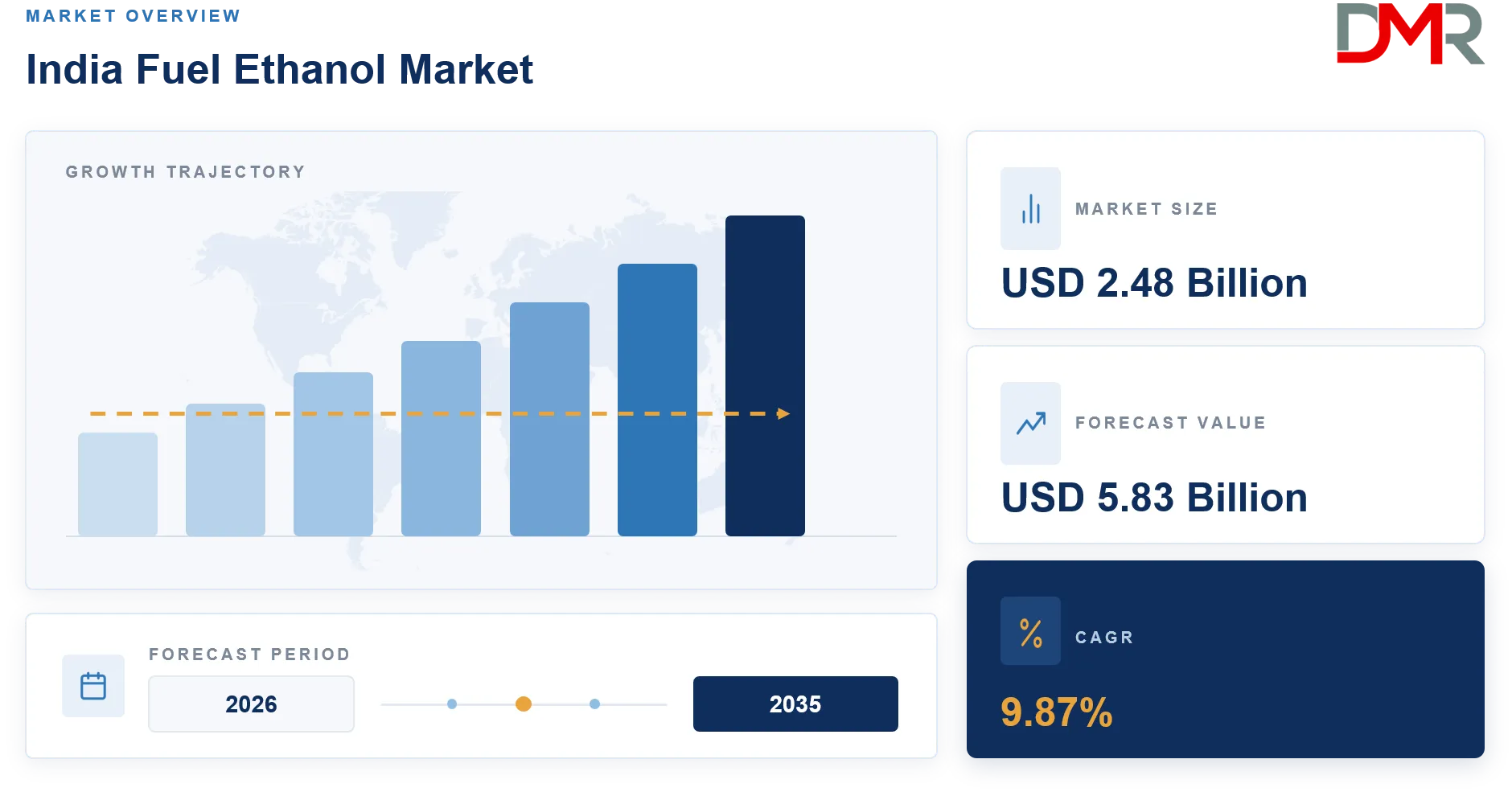
- Market Value: India fuel ethanol market is projected to reach USD 5.83 billion by 2035 from USD 2.48 billion in 2026.
- CAGR: India fuel ethanol market is expected to grow at a CAGR of 9.87% from 2026 to 2035.
- By Blend Type Segment Analysis: E11-E25 led the blend type segment with a 64% share in 2026.
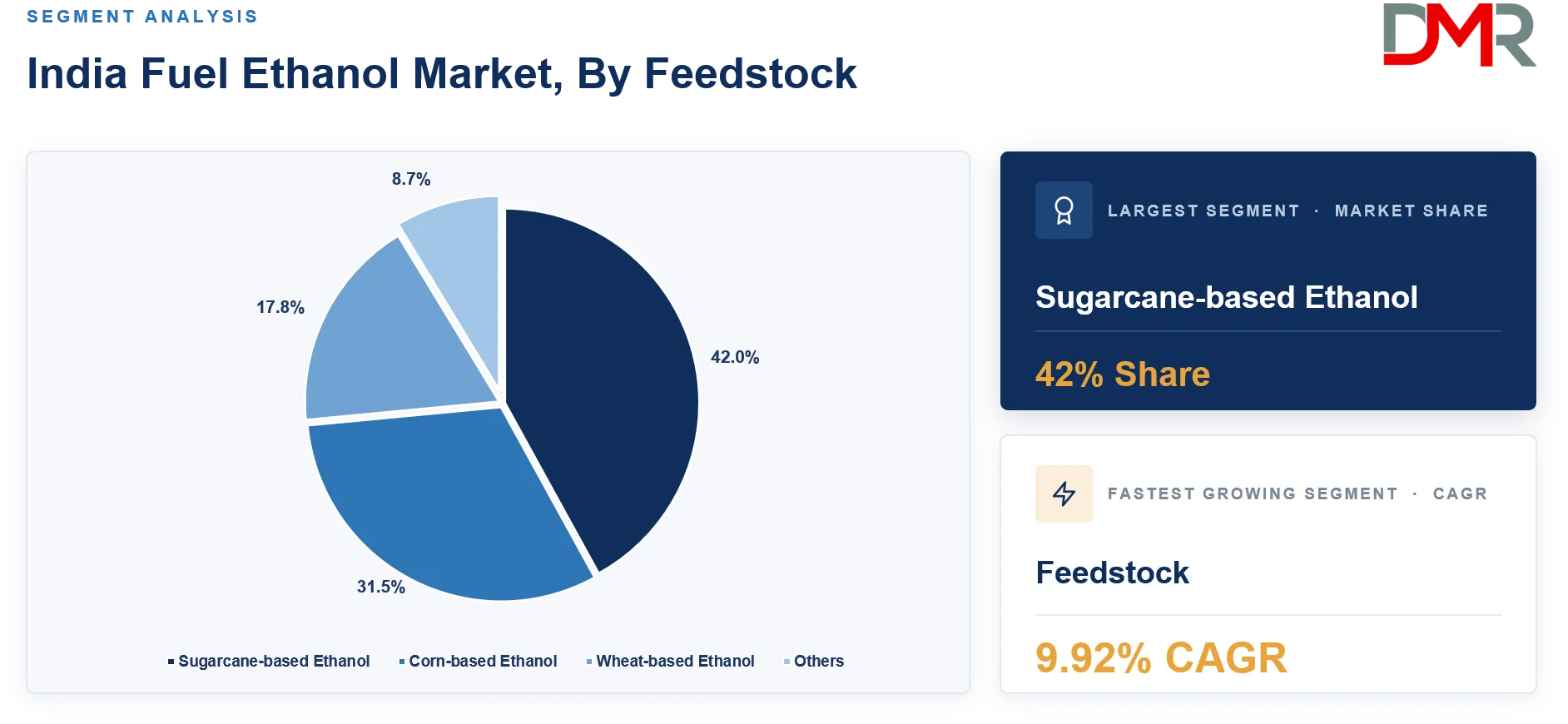
- By Feedstock Segment Analysis: Sugarcane-based ethanol led the feedstock segment with a 42% share in 2026.
- By End User Segment Analysis: Passenger vehicles accounted for a 71% share in 2026.
- Major Players: Uttam Sugar Mills Ltd., Dalmia Bharat Sugar and Industries Ltd., Balrampur Chini Mills Ltd., and Others.
What is the India Fuel Ethanol Market and its Market Size?
The India Fuel Ethanol Market size is projected to be valued at USD 2.48 billion in 2026 and is projected to reach USD 5.83 billion by 2035, expanding at a CAGR of 9.87% during the forecast period. Fuel ethanol is an oxygenated renewable fuel produced primarily from sugarcane-derived materials and grain feedstocks and blended with petrol for road transport. India's market has moved from a limited blending activity into a large, policy-supported fuel supply chain involving distilleries, sugar producers, grain processors, public sector oil marketing companies, logistics operators, fuel retailers, and vehicle manufacturers.
ℹ
To learn more about this report –
Download Your Free Sample Report Here
The commercial environment changed significantly after India reached 20% ethanol blending in 2025-26. Petroleum Planning & Analysis Cell data reported a 20% blending level during June 2026, while the Government of India reported that national ethanol production capacity had expanded from 421 crore litres in 2014 to about 2,000 crore litres in 2026. Ethanol procurement, meanwhile, was projected to exceed 1,200 crore litres in Ethanol Supply Year 2025-26. These figures indicate that the India fuel ethanol market is entering a new phase in which capacity utilization, feedstock economics, higher-blend fuels, flex-fuel adoption, and non-petrol applications are becoming increasingly important to future growth.
Use Cases
- Petrol Blending: Fuel ethanol is blended with motor spirit under India's Ethanol Blended Petrol Programme. E20 has become the central commercial blend, creating recurring procurement requirements for oil marketing companies and supporting demand from integrated sugar mills, grain distilleries, and dedicated ethanol plants.
- Passenger Mobility: Passenger cars and two-wheelers represent a major consumption channel because petrol demand is concentrated in personal mobility. Vehicle compatibility with E20 and future flex-fuel platforms can influence ethanol consumption per vehicle and determine the potential market for blends above E20.
- Commercial Mobility: Petrol-powered commercial vehicles, taxis, fleet vehicles, and light mobility applications provide an additional demand base. Fleet operators increasingly evaluate fuel economy, vehicle compatibility, maintenance requirements, fuel availability, and total operating costs when assessing ethanol-blended petrol.
- Flex-Fuel Vehicles: Higher ethanol blends can support vehicles engineered to operate across a wider ethanol-petrol range. India launched its first flex-fuel passenger vehicle initiative in 2026, creating a potential demand channel beyond the established E20 market as suitable vehicles and dispensing infrastructure expand.
- Energy Import Substitution: Domestic ethanol substitutes part of the petrol pool that would otherwise depend more heavily on crude-derived fuel. This use case links ethanol demand directly with India's energy-security strategy, agricultural value chains, foreign-exchange management, and efforts to diversify transport fuels.
How AI/Gen AI is Transforming the India Fuel Ethanol Market?
Digital intelligence is increasingly relevant across ethanol production, procurement, and plant operations. Distilleries can use machine-learning models with fermentation, temperature, pH, feedstock quality, steam consumption, and yield data to identify process deviations and improve operational control. Predictive maintenance can also help operators monitor boilers, centrifuges, molecular sieves, pumps, fermentation equipment, and other assets that affect uptime. For multi-feedstock plants, advanced analytics can support procurement decisions by comparing sugarcane derivatives, maize, rice, and other permitted raw materials against conversion yield, transport distance, inventory, and ethanol realization.
Generative AI is also creating new decision-support applications for commercial teams. Producers can use enterprise systems to summarize procurement contracts, compare tender conditions, review regulatory documents, monitor feedstock information, and prepare management-level scenarios. Oil marketing companies and logistics operators can combine forecasting systems with depot demand, storage availability, tanker movements, and blending requirements to improve ethanol allocation. The greatest value is likely to come from integrating AI tools with verified plant and supply-chain data rather than using general-purpose models independently. As India's ethanol availability rises, more accurate demand forecasting and capacity planning can become strategically important for protecting margins and improving asset utilization.
Key Drivers in the India Fuel Ethanol Market
E20 Blending Creates a Large Structural Demand Base
India's achievement of 20% ethanol blending has converted ethanol from a supplementary petrol component into a material part of the national motor-fuel pool. The government reported that blending increased from less than 1.5% in 2013-14 to 20% in 2025-26, while annual ethanol availability approached 1,200 crore litres. This creates recurring demand from Indian Oil Corporation, Bharat Petroleum Corporation, Hindustan Petroleum Corporation, and other fuel suppliers while giving producers greater visibility into the scale of the addressable fuel ethanol market.
Expansion of Domestic Production Capacity Supports Market Scale
Capital investment in molasses and grain distilleries has materially expanded India's ability to supply fuel ethanol. National production capacity reached about 2,000 crore litres in 2026, nearly five times the 421 crore litres available in 2014. Policy measures have also supported multi-feedstock conversion, long-term offtake arrangements, lower GST for ethanol supplied under the EBP Programme, and interest-subvention schemes. This infrastructure allows the industry to respond more flexibly to feedstock availability while building a larger domestic ethanol supply chain.
Restraints in the India Fuel Ethanol Market
Supply Capacity Is Growing Faster Than Current Blending Demand
The industry's rapid capacity expansion creates an emerging utilization challenge now that E20 has been achieved. Production capacity of about 2,000 crore litres in 2026 is considerably larger than the volume currently required for petrol blending alone. Producers therefore face greater exposure to plant utilization, feedstock spreads, procurement allocations, and offtake visibility. The next stage of market expansion depends increasingly on higher blends, flex-fuel vehicles, industrial uses, exports where commercially feasible, and other demand channels capable of absorbing incremental ethanol output.
Feedstock Competition Can Pressure Production Economics
Fuel ethanol competes with food, feed, sugar, starch, and other industries for agricultural raw materials. India's growing use of maize for ethanol has already increased competition between distilleries and established maize consumers. Government policy therefore encourages a broader feedstock portfolio, including sugarcane derivatives, maize, damaged foodgrains, and surplus FCI rice when permitted. Feedstock flexibility reduces dependence on a single crop, yet variable crop output, agricultural prices, transport costs, and government allocation decisions can still affect distillery margins and operating rates.
Growth Opportunities in the India Fuel Ethanol Market
Higher Blends and Flex-Fuel Vehicles Can Unlock New Demand
With E20 established, higher ethanol blends represent one of the clearest routes to expanding domestic fuel demand. Flex-fuel vehicles can operate with substantially higher ethanol concentrations and could therefore raise ethanol consumption without relying only on growth in petrol volumes. India's emerging flex-fuel vehicle initiatives and proposed expansion of ethanol dispensing infrastructure create opportunities for automakers, fuel retailers, component manufacturers, ethanol producers, and storage companies. Commercial adoption will depend on vehicle availability, consumer economics, fuel distribution, and regulatory direction.
Multi-Feedstock Plants Offer Better Capacity Utilization
Conversion of single-feedstock distilleries into multi-feedstock facilities can allow producers to respond to seasonal crop availability and changing government procurement conditions. In March 2025, the government notified a dedicated interest-subvention scheme to help cooperative sugar mills convert sugarcane-based distilleries into multi-feedstock plants. This approach can improve operating flexibility by allowing facilities to process suitable grains when sugar-derived inputs are constrained, helping producers protect utilization and reducing concentration risk in the national ethanol supply chain.
Trends in the India Fuel Ethanol Market
Feedstock Mix Is Becoming More Diversified
India's ethanol supply structure is moving beyond its traditional dependence on sugar-based materials. Government data for ESY 2025-26 showed maize accounting for 35.96% of ethanol production and surplus FCI rice accounting for 24.64%, illustrating how producers can shift feedstocks when availability and policy permit. The government's procurement framework also differentiates prices by raw material, with maize-based ethanol priced at about INR 71.86 per litre and sugarcane juice or syrup-based ethanol at INR 65.61 per litre for ESY 2025-26.
Industry Focus Is Moving From Capacity Creation to Demand Creation
The strategic question for the India fuel ethanol industry is changing. Earlier investment focused on producing enough ethanol to achieve E20. With production capacity reaching about 2,000 crore litres and the 20% blending target already achieved, producers increasingly need additional consumption channels. Higher-blend petrol, flex-fuel vehicles, improved ethanol dispensing networks, sustainable aviation fuel pathways, chemical applications, and other biofuel uses can influence future capacity utilization. This change is likely to reshape investment decisions, partnerships, and competitive positioning through 2035.
Research Scope and Analysis
The India Fuel Ethanol Market is segmented based on blend type, feedstock, end user, and other relevant commercial factors. The study evaluates market size, share, growth, demand patterns, production conditions, supply-chain developments, government policy, competitive positioning, feedstock economics, and emerging applications influencing the market through 2035.
By Blend Type
E11-E25 accounted for 64% of the India fuel ethanol market in 2026, making it the leading blend category. Its position is closely associated with national E20 implementation, which places 20% ethanol within the country's mainstream petrol supply. India recorded 20% blending during June 2026 and cumulatively from November 2025 through June 2026, indicating that E20 has progressed beyond trial-scale distribution. E10 and lower blends retain relevance for legacy applications and historical vehicle compatibility, while E26-E84 and E85 and above remain emerging categories dependent on flex-fuel vehicles and dedicated dispensing infrastructure. Over the forecast period, the higher-blend categories offer incremental growth potential if vehicle technology, fuel availability, consumer acceptance, and policy support develop together.
ℹ
To learn more about this report –
Download Your Free Sample Report Here
By Feedstock
Sugarcane-based ethanol held 42% of the market in 2026 and remained the leading feedstock category in this study. India's established sugar industry gives integrated mills access to cane juice, syrup, B-heavy molasses, and C-heavy molasses, allowing ethanol to become an important revenue diversification route alongside sugar and power. The segment also benefits from existing distillery infrastructure and established relationships with public sector oil marketing companies. At the same time, grain-based ethanol is becoming a significant competitive source of supply. Maize, surplus rice, and other approved grains allow producers to diversify raw-material exposure. Future feedstock shares are therefore expected to respond to crop conditions, sugar availability, government allocations, procurement pricing, transportation costs, and multi-feedstock capacity.
By End User
Passenger vehicles held 71% of the India fuel ethanol market in 2026. The segment's dominance reflects the scale of petrol consumption associated with personal transport, including passenger cars and other gasoline-powered mobility. E20 distribution directly connects ethanol demand with the passenger vehicle fleet because each litre of E20 contains a materially larger ethanol component than earlier E5 or E10 fuels. Commercial vehicles form a smaller but strategically relevant market, particularly among petrol-powered fleet and light-commercial applications. Future passenger-vehicle demand will be influenced by total petrol consumption, EV adoption, vehicle efficiency, E20 compatibility, flex-fuel model availability, consumer acceptance, and any policy move toward blends beyond 20%.
The India Fuel Ethanol Market Report is segmented on the basis of the following:
By Blend Type
- E10 & Below
- E11-E25
- E26-E84
- E85 & Above
By Feedstock
- Sugarcane-based Ethanol
- Corn-based Ethanol
- Wheat-based Ethanol
- Others
By End User
- Passenger Vehicles
- Commercial Vehicles
- Others
Competitive Landscape
The India fuel ethanol market has a diversified competitive structure spanning integrated sugar companies, dedicated distilleries, grain-based producers, and diversified bioenergy businesses. Established sugar producers can integrate cane procurement, sugar processing, molasses recovery, cogeneration, and ethanol manufacturing, which provides operational synergies and multiple revenue streams. Balrampur Chini Mills, Triveni Engineering & Industries, Dalmia Bharat Sugar and Industries, Shree Renuka Sugars, Bajaj Hindusthan Sugar, E.I.D. Parry, Uttam Sugar Mills, Avadh Sugar & Energy, Dhampur Bio Organics, and Godavari Biorefineries are among the companies participating in this ecosystem.
Competition is increasingly moving beyond installed litres of distillation capacity. Feedstock flexibility, ethanol yield, energy efficiency, plant utilization, procurement contracts, storage access, location relative to raw-material catchments, and logistics to OMC depots are becoming more important. As national capacity rises above immediate E20 requirements, producers with flexible plants and diversified revenue streams may be better positioned to manage changes in procurement volumes and feedstock availability. Opportunities in higher ethanol blends, flex-fuel mobility, advanced biofuels, and value-added biochemicals can further influence competitive strategies through 2035.
Some of the prominent players in the India Fuel Ethanol Industry are:
- Uttam Sugar Mills Ltd.
- Dalmia Bharat Sugar and Industries Ltd.
- Balrampur Chini Mills Ltd.
- Godavari Biorefineries Ltd.
- Avadh Sugar & Energy Ltd.
- Triveni Engineering & Industries Ltd.
- Bajaj Hindusthan Sugar Ltd.
- E.I.D. Parry (India) Ltd.
- Dhampur Bio Organics Ltd.
- Shree Renuka Sugars Ltd.
- Others
Regulatory Landscape
India's fuel ethanol regulatory landscape is primarily shaped by the Ethanol Blended Petrol Programme, administered through coordinated action by the Ministry of Petroleum and Natural Gas, Department of Food & Public Distribution, public sector oil marketing companies, and other government agencies. The policy framework accelerated the transition from E10 to E20 and supports ethanol production from sugarcane juice, sugar syrup, molasses, maize, damaged foodgrains, and other permitted feedstocks. Feedstock-specific procurement pricing, long-term ethanol offtake arrangements, interest-subvention schemes for distillery expansion, and a 5% GST rate on ethanol supplied for petrol blending have supported capacity creation.
The regulatory focus is now evolving beyond achievement of E20 toward feedstock security, multi-feedstock production, flex-fuel mobility, higher ethanol blends, storage and transportation infrastructure, and efficient utilization of installed capacity. Vehicle compatibility standards and future blending policy will therefore have a direct influence on India fuel ethanol market growth, investment planning, and demand through 2035.
Investment and White Space Analysis
Investment opportunities in the India fuel ethanol market are shifting from basic capacity expansion toward projects that improve utilization, feedstock flexibility, logistics, and access to new demand channels. With national ethanol production capacity reaching about 2,000 crore litres in 2026 and E20 already established, simply adding conventional distillation capacity may offer less differentiation than in the earlier expansion phase. White-space opportunities are emerging in multi-feedstock distilleries capable of switching between sugar-derived materials and grains, ethanol storage terminals, rail and pipeline-linked logistics, energy-efficient dehydration systems, fermentation optimization, and integrated biorefineries that monetize co-products.
Higher ethanol blends and flex-fuel vehicles could create another investment layer if supporting vehicle fleets and retail infrastructure scale commercially. Investors can also assess second-generation ethanol, sustainable aviation fuel pathways, biochemicals, and other value-added applications that could absorb incremental ethanol supply. Projects combining secure feedstock access, low conversion costs, strong logistics, and diversified offtake are positioned to capture a larger share of India fuel ethanol market growth.
Recent Developments
- July 2026: Godavari Biorefineries Ltd. Commissioned a 200 KLPD grain-based distillery at Sameerwadi, Karnataka, investing ₹130 crore to raise total ethanol capacity to 800 KLPD and enable dual-feedstock production.
- July 2026: Dhampur Bio Organics Ltd. Commissioned new distillery capacity at Asmoli and secured 74% control of Dbion Private Limited to support ethanol recovery efficiency and meet rising demand under India's blending programme.
- May 2026: E.I.D. Parry (India) Ltd. Announced an additional ₹120 crore investment to expand its grain-based ethanol facility in South India, diversifying feedstock and de-risking from sugarcane availability constraints.
Report Details
| Report Characteristics |
| Market Size (2026) |
USD 2.48 Bn |
| Forecast Value (2035) |
USD 5.83 Bn |
| CAGR (2026–2035) |
9.87% |
| Historical Data |
2021 – 2025 |
| Forecast Data |
2027 – 2035 |
| Base Year |
2025 |
| Estimate Year |
2026 |
| Segments Covered |
By Blend Type (E10 & Below, E11–E25, E26–E84, and E85 & Above), By Feedstock (Sugarcane-based Ethanol, Corn-based Ethanol, Wheat-based Ethanol, and Others), By End User (Passenger Vehicles, Commercial Vehicles, and Others) |
| Regional Coverage |
India |
Frequently Asked Questions
What is the current size of the India Fuel Ethanol Market?
▾ The India Fuel Ethanol Market is valued at USD 2.48 billion in 2026 and forecast to reach USD 5.83 billion by 2035.
What is the growth rate of the India Fuel Ethanol Market during?
▾ The India Fuel Ethanol Market is expected to grow at a CAGR of 9.87% during the forecast period from 2026 to 2035.
What factors are driving the growth of the India Fuel Ethanol Market?
▾ E20 adoption, ethanol capacity expansion, energy security goals, and feedstock diversification drive market growth.
What are the major challenges restraining the India Fuel Ethanol Market?
▾ Feedstock price volatility, competing food and feed demand, and capacity utilization risks restrain market growth.
Which segment holds the largest share of the India Fuel Ethanol Market?
▾ The E11-E25 blend segment holds the largest India Fuel Ethanol Market share, accounting for 64% of the market in 2026.
Who are the leading companies in the global India Fuel Ethanol Market?
▾ Uttam Sugar Mills Ltd., Dalmia Bharat Sugar and Industries Ltd., Balrampur Chini Mills Ltd., Godavari Biorefineries Ltd., Avadh Sugar & Energy Ltd., Triveni Engineering & Industries Ltd., Bajaj Hindusthan Sugar Ltd., E.I.D. Parry (India) Ltd., Dhampur Bio Organics Ltd., and Shree Renuka Sugars Ltd. are leading companies in the India Fuel Ethanol Market.
How is AI influencing the India Fuel Ethanol Market?
▾ AI supports the India Fuel Ethanol Market through process optimization, predictive maintenance, and demand forecasting.
What are the future opportunities and trends in the India Fuel Ethanol Market?
▾ Flex-fuel vehicles, higher blends, multi-feedstock plants, and biorefineries offer India Fuel Ethanol Market growth.