Market Snapshot
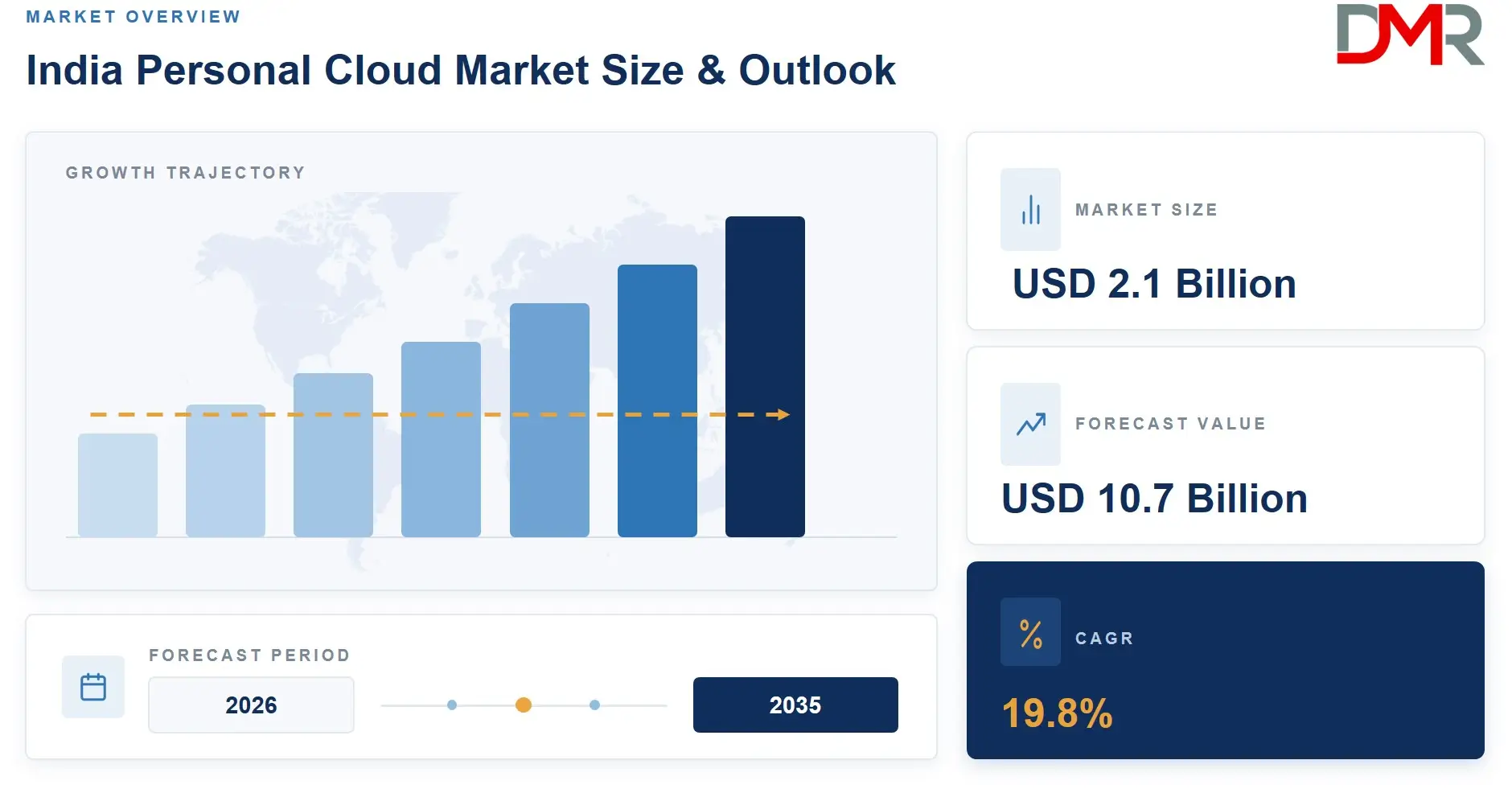
- Market Size (2026): USD 2.1 Bn
- Forecast Value (2035): USD 10.7 Bn
- CAGR (2026-2035): 19.8%
- Leading Offering (2026): Cloud Storage & File Hosting, around 46%
- Leading Deployment Mode (2026): Public Cloud, close to 61%
- Key Players: Reliance Jio, Google, Microsoft, and others
What is India Personal Cloud Market and its Market Size?
The India Personal Cloud Market size is estimated to reach USD 2.1 Bn in 2026 and is further anticipated to reach USD 10.7 Bn by 2035, at a CAGR of 19.8%. The figures track consumer and prosumer demand generated inside India: storage, backup and syncing services bought and used by individuals and households resident in the country, not the worldwide revenue booked by companies headquartered there.
ℹ
To learn more about this report –
Download Your Free Sample Report Here
Personal cloud covers the subscription storage, automated backup, photo and video management, and personal network attached storage products that let an individual keep files, media and device data accessible across phones, laptops and tablets without maintaining physical media. In India the category spans consumer storage tiers such as Google One and iCloud, telecom bundled storage from Reliance Jio and Bharti Airtel, device maker services tied to Xiaomi, Samsung and Vivo handsets, and a fast growing set of domestic backup and NAS vendors serving price sensitive households. The boundary excludes enterprise file sync and share, scoped separately under business collaboration software, and excludes cloud infrastructure sold to developers.
Demand concentrates among smartphone first consumers who generate large photo and video libraries and have limited on device storage, students and young professionals managing coursework and portfolios across devices, and small households sharing a single storage pool across family members. Purchase decisions in India are unusually price led: free tiers and telecom bundled storage set the reference point, and paid conversion depends on running out of free capacity rather than on feature comparison, a pattern distinct from more mature Personal Cloud markets where privacy and collaboration features drive upgrades.
What is structurally changing is distribution. Telecom operators and device makers are absorbing storage into broader subscription bundles rather than selling it as a standalone product, and AI features such as automated photo search and document summarisation are becoming the differentiator that persuades a free tier user to upgrade. At the same time, India's data localisation rules are pushing providers to expand in country storage capacity, which is reshaping the cost base every vendor in this market now builds its pricing around.
Use Cases
- Budget Smartphone Backup: First time smartphone buyers in tier 2 and tier 3 towns rely on free or low cost storage tiers to back up photos and contacts once onboard storage fills, since replacing a handset with more memory is rarely within reach, which keeps churn low once a family adopts one provider across every device.
- Student Portfolio Management: Engineering and design students consolidate coursework, project files and application portfolios in a single personal cloud account so the same material stays reachable from a hostel laptop, a shared computer lab machine and a phone, reducing the risk of losing final year project work to a damaged device.
- Multi Generation Family Sharing: Urban households on a single telecom plan pool one storage subscription across parents and children, using shared albums and automatic camera uploads to keep family photos and school documents organised without every member paying for a separate account.
- Small Business Document Continuity: Sole proprietors and neighbourhood retailers who cannot justify enterprise software use personal cloud storage to keep invoices, inventory photos and supplier records synced between a shop computer and a phone, treating close to 20% of their working storage as informal business backup rather than personal media.
Key Takeaways
- Market Size & Share: The market is set to grow from USD 2.1 Bn in 2026 to USD 10.7 Bn by 2035.
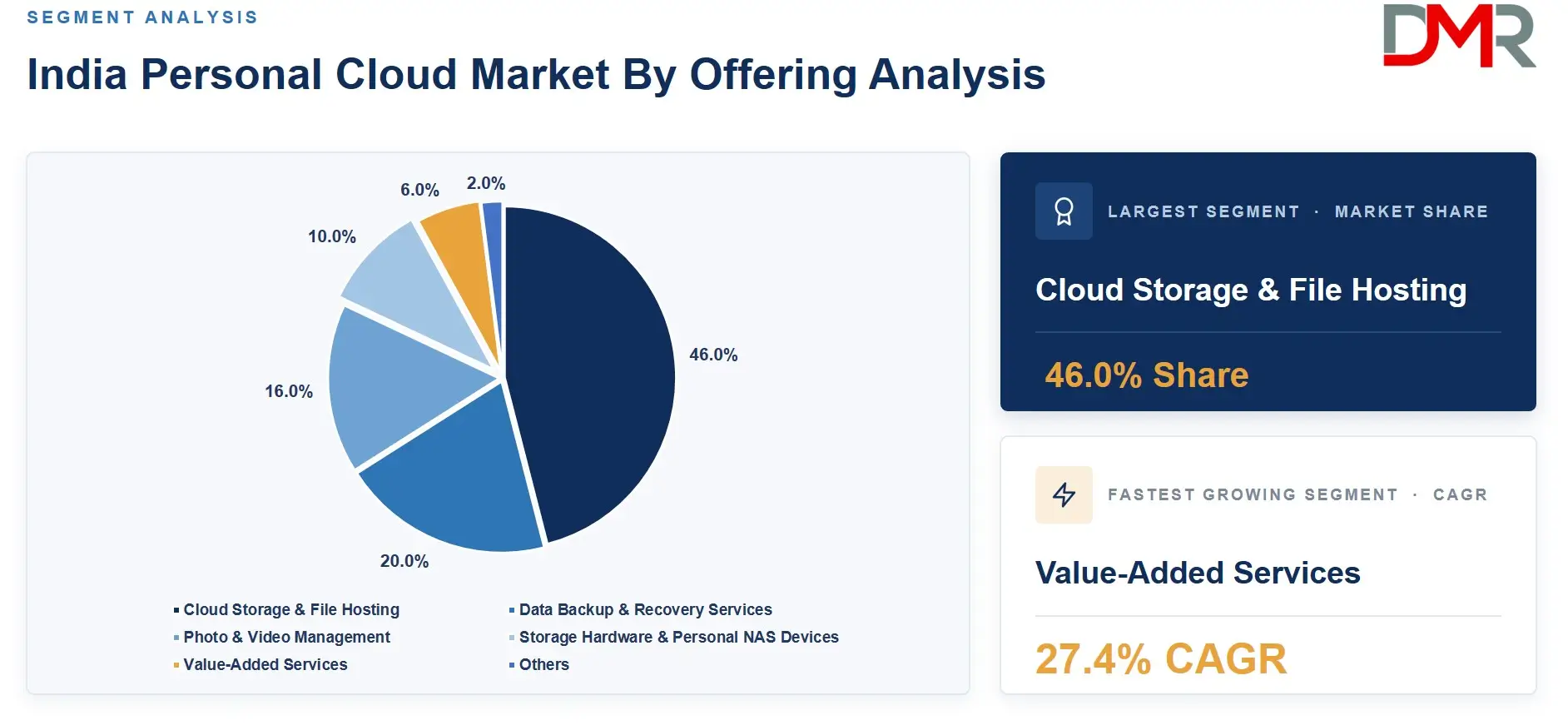
- Offering Analysis: Cloud Storage & File Hosting is expected to hold approximately 46% share in 2026, while Value Added Services grows fastest at a 27.4% CAGR.
- Demand Concentration: Metro and tier 1 city smartphone users account for the bulk of paid conversions, with tier 2 and tier 3 towns driving free tier volume growth.
- Bundled Distribution: Reliance Jio's telecom bundle, which pairs an 18 month AI subscription with 2TB of storage, is reshaping how consumers first encounter paid personal cloud tiers.
- Data Localisation Pressure: Domestic operators have committed upward of USD 2.0 Bn to expand in country storage capacity, adding to the cost base behind every subscription tier.
How AI/Gen AI is Transforming the India Personal Cloud Market?
Artificial intelligence is changing personal cloud in India primarily through automated organisation rather than headline generative features. With most Indian users storing thousands of photos and short videos on limited device memory, computer vision based search and duplicate detection have become the feature that most reliably converts a free tier user into a paying one, since it makes a large, disorganised photo library usable again without manual sorting.
Generative AI is layering on top of this operational base. Bundled offers such as Reliance Jio's Gemini partnership put document summarisation, image generation and large language model assisted search directly inside the storage app, encouraging users to treat their personal cloud account as a workspace rather than a passive backup. Providers with in country data infrastructure are better placed to offer these AI features at low latency and within data localisation requirements, which is turning AI capability into a genuine competitive differentiator rather than a marketing label.
- Computer Vision Photo Search: Automatic tagging of faces, places and objects lets users find a specific photo among thousands without folders.
- Duplicate and Clutter Detection: Algorithms flag near duplicate images and blurry shots, freeing paid storage that would otherwise sit unused.
- LLM Document Summarisation: Bundled AI assistants summarise scanned documents and PDFs stored in the account, useful for students and small business owners.
- Smart Backup Prioritisation: On device models decide which files need immediate cloud backup versus local only storage, reducing data usage on metered mobile plans.
Key Drivers in the India Personal Cloud Market
Two forces are pulling Indian consumers into paid personal cloud tiers faster than device storage alone would explain.
- Smartphone Led Media Growth Outpacing On Device Storage: Camera resolutions and video capture length on mass market Indian smartphones have grown faster than the base storage tiers manufacturers ship at budget and mid range price points, so users routinely hit device capacity within a year of purchase. Because replacing a device purely for storage is not economical for most households, the cheapest fix is a paid or bundled cloud tier, which is why free tier exhaustion, not feature marketing, remains the leading trigger for a first paid subscription across the country.
- Telecom Bundling Normalising Paid Storage: Reliance Jio and Bharti Airtel have both moved storage and AI tools into their core subscription plans rather than selling them separately, which means tens of millions of users now receive paid grade storage as a plan feature. This bundling lowers the psychological barrier to paid storage and is pulling first time payers into the market who would never have proactively purchased a stand alone subscription.
Restraints in the India Personal Cloud Market
Two brakes keep the market from converting free users into payers as quickly as its user base would suggest.
- Extreme Price Sensitivity Depressing Average Revenue: Indian consumers benchmark personal cloud pricing against free tiers and telecom bundles, which forces providers into aggressive entry pricing that keeps average revenue per paying user well below levels seen in developed Personal Cloud markets. Providers that price closer to international benchmarks see conversion stall, which limits how much of the market's unit growth can translate into revenue growth over the forecast period.
- Uneven Broadband and Storage Infrastructure Outside Metros: Upload speeds and data costs in smaller towns remain inconsistent enough that automatic backup and sync features, the core value proposition of personal cloud, work unreliably, which slows adoption in exactly the geography where the next wave of smartphone users is concentrated. Closing this gap depends on continued fibre and data centre investment that is only partly within any single provider's control.
Growth Opportunities in the India Personal Cloud Market
The clearest white space sits away from the metro markets that already carry most paid subscriptions today.
- Tier 2 and Tier 3 City Conversion: Smartphone penetration in India's smaller cities is now approaching metro levels, but paid personal cloud conversion there remains far lower, leaving a large pool of free tier users who have not yet been offered a locally priced upgrade path. Providers that design lower denomination plans and vernacular language interfaces specifically for these towns stand to capture a disproportionate share of the next wave of paid subscribers.
- Retail and Telecom Channel Bundling: Device retailers and regional telecom distributors remain an underused channel for selling personal cloud subscriptions at the point of handset purchase, where a storage upgrade can be framed as solving an immediate, visible problem rather than an abstract future need. Formalising commission structures with this channel gives providers a distribution route that bypasses app store discovery entirely.
Trends in the India Personal Cloud Market
Two shifts are changing how personal cloud is bought and used in India, distinct from the demand drivers above.
- Storage Bundled Into AI Subscriptions: Rather than selling storage on its own, providers increasingly package it inside a broader AI assistant subscription, following the pattern set by Reliance Jio's Gemini partnership, which is shifting the buying decision from how much storage a user needs to which AI ecosystem they want access to.
- Rise Of Domestic Storage Infrastructure: Data localisation expectations are pulling storage capacity investment onshore, with domestic operators expanding hyperscale and colocation capacity that personal cloud providers increasingly lease rather than routing Indian user data through overseas facilities.
Research Scope and Analysis
Segment performance is assessed across five axes: offering, deployment mode, end user, device type and distribution channel. Each axis identifies the sub-segment carrying the largest share of 2026 revenue and the one expanding fastest through 2035, along with the commercial reason behind each position.
ℹ
To learn more about this report –
Download Your Free Sample Report Here
By Offering
Cloud Storage & File Hosting is projected to hold the largest share by offering in 2026, accounting for around 46% of revenue, since basic file and photo storage remains the entry product every provider uses to convert a free tier user, and it benefits from the largest installed base of any offering as a result. Backup and recovery services sit second, valued for automatic protection against the device loss and damage that is common on budget hardware. Growth, however, is concentrated in Value Added Services, expanding at a CAGR of 27.4% between 2026 and 2035 as AI search, identity protection and family sharing features move from optional add-ons to the primary reason a household chooses one provider's paid tier over a free competitor, particularly as telecom bundled offers commoditise raw storage itself.
By Deployment Mode
Public Cloud is expected to remain the largest deployment mode in 2026, accounting for close to 61% of revenue, reflecting how thoroughly Indian consumers have adopted hosted storage over locally managed alternatives, aided by low cost mobile data and minimal setup effort. Private and on device storage retains a smaller base among privacy conscious households and small offices that keep sensitive files off third party servers. The steeper trajectory sits with Hybrid Cloud, growing at a CAGR of 24.6% through 2035 as households increasingly pair a personal NAS device for bulk media with a public cloud tier for sync and sharing, a combination that is becoming more affordable as consumer NAS hardware prices fall.
By End User
Individual and home users are estimated to account for the largest share by end user in 2026, at around 54% of revenue, since personal cloud in India is still bought overwhelmingly as a single account tied to one phone number rather than a managed household plan. Students form a meaningful secondary base, driven by coursework and portfolio storage needs. Growth, however, shifts toward Families and Multi User Households, expanding at a CAGR of 22.9% between 2026 and 2035 as telecom operators and device makers push shared storage plans that let one subscription cover several family members, a model that lowers the effective price per user and accelerates adoption among cost conscious households.
By Device Type
Smartphones dominate demand by device type, holding an estimated 58% share of 2026 revenue, since the phone remains the primary and often the only computing device for most Indian consumers, generating the bulk of the photos and videos that drive storage consumption. Laptops and PCs contribute a smaller but steady share concentrated among students and professionals. The fastest growth comes from Smart Home and IoT Devices, at a CAGR of 26.1% through 2035, as connected cameras, smart doorbells and wearables enter Indian households and generate a continuous stream of data that needs an always on cloud destination rather than periodic manual backup.
By Distribution Channel
OEM Bundled and Pre-installed offerings lead distribution in 2026, accounting for approximately 42% of revenue, because most Indian consumers first encounter personal cloud storage as a default app already present on their device rather than through active search or comparison. App stores and direct downloads make up the next largest channel among users who deliberately switch providers. Growth is fastest in Telecom Operator Bundles, at a CAGR of 25.7% between 2026 and 2035, as Reliance Jio and Bharti Airtel fold storage into core subscription plans, turning the telecom bill itself into the primary point of sale for paid personal cloud capacity.
The India Personal Cloud Market Report is Segmented Based on the Following
By Offering
- Cloud Storage & File Hosting
- Data Backup & Recovery Services
- Photo & Video Management
- Storage Hardware & Personal NAS Devices
- Value Added Services
- Others
By Deployment Mode
- Public Cloud
- Hybrid Cloud
- Private and On Device Storage
- Others
By End User
- Individual/Home Users
- Students
- Families & Multi User Households
- Small Office/Home Office (SOHO)
- Others
By Device Type
- Smartphones
- Laptops & PCs
- Tablets
- Smart Home & IoT Devices
- Others
By Distribution Channel
- OEM Bundled/Pre-installed
- App Stores/Direct Download
- Telecom Operator Bundles
- Retail/OEM Partnerships
- Others
Regulatory Landscape
India's Digital Personal Data Protection Act is the largest compliance shift facing personal cloud providers, pushing many data categories toward storage within Indian borders as enforcement rules are finalised. Providers are expanding domestic data centre capacity ahead of firm deadlines rather than waiting for penalties to clarify scope. The commercial opening sits with operators that can credibly demonstrate in country storage and processing, a claim that resonates directly with privacy aware consumers and strengthens telecom and government adjacent partnerships. The risk is fragmented, slow moving guidance that leaves smaller providers uncertain how much investment is truly required, which could concentrate the market around the few operators able to absorb compliance cost, tightening competitive intensity and shifting pricing power toward domestic infrastructure operators.
Technology Analysis
On device and cloud hybrid AI models are now the primary technology battleground, replacing raw storage capacity as the feature consumers compare first. Providers are shifting compute heavy tasks such as photo tagging onto the device to cut data usage on metered mobile plans, reserving cloud side models for tasks like document summarisation. The commercial opening favours providers with an existing AI ecosystem, since bundling storage with an assistant, as Reliance Jio has done with Gemini, converts a commodity storage sale into a stickier platform subscription. The brake is infrastructure cost: running AI inference at India's price points requires subsidised bundling from a well capitalised parent or continued declines in on device chip cost, leaving unbundled providers facing a widening competitive gap.
Competitive Landscape
Competitive intensity is high and consolidating around bundled distribution rather than product differentiation alone. Multinational hyperscalers and device makers compete on default installation and ecosystem lock in, telecom operators compete on subscription bundling, and a growing set of domestic infrastructure and backup specialists compete on price and data localisation credibility. Basis of competition is shifting from raw storage price per gigabyte toward bundled value: AI features, family sharing and telecom plan integration now decide switching behaviour more than headline pricing. Dominant strategies include partnering with telecom operators for distribution, investing in domestic data centre capacity to support compliance claims, and layering AI features onto existing storage products rather than building new standalone offerings.
Some of the Prominent Players in the India Personal Cloud Market Are
- Reliance Jio Infocomm
- Tata Communications
- Tata Consultancy Services
- Wipro
- HCLTech
- Tech Mahindra
- Zoho Corporation
- Sify Technologies
- CtrlS Datacenters
- Yotta Data Services
- ESDS Software Solution
- Netweb Technologies
- Web Werks India
- iValue InfoSolutions
- Google
- Microsoft
- Apple
- Amazon
- Samsung Electronics
- Xiaomi
- Huawei Technologies
- Dropbox
- pCloud
- Degoo
- Internxt
- IDrive
- Icedrive
- Sync.com
- MEGA
- Box
- Koofr
- Egnyte
- IceWarp
- NordLocker
- OwnCloud
- Filen
- Seagate Technology
- Western Digital
- Synology
- QNAP Systems
- Other Key Players
Recent Developments
- In June 2026, CtrlS Datacenters committed USD 2.0 Bn toward expanding hyperscale capacity by 350MW across Indian and neighbouring markets, easing the storage back end constraint that has kept personal cloud pricing above levels seen in more mature markets.
- In March 2026, Google widened availability of its Google One Lite storage plan to Android users nationwide, undercutting its base tier with a 30GB entry price point aimed at budget conscious households.
- In November 2025, Reliance Jio removed the age restriction on its free Google AI Pro bundle, extending 2TB of storage and Gemini access to its full subscriber base rather than only users aged 18 to 25.
- In October 2025, Google and Reliance Jio announced a partnership bundling an 18 month complimentary AI Pro subscription, including 2TB of cloud storage, with Jio's Unlimited 5G plans.
- In October 2025, Samsung was reported to be preparing tiered Samsung Cloud subscription plans as it moved to end a legacy OneDrive integration on Galaxy devices, signalling a shift toward in house storage monetisation.
Report Details
| Report Characteristics |
| Market Size (2026) |
USD 2.1 Bn |
| Forecast Value (2035) |
USD 10.7 Bn |
| CAGR (2026-2035) |
19.8% |
| Historical Data |
2021 - 2025 |
| Forecast Data |
2026 - 2035 |
| Base Year |
2025 |
| Segments Covered |
By Offering, By Deployment Mode, By End User, By Device Type, and By Distribution Channel |
| Regional Coverage |
India |
Frequently Asked Questions
How big is the India Personal Cloud Market?
▾ The India Personal Cloud Market is estimated at USD 2.1 Bn in 2026 and is projected to reach USD 10.7 Bn by 2035, expanding at a CAGR of 19.8% across the 2026 to 2035 forecast period. Growth is led by smartphone driven media storage demand and telecom operator bundling that is normalising paid subscriptions among budget conscious households across the country.
What is the growth rate of the India Personal Cloud Market?
▾ The market is expected to expand at a CAGR of 19.8% between 2026 and 2035, rising from USD 2.1 Bn to USD 10.7 Bn. Growth is fastest in Value Added Services, forecast to expand at a CAGR of 27.4% as AI powered features and identity protection tools become the primary reason households upgrade from a free storage tier.
What is driving demand in the India Personal Cloud Market?
▾ Demand is driven primarily by smartphone camera and video capture outpacing on device storage capacity, which pushes users toward paid or bundled cloud tiers once free storage is exhausted. Telecom operator bundling, led by Reliance Jio's AI and storage offer, is reinforcing this trend by making paid grade storage a default plan feature for tens of millions of subscribers.
Who are the key players in the India Personal Cloud Market?
▾ Prominent players include Reliance Jio, Google, Microsoft, Apple, Amazon, Tata Communications, Zoho Corporation and Samsung Electronics, alongside domestic infrastructure specialists such as CtrlS Datacenters and Yotta Data Services. Competition spans hyperscalers, telecom operators, device makers and India headquartered storage and backup providers serving price sensitive households across the country.
Which offering holds the largest share of the India Personal Cloud Market?
▾ Cloud Storage & File Hosting is expected to hold approximately 46% share of 2026 revenue, the largest of any offering, since basic file and photo storage remains the entry product most providers use to convert free tier users. Value Added Services is growing fastest, at a CAGR of 27.4% through 2035.
What role does AI play in the India Personal Cloud Market?
▾ AI features such as automated photo search, duplicate detection and document summarisation have become key differentiators as raw storage pricing converges across providers. Bundled AI subscriptions, such as the Reliance Jio and Google partnership offering 2TB of storage alongside Gemini access, are accelerating this shift by putting AI directly inside the storage experience for tens of millions of users.
How is India's data protection regulation affecting the Personal Cloud Market?
▾ India's Digital Personal Data Protection Act is reshaping compliance costs across the India Personal Cloud Market, pushing providers to expand domestic storage and processing capacity as data localisation requirements are finalised. Providers that can demonstrate in country infrastructure gain a compliance and marketing advantage, while domestic operators have already committed over USD 2.0 Bn toward new hyperscale capacity to meet this demand.