Market Snapshot
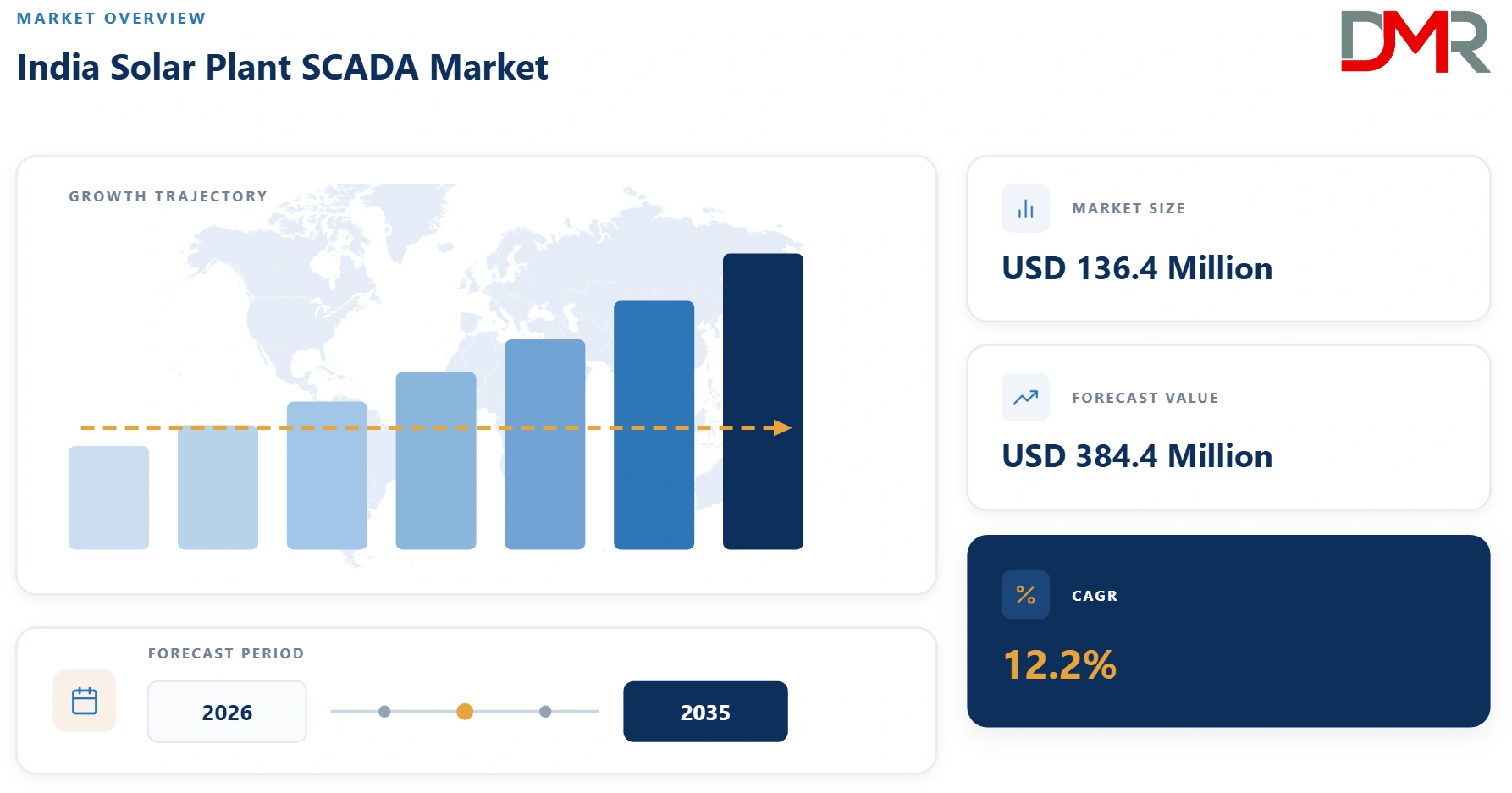
- Market Size (2026): USD 136.4 Mn
- Forecast Value (2035): USD 384.4 Mn
- CAGR (2026-2035): 12.2%
- Leading Component: SCADA Software Platforms with approximately 28.7% of 2026 revenue
- Leading Deployment Type: On-Premise SCADA with approximately 51.6%
- Leading Application: Utility-Scale Solar Plants with approximately 63.2%
What is India Solar Plant SCADA Market and its Market Size?
The India Solar Plant SCADA Market size is estimated to reach USD 136.4 Mn in 2026 and is further anticipated to reach USD 384.4 Mn by 2035, at a CAGR of 12.2%.
ℹ
To learn more about this report –
Download Your Free Sample Report Here
Solar plant supervisory control and data acquisition systems combine software, control hardware, communications, data acquisition, visualization, alarms, and plant interfaces to monitor and control photovoltaic generation assets. A typical architecture connects inverters, string monitoring devices, weather stations, meters, protection relays, trackers, transformers, switchgear, power plant controllers, energy storage systems, and grid-interconnection equipment to a centralized operator interface.
SCADA is most important in utility-scale solar plants because operators require continuous visibility into plant output, inverter availability, string performance, weather conditions, substation status, grid commands, alarms, and maintenance events. Large projects can include thousands of monitored data points, making centralized data acquisition and event management essential for safe and efficient operation.
India's rapidly expanding solar fleet is increasing demand for SCADA modernization, remote O&M, plant-level analytics, and reliable communication infrastructure. New projects increasingly require integration with power plant controllers, forecasting systems, energy storage, central scheduling requirements, and cybersecurity controls. Existing plants are also being upgraded with cloud connectivity, edge gateways, improved historian databases, and advanced analytics.
Procurement decisions are influenced by system availability, protocol compatibility, cybersecurity, historian capacity, alarm management, response time, redundancy, remote access, scalability, reporting, and integration with inverter and substation equipment. IEC 61850, Modbus, OPC UA, IEC 60870-5-104, Ethernet, and other industrial protocols are commonly used depending on plant architecture and utility requirements.
Use Cases
- Centralized Plant Monitoring: Operators supervise inverter output, meter data, weather conditions, transformer status, breaker positions, alarms, and communication health from a centralized control room.
- Grid Dispatch & Power Control: SCADA interfaces with power plant controllers and substation systems to execute active-power, reactive-power, voltage, and ramp-rate commands at the point of interconnection.
- Remote O&M: Central teams monitor multi-site portfolios, identify equipment faults, prioritize maintenance visits, and track plant availability without maintaining large permanent teams at every location.
- Performance Analytics: Historical SCADA data is combined with irradiance, temperature, inverter, and meter data to calculate performance ratio, availability, loss categories, and generation shortfalls.
Key Takeaways
- Market Size: The market is estimated at USD 136.4 Mn in 2026 and projected to reach USD 384.4 Mn by 2035.
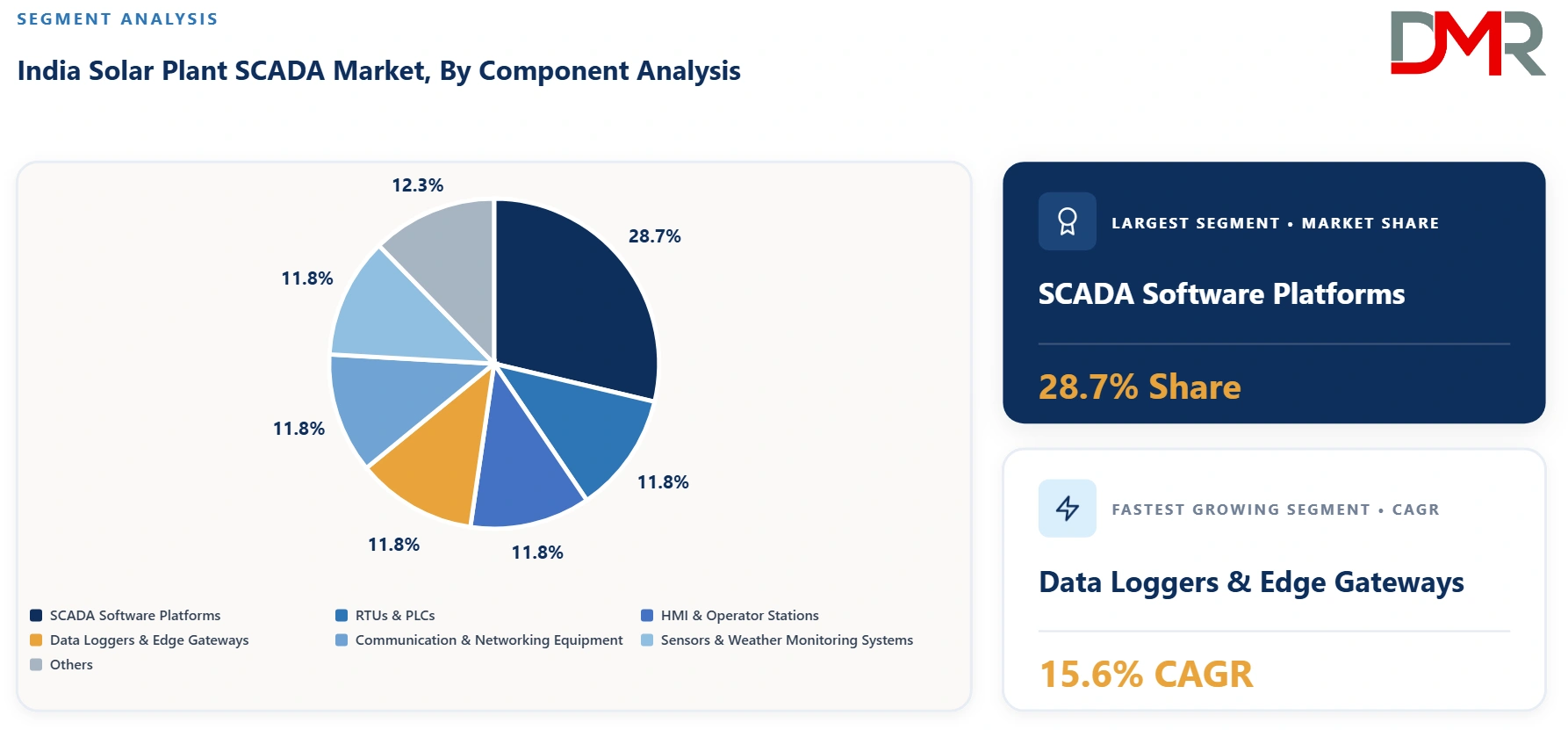
- Component Analysis: SCADA Software Platforms lead with approximately 28.7% of 2026 revenue.
- Deployment Analysis: On-Premise SCADA holds around 51.6%, while Hybrid SCADA is projected to grow at approximately 17.2% CAGR.
- Function Analysis: Plant Monitoring & Visualization accounts for about 31.4% of 2026 revenue.
- Application Analysis: Utility-Scale Solar Plants represent approximately 63.2% of demand.
- Installed Base: India had 164.59 GW of cumulative solar capacity as of July 31, 2026, including 122.57 GW of ground-mounted solar.
How AI/Gen AI is Transforming the India Solar Plant SCADA Market?
AI is changing solar SCADA from a monitoring layer into a decision-support system. Machine-learning models can analyze inverter alarms, irradiance, weather, string current, plant output, tracker status, and maintenance history to identify abnormal performance before conventional thresholds are breached. AI can also prioritize alarms by likely energy loss, classify recurring fault patterns, improve generation forecasting, and reduce the number of false or low-value alerts presented to control-room operators.
Generative AI can assist plant engineers by summarizing alarm sequences, retrieving operating procedures, drafting incident reports, converting raw SCADA histories into maintenance narratives, and supporting conversational queries across plant data. It can also help compare events across multiple projects. Human validation remains necessary because control commands, electrical switching, protection response, and cybersecurity actions require deterministic procedures and authorized operator oversight.
- Anomaly Detection: AI identifies unusual inverter, string, weather, or substation behavior before conventional alarm limits are crossed.
- Alarm Prioritization: Analytics rank events by probable energy impact, recurrence, and equipment criticality.
- Predictive Maintenance: Historical SCADA patterns support early identification of degrading inverters, fans, communication devices, and auxiliary equipment.
- Automated Reporting: Gen AI assists with shift summaries, fault reports, maintenance notes, and portfolio performance narratives.
Key Drivers in the India Solar Plant SCADA Market
Rapid Growth of Utility-Scale Solar Capacity
India continues to expand its utility-scale photovoltaic fleet, creating a larger base of plants that require centralized monitoring, control, historian databases, communications, and grid interfaces. As project sizes increase, plant operators cannot rely on local inverter displays or manual data collection. SCADA becomes necessary for monitoring thousands of field devices, coordinating substation equipment, tracking availability, and providing operational information to owners and grid operators. Continued solar additions therefore create both greenfield SCADA demand and a growing installed base for upgrades, replacements, cybersecurity improvements, and analytics.
Need for Remote O&M and Higher Plant Availability
Solar owners increasingly manage multi-gigawatt portfolios spread across several states. Centralized SCADA and remote operations centers allow engineering teams to monitor multiple plants, reduce site staffing, and identify faults quickly. Faster detection of inverter trips, communication failures, grid events, weather-related derating, and equipment alarms improves plant availability and reduces lost generation. Performance-linked O&M contracts and stronger lender reporting also increase the value of consistent, timestamped, traceable plant data.
Restraints in the India Solar Plant SCADA Market
Integration Complexity Across Multi-Vendor Equipment
Solar plants combine inverters, meters, trackers, protection relays, string monitoring devices, weather stations, transformers, switchgear, and controllers from different suppliers. Each may use different data maps, protocols, firmware versions, and alarm conventions. Integrating these devices into a stable SCADA architecture requires significant engineering, testing, and commissioning. Changes to plant equipment can also require database and interface updates, increasing lifecycle integration cost.
Cybersecurity and Legacy-System Constraints
Remote connectivity improves O&M efficiency but expands the cyberattack surface of generation assets. Older SCADA platforms may use unsupported operating systems, weak authentication, flat networks, or insecure remote-access methods. Upgrading these systems without disrupting plant operation can be difficult. Owners must balance remote access with network segmentation, access control, patch management, logging, backups, and incident response. Cybersecurity requirements can therefore increase project cost and integration effort.
Growth Opportunities in the India Solar Plant SCADA Market
Hybrid Solar and Energy Storage Plant Control
India is increasing deployment of solar-plus-storage and hybrid renewable projects. These plants require more advanced supervisory control because operators must coordinate PV generation, battery state of charge, inverter dispatch, point-of-interconnection limits, forecasting, and grid commands. SCADA suppliers can expand into integrated plant controllers, energy-management interfaces, hybrid dashboards, and coordinated alarm systems that manage solar and storage as a single operating asset.
Cloud-Connected Analytics and Fleet Management
A growing number of asset owners want a portfolio-level view rather than separate control systems for each plant. Cloud-connected SCADA architectures can replicate selected plant data to central platforms for benchmarking, analytics, reporting, and remote engineering while retaining local deterministic control. This creates opportunities for edge gateways, secure data brokers, historian replication, software subscriptions, and centralized fleet-management services.
Trends in the India Solar Plant SCADA Market
Convergence of SCADA, PPC, and Asset Performance Management
Plant SCADA is increasingly integrated with power plant controllers, forecasting platforms, energy-management systems, and asset-performance software. This allows operational data to move from field devices into control, analytics, and maintenance workflows without separate data silos. The trend supports common data models, APIs, edge processing, and centralized dashboards across multi-site portfolios.
Greater Focus on Cybersecure Industrial Communications
Solar plants are adopting stronger network segmentation, role-based access, secure remote connectivity, logging, redundancy, and industrial firewalls. Grid-connected renewable assets are part of critical power infrastructure, making cyber resilience a higher procurement priority. SCADA modernization projects increasingly include secure gateways, controlled vendor access, backup systems, user-account governance, and continuous monitoring alongside traditional control-room functionality.
Research Scope and Analysis
The study evaluates the India solar plant SCADA market by component, deployment type, function, application, and end user, with segment leadership and growth assessed across the 2026-2035 forecast period.
ℹ
To learn more about this report –
Download Your Free Sample Report Here
By Component
SCADA Software Platforms is estimated to lead the component segment with around 28.7% of 2026 revenue. Its position reflects broad use across large photovoltaic assets and established integration with plant control and monitoring architectures. Buyers prioritize system availability, protocol interoperability, cybersecurity, redundancy, historian performance, scalability, alarm management, and service support. Growth, however, is concentrated in Data Loggers & Edge Gateways, which is projected to expand at a CAGR of 15.6% between 2026 and 2035.
By Deployment Type
On-Premise SCADA is estimated to lead the deployment type segment with around 51.6% of 2026 revenue. Its position reflects broad use across large photovoltaic assets and established integration with plant control and monitoring architectures. Buyers prioritize system availability, protocol interoperability, cybersecurity, redundancy, historian performance, scalability, alarm management, and service support. Growth, however, is concentrated in Hybrid SCADA, which is projected to expand at a CAGR of 17.2% between 2026 and 2035.
By Function
Plant Monitoring & Visualization is estimated to lead the function segment with around 31.4% of 2026 revenue. Its position reflects broad use across large photovoltaic assets and established integration with plant control and monitoring architectures. Buyers prioritize system availability, protocol interoperability, cybersecurity, redundancy, historian performance, scalability, alarm management, and service support. Growth, however, is concentrated in Performance Analytics, which is projected to expand at a CAGR of 16.8% between 2026 and 2035.
By Application
Utility-Scale Solar Plants is estimated to lead the application segment with around 63.2% of 2026 revenue. Its position reflects broad use across large photovoltaic assets and established integration with plant control and monitoring architectures. Buyers prioritize system availability, protocol interoperability, cybersecurity, redundancy, historian performance, scalability, alarm management, and service support. Growth, however, is concentrated in Hybrid Solar & Energy Storage Plants, which is projected to expand at a CAGR of 18.3% between 2026 and 2035.
By End User
Independent Power Producers is estimated to lead the end user segment with around 32.8% of 2026 revenue. Its position reflects broad use across large photovoltaic assets and established integration with plant control and monitoring architectures. Buyers prioritize system availability, protocol interoperability, cybersecurity, redundancy, historian performance, scalability, alarm management, and service support. Growth, however, is concentrated in O&M Service Providers, which is projected to expand at a CAGR of 15.4% between 2026 and 2035.
The India Solar Plant SCADA Market Report is Segmented Based on the Following
By Component
- SCADA Software Platforms
- RTUs & PLCs
- HMI & Operator Stations
- Data Loggers & Edge Gateways
- Communication & Networking Equipment
- Sensors & Weather Monitoring Systems
- Others
By Deployment Type
- On-Premise SCADA
- Cloud-Connected SCADA
- Hybrid SCADA
- Edge-Enabled SCADA
- Others
By Function
- Plant Monitoring & Visualization
- Power Control & Dispatch
- Alarm & Event Management
- Performance Analytics
- Remote O&M Management
- Cybersecurity & Access Management
- Others
By Application
- Utility-Scale Solar Plants
- Solar Parks
- Commercial & Industrial Solar
- Hybrid Solar & Energy Storage Plants
- Floating Solar Plants
- Distributed & Rooftop Solar
- Others
By End User
- Independent Power Producers
- Utilities & Government Agencies
- Solar Project Developers
- EPC Contractors
- O&M Service Providers
- Commercial & Industrial Asset Owners
- Others
Regulatory Landscape
India's solar plant SCADA environment is influenced by electricity-grid regulations, connectivity requirements, protection and communication standards, cybersecurity guidance, scheduling and dispatch practices, and project-specific utility specifications. Large grid-connected plants typically require reliable telemetry, metering, event records, plant-level control, and communication with state or regional system operators. The Central Electricity Authority maintains grid management, renewable integration, communication-system planning, and cybersecurity functions within the power sector. Project owners and EPC contractors therefore design SCADA systems around grid-code compliance, controlled remote access, time synchronization, secure communications, redundancy, and auditable operating records.
Technology Analysis
Technology development is moving toward edge-enabled, hybrid, and cybersecure SCADA architectures. Modern plants use redundant servers, historian databases, industrial Ethernet, managed switches, protocol gateways, RTUs, PLCs, HMI stations, GPS or network time synchronization, plant controllers, and secure remote-access systems. Edge devices normalize data from inverter and field protocols before forwarding selected information to central platforms. Cloud-connected analytics are increasingly used for portfolio benchmarking and predictive maintenance while local SCADA retains deterministic plant control. Cybersecurity features such as network segmentation, role-based access, encrypted communication, audit logging, backup, and controlled vendor connectivity are becoming standard design considerations.
Competitive Landscape
The India solar plant SCADA market includes industrial automation companies, power-system technology suppliers, inverter manufacturers, software vendors, communication-equipment providers, weather-monitoring companies, system integrators, EPC contractors, and asset-performance platforms. Large automation vendors compete on proven SCADA platforms, cybersecure controls, service capability, and utility integration. Solar inverter suppliers increasingly bundle plant controllers and monitoring platforms with their equipment. Specialist software companies compete through portfolio analytics, cloud connectivity, alarm management, and performance optimization. Indian integrators compete on local engineering, protocol integration, commissioning, field service, and project customization.
Some of the Prominent Players in the India Solar Plant SCADA Market Are:
- Siemens Limited
- Schneider Electric India Pvt. Ltd.
- ABB India Limited
- Hitachi Energy India Limited
- Honeywell Automation India Limited
- Emerson Electric Co.
- Rockwell Automation India Pvt. Ltd.
- Yokogawa India Limited
- GE Vernova
- Mitsubishi Electric India Pvt. Ltd.
- Larsen & Toubro Limited
- Tata Consultancy Services Limited
- Kalkitech
- Chemtrols Industries Pvt. Ltd.
- Masibus Automation and Instrumentation Pvt. Ltd.
- Advantech India Pvt. Ltd.
- Moxa India Industrial Networking Pvt. Ltd.
- Phoenix Contact India Pvt. Ltd.
- WAGO Pvt. Ltd.
- Beckhoff Automation Pvt. Ltd.
- Delta Electronics India Pvt. Ltd.
- Sungrow Power Supply Co., Ltd.
- Huawei Technologies India Pvt. Ltd.
- SMA Solar Technology AG
- FIMER India Pvt. Ltd.
- Ingeteam Power Technology India Pvt. Ltd.
- TMEIC Industrial Systems India Pvt. Ltd.
- Statcon Energiaa Pvt. Ltd.
- KSolare Energy Pvt. Ltd.
- meteocontrol GmbH
- Solar-Log GmbH
- Power Factors, LLC
- GreenPowerMonitor
- Stem, Inc.
- Envision Digital International Pte. Ltd.
- Campbell Scientific India Pvt. Ltd.
- Vaisala Oyj
- OTT HydroMet
- Secure Meters Limited
- HPL Electric & Power Limited
- Other Key Players
Recent Developments
- In July 2026, India's cumulative solar capacity reached 164.59 GW, including 122.57 GW of ground-mounted solar, materially expanding the installed base requiring plant monitoring and control systems.
- In 2026, Indian utility-scale solar and hybrid projects continued increasing integration of SCADA, power plant controllers, plant historians, remote O&M, and centralized portfolio monitoring.
- In 2026, cyber resilience remained a major power-sector priority, supporting demand for stronger network segmentation, secure remote access, audit logging, and controlled communication interfaces in generation SCADA.
- In 2025, growth in solar-plus-storage procurement increased demand for supervisory systems capable of coordinating PV output, battery dispatch, point-of-interconnection limits, and grid instructions.
- In 2025, solar asset owners continued shifting toward centralized remote operations centers that aggregate plant SCADA and performance data across multi-site portfolios.
- In 2025, industrial automation and solar technology suppliers expanded edge gateways, cloud analytics, plant controllers, and secure communication solutions suitable for utility-scale renewable-energy applications.
Report Details
| Report Characteristics |
| Market Size (2026) |
USD 136.4 Mn |
| Forecast Value (2035) |
USD 384.4 Mn |
| CAGR (2026–2035) |
12.2% |
| Historical Data |
2021 – 2025 |
| Forecast Data |
2026 – 2035 |
| Base Year |
2025 |
| Segments Covered |
By Component, By Deployment Type, By Function, By Application, By End User |
| Geographic Coverage |
India |
Frequently Asked Questions
How big is the India Solar Plant SCADA Market?
▾ The India Solar Plant SCADA Market size is estimated to reach USD 136.4 Mn in 2026 and is projected to reach USD 384.4 Mn by 2035, growing at a CAGR of 12.2%.
What is the growth rate of the India Solar Plant SCADA Market?
▾ The market is expected to expand at a CAGR of 12.2% from 2026 to 2035, supported by utility-scale solar additions, remote O&M, hybrid projects, analytics, and SCADA modernization.
Which component holds the largest share in the India Solar Plant SCADA Market?
▾ SCADA Software Platforms lead with approximately 28.7% of 2026 revenue because software provides visualization, alarms, historian functions, reporting, and plant-wide supervisory control.
Who are the key players in the India Solar Plant SCADA Market?
▾ Siemens, Schneider Electric, ABB, Hitachi Energy, Honeywell, Emerson, Rockwell Automation, Yokogawa, GE Vernova, and specialist solar monitoring providers are prominent participants.
Which application is leading the India Solar Plant SCADA Market?
▾ Utility-Scale Solar Plants account for approximately 63.2% of 2026 revenue because large plants require centralized monitoring, control, telemetry, and grid-integration functions.
Which deployment type is growing fastest in the India Solar Plant SCADA Market?
▾ Hybrid SCADA is projected to expand at approximately 17.2% CAGR through 2035 as operators retain local control while adding secure cloud analytics and portfolio management.
What are the major growth drivers in the India Solar Plant SCADA Market?
▾ Growth is driven by India's expanding solar installed base, remote O&M, higher plant-availability requirements, hybrid solar-storage projects, centralized fleet monitoring, analytics, grid-control requirements, and cybersecurity upgrades.