India Steel Wire Market Snapshot
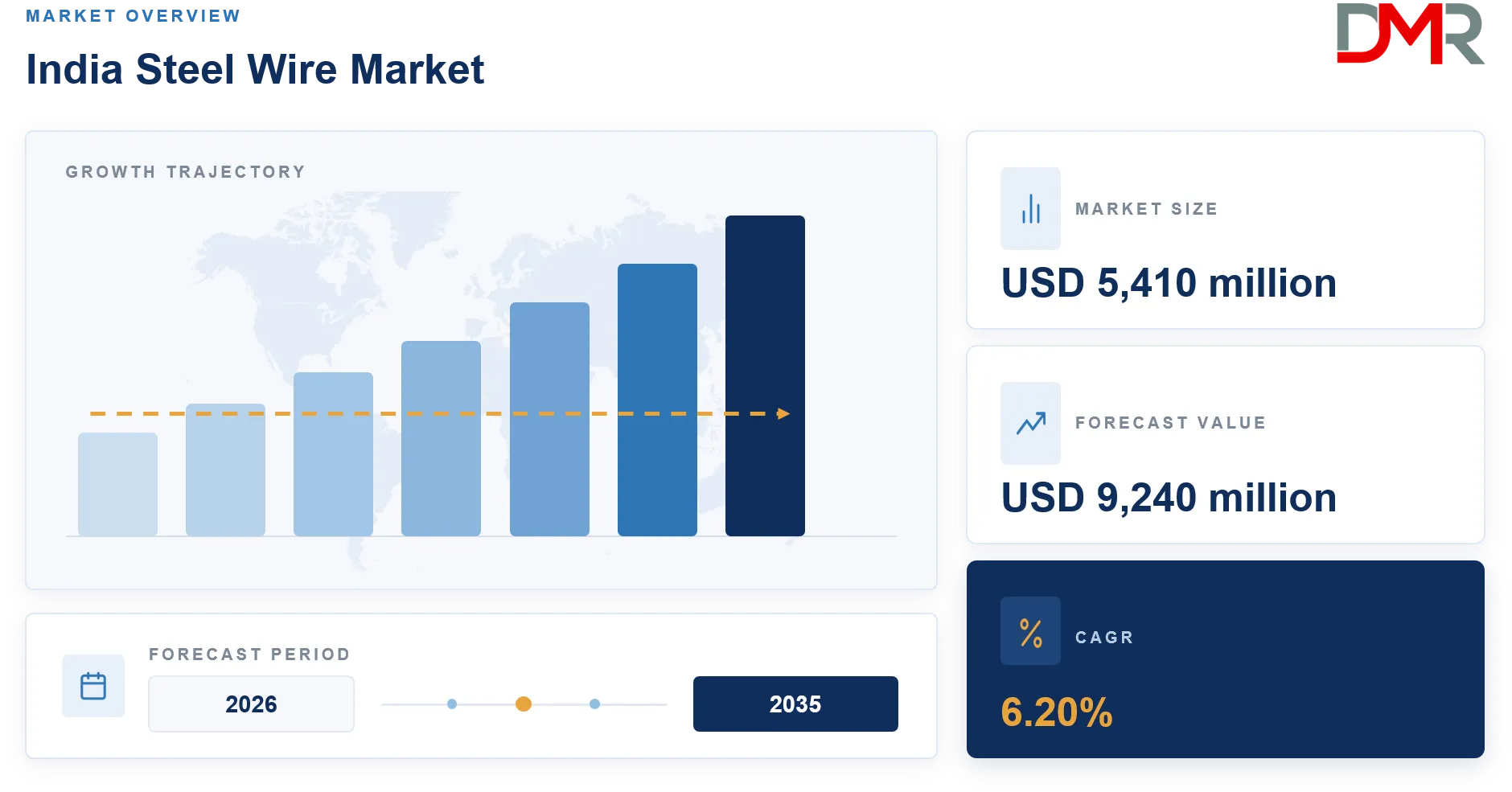
- Market Value: India steel wire market is valued at USD 5,410 million in 2026 and is expected to reach USD 9,240 million by 2035.
- CAGR: India steel wire market is expected to grow at a CAGR of 6.2% from 2026 to 2035.
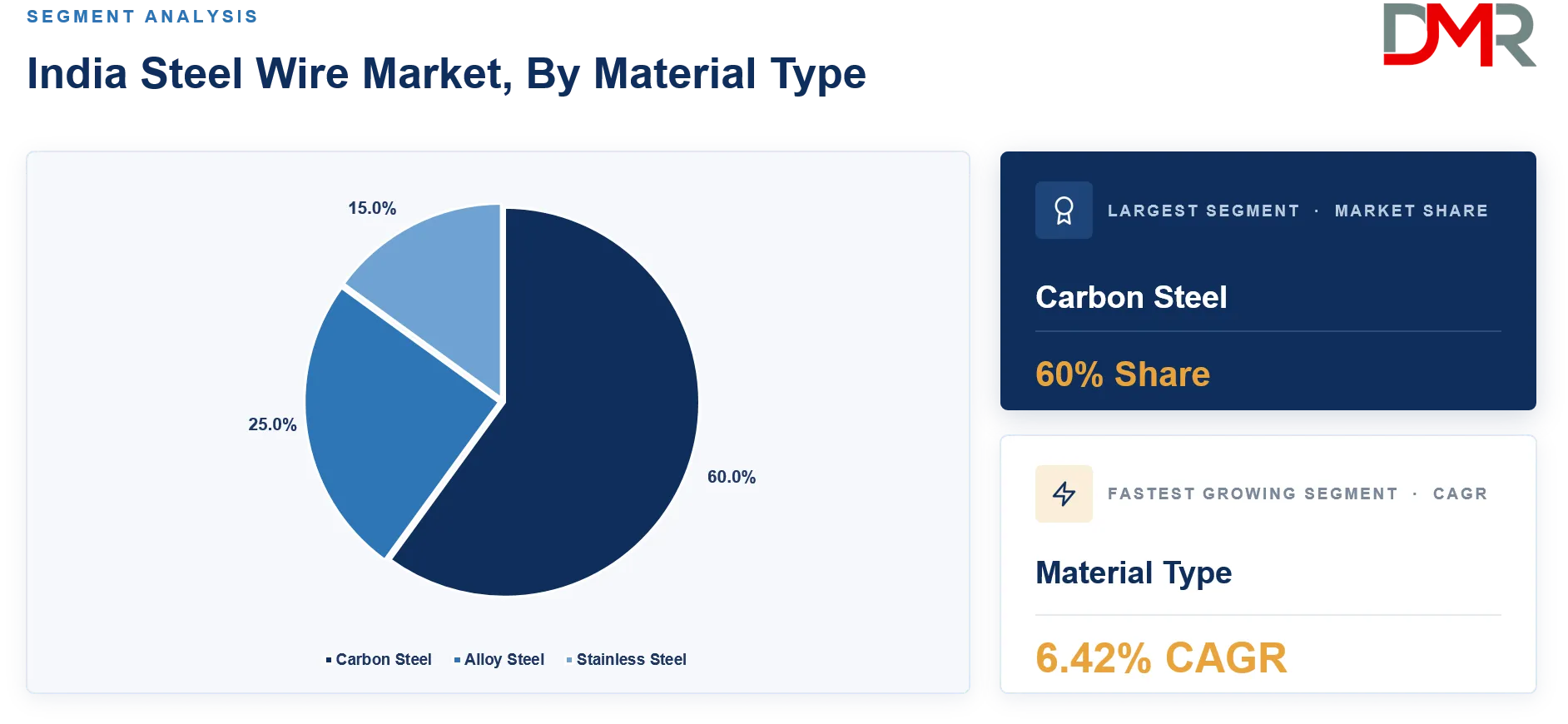
- By Material Type Segment Analysis: Carbon steel led the material type segment with a 60.0% share in 2026.
- By Application Segment Analysis: Construction led the application segment with a 30.0% share in 2026.
- Major Players: Kobe Steel Ltd, Insteel Industries, JFE Steel, WireCo WorldGroup, and Nippon Steel Corp.
What is the India Steel Wire Market and its Market Size?
The India steel wire market size is projected to be valued at USD 5,410 million in 2026 and reach USD 9,240 million by 2035, expanding at a CAGR of 6.2% during the forecast period. Steel wire includes carbon steel, alloy steel, and stainless steel wire manufactured in different diameters, tensile strengths, coatings, and surface finishes for structural, mechanical, automotive, power, agricultural, and industrial applications. The market covers wire used in reinforcement, fencing, fasteners, springs, ropes, cables, mesh, tyre reinforcement, electrodes, lifting systems, transmission infrastructure, and engineered components.
ℹ
To learn more about this report –
Download Your Free Sample Report Here
India provides a strong demand base for steel wire because it combines large steel production capacity with expanding downstream consumption. Ministry of Steel data show that finished steel consumption reached 147.7 million tonnes during April 2025 to February 2026, up 7.2% from the comparable period, while crude steel production reached 153.6 million tonnes. India also remained the world's second largest crude steel producer, with 164.9 million tonnes produced in 2025. These conditions support greater availability of wire rod feedstock and continued expansion of domestic wire drawing, galvanizing, heat treatment, coating, and fabrication capacity.
Use Cases
- Construction Reinforcement: Steel wire is used in welded mesh, binding wire, prestressed structures, concrete reinforcement systems, fencing, and structural assemblies. Rising spending on highways, railways, metros, housing, logistics facilities, and industrial construction creates recurring demand for carbon steel wire products.
- Automotive Components: High strength steel wire is used in suspension springs, seat structures, control cables, tyre reinforcement, fasteners, safety components, and mechanical assemblies. India's automobile production reached about 34.7 million units in 2025-26, strengthening demand for consistent wire quality and high fatigue resistance.
- Industrial Manufacturing: Manufacturers use steel wire in springs, fasteners, wire ropes, screens, mesh, welding consumables, lifting equipment, conveyors, machinery, and fabricated components. Demand is linked with capital goods, mining, material handling, engineering, and general manufacturing activity.
- Energy and Transmission: Steel wire provides mechanical reinforcement in conductors, stay wires, grounding systems, wire ropes, and transmission infrastructure. India's growing renewable power network and grid expansion create opportunities for corrosion resistant and high tensile wire solutions.
- Agriculture and Rural Infrastructure: Galvanized and carbon steel wire are widely used for fencing, crop protection, trellising, livestock enclosures, irrigation support structures, and rural infrastructure. Product durability, coating life, ease of installation, and pricing strongly influence purchasing decisions.
How AI/Gen AI is Transforming the India Steel Wire Market?
Digital production systems are changing how Indian steel wire producers control drawing speed, die wear, surface quality, tensile strength, coating thickness, and energy consumption. Machine learning models connected to shop floor sensors can identify abnormal vibration, temperature, lubrication, and motor load before a drawing line experiences unplanned downtime. Vision based inspection is also improving the detection of surface cracks, coating defects, dimensional variation, and packaging errors. For manufacturers serving automotive, lifting, rope, and other safety critical applications, better process control can reduce rejection rates and improve traceability between wire rod batches and finished coils.
Generative systems are also supporting technical documentation, maintenance knowledge, production scheduling, procurement analysis, and customer service. Producers can combine historical orders, inventory levels, machine availability, wire rod specifications, and delivery requirements to improve planning across multiple product grades. The larger opportunity is not automation alone, but faster commercial decision making. Steel wire companies that connect operational data with sales forecasting can respond more accurately to changes in construction demand, automotive schedules, steel prices, and regional inventories while protecting margins in a price competitive market.
Key Drivers in the India Steel Wire Market
Infrastructure Investment and Construction Activity
Infrastructure development remains a major driver of India steel wire demand. The Union Budget 2026-27 proposed public capital expenditure of ₹12.2 lakh crore, compared with ₹11.2 lakh crore in Budget Estimates for 2025-26. Spending on rail corridors, freight infrastructure, roads, urban development, industrial assets, and public facilities increases consumption of reinforcement wire, binding wire, welded mesh, fencing, prestressing products, ropes, and related fabricated products. Construction already represents 30.0% of the steel wire market in 2026, making infrastructure execution directly relevant to market growth.
Expansion of Domestic Manufacturing
Growth in automotive, engineering, machinery, fasteners, capital goods, and fabricated metal production is increasing demand for higher specification steel wire. Indian automobile production rose from about 31.0 million units in 2024-25 to nearly 34.7 million units in 2025-26. Passenger vehicle production alone exceeded 5.5 million units. Springs, tyre reinforcement, mechanical cables, seating systems, fasteners, and safety assemblies require wire with controlled chemistry, dimensional accuracy, fatigue performance, and surface quality. This creates opportunities for suppliers that can move beyond commodity wire into application specific grades.
Restraints in the India Steel Wire Market
Wire Rod and Input Cost Volatility
Steel wire producers remain exposed to movements in wire rod prices, scrap, alloying materials, zinc, electricity, natural gas, freight, and finance costs. Raw material changes can compress margins when wire suppliers operate under fixed price contracts or face delays in passing higher costs to buyers. Carbon steel wire, which accounts for 60.0% of the market, is particularly exposed to intense price competition. Small and medium wire drawers with limited inventory management and purchasing scale can face greater earnings volatility when feedstock prices move faster than finished wire prices.
Quality Compliance and Fragmented Competition
The market includes organized producers as well as numerous regional wire drawers and fabricators. Buyers in automotive, construction, power, mining, elevators, lifting, and engineered applications increasingly require documented tensile properties, coating performance, traceability, dimensional tolerance, and relevant standards compliance. Meeting these requirements involves investment in testing laboratories, process controls, drawing equipment, heat treatment, galvanizing, and certification. Suppliers competing mainly on price can find it difficult to enter high specification applications where approval cycles and customer qualification requirements are more demanding.
Growth Opportunities in the India Steel Wire Market
High Strength and Specialty Wire Products
Specialty wire offers stronger value creation than conventional commodity products. Opportunities are expanding in high carbon spring wire, stainless wire, alloy wire, tyre reinforcement, prestressing products, engineered ropes, precision wire, and corrosion resistant grades. India's National Steel Policy targets greater domestic availability of high grade automotive steel, electrical steel, special steels, and alloys. Suppliers able to combine metallurgy, controlled drawing, heat treatment, coatings, and application engineering can address customers that value lifecycle performance and consistency more than the lowest initial purchase price.
Power Grid and Renewable Energy Infrastructure
Energy infrastructure provides an expanding application base for steel wire used in transmission support, conductor reinforcement, grounding, stay wires, ropes, and structural systems. India had about 288.6 GW of installed renewable energy capacity by June 2026, including 162.15 GW of solar and 57.44 GW of wind capacity. The national transmission system is being expanded to integrate more than 500 GW of renewable capacity by 2030. Such investment creates demand for durable wire products capable of meeting mechanical strength and corrosion performance requirements across varied climatic conditions.
Trends in the India Steel Wire Market
Shift Toward Higher Specification Wire
Indian buyers are placing greater emphasis on tensile strength, fatigue life, dimensional consistency, coating uniformity, surface condition, and traceability. This trend is visible in automotive components, industrial springs, lifting systems, wire ropes, prestressing applications, and engineered fasteners. As customers automate assembly and increase equipment utilization, inconsistent wire creates higher downstream costs. Wire suppliers are therefore investing in better drawing lines, controlled cooling, inspection, coating processes, and testing systems. The shift supports gradual movement from basic price competition toward performance based supplier qualification.
Capacity Expansion Alongside Lower Import Dependence
India's broader steel supply position is becoming more supportive of downstream wire manufacturing. During April to December 2025-26, finished steel production reached 118.7 million tonnes, up 10.5%, while finished steel imports fell 37.4% to 4.65 million tonnes and exports increased 33.3% to 4.80 million tonnes. Greater domestic steel availability can strengthen access to wire rod feedstock, although grade availability and pricing remain product specific. The changing supply structure gives wire manufacturers greater incentive to develop localized products for construction, automotive, energy, industrial, and export customers.
Research Scope and Analysis.
The India Steel Wire Market is segmented based on Material Type and Application. The study provides an in-depth analysis of key segments and sub-segments, covering their applications, industry adoption, demand patterns, and contribution to overall market growth.
ℹ
To learn more about this report –
Download Your Free Sample Report Here
By Material Type
Carbon steel dominated the India steel wire market with a 60.0% share in 2026. Its leadership reflects broad usage across construction binding wire, mesh, fencing, fasteners, springs, ropes, reinforcement systems, agricultural products, and general industrial components. Carbon steel combines high tensile capability, established wire rod supply, mature processing technology, and competitive production costs. Low carbon grades serve forming, mesh, and general purpose applications, while medium and high carbon products address springs, ropes, prestressing, and applications requiring higher strength. Future opportunities will increasingly depend on coating performance, controlled mechanical properties, drawability, cleanliness, fatigue life, and customer specific wire rod chemistry.
By Application
Construction accounted for 30.0% of India steel wire market revenue in 2026, making it the leading application. Wire is consumed in binding, welded reinforcement mesh, prestressed concrete, fencing, structural assemblies, bridges, tunnels, rail systems, industrial buildings, utilities, and urban infrastructure. India has maintained a strong infrastructure investment pipeline, and construction plus infrastructure already account for more than two thirds of broader domestic steel consumption according to Ministry of Steel analysis. Public capital expenditure, industrial corridors, freight projects, housing, renewable infrastructure, and logistics facilities provide a diversified demand base that supports continuing wire consumption across project cycles.
The India Steel Wire Market Report is segmented on the basis of the following:
By Material Type
- Carbon Steel
- Alloy Steel
- Stainless Steel
By Application
- Construction
- Industrial
- Automotive
- Energy
- Agriculture
- Other Applications
Competitive Landscape
The India steel wire market operates within a competitive global and domestic supply environment where producers differentiate through material quality, tensile properties, coating capability, product range, technical service, application engineering, production scale, and customer approvals. Competition is strongest in carbon steel wire because of its 60.0% market share and broad use across construction and industrial applications. Higher value segments such as alloy wire, stainless steel wire, high tensile products, engineered ropes, automotive wire, and specialized coated products present stronger opportunities for technical differentiation. Global steel and wire companies including Kobe Steel Ltd, JFE Steel, Nippon Steel Corp, ArcelorMittal, WireCo WorldGroup, Bridon-Bekaert Ropes Group, and HBIS Group bring metallurgical expertise, international customer relationships, and broad product portfolios. Suppliers seeking to expand in India increasingly need to balance competitive pricing with local availability, certification, consistent mechanical properties, short delivery cycles, and customized solutions for construction, automotive, industrial, energy, and agricultural customers.
Some of the prominent players in the India steel wire industry are:
- Kobe Steel Ltd
- Insteel Industries
- JFE Steel
- WireCo WorldGroup
- Nippon Steel Corp
- Heico Companies
- ArcelorMittal
- Optimus Steel
- Bridon-Bekaert Ropes Group
- HBIS Group
- Others
Export-Import Analysis
India's steel wire trade is shaped by domestic wire rod availability, specialty grade requirements, regional price differences, and demand from construction, automotive, engineering, energy, and industrial users. The country has a strong steel production base, which supports local manufacturing of carbon steel wire and reduces dependence on imported standard grades. Imports remain relevant for selected alloy, stainless, precision, high tensile, and application-specific wire where buyers require specialized chemistry, coatings, tolerances, or certifications. China, Japan, South Korea, and other Asian manufacturing hubs influence the competitive import environment. On the export side, Indian producers have opportunities in South Asia, the Middle East, Africa, Europe, and other markets for galvanized wire, fencing products, wire ropes, stainless wire, and engineered products. India's improving port connectivity and expanding steel capacity can support exports, while freight costs, trade measures, quality standards, currency movements, and global steel prices continue to influence trade competitiveness.
Pricing Analysis
India steel wire pricing depends heavily on wire rod costs, which represent a major portion of the finished product cost structure. Prices also vary according to carbon content, alloy composition, stainless steel grade, wire diameter, tensile strength, coating type, heat treatment, surface finish, tolerances, order volume, and certification requirements. Carbon steel wire generally faces stronger price competition because it represented 60.0% of market revenue in 2026 and serves large-volume applications such as construction, fencing, mesh, fasteners, and general engineering. Galvanized, alloy, stainless, high tensile, and precision wire typically command higher prices because of additional material and processing requirements. Zinc, nickel, chromium, scrap, electricity, freight, labor, and financing costs can further influence producer margins. Regional availability and project demand also affect transaction prices, making procurement timing, raw material contracts, capacity utilization, and inventory management important factors for buyers and manufacturers.
Recent Developments
- March 2026: JFE Steel Corporation Completed a 50:50 JV with JSW Steel for Odisha’s Bhushan Power & Steel integrated plant, backed by JFE’s INR 157.5 billion investment, strengthening India’s steel and wire-rod supply base.
- February 2026: Bansal Wire Industries Planned INR 2,500 crore investment in a Dadri, Uttar Pradesh steel-cord manufacturing vertical, expanding domestic specialty-wire capacity and reducing dependence on imports.
- May 2025: Nippon Steel Corporation AM/NS India acquired land in Andhra Pradesh for a proposed 7-million-tonne integrated steel mill, supporting long-term regional supply growth for steel products including wire rod.
Report Details
| Report Characteristics |
| Market Size (2026) |
USD 5,410 Million |
| Forecast Value (2035) |
USD 9,240 Million |
| CAGR (2026-2035) |
6.2% |
| Historical Data |
2021 - 2025 |
| Forecast Data |
2027 - 2035 |
| Base Year |
2025 |
| Estimate Year |
2026 |
| Segments Covered |
By Material Type (Carbon Steel, Alloy Steel, and Stainless Steel), By Application (Construction, Industrial, Automotive, Energy, Agriculture, and Other Applications) |
| Regional Coverage |
India |
Frequently Asked Questions
What is the current size of the India Steel Wire Market?
▾ The India Steel Wire Market is valued at USD 5,410 million in 2026 and is forecast to reach USD 9,240 million by 2035.
What is the growth rate of the India Steel Wire Market during?
▾ The India Steel Wire Market is expected to grow at a CAGR of 6.2% during the forecast period from 2026 to 2035.
What factors are driving the growth of the India Steel Wire Market?
▾ Infrastructure spending, construction activity, automotive production, industrial growth, and energy projects drive the India Steel Wire Market.
What are the major challenges restraining the India Steel Wire Market?
▾ Wire rod price volatility, energy costs, fragmented competition, quality compliance, and margin pressure restrain the India Steel Wire Market.
Which segment holds the largest share of the India Steel Wire Market?
▾ Carbon steel holds the largest India Steel Wire Market share at 60.0% in 2026, driven by construction and industrial applications.
Who are the leading companies in the India Steel Wire Market?
▾ Kobe Steel Ltd, Insteel Industries, JFE Steel, WireCo WorldGroup, Nippon Steel Corp, Heico Companies, ArcelorMittal, Optimus Steel, Bridon-Bekaert Ropes Group, and HBIS Group are leading companies in the India Steel Wire Market.
How is AI influencing the India Steel Wire Market?
▾ AI supports the India Steel Wire Market through predictive maintenance, quality inspection, production planning, and process optimization.
What are the future opportunities and trends in the India Steel Wire Market?
▾ High-strength wire, specialty grades, renewable energy, infrastructure, automation, and advanced coatings offer India Steel Wire Market opportunities.