India Urban Micro-Warehousing Market Snapshot
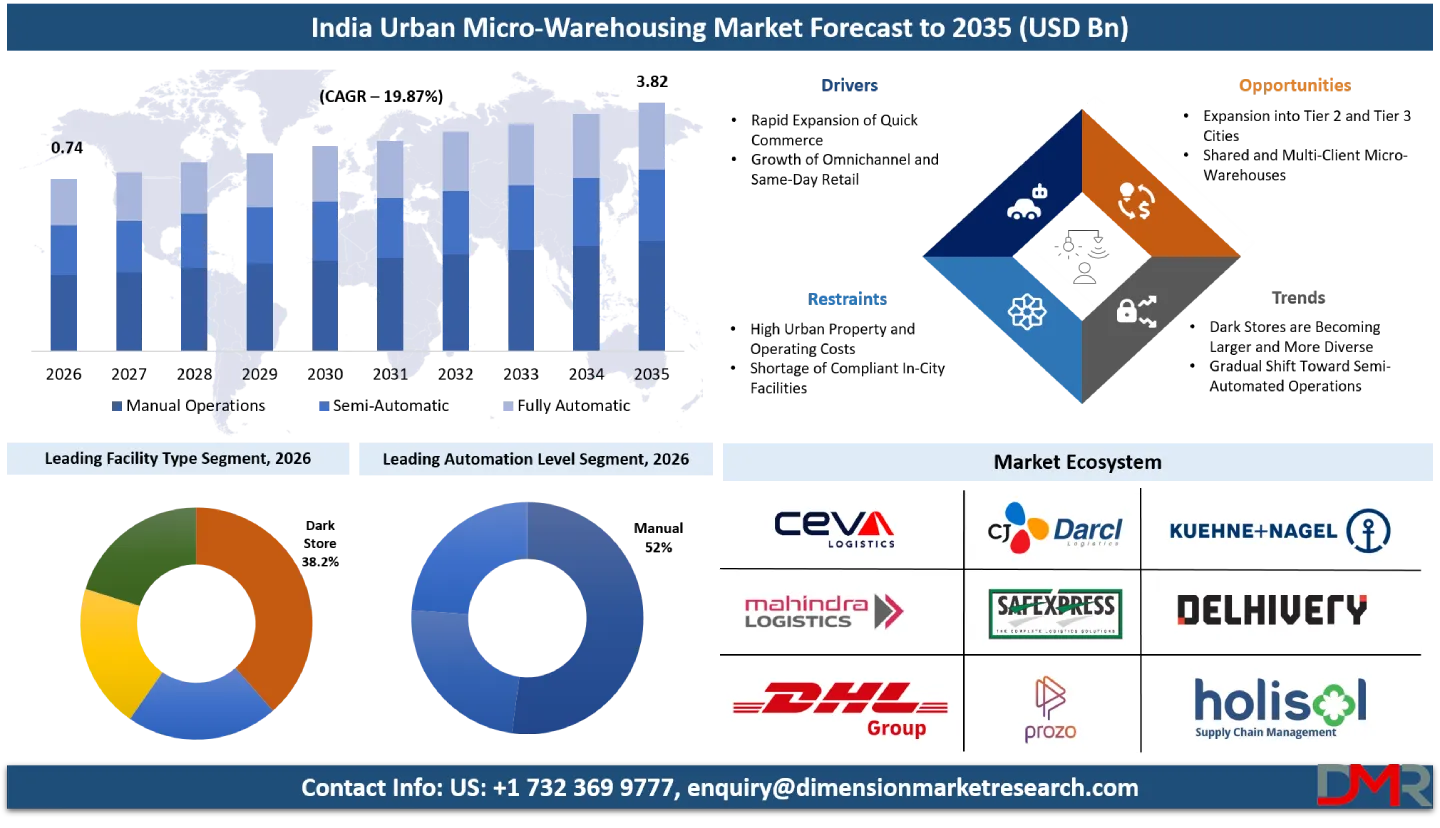
- Market Value: The India Urban Micro-Warehousing Market is expected to reach USD 3.82 billion by 2035 from USD 0.74 billion in 2026, at a CAGR of 19.87%.
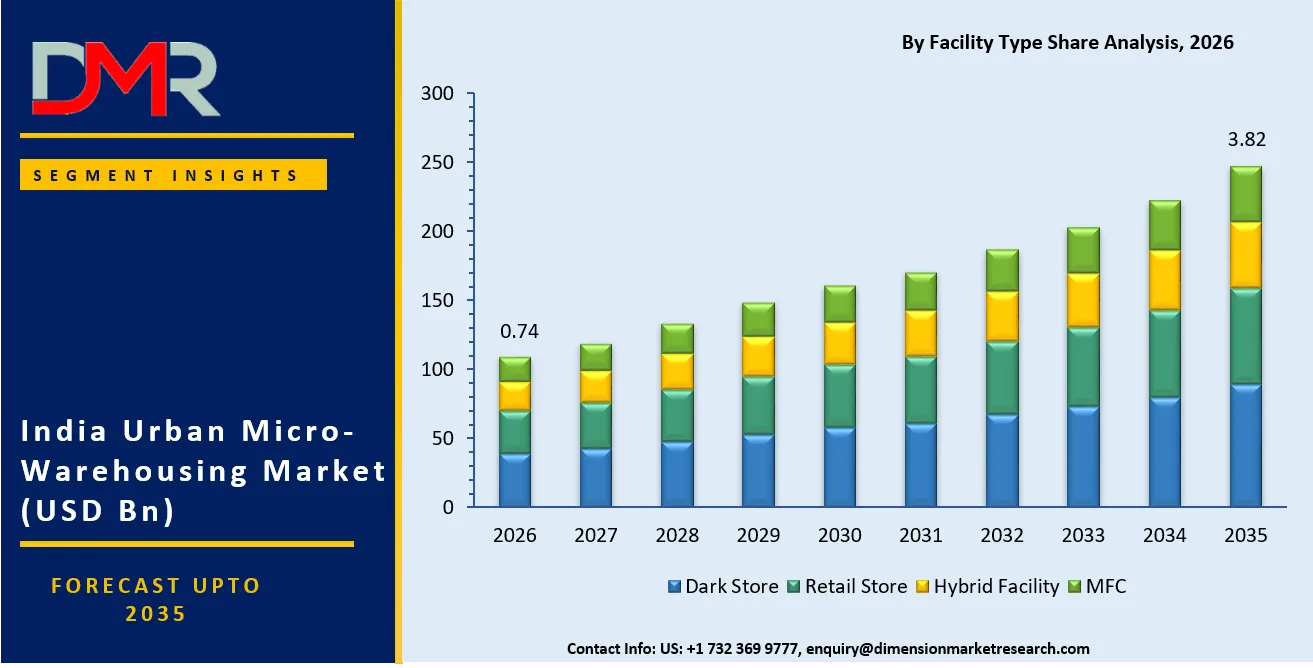
- By Facility Type Segment Analysis: Dark Store-Based Fulfillment dominated with 38.2% share in 2026.
- By Temperature Type Segment Analysis: Non-Temperature Controlled facilities held 76.4% share in 2026.
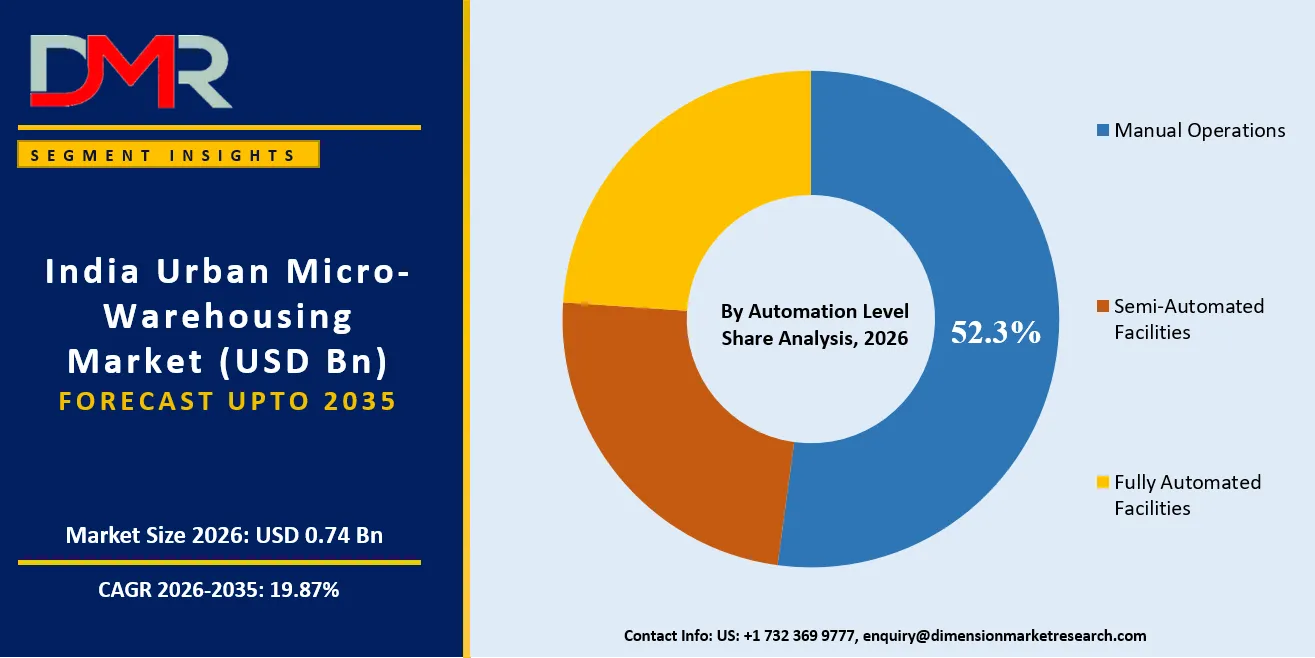
- By Automation Level Segment Analysis: Manual Operations accounted for 52.3% share in 2026.
- By End-Use Industry Segment Analysis: Grocery Retail led with 24.8% share in 2026.
- Major Key Players: Kuehne+Nagel, Delhivery Ltd., Safexpress Pvt. Ltd., CJ Darcl Logistics Ltd., DHL Group, and Others
What is the India Urban Micro-Warehousing Market and its Market Size?
The India Urban Micro-Warehousing Market size is projected to be valued at USD 0.74 billion in 2026 and is expected to reach USD 3.82 billion by 2035, expanding at a CAGR of 19.87% during the forecast period. Urban micro-warehousing refers to compact storage, sorting, and order fulfillment facilities located inside cities or near dense consumer catchments. These sites include dark stores, micro-fulfillment centers, neighborhood distribution hubs, retail backrooms, and shared last-mile warehouses.
ℹ
To learn more about this report –
Download Your Free Sample Report Here
The India urban micro-warehousing market is developing as a distinct part of the wider logistics real estate industry. Its value comes from inventory proximity rather than large storage capacity. Operators use small facilities to position fast-moving products near customers, reduce delivery distance, improve order accuracy, and support delivery windows ranging from a few hours to less than 30 minutes. Demand is closely linked with quick commerce, omnichannel retail, online grocery, direct-to-consumer brands, pharmaceutical delivery, and same-day e-commerce services.
India's broader warehouse market is also moving toward higher-quality infrastructure. JLL expects Grade A warehouse stock to rise from about 290 million square feet in 2023 to approximately 400 million square feet by 2027. The firm also notes that total warehouse demand across Indian cities could reach around 1.2 billion square feet by 2027. This formalization supports urban micro-warehousing by improving access to compliant facilities, institutional capital, digital warehouse systems, and organized third-party logistics services.
Use Cases
- Quick-Commerce Fulfillment: Urban dark stores hold groceries, personal care products, household supplies, electronics, and other high-frequency items close to residential neighborhoods. This allows platforms to shorten picking and delivery cycles while maintaining localized product assortments.
- Omnichannel Retail Distribution: Retailers use micro-warehouses and store backrooms to fulfill app, website, click-and-collect, and home-delivery orders from a common inventory pool. The model increases stock productivity and supports faster replenishment across city stores.
- Direct-to-Consumer Brand Fulfillment: D2C brands use shared urban facilities to store limited inventory near major customer clusters. This reduces dependence on distant regional warehouses and helps smaller brands offer same-day or next-day delivery without owning logistics infrastructure.
- Healthcare and Pharmaceutical Delivery: Urban fulfillment hubs store medicines, diagnostic supplies, wellness products, and selected temperature-sensitive items. Their proximity supports urgent orders, scheduled home delivery, and faster replenishment of pharmacies and clinics.
- Reverse Logistics and Returns: Micro-warehouses act as local consolidation points for e-commerce returns, product exchanges, packaging recovery, and quality inspection. Local processing lowers long-distance transport and moves approved products back into available inventory more quickly.
How AI and Generative AI are Transforming the India Urban Micro-Warehousing Market?
Artificial intelligence is improving demand forecasting, assortment planning, inventory allocation, and route scheduling across urban fulfillment networks. Since each micro-warehouse serves a small catchment, inventory errors can quickly cause stockouts or excess stock. Predictive models use order history, weather, local events, time of day, festivals, and neighborhood demand patterns to decide which products should be stored at each site. Computer vision can support cycle counting, package verification, worker safety, and shelf monitoring. Location optimization models also help operators select sites based on population density, travel time, delivery radius, road conditions, rental cost, and facility capacity. Academic research on dark-store placement confirms that delivery reach, daily order capacity, population distribution, and variable travel times are central to network design.
Generative AI adds value by converting operational data into warehouse instructions, exception summaries, inventory alerts, and customer-service responses. Managers can use conversational interfaces to review delayed orders, compare warehouse productivity, identify unusual wastage, or create replenishment plans. The technology can also support workforce training by producing role-specific picking guides and safety instructions in local languages. Adoption will remain gradual because many Indian urban facilities still rely on manual operations, fragmented software, and limited data standardization. The strongest near-term value will come from practical applications that improve forecast accuracy, picking speed, stock visibility, and delivery reliability without requiring a fully automated building.
Key Drivers in the India Urban Micro-Warehousing Market
Rapid Expansion of Quick Commerce
Quick-commerce expansion is the strongest driver of India urban micro-warehousing market growth. Fast delivery depends on dense networks of small facilities located close to consumers. India had an estimated 2,525 operational dark stores in October 2025, and Savills projected the number could reach 7,500 by 2030. Swiggy Instamart alone operated 1,171 stores across 131 cities by July 2026. These networks create sustained demand for compact properties, local replenishment, inventory technology, labor, and last-mile fleet integration.
Growth of Omnichannel and Same-Day Retail
Indian retailers are integrating stores, warehouses, websites, and delivery apps into unified fulfillment networks. Micro-warehouses allow inventory to be placed closer to high-value customer clusters without the cost of building large central facilities in expensive city locations. They also support click-and-collect, ship-from-store, scheduled grocery delivery, and rapid product exchanges. E-commerce, third-party logistics, and manufacturing demand helped India's industrial and warehousing leasing reach 9 million square feet across eight major cities in the first quarter of 2025, an increase of 15% from the previous year.
Restraints in the India Urban Micro-Warehousing Market
High Urban Property and Operating Costs
Prime urban locations offer shorter delivery routes but carry high rents, limited loading space, traffic restrictions, and rising conversion costs. A micro-warehouse must generate enough orders within a small catchment to recover property, labor, technology, utilities, and delivery expenses. Low order density can weaken unit economics, while poor assortment planning may lead to duplicated or slow-moving inventory across several sites. Competition for suitable ground-floor buildings also raises occupancy costs in Mumbai, Delhi-NCR, Bengaluru, and other dense markets.
Shortage of Compliant In-City Facilities
Many small urban properties were not designed for intensive warehousing activity. Common issues include weak fire protection, inadequate ventilation, limited power capacity, narrow access roads, low ceiling heights, and insufficient parking for delivery riders. Converting such properties requires capital and regulatory approval. City governments are also paying greater attention to congestion, pollution, and freight movement. Delhi's proposed Logistics and Warehousing Policy 2025, for example, emphasizes logistics hubs, green freight systems, cleaner transport, and technology-led planning, showing that urban operators will face more structured compliance requirements.
Growth Opportunities in the India Urban Micro-Warehousing Market
Expansion into Tier 2 and Tier 3 Cities
Smaller cities offer lower property costs, improving digital adoption, rising consumer expectations, and less saturated quick-commerce networks. Around one-third of India's dark stores were located in Tier 2 cities and smaller towns by late 2025, showing that the model is moving beyond the largest metropolitan areas. Operators can use modular facilities, shared infrastructure, and carefully selected product ranges to serve these markets. Jaipur, Kochi, Lucknow, Coimbatore, Chandigarh, Indore, Surat, and Nagpur present opportunities for phased network development.
Shared and Multi-Client Micro-Warehouses
Shared facilities can make urban fulfillment more affordable for D2C brands, pharmacy companies, specialty retailers, and regional sellers that lack enough volume for dedicated sites. A third-party operator can combine inventory, technology, labor, security, and local transport for several clients while maintaining separate stock records. This model improves space utilization and reduces entry costs. It also creates opportunities for flexible contracts, pay-per-order pricing, temporary festival capacity, reverse logistics, and sector-specific services such as cold rooms or high-security storage.
Trends in the India Urban Micro-Warehousing Market
Dark Stores are Becoming Larger and More Diverse
Dark stores are expanding beyond basic grocery assortments. Leading platforms now carry electronics, beauty products, apparel, toys, home products, pet supplies, and seasonal goods. The larger selection requires more storage space, better category zoning, stronger inventory systems, and improved inbound scheduling. Swiggy reported that broader assortment and higher repeat usage supported improved Instamart contribution margins in 2026. This shift is moving selected sites from simple neighborhood stockrooms toward more sophisticated urban fulfillment centers.
Gradual Shift Toward Semi-Automated Operations
Manual operations held 52.3% of the market in 2026 because they require lower initial investment and can adapt to irregular buildings. However, rising order volumes are encouraging selective automation through pick-to-light systems, handheld scanners, conveyor modules, automated sorting, mobile shelving, and warehouse management software. Automation is most attractive in high-throughput sites where space productivity and picking accuracy directly affect delivery speed. The transition is likely to remain modular, with operators automating specific processes before investing in fully automated micro-fulfillment systems.
Research Scope and Analysis
The India Urban Micro-Warehousing Market is segmented based on facility type, temperature type, automation level, end-use industry, operating model, facility size, and geography. The study analyzes the role of each segment in urban inventory storage, order processing, last-mile delivery, omnichannel retail, and local supply-chain resilience. Market revenue includes services and operating income associated with compact urban warehouses, dark stores, micro-fulfillment centers, and related third-party fulfillment activities.
ℹ
To learn more about this report –
Download Your Free Sample Report Here
By Automation Level
Manual Operations accounted for 52.3% of market revenue in 2026. Labor-based picking remains practical in smaller facilities with varied layouts, changing assortments, and uncertain order volumes. Manual sites can also begin operations faster and require less capital. Their limitations include higher error rates, inconsistent productivity, difficult stock counting, and dependence on worker availability. Semi-automated facilities are expected to gain share through warehouse management systems, barcode scanning, digital picking, mobile racks, and automated sorting. Highly automated micro-fulfillment will remain concentrated in high-volume locations where order density, rental pressure, and extended operating hours support the investment case.
By Temperature Type
Non-Temperature Controlled facilities held 76.4% of the market in 2026. These sites store packaged food, household goods, personal care products, consumer electronics, fashion items, and general merchandise. They require less capital and consume less energy than refrigerated facilities, making them suitable for distributed urban networks. Temperature-controlled micro-warehouses serve dairy products, frozen foods, fresh produce, medicines, and specialty products but need insulated storage, backup power, monitoring systems, and stricter handling controls. Growth in online grocery and healthcare delivery will increase cold-space demand, although ambient facilities will retain the largest share because most urban fulfillment inventory does not require continuous cooling.
By End-Use Industry
Grocery Retail led the market with a 24.8% share in 2026. Grocery products generate repeat purchases, predictable household demand, and high order frequency, making them well suited to neighborhood warehousing. Milk, snacks, beverages, packaged foods, fresh products, cleaning supplies, and personal care items create daily inventory movement. Quick-commerce companies are also expanding into adjacent categories to raise basket value and improve facility productivity. Other growing end users include pharmaceuticals, electronics, fashion, beauty, D2C brands, restaurants, and omnichannel retailers. Grocery will remain the leading segment, while its share may moderate as micro-warehousing expands into wider product categories.
ℹ
To learn more about this report –
Download Your Free Sample Report Here
By Facility Type
Dark Store-Based Fulfillment dominated the India urban micro-warehousing market with a 38.2% share in 2026. Dark stores lead because they are central to quick-commerce operations and can be deployed in converted retail units, small warehouses, basements, and neighborhood commercial properties. Their location near residential catchments reduces travel time and supports frequent delivery cycles. Operators also adjust stock by locality, allowing a site near a business district to carry a different assortment from one serving a family-oriented suburb. The segment will continue to grow as platforms add pin codes and increase product variety. However, micro-fulfillment centers may record faster technology adoption because their higher throughput can justify automation.
The India Urban Micro-Warehousing Market Report is segmented on the basis of the following:
By Facility Type
By Temperature Type
By Automation Level
By End-Use Industry
Competitive Landscape
The India urban micro-warehousing market is fragmented and includes global logistics companies, Indian third-party logistics providers, express-delivery firms, supply-chain technology platforms, cold-chain specialists, and regional warehouse operators.
Some of the prominent players in the India Urban Micro-Warehousing Industry are:
- Kuehne+Nagel
- Delhivery Ltd.
- Safexpress Pvt. Ltd.
- CJ Darcl Logistics Ltd.
- DHL Group
- Prozo Integrated Supply Chain Solutions
- CEVA Logistics (CMA CGM Group)
- Mahindra Logistics Ltd.
- Blue Dart Express Ltd.
- Holisol Logistics Pvt. Ltd.
- TVS Supply Chain Solutions Ltd.
- DSV Air and Sea Pvt. Ltd.
- Edgistify
- DP World Logistics India
- Om Logistics Ltd.
- Allcargo Supply Chain Pvt. Ltd.
- Xpressbees Logistics Pvt. Ltd.
- FM Logistic India Pvt. Ltd.
- TCI Supply Chain Solutions
- Snowman Logistics Ltd.
- AWL India Pvt. Ltd.
- KSH Integrated Logistics Pvt. Ltd.
- Others
Report Details
| Report Characteristics |
| Market Size (2026) |
USD 0.74 Billion |
| Forecast Value (2035) |
USD 3.82 Billion |
| CAGR (2026–2035) |
19.87% |
| The India Market Size (2026) |
USD 0.74 Billion |
| Historical Data |
2021 – 2025 |
| Forecast Data |
2027 – 2035 |
| Base Year |
2025 |
| Estimate Year |
2026 |
| Segments Covered |
By Facility Type, By Temperature Type, By Automation Level, By End-Use Industry |
| Regional Coverage |
Kuehne+Nagel, Delhivery Ltd., Safexpress Pvt. Ltd., CJ Darcl Logistics Ltd., DHL Group, Prozo Integrated Supply Chain Solutions, CEVA Logistics, Mahindra Logistics Ltd., Blue Dart Express Ltd., Holisol Logistics Pvt. Ltd., TVS Supply Chain Solutions Ltd., DSV Air and Sea Pvt. Ltd., Edgistify, DP World Logistics India, Om Logistics Ltd., Allcargo Supply Chain Pvt. Ltd., Xpressbees Logistics Pvt. Ltd., FM Logistic India Pvt. Ltd., TCI Supply Chain Solutions, Snowman Logistics Ltd., AWL India Pvt. Ltd., and KSH Integrated Logistics Pvt. Ltd., and Others |
Frequently Asked Questions
What is the current size of the India Urban Micro-Warehousing Market?
▾ The India Urban Micro-Warehousing Market is valued at USD 0.74 billion in 2026 and may reach USD 3.82 billion by 2035.
What is the growth rate of the India Urban Micro-Warehousing Market?
▾ The India Urban Micro-Warehousing Market is projected to grow at a CAGR of 19.87% from 2026 to 2035.
What factors are driving the growth of the India Urban Micro-Warehousing Market?
▾ Quick commerce, omnichannel retail, and faster delivery are driving the India Urban Micro-Warehousing Market.
What are the major challenges restraining the India Urban Micro-Warehousing Market?
▾ High urban rents, limited compliant space, and traffic constraints restrain the India Urban Micro-Warehousing Market.
Which segment holds the largest share of the India Urban Micro-Warehousing Market?
▾ Dark Store-Based Fulfillment leads the India Urban Micro-Warehousing Market with a 38.2% share in 2026.
Who are the leading companies in the India Urban Micro-Warehousing Market?
▾ Kuehne+Nagel, Delhivery Ltd., Safexpress Pvt. Ltd., CJ Darcl Logistics Ltd., DHL Group, Prozo Integrated Supply Chain Solutions, CEVA Logistics, Mahindra Logistics Ltd., Blue Dart Express Ltd., Holisol Logistics Pvt. Ltd., TVS Supply Chain Solutions Ltd., DSV Air and Sea Pvt. Ltd., Edgistify, DP World Logistics India, Om Logistics Ltd., Allcargo Supply Chain Pvt. Ltd., Xpressbees Logistics Pvt. Ltd., FM Logistic India Pvt. Ltd., TCI Supply Chain Solutions, Snowman Logistics Ltd., AWL India Pvt. Ltd., and KSH Integrated Logistics Pvt. Ltd. are leading companies in the India Urban Micro-Warehousing Market.
How is AI influencing the India Urban Micro-Warehousing Market?
▾ AI improves demand forecasts, inventory placement, picking, and routes in the India Urban Micro-Warehousing Market.
What are the future opportunities and trends in the India Urban Micro-Warehousing Market?
▾ Tier 2 expansion, shared facilities, automation, and cold chains will shape the India Urban Micro-Warehousing Market.