Indian Ayurvedic Manufacturing Market Snapshot
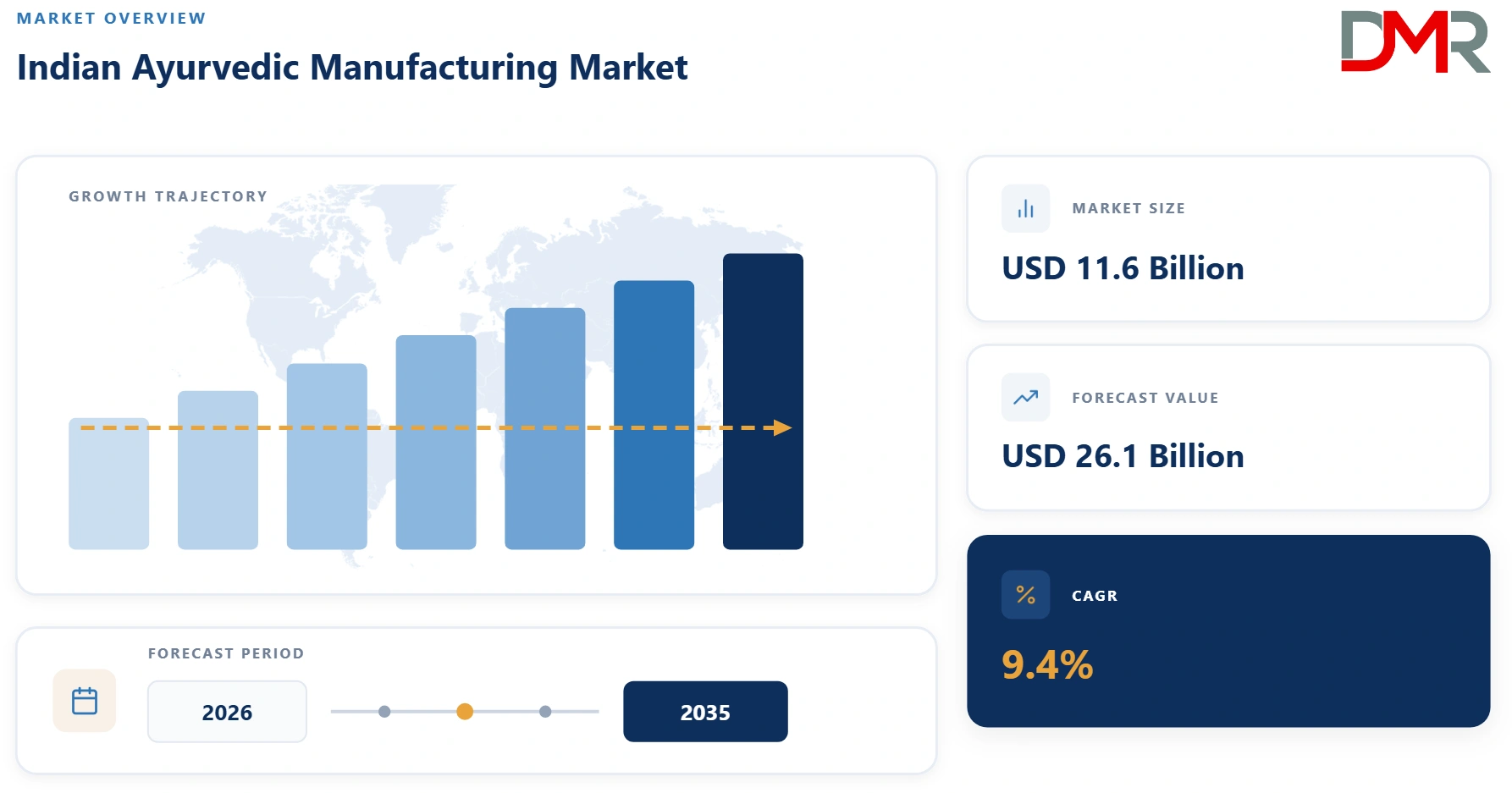
- Market Size in 2026: USD 11.6 billion
- Market Size in 2035: USD 26.1 billion
- CAGR, 2026–2035: 9.4%
- Leading Product Type, 2026: Ayurvedic Medicines, 43.0%
- Leading Dosage Form, 2026: Tablets & Capsules, 34.0%
- Leading Ingredient Source, 2026: Plant-Based, 88.0%
- Leading Distribution Channel, 2026: Offline, 69.0%
- Leading End User, 2026: Consumers, 64.0%
- Fastest-Growing Segment: E-Commerce Platforms, 14.2% CAGR
What is the Indian Ayurvedic Manufacturing and its Market Size?
The market is estimated at USD 11.6 billion in 2026 and is projected to reach approximately USD 26.1 billion by 2035, representing a 9.4% CAGR.
ℹ
To learn more about this report –
Download Your Free Sample Report Here
The Indian Ayurvedic Manufacturing Market comprises the production and commercialization of products based on Ayurvedic principles, formulations, ingredients and therapeutic traditions. It includes classical and proprietary Ayurvedic medicines, herbal nutraceuticals and supplements, personal-care products, oils, creams, powders, juices, Ayurveda-linked foods and beverages, and related wellness products. Manufacturing ranges from large-scale GMP-compliant facilities operated by national brands to specialized regional manufacturers and smaller producers. The industry's value proposition combines traditional Indian knowledge with standardized processing, modern packaging, quality control, formulation science, branding and increasingly sophisticated digital distribution.
Use Cases
- Preventive wellness: Daily Ayurvedic supplements, tonics and herbal formulations support consumers pursuing long-term health and wellness.
- Chronic-condition support: Ayurvedic formulations are increasingly used alongside conventional care for long-duration wellness-management needs.
- Personal care: Herbal shampoos, oils, skincare, oral-care and cosmetic formulations capitalize on demand for natural ingredients.
- Digestive and immunity wellness: Chyawanprash, herbal juices, digestive formulations and supplements remain major consumer applications.
- Sports and active wellness: Ashwagandha, protein products, recovery formulations and herbal supplements target fitness-oriented consumers.
- Clinical Ayurveda: Licensed medicines and classical formulations are supplied through Ayurvedic physicians, clinics and healthcare institutions.
Key Takeaways
- Market Size: Indian Ayurvedic Manufacturing is estimated at USD 11.6 billion in 2026, reaching USD 26.1 billion by 2035.
- Growth: The market is projected to expand at approximately 9.4% CAGR during 2026–2035.
- Key Drivers: Preventive healthcare, natural-product adoption, premiumization, digital commerce, formalization and global interest in Ayurveda.
- Segment Dominance: Ayurvedic medicines lead product categories, plant-based ingredients dominate sourcing, and offline distribution remains largest.
- Fastest Growth: E-commerce is expected to be the fastest-growing distribution sub-segment, supported by direct-to-consumer brands, marketplace penetration and personalized digital marketing.
- Industry Direction: The competitive basis is shifting from traditional heritage alone toward Ayurveda + science, standardized quality, traceability, clinical substantiation and premium branding.
How AI/Gen AI is Transforming the Indian Ayurvedic Manufacturing Market?
AI, IoT and advanced manufacturing are increasingly being applied across Ayurvedic product development, raw-material identification, batch monitoring, demand forecasting and quality assurance. Manufacturers can use analytical databases and AI-assisted systems to identify formulation patterns, optimize ingredient combinations and forecast demand, while IoT-enabled equipment can monitor temperature, humidity, extraction and processing parameters in real time. Digital traceability is also becoming increasingly relevant as manufacturers seek stronger control over medicinal plants and raw materials.
The principal benefits are higher consistency, reduced manufacturing waste, improved inventory planning, stronger quality control and lower unit costs at scale. Automation also enables standardized tablet, capsule, powder, liquid and cosmetic production while preserving formulation flexibility. India's AYUSH ecosystem already emphasizes technology upgrades, analytical testing, certification and manufacturing quality improvement
Key Drivers in the Indian Ayurvedic Manufacturing Market
Preventive Healthcare and Natural-Product Adoption
Consumer behavior is moving toward prevention, holistic wellness and lifestyle management rather than treatment alone. Ayurveda is particularly well positioned because its product ecosystem extends beyond prescription-style medicines into supplements, nutrition, personal care, massage oils, digestive products and everyday wellness. Increasing health awareness among urban consumers is creating demand for products perceived as natural, plant-derived and compatible with long-term use. The expansion of organized retail and e-commerce is also bringing traditionally regional Ayurvedic products to national consumers. Recent market research identifies preference for natural and chemical-free wellness products and preventive healthcare as major growth factors.
Formalization, Standardization and Globalization
The progressive formalization of Ayurveda manufacturing is a major driver of the Indian Ayurvedic Manufacturing Market. Government initiatives promoting GMP compliance, testing infrastructure, certification, quality control and digital licensing are improving manufacturing standards across the industry. At the same time, export-promotion initiatives are helping Indian Ayurvedic manufacturers expand into international markets. Greater standardization enables established manufacturers to differentiate themselves from low-quality and unorganized producers, strengthens consumer confidence, improves product consistency and supports compliance with international quality expectations. As manufacturers increasingly adopt modern production systems, testing protocols and traceable supply chains, the Indian Ayurvedic Manufacturing Market is becoming more organized and competitive, creating stronger opportunities for companies with high-quality, scalable and export-ready manufacturing capabilities.
Restraints in the Indian Ayurvedic Manufacturing Market
Raw-Material Quality, Supply and Standardization
Ayurvedic manufacturing remains highly dependent on medicinal plants, botanical extracts, minerals and other natural inputs whose chemical composition can vary according to geography, season, cultivation methods, harvesting practices and storage conditions. This creates challenges in achieving consistent active-ingredient profiles across batches. Climate variability and supply disruptions can further affect availability and prices. Manufacturers must invest in supplier qualification, authentication, testing, storage and traceability. The problem is especially significant for smaller manufacturers with limited analytical infrastructure. India's E-Charak platform is one government initiative supporting medicinal-plant market information and stakeholder connectivity, illustrating the industry's need for better raw-material market infrastructure.
Regulatory Complexity and Evidence Requirements
The market spans medicines, foods, supplements, cosmetics and wellness products, creating different regulatory requirements depending on product classification. Manufacturers must manage licensing, GMP, labeling, safety, ingredient restrictions, advertising claims and quality testing. International expansion adds further complexity because an Ayurvedic product may be classified as a medicine, supplement, cosmetic or food in different jurisdictions. Increasing scrutiny of efficacy and safety claims can also raise R&D costs. The regulatory direction is nevertheless becoming more structured: India's AYUSH framework includes GMP requirements and dedicated mechanisms for licensing and quality certification.
Growth Opportunities in the Indian Ayurvedic Manufacturing Market
Premium, Science-Backed Ayurveda
One of the largest white-space opportunities is the development of premium Ayurvedic products positioned around Ayurveda + modern science. Consumers increasingly expect clean-label ingredients, standardized extracts, clinical evidence, transparent sourcing and contemporary formats such as gummies, capsules, functional beverages and concentrated extracts. Large manufacturers are already moving in this direction. For example, Dabur launched its science-oriented Siens nutraceutical brand in 2025, targeting beauty, daily wellness and gut-health categories.
Digital Commerce and Export-Led Manufacturing
Digital commerce provides manufacturers with a scalable route to consumers without requiring equivalent physical-distribution investment. Direct-to-consumer websites, marketplaces, social commerce, subscriptions and personalized wellness recommendations can increase product discovery and repeat purchases. Internationally, exporters can use India's Ayurvedic heritage as a differentiation platform while developing products designed for foreign regulatory environments. India's AYUSH export ecosystem is becoming more organized, with the Ayush Export Promotion Council supporting export procedures, regulatory compliance, international exhibitions and overseas market development.
Trends in the Indian Ayurvedic Manufacturing Market
Ayurveda Meets Modern Consumer Formats
Traditional formulations are increasingly being converted into convenient contemporary formats such as tablets, capsules, gummies, ready-to-drink beverages, functional foods, serums and modern skincare. The objective is to reduce preparation complexity and fit Ayurveda into fast-paced lifestyles. Product portfolios from major manufacturers increasingly span medicines, supplements, personal care and food categories rather than remaining confined to classical dosage forms.
Omnichannel and Direct-to-Consumer Ayurveda
The market is shifting from a predominantly pharmacy/store-led model toward an omnichannel structure combining pharmacies, Ayurvedic stores, modern retail, marketplaces and manufacturer-owned digital channels. Online channels enable brands to educate consumers, gather first-party data and sell specialized products nationwide. This is particularly advantageous for newer Ayurvedic brands that lack the physical distribution networks of established FMCG companies.
Research Scope and Analysis
The market is segmented by Product Type, Dosage Form, Ingredient Source, Distribution Channel and End User. The analysis covers medicines, supplements, personal care, food and beverage products manufactured for Indian consumers and institutional markets.
ℹ
To learn more about this report –
Download Your Free Sample Report Here
By Product Type Analysis
Ayurvedic Medicines represented the dominant product category in 2026, accounting for an estimated 43.0% of the market, supported by Ayurveda's established therapeutic role, physician/clinic demand and extensive portfolios of classical and proprietary formulations. Ayurvedic Nutraceuticals & Supplements, estimated at 27.0%, represent the second-largest category as consumers increasingly adopt Ayurveda for immunity, stress, sleep, digestion, sports nutrition and preventive wellness. Within medicines, classical formulations retain strong demand because of established practitioner familiarity, while proprietary formulations are gaining share through modern branding and targeted indications. Ayurvedic Personal Care Products, estimated at roughly 21.0%, benefit from natural-beauty trends and the ability to combine Ayurvedic ingredients with contemporary cosmetic science. Ayurvedic Food & Beverages, at approximately 9.0%, is the smaller category but is forecast to be the fastest-growing product segment at around 12.4% CAGR, driven by functional beverages, herbal juices, Ayurveda Aahara products and everyday wellness nutrition.
By Dosage Form Analysis
Tablets & Capsules lead the dosage-form segmentation with an estimated 34.0% share in 2026, reflecting convenience, precise dosing, long shelf life, portability and compatibility with large-scale automated manufacturing. Liquids account for approximately 22.0%, supported by syrups, herbal juices, tonics and traditional liquid preparations. Oils, with around 18.0%, remain important because of Ayurveda's established use of medicated oils for hair care, massage and wellness. Powders & Granules represent approximately 15.0%, retaining relevance in classical formulations, herbal powders and customizable preparation. Creams, Gels & Ointments contribute about 11.0%. The fastest-growing dosage-form category is estimated to be Tablets & Capsules at approximately 10.8% CAGR, as manufacturers convert traditional formulations into convenient standardized formats. However, modern liquid and gummy formats are expected to outperform in selected nutraceutical niches.
By Ingredient Source Analysis
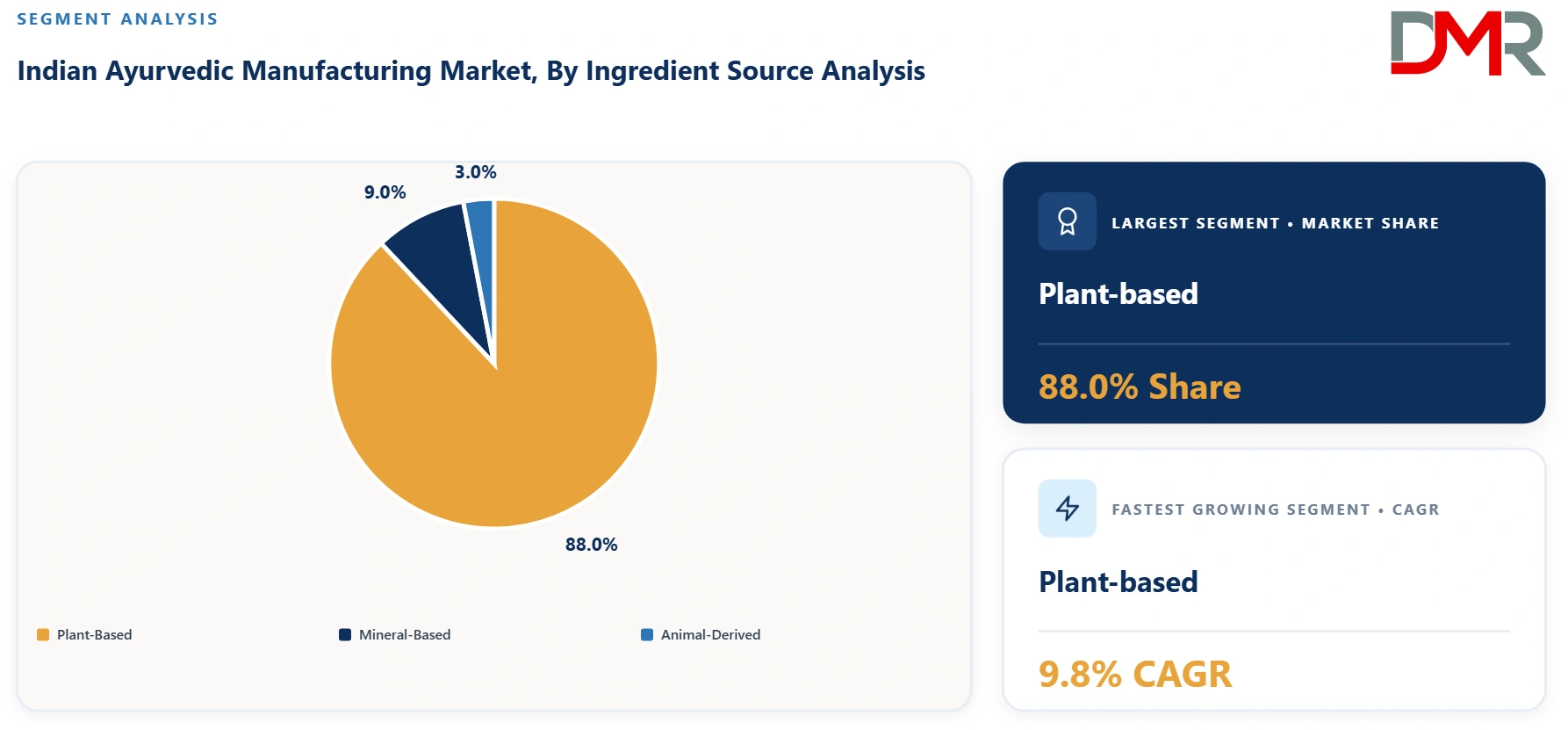
Plant-Based ingredients dominate with an estimated 88.0% share in 2026, reflecting Ayurveda's extensive botanical heritage and consumer preference for herbal and natural ingredients. The segment benefits from broad availability of botanical inputs, established traditional knowledge and strong marketing appeal around natural wellness. Mineral-Based formulations account for approximately 9.0%, retaining importance in classical herbomineral and Rasa Shastra preparations but facing higher requirements for quality control, testing and consumer education. Animal-Derived ingredients represent roughly 3.0% and remain a niche category because of ethical, regulatory and consumer-preference considerations. Plant-based products are expected to remain dominant, while standardized botanical extracts, organically cultivated medicinal plants and traceable sourcing are projected to generate the strongest growth. The plant-based segment is estimated at 9.8% CAGR, supported by both domestic demand and international clean-label positioning.
By Distribution Channel Analysis
Offline channels retain the largest share at approximately 69.0% in 2026, reflecting India's deep pharmacy network, Ayurvedic stores, clinics, hospitals and traditional retail relationships. Within offline distribution, pharmacies and Ayurvedic stores represent the largest component, followed by specialty/health stores and healthcare institutions. Online channels account for an estimated 31.0%, split between e-commerce marketplaces and brand-owned digital channels. Online is the fastest-growing distribution segment at approximately 14.2% CAGR, substantially above overall market growth. Digital channels offer national reach, lower customer-acquisition barriers for emerging brands, detailed product education, personalized recommendations and subscription-based purchasing. Brand-owned channels are particularly valuable because they provide first-party consumer data and stronger control over pricing and brand presentation.
By End User Analysis
Consumers account for approximately 64.0% of 2026 demand, making them the largest end-user group. Consumer demand spans everyday wellness, supplements, personal care, digestive products, immunity, hair care and preventive health. Healthcare Institutions & Ayurvedic Clinics represent around 22.0%, driven by practitioner-recommended medicines and institutional procurement. Wellness & Spa Centers account for approximately 14.0%, particularly through oils, creams, massage products and wellness formulations. The fastest-growing end-user category is estimated to be Wellness & Spa Centers at approximately 11.6% CAGR, reflecting the expansion of integrated wellness tourism, premium spas and holistic lifestyle services. Nevertheless, consumers will remain the principal revenue pool because Ayurvedic products are increasingly becoming routine consumer packaged goods rather than exclusively practitioner-mediated medicines.
The Indian Ayurvedic Manufacturing Market Report is segmented on the basis of the following:
By Product Type
- Ayurvedic Medicines
- Classical Formulations
- Proprietary Formulations
- Ayurvedic Nutraceuticals & Supplements
- Ayurvedic Personal Care Products
- Ayurvedic Food & Beverages
By Dosage Form
- Tablets & Capsules
- Powders & Granules
- Liquids
- Oils
- Creams, Gels & Ointments
By Ingredient Source
- Plant-Based
- Mineral-Based
- Animal-Derived
By Distribution Channel
- Offline
- Pharmacies & Ayurvedic Stores
- Hospitals & Clinics
- Specialty & Health Stores
- Online
- E-Commerce Platforms
- Brand-Owned Online Channels
By End User
- Healthcare Institutions & Ayurvedic Clinics
- Wellness & Spa Centers
- Consumers
Regulatory Landscape
India's Ayurvedic manufacturing environment is becoming progressively more formalized through licensing, GMP, laboratory testing, product standards and certification mechanisms. The Ministry of AYUSH reports that GMP requirements apply to Ayurvedic, Siddha and Unani manufacturing, while the broader ecosystem includes e-AUSHADHI licensing and AYUSH Standard/Premium Mark initiatives. Regulation creates compliance costs, particularly for small manufacturers, but simultaneously provides an opportunity for credible companies to differentiate on quality, traceability and safety. The growing international focus on standardized terminology and quality benchmarks should benefit export-oriented manufacturers. The key risk is regulatory fragmentation across medicines, foods, supplements and cosmetics, which increases classification and compliance complexity.
Investment and White Space Analysis
Investment opportunities are strongest in standardized botanical extracts, clinical-grade nutraceuticals, premium personal care, functional beverages, digital-first brands and export-oriented manufacturing. The market remains fragmented outside the largest national players, creating scope for consolidation and strategic acquisitions. Emami demonstrated this strategy in April 2026 by agreeing to acquire the remaining stake in Axiom Ayurveda, a business spanning Ayurvedic juices and health-oriented beverages, for aggregate consideration of up to INR 200 crore. Attractive white spaces include traceable medicinal-plant supply chains, evidence-backed formulations, personalized Ayurveda and convenient modern dosage forms. Principal investment risks include raw-material variability, regulatory claims, efficacy substantiation and intense competition from established FMCG brands..
Competitive Landscape
The Indian Ayurvedic Manufacturing Market is moderately fragmented but increasingly consolidating, with large national brands competing alongside regional manufacturers, specialist Ayurvedic companies, nutraceutical startups and private-label producers. Major competitors differentiate through brand heritage, manufacturing scale, physician relationships, product breadth, distribution reach, ingredient sourcing, R&D and consumer trust. Dabur, Patanjali Ayurved, Himalaya Wellness, Baidyanath and Emami are among the prominent organized players, alongside Kerala Ayurveda, Vicco and numerous regional manufacturers. Competitive strategies increasingly include portfolio expansion, acquisitions, premiumization, science-backed formulations, e-commerce investment, exports and omnichannel distribution.
Some of the prominent players in the Indian Ayurvedic Manufacturing Market are:
- Dabur India
- Patanjali Ayurved
- Himalaya Wellness
- Shree Baidyanath Ayurved Bhawan
- Emami
- Charak Pharma
- Kerala Ayurveda
- Vicco Laboratories
- Amrutanjan Health Care
- Sri Sri Tattva
- Maharishi Ayurveda
- Hamdard India
- Zandu Pharmaceuticals
- Arya Vaidya Pharmacy (AVP)
- Arya Vaidya Sala (Kottakkal)
- The Arya Vaidya Pharmacy
- Sandu Pharmaceuticals
- Shahnaz Husain Group
- Biotique
- Herbal Hills
- Kapiva
- Jiva Ayurveda
- Vaidyaratnam Oushadhasala
- Vaidyaratnam P.S. Varier's Arya Vaidya Sala
- Nagarjuna Ayurvedic Group
- AVN Ayurveda Formulations
- Kairali Ayurvedic Group
- Sitaram Ayurveda
- Kottakkal Ayurveda
- Kerala Ayurveda Limited
- AyurVaid Hospitals
- Ayurvet
- AIMIL Pharmaceuticals
- Baidyanath Group
- Rasna International
- Sri Baidyanath Ayurved Bhawan
- Ban Labs
- Shree Dhanwantri Herbals
- Planet Ayurveda
- Vyas Pharmaceuticals
- Other Key Players
Recent Developments
- April 2026: Emami announced an agreement to acquire the remaining approximately 73.5% stake in Axiom Ayurveda, expanding its exposure to Ayurvedic beverages and health-oriented products for aggregate consideration of up to INR 200 crore.
- October 2025: Dabur announced Dabur Ventures, an investment platform with capital allocation of up to INR 500 crore targeting digital-first businesses across personal care, healthcare, wellness foods, beverages and Ayurveda.
- June 2025: Dabur entered the nutraceutical category with Siens, a digital-first wellness brand covering beauty and skin health, daily wellness and gut health, reflecting the industry's shift toward science-oriented supplementation.
- January 2025: Dabur launched a Pure Aloe Vera Gel enriched with hyaluronic acid, illustrating the convergence of Ayurvedic/natural positioning with modern cosmetic ingredients and formulation technology.
Report Details
| Report Characteristics |
| Market Size (2026) |
USD 11.6 Bn |
| Forecast Value (2035) |
USD 26.1 Bn |
| CAGR (2026–2035) |
9.4% |
| Historical Data |
2021 – 2025 |
| Forecast Data |
2026 – 2035 |
| Base Year |
2025 |
| Segments Covered |
By Product Type, By Dosage Form, By Ingredient Source, By Distribution Channel, By End User |
| Country Coverage |
India |
Frequently Asked Questions
What is the size of the Indian Ayurvedic Manufacturing Market in 2026?
▾ The Indian Ayurvedic Manufacturing Market is estimated at USD 11.6 billion in 2026, covering medicines, supplements, personal care, food and beverage products.
What will be the Indian Ayurvedic Manufacturing Market size by 2035?
▾ The Indian Ayurvedic Manufacturing Market is projected to reach approximately USD 26.1 billion by 2035, supported by sustained consumer adoption and manufacturing formalization.
What is the CAGR of the Indian Ayurvedic Manufacturing Market?
▾ The Indian Ayurvedic Manufacturing Market is expected to expand at approximately 9.4% CAGR between 2026 and 2035, driven by increasing domestic and international demand.
What are the key drivers of the Indian Ayurvedic Manufacturing Market?
▾ Key drivers of the Indian Ayurvedic Manufacturing Market include preventive healthcare, natural-product demand, premiumization, e-commerce, quality standards, product innovation and global interest in Ayurveda.
Which segment dominates the Indian Ayurvedic Manufacturing Market?
▾ Ayurvedic Medicines dominate the Indian Ayurvedic Manufacturing Market by product type, accounting for an estimated 43.0% share in 2026.
Which is the fastest-growing segment in the Indian Ayurvedic Manufacturing Market?
▾ E-Commerce Platforms are expected to be the fastest-growing distribution sub-segment in the Indian Ayurvedic Manufacturing Market, with approximately 14.2% CAGR.
Who are the major players in the Indian Ayurvedic Manufacturing Market?
▾ Major players in the Indian Ayurvedic Manufacturing Market include Dabur, Patanjali Ayurved, Himalaya Wellness, Baidyanath and Emami, alongside numerous regional manufacturers.
How is the Indian Ayurvedic Manufacturing Market segmented?
▾ The Indian Ayurvedic Manufacturing Market is segmented by Product Type, Dosage Form, Ingredient Source, Distribution Channel and End User, providing detailed demand and competitive analysis.