Industrial Water Recycling Market Snapshot
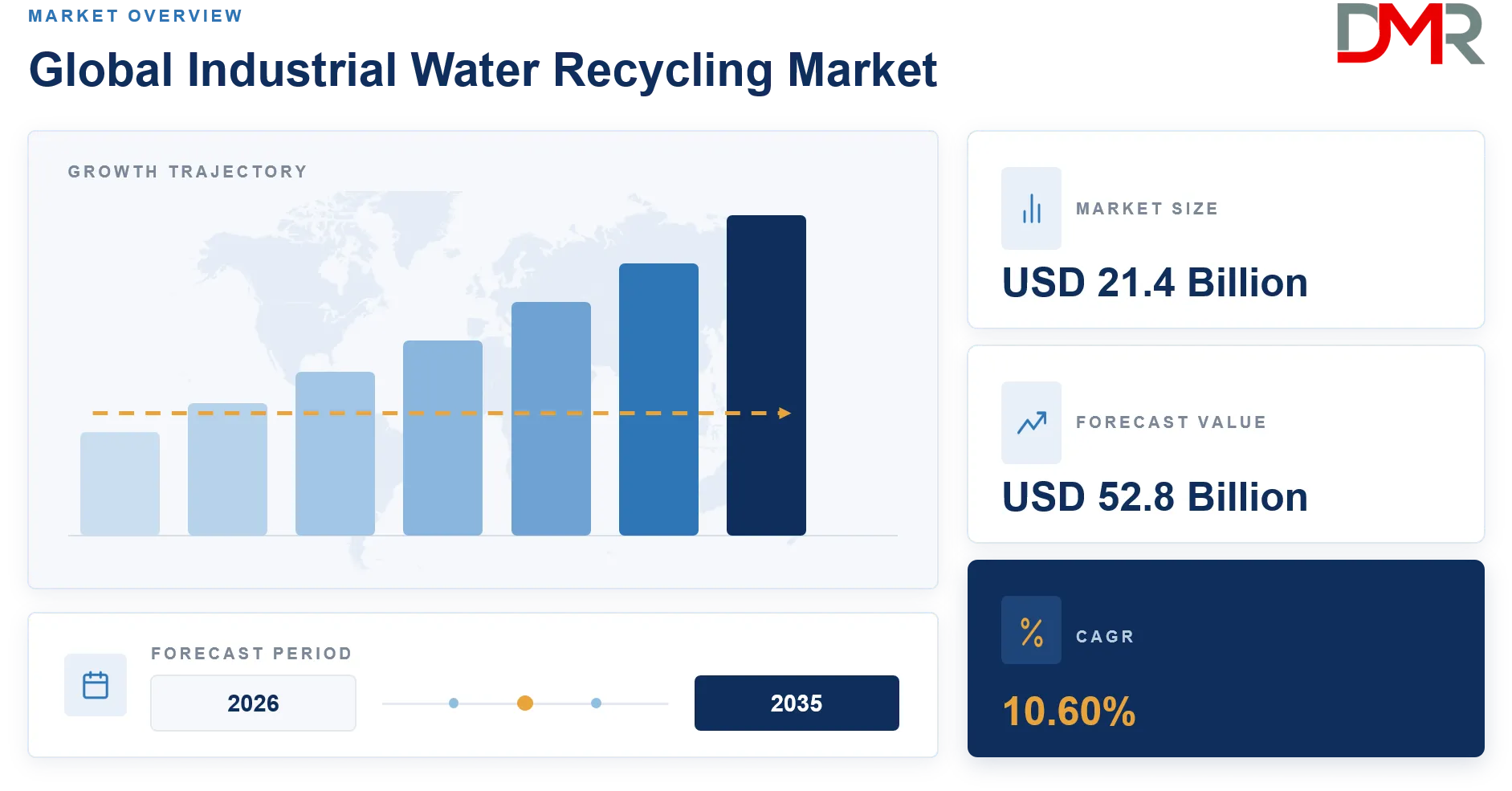
- Market Value: Industrial Water Recycling Market is valued at USD 21.4 billion in 2026 and is projected to reach USD 52.8 billion by 2035.
- CAGR: Industrial Water Recycling Market is expected to grow at a CAGR of 10.6% from 2026 to 2035.
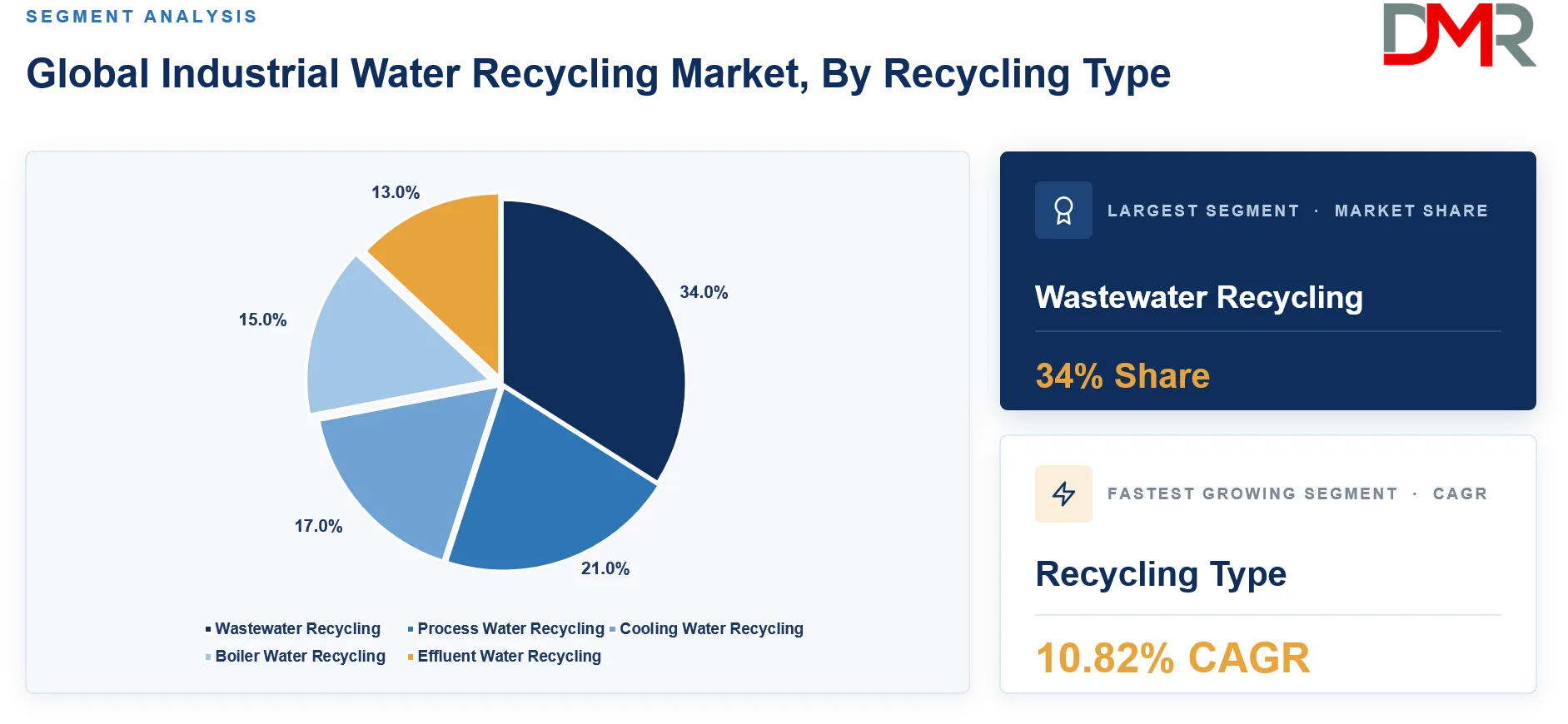
- By Recycling Type Analysis: Wastewater Recycling led the recycling type segment with a 34% share in 2026.
- By Technology Segment Analysis: Membrane Filtration led technology types with a 42% share in 2026.
- By End-User Industry Segment Analysis: Power Generation held a 21% share in 2026.
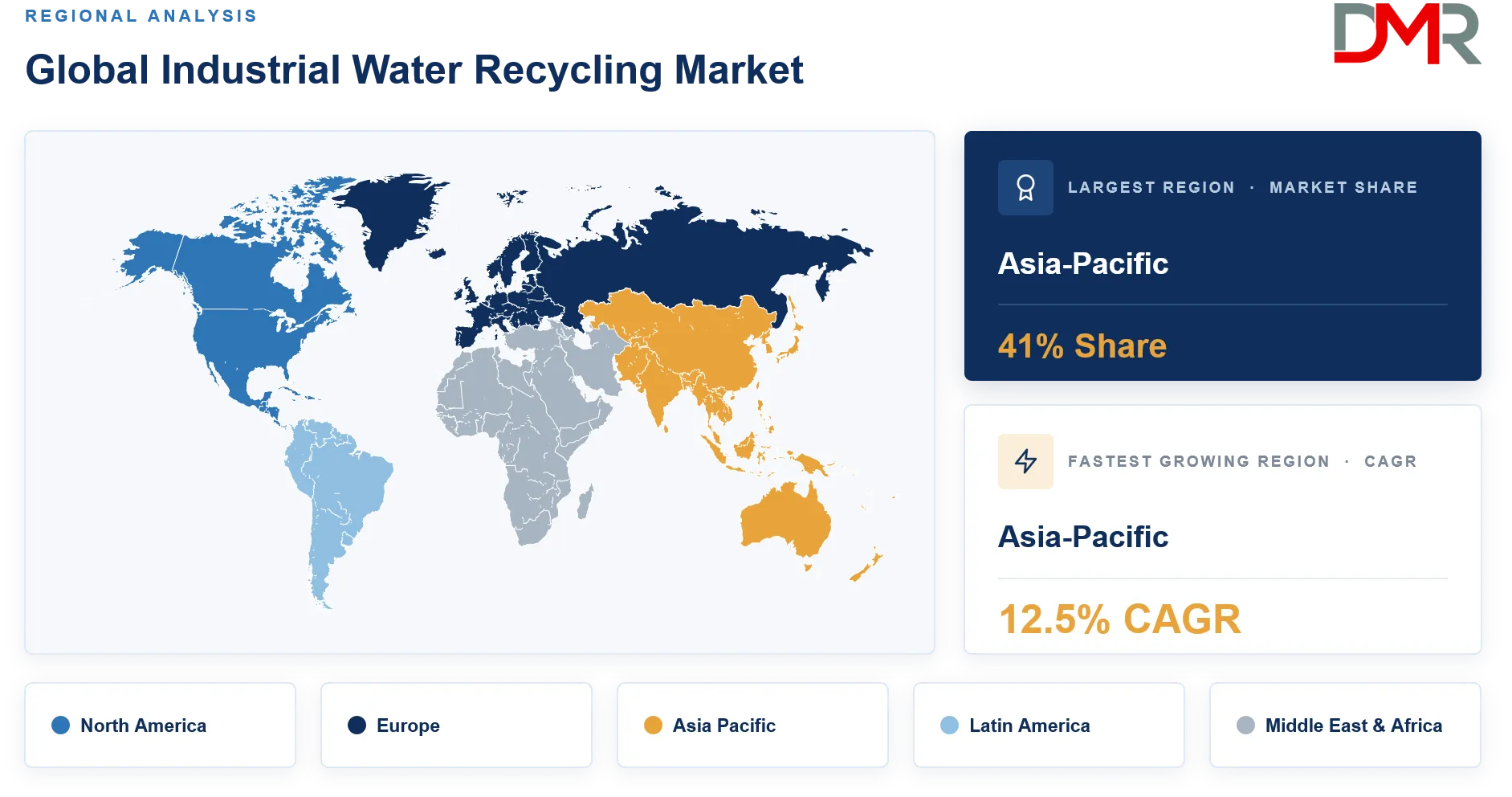
- Regional Analysis: Asia-Pacific led the Industrial Water Recycling Market with a 41% revenue share in 2026.
- US Market Size: The United States size is expected to reach USD 9.8 billion by 2035 from USD 4.3 billion in 2026, at a CAGR of 9.5%.
- India Market Size: The India size is expected to reach USD 7.6 billion by 2035 from USD 2.9 billion in 2026, at a CAGR of 11.3%.
- China Market Size: The China size is expected to reach USD 11.2 billion by 2035 from USD 4.8 billion in 2026, at a CAGR of 9.8%.
- Major Players: Veolia Water Technologies, SUEZ Water Technologies & Solutions, Xylem Inc., DuPont Water Solutions, and Others.
What is the Industrial Water Recycling Market and its Market Size?
The Industrial Water Recycling Market size is projected to be valued at USD 21.4 billion in 2026 and is projected to reach USD 52.8 billion by 2035, expanding at a CAGR of 10.6% during the forecast period. Industrial water recycling covers equipment, treatment processes, membrane systems, biological treatment, chemical treatment, zero liquid discharge systems, storage, monitoring, and supporting infrastructure used to collect, treat, recover, and reuse industrial wastewater. The market addresses cooling water, boiler feed, process water, equipment washing, utility water, and wastewater discharge reduction across water-intensive industries.
ℹ
To learn more about this report –
Download Your Free Sample Report Here
Industrial water recycling demand is moving beyond basic wastewater compliance toward plant-level water security and operating efficiency. Manufacturing facilities increasingly evaluate the cost of freshwater withdrawal, wastewater discharge, production interruptions, treatment chemicals, pumping, and thermal energy together. This changes the business case for reuse systems. Plants can design treatment trains around the quality needed for each application instead of treating every stream to one specification. Membrane filtration, biological treatment, advanced oxidation, chemical conditioning, and ZLD technologies therefore serve different water-quality and recovery requirements.
Use Cases
- Cooling Water Reuse: Industrial facilities treat wastewater for cooling towers to reduce freshwater withdrawal and improve supply reliability. Filtration, membrane treatment, softening, and disinfection help control suspended solids, salts, scaling, corrosion, and biological growth in recirculating cooling systems.
- Boiler Feed Water: Recycled water can be upgraded through reverse osmosis, ion removal, polishing, and chemical conditioning for boiler applications. High-quality treatment reduces dissolved solids and impurities that can cause scaling, deposition, corrosion, and lower thermal efficiency in steam systems.
- Process Water Recovery: Manufacturers recover rinse water, wash water, condensate, and process effluent for reuse within production. The treatment configuration depends on contaminants, conductivity, organic loading, product-quality requirements, and the level of water recovery required at the facility.
- Wastewater Discharge Reduction: High-recovery and zero liquid discharge systems reduce the volume of wastewater sent to sewers, surface-water discharge points, or external treatment facilities. This is particularly relevant for industrial sites facing discharge restrictions, high disposal charges, or limited receiving-water capacity.
- Equipment Washing and Utility Water: Treated wastewater can replace freshwater for equipment cleaning, floor washing, utility operations, dust control, and other non-product-contact uses. These applications can offer an accessible entry point for companies starting plant-wide water reuse programs.
How AI/Gen AI is Transforming the Industrial Water Recycling Market?
Artificial intelligence and data-driven automation are changing how industrial recycling systems are operated rather than replacing the underlying treatment processes. Smart monitoring platforms combine conductivity, pressure, flow, turbidity, pH, temperature, dissolved solids, membrane pressure differential, and energy data to detect performance changes earlier. Predictive models can identify membrane fouling, abnormal pump behavior, chemical dosing deviations, and declining recovery efficiency before they cause an unscheduled shutdown. For operators managing large treatment trains, this supports more stable water quality and reduces dependence on fixed maintenance intervals.
Generative and analytical tools also support engineering workflows, maintenance records, operating procedures, and troubleshooting. Treatment providers can use plant operating data to compare water-quality conditions with previous fouling events, optimize clean-in-place cycles, or recommend changes in pretreatment. Digital systems are especially valuable in decentralized installations where specialist water-treatment staff may not be continuously available. The commercial opportunity is therefore strongest where automation is integrated with sensors, membranes, pumps, dosing systems, and remote service contracts, creating recurring software and lifecycle service revenue for technology suppliers.
Key Drivers in the Industrial Water Recycling Market
Growing Industrial Water Security Requirements
Water availability is becoming an operating risk for power plants, chemical facilities, refineries, semiconductor production sites, food processors, textile mills, and other water-intensive industries. Recycling allows facilities to create an internal source of treated water and reduce dependence on variable freshwater supplies. The investment case becomes stronger where water withdrawal limits, seasonal shortages, rising utility charges, or production expansion make additional freshwater difficult or costly to secure.
Improving Economics of High-Recovery Treatment
Advances in reverse osmosis, ultrafiltration, membrane bioreactors, automated controls, energy recovery, pretreatment, and fouling management are improving the feasibility of industrial water reuse. Rather than evaluating only treatment equipment cost, operators increasingly assess avoided freshwater purchases, wastewater fees, disposal costs, downtime risk, and recovered heat or materials. This whole-system approach supports investment in higher-recovery treatment trains and creates demand for integrated equipment, engineering, operations, and monitoring services.
Restraints in the Industrial Water Recycling Market
High Capital Cost for Complex Treatment Trains
Industrial effluent can contain dissolved salts, oils, heavy metals, suspended solids, organic compounds, nutrients, or process-specific contaminants. Difficult streams may require biological treatment, clarification, ultrafiltration, reverse osmosis, advanced oxidation, evaporation, and crystallization in sequence. This increases capital expenditure and engineering complexity. Smaller industrial plants may delay adoption when water and discharge costs remain below the financial threshold needed to justify a sophisticated recycling system.
Membrane Fouling and Concentrate Management
Higher water recovery concentrates contaminants into a smaller liquid volume. Membrane fouling, scaling, biological growth, variable feed chemistry, and disposal of concentrated brine can materially affect operating cost. Zero liquid discharge can solve the liquid disposal issue, but evaporation and crystallization require additional energy and equipment. Suppliers that reduce pretreatment requirements, improve membrane life, control scaling, or lower brine concentration costs can address one of the key technical barriers to wider adoption.
Growth Opportunities in the Global Industrial Water Recycling Market
Expansion of Decentralized and Modular Recycling Systems
Modular treatment systems create opportunities at industrial sites where centralized infrastructure is unavailable or where water requirements change as production expands. Containerized membrane, biological, filtration, and polishing units can be installed close to the wastewater source and expanded in stages. This reduces construction complexity and enables companies to target specific reuse loops. Suppliers can combine modular equipment with remote monitoring and service contracts to build recurring revenue beyond the initial system sale.
High-Purity Water Recovery for Advanced Manufacturing
Electronics, pharmaceuticals, specialty chemicals, battery manufacturing, and other advanced industries require tightly controlled process water. Their wastewater may also contain streams that can be separated and treated for reuse. This creates opportunities for ultrafiltration, nanofiltration, reverse osmosis, advanced oxidation, ion removal, polishing, and real-time monitoring. Technology providers capable of maintaining consistent recycled-water quality while reducing freshwater intake can address a higher-value segment of industrial water management.
Trends in the Industrial Global Water Recycling Market
Shift Toward Fit-for-Purpose Water Treatment
Industrial facilities are increasingly matching recycled-water quality to its final use instead of producing a single high-purity stream for every application. Cooling systems, wash water, boiler feed, process water, and product-contact applications have different treatment requirements. Fit-for-purpose design can reduce unnecessary treatment, chemicals, energy use, and membrane loading. This trend supports multi-stage recycling networks that separate wastewater streams and route recovered water according to quality.
Integration of Membranes with ZLD and Resource Recovery
Membrane concentration is increasingly combined with evaporation, crystallization, chemical recovery, or selective separation where very high water recovery is required. Reverse osmosis can recover a large portion of reusable water before thermal treatment, reducing the volume entering energy-intensive ZLD equipment. The resulting architecture creates opportunities for membrane manufacturers, evaporator suppliers, process integrators, chemical providers, and monitoring companies that can optimize the entire treatment train rather than a single unit operation.
Research Scope and Analysis
The Industrial Water Recycling Market is segmented based on Recycling Type, Technology, Equipment, Capacity, Application, End-User Industry, System Configuration, and geography. The study examines industrial adoption, system requirements, water-quality targets, technology deployment, demand patterns, equipment procurement, operating conditions, and the contribution of major segments to overall Industrial Water Recycling Market growth.
ℹ
To learn more about this report –
Download Your Free Sample Report Here
By Recycling Type
Wastewater Recycling dominated the recycling type segment with a 34% share in 2026. Its position reflects the large volume of wastewater generated by power generation, chemicals, oil and gas, food processing, pharmaceuticals, metals, pulp and paper, and textile operations. Industrial facilities can reuse treated effluent for cooling, washing, process applications, utilities, and boiler systems depending on water quality. Wastewater recycling also provides a direct route to lowering discharge volume while reducing freshwater consumption. Process water, cooling water, boiler water, and effluent recycling remain important submarkets as companies build more targeted closed-loop systems.
By Technology
Membrane Filtration led the technology segment with a 42% share in 2026. Reverse osmosis is widely used for dissolved salt reduction and high-quality reuse, while ultrafiltration and microfiltration provide effective pretreatment and suspended-solid removal. Nanofiltration offers selective separation where partial salt or hardness removal is appropriate. Membrane systems can also be integrated with membrane bioreactors, chemical treatment, advanced oxidation, and ZLD. Their modular design and ability to deliver predictable treated-water quality make membranes central to process-water recovery, boiler feed treatment, cooling reuse, and high-purity industrial applications.
By End-User Industry
Power Generation held a 21% share of the Industrial Water Recycling Market in 2026. Power facilities require significant volumes of water for cooling, steam cycles, boiler feed, flue-gas treatment, cleaning, and other utility functions. Recycling can reduce dependence on freshwater and help plants manage wastewater discharge. Cooling-water recovery represents a particularly important opportunity because small improvements in cycles of concentration and blowdown recovery can affect total facility water demand. Membrane treatment, clarification, biological processes, chemical conditioning, and ZLD systems are deployed according to plant configuration and discharge requirements.
The Global Industrial Water Recycling Market Report is segmented on the basis of the following:
By Recycling Type
- Wastewater Recycling
- Process Water Recycling
- Cooling Water Recycling
- Boiler Water Recycling
- Effluent Water Recycling
By Technology
- Membrane Filtration
- Reverse Osmosis
- Ultrafiltration
- Microfiltration
- Nanofiltration
- Biological Treatment
- Membrane Bioreactors
- Activated Sludge
- Moving Bed Biofilm
- Chemical Treatment
- Coagulation Flocculation
- Oxidation Reduction
- Disinfection
- Zero Liquid Discharge
- Evaporation
- Crystallization
- Advanced Oxidation
By Equipment
- Filtration Equipment
- Treatment Machinery
- Storage Tanks
- Pumps
- Membrane Systems
- Monitoring Equipment
By Capacity
- Below 25,000 Liters
- 25,000-50,000 Liters
- 50,000-100,000 Liters
- Above 100,000 Liters
By Application
- Cooling Water Reuse
- Boiler Feed Water
- Process Water Reuse
- Equipment Washing
- Utility Water Reuse
- Wastewater Discharge Reduction
By End-User Industry
- Power Generation
- Oil and Gas
- Chemical Manufacturing
- Pharmaceutical Manufacturing
- Food and Beverage
- Textile Manufacturing
- Pulp and Paper
- Metal Manufacturing
By System Configuration
- Centralized Recycling Systems
- Decentralized Recycling Systems
- Hybrid Recycling Systems
Regional Analysis
Asia-Pacific is the Leading Region in the Industrial Water Recycling Market
Asia-Pacific accounted for 41% of Global Industrial Water Recycling Market revenue in 2026. China, India, Japan, South Korea, and Southeast Asian manufacturing hubs combine high industrial water demand with expanding power, chemicals, electronics, metals, pharmaceutical, textile, and food production. Water constraints around major industrial clusters strengthen demand for wastewater recycling, high-recovery membrane systems, cooling-water reuse, and ZLD. Domestic engineering capability and manufacturing of membranes, pumps, filtration equipment, and treatment systems also support regional deployment.
By Region
North America
Europe
- Germany
- France
- The UK
- Italy
- Spain
- Rest of Europe
Asia-Pacific
- China
- Japan
- India
- Australia
- South Korea
- Rest of APAC
Latin America
- Mexico
- Brazil
- Colombia
- Argentina
- Rest of LATAM
Middle East & Africa
- Saudi Arabia
- The UAE
- South Africa
- Rest of MEA
ℹ
To learn more about this report –
Download Your Free Sample Report Here
Major Countries Analysis
United States Industrial Water Recycling Market
The United States Industrial Water Recycling Market is expected to increase from USD 4.3 billion in 2026 to USD 9.8 billion by 2035 at a CAGR of 9.5%. Growth is supported by manufacturing expansion, water constraints in several industrial states, data-center cooling demand, semiconductor investment, power generation, food processing, refining, and chemical production. Companies increasingly evaluate reuse as part of site resilience planning, creating demand for membrane filtration, advanced oxidation, decentralized systems, digital monitoring, and high-recovery treatment.
China Industrial Water Recycling Market
The China Industrial Water Recycling Market is projected to grow from USD 4.8 billion in 2026 to USD 11.2 billion by 2035 at a CAGR of 9.8%. China has a large installed base of power, steel, chemicals, textiles, electronics, refining, battery production, and industrial parks where water efficiency is commercially important. Expansion of industrial wastewater reuse, unconventional-water utilization, high-efficiency cooling, intelligent water management, and advanced treatment equipment supports demand for membranes, pumps, biological systems, ZLD technologies, and integrated recycling plants.
India Industrial Water Recycling Market
The India Industrial Water Recycling Market is expected to rise from USD 2.9 billion in 2026 to USD 7.6 billion by 2035 at a CAGR of 11.3%. Rapid industrial development and freshwater constraints support recycling investment in power, textiles, pharmaceuticals, chemicals, refineries, food processing, metals, and industrial parks. ZLD and effluent management requirements in high-pollution industries create demand for reverse osmosis, multiple-effect evaporation, crystallization, membrane bioreactors, and advanced pretreatment. Local EPC and water-treatment companies also support wider project execution.
Competitive Landscape
The Industrial Water Recycling Market has a competitive structure that includes global water-technology groups, membrane manufacturers, specialized ZLD providers, equipment companies, chemical-treatment specialists, and engineering firms. Veolia Water Technologies and SUEZ compete through integrated water-management, treatment, reuse, and service capabilities. Xylem, including Evoqua Water Technologies, combines treatment equipment, filtration, disinfection, pumps, analytics, and lifecycle services. DuPont Water Solutions and Toray Industries are important membrane technology suppliers, while Aquatech International and Saltworks Technologies focus strongly on high-recovery treatment, brine concentration, and ZLD applications.
Ecolab through Nalco Water has a strong position in industrial water chemistry and plant-level water optimization. Competitive differentiation increasingly depends on recovery rate, energy intensity, membrane life, concentrate management, automation, operating reliability, service coverage, modularity, and total lifecycle cost. Partnerships with EPC contractors and industrial customers are important because recycling systems usually require site-specific integration rather than standardized equipment alone.
Some of the prominent players in the Global Industrial Water Recycling Industry are:
- Veolia Water Technologies
- SUEZ Water Technologies & Solutions
- Xylem Inc. including Evoqua Water Technologies
- DuPont Water Solutions
- Aquatech International LLC
- Fluence Corporation Limited
- Kurita Water Industries Ltd.
- Ecolab Inc. through Nalco Water
- IDE Technologies Ltd.
- Pentair plc
- Hitachi Ltd. / Hitachi Zosen Corporation
- Kubota Corporation
- Alfa Laval AB
- Toray Industries Inc.
- Siemens AG, Water Technologies
- GE Water & Process Technologies
- Toshiba Infrastructure Systems & Solutions
- VA Tech Wabag Ltd.
- Aquarion AG
- Saltworks Technologies Inc.
- Others
Regulatory Landscape
The Industrial Water Recycling Market is increasingly shaped by tighter water withdrawal, effluent discharge, reuse, and pollution-control requirements across major industrial economies. In the United States, the Clean Water Act and National Pollutant Discharge Elimination System influence industrial wastewater management, while state-level water reuse rules affect project design. The European Union applies the Water Framework Directive and Industrial Emissions Directive to water quality and industrial pollution control. China continues to strengthen industrial water conservation, wastewater treatment, and unconventional water reuse policies. In India, the Central Pollution Control Board and State Pollution Control Boards regulate industrial effluent, while zero liquid discharge requirements apply to selected highly polluting activities and locations. These frameworks increase demand for monitoring, membrane filtration, biological treatment, advanced oxidation, brine management, and ZLD systems as manufacturers seek lower discharge volumes, improved compliance, and secure reusable water supplies.
Technology Analysis
Technology development in the Industrial Water Recycling Market is centered on achieving higher water recovery with lower energy, chemical consumption, membrane fouling, and residual waste. Membrane Filtration held a 42% market share in 2026, supported by reverse osmosis, ultrafiltration, microfiltration, and nanofiltration across process-water and wastewater reuse applications. Membrane bioreactors combine biological treatment with membrane separation where facilities require compact footprints and consistent effluent quality. Advanced oxidation is valuable for difficult organic contaminants, while chemical treatment supports coagulation, precipitation, oxidation, disinfection, and pretreatment. For facilities targeting very high recovery, reverse osmosis is increasingly integrated with evaporation and crystallization in zero liquid discharge configurations. Sensors and automated monitoring further improve control of conductivity, pressure, flow, turbidity, pH, and membrane performance. Future competition will focus on lifecycle cost, recovery rates, energy intensity, modular deployment, membrane durability, and concentrate management.
Recent Developments
- July 2026: Aquatech International LLC completed acquisition of UAE-based Metito Chemical Solutions (METICHEM), expanding industrial water-treatment chemicals and O&M services across MENA and Southeast Asia.
- June 2026: Xylem Inc. signed a long-term agreement with Dow to design, build, and operate advanced water systems at the Fort Saskatchewan industrial complex in Alberta, Canada.
- January 2026: Xylem Inc. completed the USD 7.5 billion acquisition of Evoqua Water Technologies, forming a USD 7 billion revenue platform spanning membranes, analytics, and multi-year service contracts.
Report Details
| Report Characteristics |
| Market Size (2026) |
USD 21.4 Bn |
| Forecast Value (2035) |
USD 52.8 Bn |
| CAGR (2026–2035) |
10.6% |
| The Country Market Size (2026) |
US: USD 4.3 Bn; India: USD 2.9 Bn; China: USD 4.8 Bn |
| Historical Data |
2021 – 2025 |
| Forecast Data |
2026 – 2035 |
| Base Year |
2025 |
| Segments Covered |
By Recycling Type, By Technology, By Equipment, By Capacity, By Application, By End-User Industry, and By System Configuration |
| Regional Coverage |
North America – The US and Canada; Europe – Germany, France, The UK, Italy, Spain, Rest of Europe; Asia-Pacific – China, Japan, India, Australia, South Korea, Rest of APAC; Latin America – Mexico, Brazil, Colombia, Argentina, Rest of LATAM; Middle East & Africa – Saudi Arabia, The UAE, South Africa, Rest of MEA |
Frequently Asked Questions
What is the current size of the Industrial Water Recycling Market?
▾ The Industrial Water Recycling Market size is valued at USD 21.4 billion in 2026 and may reach USD 52.8 billion by 2035.
What is the growth rate of the Industrial Water Recycling Market during?
▾ The Industrial Water Recycling Market is expected to grow at a CAGR of 10.6% during the forecast period 2026-2035.
Which region dominates the global Industrial Water Recycling Market?
▾ Asia-Pacific leads the global Industrial Water Recycling Market with a 41% revenue share in 2026, driven by industrial demand.
What factors are driving the growth of the Industrial Water Recycling Market?
▾ Water scarcity, tighter discharge rules, and process-water reuse are driving Industrial Water Recycling Market growth.
What are the major challenges restraining the Industrial Water Recycling Market?
▾ High capital costs, membrane fouling, energy use, and brine disposal restrain Industrial Water Recycling Market growth.
Which segment holds the largest share of the Industrial Water Recycling Market?
▾ Wastewater Recycling holds a 34% share of the Industrial Water Recycling Market by recycling type in 2026.
Who are the leading companies in the global Industrial Water Recycling Market?
▾ Veolia Water Technologies, SUEZ Water Technologies & Solutions, Xylem Inc., DuPont Water Solutions, Aquatech International LLC, Fluence Corporation Limited, Kurita Water Industries Ltd., Ecolab Inc., IDE Technologies Ltd., Pentair plc, Hitachi Ltd., Hitachi Zosen Corporation, Kubota Corporation, Alfa Laval AB, Toray Industries Inc., Siemens AG, GE Water & Process Technologies, Toshiba Infrastructure Systems & Solutions, VA Tech Wabag Ltd., Aquarion AG, and Saltworks Technologies Inc. are prominent companies in the Industrial Water Recycling Market.
How is AI influencing the Industrial Water Recycling Market?
▾ AI shapes the Industrial Water Recycling Market through predictive maintenance, smart monitoring, and process control.
What are the future opportunities and trends in the Industrial Water Recycling Market?
▾ ZLD, modular systems, membrane advances, and water reuse create new Industrial Water Recycling Market opportunities.