Japan Aging Workforce Factory Automation Market Snapshot
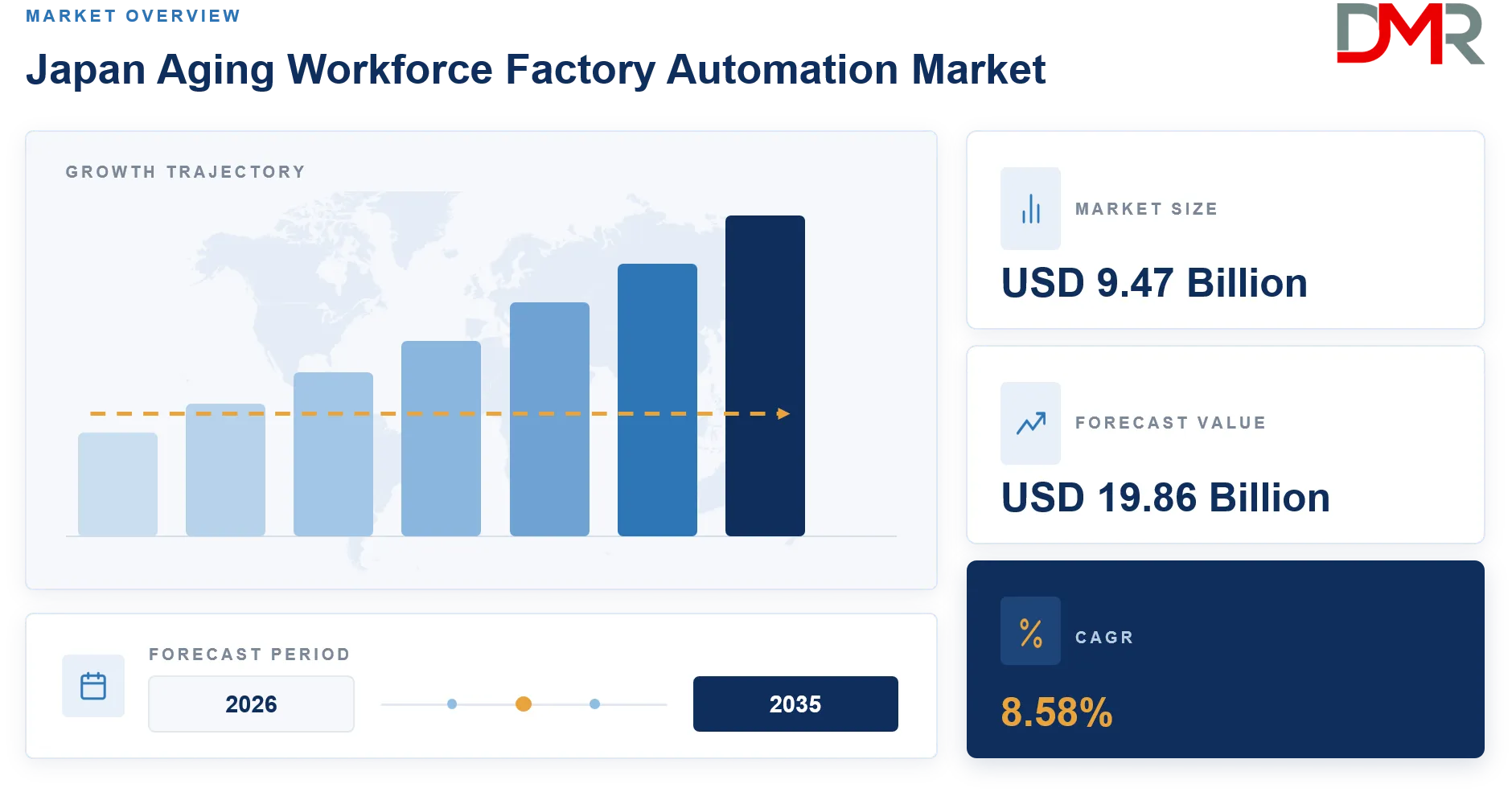
- Market Value: Japan aging workforce factory automation market is valued at USD 9.47 billion in 2026 and is projected to reach USD 19.86 billion by 2035.
- CAGR: Japan aging workforce factory automation market is expected to grow at a CAGR of 8.58% from 2026 to 2035.
- By Type Segment Analysis: Industrial robotics led the type segment with a 25.8% share in 2026.
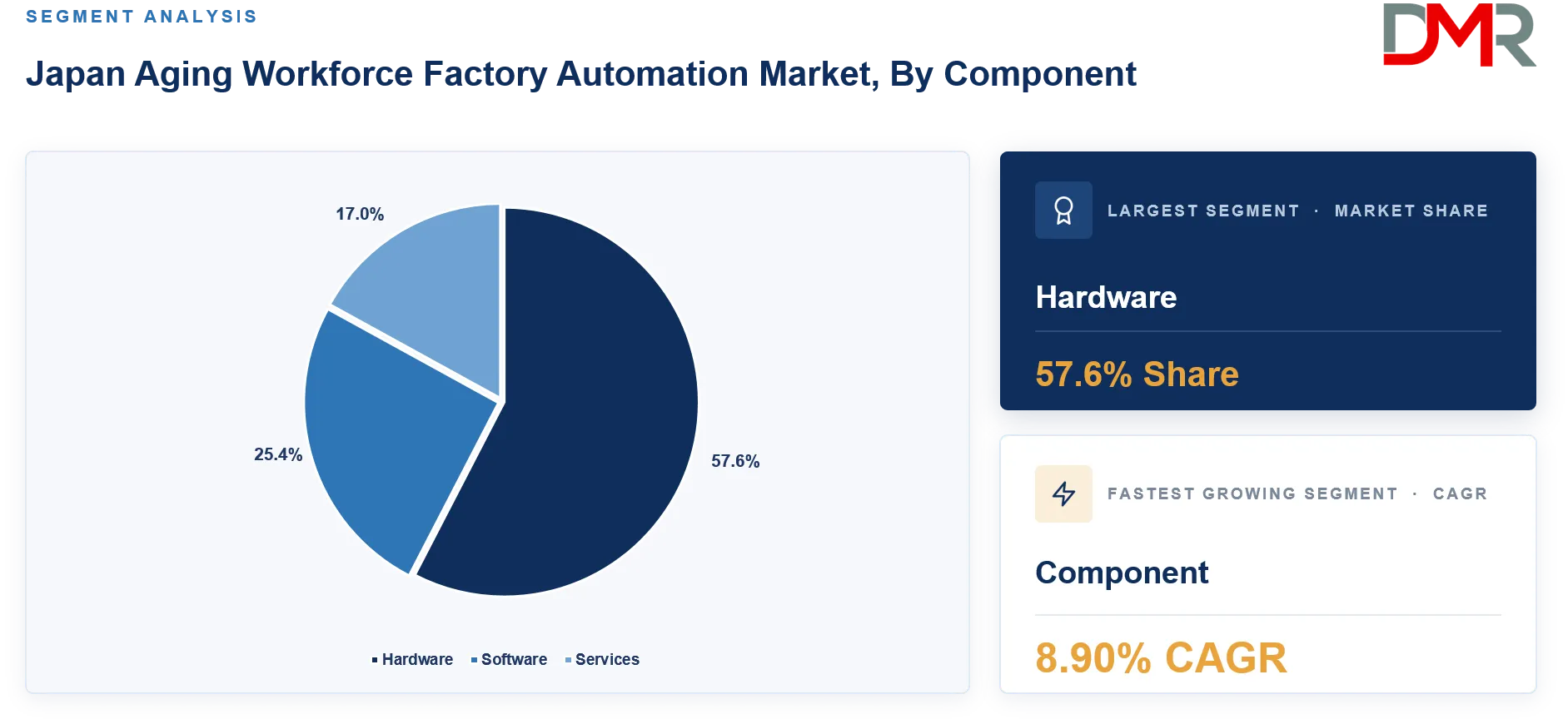
- By Component Segment Analysis: Hardware led the component segment with a 57.6% share in 2026.
- By End-User Industry Segment Analysis: Automotive & transportation held the largest end-user industry share at 27.4% in 2026.
- By Application Segment Analysis: Discrete manufacturing led the application segment with a 31.8% share in 2026.
- Major Players: Fanuc Corporation, Yaskawa Electric Corporation, Mitsubishi Electric Corporation, Kawasaki Heavy Industries, and Omron Corporation.
What is the Japan Aging Workforce Factory Automation Market and its Market Size?
The Japan Aging Workforce Factory Automation Market size is projected to be valued at USD 9.47 billion in 2026 and is expected to reach USD 19.86 billion by 2035, expanding at a CAGR of 8.58% during the forecast period. The market covers robotics, industrial controls, machine vision, sensors, motion systems, industrial networking, software, safety equipment, and related integration services used to sustain factory output as Japan's working-age population contracts.
ℹ
To learn more about this report –
Download Your Free Sample Report Here
Japan's automation demand is increasingly driven by workforce availability rather than only conventional productivity improvement. METI has identified structural labor shortages as a challenge for domestic manufacturing, while the government continues to promote new manufacturing technologies and labor-saving investment. Japan also remains one of the world's most automated manufacturing economies. IFR data recorded 44,453 industrial robot installations in Japan during 2024 and an operational stock of about 450,500 units, giving manufacturers a large installed base for further modernization.
Use Cases
- Labor-Shortage Production: Manufacturers deploy robots, programmable controls, automated material transport, and machine vision to sustain line output when operators are difficult to recruit. Automation is especially valuable for repetitive loading, welding, handling, inspection, and assembly tasks that otherwise require continuous staffing.
- Skilled Worker Replacement: Digital controls, adaptive robotics, connected machining systems, and automated inspection help factories capture process knowledge previously held by experienced technicians. This is increasingly important as Japan loses skilled manufacturing workers through retirement and smaller suppliers struggle to replace specialized labor.
- Automotive Manufacturing: Vehicle and component plants use industrial robots for welding, painting, assembly, handling, battery production, and inspection. Japan's automotive sector installed about 13,000 industrial robots in 2024, the highest annual level in five years, showing continued demand for flexible automated production.
- Electronics Production: Semiconductor, electronic component, and precision equipment plants use high-speed robots, motion control, machine vision, sensors, and automated handling where small tolerances and repeatable production are critical. Electronics remains one of Japan's largest industrial robot customer sectors.
- Warehouse and Intralogistics: Automated storage systems, conveyors, robotic picking, palletizing, sorting, and autonomous material movement reduce manual transport requirements inside factories and distribution facilities while improving throughput, inventory visibility, worker safety, and round-the-clock operating capability.
How AI/Gen AI is Transforming the Japan Aging Workforce Factory Automation Market?
AI is expanding factory automation beyond fixed repetitive motion into systems that can interpret images, detect anomalies, optimize motion, and adapt production settings. In Japan, this has direct workforce value because fewer technicians must supervise more equipment. AI-enabled machine vision can identify defects, predictive maintenance systems can prioritize service work, and robot controllers can optimize paths and cycle times. These capabilities help factories preserve quality and production capacity even when experienced operators retire.
Generative technologies are also reducing the engineering effort required to configure and operate automation. Manufacturers are developing software that supports programming, simulation, process planning, troubleshooting, and knowledge transfer through more intuitive interfaces. Japan's manufacturing policy already recognizes the need to strengthen digital adoption as skilled labor becomes harder to secure. The commercial opportunity is strongest where AI is combined with robotics, industrial data, sensors, and machine controls rather than deployed as a separate factory application.
Key Drivers in the Japan Aging Workforce Factory Automation Market
Structural Manufacturing Labor Shortage
Japan's shrinking labor pool is changing the economics of automation. Factories increasingly require equipment that can preserve production volume with fewer operators, particularly for repetitive, physically demanding, and hard-to-staff tasks. Government policy has formally recognized structural labor shortages across domestic manufacturing. As retirements increase, investment decisions are shifting from simple labor-cost reduction toward production continuity, making robotics, control systems, machine vision, and automated material handling essential capacity tools.
Large Existing Robotics and Automation Base
Japan already has one of the world's largest installed bases of industrial robots, which lowers barriers to further automation because manufacturers possess engineering expertise, established suppliers, integrator networks, and proven production applications. Around 450,500 industrial robots were operational in Japan in 2024. This installed infrastructure supports replacement demand, connected upgrades, machine vision integration, new safety systems, industrial networking, and migration toward more flexible cells capable of handling varied products with fewer workers.
Restraints in the Japan Aging Workforce Factory Automation Market
High Upfront Integration and Retrofitting Costs
Automation projects can require significant spending on robots, controllers, sensors, safety equipment, software, tooling, line redesign, installation, and employee training. The challenge is greater in older factories where machinery was not designed for connected automation. Small and medium enterprises may find project economics difficult when production runs are short or product variation is high. These conditions can extend payback periods and make manufacturers dependent on systems integrators capable of combining legacy equipment with modern factory platforms.
Shortage of Automation and Digital Engineering Skills
Automation itself requires skilled people to design cells, program robots, integrate industrial networks, maintain equipment, secure operational technology, and analyze production data. Japan's demographic pressure affects these technical occupations as well as factory operators. Smaller manufacturers can struggle to retain specialists across robotics, controls, software, and data engineering. This skills gap can slow projects, increase integration costs, and strengthen demand for turnkey systems, remote monitoring, easier programming tools, and external engineering services.
Growth Opportunities in the Japan Aging Workforce Factory Automation Market
Automation Adoption Among Small and Medium Manufacturers
SMEs represent a major expansion opportunity because many smaller Japanese factories still rely on manual processes and experienced technicians. Japan's labor-saving investment programs specifically support SMEs facing worker shortages in adopting IoT, robots, process automation, and digital systems. The continued availability of such programs can improve project economics and expand demand for compact robots, machine vision, modular automation, simple controls, subscription software, and standardized systems that require less in-house engineering expertise.
Flexible Robotics for High-Mix Production
Traditional fixed automation works best at stable, high production volumes, while many Japanese manufacturers operate high-mix production involving smaller batches and frequent product changes. Flexible robots, collaborative systems, vision-guided handling, rapid changeover tooling, and software-based programming can open applications that were previously difficult to automate. Vendors that reduce setup time and make automation economical at lower volumes can address manufacturers seeking labor savings without sacrificing the production flexibility required by diversified product portfolios.
Trends in the Japan Aging Workforce Factory Automation Market
Shift Toward Human-Robot Collaborative Production
Factory automation is moving from isolated robotic cells toward systems designed to operate closer to human workers. Collaborative robots, improved safety sensors, force control, vision systems, and easier programming allow manufacturers to automate individual tasks without rebuilding an entire production line. This approach is well suited to aging-workforce conditions because manufacturers can assign robots to repetitive lifting, machine tending, inspection, and handling while experienced employees remain focused on setup, quality decisions, and higher-value production activities.
Connected Automation and Data-Driven Factories
Industrial networking, IIoT platforms, sensors, edge computing, and manufacturing software are connecting previously separate machines into measurable production systems. Factory managers can use equipment data to monitor utilization, detect downtime, schedule maintenance, trace quality problems, and identify processes suitable for further automation. As worker availability falls, centralized visibility becomes more valuable because fewer supervisors and technicians can oversee larger production areas. This trend is strengthening demand beyond robots themselves and increasing the importance of software and services.
Research Scope and Analysis
The Japan Aging Workforce Factory Automation Market is segmented based on Type, Component, End-User Industry, Application, Factory Size, Distribution Channel, and other relevant categories. The study provides an in-depth analysis of key segments and sub-segments, covering their applications, industry adoption, demand patterns, and contribution to overall market growth.
ℹ
To learn more about this report –
Download Your Free Sample Report Here
By Type;
Industrial robotics led the type segment with a 25.8% share in 2026. The segment's position reflects Japan's established robot manufacturing ecosystem and the direct relationship between robotics and labor substitution on production lines. Robots are widely used for welding, assembly, machine tending, painting, material handling, palletizing, and inspection. Japan installed 44,453 industrial robots in 2024 and remained the world's second-largest robot market. Automotive and electronics factories provide a large demand base, while food production, logistics, machinery, and smaller manufacturers create additional opportunities. Growth is increasingly moving toward flexible robots, vision-guided applications, collaborative systems, easier programming, and cells that can operate across shorter production runs.
By Component;
Hardware accounted for 57.6% of the component segment in 2026, supported by the capital-intensive nature of factory automation. Robots, controllers, sensors, industrial PCs, drives, motors, machine vision cameras, networking equipment, safety systems, conveyors, and automated handling equipment form the physical layer required to reduce manual production work. Aging factories also create replacement and retrofit demand as manufacturers connect older equipment to modern control architectures. Over the forecast period, hardware will remain central to spending, while software and services should gain strategic value as factories require system integration, equipment analytics, cybersecurity, simulation, remote monitoring, programming support, and lifecycle maintenance.
By End-User Industry;
Automotive & transportation held the largest end-user industry share at 27.4% in 2026. Japan's vehicle manufacturing ecosystem has long used automation in welding, painting, assembly, inspection, material movement, and component production. The sector installed about 13,000 industrial robots in 2024, an 11% increase from the prior year and its highest installation level since 2020. Production changes linked to battery electric vehicles, fuel cells, alternative powertrains, electronics integration, and new vehicle platforms create further automation requirements because plants must maintain efficiency while managing more diverse manufacturing processes.
By Application;
Discrete manufacturing led the application segment with a 31.8% share in 2026. Automotive parts, electronics, machinery, precision equipment, and other assembled products require repeatable movement, machining, fastening, welding, inspection, and component handling, making these operations suitable for industrial robotics and control systems. Discrete factories also face strong pressure from retirement of skilled operators because production knowledge is often tied to machine setup and quality control. Integrated robots, vision systems, sensors, digital work instructions, and connected controls can standardize these processes while enabling fewer operators to manage a larger number of production assets.
The Japan Aging Workforce Factory Automation Market Report is segmented on the basis of the following:
By Type
- Industrial Robotics
- Industrial Control Systems
- Motion Control
- Machine Vision & Identification
- Industrial Sensors & Transmitters
- Human Machine Interface & Industrial PCs
- Industrial Networking & IIoT
- Safety Systems
- Industrial Software
By Component
- Hardware
- Software
- Services
By End-User Industry
- Automotive & Transportation
- Electronics & Semiconductor
- Food & Beverage
- Pharmaceuticals & Medical Devices
- Chemicals & Petrochemicals
- Metals & Machinery
- Logistics & Warehousing
By Application
- Discrete Manufacturing
- Process Automation
- Packaging & Palletizing
- Quality Inspection
- Material Handling
By Factory Size
- Large Enterprises
- Small & Medium Enterprises
By Distribution Channel
- Direct Sales
- Distributors & Systems Integrators
- Online Platforms
Competitive Landscape
The Japan aging workforce factory automation market has a strong domestic competitive base spanning industrial robots, controls, sensors, pneumatics, drives, machine vision, material handling, software, and systems integration. Fanuc Corporation, Yaskawa Electric Corporation, Mitsubishi Electric Corporation, Kawasaki Heavy Industries, Omron Corporation, DENSO, Nachi-Fujikoshi Corp., Seiko Epson Corporation, SMC Corporation, and Daifuku Co., Ltd. benefit from established manufacturing relationships and extensive automation portfolios.
Competition is increasingly shifting from individual products toward integrated systems that combine robotics, vision, software, industrial connectivity, simulation, predictive maintenance, and lifecycle services. Newer technology companies such as Mujin and Preferred Networks add software, intelligent robotics, and data-driven automation capabilities, while international vendors such as Universal Robots compete in flexible collaborative applications. Suppliers that simplify deployment, reduce engineering requirements, retrofit older factories, and demonstrate measurable labor savings are positioned to capture demand as workforce constraints become more severe.
Some of the prominent players in the Japan Aging Workforce Factory Automation Industry are:
- Fanuc Corporation
- Yaskawa Electric Corporation
- Mitsubishi Electric Corporation
- Kawasaki Heavy Industries
- Omron Corporation
- DENSO
- Nachi-Fujikoshi Corp.
- Seiko Epson Corporation
- SMC Corporation
- Daifuku Co., Ltd.
- Harmonic Drive Systems
- Kawada Robotics Corporation
- Preferred Networks
- Mujin
- Terra Drone
- Cyberdyne
- Fujitsu Limited
- Panasonic Corporation
- Yokogawa Electric Corporation
- Universal Robots
- Others
Demographic & Workforce Analysis
Japan's demographic structure is creating a long-term business case for factory automation as manufacturers face a shrinking pool of production workers and accelerating retirement of experienced employees. People aged 65 and above account for roughly 29% of Japan's population, while the working-age population continues to contract, increasing recruitment pressure across manufacturing, logistics, and technical occupations. This shift is particularly important for factories that depend on skilled operators for welding, machining, assembly, inspection, maintenance, and material handling. Smaller manufacturers face greater exposure because they often have limited recruitment reach and depend heavily on experienced workers. Industrial robots, automated handling, machine vision, digital controls, and labor-saving equipment allow companies to maintain production with fewer employees while transferring process knowledge into standardized systems. As workforce scarcity becomes structural rather than cyclical, automation spending is increasingly viewed as a capacity, continuity, and competitiveness investment.
Technology Analysis
Technology development in the Japan aging workforce factory automation market is shifting from isolated machines toward connected, flexible production environments that require fewer operators and less specialist intervention. Industrial robots remain central, supported by machine vision, motion control, sensors, programmable controllers, industrial PCs, safety systems, IIoT networks, and manufacturing software. Japan had about 450,500 industrial robots operating in factories in 2024, providing a substantial installed base for upgrades and integration. New systems increasingly combine vision-guided robotics, predictive maintenance, digital twins, edge processing, autonomous material movement, and easier robot programming to address high-mix manufacturing. Collaborative robots also create opportunities where full line automation is impractical because they can support machine tending, inspection, assembly, and handling alongside employees. Technology suppliers that reduce commissioning time, simplify retrofits, connect legacy machinery, and lower dependence on scarce automation engineers are positioned to gain stronger demand.
Recent Developments
- July 2026: Fujitsu, FANUC, Yaskawa Electric, Kawasaki Heavy Industries began exploring a collaborative physical-AI control platform using NVIDIA technology to connect robots and factory systems, targeting Japan’s labor shortages and aging workforce.global
- December 2025: Fujitsu launched Kozuchi Physical AI 1.0, integrating NVIDIA’s software stack with its proprietary technologies to link physical and agentic AI, supporting more autonomous, adaptable factory automation.global
- July 2025: Yaskawa Electric expanded its U.S. automation footprint by investing in a new Franklin, Wisconsin campus that will manufacture robots, strengthening production capacity amid global demand driven by industrial labor shortages.
Report Details
| Report Characteristics |
| Market Size (2026) |
USD 9.47 Bn |
| Forecast Value (2035) |
USD 19.86 Bn |
| CAGR (2026-2035) |
8.58% |
| Historical Data |
2021 - 2025 |
| Forecast Data |
2027 - 2035 |
| Base Year |
2025 |
| Estimate Year |
2026 |
| Segments Covered |
By Type (Industrial Robotics, Industrial Control Systems, Motion Control, Machine Vision & Identification, Industrial Sensors & Transmitters, Human Machine Interface & Industrial PCs, Industrial Networking & IIoT, Safety Systems, Industrial Software), By Component (Hardware, Software, Services), By End-User Industry (Automotive & Transportation, Electronics & Semiconductor, Food & Beverage, Pharmaceuticals & Medical Devices, Chemicals & Petrochemicals, Metals & Machinery, Logistics & Warehousing), By Application (Discrete Manufacturing, Process Automation, Packaging & Palletizing, Quality Inspection, Material Handling), By Factory Size (Large Enterprises, Small & Medium Enterprises), and By Distribution Channel (Direct Sales, Distributors & Systems Integrators, Online Platforms) |
| Regional Coverage |
Japan |
Frequently Asked Questions
What is the current size of the Japan Aging Workforce Factory Automation Market?
▾ The Japan Aging Workforce Factory Automation Market size is valued at USD 9.47 billion in 2026 and is forecast to reach USD 19.86 billion by 2035.
What is the growth rate of the Japan Aging Workforce Factory Automation Market during?
▾ The Japan Aging Workforce Factory Automation Market is expected to grow at a CAGR of 8.58% during the forecast period 2026-2035.
What factors are driving the growth of the Japan Aging Workforce Factory Automation Market?
▾ Japan's aging workforce, labor shortages, skilled-worker retirements, robotics adoption, and productivity needs are driving the Japan Aging Workforce Factory Automation Market.
What are the major challenges restraining the Japan Aging Workforce Factory Automation Market?
▾ High integration costs, legacy factory equipment, automation skill shortages, and complex retrofits restrain the Japan Aging Workforce Factory Automation Market.
Which segment holds the largest share of the Japan Aging Workforce Factory Automation Market?
▾ Industrial robotics holds 25.8% of the Japan Aging Workforce Factory Automation Market by type, supported by automotive, electronics, and machinery demand.
Who are the leading companies in the Japan Aging Workforce Factory Automation Market?
▾ Fanuc Corporation, Yaskawa Electric Corporation, Mitsubishi Electric Corporation, Kawasaki Heavy Industries, Omron Corporation, DENSO, Nachi-Fujikoshi Corp., Seiko Epson Corporation, SMC Corporation, Daifuku Co., Ltd., Harmonic Drive Systems, Kawada Robotics Corporation, Preferred Networks, Mujin, Terra Drone, Cyberdyne, Fujitsu Limited, Panasonic Corporation, Yokogawa Electric Corporation, and Universal Robots are prominent companies in the Japan Aging Workforce Factory Automation Market.
How is AI influencing the Japan Aging Workforce Factory Automation Market?
▾ AI supports the Japan Aging Workforce Factory Automation Market through predictive maintenance, machine vision, adaptive robotics, quality inspection, and production optimization.
What are the future opportunities and trends in the Japan Aging Workforce Factory Automation Market?
▾ Collaborative robots, SME automation, smart factories, IIoT, machine vision, flexible robotics, and connected production offer opportunities in the Japan Aging Workforce Factory Automation Market.