What is the Japan E-Discovery Market Size?
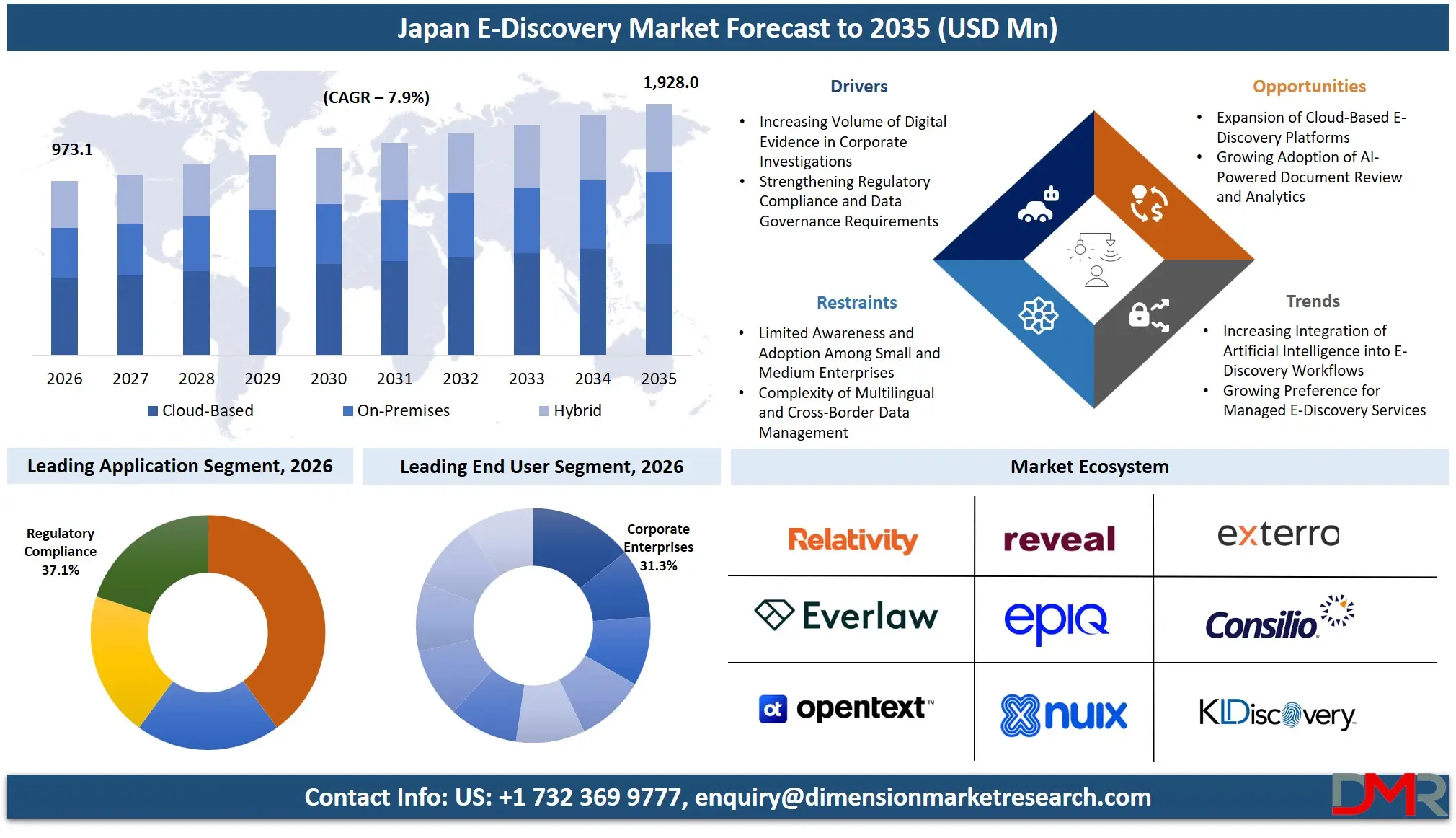
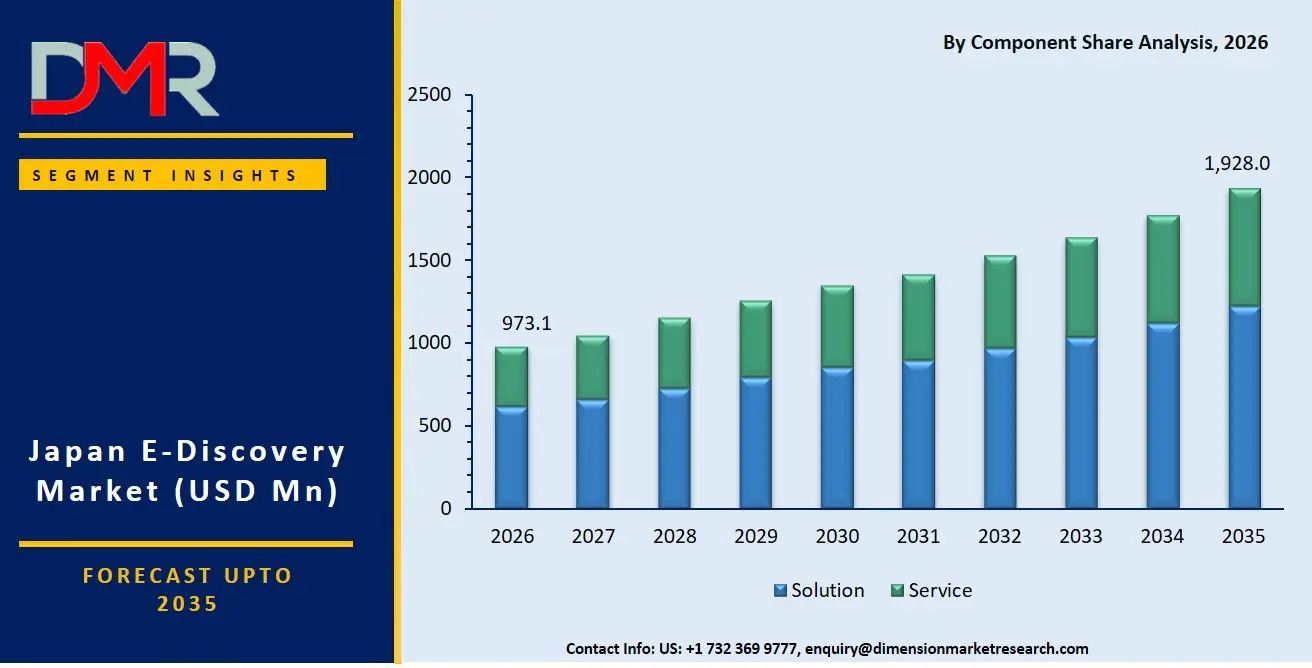
The Japan E-Discovery Market is expected to reach a value of USD 973.1 million in 2026, and it is further anticipated to reach USD 1,928.0 million by 2035, growing at a CAGR of 7.9% during the forecast period.
ℹ
To learn more about this report –
Download Your Free Sample Report Here
The e-discovery market in Japan has witnessed impressive growth, driven by the nation's focus on strengthening corporate governance and adapting to a rapidly digitalizing business environment. The Japan e-discovery market consists of solutions and services for identifying, preserving, collecting, processing, reviewing, and producing electronically stored information (ESI) in response to legal, regulatory, or internal investigation requests. The surge in cross-border litigation, the enforcement of stringent data privacy regulations like Japan's Act on the Protection of Personal Information (APPI), and the growing volume of unstructured data from enterprise collaboration tools have necessitated sophisticated e-discovery capabilities. Law firms, corporate legal departments, and government agencies are the major drivers in this industry. Cloud-based platforms with AI-driven analytics and technology-assisted review (TAR) continue to be the dominant forms of solutions due to their precision, scalability, and cost-effectiveness.
Key Takeaways
- Market Size & Forecast: Japan's e-discovery market is projected to reach USD 973.1 million in 2026 and USD 1,928.0 million by 2035, driven by rising regulatory complexity, expanding digital evidence volumes, and increasing enterprise investments in technology-enabled legal investigation and compliance solutions.
- Growth Rate & Outlook: The market is expected to expand at a CAGR of 7.9% during the forecast period, supported by Japan's accelerating digital transformation, stronger corporate governance, growing electronic data volumes, and increasing demand for efficient legal risk and compliance management.
- Primary Growth Drivers: Key growth drivers include stricter regulatory compliance requirements, rising cross-border investigations, expanding digital business operations, increasing electronically stored information, and wider adoption of AI-powered document review, predictive analytics, and automation across corporate legal and compliance functions.
- Key Market Trends: Major trends include growing adoption of cloud-based e-discovery platforms, AI-driven document review, predictive coding, advanced analytics, multilingual data processing, and increasing demand for specialized solutions supporting intellectual property disputes, regulatory investigations, and corporate governance requirements.
- By Component Analysis: The Solutions segment dominates the market, driven by strong demand for automated identification, processing, review, analytics, and production tools that improve investigation efficiency, reduce manual workloads, strengthen compliance, and accelerate legal decision-making across enterprises.
- By Deployment Analysis: Cloud-Based deployment leads the Japan e-discovery market by providing secure, scalable, and cost-effective evidence management, enabling legal teams to collaborate remotely, accelerate investigations, reduce infrastructure costs, and efficiently manage growing volumes of digital evidence.
What is the E-Discovery?
E-discovery can be described as the specific discipline of digital forensics and legal technology that involves identifying, collecting, and analyzing electronically stored information (ESI) for the purpose of using it as evidence in legal cases. Unlike traditional paper-based discovery, the provision of e-discovery is fundamentally different as it seeks to manage vast troves of digital data at the source of corporate information systems. This is done through two core approaches: a SaaS-based approach, which involves using cloud platforms to process and host documents for remote review by legal teams, and an on-premises approach, which entails deploying software inside a corporation's firewall for highly sensitive cross-border investigations. Considering Japan's rigorous data localization preferences and the APPI, e-discovery workflows require specialized legal hold mechanisms and anonymization techniques for early case assessment, necessitating ongoing technological adaptation even after implementation.
Use Cases
- Management of Cross-Border Litigation: An international approach involving the use of cloud-based review platforms to centralize multilingual documents is adopted by law firms and multinational corporations to respond to discovery requests from U.S. and European courts involving Japanese subsidiaries.
- Investigation of Corporate Fraud: A compliance-based therapy involves applying e-discovery analytics using forensic collection tools deployed across a corporate network in order to provide audit committees with an intact chain-of-custody over employee communications during internal investigations.
- Response to Regulatory Inquiries: Corporate enterprises together with government affairs departments apply the targeted collection of specific email and chat records so as to provide agencies like the Japan Fair Trade Commission (JFTC) with responsive, non-privileged data in antitrust reviews.
- Management of Data Breach Notification: Technology and insurance companies adopt the use of automated data mapping and review tools to rapidly classify compromised records and facilitate the legally required notifications to the Personal Information Protection Commission.
How AI is Transforming the E-Discovery Market?
The impact of AI on the Japanese e-discovery market covers quickening the process of document review with safety and accuracy, as well as optimizing early case assessments. Speaking of document review, AI-driven prediction tools will be helpful for exploring large amounts of data in order to develop active learning models demonstrating improved relevance ranking and reduced manual review time without any human error. AI-based sentiment and concept clustering allows predicting privileged communications and optimizing review strategies.
Furthermore, the role of AI in legal strategy and implementation is quite important. Thus, while searching for fact patterns across disparate data sources, AI algorithms help explore chat logs and audio transcripts in Japanese to identify the most appropriate evidence for litigation. Last but not least, AI-driven assistants assist with regulatory filing strategies through simulating all phases of assessment, evaluating compliance gaps, and providing an overview of corporate data risk and governance.
Market Dynamics
Key Drivers in the Japan E-Discovery Market
Increasing Digital Evidence in Corporate Investigations
The rapid digitalization of Japanese enterprises has significantly increased the volume of electronically stored information (ESI), including emails, messaging platforms, cloud documents, mobile data, and collaboration tools. Organizations require advanced e-discovery solutions to efficiently identify, preserve, collect, review, and produce digital evidence during internal investigations and legal disputes. Growing adoption of hybrid work environments and cloud-based collaboration platforms further expands the volume of discoverable information. As businesses seek to minimize legal risks, improve investigation efficiency, and reduce manual document review, demand for advanced e-discovery platforms continues to strengthen across Japan's corporate and legal sectors.
Strengthening Regulatory Compliance and Data Governance Requirements
Japan's evolving regulatory landscape and increasing emphasis on corporate governance are major drivers of the e-discovery market. Organizations must maintain accurate electronic records while complying with domestic privacy regulations, financial reporting standards, and industry-specific compliance requirements. Multinational companies operating in Japan also face cross-border investigation and litigation obligations that require efficient management of electronic evidence. Modern e-discovery platforms help organizations automate legal holds, improve document preservation, support regulatory investigations, and maintain audit readiness. Rising compliance expectations encourage enterprises to invest in scalable e-discovery technologies that strengthen governance, transparency, and legal risk management.
Restraints in the Japan E-Discovery Market
Limited Awareness Among Small and Medium Enterprises
Despite growing digital transformation, many small and medium enterprises in Japan have limited awareness regarding the strategic value of e-discovery technologies. SMEs often perceive e-discovery as relevant only to large corporations or international litigation, reducing investment in specialized software and managed services. Budget constraints, limited legal expertise, and relatively fewer complex investigations further slow market adoption. Many organizations continue relying on manual document management processes that reduce efficiency and increase legal risks. This limited awareness delays technology adoption and restricts broader market expansion, particularly among businesses with limited information governance capabilities.
Complexity of Multilingual and Cross-Border Data Management
Japanese organizations increasingly operate across international markets, creating challenges in managing multilingual electronic evidence and cross-border legal investigations. E-discovery projects frequently involve Japanese and English documents, requiring advanced language processing, accurate translation, and consistent legal review. Differences in international legal procedures, privacy regulations, and data transfer requirements further complicate evidence management. Organizations must ensure secure handling of sensitive corporate information while maintaining compliance with domestic and foreign regulations. These operational complexities increase implementation costs, extend project timelines, and require specialized expertise, creating barriers to broader adoption of sophisticated e-discovery platforms.
Growth Opportunities in the Japan E-Discovery Market
Expansion of Cloud-Based E-Discovery Platforms
Cloud-based e-discovery solutions present substantial growth opportunities in Japan as organizations modernize legal operations and digital governance strategies. Cloud platforms provide scalable storage, remote collaboration, automated updates, and reduced infrastructure costs compared with traditional on-premises deployments. Legal teams can securely access electronic evidence from multiple locations while improving investigation efficiency and accelerating case resolution. Growing confidence in enterprise cloud security and increasing adoption of hybrid work models further encourage organizations to migrate e-discovery workflows to cloud environments. Vendors offering secure, compliant, and localized cloud solutions are well positioned to benefit from expanding enterprise demand.
Growing Adoption of AI-Powered Document Review
Artificial intelligence is creating significant opportunities for Japan's e-discovery market by improving the speed and accuracy of document review processes. AI-powered technologies such as predictive coding, intelligent document classification, natural language processing, and automated relevance ranking reduce manual review efforts while improving legal accuracy. These capabilities help organizations manage growing volumes of electronic evidence more efficiently and lower investigation costs. Japanese enterprises increasingly recognize AI as a practical solution for addressing workforce shortages and improving productivity. Vendors integrating advanced AI capabilities into e-discovery platforms are expected to experience strong long-term market growth.
Trends in the Japan E-Discovery Market
Increasing Integration of Artificial Intelligence into E-Discovery Workflows
A major trend in Japan's e-discovery market is the growing integration of artificial intelligence throughout the electronic discovery lifecycle. AI technologies automate document classification, duplicate detection, privilege review, predictive coding, and relevance assessment, significantly improving legal workflow efficiency. Organizations increasingly deploy intelligent analytics to reduce review times, improve investigation quality, and minimize litigation costs. As AI models continue advancing, legal professionals gain faster access to critical evidence while reducing manual workloads. This trend is transforming traditional e-discovery processes into more efficient, data-driven, and technology-enabled legal operations across Japan.
Growing Preference for Managed E-Discovery Services
Japanese organizations are increasingly outsourcing e-discovery operations to managed service providers that offer specialized legal, technical, and compliance expertise. Managed services reduce implementation complexity while providing scalable infrastructure, expert consulting, secure data handling, and continuous technical support. Organizations benefit from predictable operational costs, improved investigation efficiency, and access to advanced technologies without maintaining dedicated in-house resources. Growing legal complexity, cybersecurity concerns, and workforce shortages continue encouraging businesses to partner with experienced service providers. This shift toward managed e-discovery services is becoming a defining trend supporting long-term market expansion in Japan.
Research Scope and Analysis
The Japan E-Discovery Market is segmented by Component, Deployment, Organization Size, Application, and End User. It includes software solutions and services, cloud and on-premises deployments, enterprises of varying sizes, applications supporting compliance and investigations, and end users such as legal firms, corporations, government agencies, BFSI, healthcare, IT, manufacturing, retail, energy, and other industries.
ℹ
To learn more about this report –
Download Your Free Sample Report Here
By Component Analysis
The Solutions segment is poised to dominate the Japan E-Discovery market because organizations primarily invest in software platforms that automate the identification, preservation, processing, review, analysis, and production of electronically stored information. Japanese enterprises increasingly manage large volumes of digital evidence generated through cloud platforms, email systems, collaboration tools, and enterprise applications.
ℹ
To learn more about this report –
Download Your Free Sample Report Here
Advanced e-discovery solutions improve legal workflow efficiency, reduce manual document review, strengthen regulatory compliance, and support faster investigations. Growing adoption of artificial intelligence, predictive coding, analytics, and automated legal hold capabilities further enhances solution effectiveness, making software platforms the largest revenue-generating component across Japan's legal and corporate sectors.
By Deployment Analysis
The Cloud-Based deployment segment is projected to dominate the Japan E-Discovery market due to increasing enterprise cloud adoption and the need for scalable legal data management. Cloud platforms enable secure remote access, centralized evidence storage, rapid deployment, automatic software updates, and reduced infrastructure costs compared with traditional on-premises environments. Organizations benefit from improved collaboration among legal teams, external counsel, and compliance professionals while accelerating investigation timelines. Growing digital transformation, hybrid work adoption, and investments in secure cloud infrastructure continue driving cloud-based implementations. These operational and economic advantages position cloud deployment as the preferred model across Japanese enterprises and legal organizations.
By Organization Size Analysis
Large Enterprises is expected to dominate the Japan E-Discovery market because they generate vast amounts of electronically stored information and frequently conduct complex litigation, regulatory investigations, compliance reviews, and internal audits. These organizations possess the financial resources, legal expertise, and IT infrastructure necessary to implement enterprise-grade e-discovery platforms. Large multinational corporations operating in Japan also require cross-border discovery capabilities, multilingual document review, and advanced information governance. Increasing regulatory obligations, cybersecurity investigations, and digital transformation initiatives further accelerate investment in sophisticated e-discovery technologies. Consequently, large enterprises remain the largest adopters and contributors to overall market revenue.
By Application Analysis
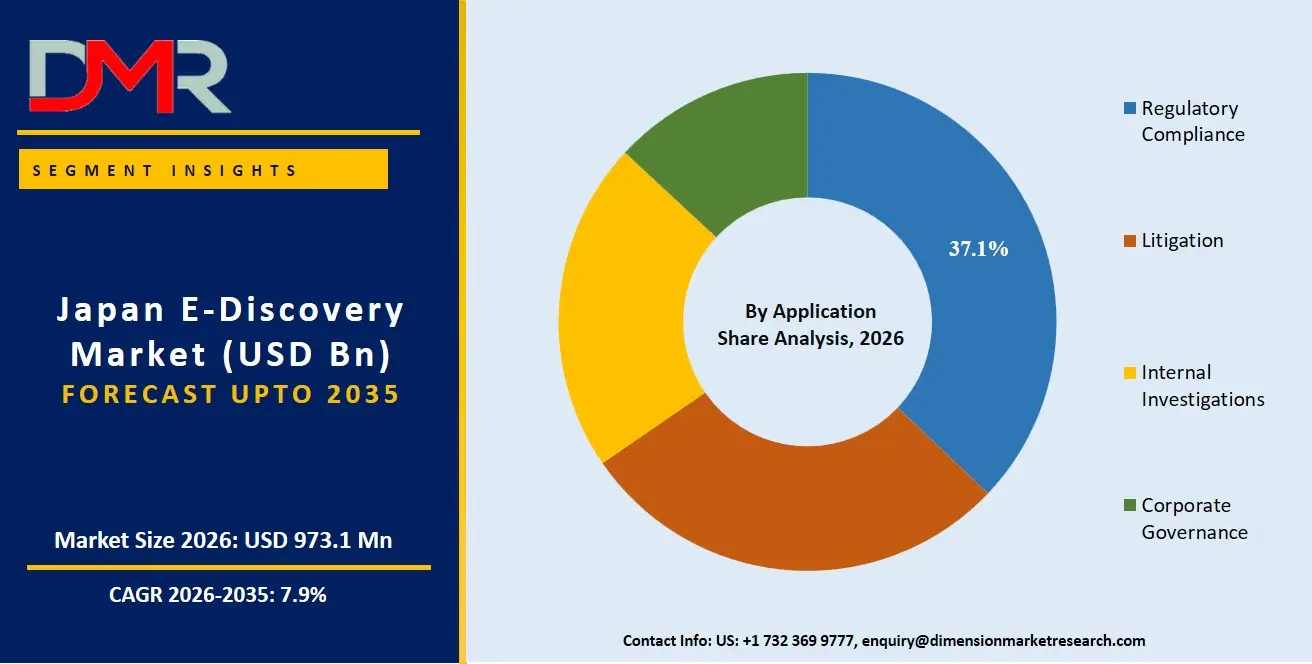
Regulatory Compliance is projected to dominates the Japan E-Discovery market as organizations prioritize adherence to corporate governance requirements, financial regulations, privacy laws, and industry-specific compliance standards. Enterprises increasingly use e-discovery solutions to preserve electronic records, respond efficiently to regulatory inquiries, manage legal holds, and maintain comprehensive audit trails. Automated document review, intelligent search, and evidence management capabilities improve compliance accuracy while reducing operational risks and manual effort. Growing regulatory scrutiny across financial services, healthcare, manufacturing, and technology sectors continues driving investment in advanced compliance-focused e-discovery platforms, making regulatory compliance the leading application segment in Japan.
By End User Analysis
Corporate Enterprises is anticipated to dominate the Japan E-Discovery market because businesses across industries increasingly require efficient management of electronic evidence for compliance, litigation, internal investigations, and corporate governance. Large corporations generate extensive digital information through emails, cloud applications, enterprise systems, messaging platforms, and collaboration tools that require secure preservation and review. E-discovery solutions help organizations reduce legal risks, improve investigation efficiency, and strengthen information governance while supporting regulatory compliance. Continued digital transformation, expansion of multinational operations, and increasing cybersecurity incidents further encourage corporate investment, making enterprises the dominant end-user segment in Japan's e-discovery market.
The Japan E-Discovery Market Report is segmented on the basis of the following:
By Component
- Solutions
- Identification, Preservation & Collection
- Processing, Review & Analysis
- Production & Presentation
- Services
- Managed Services
- Maintenance & Support
- Training, Consulting & Integration
By Deployment
- Cloud-Based
- On-Premises
- Hybrid
By Organization Size
- Large Enterprises
- Small & Medium Enterprises
By Application
- Regulatory Compliance
- Litigation
- Internal Investigations
- Corporate Governance
By End User
- Legal Firms
- Corporate Enterprises
- Government Agencies
- Banking, Financial Services & Insurance
- Healthcare & Life Sciences
- IT & Telecommunications
- Manufacturing
- Retail & Consumer Goods
- Energy & Utilities
- Other End User
Competitive Landscape
The nature of competition in the Japan e-discovery market has become very dynamic, given the diverse range of global technology giants operating in the space, as well as Japanese IT conglomerates and small specialized legal tech firms focusing on advanced analytics applications. Strategic alliances with major law firms and investigative agencies would be crucial for the company, as they help gain access to case briefs and get early validation of the company's innovative NLP technology platforms. The trend of consolidation is growing at a rapid pace, as international software providers are acquiring local Japanese data processing vendors specializing in forensic collection and legacy data migration in order to stay in business. IP differentiators such as proprietary Japanese-language linguistic models, optimized workflow automations, and pre-built compliance templates are playing an increasingly significant role compared to a traditional generic processing platform.
Some of the prominent players in the Japan E-Discovery Market are:
- Relativity
- OpenText
- Exterro
- Reveal Data
- DISCO
- Everlaw
- Nuix
- KLDiscovery
- Epiq
- Consilio
- HaystackID
- Ricoh Japan
- FRONTEO
- LegalOn Technologies
- NEC Corporation
- Fujitsu
- Hitachi
- IBM
- Microsoft
- Deloitte Tohmatsu
- Other Key Players
Recent Developments
- May 2026: Japan's amended Civil Procedure Code came fully into effect, introducing mandatory electronic filing for attorneys, electronic court records, and recognition of electronic records as admissible evidence, accelerating digital litigation and supporting wider adoption of e-discovery technologies.
- March 2026: Japan's Ministry of Economy, Trade and Industry and Ministry of Internal Affairs and Communications released Version 1.2 of the AI Guidelines for Business, strengthening AI governance practices for enterprises deploying AI in document analysis, compliance, and legal workflows.
- January 2026: EY Japan began full-scale deployment of its AI-powered Document Intelligence Platform (DIP) across its audit practice, expanding AI-driven document analysis capabilities and demonstrating increasing adoption of intelligent document review technologies in Japan's professional services sector.
Report Details
| Report Characteristics |
| Market Size (2026) |
USD 973.1 Mn |
| Forecast Value (2035) |
USD 1,928.0 Mn |
| CAGR (2026–2035) |
7.9% |
| Historical Data |
2021 – 2025 |
| Forecast Data |
2027 – 2035 |
| Base Year |
2025 |
| Estimate Year |
2026 |
| Segments Covered |
By Component, By Deployment, By Organization Size, By Application, and By End User |
| Country Coverage |
Japan |
Frequently Asked Questions
How big is the Japan E-Discovery Market?
▾ The Japan E-Discovery market is poised to be valued at USD 973.1 million in 2026 and is projected to reach USD 1,928.0 million by 2035, driven by the universal need for defensible, technology-driven solutions for a corporate sector facing rising litigation and regulatory scrutiny.
What is the CAGR of the Japan E-Discovery Market from 2026 to 2035?
▾ The market is expected to grow at a CAGR of 7.9% from 2026 to 2035, reflecting the accelerating digitalization of legal operations and the nation's unique regulatory framework enabling stricter corporate enforcement mandates.
What factors are driving the growth of the Japan E-Discovery Market?
▾ Key drivers include Japan’s stringent data privacy and anti-monopoly enforcement, the escalating information management burden of a mature digital economy, and a deep ecosystem of engineering excellence in natural language processing and forensic technologies.
What are the major trends in the Japan E-Discovery Market?
▾ Major trends include the development of specialized Japanese-language analytics for safer AI review, the shift toward SaaS-based "managed services" models using predictive coding, and a strong focus on applications in cross-border regulatory inquiries and internal corporate investigations.
Who are the key players in the Japan E-Discovery Market?
▾ Key players in the Japan E-Discovery Market include FRONTEO, Relativity, Nuix, Deloitte, PwC, KLDiscovery, and Lighthouse, driving innovation through analytics research, service delivery, forensic development, and market expansion activities.
How is the Japan E-Discovery Market segmented?
▾ The market is segmented by Component, Deployment, Organization Size, Application, and End User.