Market Snapshot
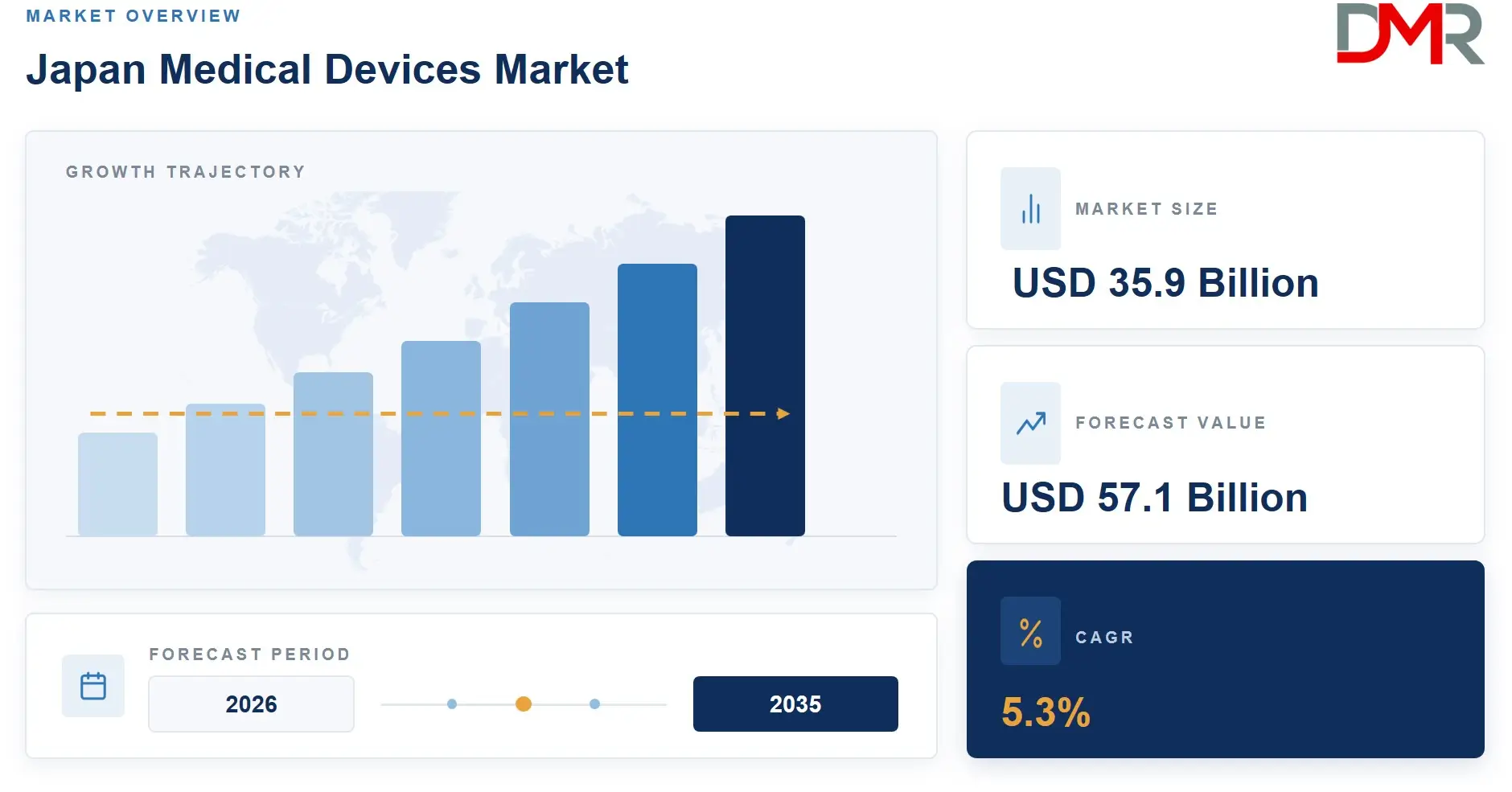
- Market Size (2026): USD 35.9 Bn
- Forecast Value (2035): USD 57.1 Bn
- CAGR (2026-2035): 5.3%
- Leading Product Type (2026): Diagnostic Imaging Devices, approximately 24%
- Leading Technology (2026): Conventional & Electromechanical, around 38%
- Key Players: Terumo Corporation, Olympus Corporation, Sysmex Corporation and others
What is Japan Medical Devices Market and its Market Size?
The Japan Medical Devices Market size is estimated to reach USD 35.9 Bn in 2026 and is further anticipated to reach USD 57.1 Bn by 2035, at a CAGR of 5.3%.
ℹ
To learn more about this report –
Download Your Free Sample Report Here
Medical devices in this report cover equipment, instruments, systems, implants, monitoring platforms and disposable products used to diagnose, prevent, monitor or treat disease and injury. The boundary includes regulated hardware and software-led devices sold for use in hospitals, clinics, diagnostic centers, ambulatory settings and homes. It excludes pharmaceutical products, general wellness products without a regulated medical purpose, and revenue earned outside Japan by companies headquartered in the country.
Demand inside Japan is shaped by a large installed base of hospital equipment, high utilization of diagnostic imaging and endoscopy, and the need to manage chronic disease in an aging population. Procurement is increasingly focused on lifecycle value rather than acquisition price alone, which supports service contracts, remote maintenance, interoperable monitoring and systems that reduce staff workload. Imported advanced devices remain important, while domestic suppliers retain strong positions in endoscopy, patient monitoring, diagnostics and precision components.
Structural change is moving the sector toward less invasive intervention, software-assisted diagnosis, connected monitoring and care closer to the home. Hospitals are under pressure to improve throughput despite workforce constraints, creating a clear commercial case for automation, integrated data flows and easier-to-use equipment. Regulatory pathways under the PMD Act and PMDA review processes also make evidence quality, cybersecurity, quality management and post-market surveillance central to product strategy.
Use Cases
- Acute Hospital Imaging: Radiology departments deploy CT, MRI, ultrasound and digital X-ray systems to identify disease, stage treatment and support emergency decisions. Higher image quality and faster reconstruction reduce repeat scans, while workflow software helps facilities use limited technologist capacity more efficiently across high-volume diagnostic services.
- Minimally Invasive Intervention: Gastroenterology, cardiology and surgery teams use endoscopes, catheters, guidewires and energy devices to treat disease through smaller access points. The result is shorter recovery, lower procedural trauma and greater suitability for older or higher-risk patients who may not tolerate conventional open surgery.
- Chronic Disease Monitoring: Hospitals, clinics and home-care providers deploy ECG, blood pressure, glucose, respiratory and multiparameter monitoring equipment to follow patients between visits. Connected measurements allow earlier escalation when readings deteriorate and reduce dependence on repeated in-person checks for stable patients.
- Laboratory and Point-of-Care Testing: Diagnostic laboratories and clinical departments use hematology, immunoassay, molecular and point-of-care systems to support treatment selection and rapid triage. Automation standardizes sample handling, shortens turnaround times and helps laboratories manage rising test complexity without matching growth in skilled staffing.
Key Takeaways
- Market Size & Share: Domestic demand is estimated at USD 35.9 Bn in 2026, supported by replacement cycles, procedure volumes and continued adoption of higher-value diagnostic and therapeutic systems.
- Product Type Analysis: Diagnostic Imaging Devices are expected to account for roughly 24% of 2026 revenue because hospitals maintain broad installed bases of CT, MRI, ultrasound and radiography equipment.
- Demand Concentration: Hospitals are projected to represent close to 56% of end-user revenue in 2026, reflecting inpatient procedure intensity, imaging capacity and centralized procurement of capital medical equipment.
- Technology Shift: AI-Enabled devices are forecast to expand at a CAGR of 10.8% through 2035 as image interpretation, workflow prioritization and decision support move into regulated clinical products.
- Care Delivery: Home Healthcare is expected to grow at a CAGR of 8.3% through 2035 as monitoring, respiratory therapy and chronic-care equipment move closer to patients.
- Channel Evolution: Digital and E-commerce Channels are projected to expand at a CAGR of 9.0% through 2035, especially for standardized accessories, consumables and lower-complexity equipment.
How AI/Gen AI is Transforming the Japan Medical Devices Market?
AI adoption is moving from isolated image-reading tools toward embedded clinical workflow support. Computer vision is being applied to radiology, endoscopy and pathology-like imaging to flag suspicious patterns, prioritize worklists and improve consistency. Predictive models can also use device telemetry to identify maintenance needs before equipment failure, which matters in hospitals with high utilization and limited engineering staff.
Generative AI has a narrower but growing role. LLM-based document processing can assist manufacturers with regulatory evidence organization, complaint triage and service documentation, while generative design can shorten iteration cycles for components and ergonomics. Digital twins and simulation models are also improving equipment testing and procedure planning. The highest-value deployments are likely to remain human-supervised because regulated medical decisions require traceability, validation and post-market control.
- Computer Vision: Supports lesion detection, anatomical recognition and image quality checks in diagnostic and endoscopic workflows.
- Predictive Maintenance: Uses device telemetry to anticipate service needs and reduce unplanned downtime for high-use hospital equipment.
- LLM Document Processing: Organizes technical files, vigilance records and structured regulatory documentation for review by qualified teams.
- Digital Twins and Generative Design: Simulate device behavior, component stress and workflow interaction before physical prototypes are finalized.
Key Drivers in the Japan Medical Devices Market
Demand is being pulled by clinical intensity and the need to operate healthcare capacity more efficiently. Two forces are particularly important because they affect both capital equipment and recurring device consumption.
- Aging Population and Procedure Intensity: Japan's disease burden increasingly favors diagnostics, cardiovascular intervention, orthopedics, endoscopy, monitoring and home-based support. Hospitals need devices that can handle older patients with multiple conditions while reducing recovery time and avoiding long inpatient stays. This supports minimally invasive tools and higher-frequency monitoring. Endoscopy & Minimally Invasive Devices are therefore forecast to grow at a CAGR of 6.7% through 2035, above the wider market, as providers shift appropriate procedures toward smaller access routes and advanced visualization.
- Replacement and Digital Modernization of Installed Equipment: A large hospital installed base creates recurring demand when scanners, monitors, analyzers and operating-room systems reach replacement or software-obsolescence points. Buyers increasingly favor connected equipment that shares data with hospital systems and supports remote service. Digital & Connected technologies are expected to expand at a CAGR of 7.5% through 2035. The mechanism is practical: integration can reduce duplicate data entry, improve asset utilization and make limited clinical staff more productive without adding equivalent headcount.
Restraints in the Japan Medical Devices Market
Growth is moderated by reimbursement economics and the cost of proving safety and clinical value. These pressures are strongest for novel devices that need new workflows or significant capital budgets.
- Reimbursement and Hospital Budget Pressure: Publicly influenced reimbursement and cost-control policies can limit the price premium available for new equipment even when clinical performance improves. Hospitals must balance replacement needs with labor, pharmaceutical and infrastructure spending. Conventional & Electromechanical technology is still expected to hold around 38% of 2026 revenue partly because established systems fit familiar workflows and procurement criteria. Vendors introducing higher-cost platforms must demonstrate measurable throughput, reduced complications or lower lifecycle cost to overcome cautious purchasing.
- Regulatory Evidence and Quality-System Burden: Medical devices must meet PMD Act requirements, PMDA expectations, quality management obligations and post-market surveillance standards. Software updates, cybersecurity controls and AI model changes can add documentation and validation work across the product lifecycle. AI-Enabled products account for only about 9% of technology revenue in 2026 despite their strong growth outlook. Smaller developers can face longer commercialization cycles because regulatory strategy, clinical evidence, Japanese-language documentation and local market authorization capabilities require specialized resources.
Growth Opportunities in the Japan Medical Devices Market
White space is forming where technology can reduce labor intensity, move care outward from hospitals and support earlier intervention. Opportunities are strongest when products fit existing reimbursement and clinical pathways.
- Home Monitoring and Decentralized Care: Japan's aging population and workforce constraints create room for devices that allow stable patients to be followed outside acute facilities. Wearable & Home-Based technology represents nearly 8% of 2026 technology revenue but is forecast to grow at a CAGR of 8.9% through 2035. Opportunities include respiratory support, cardiac monitoring, blood pressure tracking, rehabilitation devices and connected measurements that can be reviewed by clinicians. Suppliers that simplify setup, adherence and data integration can expand beyond traditional hospital procurement.
- Specialty Minimally Invasive and Robotic Workflows: Procedure areas that reduce hospital stay or improve precision offer room for differentiated devices, especially in gastrointestinal, cardiovascular, urology and orthopedic care. Minimally Invasive & Robotic technology is expected to hold roughly 16% of 2026 revenue and expand at a CAGR of 8.1% through 2035. Commercial opportunity extends beyond capital systems to instruments, disposable accessories, navigation, imaging, training and service, creating recurring revenue around each installed platform.
Trends in the Japan Medical Devices Market
Technology, channel design and procurement behavior are shifting together. Suppliers are increasingly expected to sell clinical workflow improvement rather than isolated hardware specifications.
- Integration of Imaging, Software and Workflow Support: Medical equipment is becoming more software-defined, with image enhancement, workflow orchestration, remote diagnostics and decision support embedded into systems. Diagnostic applications are projected to hold close to 31% of 2026 revenue, giving imaging and testing vendors a large base for software upgrades and subscription features. Hospitals increasingly compare systems on interoperability, serviceability and staff time saved. This favors modular platforms that can gain capabilities through validated software releases rather than only through full hardware replacement.
- Greater Use of Recurring Consumables and Service Models: Vendors are expanding beyond one-time capital sales toward procedure-linked accessories, maintenance, managed services and digital support. Direct Sales are expected to account for approximately 61% of distribution revenue in 2026 because complex systems still require application support and long sales cycles. At the same time, standardized consumables and accessories are moving through more efficient channels. This mix encourages suppliers to pair high-touch clinical selling with lower-cost replenishment and service delivery models.
Research Scope and Analysis
Segment performance is assessed across product type, technology, application, end user and distribution channel. Each axis identifies where 2026 revenue is concentrated and which sub-segment is expanding fastest through 2035, linking market position to procurement, clinical workflow and technology adoption.
ℹ
To learn more about this report –
Download Your Free Sample Report Here
By Product Type
Diagnostic Imaging Devices are projected to hold the largest product share in 2026, accounting for approximately 24% of revenue, because hospitals maintain substantial CT, MRI, ultrasound and digital radiography capacity and replace these systems on structured cycles. Imaging also supports a broad range of specialties, which protects utilization even when individual procedure categories fluctuate. Growth, however, is concentrated in Endoscopy & Minimally Invasive Devices, forecast to expand at a CAGR of 6.7% between 2026 and 2035. The segment benefits from demand for smaller-incision procedures, advanced visualization, disposable accessories and therapeutic endoscopy. Japan's clinical strength in gastrointestinal care and the need to shorten recovery for older patients support continuing adoption across both diagnostic and interventional settings.
By Technology
Conventional & Electromechanical technology is expected to remain the largest technology category in 2026 with around 38% of revenue, reflecting the installed base of mature imaging, surgical, diagnostic and monitoring equipment whose core functions remain hardware-led. Established maintenance practices and familiar clinical workflows also support continued purchasing. The steeper trajectory sits with AI-Enabled devices, which are forecast to grow at a CAGR of 10.8% through 2035. Expansion is being pulled by computer vision in imaging and endoscopy, workflow prioritization, automated measurements and decision-support features that can reduce repetitive tasks. Regulatory scrutiny remains high, but clearer review experience and stronger hospital demand for productivity tools are widening the addressable base.
By Application
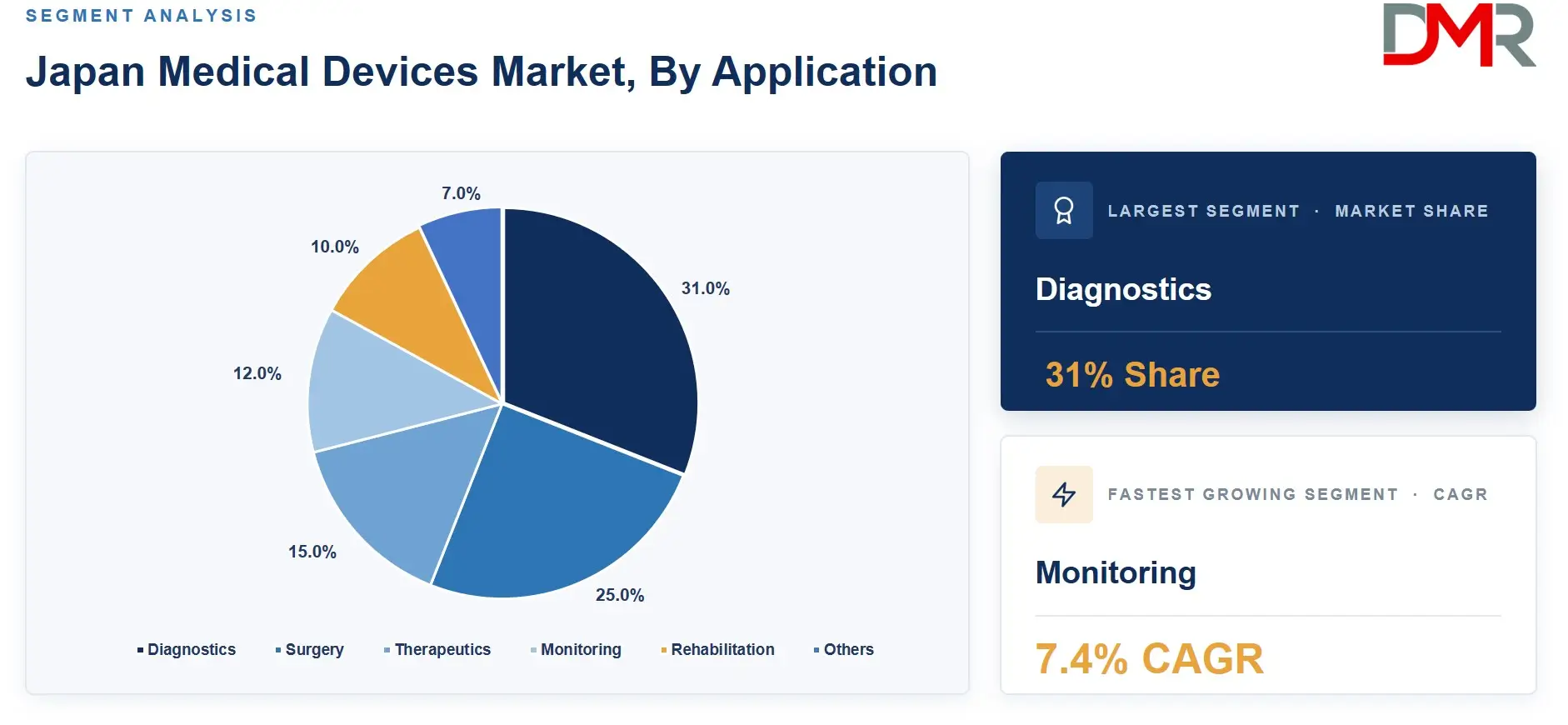
Diagnostics are expected to lead application revenue in 2026 with close to 31%, supported by high use of imaging, laboratory testing, endoscopy and physiological measurement across Japan's hospital network. Early diagnosis and ongoing disease surveillance keep equipment utilization high, while replacement needs protect demand for mature modalities. Growth, however, is concentrated in Monitoring, forecast to expand at a CAGR of 7.4% through 2035. Monitoring is moving beyond intensive-care beds into general wards, outpatient care and homes, supported by wireless sensors and connected platforms. As clinicians manage more chronic patients with limited staffing, devices that provide reliable longitudinal data and reduce manual observation gain value across cardiac, respiratory and post-procedure pathways.
By End User
Hospitals are projected to account for roughly 56% of end-user revenue in 2026 because they concentrate complex imaging, surgery, intensive care, interventional cardiology and laboratory infrastructure. Their purchasing scale also makes them the primary destination for high-value capital equipment and bundled service agreements. The fastest growth is expected in Home Healthcare, which is forecast to expand at a CAGR of 8.3% through 2035. Respiratory therapy, patient monitoring, rehabilitation and chronic-disease devices are becoming easier to operate outside institutional settings. Aging demographics and pressure to avoid unnecessary inpatient utilization create a strong incentive for products that allow clinicians to supervise stable patients remotely while keeping escalation pathways available when readings deteriorate.
By Distribution Channel
Direct Sales are expected to hold the largest channel share in 2026 at approximately 61%, since complex medical systems require technical demonstrations, configuration, installation, training and post-sale service that favor direct manufacturer relationships with hospitals and large healthcare groups. Direct account teams also manage tender requirements and lifecycle contracts. Growth, however, is concentrated in Digital & E-commerce Channels, forecast to expand at a CAGR of 9.0% through 2035. The channel is most relevant to standardized accessories, consumables, lower-complexity devices and repeat orders where buyers already understand specifications. Improved procurement portals and digital catalog integration can reduce transaction cost while leaving complex capital sales in higher-touch channels.
The Japan Medical Devices Market Report is Segmented Based on the Following
By Product Type
- Diagnostic Imaging Devices
- Cardiovascular Devices
- Endoscopy & Minimally Invasive Devices
- Orthopedic Devices
- Patient Monitoring & Life Support Devices
- Consumables & Disposables
- Others
By Technology
- Conventional & Electromechanical
- Digital & Connected
- Minimally Invasive & Robotic
- AI-Enabled
- Wearable & Home-Based
- Others
By Application
- Diagnostics
- Surgery
- Therapeutics
- Monitoring
- Rehabilitation
- Others
By End User
- Hospitals
- Clinics
- Diagnostic Centers & Laboratories
- Home Healthcare
- Ambulatory Surgical Centers
- Others
By Distribution Channel
- Direct Sales
- Distributors & Dealers
- Group Purchasing & Institutional Procurement
- Digital & E-commerce Channels
- Others
Competitive Landscape
Competition in Japan combines strong domestic specialists with multinational suppliers that maintain local commercial and regulatory operations. Domestic companies are especially influential in endoscopy, patient monitoring, diagnostics, catheters, ophthalmic equipment and precision components, while foreign firms hold important positions in cardiovascular intervention, orthopedics, surgical robotics, imaging and critical-care technologies. Competition centers on clinical evidence, installed-base service, reimbursement fit, physician familiarity, product reliability and the ability to navigate PMDA requirements. Vendors are increasingly pairing hardware with software, training, disposable accessories and long-term service agreements. Partnerships with hospitals and local distributors remain important for specialist products, while larger suppliers use direct account teams for capital equipment and national key accounts.
Some of the Prominent Players in the Japan Medical Devices Market Are
- Terumo Corporation
- Olympus Corporation
- Sysmex Corporation
- FUJIFILM Healthcare Corporation
- Canon Medical Systems Corporation
- Nipro Corporation
- Nihon Kohden Corporation
- HOYA Corporation
- Topcon Corporation
- Shimadzu Corporation
- Asahi Intecc Co., Ltd.
- Japan Lifeline Co., Ltd.
- MANI, Inc.
- Fukuda Denshi Co., Ltd.
- Konica Minolta, Inc.
- OMRON Healthcare Co., Ltd.
- PHC Holdings Corporation
- ARKRAY, Inc.
- JMS Co., Ltd.
- A&D Company, Limited
- HORIBA, Ltd.
- Rion Co., Ltd.
- Sekisui Medical Co., Ltd.
- Medtronic plc
- Johnson & Johnson MedTech
- Abbott Laboratories
- Boston Scientific Corporation
- Stryker Corporation
- Becton, Dickinson and Company
- Siemens Healthineers AG
- GE HealthCare Technologies Inc.
- Koninklijke Philips N.V.
- F. Hoffmann-La Roche Ltd.
- Edwards Lifesciences Corporation
- Zimmer Biomet Holdings, Inc.
- Intuitive Surgical, Inc.
- Baxter International Inc.
- Fresenius Medical Care AG
- ResMed Inc.
- Carl Zeiss Meditec AG
- Other Key Players
Recent Developments
- In June 2026, Olympus introduced new 4K LCD monitors in Japan for use with endoscopy systems, extending its imaging chain and giving hospitals additional options to improve visualization across diagnostic and therapeutic procedures.
- In June 2026, PMDA published review points for home-use software medical devices that detect signs of disease and prompt users to seek care, clarifying expectations for a growing category of digital health products in Japan.
- In December 2025, Japan approved Philips Japan's TightRail family, expanding the locally authorized toolkit for lead-management procedures and reinforcing demand for specialized cardiovascular devices used in complex hospital interventions.
- In December 2025, Japan approved the PillCam COLON 2 and PillCam SB 3 capsule endoscopy systems marketed through Medtronic's local operations, widening access to swallowable imaging technologies for gastrointestinal diagnostics.
- In November 2025, Japan approved Apple's hypertension pattern notification program as a medical device, illustrating how regulated software and consumer hardware are moving closer to formal clinical screening and referral pathways.
- In October 2025, Olympus announced the Japan launch of an NBI+TXI observation mode for its EVIS X1 endoscopy platform, combining image-enhancement approaches to support more detailed endoscopic observation and treatment workflows.
Report Details
| Report Characteristics |
| Market Size (2026) |
USD 35.9 Bn |
| Forecast Value (2035) |
USD 57.1 Bn |
| CAGR (2026-2035) |
5.3% |
| Historical Data |
2021 - 2025 |
| Forecast Data |
2026 - 2035 |
| Base Year |
2025 |
| Segments Covered |
By Product Type, By Technology, By Application, By End User and By Distribution Channel |
| Regional Coverage |
Japan |
Frequently Asked Questions
How big is the Japan Medical Devices Market?
▾ Japan Medical Devices Market revenue is estimated at USD 35.9 Bn in 2026. Demand spans diagnostic imaging, cardiovascular systems, endoscopy, orthopedics, patient monitoring, life-support equipment, consumables and regulated digital devices used across hospitals, clinics, laboratories and home-care settings.
What is the growth rate of the Japan Medical Devices Market?
▾ The industry is forecast to expand at a CAGR of 5.3% from 2026 to 2035. Growth is supported by equipment replacement, an aging patient base, minimally invasive procedures, connected monitoring and software-enabled clinical workflows, while reimbursement pressure and regulatory evidence requirements moderate the pace.
What is driving demand in the Japan Medical Devices Market?
▾ Demand is driven by high utilization of diagnostics and intervention, an aging population with complex chronic-care needs, and hospital pressure to improve productivity. These factors favor imaging, endoscopy, cardiovascular devices, monitoring and systems that shorten recovery or reduce manual workload across constrained clinical environments.
Who are the key players in the Japan Medical Devices Market?
▾ Key suppliers include Terumo Corporation, Olympus Corporation, Sysmex Corporation, FUJIFILM Healthcare Corporation, Canon Medical Systems Corporation, Medtronic plc and Siemens Healthineers AG. Competition is based on clinical evidence, product reliability, service coverage, physician familiarity, regulatory execution and the ability to integrate equipment with hospital workflows.
Which product type leads the Japan Medical Devices Market?
▾ Diagnostic Imaging Devices are expected to lead product revenue in 2026 with a share of roughly 24%. CT, MRI, ultrasound and digital radiography systems have broad use across specialties, and their installed base creates regular replacement, service and software-upgrade demand within hospitals and diagnostic facilities.
Which technology is growing fastest in the Japan Medical Devices Market?
▾ AI-Enabled devices are forecast to post the fastest technology growth, with a CAGR of 10.8% from 2026 to 2035. Computer vision, automated measurement, workflow prioritization and decision support are expanding into imaging, endoscopy and monitoring, although adoption remains tied to validation, explainability and PMDA-compliant lifecycle management.
What will shape the Japan Medical Devices Market through 2035?
▾ The Japan Medical Devices Market will be shaped by minimally invasive procedures, connected monitoring, home-care expansion, software-defined equipment and stricter expectations for cybersecurity and post-market performance. Suppliers that combine hardware reliability with clinical workflow support, local regulatory capability and lifecycle service are positioned to capture a larger share of future spending.