Market Snapshot
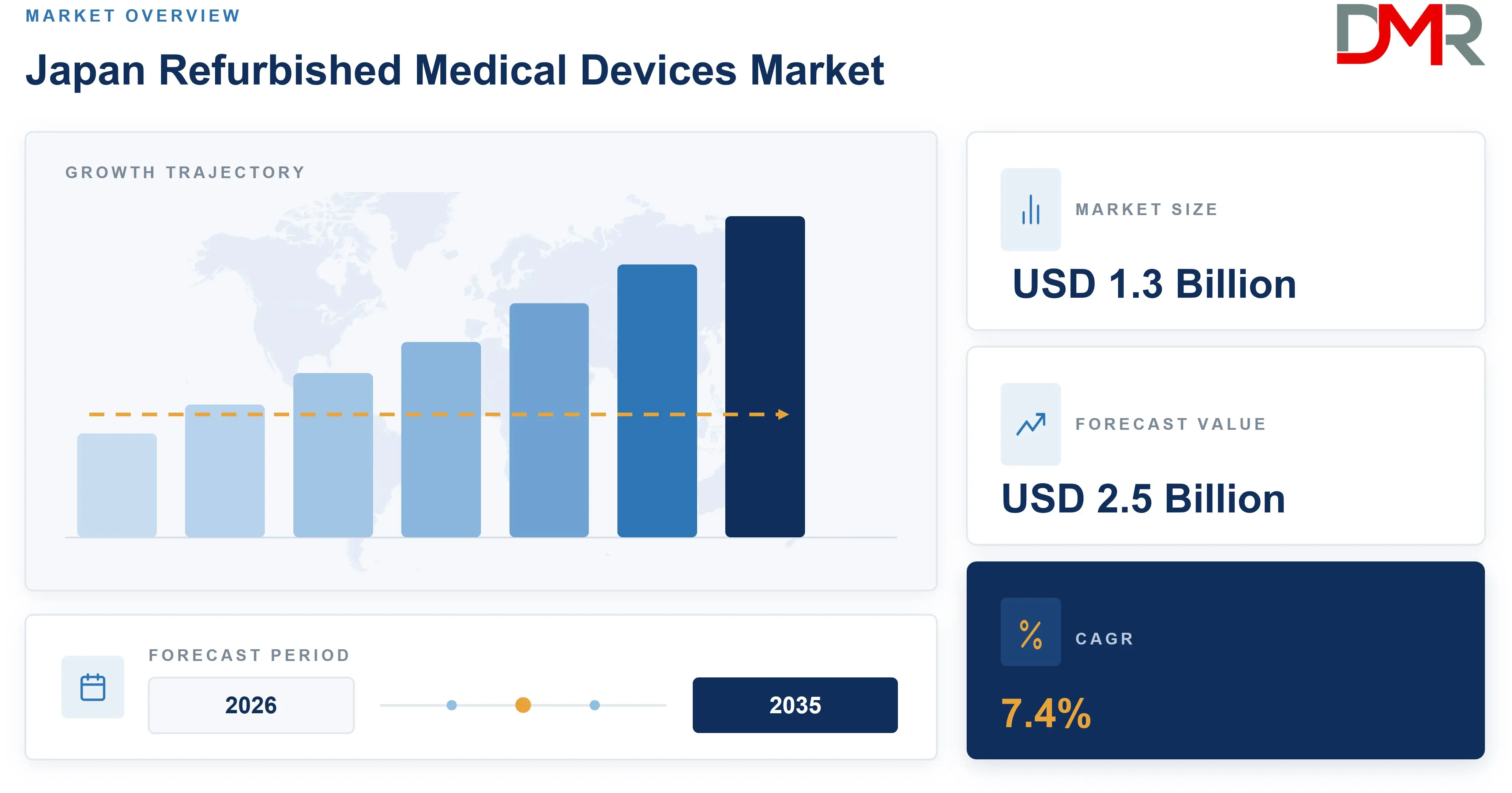
- Market Size (2026): USD 1.3 Bn
- Forecast Value (2035): USD 2.5 Bn
- CAGR (2026-2035): 7.4%
- Leading Product (2026): Medical Imaging Equipment, approximately 42%
- Leading Refurbishment Provider (2026): OEM/Authorized Refurbishers, around 46%
- Key Players: Siemens Healthineers, GE HealthCare, Canon Medical Systems Corporation, and others
What is Japan Refurbished Medical Devices Market and its Market Size?
The Japan Refurbished Medical Devices Market size is estimated to reach USD 1.3 Bn in 2026 and is further anticipated to reach USD 2.5 Bn by 2035, at a CAGR of 7.4%. Refurbished medical devices are pre-owned systems that are inspected, cleaned, repaired where permitted, functionally tested, and returned to a defined condition for resale or redeployment. In Japan, the category spans high-value imaging systems, endoscopy equipment, patient monitoring devices, operating room equipment, laboratory instruments, and related accessories that retain useful clinical life after their first installation.
ℹ
To learn more about this report –
Download Your Free Sample Report Here
The figures in this report cover demand inside Japan, including purchases by hospitals, clinics, and diagnostic centers, rather than the worldwide revenue of companies headquartered in Japan. The boundary includes OEM-refurbished systems, independently refurbished equipment, reconditioned units sold by specialist medical dealers, and qualifying pre-owned equipment that receives inspection and technical preparation before resale. Disposable devices and simple secondhand sales outside a credible medical equipment channel are excluded from the core sizing.
Buyer economics are shaped by a combination of capital discipline and a demanding quality culture. Large imaging platforms can remain clinically productive after a site upgrade, hospital consolidation, lease return, or technology refresh, creating a recurring pool of equipment with residual value. Hospitals with constrained investment budgets can use refurbished systems to add capacity, replace aging units, or bridge the interval before a planned new-equipment purchase, provided installation history, maintenance records, parts availability, software status, and service support are sufficiently transparent.
Market structure is changing as lifecycle management becomes more formal. OEM trade-in programs and condition-based maintenance are narrowing the information gap between new and pre-owned equipment. Japan's regulatory controls over sales, repair, maintenance, and traceability also limit informal price-only competition, favoring licensed operators with engineers and dependable after-sales support. This creates a formal secondary channel for clinically serviceable equipment nationwide.
Use Cases
- Regional Hospital Imaging Replacement: Community hospitals deploy refurbished CT, MRI, X-ray, or ultrasound systems when a full new-equipment purchase would disrupt capital plans. Lower acquisition cost helps restore capacity while preserving funds for staffing, construction, software, and other clinical priorities.
- Diagnostic Clinic Capacity Expansion: Imaging and specialty clinics use pre-owned equipment to add a room, extend operating hours, or open a satellite site without matching new-equipment economics. Qualified vendors combine the device with site preparation, installation, calibration, training, and service coverage.
- Endoscopy Suite Continuity: Hospitals and gastroenterology clinics acquire refurbished processors, light sources, scopes, and compatible peripherals when an existing platform remains clinically adequate. This reduces disruption and can postpone a full platform migration until the facility is ready to standardize its endoscopy fleet.
- Teaching and Backup Fleets: Academic hospitals, training centers, and larger medical groups deploy inspected pre-owned systems for simulation, staff familiarization, non-primary rooms, or contingency capacity. Secondary units reduce pressure on production equipment and provide a controlled environment for maintenance practice and workflow validation.
Key Takeaways
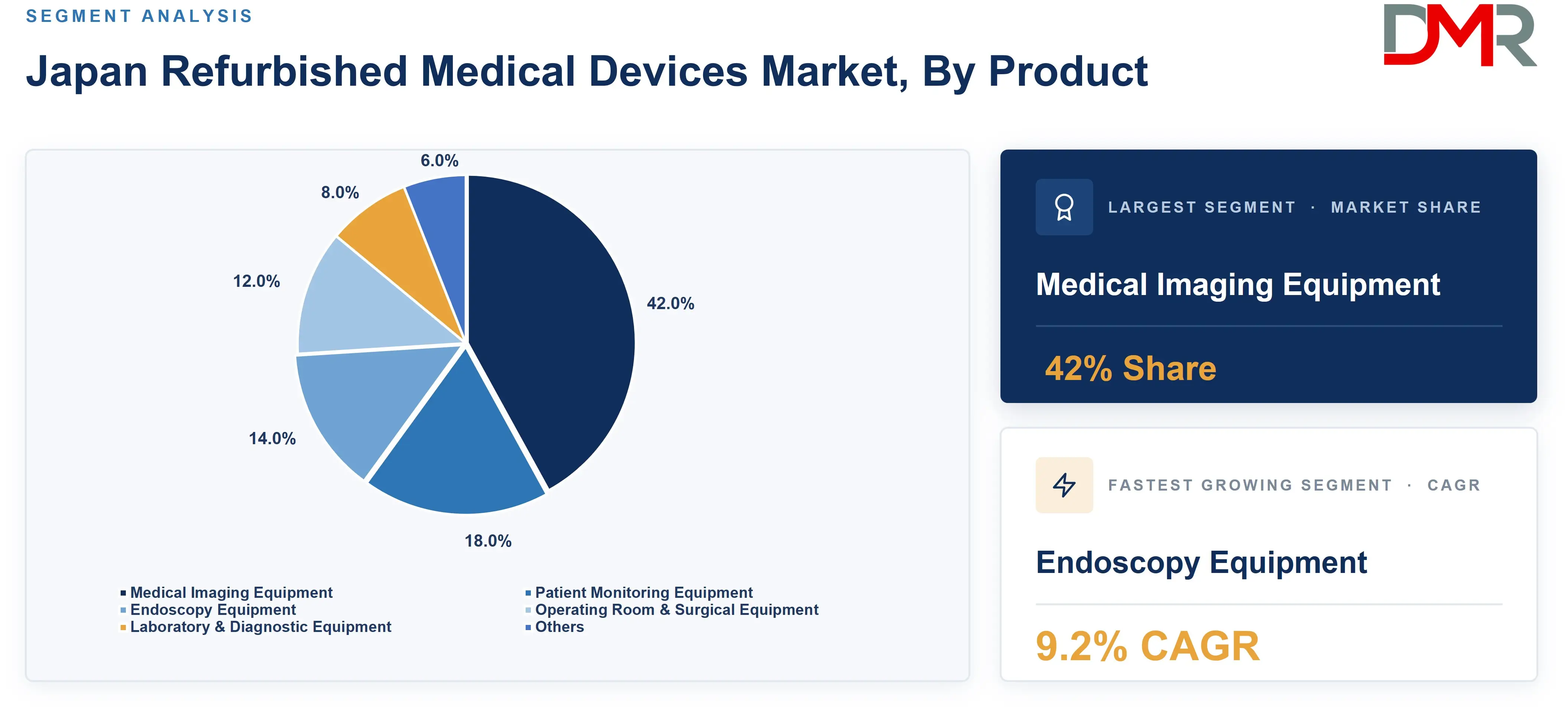
- Market Size & Share: Medical Imaging Equipment is expected to hold approximately 42% of 2026 revenue.
- Product Analysis: Endoscopy Equipment is forecast to expand at a CAGR of 9.2% during 2026-2035.
- Demand Concentration: Hospitals are set to account for roughly 55% of 2026 demand.
- Sales Channel Analysis: Direct Sales is projected to represent close to 44% of 2026 revenue.
- Digital Channel Shift: Online Platforms are forecast to grow at a CAGR of 10.0% during 2026-2035.
- Application Growth: Gastroenterology is expected to expand at a CAGR of 9.1% through 2035.
How AI/Gen AI is Transforming the Japan Refurbished Medical Devices Market?
AI is most useful in refurbishment where it reduces uncertainty about condition, serviceability, and documentation. Computer vision can support inspection of housings, connectors, displays, cables, and selected components before deeper functional checks. Predictive maintenance models can combine operating hours, fault logs, error codes, and parts records to flag poor candidates or units likely to need expensive service after installation.
Gen AI has a narrower but practical role in document-heavy workflows. Language models can organize maintenance histories, summarize service notes, identify missing records, and prepare handover packages for engineer review without replacing regulated technical judgment. Digital twins can test room fit, network interfaces, utilization, and planning before redeployment. These tools improve screening consistency, while accountability remains with licensed sellers, repair organizations, engineers, and healthcare institutions.
- Automated Condition Screening: Computer vision assists technicians in triaging visible wear, missing parts, labeling issues, and connector damage before bench testing.
- Predictive Service Risk: Machine learning uses service logs and fault history to estimate maintenance exposure and prioritize units for deeper inspection.
- LLM Document Processing: Language models structure installation records, service notes, parts histories, and handover documentation for engineer review.
- Digital Twin Planning: Simulation supports room-fit checks, workflow redesign, network planning, and utilization scenarios before redeployment.
Key Drivers in the Japan Refurbished Medical Devices Market
Demand is supported by hospital capital discipline and a large installed base of technically capable equipment entering replacement cycles.
- Hospital Capital Discipline and Asset Sweating: Hospitals are expected to generate around 55% of 2026 demand, making procurement economics a central growth mechanism. Refurbished systems let facilities restore capacity, add throughput, or equip secondary sites without timing every need to a premium new-platform purchase. The case strengthens when maintenance history, installation, training, and service are bundled. This allows procurement teams to treat pre-owned equipment as one option within a wider capital plan rather than only as an emergency substitute. It also reduces the risk of delaying a clinically necessary replacement.
- High Residual Value of Imaging and Endoscopy Assets: Endoscopy Equipment is expected to represent about 14% of 2026 product revenue, while many imaging and endoscopy systems remain useful after the original owner upgrades. Japan's dense installed base and disciplined maintenance create recurring supply of processors, scanners, ultrasound systems, monitors, and peripherals. When software, accessories, spare parts, and service remain available, these assets can move to lower-volume sites or backup roles, giving refurbishers enough inventory to specialize by modality and model generation. This depth improves price discovery and speeds matching between sellers and buyers.
Restraints in the Japan Refurbished Medical Devices Market
Growth is constrained by regulatory responsibility and by lifecycle economics that weaken when parts, software, or service support become uncertain.
- Licensing, Traceability, and Repair Compliance: Independent Third-Party Refurbishers are projected to account for roughly 28% of 2026 provider revenue, but compliance limits casual entry. Japan requires appropriate permissions or notifications for regulated-device sales and a repair-business license for commercial medical-device repair. Buyers also expect service history, inspection evidence, decontamination practices, installation records, and clear accountability. These obligations raise fixed costs for qualified personnel, premises, procedures, and quality systems, slowing transactions when device status cannot be established and favoring experienced licensed operators. For smaller dealers, these costs can make low-volume transactions unattractive.
- Parts Obsolescence and Software Support Risk: Laboratory & Diagnostic Equipment is expected to contribute close to 9% of 2026 product revenue, but support risk affects every complex device. A low purchase price can become uneconomic if proprietary boards, detectors, probes, batteries, software keys, cybersecurity patches, or calibration support are unavailable. OEM end-of-service decisions can shorten the viable resale window even when mechanical condition is good. Buyers therefore assess total lifecycle cost, while refurbishers without dependable parts channels face higher warranty exposure. Older devices also face faster value erosion as support windows narrow.
Growth Opportunities in the Japan Refurbished Medical Devices Market
The strongest white space lies in lower-capital outpatient settings and channels that make condition, documentation, and after-sales obligations easier to evaluate.
- Clinic and Specialty-Center Modernization: Clinics are projected to represent around 12% of 2026 end-user revenue and offer a strong route for refurbished ultrasound, endoscopy, X-ray, ophthalmic, and monitoring equipment. Smaller facilities often need capable technology but cannot justify premium systems built for tertiary-hospital utilization. Refurbishers can combine equipment with installation, maintenance, financing support, and trade-in services. This converts a used-device sale into a managed replacement project and reduces the operational burden on clinic owners. Regional service coverage can further strengthen conversion among owner-operated practices and specialty centers across Japan today.
- Verified Online Inventory and Remote Inspection: Online Platforms are expected to account for nearly 9% of 2026 sales-channel revenue, leaving room for faster growth if listings become more trustworthy. Buyers need serial-level information, photos, operating hours, software versions, service history, accessories, inspection status, and clear logistics responsibility. Standardized records, remote video inspection, and technician consultations can shorten sourcing cycles and reduce uncertainty while keeping regulated repair, installation, and acceptance work with qualified organizations. Trust features therefore become part of the product rather than a separate service, especially for first-time buyers.
Trends in the Japan Refurbished Medical Devices Market
Market behavior is shifting from one-off resale toward lifecycle services and clearer differentiation between basic secondhand equipment and documented refurbishment.
- OEM-Led Lifecycle Programs and Trade-In Integration: OEM/Authorized Refurbishers are expected to hold around 46% of 2026 provider revenue, showing the value of manufacturer-backed assurance. OEM programs increasingly connect trade-in, de-installation, refurbishment, software updates, installation, training, and service. This lets residual value enter replacement planning before equipment is removed and raises expectations for independent dealers. Competitors must respond with stronger inspection records, engineering capability, and after-sales support, so price increasingly competes with provenance, serviceability, and documented technical condition. Lifecycle transparency is becoming a competitive requirement, especially for imaging systems and multi-site hospital fleets.
- Greater Demand for Newer-Generation Pre-Owned Systems: Auctions & Brokers are projected to account for close to 7% of 2026 channel revenue, but buyers are becoming more selective about model age and support horizon. Recent lease returns, demonstration systems, and equipment removed during planned upgrades are more likely to retain current accessories, interfaces, software, and maintenance support. This preference compresses the resale window for older assets while improving pricing for well-documented newer models and encouraging earlier sourcing relationships with hospitals and leasing firms. That shift rewards sourcing networks that identify equipment before technical value deteriorates.
Research Scope and Analysis
Segment performance is assessed across five axes: product, refurbishment provider, end user, sales channel, and application. Each axis identifies where 2026 revenue is concentrated and which sub-segment is expanding fastest through 2035, with the commercial reason behind each position.
ℹ
To learn more about this report –
Download Your Free Sample Report Here
By Product
Medical Imaging Equipment is projected to hold the largest product share in 2026, accounting for approximately 42% of revenue, because CT, MRI, X-ray, ultrasound, and related systems combine high new-equipment prices with long technical lives and established service ecosystems. Their residual value supports formal trade-in, inspection, and resale when software and service remain available. Growth, however, is concentrated in Endoscopy Equipment, forecast to expand at a CAGR of 9.2% during 2026-2035. Hospitals and clinics frequently need compatible processors, light sources, scopes, and peripherals while transitioning between platform generations. Japan's large procedural base and domestic endoscopy expertise create recurring replacement opportunities, while compact equipment is easier to inspect, store, and redistribute than fixed imaging systems.
By Refurbishment Provider
OEM/Authorized Refurbishers are expected to lead provider revenue in 2026 with a share of around 46%, supported by original service procedures, software, parts, trained engineers, installation capability, and warranty structures. This position is strongest in complex imaging systems where hospitals value documented provenance and a defined support path. Growth, however, is concentrated in Independent Third-Party Refurbishers, expanding at a CAGR of 8.8% during 2026-2035. Independent specialists can source across brands, serve narrower budgets, and support mixed fleets that do not fit a single-OEM strategy. Their trajectory depends on disciplined compliance, parts access, qualified repair capability, and transparent inspection records because lower price alone cannot offset unclear technical accountability in Japan.
By End User
Hospitals are projected to account for roughly 55% of 2026 end-user revenue because they operate the broadest installed base and generate replacement opportunities across imaging, monitoring, endoscopy, operating rooms, and diagnostics. Large facilities also have procurement and biomedical teams capable of evaluating maintenance history and service contracts. Growth, however, is expected to be strongest in Clinics, forecast to expand at a CAGR of 8.6% during 2026-2035. Specialty practices need capable equipment but often face lower utilization than tertiary hospitals, making refurbished ultrasound, X-ray, endoscopy, ophthalmic, and monitoring devices attractive. Dealers that combine equipment with financing, installation, training, and maintenance can reduce adoption friction for smaller operators and new specialty sites.
By Sales Channel
Direct Sales is expected to remain the leading channel in 2026, representing close to 44% of revenue, because higher-value refurbished systems require technical consultation, site assessment, logistics, installation, commissioning, and service planning. Direct engagement also gives sellers more control over asset history and post-installation accountability. Growth, however, is concentrated in Online Platforms, forecast to advance at a CAGR of 10.0% during 2026-2035. Digital inventory tools reduce search costs and allow buyers to compare model age, configuration, accessories, location, and availability across a wider seller base. Strong platforms will support verified documentation and engineer-assisted inspection rather than treating regulated medical equipment like ordinary secondhand merchandise or consumer resale inventory in Japan.
By Application
Diagnostic Imaging is projected to hold the largest application share in 2026 at around 38%, reflecting the value and secondary-market depth of CT, MRI, ultrasound, X-ray, mammography, and nuclear imaging systems. Capable units can move to secondary rooms or lower-volume sites when service and parts remain available. Growth, however, is concentrated in Gastroenterology, forecast to expand at a CAGR of 9.1% during 2026-2035. Endoscopy platforms create frequent demand for processors, light sources, scopes, washers, and compatible accessories, and hospitals often need replacements without changing the whole installed ecosystem. Japan's endoscopy expertise supports a technically informed resale channel with strong inspection and maintenance knowledge across hospital and clinic settings nationwide today.
The Japan Refurbished Medical Devices Market Report is Segmented Based on the Following
By Product
- Medical Imaging Equipment
- Patient Monitoring Equipment
- Endoscopy Equipment
- Operating Room & Surgical Equipment
- Laboratory & Diagnostic Equipment
- Others
By Refurbishment Provider
- OEM/Authorized Refurbishers
- Independent Third-Party Refurbishers
- Specialized Medical Equipment Dealers
- Healthcare Facility/Leasing-Company Reconditioning
- Others
By End User
- Hospitals
- Diagnostic Imaging Centers
- Clinics
- Ambulatory Surgical Centers
- Academic & Research Institutions
- Others
By Sales Channel
- Direct Sales
- Distributors & Dealers
- Online Platforms
- Auctions & Brokers
- Others
By Application
- Diagnostic Imaging
- Surgery
- Critical Care & Monitoring
- Gastroenterology
- Cardiology
- Others
Regulatory Landscape
Japan's refurbished-device channel operates within the Pharmaceuticals and Medical Devices Act, with oversight involving the Ministry of Health, Labour and Welfare, prefectural authorities, and the PMDA depending on the activity and device. Used-device sales can require a permit or notification by classification, while commercial medical-device repair requires an appropriate repair-business license and qualified technical responsibility. Buyer attention is therefore shifting toward traceable service history, documented inspection, decontamination, and qualified installation rather than simple resale. The commercial opening sits with operators that package compliance with logistics and service. The brake is higher fixed cost for qualified staff, records, premises, and controlled processes, favoring scale and disciplined quality systems.
Pricing Analysis
Pricing depends less on nominal device age than on remaining supportability. Residual value rises when a system has complete maintenance records, current software, compatible accessories, available parts, and a credible service path after installation. OEM-backed units typically command a premium for documentation, engineering support, and warranty, while independent dealers compete through multi-brand sourcing and sharper acquisition economics. The strongest opening is in newer-generation lease returns and planned de-installations, where sellers can capture value before support declines. Pricing risk increases when transport, site work, tube replacement, probe condition, cybersecurity updates, or proprietary components are uncertain. These lifecycle costs determine whether a low purchase price remains attractive.
Competitive Landscape
Competition in Japan is fragmented across OEM lifecycle programs, domestic medtech manufacturers, specialist used-equipment dealers, and international device suppliers whose installed products enter the secondary channel. The market does not reward inventory ownership alone. Buyers compare engineering credibility, licensing, maintenance history, de-installation competence, logistics, parts access, software support, installation, warranty, and response time after commissioning. OEMs are strongest in high-value imaging systems and tightly controlled service ecosystems, while independent Japanese dealers compete through multi-brand sourcing, nationwide hospital relationships, export channels, and flexible equipment matching. A growing differentiator is documentation quality, including serial-level records, operating history, configuration data, photographs, inspection results, and clear statements of what is included. Digital inventory visibility is improving, but regulated technical work remains a relationship and service business.
Some of the Prominent Players in the Japan Refurbished Medical Devices Market Are
- Siemens Healthineers
- GE HealthCare
- Philips
- Drägerwerk AG & Co. KGaA
- Getinge AB
- Stryker Corporation
- Medtronic plc
- Baxter International Inc.
- B. Braun SE
- Boston Scientific Corporation
- Canon Medical Systems Corporation
- FUJIFILM Corporation
- Olympus Corporation
- Shimadzu Corporation
- Nihon Kohden Corporation
- Terumo Corporation
- Nipro Corporation
- Sysmex Corporation
- HOYA Corporation
- Konica Minolta, Inc.
- Fukuda Denshi Co., Ltd.
- Topcon Corporation
- Cielo Co., Ltd.
- MTJ Inc.
- Intermedical Co., Ltd.
- Bond Japan Co., Ltd.
- Astead Co., Ltd.
- Japan Central Medical Inc.
- LJ Business Co., Ltd.
- Fair Medical Co., Ltd.
- HOYU AND CO., LTD.
- M-solutions Inc.
- Japan Care Co., Ltd.
- Gate Medical LLC
- Mindray
- Hologic, Inc.
- KARL STORZ SE & Co. KG
- Esaote S.p.A.
- Carestream Health
- Agfa-Gevaert Group
- Other Key Players
Recent Developments
- In July 2026, Bond Japan announced participation in Expo Med | Hospitalar México, extending international visibility for Japan-sourced used and refurbished systems and strengthening an export route for domestically collected inventory.
- In May 2026, Siemens Healthineers Japan and Hakuhokai Group reported MRI power-consumption monitoring at Osaka Gyoumeikan Hospital, including analysis of software-update potential that supports longer productive use of installed imaging assets.
- In April 2026, M-solutions renewed its pre-owned medical equipment website while continuing to display MRI, CT, PET/CT, angiography, and related inventory, improving digital visibility for buyers seeking Japan-sourced systems.
- In January 2026, Bond Japan announced relocation of its Kyushu sales office, supporting a broader domestic sourcing and customer network for used medical equipment across a hospital-dense region.
- In June 2025, Bond Japan participated in Japan Health, giving the specialist reseller a venue to present used-equipment capabilities and develop relationships with healthcare buyers, distributors, and service partners.
- In November 2024, Siemens Healthineers Japan and Ryokusenkai agreed to a long-term managed equipment services partnership for Yonemori Hospital, embedding structured equipment renewal, maintenance, and lifecycle planning into hospital technology management.
Report Details
| Report Characteristics |
| Market Size (2026) |
USD 1.3 Bn |
| Forecast Value (2035) |
USD 2.5 Bn |
| CAGR (2026-2035) |
7.4% |
| Historical Data |
2021 - 2025 |
| Forecast Data |
2026 - 2035 |
| Base Year |
2025 |
| Segments Covered |
By Product, By Refurbishment Provider, By End User, By Sales Channel, and By Application |
| Regional Coverage |
Japan |
Frequently Asked Questions
How big is the Japan Refurbished Medical Devices Market?
▾ The Japan Refurbished Medical Devices Market is estimated at USD 1.3 Bn in 2026. Demand comes from hospitals, diagnostic centers, clinics, and other institutions seeking lower-capital alternatives for imaging, endoscopy, monitoring, surgical, and diagnostic equipment. The market is anticipated to reach USD 2.5 Bn by 2035 as formal refurbishment and lifecycle-management channels expand.
What is the growth rate of the Japan Refurbished Medical Devices Market?
▾ The Japan Refurbished Medical Devices Market is forecast to expand at a CAGR of 7.4% during 2026-2035. Growth is supported by hospital capital discipline, a steady flow of trade-in and lease-return equipment, stronger lifecycle programs, and improving digital inventory transparency, while regulatory requirements and parts obsolescence keep growth measured rather than speculative.
What is driving demand in the Japan Refurbished Medical Devices Market?
▾ Demand is driven mainly by the need to preserve clinical capacity without committing to the full capital cost of new equipment. Hospitals are expected to represent roughly 55% of 2026 demand because they manage large installed fleets and frequent replacement cycles. A mature service ecosystem also makes selected pre-owned systems easier to evaluate, install, and maintain.
Which product segment holds the largest share in the Japan Refurbished Medical Devices Market?
▾ Medical Imaging Equipment is projected to lead the product mix with approximately 42% of 2026 revenue. CT, MRI, X-ray, ultrasound, and related systems retain meaningful residual value because they are expensive when new, can remain clinically useful after upgrades, and have established service and parts ecosystems that support planned de-installation and redeployment.
Which refurbishment provider segment is expected to grow fastest?
▾ Independent Third-Party Refurbishers are forecast to grow at a CAGR of 8.8% during 2026-2035. Their advantage is multi-brand sourcing and the ability to match narrower budgets or mixed installed fleets. Growth depends on strong compliance, qualified technicians, documented inspection, reliable parts sourcing, and after-sales service that can compete with manufacturer-backed lifecycle programs.
Who are the key players in the Japan Refurbished Medical Devices Market?
▾ Key participants include Siemens Healthineers, GE HealthCare, Canon Medical Systems Corporation, FUJIFILM Corporation, Olympus Corporation, Bond Japan Co., Ltd., and Intermedical Co., Ltd. in Japan. Competition spans OEM lifecycle programs, Japan-based medical manufacturers, specialist refurbished-equipment dealers, and service-led distributors, with quality documentation and technical support carrying significant weight in procurement.
What factors will shape the Japan Refurbished Medical Devices Market through 2035?
▾ The Japan Refurbished Medical Devices Market will be shaped by lifecycle-management adoption, serviceability of older platforms, digital equipment histories, parts availability, software and cybersecurity support, hospital investment budgets, and regulatory compliance. Buyers will increasingly favor devices with verifiable maintenance records, known configuration, qualified installation, and a clear support horizon rather than selecting equipment on acquisition price alone.