What is the Managed Communication Service Market Size?
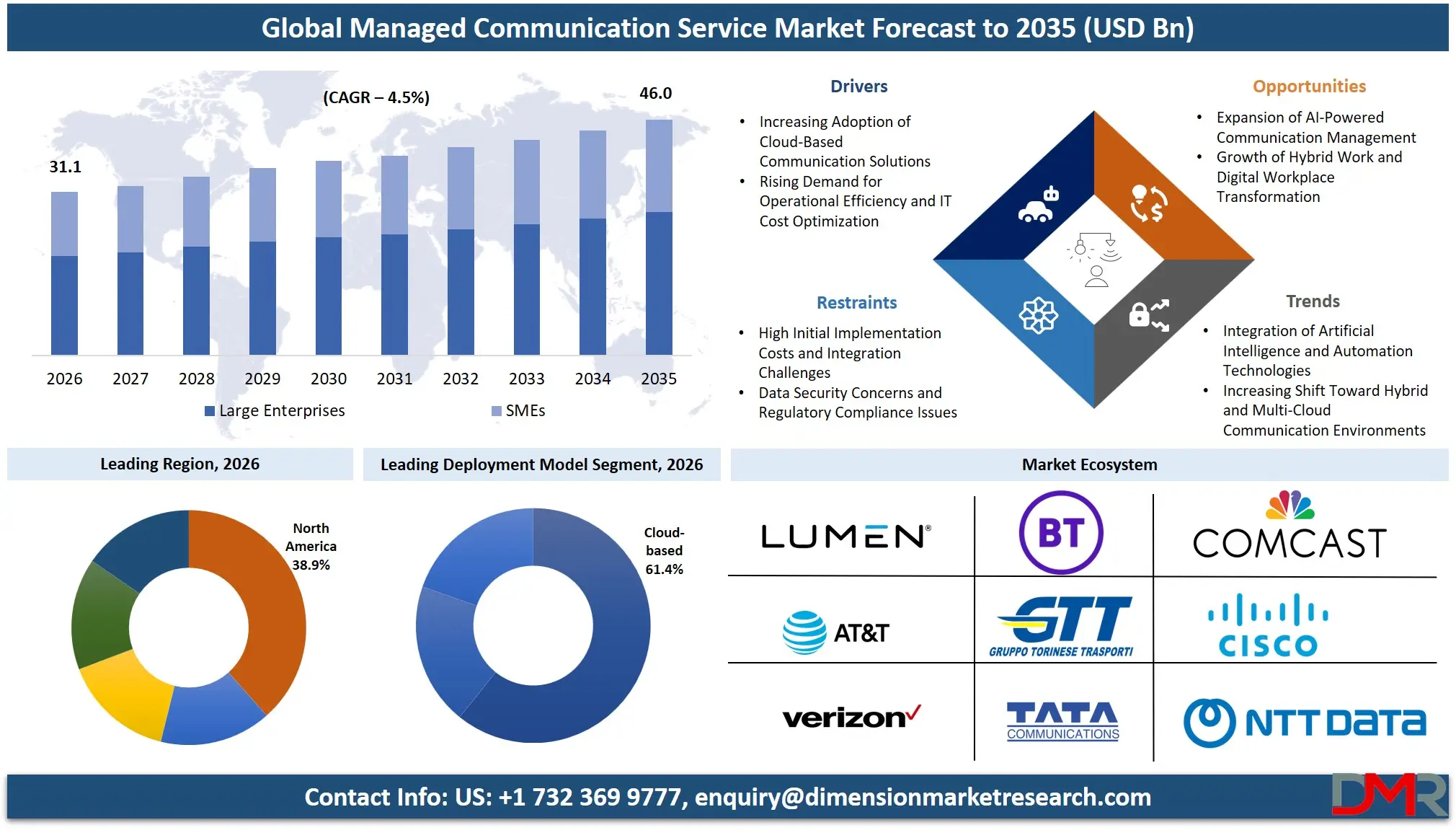
The Managed Communication Service Market size is expected to be USD 31.1 billion in 2026 and increase at a compound annual growth rate of 4.5% to USD 46.0 billion in 2035 due to increasing adoption of cloud-based communication solutions.
ℹ
To learn more about this report –
Download Your Free Sample Report Here
The Managed Communication Service Market refers to the industry providing outsourced management, monitoring, optimization, and support of enterprise communication infrastructure, including unified communications, voice networks, data connectivity, mobility solutions, contact centers, and communication security services. The market integrates technologies such as cloud communications, artificial intelligence, automation, and network analytics to enhance business collaboration and operational efficiency. It plays a significant role in digital transformation strategies as organizations increasingly shift toward flexible, scalable, and secure communication ecosystems. Growing remote work adoption, hybrid workplace models, increasing cybersecurity requirements, and demand for cost-efficient IT operations are accelerating market expansion globally.
The US Managed Communication Service Market
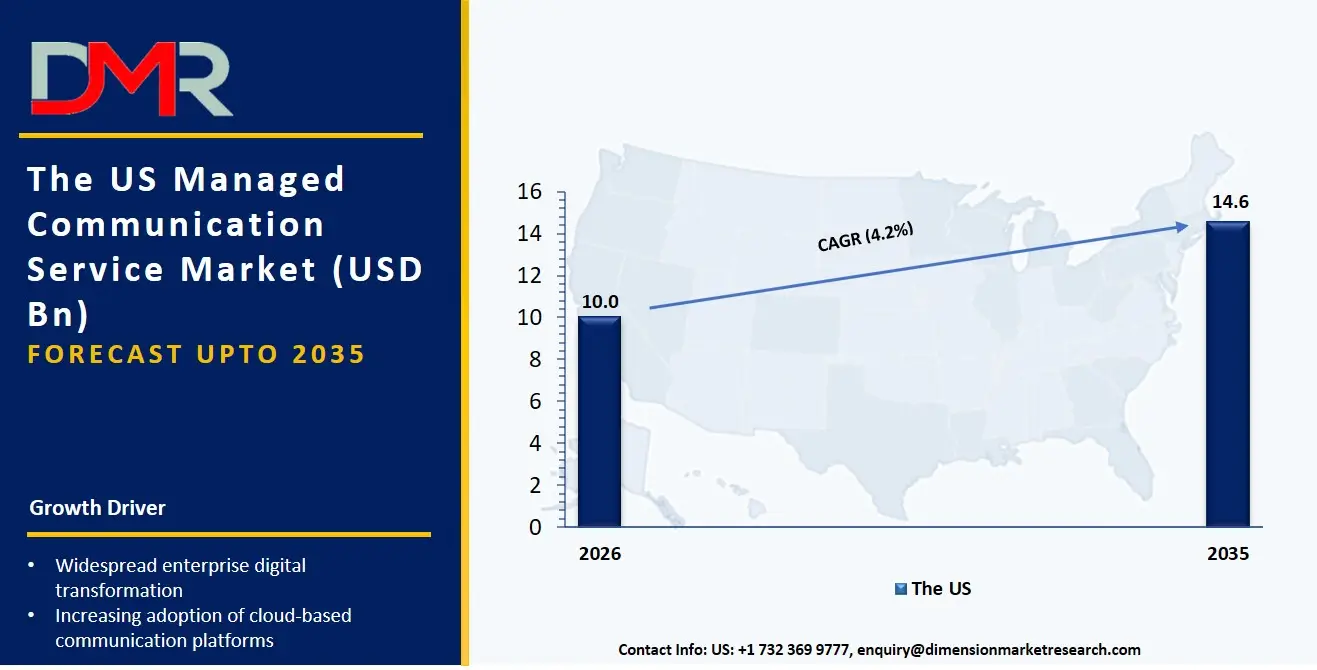
The US Managed Communication Service Market size is estimated to be USD 10.0 billion in 2026 and is expected to increase at a CAGR of 4.2% over the forecast period.
ℹ
To learn more about this report –
Download Your Free Sample Report Here
The US Managed Communication Service Market is experiencing strong growth due to widespread enterprise digital transformation, increasing adoption of cloud-based communication platforms, and the expansion of hybrid work environments. Businesses are increasingly outsourcing communication management to reduce IT costs and improve operational efficiency. Advanced enterprise infrastructure, high technology adoption, and strong demand from sectors such as IT, BFSI, healthcare, and government are supporting market expansion. Regulatory requirements related to data protection and communication security are encouraging organizations to adopt managed solutions with enhanced compliance capabilities. The presence of mature technology ecosystems and service innovation continues to strengthen the US market position.
Europe Managed Communication Service Market
The Europe Managed Communication Service Market size is estimated to be USD 6.8 billion in 2026 and is expected to increase at a CAGR of 4.3% over the forecast period.
The European Managed Communication Service Market is expanding due to increasing cloud adoption, strict data privacy regulations, and enterprise demand for secure communication solutions. Policies supporting digital transformation and sustainability initiatives are encouraging organizations to modernize communication infrastructure. The implementation of regulations such as GDPR has increased demand for secure managed communication services with compliance monitoring capabilities. Enterprises across manufacturing, healthcare, financial services, and public sectors are adopting managed solutions to improve connectivity and operational flexibility. The region is also witnessing accelerated innovation in AI-powered communication management, automation, and hybrid communication environments.
Japan Managed Communication Service Market
The market size of Japan Managed Communication Service will be USD 1.6 billion in 2026 and at a CAGR of 4.6% in the forecast period.
The Japan Managed Communication Service Market is growing steadily due to increasing enterprise automation, aging workforce challenges, and government-supported digital transformation initiatives. Japanese businesses are adopting managed communication solutions to improve operational efficiency, support remote collaboration, and reduce dependence on traditional communication infrastructure. Manufacturing, healthcare, financial services, and technology sectors are among the fastest-growing adopters. Government programs promoting digitalization and smart infrastructure development are supporting market opportunities. However, challenges such as conservative enterprise adoption patterns and integration complexity remain important considerations. Demand for AI-enabled communication management and cloud-based platforms is expected to create new growth opportunities.
Key Takeaways
- Market Size & Forecast: The Managed Communication Service Market size is projected to reach USD 31.1 billion in 2026 and is anticipated to have a value of USD 46.0 billion in 2035.
- Growth Rate & Outlook: The Managed Communication Service Market size is set to grow at a compound annual growth rate of 4.5% during the forecast period of 2026 to 2035.
- Primary Growth Drivers: Some of the major growth drivers in the market are Increasing Adoption of Cloud-Based Communication Solutions, and more.
- Key Market Trends: Some of the major trends in the market are Increasing Shift Toward Hybrid and Multi-Cloud Communication Environments, and more.
- By Deployment Model Type: Cloud-based is anticipated to get the majority share of the Managed Communication Service Market in 2026.
- By Enterprise Size Type: Large Enterprises are expected to get the largest revenue share in 2026 in the Managed Communication Service Market.
- Regional Leadership: North America is set to lead the Managed Communication Service Market with an estimated 38.9% share in 2026.
What is the Managed Communication Service?
Managed Communication Service refers to a specialized service model where external providers manage, maintain, monitor, and optimize an organization's communication platforms and infrastructure. It includes services such as unified communications management, voice solutions, network monitoring, mobility management, contact center operations, and security compliance support. These services enable businesses to improve communication reliability, reduce operational complexity, enhance scalability, and access advanced technologies without significant internal investment. Managed Communication Service providers combine cloud platforms, automation tools, analytics, and expert support to deliver efficient communication environments for enterprises across multiple industries.
Use Cases
- Enterprise Unified Communications Management: Managed Communication Services help organizations manage collaboration platforms integrating voice, video conferencing, messaging, and file-sharing capabilities. These solutions enable seamless communication across distributed teams, improve employee productivity, and reduce the complexity of maintaining multiple communication systems internally.
- Cloud Communication Infrastructure Management: Organizations use managed services to migrate and operate cloud-based communication environments without requiring extensive internal expertise. Providers manage deployment, maintenance, performance monitoring, and upgrades, allowing enterprises to achieve scalable communication capabilities while controlling operational expenses.
- Contact Center Optimization: Managed Communication Services support businesses in managing customer interaction platforms through advanced contact center technologies, analytics, automation, and AI-powered tools. These services improve customer experience, reduce response times, and enable organizations to deliver personalized support across multiple communication channels.
- Communication Security and Compliance Management: Businesses utilize managed communication solutions to strengthen security through monitoring, threat detection, encryption management, and regulatory compliance support. These capabilities are increasingly important as organizations face growing cybersecurity risks and stricter data protection requirements.
How AI Is Transforming the Managed Communication Service Market
Artificial intelligence is transforming the Managed Communication Service Market by enabling predictive network monitoring, intelligent traffic management, automated fault detection, and proactive maintenance. AI-powered analytics help service providers identify communication bottlenecks before they affect business operations, improving service availability while reducing downtime. Machine learning algorithms also optimize bandwidth utilization, enhance voice quality, and automate routine administrative tasks, allowing enterprises to achieve higher operational efficiency with lower management costs.
AI is also improving customer experiences through intelligent virtual assistants, conversational chatbots, speech analytics, and automated contact center management. Service providers are leveraging generative AI to deliver personalized support, automate ticket resolution, and provide actionable communication insights. AI-driven cybersecurity tools strengthen communication platforms by detecting anomalies, identifying threats in real time, and supporting compliance monitoring. As enterprises increasingly embrace digital workplaces, AI continues to enhance scalability, service quality, and decision-making across managed communication environments.
Market Dynamic
Driving Factors in the Managed Communication Service Market
Increasing Adoption of Cloud-Based Communication Solutions
The transition from traditional communication infrastructure to cloud-based platforms is a major factor driving the Managed Communication Service Market. Organizations are increasingly adopting cloud communication solutions to improve scalability, reduce infrastructure costs, and support remote and hybrid work models. Cloud platforms allow businesses to access advanced communication capabilities without large capital investments. Managed service providers help enterprises deploy, manage, and optimize these environments while ensuring reliability and security. The growing preference for flexible IT models, subscription-based services, and digital workplace transformation initiatives continues to accelerate demand for managed communication solutions across industries.
Restraints in the Managed Communication Service Market
High Initial Implementation Costs and Integration Challenges
Despite increasing adoption, high implementation costs and integration complexities remain key challenges in the Managed Communication Service Market. Organizations often require significant investments for migrating legacy communication systems, integrating existing applications, and training employees on new platforms. Enterprises with outdated infrastructure may face difficulties achieving seamless interoperability between traditional systems and modern cloud-based solutions. These challenges can slow adoption, particularly among small and medium-sized businesses with limited technology budgets. Service providers must offer flexible deployment options, migration support, and customized solutions to overcome these barriers and encourage wider market acceptance.
Opportunities in the Managed Communication Service Market
Growth of Hybrid Work and Digital Workplace Transformation
The continued expansion of hybrid work models is creating substantial opportunities for managed communication service providers. Organizations require reliable communication platforms that support employees working across offices, remote locations, and multiple devices. Managed services help businesses maintain consistent connectivity, collaboration, and security across distributed environments. The increasing adoption of digital workplace strategies across industries is encouraging investments in communication modernization. Emerging markets and SMEs also represent significant growth opportunities as they increasingly adopt cloud-based communication solutions to compete effectively and improve operational flexibility.
Trends in the Managed Communication Service Market
Increasing Shift Toward Hybrid and Multi-Cloud Communication Environments
The growing adoption of hybrid and multi-cloud architectures is transforming communication service models. Enterprises are combining private infrastructure with public cloud platforms to achieve flexibility, security, and cost efficiency. Managed service providers are developing solutions capable of managing complex multi-platform communication environments. This trend is driven by the need for business continuity, scalability, and seamless collaboration across geographically distributed teams. As organizations continue modernizing their IT ecosystems, demand for integrated managed communication solutions supporting diverse environments is expected to increase.
Research Scope and Analysis
The research evaluates the Managed Communication Service Market across service types, deployment models, enterprise sizes, and end-user industries. It analyzes market trends, growth drivers, competitive dynamics, regional performance, technological advancements, adoption patterns, and future opportunities, providing strategic insights and forecast-based assessments for industry stakeholders.
ℹ
To learn more about this report –
Download Your Free Sample Report Here
By Service Type Analysis
Among service types, Unified Communications (UC) Management is projected to remain the leading segment, accounting for an estimated 34.8% market share in 2026. Organizations increasingly prefer integrated communication environments combining voice, video conferencing, messaging, collaboration, and file-sharing into a single managed platform. The continued expansion of hybrid work, cloud collaboration, and enterprise digital transformation strengthens the dominance of UC management services. Businesses are prioritizing seamless communication experiences across geographically distributed teams while reducing infrastructure complexity and maintenance costs. Meanwhile, Security & Compliance Management is expected to be the fastest-growing segment as enterprises face increasing cybersecurity threats, stricter regulatory requirements, and growing demand for secure communication platforms. AI-driven monitoring, zero-trust architectures, and continuous compliance management are accelerating adoption. Contact Center Management is also witnessing healthy growth due to increasing customer engagement initiatives, while Mobility Management continues expanding with the rising use of enterprise mobile devices and remote workforce solutions.
By Deployment Model Analysis
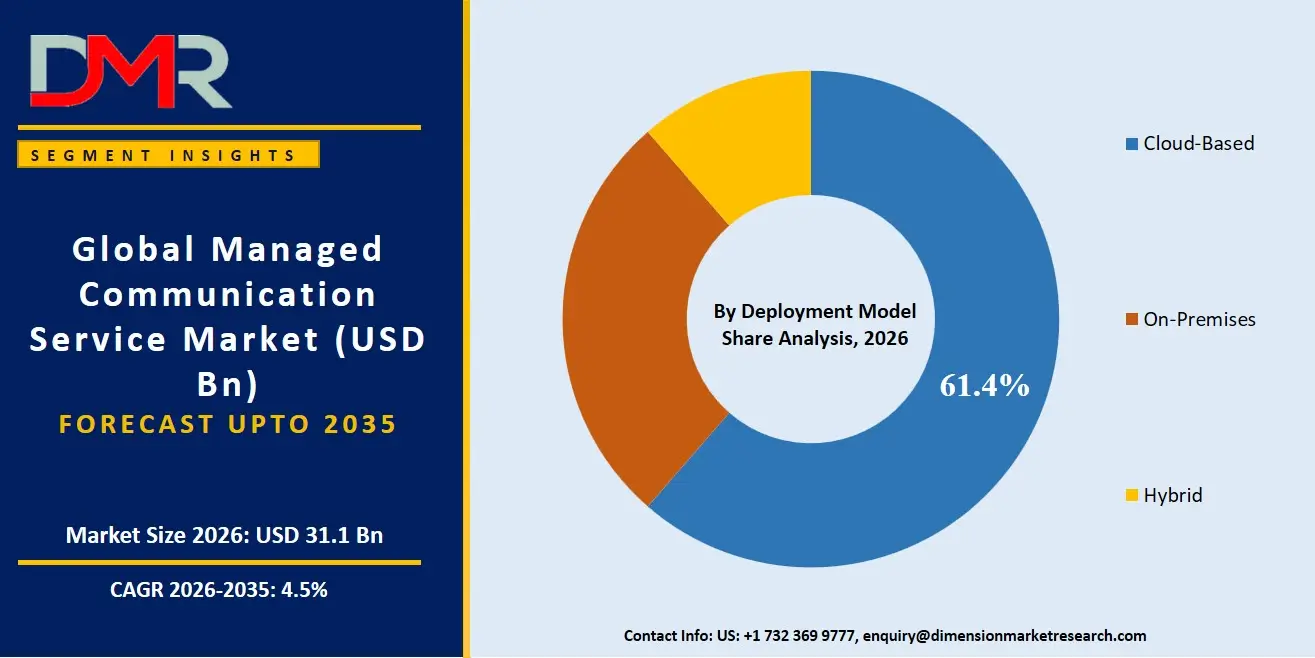
Cloud-Based deployment is anticipated to dominate the Managed Communication Service Market with an estimated 61.4% market share in 2026. Organizations are rapidly migrating communication infrastructure to cloud environments because they provide scalability, lower capital expenditure, simplified maintenance, and faster deployment. Cloud-based managed services also support hybrid work environments by enabling secure access from multiple devices and locations. Continuous innovation by cloud platform providers, subscription-based pricing models, and integrated collaboration tools further reinforce market leadership. The Hybrid deployment segment is expected to record the fastest growth as enterprises seek to balance security, regulatory compliance, and operational flexibility by integrating on-premises infrastructure with cloud platforms. Hybrid deployments allow organizations to modernize communication systems without replacing existing infrastructure entirely, making them particularly attractive for highly regulated industries including healthcare, BFSI, and government sectors.
By Enterprise Size Analysis
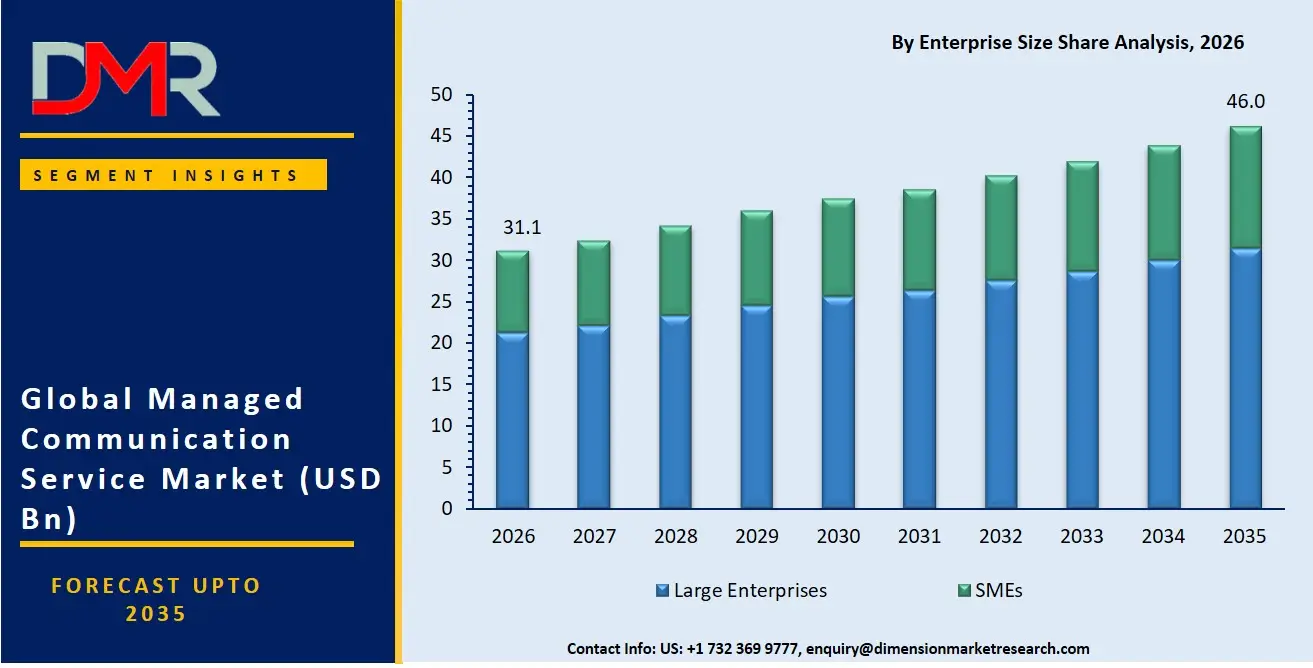
Large Enterprises are expected to account for an estimated 68.2% market share in 2026, maintaining leadership due to their extensive communication infrastructure, global operations, and significant investments in digital transformation.
ℹ
To learn more about this report –
Download Your Free Sample Report Here
Large organizations require comprehensive managed communication services to support complex collaboration environments, ensure business continuity, improve cybersecurity, and optimize operational efficiency. Their larger IT budgets also facilitate rapid adoption of advanced cloud communication technologies, AI-driven monitoring, and managed security services. However, Small & Medium Enterprises (SMEs) represent the fastest-growing segment as affordable cloud-based communication platforms reduce deployment costs and eliminate the need for extensive in-house IT expertise. Increasing awareness of managed services, subscription pricing models, and growing digitalization among SMEs are creating strong long-term growth opportunities across both developed and emerging economies.
By End Use Industry Analysis
The IT & Telecommunications segment is projected to lead the Managed Communication Service Market with an estimated 26.7% market share in 2026. Organizations within this industry require highly reliable, scalable, and secure communication infrastructure to support digital operations, customer engagement, cloud services, and network management. Rapid technological innovation and increasing adoption of advanced collaboration platforms continue strengthening this segment's leadership. Meanwhile, the Healthcare sector is expected to emerge as the fastest-growing end-user industry due to increasing telehealth adoption, digital patient engagement, secure communication requirements, and regulatory compliance demands. Healthcare organizations are investing heavily in managed communication solutions to improve coordination between medical professionals, enhance patient services, and protect sensitive healthcare data. Retail, BFSI, manufacturing, education, and government sectors are also steadily increasing investments in managed communication technologies.
The Managed Communication Service Market Report is segmented on the basis of the following:
By Service Type
- Unified Communications (UC) Management
- Voice Services Management
- Data Network Management
- Mobility Management
- Contact Center Management
- Security & Compliance Management
By Deployment Model
- Cloud-Based
- On-Premises
- Hybrid
By Enterprise Size
- Large Enterprises
- Small & Medium Enterprises (SMEs)
By End-User Industry
- IT & Telecommunications
- BFSI
- Healthcare
- Retail & E-commerce
- Manufacturing
- Government & Public Sector
- Media & Entertainment
- Transportation & Logistics
- Energy & Utilities
- Education
- Others
Regional Analysis
Leading Region in the Managed Communication Service Market
ℹ
To learn more about this report –
Download Your Free Sample Report Here
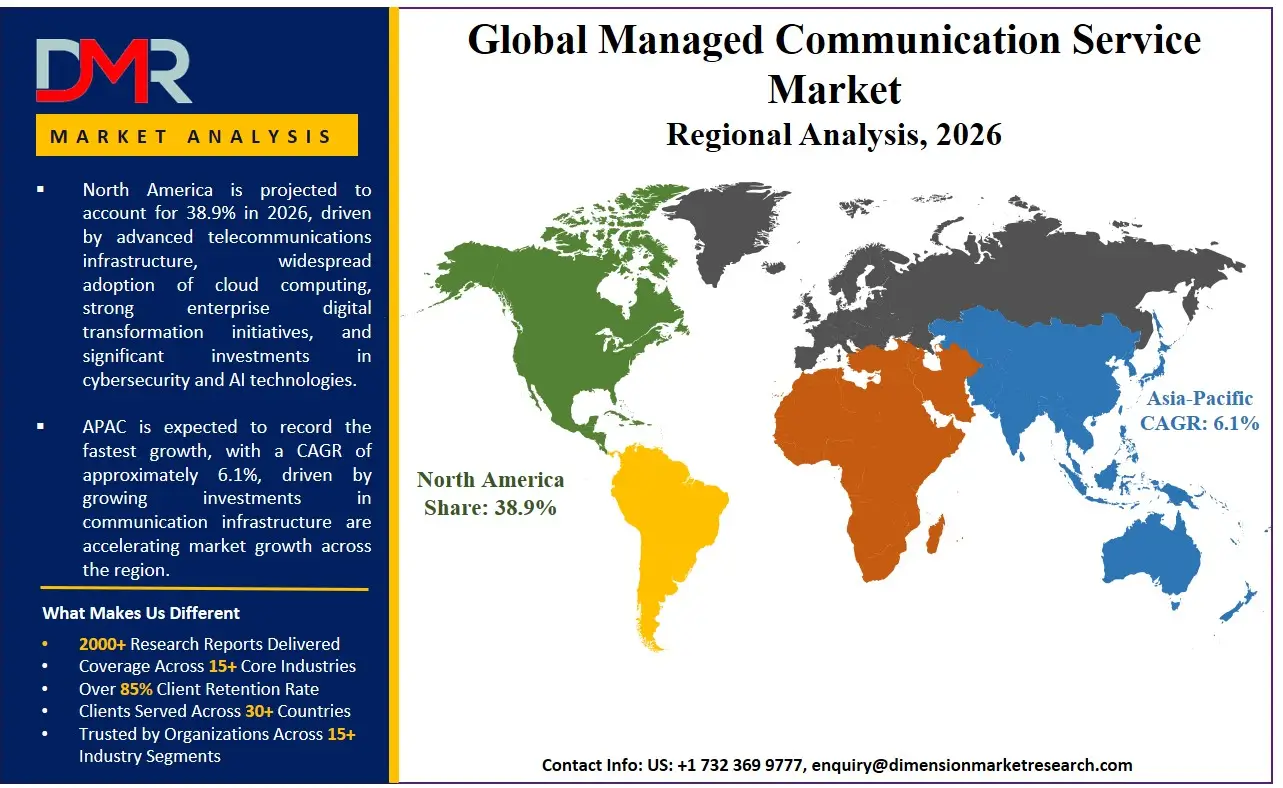
North America is expected to remain the leading regional market, accounting for an estimated 38.9% share of the global Managed Communication Service Market in 2026. The region benefits from advanced telecommunications infrastructure, widespread adoption of cloud computing, strong enterprise digital transformation initiatives, and significant investments in cybersecurity and AI technologies. Organizations across healthcare, BFSI, IT, manufacturing, and government sectors continue expanding managed communication deployments to improve operational efficiency and business continuity. The presence of mature technology ecosystems, high enterprise IT spending, favorable regulatory frameworks supporting cloud adoption, and continuous innovation in unified communications further strengthen North America's dominant market position. The growing demand for hybrid workplace solutions and intelligent communication management is expected to sustain regional leadership throughout the forecast period.
Fastest Growing Region in the Managed Communication Service Market
Asia-Pacific is anticipated to be the fastest-growing region in the Managed Communication Service Market during the forecast period. Rapid digital transformation, expanding cloud adoption, increasing enterprise mobility, and growing investments in communication infrastructure are accelerating market growth across the region. Countries including China, India, South Korea, Singapore, and Australia are witnessing substantial demand for managed communication solutions as businesses modernize operations and support hybrid work environments. Government initiatives promoting digital economies, expanding internet connectivity, and smart city development further contribute to market expansion. The increasing presence of SMEs adopting cloud-based communication services and rising investments in AI-enabled enterprise technologies position Asia-Pacific as the fastest-growing regional market.
By Region
North America
Europe
- Germany
- The U.K.
- France
- Italy
- Russia
- Spain
- Benelux
- Nordic
- Rest of Europe
Asia-Pacific
- China
- Japan
- South Korea
- India
- ANZ
- ASEAN
- Rest of Asia-Pacific
Latin America
- Brazil
- Mexico
- Argentina
- Colombia
- Rest of Latin America
Middle East & Africa
- Saudi Arabia
- UAE
- South Africa
- Israel
- Egypt
- Rest of MEA
Competitive Landscape
The Managed Communication Service Market is characterized by intense competition driven by technological innovation, service quality, pricing strategies, and the ability to deliver integrated communication solutions across cloud and hybrid environments. Market participants are focusing on expanding managed service portfolios through artificial intelligence, automation, cybersecurity enhancements, and advanced analytics. Strategic partnerships with cloud platform providers, continuous investment in research and development, geographic expansion, and acquisitions remain common approaches for strengthening competitive positioning. High technical expertise requirements, established customer relationships, and infrastructure investments create notable entry barriers, while increasing enterprise demand for customized communication services encourages continuous innovation and differentiation.
Some of the prominent players in the global Managed Communication Service are:
- Cisco Systems, Inc.
- AT&T Inc.
- Verizon Communications Inc.
- Lumen Technologies, Inc.
- Orange Business
- BT Group plc
- NTT DATA Group Corporation
- Tata Communications Limited
- Vodafone Business
- Telefónica Tech
- Deutsche Telekom AG (T-Systems)
- Comcast Business
- GTT Communications, Inc.
- Colt Technology Services
- Kyndryl Holdings, Inc.
- Fujitsu Limited
- NEC Corporation
- IBM Corporation
- Accenture plc
- Wipro Limited
- Other Key Players
Recent Developments
- In July 2025, LevelBlue signed a definitive agreement to acquire Trustwave, expanding its portfolio of AI-driven managed security and communication services. The acquisition combines Trustwave's managed detection and response capabilities with LevelBlue's cloud-based cybersecurity expertise to deliver enhanced security, threat intelligence, and compliance services for enterprise communication environments.
- In July 2025, Ericsson announced the completion of the Aduna joint venture after twelve global communication service providers finalized their equity investments, creating a 50:50 ownership structure. The initiative is designed to commercialize standardized network APIs globally, enabling developers and enterprises to securely access advanced network capabilities across multiple operators.
- In July 2025, Ericsson announced the completion of the Aduna joint venture after twelve global communication service providers finalized their equity investments, creating a 50:50 ownership structure. The initiative is designed to commercialize standardized network APIs globally, enabling developers and enterprises to securely access advanced network capabilities across multiple operators.
Report Details
| Report Characteristics |
| Market Size (2026) |
USD 31.1 Bn |
| Forecast Value (2035) |
USD 46.0 Bn |
| CAGR (2026–2035) |
4.5% |
| Historical Period |
2021 – 2025 |
| Forecast Period |
2027 – 2035 |
| Base Year |
2025 |
| Estimate Year |
2026 |
| Segments Covered |
By Service Type, By Deployment Model, By Enterprise Size, By End-User Industry |
| Regional Coverage |
North America – The US and Canada; Europe – Germany, The UK, France, Russia, Spain, Italy, Benelux, Nordic, & Rest of Europe; Asia-Pacific – China, Japan, South Korea, India, ANZ, ASEAN, Rest of APAC; Latin America – Brazil, Mexico, Argentina, Colombia, Rest of Latin America; Middle East & Africa – Saudi Arabia, UAE, South Africa, Turkey, Egypt, Israel, & Rest of MEA |
Frequently Asked Questions
How big is the Managed Communication Service Market?
▾ The Managed Communication Service Market size is expected to reach USD 31.1 billion by 2026 and is projected to reach USD 46.0 billion by the end of 2035.
What is the CAGR of the Managed Communication Service Market from 2026 to 2035?
▾ The market is growing at a CAGR of 4.5 percent over the forecasted period.
What factors are driving the growth of the Managed Communication Service Market?
▾ Increasing Adoption of Cloud-Based Communication Solutions, and more are the factors driving the growth of the Managed Communication Service Market.
What are the major trends in the Managed Communication Service Market?
▾ Increasing Shift Toward Hybrid and Multi-Cloud Communication Environments, and more are some of the major trends in the market.
Who are the key players in the Managed Communication Service Market?
▾ Some of the key players in the Managed Communication Service Market include BT, AT&T, Lumen, more
How is the Managed Communication Service Market segmented?
▾ The Managed Communication Service Market is segmented by service type, deployment model, enterprise size, end-user industry.
Which region held the largest share of the Managed Communication Service Market in 2026?
▾ North America is set to lead the Managed Communication Service Market with an estimated 38.9% share in 2026.
Which region is expected to grow the fastest in the Managed Communication Service Market?
▾ Asia Pacific is the fastest-growing region in the Managed Communication Service Market during the forecast period.