Global Managed Testing Services Market Snapshot
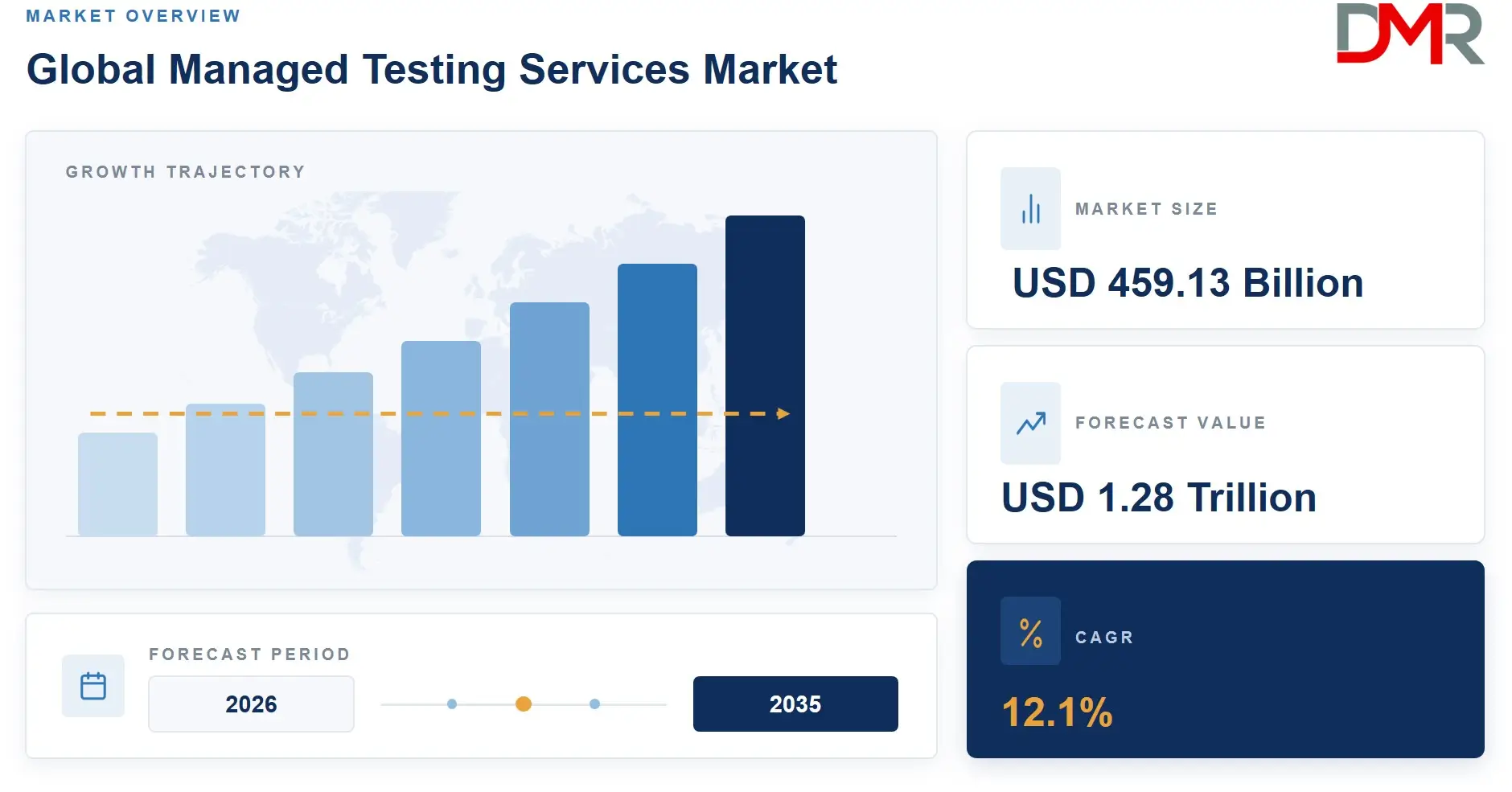
- Market Size, 2026: USD 459.13 billion
- Market Size, 2035: USD 1.28 Trillion
- Global CAGR, 2026–2035: 12.1%
- Leading Service Type: Functional Testing, 31% share
- Leading Testing Approach: Automated Testing, 55% share
- Leading Industry Vertical: BFSI, 28.5% share
- Fastest-Growing Segment: AI-enabled Security & Continuous Testing 14.5% CAGR
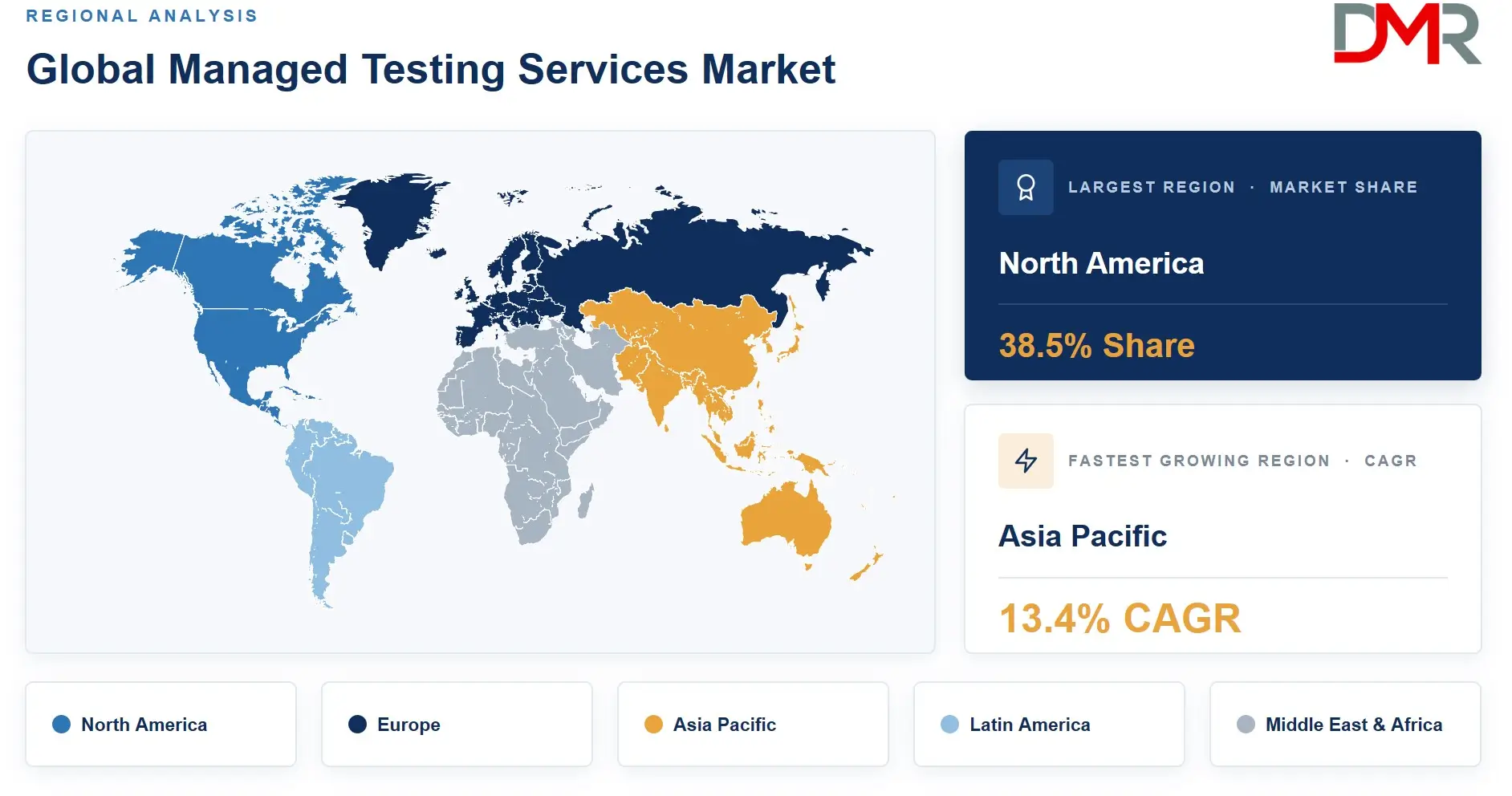
- Leading Region North America, 38.5% share
- Fastest-Growing Region: Asia-Pacific, 13.4% CAGR
What is the Global Managed Testing Services and its Market Size?
The Global Managed Testing Services Market is projected to reach USD 459.13 billion in 2026 and grow at a compound annual growth rate of 12.1% from there until 2035 to reach a value of USD 1.28 trillion.
ℹ
To learn more about this report –
Download Your Free Sample Report Here
Managed Testing Services (MTS) refers to the outsourcing of software and application quality assurance to specialized third-party providers that assume responsibility for some or all of the testing lifecycle. Services can include test strategy, test planning, functional and regression testing, performance and load testing, security validation, test automation, API and integration testing, mobile testing, test-data management, continuous testing, defect management, reporting and quality governance.
The market is transitioning from labor-intensive outsourced testing toward managed quality engineering, in which providers integrate automation, cloud infrastructure, DevOps, observability, AI/GenAI, analytics and continuous validation. Providers increasingly position themselves around measurable business outcomes, release velocity, defect reduction, resilience, compliance and customer experience, rather than simply supplying testing personnel.
Use Cases
- Functional and Regression Testing: Validates business workflows and ensures software changes do not disrupt existing functionality.
- Performance and Load Testing: Measures application behavior under peak transaction volumes, concurrent users and stressful operating conditions.
- Security and Compliance Testing: Identifies vulnerabilities and validates security controls required by industry regulations and standards.
- Continuous Testing: Embeds automated quality checks throughout CI/CD pipelines to support frequent software releases.
- Mobile and Cross-Platform Testing: Validates applications across devices, operating systems, browsers, networks and hardware configurations.
- AI/ML Assurance: Tests model accuracy, robustness, bias, security, explainability, drift and reliability throughout the AI lifecycle.
Key Takeaways
- Market growth: Managed testing is becoming a strategic quality-engineering function rather than a conventional outsourced QA activity.
- Growth drivers: Digital transformation, cloud adoption, DevOps, cybersecurity, regulatory requirements and AI adoption underpin sustained demand.
- Segment dominance: Functional testing remains the largest individual service category, while automated testing represents the dominant testing approach.
- Fastest growth: AI-enabled, automated, security and continuous-testing capabilities should outpace traditional manual testing.
- Regional leadership: North America remains the largest market, while Asia-Pacific is expected to expand fastest due to digitalization, cloud adoption and technology-services investment.
- Competitive shift: Large IT-services companies compete with specialist quality-engineering firms, with differentiation increasingly based on AI platforms, domain expertise, automation assets and outcome-based commercial models.
How AI/Gen AI is Transforming the Managed Testing Services Market?
AI and GenAI are changing managed testing from a predominantly execution-oriented service into an increasingly intelligence-driven discipline. Providers are using machine learning and LLMs for test-case generation, test prioritization, defect prediction, test-data generation, failure analysis, script maintenance and quality analytics.
The principal benefits are lower testing effort, faster regression cycles, broader coverage and earlier defect identification. AI can analyze historical defects, test results and production incidents to identify high-risk areas and optimize testing priorities. Wipro, for example, positions its AI/GenAI managed-testing offering around scalability, automation and cost optimization, while Infosys describes AI-first testing capabilities spanning the QA lifecycle.
Cloud infrastructure further changes the competitive model by enabling providers to provision test environments dynamically, execute large parallel test suites and support geographically distributed teams. The result is a move toward continuous quality engineering, where testing becomes embedded throughout software development and operations rather than concentrated before release.
Key Drivers in the Global Managed Testing Services Market
Digital Transformation and Accelerating Software Release Cycles
Enterprise software estates are becoming larger, more interconnected and more frequently updated. Cloud-native applications, APIs, microservices, mobile applications and enterprise platforms create substantially more combinations that need validation. Organizations increasingly require testing to operate continuously alongside Agile and DevOps rather than as a separate final-stage activity.
AI Adoption and the Rise of AI-Assurance Requirements
AI is simultaneously creating new testing demand and automating portions of traditional testing. Enterprises deploying GenAI applications need assurance for accuracy, reliability, bias, security, explainability, data quality and model behavior. AI agents introduce additional requirements because systems may make decisions or execute actions dynamically.
Restraints in the Global Managed Testing Services Market
Data Security, Privacy and Compliance Complexity
Managed testing providers often need access to production-like data, application environments, source-code repositories and sensitive business processes. This creates significant requirements around data residency, access control, encryption, anonymization, auditability and third-party risk management.
GDPR applies technology-neutrally to personal-data processing and imposes requirements around lawful processing, security, breach notification and data-subject rights. Healthcare customers face additional requirements under HIPAA, while financial institutions increasingly require robust third-party ICT-risk controls.
Growth Opportunities in the Global Managed Testing Services Market
AI Assurance and Agentic-AI Testing
The emergence of AI agents creates a new category of managed testing. Traditional deterministic test cases are insufficient when systems generate variable outputs, interact with external tools or make decisions dynamically.
Providers can develop specialized services covering prompt testing, model evaluation, hallucination detection, adversarial testing, RAG validation, model drift, AI security, responsible-AI controls and continuous AI monitoring. Cognizant, for example, now positions AI assurance around testability, traceability and reliability across the AI lifecycle.
Cloud-Native and Continuous Testing-as-a-Service
Cloud migration creates persistent demand for scalable environments, cross-browser/device coverage, API validation, resilience testing and continuous testing integrated with CI/CD.
Managed providers can offer consumption-based models where customers pay for automated execution, environments, devices or testing capacity rather than maintaining dedicated QA teams.
Trends in the Global Managed Testing Services Market
From Managed QA to AI-First Quality Engineering
The market is moving from "testing as a service" toward quality engineering as a managed business capability. AI, analytics and automation are increasingly embedded throughout development rather than used only to accelerate test execution. Infosys and HCLTech both describe quality engineering as moving toward AI-enabled, continuous and engineering-centric models.
Outcome-Based and Platform-Led Delivery
Customers increasingly expect providers to own quality outcomes rather than simply provide testing resources. Commercial models are consequently shifting toward managed capacity, subscriptions, automation-based pricing and outcome-linked contracts.
Research Scope and Analysis
The market is analyzed primarily by Service Type, Testing Approach, Deployment Model, Organization Size, Application and Industry Vertical. Service-type and testing-approach estimates are modeled from public market structures and current provider portfolios; they should be treated as directional rather than audited market shares.
ℹ
To learn more about this report –
Download Your Free Sample Report Here
By Service Type Analysis
Functional Testing is estimated to remain the largest service category in 2026 at approximately 31% share, because virtually every enterprise application requires functional validation regardless of architecture or deployment model. Regression testing is particularly important for large application estates undergoing frequent updates. Performance & Load Testing is the second-largest category at approximately 17%, supported by cloud applications, e-commerce, financial transactions and digital customer experiences. Security testing represents approximately 15%, while test automation accounts for around 14% when measured as a distinct managed service. API/integration, mobile/application, compatibility and specialized testing make up the remainder. The fastest-growing area is security and AI-enabled testing, estimated at roughly 14.5% CAGR, as organizations face increasingly complex attack surfaces and AI-related risks. Functional testing will retain scale, but the strategic value of security, automation and AI assurance should increase more rapidly through 2035. Public market data also identifies functional testing as the largest category in narrower managed-testing market models.
By Testing Approach Analysis
Automated Testing is estimated to represent approximately 55% of the 2026 market, making it the leading approach. Automation is favored because managed-service customers increasingly require faster regression cycles, repeatability and integration with CI/CD pipelines. Manual Testing remains important at roughly 30%, particularly for exploratory, usability, accessibility and complex domain workflows that remain difficult to automate fully. Continuous Testing represents approximately 15%, but is the fastest-growing approach at an estimated 15% CAGR, because it connects quality validation directly with DevOps and continuous delivery. AI-assisted test generation, self-healing scripts and intelligent test prioritization are accelerating the transition from conventional automation toward adaptive automation. Providers including Infosys and Cognizant are explicitly positioning AI-driven testing and continuous quality engineering as strategic offerings.
By Deployment Model Analysis
Cloud-Based Managed Testing is estimated to account for approximately 46% of the market in 2026, reflecting the growing use of cloud application environments and the ability to provision scalable testing infrastructure without large capital expenditures. On-Premises services represent approximately 32%, supported by banks, government organizations, manufacturers and enterprises with legacy or sensitive systems. Hybrid represents approximately 22% and is expected to grow rapidly as enterprises operate mixed estates during long modernization programs. Hybrid environments are particularly attractive to managed providers because they require sophisticated integration, environment management, data controls and orchestration. Cloud-based testing should maintain leadership through 2035, while hybrid testing is likely to achieve the strongest growth among deployment categories as organizations avoid immediate migration of critical legacy applications.
By Organization Size Analysis
Large Enterprises account for an estimated 71% of 2026 demand because they operate larger application portfolios, require multiple specialized testing disciplines and frequently have geographically distributed development organizations. Large organizations also have greater exposure to regulatory and operational risks. SMEs, at approximately 29%, represent the faster-growing customer group because managed services allow them to access automation, security and performance-testing capabilities without building specialist teams internally. Public market research similarly places large enterprises at approximately 71% of managed-testing demand and identifies SMEs as a faster-growing customer category.
By Application Analysis
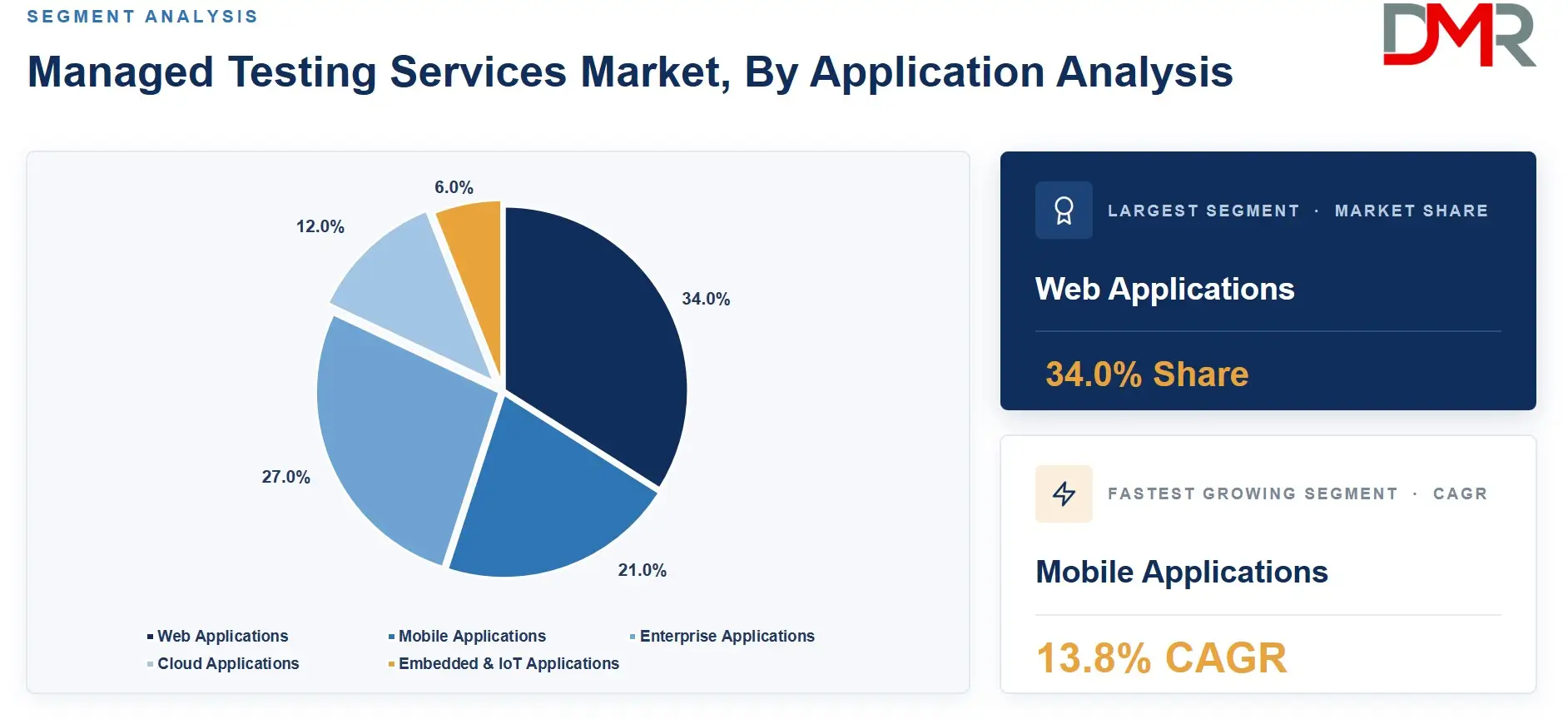
Web Applications are estimated to dominate the Global Managed Testing Services Market with approximately 34% share in 2026, supported by widespread use of e-commerce, SaaS, enterprise portals and digital platforms. Enterprise Applications follow with around 27%, driven by ERP, CRM, finance and supply-chain systems requiring continuous regression and integration testing. Mobile Applications account for approximately 21% and are expected to grow fastest at around 13.8% CAGR, supported by mobile banking, digital commerce and app-based services. Cloud Applications represent about 12%, benefiting from enterprise cloud migration, while Embedded & IoT Applications account for roughly 6% and offer strong long-term potential from connected-device adoption.
By Industry Vertical Analysis
BFSI leads the Global Managed Testing Services Market with approximately 28.5% share in 2026, driven by high requirements for security, compliance, transaction accuracy and performance. IT & Telecommunications follows with around 22%, supported by rapid software releases, cloud adoption and complex digital infrastructure. Retail & E-Commerce accounts for about 17%, while Healthcare & Life Sciences represents approximately 15%, supported by digital healthcare and stringent data requirements. Manufacturing holds around 9%, driven by Industry 4.0 and IoT adoption. Government, Energy & Utilities, Media & Entertainment, Logistics and other sectors make up the remainder. Healthcare, Manufacturing and Government are expected to record strong growth as digitalization and cybersecurity requirements increase.
The Global Managed Testing Services Market Report is segmented on the basis of the following:
By Service Type
- Functional Testing
- Performance & Load Testing
- Security Testing
- Test Automation
- Compatibility Testing
- Mobile & Application Testing
- API & Integration Testing
By Testing Approach
- Manual Testing
- Automated Testing
- Continuous Testing
By Deployment Model
- Cloud-Based
- On-Premises
- Hybrid
By Organization Size
- Large Enterprises
- Small & Medium Enterprises
By Application
- Web Applications
- Mobile Applications
- Enterprise Applications
- Cloud Applications
- Embedded & IoT Applications
By Industry Vertical
- BFSI
- Healthcare & Life Sciences
- IT & Telecommunications
- Retail & E-Commerce
- Manufacturing
- Government & Defense
- Media & Entertainment
- Energy & Utilities
- Automotive
- Travel & Hospitality
- Others
Regional Analysis
North America is the Leading Region in the Global Managed Testing Services Market
North America is estimated to remain the largest managed testing services market, with approximately 38.5% share in 2026, equivalent to roughly USD 176.8 billion under this report's global baseline. The region benefits from a high concentration of technology companies, financial institutions, healthcare organizations, SaaS providers and large enterprises with complex application portfolios. Cloud migration, cybersecurity investment, AI adoption and regulatory requirements reinforce demand. Public market research also identifies North America as the largest regional market.
ℹ
To learn more about this report –
Download Your Free Sample Report Here
The region is particularly important for high-value testing disciplines such as security, performance engineering, AI assurance and cloud-native testing, where customers prioritize specialized expertise and business-risk reduction over simple labor arbitrage.
Asia Pacific is the Fastest-Growing Region in the Global Managed Testing Services Market
Asia-Pacific is projected to be the fastest-growing major regional market, with a modeled 13.4% CAGR. Growth is driven by India, China, Japan, South Korea, Southeast Asia and Australia, supported by cloud migration, digital payments, e-commerce, telecommunications, manufacturing modernization and expanding technology-services ecosystems. Public market research consistently identifies Asia-Pacific as the fastest-growing region.
India is especially important as both a customer market and a global delivery hub. AI adoption is also increasing the productivity of India's IT-services sector, reinforcing the region's position in AI-enabled managed testing.
The Europe Managed Testing Services Market
Europe is estimated at approximately USD 129.5 billion in 2026, based on a modeled 28.2% regional share, and could reach roughly USD 329 billion by 2035 at an illustrative 10.8% CAGR. GDPR, financial-services regulation, cybersecurity requirements, cloud modernization and enterprise digital transformation support demand. DORA is particularly important for financial-sector testing because it applies to digital operational resilience and ICT risk from January 17, 2025.
Latin America Managed Testing Services Market
Latin America is modeled at approximately USD 37.2 billion in 2026, representing about 8.1% share, and could reach approximately USD 96 billion by 2035 at an illustrative 11.0% CAGR. Banking digitization, fintech, e-commerce, cloud adoption and telecommunications modernization are major demand drivers. Brazil and Mexico should account for the majority of regional demand.
MEA Managed Testing Services Market
MEA is modeled at approximately USD 27.1 billion in 2026, or 5.9% share, with a potential 11.8% CAGR through 2035. Saudi Arabia and the UAE are particularly attractive because of large digital-government, cloud, AI, smart-city and economic-diversification programs. Saudi Vision 2030 explicitly prioritizes digital infrastructure, cloud, AI, cybersecurity and digital government.
Major Countries Analysis
United States Managed Testing Services Market
The U.S. is estimated at approximately USD 142 billion in 2026 and could reach roughly USD 370 billion by 2035, implying a modeled 10.9% CAGR. Demand is concentrated in BFSI, healthcare, technology, retail, telecommunications and government. Cloud-native modernization, AI assurance, cybersecurity and continuous delivery are major growth areas.
Japan Managed Testing Services Market
Japan is estimated at approximately USD 16 billion in 2026, growing toward USD 36 billion by 2035 at roughly 9.3% CAGR. The market is supported by manufacturing digitization, automotive software, enterprise modernization and demand for reliable mission-critical systems. Japan's relatively cautious enterprise AI adoption creates both a near-term constraint and a substantial future testing opportunity. A recent Reuters poll found only 16% of surveyed Japanese companies had adopted AI company-wide, suggesting considerable headroom.
Saudi Arabia Managed Testing Services Market
Saudi Arabia is estimated at approximately USD 4.6 billion in 2026 and could approach USD 16 billion by 2035, implying roughly 14% CAGR. Vision 2030, digital government, AI, cloud, cybersecurity, financial-services modernization and large-scale infrastructure projects are supporting technology spending. Saudi Arabia's revised Digital Government Strategy for 2025–2030 specifically emphasizes cloud computing, AI, integrated digital services and digital transformation.
Regulatory Landscape
Managed testing is indirectly but significantly affected by regulations governing privacy, cybersecurity, financial resilience, healthcare information and AI. In Europe, GDPR requires organizations processing personal data to maintain appropriate security and governance controls, making data handling in testing environments a major consideration. DORA raises the importance of operational-resilience and third-party ICT testing for financial entities. The EU AI Act is creating additional requirements around AI-system governance and transparency, with Article 50 transparency obligations applying from August 2, 2026. In healthcare, the HIPAA Security Rule requires safeguards for electronic protected health information, while proposed changes have emphasized recurring security testing and vulnerability management. PCI DSS v4.0.1 is another important framework for payment-related applications.
Investment and White Space Analysis
The most attractive investment areas are AI assurance, continuous testing, cybersecurity testing, cloud-native testing, test-data management and specialized testing for regulated industries. AI assurance is particularly promising because organizations need independent validation of AI applications, models and agents as deployment expands. Emerging markets such as India, Southeast Asia, Saudi Arabia and the UAE provide additional white space because digital transformation is expanding faster than many organizations can develop internal quality-engineering capabilities. Investors should favor providers with proprietary automation assets, recurring managed-service revenue, strong domain expertise and global delivery capabilities rather than companies dependent predominantly on manual-testing headcount.
By Region
North America
Europe
- Germany
- France
- The U.K.
- Italy
- Spain
- Rest of Europe
Asia-Pacific
- China
- Japan
- India
- Australia
- South Korea
- Rest of APAC
Latin America
- Mexico
- Brazil
- Rest of LATAM
Middle East & Africa
- Saudi Arabia
- The UAE
- South Africa
- Rest of MEA
Competitive Landscape
The managed testing services market is fragmented but increasingly concentrated around global IT-service providers and specialist quality-engineering companies. Major participants include Capgemini, Wipro, Infosys, Cognizant, HCLTech and specialist providers such as QualityAI. Public market research also lists TCS, IBM, Accenture, Hexaware, Testhouse and others among significant participants.
Competition is shifting away from labor cost toward AI capabilities, automation IP, cloud expertise, industry specialization, security, global delivery and measurable outcomes. Large providers increasingly integrate testing with broader application modernization, cloud, data and AI transformation engagements.
Some of the prominent players in the Global Managed Testing Services Market are:
- Accenture
- Tata Consultancy Services (TCS)
- Cognizant
- Infosys
- Capgemini
- Wipro
- HCLTech
- IBM
- Tech Mahindra
- LTIMindtree
- NTT DATA
- DXC Technology
- Deloitte
- EPAM Systems
- CGI
- Persistent Systems
- Virtusa
- Mphasis
- Coforge
- Hexaware Technologies
- UST
- Qualitest
- TestingXperts
- Cigniti Technologies
- Tricentis
- Software Testing Solutions
- Testlio
- QualiTest Group
- GlobalLogic
- Nagarro
- Globant
- Endava
- Thoughtworks
- Grid Dynamics
- SoftServe
- Sogeti
- Sopra Steria
- Atos
- Kyndryl
- Publicis Sapient
- Other Key Players
Recent Developments
- June 2026: Qualitest rebranded as QualityAI, reflecting its strategic shift from conventional software testing toward AI-first quality engineering and assurance, including enterprise AI testing and assurance capabilities.
- March 2026: HCLTech expanded its AI-led quality-engineering strategy, emphasizing AI, automation and engineering capabilities as part of its broader enterprise transformation portfolio.
- March 2026: Infosys advanced its AI-first quality-engineering agenda through industry initiatives focused on AI-powered testing, automation and next-generation assurance capabilities.
- August 2025: Cognizant highlighted multi-agent intelligence for quality engineering, with AI agents supporting activities such as test design, validation and execution.
- January 2025: Accenture launched AI Refiner for Industry, an AI-powered platform supporting enterprise AI development and deployment, reinforcing demand for AI-driven software development and quality-engineering services.
Report Details
| Report Characteristics |
| Market Size (2026) |
USD 459.13 Bn |
| Forecast Value (2035) |
USD 1.28 Tn |
| CAGR (2026–2035) |
12.1% |
| The US Market Size (2026) |
USD 142.0 Bn |
| Historical Data |
2021 – 2025 |
| Forecast Data |
2026 – 2035 |
| Base Year |
2025 |
| Segments Covered |
By Service Type, By Testing Approach, By Deployment Model, By Organization Size, By Application, By Industry Vertical |
| Regional Coverage |
North America – The US and Canada; Europe – Germany, France, The UK, Italy, Spain, Rest of Europe; Asia-Pacific – China, Japan, India, Australia, South Korea, Rest of APAC; Latin America – Mexico, Brazil, Colombia, Argentina, Rest of LATAM; Middle East & Africa – Saudi Arabia, The UAE, South Africa, Rest of MEA |
Frequently Asked Questions
What is the Global Managed Testing Services Market size in 2026?
▾ The Global Managed Testing Services Market is estimated at USD 459.13 billion in 2026, based on the selected broad market definition.
What will the Global Managed Testing Services Market size be in 2035?
▾ The Global Managed Testing Services Market is projected to reach approximately USD 1.28 trillion by 2035, based on the modeled 12.1% CAGR.
What is the CAGR of the Global Managed Testing Services Market from 2026 to 2035?
▾ The Global Managed Testing Services Market is modeled to expand at approximately 12.1% CAGR from 2026 through 2035.
What are the major growth drivers of the Global Managed Testing Services Market?
▾ The Global Managed Testing Services Market is driven by digital transformation, cloud migration, DevOps adoption, software complexity, cybersecurity, compliance and AI-based automation.
Which region leads the Global Managed Testing Services Market?
▾ North America leads the Global Managed Testing Services Market, while Asia-Pacific is projected to be the fastest-growing major regional market.
Which trends are shaping the Global Managed Testing Services Market?
▾ Major Global Managed Testing Services Market trends include AI-driven test automation, continuous testing, cloud-based testing, test observability and increasing quality-assurance outsourcing.
Who are the key players in the Global Managed Testing Services Market?
▾ Major Global Managed Testing Services Market participants include Accenture, IBM, TCS, NTT DATA, Capgemini, Cognizant, Infosys, HCLTech, Wipro, EPAM, Qualitest and Hexaware.
How is the Global Managed Testing Services Market segmented?
▾ The Global Managed Testing Services Market is analyzed by service type, testing approach, deployment model, organization size, application, industry vertical and geographic region.