Market Snapshot
- Market Size (2026): USD 2.1 Bn
- Forecast Value (2035): USD 5.5 Bn
- CAGR (2026-2035): 11.4%
- Leading Drug Class (2026): Azoles, around 46%
- Leading Application (2026): Dermatophytosis, close to 34%
- Key Players: Pfizer, Novartis, Hikma Pharmaceuticals and others
What is MEA Anti-Fungal Agents Market and its Market Size?
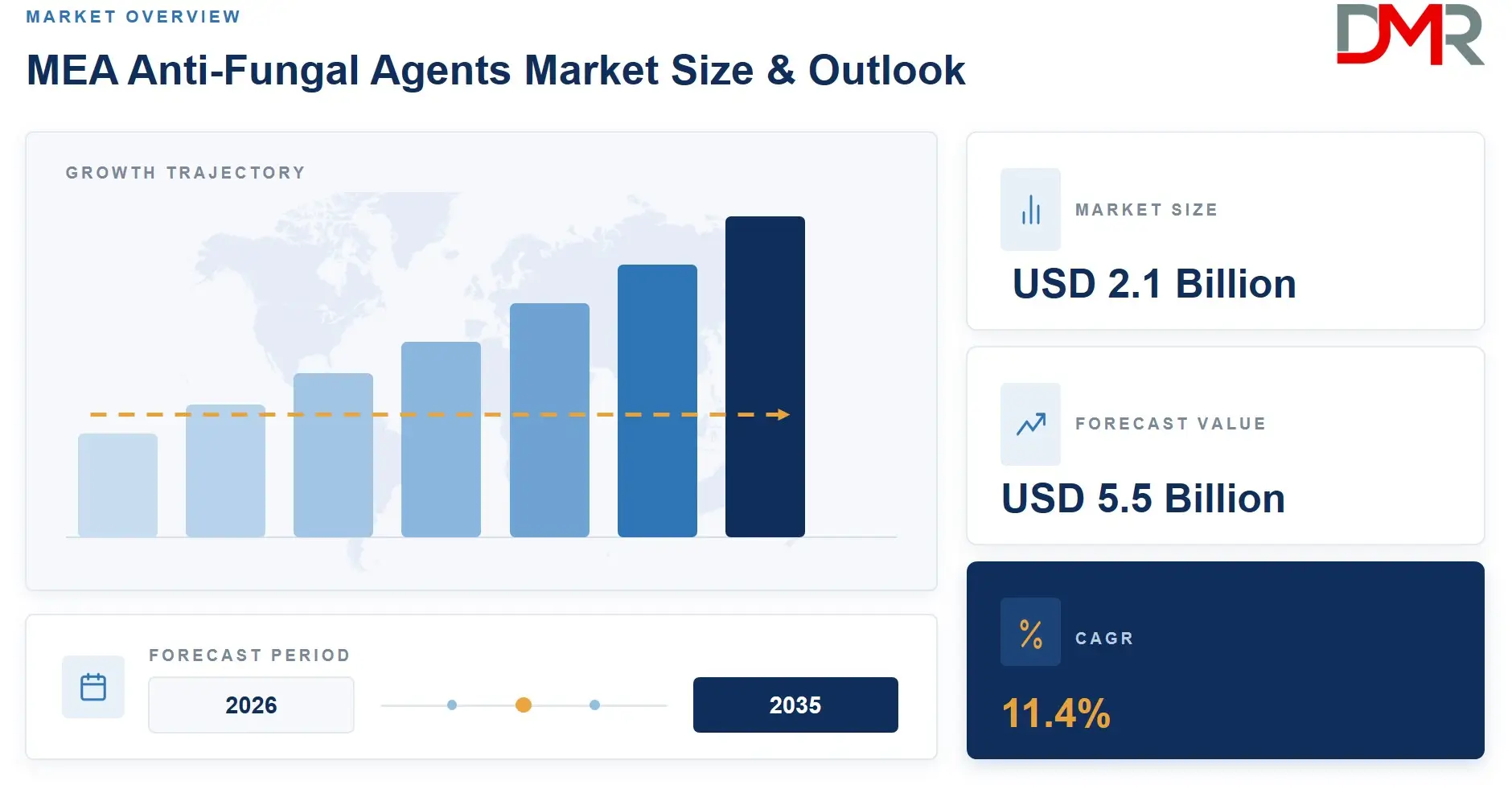
The MEA Anti-Fungal Agents Market size is estimated to reach USD 2.1 Bn in 2026 and is further anticipated to reach USD 5.5 Bn by 2035, at a CAGR of 11.4%.
ℹ
To learn more about this report –
Download Your Free Sample Report Here
The market covers prescription and over the counter antifungal therapeutics, azoles, polyenes, echinocandins and allylamines, dispensed to treat superficial and invasive fungal infections across Saudi Arabia, the UAE, South Africa and the wider Middle East and Africa region. The sizing captures demand generated inside these markets rather than the worldwide revenue booked by companies headquartered in the region, since several of the leading suppliers active locally sell most of their output outside MEA borders.
Buyers span public tertiary hospitals, private dermatology clinics, HIV treatment programs and retail pharmacy chains. Demand is shaped by a dual disease burden: a high prevalence of superficial dermatophyte and candidal skin infections tied to heat, humidity and rising diabetes rates in Gulf states, alongside a heavier load of invasive and opportunistic infections in Sub-Saharan Africa linked to advanced HIV disease, tuberculosis co-infection and expanding intensive care capacity. Procurement runs through a mix of national tender bodies, private insurers and out of pocket retail purchase.
Antifungal resistance is reshaping prescribing patterns. Azole-resistant Candida strains, drug-resistant Aspergillus fumigatus and the emergence of Candida auris in hospital settings across Saudi Arabia and South Africa are pushing clinicians toward echinocandins and newer agents earlier in treatment, ahead of the fluconazole-first protocols that dominated the previous decade. Weak mycology diagnostic capacity in many Sub-Saharan African facilities still delays confirmed treatment and encourages empirical, broad-spectrum prescribing that the region's antifungal stewardship programs are only beginning to address.
The scope excludes veterinary and agricultural antifungals, antiseptic cosmetic formulations and diagnostic reagents, focusing on human prescription and pharmacy-dispensed therapeutics sold for treatment rather than prevention. Local manufacturing is expanding, with Saudi Arabia's localization push and Egypt's generics base increasingly supplying formulated azoles and topical agents domestically, narrowing the import dependency that has historically defined antifungal supply across most of the Middle East and Africa.
Use Cases
- Gulf Tertiary Hospital ICU Stewardship: Intensive care units in Saudi Arabia and the UAE deploy echinocandins and amphotericin B formulations as first-line therapy for candidemia in critically ill patients, guided by stewardship committees that track resistance patterns and rotate agents to slow the spread of azole-resistant Candida strains.
- Sub-Saharan HIV Clinic Prophylaxis Programs: Public HIV treatment centers across East and Southern Africa administer fluconazole-based prophylaxis and induction therapy to prevent cryptococcal meningitis in patients with advanced HIV disease, integrating antifungal dispensing directly into routine antiretroviral clinic visits.
- Private Dermatology Practice Chronic Infection Management: Dermatology clinics in Gulf urban centers treat recurrent dermatophyte and candidal skin infections linked to rising diabetes prevalence, combining topical allylamines with oral azole courses for patients whose infections resist first-line topical treatment alone.
- North African Community Pharmacy Dispensing: Retail and community pharmacies across Egypt and Morocco dispense over the counter topical antifungals to outdoor laborers and agricultural workers exposed to prolonged heat and moisture, positioning pharmacists as the first point of contact for superficial infection treatment.
Key Takeaways
- Market Size & Share: The MEA Anti-Fungal Agents Market is valued at USD 2.1 Bn in 2026 and is set to expand to USD 5.5 Bn by 2035.
- Drug Class Analysis: Azoles are expected to hold approximately 46% of 2026 revenue, while echinocandins post the fastest sub-segment CAGR at 16.8%.
- Demand Concentration: South Africa is estimated to account for the largest share of 2026 demand within the geography, ahead of Saudi Arabia and the UAE.
- Resistance Pressure: Rising azole-resistant Candida and Candida auris cases are accelerating a shift toward echinocandin and amphotericin-based protocols in Gulf and South African hospitals.
- Channel Shift: Hospital pharmacies are projected to remain the largest distribution channel in 2026, accounting for around 44% of revenue, while online pharmacies grow fastest.
- Localization Drive: Saudi and Egyptian generic manufacturing capacity is expanding, narrowing the region's historic dependence on imported antifungal formulations.
How AI/Gen AI is Transforming the MEA Anti-Fungal Agents Market?
Artificial intelligence is entering the MEA Anti-Fungal Agents Market chiefly through diagnostics rather than drug discovery. Computer vision models trained on microscopy and culture images are being piloted in Saudi and South African reference laboratories to speed fungal species identification, a step that has historically bottlenecked treatment initiation across the region's under-resourced mycology labs. Faster, more accurate species identification lets clinicians move from empirical broad-spectrum prescribing to targeted therapy sooner, which matters directly for antifungal stewardship in a region where resistant Candida and Aspergillus strains are increasingly documented.
Machine learning is also being applied to predict antifungal susceptibility from genomic and phenotypic data ahead of full laboratory confirmation, and natural language processing tools are helping regulators and hospital pharmacovigilance units process adverse event reports and post-market surveillance data faster across multiple languages. These applications remain operational rather than transformative for now, supporting existing clinical workflows instead of replacing them, but they are steadily compressing the diagnostic and reporting lag that has long slowed antifungal treatment decisions in parts of the region.
- Computer Vision Diagnostics: Automated microscopy image analysis for faster fungal species identification in reference laboratories.
- Susceptibility Prediction Models: Machine learning models estimating likely antifungal resistance ahead of full culture results.
- Pharmacovigilance NLP: Natural language processing tools screening adverse event reports for regulatory safety signals.
- Generative Drug Design: Early-stage generative chemistry platforms assisting discovery of novel antifungal compound candidates.
Key Drivers in the MEA Anti-Fungal Agents Market
Demand for antifungal therapeutics across the Middle East and Africa is being pulled forward by two distinct forces.
- Rising Burden of Resistant and Invasive Fungal Infections: Growing case counts of azole-resistant Candida species, Candida auris outbreaks documented in Saudi and South African hospitals, and a persistently high HIV-associated cryptococcal disease burden in Sub-Saharan Africa are pushing clinicians toward newer, higher-cost antifungal classes. Expanding intensive care capacity across Gulf states means more immunocompromised and critically ill patients survive long enough to develop invasive candidiasis and aspergillosis, conditions that require sustained parenteral or oral azole and echinocandin therapy rather than short topical courses, structurally lifting per-patient spending even where overall infection incidence grows only gradually.
- Expanding Insurance Coverage and Healthcare Infrastructure: Mandatory private health insurance rollouts in Saudi Arabia and the UAE, alongside continued public hospital investment across South Africa and Egypt, are widening the pool of patients who can access branded and newer-generation antifungal therapies rather than relying solely on the cheapest generic fluconazole. As formulary coverage broadens and diagnostic referral pathways mature, prescribers gain more room to move beyond first-line topical and oral generics into hospital-administered intravenous therapy for patients who previously would have gone undiagnosed or undertreated, particularly outside the region's largest urban centers.
Restraints in the MEA Anti-Fungal Agents Market
Two structural brakes temper how quickly antifungal spending can scale across the region.
- Diagnostic Capacity Gaps Across Sub-Saharan Africa: Many public hospital laboratories outside South Africa's major urban centers lack reliable fungal culture, susceptibility testing or point-of-care diagnostic capability, so clinicians frequently prescribe broad-spectrum antifungals empirically rather than targeting a confirmed pathogen. This slows the shift toward higher-value, resistance-guided therapy already underway in better-resourced Gulf hospitals, keeps a larger share of regional volume locked into low-cost generic fluconazole, and complicates stewardship efforts aimed at slowing the spread of azole-resistant Candida strains, since prescribers without confirmed diagnoses have little basis for de-escalating or switching therapy.
- High Cost of Newer-Generation Agents Relative to Health Spending: Echinocandins, liposomal amphotericin B formulations and emerging agents such as fosmanogepix carry list prices that remain difficult to reconcile with per-capita health expenditure across most of the region outside the Gulf states, limiting their use to reference hospitals and insured patient populations. Reimbursement frameworks in several African markets have not kept pace with the newer antifungal pipeline, and currency volatility in some economies raises the effective cost of imported branded therapies further, reinforcing a two-tier market in which advanced treatment options remain concentrated in a small number of well-funded facilities.
Growth Opportunities in the MEA Anti-Fungal Agents Market
Two areas of white space stand out for suppliers positioning across the region.
- Retail and Online Pharmacy Channel Expansion in Gulf Cities: E-pharmacy platforms are scaling quickly across Saudi Arabia and the UAE, giving antifungal manufacturers a direct-to-consumer channel for topical and OTC oral therapies that previously moved almost entirely through physical retail pharmacies and hospital dispensing. This channel is particularly suited to chronic dermatophyte and recurrent vulvovaginal candidiasis treatment, conditions patients often prefer to manage with minimal in-person clinical contact, and it opens room for manufacturers and distributors to build direct patient relationships, subscription refill models and app-based adherence support that the traditional retail channel has not offered.
- Domestic Generic Manufacturing Localization in Saudi Arabia and Egypt: Saudi Arabia's industrial localization program and Egypt's established generics manufacturing base are opening space for domestic production of azole and topical antifungal formulations that the region has historically imported. Local manufacturers that can secure Saudi Food and Drug Authority or Egyptian regulatory approval for finished-dose antifungal products stand to win preferential national tender allocations and reduce currency-driven cost volatility for public procurement bodies, creating an opening for both established regional generics houses and new entrants willing to invest in local manufacturing capacity ahead of broader demand growth.
Trends in the MEA Anti-Fungal Agents Market
Prescribing and channel behavior are shifting in two directions worth tracking.
- Earlier Adoption of Oral Step-Down Therapy: Hospitals in Saudi Arabia and South Africa are increasingly moving stabilized invasive candidiasis patients from intravenous echinocandin therapy to oral azole step-down regimens sooner than prior protocols recommended, shortening inpatient stays and reducing the intravenous drug and nursing burden on stretched hospital budgets. The shift is being reinforced by updated regional clinical guidance drawing on international stewardship frameworks, and it is gradually reshaping the split between hospital-administered parenteral therapy and take-home oral prescriptions within the region's route of administration segmentation.
- Growing Adoption of Point-of-Care Fungal Diagnostics: Rapid antigen and PCR-based point-of-care tests for cryptococcal and candidal infections are gaining traction in reference hospitals and select HIV treatment programs, compressing the time between patient presentation and confirmed diagnosis from days to hours in facilities that adopt them. Faster confirmation supports more targeted first-line prescribing and reduces unnecessary empirical broad-spectrum use, a trend donor-funded HIV programs across Sub-Saharan Africa are actively encouraging as part of broader efforts to reduce cryptococcal meningitis mortality among patients with advanced disease.
Research Scope and Analysis
Segment performance is assessed across five axes: drug class, application, route of administration, distribution channel and end user. Each axis identifies the sub-segment carrying the largest share of 2026 revenue and the one expanding fastest through 2035, with the commercial reason behind each position.
ℹ
To learn more about this report –
Download Your Free Sample Report Here
By Drug Class
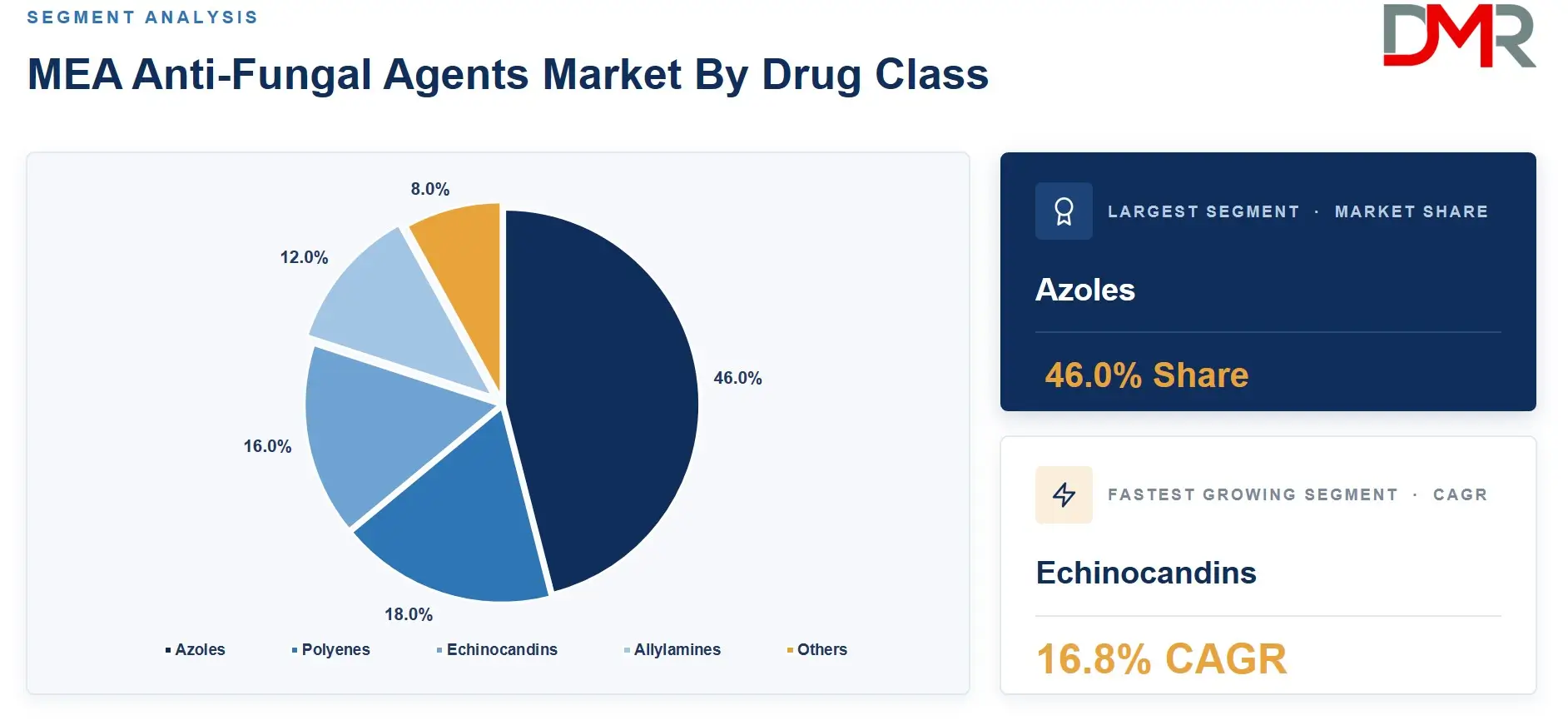
Azoles are projected to hold the largest share of 2026 revenue, accounting for approximately 46%, a position built on decades of fluconazole and itraconazole use as first-line therapy across both hospital and retail settings, low manufacturing cost, and broad availability from regional generic producers in Egypt and Saudi Arabia. Growth, however, is concentrated in echinocandins, expanding at a CAGR of 16.8% between 2026 and 2035 as hospitals in Saudi Arabia, the UAE and South Africa shift invasive candidiasis and Candida auris cases toward this class ahead of resistant fluconazole failure, supported by expanding intensive care capacity and antifungal stewardship programs that favor earlier, more targeted use of higher-potency agents over broad-spectrum azole therapy.
By Application
Dermatophytosis is expected to remain the leading application by 2026 revenue, accounting for close to 34% of the total, reflecting the sheer volume of superficial skin, nail and scalp infections treated through retail and dermatology channels across the region's hot, humid Gulf coastal cities and densely populated North African urban centers. The steeper trajectory sits with aspergillosis, forecast to grow at a CAGR of 17.5% through 2035, as expanding intensive care capacity, rising tuberculosis-related lung disease and a growing population of transplant and oncology patients increase the pool of individuals vulnerable to invasive Aspergillus infection, a condition that requires costlier, longer courses of voriconazole or newer triazole therapy than superficial skin infections.
By Route of Administration
Oral formulations are estimated to account for approximately 40% of 2026 revenue, the largest share by route, since fluconazole and itraconazole tablets remain the default first-line choice for both superficial and many uncomplicated systemic infections across retail and outpatient settings. Growth, however, is concentrated in parenteral and injectable formulations, projected to expand at a CAGR of 16.2% between 2026 and 2035 as hospital intensive care units across Saudi Arabia, the UAE and South Africa administer more intravenous echinocandin and amphotericin B therapy to critically ill and immunocompromised patients, a shift tied directly to rising invasive fungal infection rates in expanding regional ICU capacity.
By Distribution Channel
Hospital pharmacies are expected to hold the largest share of 2026 revenue at around 44%, reflecting their role dispensing the parenteral and higher-cost oral therapies used to treat invasive infections in inpatient settings, alongside direct national tender procurement relationships with manufacturers. The fastest growth sits with online pharmacies, projected at a CAGR of 19.6% through 2035, as e-pharmacy platforms scale rapidly across Saudi Arabia and the UAE and increasingly capture repeat OTC topical antifungal purchases and recurrent vulvovaginal candidiasis prescription refills that patients prefer to manage without an in-person retail pharmacy visit.
By End User
Hospitals are projected to remain the largest end user segment in 2026, accounting for approximately 48% of revenue, driven by their role treating invasive and hospital-acquired fungal infections that require intravenous therapy and close monitoring. Growth is fastest in homecare settings, forecast at a CAGR of 15.4% between 2026 and 2035, as stabilized patients increasingly step down to oral or self-administered topical therapy at home under outpatient follow-up rather than remaining hospitalized, a shift consistent with the broader oral step-down prescribing trend reshaping the region's route of administration mix.
The MEA Anti-Fungal Agents Market Report is Segmented Based on the Following
By Drug Class
- Azoles
- Polyenes
- Echinocandins
- Allylamines
- Others
By Application
- Dermatophytosis
- Candidiasis
- Aspergillosis
- Cryptococcosis
- Others
By Route of Administration
- Oral
- Topical
- Parenteral/Injectable
- Others
By Distribution Channel
- Hospital Pharmacies
- Retail Pharmacies
- Online Pharmacies
- Others
By End User
- Hospitals
- Dermatology & Specialty Clinics
- Homecare Settings
- Others
Regulatory Landscape
Antifungal drug approval and pricing across the region runs through separate national frameworks. The Saudi Food and Drug Authority maintains an independent review process with its own bioequivalence and Saudi Authorized Representative requirements, while the South African Health Products Regulatory Authority has been refining submission guidelines and post-approval change pathways since 2025. Neither regulator automatically recognizes approvals from international agencies, which lengthens registration timelines for newer classes such as echinocandins and next-generation triazoles entering the region. National procurement bodies increasingly favor suppliers with local manufacturing or fill-finish presence, tying regulatory approval closely to localization strategy, and this dynamic is expected to keep shaping which suppliers can compete for public tender volume through 2035.
Epidemiology
Fungal disease burden varies sharply across the region. Gulf states report a high volume of superficial dermatophyte and candidal skin infections linked to heat, humidity and rising diabetes prevalence, while Sub-Saharan Africa carries a disproportionate share of invasive, life-threatening infections tied to advanced HIV disease, particularly cryptococcal meningitis and disseminated histoplasmosis. Hospital surveillance in Saudi Arabia and South Africa has documented rising azole-resistant Candida and Candida auris cases in intensive care settings, reinforcing the shift toward echinocandin and amphotericin-based protocols. This uneven disease pattern means demand growth is not uniform: it is pulled by resistance and ICU expansion in the Gulf and by HIV-associated opportunistic infection in Sub-Saharan Africa.
Competitive Landscape
The MEA Anti-Fungal Agents Market remains moderately fragmented, with multinational originators competing alongside a deep bench of Indian, Egyptian, Gulf and South African generic manufacturers. Pfizer, Novartis, Gilead Sciences and GlaxoSmithKline hold positions in newer-generation and branded segments, particularly echinocandins and antiretroviral-adjacent antifungal prophylaxis, while Indian majors such as Cipla, Sun Pharmaceutical Industries and Aurobindo Pharma compete heavily on price in the dominant azole and topical segments. Regional players including Hikma Pharmaceuticals, Julphar, Aspen Pharmacare and Egypt's EIPICO and EVA Pharma compete on local manufacturing footprint, tender relationships with national procurement bodies such as Saudi Arabia's NUPCO, and distribution reach into secondary cities. Competition centers on price for generics, formulary access and stewardship-driven institutional relationships for newer agents, with local manufacturing increasingly a decisive factor in winning public tender volume.
Some of the Prominent Players in the MEA Anti-Fungal Agents Market are:
- Pfizer Inc.
- Novartis AG
- Bayer AG
- Sanofi
- GlaxoSmithKline plc
- Merck & Co., Inc.
- Teva Pharmaceutical Industries Ltd.
- Viatris Inc.
- Cipla Limited
- Sun Pharmaceutical Industries Ltd.
- Astellas Pharma Inc.
- Gilead Sciences, Inc.
- F2G Ltd.
- Scynexis, Inc.
- Mundipharma
- Bausch Health Companies Inc.
- Perrigo Company plc
- Taro Pharmaceutical Industries Ltd.
- Torrent Pharmaceuticals Ltd.
- Lupin Limited
- Dr. Reddy's Laboratories Ltd.
- Aurobindo Pharma Limited
- Zydus Lifesciences Limited
- Glenmark Pharmaceuticals Ltd.
- Amneal Pharmaceuticals, Inc.
- Hikma Pharmaceuticals plc
- Julphar (Gulf Pharmaceutical Industries)
- SPIMACO Addwaeih
- Tabuk Pharmaceutical Manufacturing Co.
- Jamjoom Pharma
- NeoPharma LLC
- Pharmaceutical Solutions Industry (PSI)
- Aspen Pharmacare Holdings Limited
- Adcock Ingram Holdings Limited
- Pharco Pharmaceuticals
- EIPICO (Egyptian International Pharmaceutical Industries Co.)
- EVA Pharma
- Amoun Pharmaceutical Company
- Marcyrl Pharmaceutical Industries
- Nahdi Medical Company
- Other Key Players
Recent Developments
- In March 2026, a Phase 2 clinical study conducted across intensive care units in South Africa reported strong treatment success with the investigational agent fosmanogepix in patients with candidemia caused by drug-resistant Candida auris, adding to the region's evidence base for next-generation antifungal options.
- In September 2025, the South African Health Products Regulatory Authority introduced revised submission guidelines intended to streamline review pathways for medicinal products, a change expected to affect timelines for new antifungal generic and branded registrations in the country.
- In August 2025, researchers published a comprehensive hospital surveillance review of Candida auris cases across Saudi Arabia, consolidating antifungal susceptibility and mortality data that is informing updated stewardship guidance in the Kingdom's intensive care units.
- In 2025, clinicians across Gulf and Sub-Saharan African reference hospitals reported expanded screening for Candida auris and azole-resistant Aspergillus fumigatus as part of infection-control protocols aligned with the World Health Organization's fungal priority pathogens guidance.
Report Details
| Report Characteristics |
| Market Size (2026) |
USD 2.1 Bn |
| Forecast Value (2035) |
USD 5.5 Bn |
| CAGR (2026-2035) |
11.4% |
| Historical Data |
2021 - 2025 |
| Forecast Data |
2026 - 2035 |
| Base Year |
2025 |
| Segments Covered |
By Drug Class, By Application, By Route of Administration, By Distribution Channel, and By End User |
| Regional Coverage |
Middle East & Africa - Saudi Arabia, The UAE, South Africa, Rest of MEA |
Frequently Asked Questions
How big is the MEA Anti-Fungal Agents Market?
▾ The MEA Anti-Fungal Agents Market is estimated at USD 2.1 Bn in 2026. Demand is concentrated in Saudi Arabia, the UAE and South Africa, driven by a mix of high superficial infection volume in the Gulf and a heavier invasive fungal infection burden across Sub-Saharan Africa linked to advanced HIV disease and expanding intensive care capacity.
What is the growth rate of the MEA Anti-Fungal Agents Market?
▾ The market is projected to expand at a CAGR of 11.4% between 2026 and 2035, reaching USD 5.5 Bn by the end of the forecast period. Growth is led by rising resistant and invasive infection rates, expanding insurance coverage in Gulf states, and continued healthcare infrastructure investment across South Africa and Egypt.
Which country holds the largest share in the MEA Anti-Fungal Agents Market?
▾ South Africa is estimated to hold the largest share of regional demand in 2026, reflecting its high invasive fungal infection burden, extensive public hospital network and established generic pharmaceutical manufacturing base. Saudi Arabia and the UAE follow closely, supported by expanding private insurance coverage and Gulf healthcare infrastructure investment.
Who are the key players in the MEA Anti-Fungal Agents Market?
▾ Leading participants include Pfizer, Novartis, Gilead Sciences, Cipla, Hikma Pharmaceuticals, Aspen Pharmacare and Julphar, alongside a wide base of Egyptian, Saudi and South African generic manufacturers. Competition spans multinational originators serving newer-generation segments and regional producers competing on price and local manufacturing presence across national tender programs.
Which drug class leads the MEA Anti-Fungal Agents Market?
▾ Azoles lead the market, accounting for approximately 46% of 2026 revenue on the strength of decades-long use as first-line therapy and low generic manufacturing cost. Echinocandins are the fastest-growing class, expanding at a CAGR of 16.8% as hospitals shift toward them for resistant and invasive infections.
What is driving demand growth in the MEA Anti-Fungal Agents Market?
▾ Demand growth is driven by rising rates of azole-resistant and invasive fungal infections, expanding intensive care capacity across Gulf states, a persistent HIV-associated opportunistic infection burden in Sub-Saharan Africa, and widening private insurance coverage that is bringing more patients within reach of newer-generation antifungal therapy.
What challenges affect antifungal treatment access across the MEA Anti-Fungal Agents Market?
▾ Diagnostic capacity gaps in many Sub-Saharan African hospital laboratories delay confirmed treatment and encourage broad-spectrum empirical prescribing. In the MEA Anti-Fungal Agents Market, the high cost of newer-generation agents relative to regional health spending further limits access outside well-funded Gulf facilities, keeping advanced treatment options concentrated in a small number of reference hospitals.