Market Snapshot
- Market Size (2026): USD 2.4 Bn
- Forecast Value (2035): USD 7.0 Bn
- CAGR (2026 to 2035): 12.6%
- Leading By Product (2026): Patient Monitors, around 34%
- Leading By End User (2026): Hospitals and ICUs, close to 52%
- Key Players: Medtronic, GE HealthCare, Drägerwerk and others
What is MEA Critical Care Equipment Market and its Market Size?
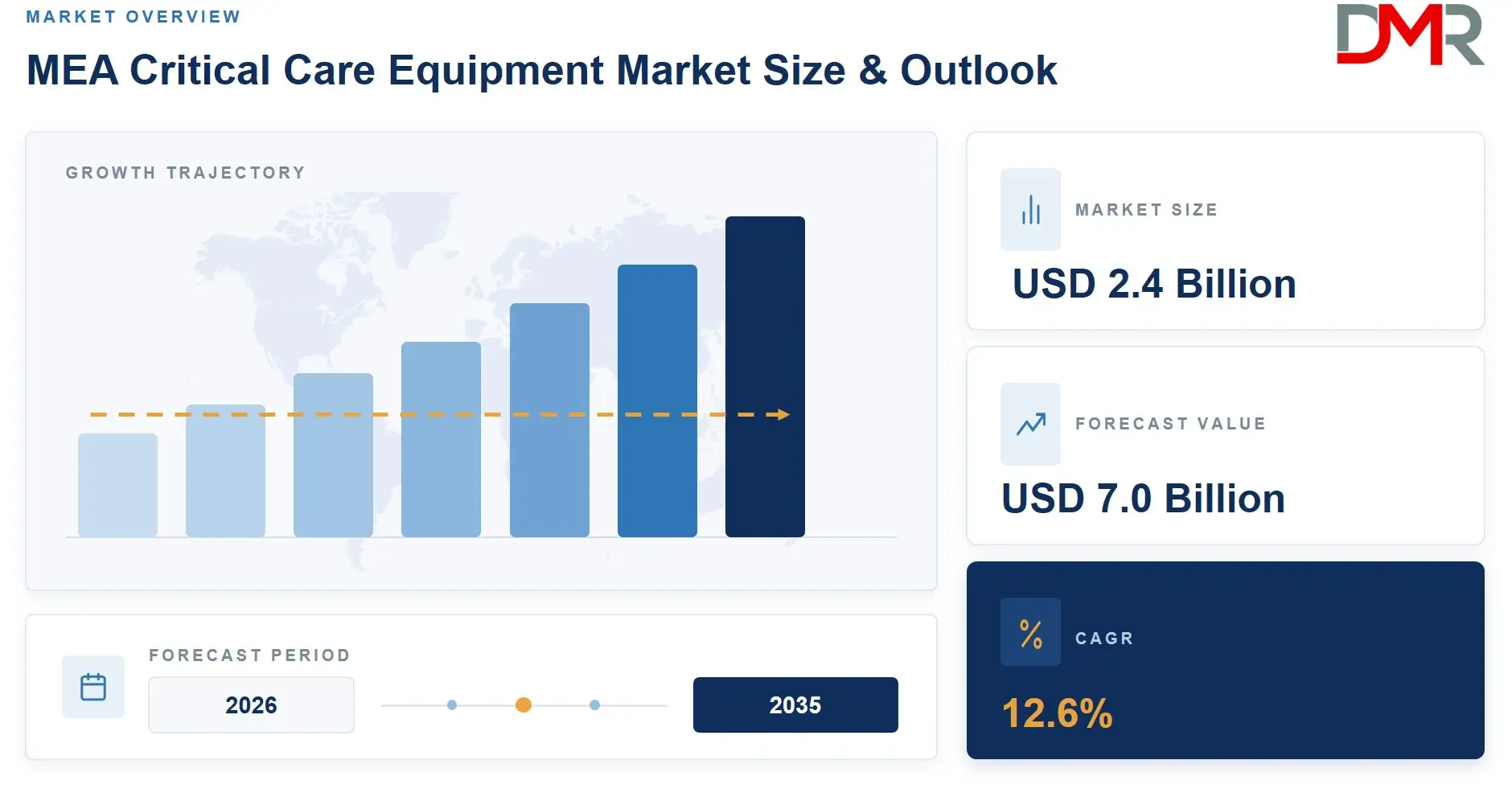
The MEA Critical Care Equipment Market size is estimated to reach USD 2.4 Bn in 2026 and is further anticipated to reach USD 7.0 Bn by 2035, at a CAGR of 12.6%.
ℹ
To learn more about this report –
Download Your Free Sample Report Here
The market covers durable equipment used to monitor, stabilize and support critically ill patients across intensive care, emergency, cardiac and neonatal settings in Saudi Arabia, the UAE, South Africa and the wider Middle East and Africa region. Scope includes patient monitors, mechanical ventilators, infusion and syringe pumps, defibrillators, anesthesia machines and ECMO or extracorporeal support systems, together with the service contracts bundled into institutional procurement. Consumables, general ward furniture and diagnostic imaging systems sit outside this scope. These figures represent equipment demand inside the stated geography rather than the worldwide revenue of companies headquartered there, a distinction that matters given how many multinational device makers book regional sales through local distributors and joint ventures rather than direct subsidiaries.
Critical care equipment exists to keep a deteriorating patient alive long enough for the underlying condition to be treated. A multi-parameter monitor tracks heart rhythm, oxygen saturation and blood pressure continuously; a ventilator takes over or assists breathing when the lungs cannot manage alone; infusion pumps deliver medication and fluids at precise, programmable rates; defibrillators restore a viable heart rhythm during cardiac arrest. Buyers are almost exclusively institutional: ministries of health running centralized tenders, private hospital groups refreshing capital equipment on fixed cycles, and specialty centers building out cardiac, trauma or neonatal capacity.
What is changing structurally is the shift from reactive, pandemic-driven procurement toward planned tertiary care buildout. Saudi Arabia's health cluster program and comparable specialty hospital expansions in the UAE and South Africa are replacing one-off equipment purchases with multi-year fleet contracts. At the same time, regulators in both Saudi Arabia and South Africa have tightened device registration requirements since 2025, pushing suppliers toward longer compliance timelines and favoring vendors already established in the region's distribution networks.
Use Cases
- Tertiary ICU Buildout: Ministry-run hospital networks inside Saudi Arabia's health cluster program equip new intensive care wings with multi-parameter monitors and ventilators procured through centralized tenders, standardizing fleets across sites to simplify maintenance contracts and reduce staff retraining between facilities.
- Private Hospital Capital Refresh: UAE and South African private hospital groups replace ICU monitoring and infusion equipment on five to seven year cycles, prioritizing platforms that feed data directly into hospital information systems rather than standalone bedside devices requiring manual charting.
- Neonatal and Pediatric Care Expansion: Specialty children's hospitals across the GCC add incubator-integrated ventilators and dedicated pediatric monitors as high-risk birth referrals concentrate in a smaller number of accredited tertiary centers, lifting equipment density per facility by close to 15%.
- Remote and Home-Based Critical Care: Homecare providers in urban South Africa and the UAE deploy portable ventilators and wearable monitoring devices for patients transitioning out of hospital ICUs, extending critical care oversight into residential settings under telemonitoring protocols.
Key Takeaways
- Market Size and Share: the MEA Critical Care Equipment Market is valued at USD 2.4 Bn in 2026 and is projected to reach USD 7.0 Bn by 2035 at a CAGR of 12.6%.
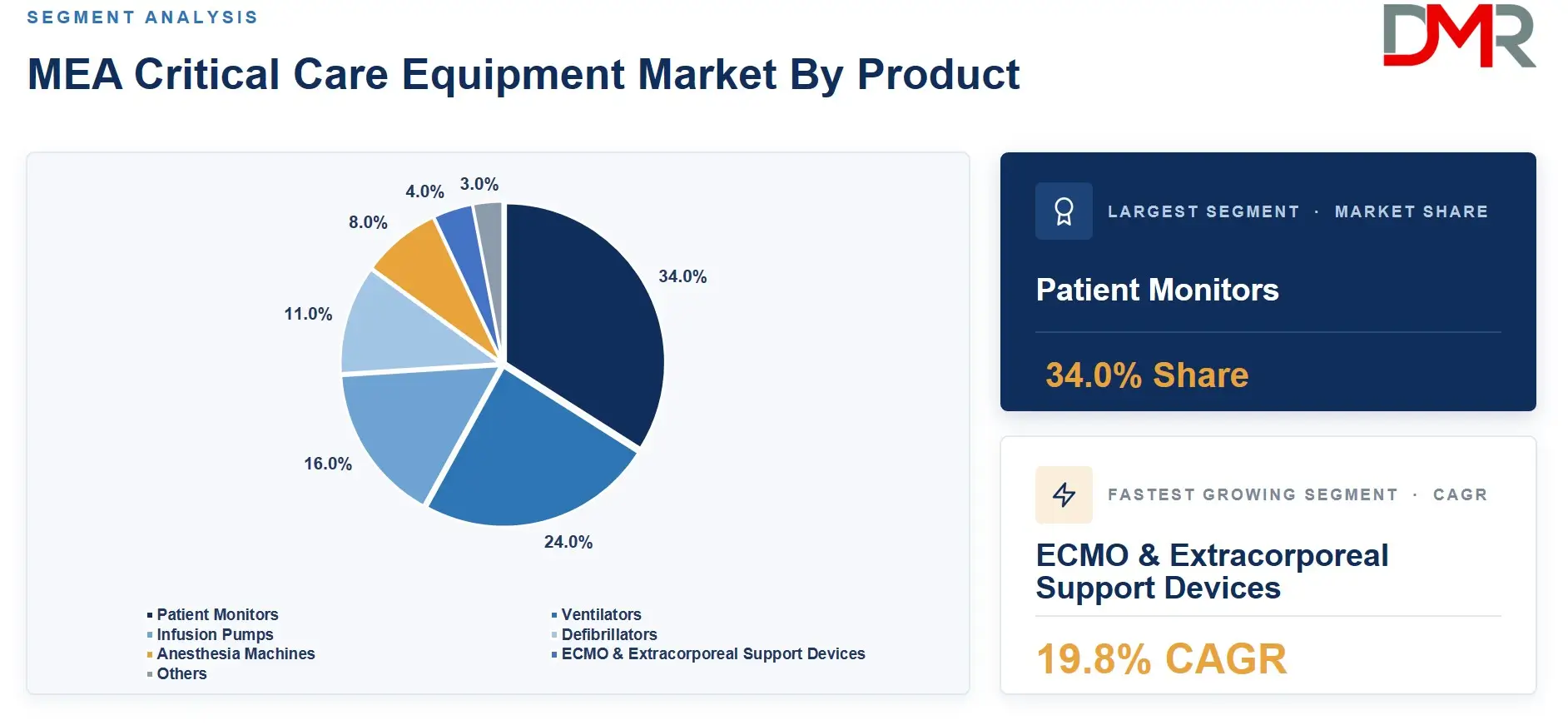
- Product Analysis: Patient Monitors lead with approximately 34% of 2026 demand, while ECMO and Extracorporeal Support Devices post the fastest sub-segment CAGR at 19.8% through 2035.
- Demand Concentration: Saudi Arabia holds the largest share of regional demand, with South Africa expanding fastest as tertiary hospital networks scale critical care capacity.
- Regulatory Tightening: Saudi Arabia's SFDA and South Africa's SAHPRA both moved to stricter risk-based device frameworks across 2025 and 2026, extending registration timelines for new ventilator and monitoring platforms.
- AI-Enabled Monitoring: predictive deterioration alerts and automated ventilator weaning protocols are moving from pilot deployments into standard tender specifications at flagship tertiary hospitals.
- Home Care Growth: Home Care Settings post the fastest 2026 to 2035 CAGR among end users at 21.4%, as portable monitoring extends critical care beyond hospital walls.
How AI/Gen AI is Transforming the MEA Critical Care Equipment Market?
Artificial intelligence in this market is showing up as an operational layer bolted onto existing monitors and ventilators rather than a new product category on its own. Hospitals in Saudi Arabia and the UAE are the earliest adopters, largely because their tertiary centers already run the multi-parameter monitoring infrastructure that machine learning models need to train on. South African private hospital groups are following through vendor-managed pilot programs rather than in-house development, since local data science capacity remains concentrated in banking and telecoms rather than healthcare.
The practical effect is fewer false alarms, faster escalation for genuine deterioration and less manual charting for nursing staff working double shifts in ICUs that remain chronically understaffed across the region. Vendors are packaging these capabilities as software add-ons to existing hardware contracts rather than standalone products, which keeps procurement inside familiar capital equipment budgets instead of creating a new software line item that hospital finance committees would need to separately approve.
- Predictive Deterioration Scoring: bedside monitors run continuous machine learning models against vital sign streams to flag early signs of sepsis or respiratory decline, giving nursing staff a lead time window before a patient crosses into a full emergency response.
- Automated Ventilator Weaning: closed-loop ventilator algorithms adjust pressure support and oxygen delivery incrementally as a patient's own breathing effort improves, shortening the manual titration process that otherwise consumes significant respiratory therapist time.
- Smart Alarm Management: signal-processing filters distinguish clinically significant alarms from motion artifacts and sensor noise, addressing alarm fatigue that has been linked to delayed response in high-volume ICUs.
- Remote Tele-Critical-Care Hubs: centralized monitoring centers in Riyadh and Johannesburg extend specialist intensivist oversight to smaller regional hospitals that cannot staff a dedicated ICU physician around the clock.
Key Drivers in the MEA Critical Care Equipment Market
Two forces are pulling demand in different but complementary ways.
- Tertiary Hospital Infrastructure Programs: Saudi Arabia's Vision 2030 health transformation strategy has committed sustained capital toward a network of specialty and tertiary hospitals organized under regional health clusters, each requiring a full complement of ICU monitors, ventilators and infusion systems on opening. Comparable specialty hospital expansions are underway in the UAE, including cardiology, neurology and critical care capacity additions at flagship academic medical centers. This institutional buildout is structurally different from replacement demand: it adds net new bed capacity rather than swapping out aging equipment, which is why the region's headline CAGR of 12.6% through 2035 sits above the more mature demand growth typical of established equipment markets.
- Rising Chronic and Cardiovascular Disease Burden: the GCC and South Africa both carry elevated rates of diabetes, hypertension and cardiovascular disease relative to their income levels, driving a steady rise in ICU and cardiac care admissions independent of any single infrastructure program. Hospitals responding to this baseline demand growth are standardizing on multi-parameter monitors and infusion platforms that can flex between general ICU, cardiac and post-surgical recovery use, which supports replacement cycles even in facilities not directly tied to a new-build program.
Restraints in the MEA Critical Care Equipment Market
Two structural brakes temper the pace of adoption.
- Import Dependency and Currency Exposure: South Africa sources more than nine in ten complex medical devices from overseas manufacturers, and Gulf markets show a similar reliance on imported capital equipment. This leaves procurement budgets exposed to currency depreciation and freight cost volatility, and it means a weakening rand or riyal can defer planned equipment purchases even when clinical need is unchanged, since public hospital budgets are set in local currency terms that do not automatically adjust for import cost inflation.
- Rising Regulatory Compliance Costs: Saudi Arabia's move to mandatory MDMA2 technical file assessment for every device class and South Africa's phased ISO 13485 certification requirement both raise the fixed cost of market entry for device manufacturers and their local distributors. Smaller specialist vendors without an established regulatory affairs function inside the region face longer approval timelines than the multinational majors that already maintain authorized representative relationships, which can slow the introduction of newer, more differentiated equipment even where hospital demand exists.
Growth Opportunities in the MEA Critical Care Equipment Market
Two areas of white space stand out against the region's current buildout.
- Home and Step-Down Care Channel: as tertiary ICUs fill with the sickest patients, hospitals in the UAE and South Africa are increasingly discharging stabilized patients to home-based or step-down monitoring rather than occupying scarce ICU beds for extended recovery. This creates a distinct procurement channel for portable ventilators and wearable monitors sold through home healthcare providers rather than hospital tenders, a channel largely absent from the region's equipment market a decade ago.
- Neonatal and Pediatric Tertiary Centers: dedicated children's hospitals are a comparatively underserved niche across the GCC relative to adult tertiary care, and new specialty pediatric facilities create concentrated demand for incubator-integrated ventilation and pediatric-calibrated monitoring that general ICU equipment cannot substitute for, giving vendors with a genuine neonatal product line a defensible entry point into new-build tenders.
Trends in the MEA Critical Care Equipment Market
Two shifts are reshaping how equipment gets bought and used, distinct from the drivers above.
- Centralization of Public Procurement: Saudi Arabia's move toward unified national procurement bodies is consolidating what used to be facility-level purchasing decisions into fewer, larger framework tenders, which favors vendors able to guarantee regional service and spare parts coverage over smaller specialist suppliers competing purely on device features.
- Interoperability Over Standalone Devices: hospital buyers increasingly specify that new monitors and infusion pumps integrate directly with existing hospital information systems rather than operating as isolated bedside units, shifting competitive emphasis toward software and data architecture credentials alongside the traditional hardware specifications that dominated purchasing decisions a decade ago.
Research Scope and Analysis
Segment performance is assessed across five axes: product, end user, application, modality and distribution channel. Each axis identifies the sub-segment carrying the largest share of 2026 demand and the one expanding fastest through 2035, along with the commercial reason behind each position.
ℹ
To learn more about this report –
Download Your Free Sample Report Here
By Product
Patient Monitors hold the largest share by product in 2026, accounting for approximately 34% of demand, since every ICU, cardiac and post-surgical bed requires continuous vital-sign tracking regardless of the underlying condition, giving this category the broadest installed base and the steadiest replacement cycle of any device type. Growth, however, is concentrated in ECMO and Extracorporeal Support Devices, expanding at a CAGR of 19.8% between 2026 and 2035 as flagship tertiary centers in Saudi Arabia and the UAE add advanced cardiac and respiratory support capability that was previously unavailable outside referral to Europe or North America, pulling a small but fast-growing category of high-value equipment into regional procurement for the first time.
By End User
Hospitals and ICUs account for the largest share by end user in 2026, close to 52% of demand, reflecting the fact that critical care equipment is overwhelmingly an institutional purchase tied to licensed bed capacity rather than a device bought by individual clinicians or patients. The steeper trajectory sits with Home Care Settings, growing at a CAGR of 21.4% through 2035 as step-down discharge protocols in the UAE and South Africa shift stabilized patients out of scarce ICU beds and into monitored home recovery, creating a genuinely new buyer category for portable equipment that did not meaningfully exist in the region a decade ago.
By Application
Respiratory Care leads by application, holding around 31% of 2026 demand, driven by the sustained volume of ventilator and oxygen therapy use across general ICU, emergency and post-surgical recovery settings that spans nearly every hospital admission pathway. Growth is fastest in Neonatal and Pediatric Care, at a CAGR of 18.6% through 2035, as new specialty children's hospitals across the GCC concentrate high-risk births into fewer accredited centers that each require a dedicated fleet of pediatric-calibrated monitors and ventilators.
By Modality
Bedside and Fixed Systems remain the largest modality in 2026, at approximately 48% of demand, since the majority of critical care still takes place at a stationary ICU bed with continuous power and network connectivity that portable devices cannot match on battery life or display size. The fastest-growing modality is Wearable and Remote Monitoring Devices, at a CAGR of 22.8% through 2035, pulled by the same step-down and home-care discharge trend reshaping the end-user axis, which requires monitoring hardware small and battery-efficient enough to travel with a recovering patient outside the hospital.
By Distribution Channel
Direct Tenders and Institutional Procurement dominate distribution, close to 46% of 2026 demand, because ministries of health and large private hospital groups negotiate multi-year framework contracts directly with manufacturers or their authorized representatives rather than routing large capital purchases through general distributors. Online and E-Procurement Platforms show the fastest growth, at a CAGR of 20.4% through 2035, as smaller private clinics and step-down care providers increasingly source lower-value consumable-adjacent equipment through digital B2B marketplaces rather than traditional sales representative visits.
The MEA Critical Care Equipment Market Report is Segmented Based on the Following
By Product
- Patient Monitors
- Ventilators
- Infusion Pumps
- Defibrillators
- Anesthesia Machines
- ECMO and Extracorporeal Support Devices
- Others
By End User
- Hospitals and ICUs
- Ambulatory Surgical Centers
- Specialty Cardiac and Trauma Centers
- Home Care Settings
- Others
By Application
- Respiratory Care
- Cardiac Care
- Trauma and Emergency Care
- Neonatal and Pediatric Care
- Others
By Modality
- Bedside and Fixed Systems
- Portable and Transport Systems
- Modular Multi-Parameter Systems
- Wearable and Remote Monitoring Devices
- Others
By Distribution Channel
- Direct Tenders and Institutional Procurement
- Third-Party Distributors
- Online and E-Procurement Platforms
- Others
Regulatory Landscape
Saudi Arabia and South Africa now run the region's two most demanding device frameworks, and both tightened materially through 2025 and 2026. Saudi Arabia's SFDA requires every device class to complete a full technical file assessment through its GHAD portal under the MDMA2 pathway, ending the shortcut routes that previously let CE or FDA-cleared products enter on prior approvals alone. South Africa's SAHPRA is phasing in mandatory ISO 13485 certification for device establishment licenses through 2028 and, separately, now requires standalone authorization for AI or machine learning-enabled devices before marketing. The commercial opening favors manufacturers and distributors who already hold authorized representative relationships and can absorb the added technical file cost, since Saudi Arabia's SFDA registration is recognized across the rest of the GCC, turning a single compliant filing into a six-country entry point. The risk is a widening gap between well-resourced multinational suppliers and smaller specialist vendors priced out of the compliance workload, which could slow the pace at which newer AI-enabled or niche devices reach regional hospitals even where clinical demand for them already exists.
Technology Analysis
The region's device base is shifting from analog, standalone bedside hardware toward networked platforms that report continuously into hospital information systems, a transition still incomplete across much of the public hospital estate in South Africa but advancing quickly inside Saudi Arabia's newer health cluster facilities. What is shifting now is the bundling of predictive analytics and closed-loop control directly into monitors and ventilators rather than selling them as separate software licenses, which keeps adoption inside familiar hardware procurement budgets. The commercial opening sits with vendors able to demonstrate interoperability certifications alongside device performance, since hospital IT departments are increasingly gatekeepers on new equipment specifications rather than clinical departments acting alone. The principal risk is infrastructure unevenness: rural and lower-tier facilities across South Africa and parts of North Africa lack the network reliability and IT staffing that connected devices assume, which could concentrate the technology premium in a narrower band of flagship urban hospitals and widen the equipment gap between tiers of care rather than closing it.
Competitive Landscape
The market sits between two distinct tiers of competition. Multinational device majors compete on breadth of portfolio, service network reach and the regulatory relationships needed to clear Saudi Arabia's and South Africa's tightening approval frameworks, while a dense layer of regionally headquartered distributors competes on installation speed, spare parts availability and after-sales service response inside individual countries. Consolidation pressure is building at the distribution layer as larger groups form supply alliances to cover the full GCC and southern Africa footprint from a single relationship, reducing the number of counterparties large hospital groups need to manage. Price competition remains secondary to service reliability and regulatory compliance credentials, since equipment failures in an ICU setting carry consequences that hospital procurement teams weigh well above modest cost differences between comparable devices.
Some of the Prominent Players in the MEA Critical Care Equipment Market Are
- Medtronic
- GE HealthCare
- Koninklijke Philips
- Getinge AB
- Drägerwerk AG
- Mindray Bio-Medical Electronics
- Nihon Kohden Corporation
- Baxter International
- Fresenius Kabi
- B. Braun Melsungen
- Becton, Dickinson and Company
- Siemens Healthineers
- Hamilton Medical
- Vyaire Medical
- ICU Medical
- Edwards Lifesciences
- ResMed
- ZOLL Medical Corporation
- Ambu A/S
- Löwenstein Medical Technology
- Masimo Corporation
- Nonin Medical
- Comen Medical Instruments
- Weinmann Emergency Medical Technology
- Air Liquide Medical Systems
- Metran Co.
- Smiths Medical
- Contec Medical Systems
- Tamer Group
- Al Faisaliah Medical Systems
- Al Jeel Medical and Trading Co.
- National Unified Procurement Company (NUPCO)
- Respiratory Care Africa
- Lodox Systems
- Hutz Hospi Tec
- Medhold Medical
- Alkan Medical
- GESCA
- Cairo Medical
- Care Medical Egypt
- Other Key Players
Recent Developments
- In March 2026, South Africa's SAHPRA published a Medical Device Registration Feasibility Study advancing a stricter risk-based framework, signaling further tightening of establishment licensing ahead of full implementation.
- In 2026, Dubai's health authorities advanced a USD 150 million investment plan to add ten hospitals across the emirate, widening the addressable base for tertiary critical care equipment tenders.
- In 2026, Saudi Arabia's SFDA made the MDMA2 technical file assessment pathway mandatory for all device risk classes through its GHAD portal, ending prior shortcut routes for CE or FDA-cleared products.
- In September 2025, SAHPRA formally enforced mandatory ISO 13485 quality management certification for medical device establishment licenses, with a phased rollout continuing through 2028.
- In September 2025, SAHPRA extended its regulatory scope to require standalone authorization for AI and machine learning-enabled medical devices before they can be marketed in South Africa.
- In 2025, Pure Health Holding formed a distribution alliance with Sinopharm Group to expand local supply of medical consumables and devices across the UAE and the wider GCC.
Report Details
| Report Characteristics |
| Market Size (2026) |
USD 2.4 Bn |
| Forecast Value (2035) |
USD 7.0 Bn |
| CAGR (2026 to 2035) |
12.6% |
| Historical Data |
2021 to 2025 |
| Forecast Data |
2026 to 2035 |
| Base Year |
2025 |
| Segments Covered |
By Product, By End User, By Application, By Modality, and By Distribution Channel |
| Regional Coverage |
Middle East & Africa - Saudi Arabia, The UAE, South Africa, Rest of MEA |
Frequently Asked Questions
How big is the MEA Critical Care Equipment Market?
▾ The MEA Critical Care Equipment Market is estimated at USD 2.4 Bn in 2026 and is projected to reach USD 7.0 Bn by 2035, reflecting sustained tertiary hospital buildout across Saudi Arabia, the UAE and South Africa through the forecast period.
What is the growth rate of the MEA Critical Care Equipment Market?
▾ The market is projected to expand at a CAGR of 12.6% between 2026 and 2035, driven by health cluster infrastructure programs, specialty hospital expansion and a rising chronic disease burden across the region's largest healthcare economies.
Which country holds the largest share in the MEA Critical Care Equipment Market?
▾ Saudi Arabia holds the largest share of regional demand, supported by its Vision 2030 health cluster program, while South Africa is expanding fastest as private and public hospital networks scale tertiary critical care capacity from a smaller existing base.
Who are the key players in the MEA Critical Care Equipment Market?
▾ Key players include Medtronic, GE HealthCare, Drägerwerk, Mindray Bio-Medical Electronics, Getinge, Tamer Group and Al Faisaliah Medical Systems, alongside a broad layer of regional distributors serving Saudi Arabia, the UAE, Egypt and South Africa.
Which product segment leads the MEA Critical Care Equipment Market?
▾ Patient Monitors lead by product, well ahead of the next largest category, given their presence in nearly every ICU, cardiac and post-surgical bed, while ECMO and Extracorporeal Support Devices post the fastest 2026 to 2035 CAGR at 19.8%.
What is driving demand in the MEA Critical Care Equipment Market?
▾ Demand is driven primarily by tertiary hospital infrastructure programs in Saudi Arabia and the UAE that add net new ICU bed capacity, alongside a rising baseline of cardiovascular and chronic disease admissions across the region's public and private hospital systems.
How is AI influencing the MEA Critical Care Equipment Market?
▾ AI is entering the market as a software layer bundled into existing monitors and ventilators, supporting predictive deterioration scoring, automated ventilator weaning and smart alarm management, with flagship hospitals in Saudi Arabia and the UAE leading regional adoption.