Market Snapshot
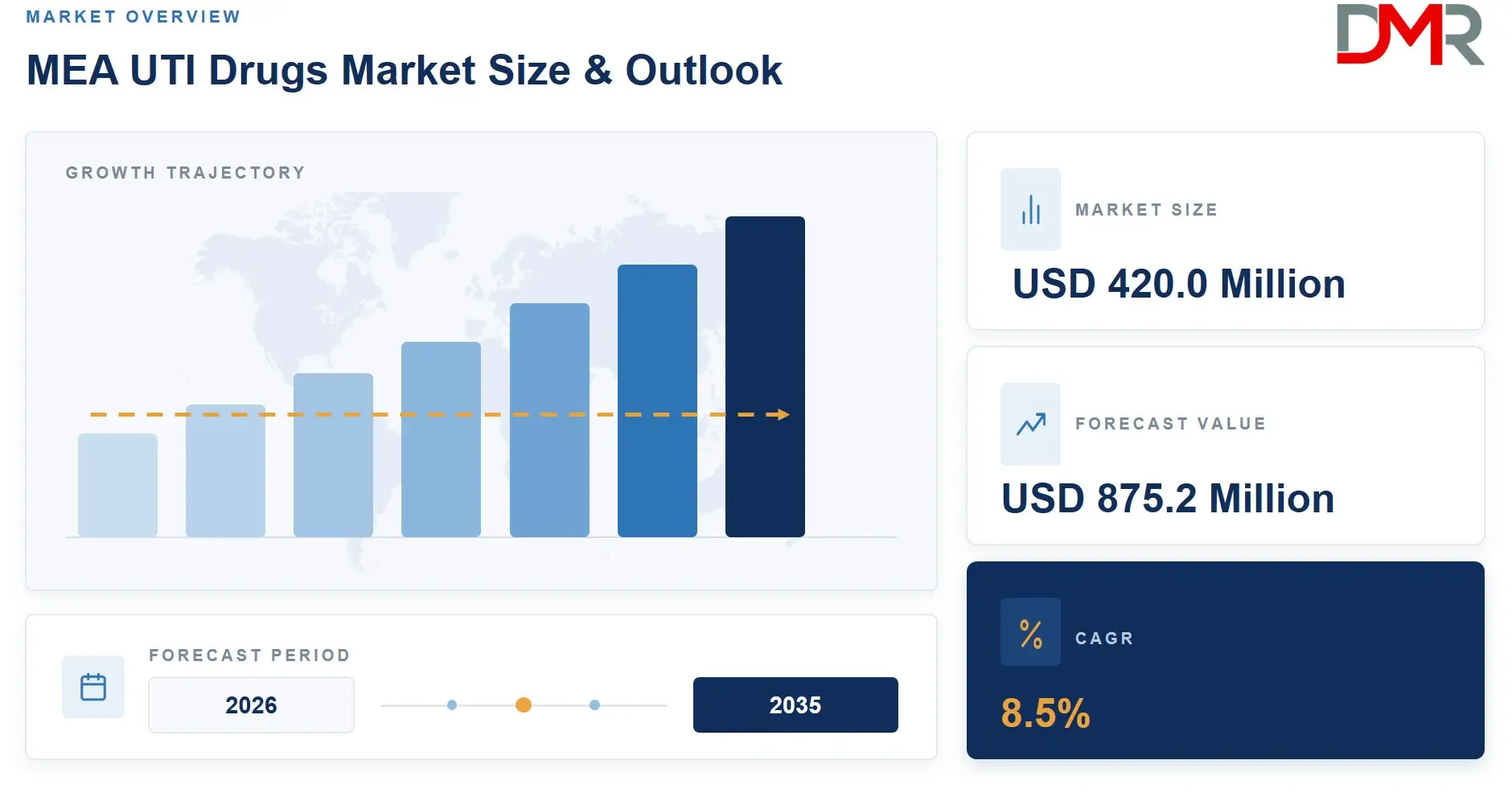
- Market Size (2026): USD 420.0 Mn
- Forecast Value (2035): USD 875.2 Mn
- CAGR (2026-2035): 8.5%
- Leading Drug Class (2026): Fluoroquinolones, around 34%
- Leading Infection Type (2026): Uncomplicated UTI, close to 54%
- Key Players: Hikma Pharmaceuticals, Pfizer, EIPICO, and others
What is MEA UTI Drugs Market and its Market Size?
The MEA UTI Drugs Market size is estimated to reach USD 420.0 Mn in 2026 and is further anticipated to reach USD 875.2 Mn by 2035, at a CAGR of 8.5%.
ℹ
To learn more about this report –
Download Your Free Sample Report Here
The market covers antibacterial and adjunct pharmacotherapy prescribed for urinary tract infections across Saudi Arabia, the UAE, South Africa, and the wider Middle East and Africa geography, spanning oral and injectable antibiotics, urinary antiseptics, and analgesic adjuncts dispensed through hospital, retail, and increasingly online pharmacy channels. The figures published here describe demand consumed inside the stated geography, not the worldwide revenue of the pharmaceutical companies headquartered or operating there; a Saudi generics maker with export volumes to Europe or Asia contributes to this market only through the units it sells domestically.
Physicians treat urinary tract infections empirically in most primary care settings across the region, with fluoroquinolones and nitrofurantoin remaining first-line choices even as rising resistance rates push prescribers toward newer beta-lactam and beta-lactamase inhibitor combinations for complicated presentations. Buyers span public health ministries procuring through centralized tenders, private hospital networks, and a fast-growing retail and e-pharmacy segment serving a young, urbanizing population with high antibiotic self-medication rates in several markets.
What is structurally changing is the interaction between antimicrobial resistance surveillance, local manufacturing policy, and prescribing behavior. Gulf regulators are tightening antibiotic stewardship requirements at the same time several governments are pushing pharmaceutical localization mandates, which is reshaping where UTI drugs are formulated and how quickly newer combination therapies reach public formularies.
Use Cases
- Primary Care Empiric Prescribing: General practitioners and family medicine clinics across urban Gulf centers prescribe short-course oral antibiotics for uncomplicated cystitis in adult women, relying on national treatment guidelines that favor nitrofurantoin or fluoroquinolones as first-line therapy before culture results return.
- Hospital Management of Complicated Infections: Tertiary hospitals in Saudi Arabia and South Africa administer injectable beta-lactam and beta-lactamase inhibitor combinations to patients with pyelonephritis, sepsis risk, or catheter-associated infections, where intravenous dosing and inpatient monitoring are required.
- Recurrent Infection Management in Older Adults: Urology and geriatric clinics manage recurrent UTIs in older patients through prophylactic low-dose antibiotic regimens combined with adjunct urinary analgesics, a use case growing alongside the region's aging population and higher comorbidity burden.
- Retail and Digital Pharmacy Dispensing: Community and online pharmacies in the UAE and Saudi Arabia fill a rising share of UTI prescriptions directly to consumers, a channel expanding fastest among younger, digitally native patients accounting for approximately 14% of 2026 distribution.
Key Takeaways
- Market Size and Share: The market is estimated at USD 420.0 Mn in 2026, expanding at a CAGR of 8.5% through 2035.
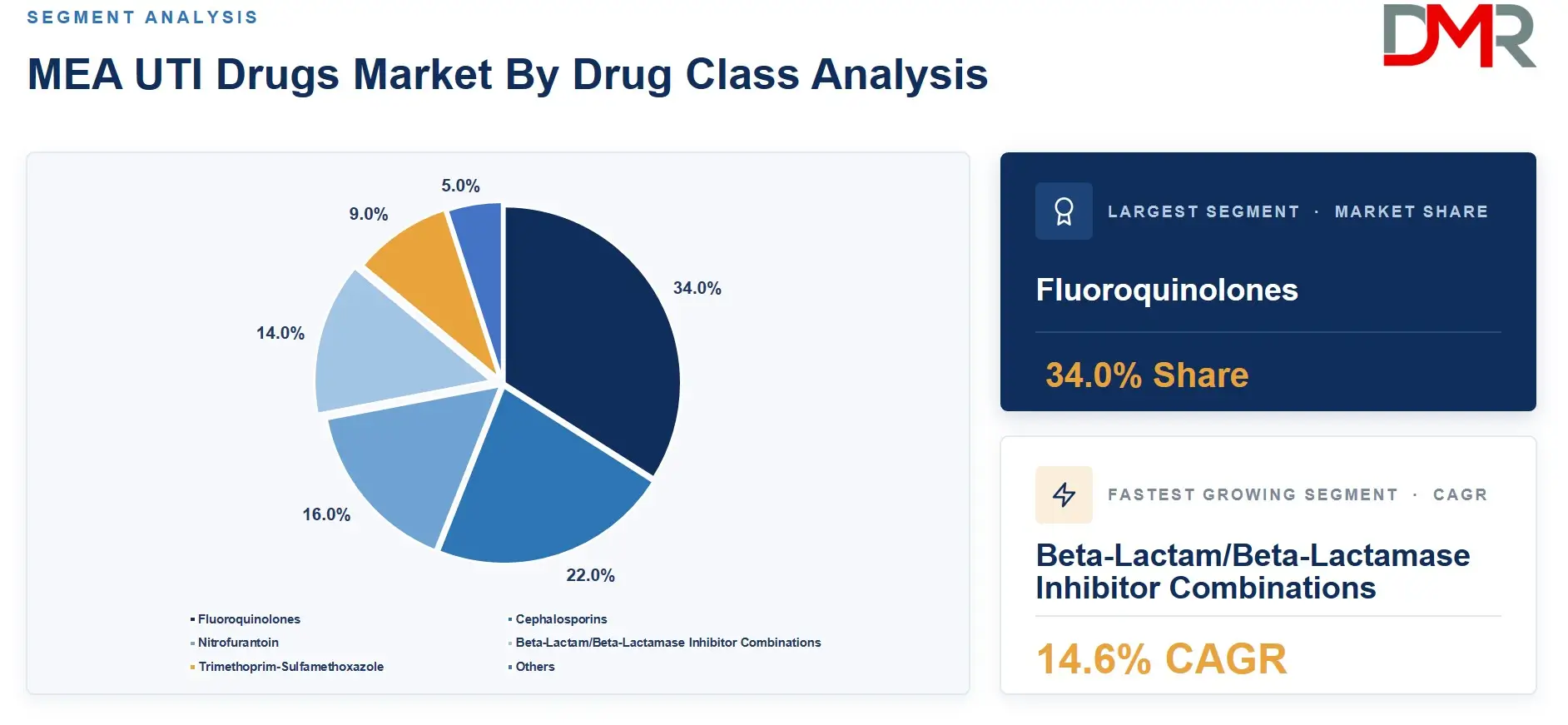
- Drug Class Analysis: Fluoroquinolones are expected to remain the leading drug class in 2026, accounting for approximately 34% of revenue.
- Demand Concentration: Saudi Arabia is expected to anchor the largest share of regional demand, with Egypt and South Africa forming the next-largest pockets of consumption.
- Resistance-Driven Substitution: Beta-Lactam/Beta-Lactamase Inhibitor Combinations are projected to post the fastest sub-segment CAGR at 14.6% through 2035 as resistance narrows the utility of older agents.
- Channel Shift: Online pharmacy dispensing is set to grow fastest among distribution channels at a CAGR of 18.2% between 2026 and 2035.
How AI/Gen AI is Transforming the MEA UTI Drugs Market?
Artificial intelligence adoption in this market is concentrated on operational and surveillance tasks rather than drug discovery. Regional health authorities and hospital networks are piloting machine learning tools to track resistance patterns across laboratory networks, flag inappropriate empiric prescribing, and forecast antibiotic demand for centralized procurement, rather than deploying generative models to design new molecules.
The more visible shift is in supply chain and pharmacy operations, where predictive demand forecasting reduces stockouts of essential antibiotics across public formularies and distributors use pattern recognition to detect counterfeit or substandard stock entering the supply chain. Clinical decision support tools embedded in hospital information systems are also becoming more common, nudging prescribers toward narrower-spectrum agents when local resistance data supports it.
- Resistance Surveillance Analytics: Machine learning models aggregate laboratory culture and sensitivity data to map real-time resistance trends by region and pathogen.
- Demand Forecasting for Procurement: Predictive models support ministries of health and hospital groups in sizing centralized antibiotic tenders more accurately.
- Clinical Decision Support: Rules-based and machine learning tools embedded in prescribing systems recommend narrower-spectrum agents based on local antibiogram data.
- Counterfeit Detection: Computer vision and track-and-trace analytics help distributors and regulators identify substandard or diverted antibiotic stock.
Key Drivers in the MEA UTI Drugs Market
Two structural forces are pushing demand for UTI pharmacotherapy higher across the region.
- Rising Prevalence Linked to Diabetes and Urbanization: The region's growing burden of diabetes and metabolic disease raises susceptibility to recurrent and complicated urinary tract infections, since impaired immune response and glycosuria both favor bacterial colonization. Urbanization is compounding this by concentrating populations in cities with higher rates of catheterization, hospital-acquired infection exposure, and sedentary lifestyles linked to metabolic risk. Saudi Arabia and the UAE, both carrying diabetes prevalence well above the worldwide average, are seeing hospitals report a steady rise in complicated UTI admissions tied to comorbid metabolic disease, which sustains demand for injectable and combination antibiotic therapy well beyond simple outpatient treatment volumes.
- Government-Backed Antimicrobial Stewardship and Access Programs: National health authorities in Saudi Arabia, the UAE, and South Africa have expanded public formulary access to newer antibiotic classes as part of antimicrobial resistance action plans, widening the pool of patients who can access beta-lactam and beta-lactamase inhibitor combinations rather than defaulting to older, increasingly resistant agents. These programs pair expanded access with stewardship audits, which paradoxically increases prescribing of the correct combination therapy even as it curbs blanket antibiotic use, because clinicians are guided toward effective regimens rather than broad discretion. The net effect over the forecast period is a shift in prescribing mix toward higher-value combination products rather than a simple volume increase.
Restraints in the MEA UTI Drugs Market
Two genuine brakes temper the pace of expansion.
- Centralized Procurement Pricing Pressure: Public health systems across the Gulf and South Africa rely heavily on centralized tendering, which compresses per-unit pricing for generic antibiotics and squeezes margins for manufacturers competing on cost rather than differentiation. Tender cycles also introduce demand lumpiness, since large multi-year contract awards can concentrate volume with a small number of suppliers and leave others without predictable revenue between award cycles. This pricing discipline keeps headline revenue growth below what unit volume alone would suggest, particularly in the largest drug classes where multiple generic manufacturers compete for the same tender.
- Antimicrobial Resistance Eroding Established Agents: Rising resistance to fluoroquinolones and trimethoprim-sulfamethoxazole, the two most established and lowest-cost drug classes in the market, is forcing a shift toward newer, more expensive combination therapies that are not yet universally reimbursed or stocked at the primary care level. This creates a treatment gap in lower-income segments of the population, where patients may receive an agent likely to fail rather than the appropriate, costlier alternative, and it slows aggregate revenue growth in the near term even as it eventually favors higher-value products once access catches up. Supply-chain concentration in active pharmaceutical ingredient sourcing, much of it imported from outside the region, adds a further layer of cost and availability risk to this transition.
Growth Opportunities in the MEA UTI Drugs Market
The clearest white space sits at the intersection of local manufacturing and channel expansion.
- Local API and Finished-Dose Manufacturing Localization: Saudi Arabia and Egypt are actively incentivizing domestic active pharmaceutical ingredient production and finished-dose manufacturing for essential antibiotic classes, reducing import dependence and positioning locally based manufacturers to win a larger share of public tenders. Companies that establish sterile injectable or biologics-adjacent manufacturing capacity inside the region stand to capture both the cost advantage of local production and preferential treatment in national procurement scoring, a combination that is opening genuine share-gain opportunities for regional players against multinational importers.
- Online and Retail Pharmacy Channel Expansion: Digital pharmacy platforms are scaling quickly in the UAE and Saudi Arabia, giving branded and generic UTI drug manufacturers a direct-to-consumer channel that bypasses some of the pricing pressure inherent in hospital and centralized tender channels. This channel favors convenience-oriented packaging, faster delivery of short-course therapies, and stronger brand visibility at the point of online search, creating a commercial opening for manufacturers willing to invest in digital distribution partnerships rather than relying solely on traditional wholesale networks.
Trends in the MEA UTI Drugs Market
Two shifts are visibly reshaping how the market behaves today, distinct from the structural drivers above.
- Shift Toward Shorter, Higher-Compliance Dosing Regimens: Prescribers across the region are increasingly favoring shorter-course, higher-dose regimens over traditional multi-day courses, driven by evidence that shorter courses improve patient adherence without compromising cure rates for uncomplicated infections. Pharmaceutical manufacturers are responding with reformulated dosing strengths and packaging tailored to these shorter regimens, a trend that is subtly changing unit economics since fewer tablets per prescription can be priced at a premium per unit even as total prescription revenue holds steady.
- Consolidation Among Regional Generic Manufacturers: Mid-sized generic manufacturers across Saudi Arabia, the UAE, and Egypt are pursuing partnerships and capacity-sharing arrangements to compete more effectively in centralized tenders that increasingly favor suppliers who can guarantee large, consistent volumes. This consolidation trend is gradually narrowing the number of credible domestic suppliers able to bid competitively on major public contracts, concentrating tender wins among a smaller set of scaled regional players.
Research Scope and Analysis
Segment performance is assessed across five axes: drug class, route of administration, infection type, distribution channel, and end user, identifying where 2026 revenue concentrates and which sub-segments are expanding fastest through 2035.
ℹ
To learn more about this report –
Download Your Free Sample Report Here
By Drug Class
Fluoroquinolones are projected to hold the largest share by drug class in 2026, accounting for around 34% of revenue, reflecting their entrenched position as a broad-spectrum, low-cost first-line option stocked across virtually every public and private formulary in the region. Growth, however, is concentrated in Beta-Lactam/Beta-Lactamase Inhibitor Combinations, expanding at a CAGR of 14.6% between 2026 and 2035 as rising fluoroquinolone resistance pushes prescribers and procurement bodies toward these newer combination agents for complicated and hospital-acquired infections, a shift reinforced by expanding public formulary access under national antimicrobial stewardship programs.
By Route of Administration
Oral therapy is expected to remain the largest route of administration in 2026, holding close to 68% of revenue, since the overwhelming majority of uncomplicated infections are managed in outpatient settings where oral dosing is clinically sufficient and far less costly than inpatient care. The steeper trajectory sits with injectable and parenteral therapy, forecast to grow at a CAGR of 12.4% through 2035 as rising rates of complicated and hospital-acquired infection push more patients into inpatient settings requiring intravenous antibiotic administration, particularly among older adults with comorbid conditions.
By Infection Type
Uncomplicated UTI is projected to account for the largest share by infection type in 2026, at approximately 54% of revenue, consistent with its status as the most common presentation among otherwise healthy adult women across the region. Recurrent UTI shows the fastest growth, at a CAGR of 13.8% between 2026 and 2035, pulled by an aging population, rising diabetes prevalence, and growing clinical recognition that recurrent cases warrant structured prophylactic management rather than repeated one-off treatment courses.
By Distribution Channel
Retail pharmacies are expected to lead distribution channel share in 2026 at around 46% of revenue, anchored by their role as the first point of access for most outpatient antibiotic prescriptions across urban and semi-urban centers alike. Online pharmacies are growing fastest, projected at a CAGR of 18.2% through 2035, as digital health platforms in the UAE and Saudi Arabia scale rapidly and younger, tech-comfortable patients increasingly prefer ordering short-course antibiotic therapy for home delivery over an in-person pharmacy visit.
By End User
Adult women are expected to remain the largest end-user segment in 2026, accounting for close to 58% of revenue, reflecting the well-documented higher incidence of urinary tract infection in women across all age groups in the region. Growth is fastest among geriatric patients, forecast at a CAGR of 15.4% between 2026 and 2035, driven by the region's aging population and the higher rate of complicated, recurrent, and catheter-associated infection among older adults with reduced mobility and comorbid chronic disease.
The MEA UTI Drugs Market Report is Segmented Based on the following
By Drug Class
- Fluoroquinolones
- Cephalosporins
- Nitrofurantoin
- Beta-Lactam/Beta-Lactamase Inhibitor Combinations
- Trimethoprim-Sulfamethoxazole
- Others
By Route of Administration
- Oral
- Injectable/Parenteral
- Topical/Intravesical
- Others
By Infection Type
- Uncomplicated UTI
- Complicated UTI
- Recurrent UTI
- Catheter-Associated UTI
By Distribution Channel
- Retail Pharmacies
- Hospital Pharmacies
- Online Pharmacies
- Others
By End User
- Adult Women
- Adult Men
- Pediatric
- Geriatric
Regulatory Landscape
Antibiotic dispensing across the region is governed by a mix of national drug authorities, chiefly the Saudi Food and Drug Authority, South Africa's health products regulator, and the UAE's Ministry of Health and Prevention, each tightening prescription-only status enforcement for antibiotics that were historically available over the counter. What is shifting now is a coordinated push toward antimicrobial stewardship reporting requirements at the hospital level, alongside faster registration pathways for newer combination agents once resistance data justifies formulary inclusion. The commercial opening lies with manufacturers able to navigate expedited registration for resistance-relevant combination therapies ahead of competitors still filing through standard timelines. The principal risk is regulatory fragmentation, since registration and stewardship requirements differ meaningfully between Gulf states and North and Southern Africa, forcing manufacturers to run separate compliance tracks that slow simultaneous regional launches and raise the cost of market entry for smaller suppliers.
Epidemiology
Urinary tract infection remains one of the most common bacterial infections diagnosed in outpatient settings across the region, with adult women bearing the largest share of cases and diabetes prevalence acting as a significant comorbid risk multiplier in several Gulf states. What is shifting now is the epidemiological profile itself, as rising life expectancy and diabetes incidence push a growing share of cases into the complicated and recurrent categories rather than simple uncomplicated presentations. The commercial opening this creates is for therapies and diagnostics tailored to comorbid, resistant, and recurrent presentations rather than first-line uncomplicated treatment alone. The risk is that resistance surveillance infrastructure remains uneven across the region, meaning some markets still lack the local antibiogram data needed to guide optimal empiric prescribing, which can leave patients on regimens more likely to fail and slow the shift toward the combination therapies epidemiological trends otherwise favor.
Competitive Landscape
The market is moderately fragmented, with multinational generics majors, regional pharmaceutical manufacturers, and a smaller tier of antibiotic-focused specialty players all competing primarily on tender pricing, formulary access, and local manufacturing presence. Competition centers on winning centralized public procurement contracts in Saudi Arabia and the UAE, where price and supply reliability outweigh brand differentiation, while private hospital and retail channels reward faster registration of newer combination therapies and stronger distributor relationships. Regional manufacturers with local finished-dose or API capacity hold a structural cost and procurement-scoring advantage over pure importers, a dynamic that is gradually reshaping market share toward companies investing in domestic production.
Some of the Prominent Players in the MEA UTI Drugs Market Are
- Pfizer
- GSK
- Sanofi
- Bayer
- Viatris
- Teva Pharmaceutical Industries
- Sandoz
- Cipla
- Sun Pharmaceutical Industries
- Lupin
- Wockhardt
- Aurobindo Pharma
- Zydus Lifesciences
- Dr. Reddy's Laboratories
- Torrent Pharmaceuticals
- Alkem Laboratories
- Glenmark Pharmaceuticals
- Macleods Pharmaceuticals
- Micro Labs
- Innoviva
- Spero Therapeutics
- Paratek Pharmaceuticals
- Iterum Therapeutics
- Venatorx Pharmaceuticals
- Utility Therapeutics
- Fresenius Kabi
- Julphar
- SPIMACO
- Tabuk Pharmaceuticals
- Jamjoom Pharma
- NeoPharma
- Aspen Pharmacare
- Adcock Ingram
- Pharco Pharmaceuticals
- EIPICO
- EVA Pharma
- Amoun Pharmaceutical
- Marcyrl Pharmaceutical Industries
- Hikma Pharmaceuticals
- Nahdi Medical Company
- Other Key Players
Recent Developments
- In July 2026, EIPICO opened a new sterile and biologics manufacturing plant in Egypt, expanding domestic capacity for injectable antibiotic production relevant to complicated UTI treatment.
- In May 2026, a Saudi retrospective study on pediatric UTI antimicrobial resistance patterns was published, prompting several children's hospitals to review empiric prescribing protocols.
- In January 2026, Arab API began construction on a USD 165 million active pharmaceutical ingredient localization facility aimed at reducing the region's reliance on imported antibiotic APIs.
- In December 2025, researchers in Al-Baha, Saudi Arabia published a study on antimicrobial resistance among UTI patients with renal comorbidities, informing updated regional treatment guidance.
- In November 2025, Julphar signed an AED 300 million lease for a new biologics and sterile manufacturing facility in Jeddah, expanding its footprint for injectable therapies.
Report Details
| Report Characteristics |
| Market Size (2026) |
USD 420.0 Mn |
| Forecast Value (2035) |
USD 875.1 Mn |
| CAGR (2026-2035) |
8.5% |
| Historical Data |
2021 - 2025 |
| Forecast Data |
2026 - 2035 |
| Base Year |
2025 |
| Segments Covered |
By Drug Class, By Route of Administration, By Infection Type, By Distribution Channel, and By End User |
| Regional Coverage |
Middle East & Africa - Saudi Arabia, The UAE, South Africa, Rest of MEA |