Network Slice as a Service Market Snapshot
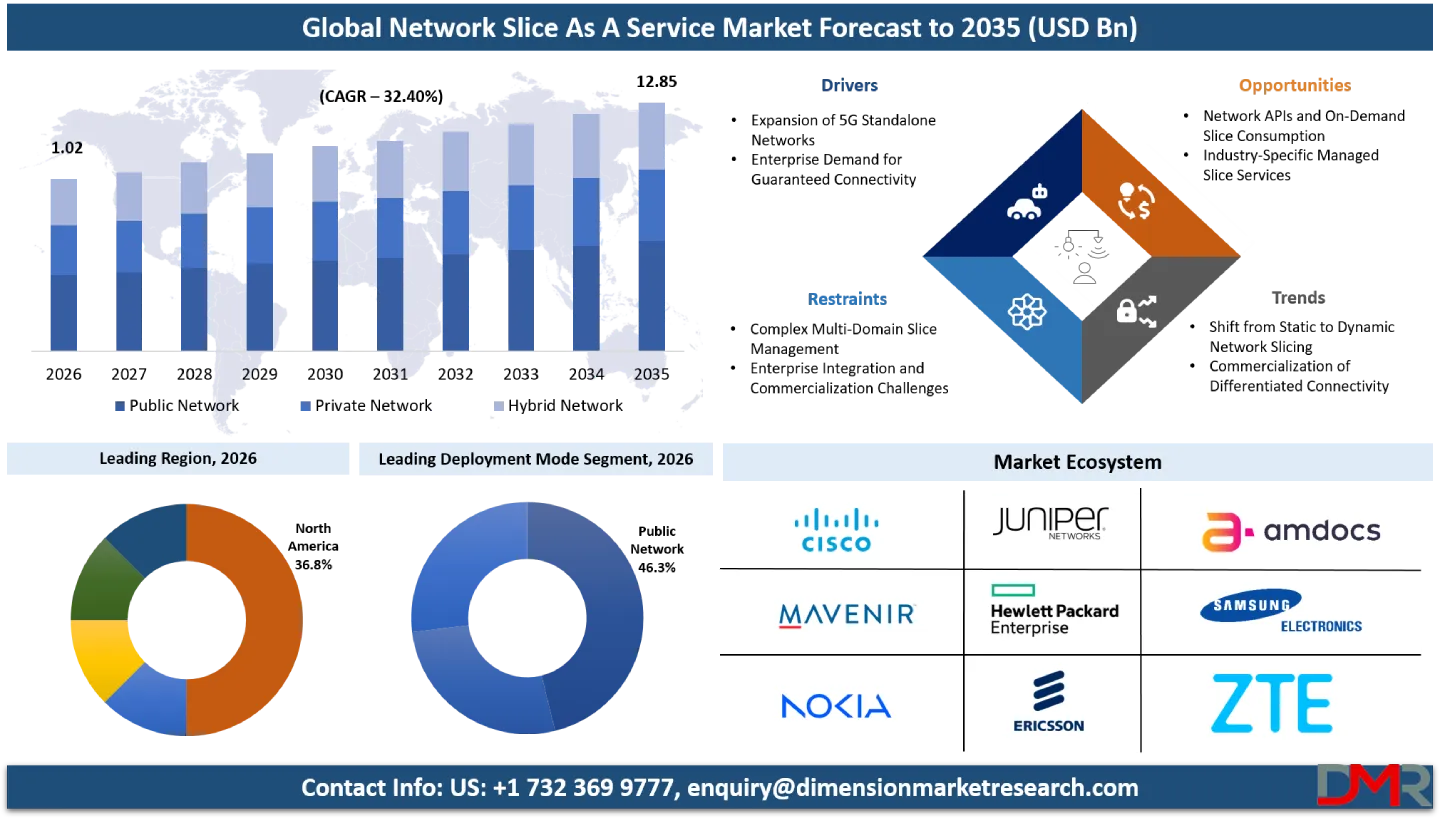
- Market Value: The global Network Slice as a Service market is expected to reach USD 13,847.6 million by 2035 from USD 712.4 million in 2026, at a CAGR of 38.7%.
- By Service Segment Analysis: EMBB Slice as a Service segment dominated with 34.2% share in 2026.
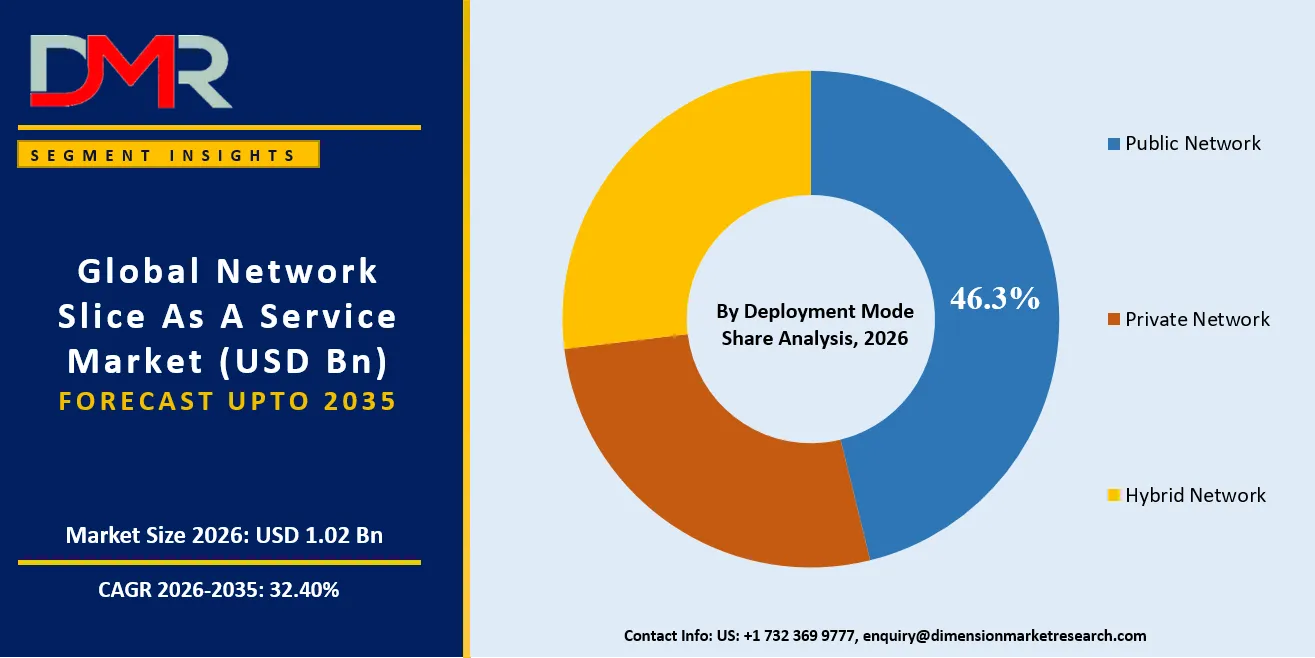
- By Deployment Mode Segment Analysis: Public Network Slice led deployment modes with 46.3% share in 2026.
- By Application Segment Analysis: Industrial IoT held the largest application share at 27.4% in 2026.
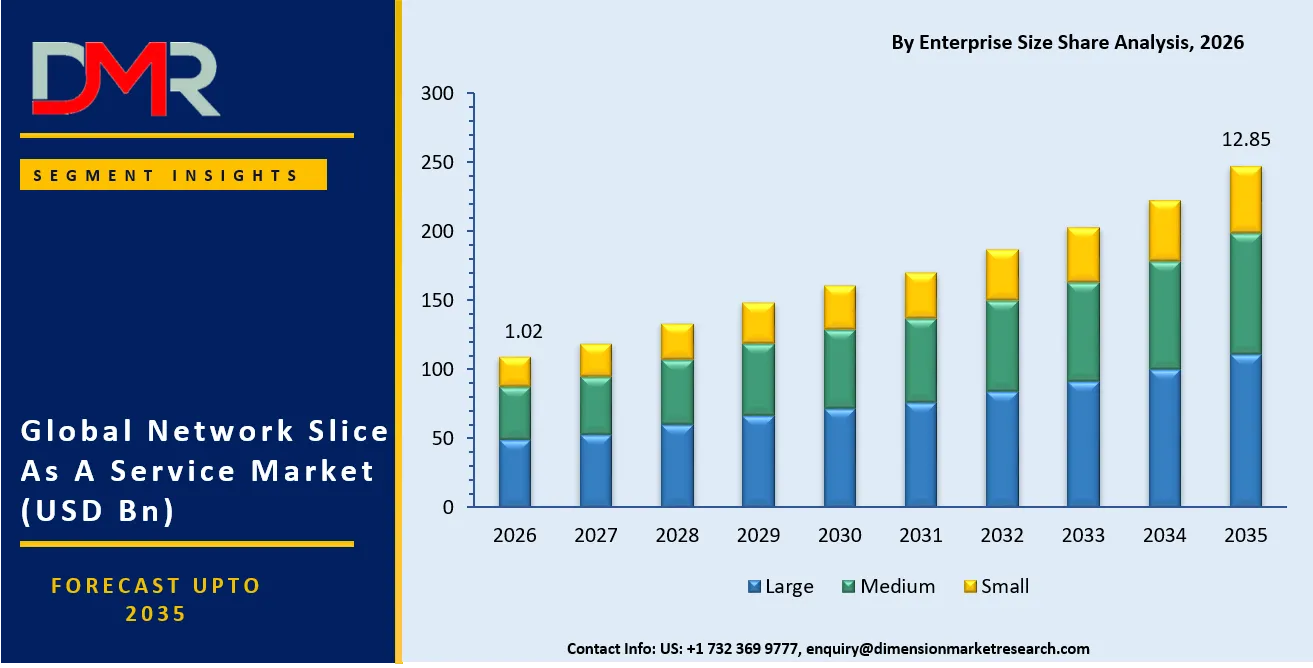
- By Enterprise Size Segment Analysis: Large Enterprises accounted for 58.7% of market revenue in 2026.
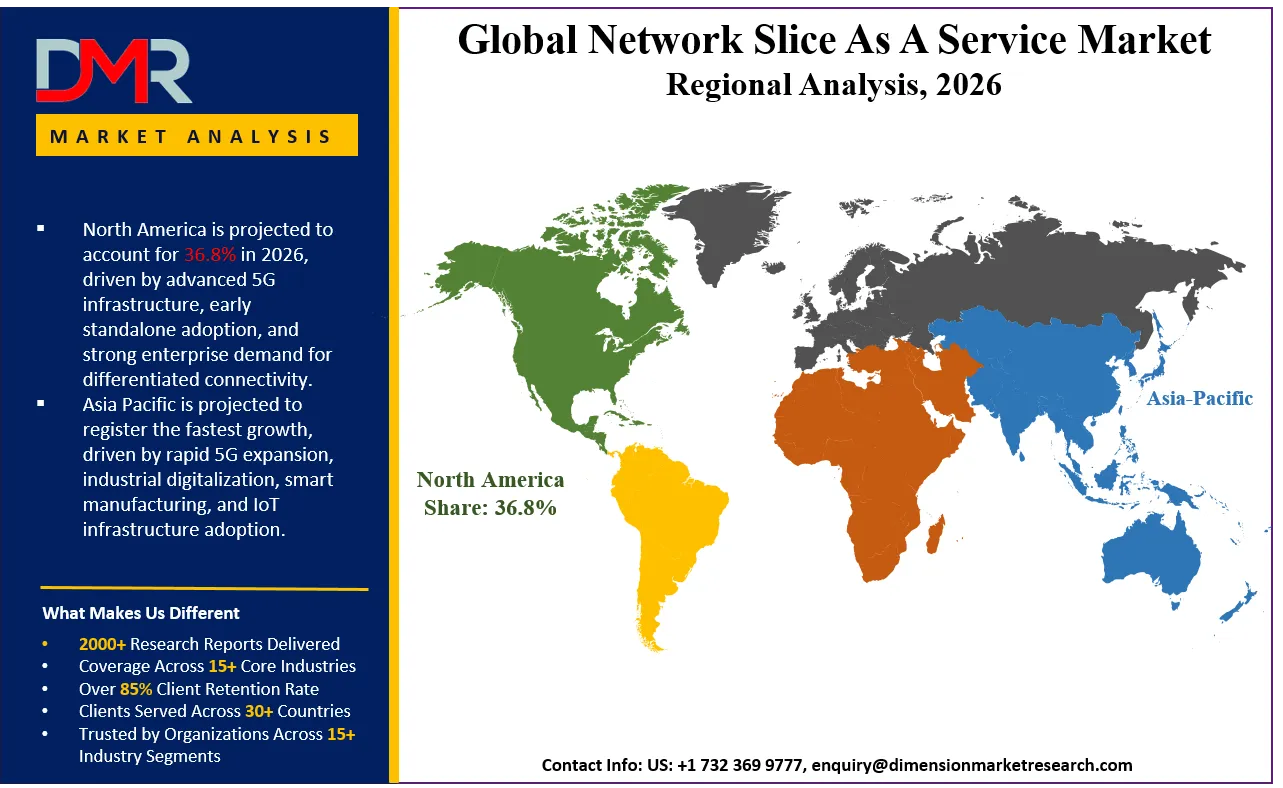
- Regional Analysis: North America led the global Network Slice as a Service market with 36.8% revenue share in 2026.
- Major Players: Juniper Networks, Inc., Samsung Electronics Co., Ltd., Amdocs Limited, Ericsson, ZTE Corporation and Others
What is the Global Network Slice as a Service Market and its Market Size?
The Global Network Slice as a Service market size is projected to be valued at USD 712.4 million in 2026 and is projected to reach USD 13,847.6 million by 2035, expanding at a strong CAGR of 38.7% during the forecast period. Network Slice as a Service, also referred to as NSaaS, allows telecom operators and enterprises to obtain dedicated logical network resources with defined bandwidth, latency, reliability, security, and quality-of-service requirements without building an entirely separate physical network.
ℹ
To learn more about this report –
Download Your Free Sample Report Here
The growth of the market is driven by wider deployment of 5G Standalone infrastructure, cloud-native telecom cores, software-defined networking, network function virtualization, edge computing, and automated service orchestration. A network slice can include resources across radio access, core, and transport network domains, allowing operators to support different services over common infrastructure while maintaining distinct performance characteristics. This model is gaining commercial importance as businesses seek predictable connectivity for industrial automation, private enterprise applications, video services, connected transportation, healthcare, and mission-critical communications.
Use Cases
- Industrial Automation: Network Slice as a Service provides factories with dedicated connectivity for robots, sensors, machine vision, automated guided vehicles, and production systems. Enterprises can obtain predictable latency and service quality while using shared mobile infrastructure, improving the business case for connected manufacturing and Industrial IoT.
- Immersive Media and eMBB: Enhanced Mobile Broadband slices can allocate high-capacity network resources to applications such as 4K and 8K video, live broadcasting, augmented reality, cloud gaming, and extended reality. The model enables service providers to offer differentiated connectivity rather than relying only on conventional best-effort mobile broadband.
- Connected Transportation: Dedicated slices can support connected vehicles, fleet management, smart ports, airports, logistics hubs, and transportation monitoring systems. Different connectivity profiles can be assigned to operational data, passenger applications, video feeds, tracking systems, and safety-related communication.
- Healthcare Connectivity: Hospitals and healthcare organizations can use network slices for connected medical equipment, high-resolution imaging, remote consultation, ambulance connectivity, and campus communication. Controlled service characteristics support applications where network congestion or unpredictable performance could reduce operational efficiency.
- Enterprise Private Services: Businesses can use public or hybrid network slices to obtain enterprise-grade mobile connectivity without owning a complete private cellular network. This creates opportunities for managed connectivity packages covering offices, campuses, warehouses, retail sites, utilities, construction sites, and distributed business operations.
How AI/Gen AI is Transforming the Network Slice as a Service Market?
Artificial intelligence is strengthening Network Slice as a Service operations by improving demand prediction, capacity allocation, anomaly detection, assurance, and automated network optimization. A service provider can analyze traffic volumes, application behavior, device density, latency, and quality indicators to adjust slice resources more dynamically. This reduces dependence on manual configuration and supports service-level commitments across large numbers of enterprise customers. AI-assisted orchestration is particularly relevant when slices extend across radio, transport, core, cloud, and edge environments, where changing one resource may influence overall application performance.
Generative AI can further improve operational workflows by helping network teams interpret alarms, summarize service incidents, generate configuration recommendations, and provide natural-language interfaces for network management systems. Over time, these tools could make slice ordering and lifecycle management more accessible to enterprise customers. A business could define required coverage, latency, throughput, device volume, or application priority, while orchestration platforms translate those requirements into network policies. AI-based capabilities are also becoming more closely associated with 5G Advanced network operations, where automation and enhanced network slicing support increasingly demanding enterprise applications.
Key Drivers in the Network Slice as a Service Market
Expansion of 5G Standalone Networks
Growing 5G Standalone adoption is a major driver of Network Slice as a Service demand because SA architecture provides the cloud-native 5G core capabilities needed for advanced slice creation, management, policy control, and service differentiation. Commercial slicing offerings are expanding as operators move beyond basic 5G coverage toward programmable connectivity services. Ericsson reported that global 5G subscriptions passed three billion during the first quarter of 2026 and noted continued growth in commercial 5G SA network slicing offerings. This transition creates a larger addressable base for enterprise NSaaS services.
Enterprise Demand for Guaranteed Connectivity
Enterprises increasingly depend on wireless networks for automation, IoT devices, cloud applications, video, mobile workforces, and operational technology. Conventional best-effort connectivity cannot always deliver the predictable performance required by business-critical workloads. NSaaS enables operators to offer differentiated service levels using common infrastructure, creating a more flexible alternative to dedicated networks in suitable use cases. The ability to tailor network performance according to application requirements strengthens demand from manufacturing, logistics, healthcare, energy, media, and transportation companies.
Restraints in the Network Slice as a Service Market
Complex Multi-Domain Slice Management
Operational complexity remains a key restraint for Network Slice as a Service market adoption. End-to-end slices may require coordination between radio access networks, transport systems, 5G core functions, cloud infrastructure, edge computing resources, security tools, and service assurance platforms. Maintaining consistent service levels across these domains can be difficult in multivendor environments. Operators also need mature lifecycle automation covering slice design, provisioning, monitoring, scaling, modification, and termination before large numbers of enterprise slices can be managed profitably.
Enterprise Integration and Commercialization Challenges
Technical availability alone does not guarantee NSaaS adoption. Enterprises need clear service-level agreements, compatible devices, application integration, transparent pricing, security policies, coverage assurance, and measurable business benefits. Operators must also determine how slices should be packaged and sold across industries with very different connectivity requirements. Lengthy enterprise procurement cycles and uncertain returns from early use cases can slow investment. These challenges make strong ecosystem partnerships and repeatable industry-specific service packages important for wider market expansion.
Growth Opportunities in the Network Slice as a Service Market
Network APIs and On-Demand Slice Consumption
Programmable network APIs create an important growth opportunity by allowing applications and enterprise platforms to request differentiated network capabilities more directly. API-based models could simplify ordering, activation, modification, and billing for network slices while reducing manual interaction with telecom systems. Enterprises may eventually consume premium connectivity in a way that resembles cloud infrastructure services, selecting performance levels according to workload requirements. This model can expand the Network Slice as a Service market by connecting telecom capabilities with application developers and digital platforms.
Industry-Specific Managed Slice Services
Vertical-specific NSaaS offerings represent a major opportunity for telecom operators and technology vendors. Manufacturing customers may prioritize deterministic performance and machine connectivity, while media companies require uplink capacity and healthcare organizations may emphasize reliability and security. Packaging slices with edge computing, cybersecurity, device management, analytics, and application support can create higher-value managed services. Ericsson identifies remote broadcasting, cloud gaming, and campus services among early commercial network slicing use cases, illustrating the widening revenue opportunity.
Trends in the Global Network Slice as a Service Market
Shift from Static to Dynamic Network Slicing
The Network Slice as a Service market trend is moving toward increasingly dynamic service creation and resource management. Earlier implementations often relied on predefined configurations, while newer platforms are designed to adjust resources according to traffic, application priority, location, and service-level requirements. Automation reduces provisioning time and can improve infrastructure utilization. Dynamic slicing also supports event-driven and temporary use cases, including live broadcasts, sports venues, emergency operations, enterprise events, and short-term industrial projects where premium connectivity is needed only for a defined period.
Commercialization of Differentiated Connectivity
Telecom operators are moving from technology trials toward commercial models based on differentiated connectivity. Network slicing allows providers to position connectivity according to business value rather than selling only generic bandwidth. Premium services may combine guaranteed performance, priority access, security, edge processing, application awareness, or geographic coverage. Commercial deployments are already demonstrating practical slicing over 5G Standalone networks, including video communication use cases. This trend supports new pricing models and strengthens the long-term Network Slice as a Service market outlook.
Research Scope and Analysis
The Network Slice as a Service market is segmented based on Service, Deployment Mode, Application, Enterprise Size, and other relevant categories. The study provides an in-depth analysis of key segments and sub-segments, covering their applications, industry adoption, demand patterns, and contribution to overall market growth.
ℹ
To learn more about this report –
Download Your Free Sample Report Here
By Service;
EMBB Slice as a Service dominated the service segment with 34.2% of market revenue in 2026. Enhanced Mobile Broadband slices address applications requiring high throughput and dependable data capacity, making the category relevant to enterprise video, immersive media, cloud applications, live production, augmented reality, large-file transfer, and high-density mobile environments. Its leadership reflects the immediate commercial value of improving broadband performance using programmable network resources. As 5G SA coverage expands, eMBB slices can evolve from general premium broadband into application-specific connectivity packages. Future opportunities include broadcast production, venues, cloud gaming, enterprise collaboration, retail experiences, and high-capacity temporary connectivity, supporting the segment's contribution to Network Slice as a Service market growth.
By Application;
Industrial IoT held the largest application share at 27.4% in 2026, reflecting strong demand for reliable wireless connectivity across factories, warehouses, ports, utilities, mining operations, and other industrial environments. Industrial organizations are connecting growing numbers of sensors, machines, cameras, robots, vehicles, and control systems, but individual workloads can require very different levels of throughput, latency, reliability, and security. Network slicing enables these requirements to be separated logically over common infrastructure. As manufacturers increase automation and edge computing adoption, NSaaS can support machine vision, predictive maintenance, asset monitoring, autonomous material handling, and real-time production systems without treating every device as a conventional broadband endpoint.
ℹ
To learn more about this report –
Download Your Free Sample Report Here
By Deployment Mode;
Public Network Slice led deployment modes with a 46.3% market share in 2026. The segment benefits from the ability of mobile operators to provide differentiated services through existing wide-area public infrastructure. This approach can reduce the need for individual enterprises to deploy and manage complete private cellular systems while still allowing specific applications or users to receive tailored service characteristics. Public slices are particularly suited to organizations with distributed assets, mobile workforces, transportation operations, logistics routes, healthcare teams, utilities, and multi-site businesses. Operator investment in 5G core modernization, orchestration, assurance, and exposure platforms is expected to improve public slicing capabilities and create scalable recurring-service opportunities throughout the forecast period.
By Enterprise Size;
Large Enterprises accounted for 58.7% of Network Slice as a Service market revenue in 2026. Large organizations are generally better positioned to adopt advanced connectivity services because they operate complex digital infrastructure, distributed facilities, large device estates, and business-critical applications. Their requirements can justify premium service-level agreements and customized network configurations across manufacturing sites, campuses, supply chains, transportation assets, and customer-facing operations. Large enterprises also have greater resources for integrating slicing with cloud, cybersecurity, IoT, and edge platforms. As commercial models mature, adoption is expected to broaden toward medium-sized organizations through standardized managed packages that reduce integration effort and upfront technical complexity.
The Network Slice As A Service Market Report is segmented on the basis of the following:
By Service
- MMTC (Massive Machine-Type Communications) Slice as a Service
- Private/Customized Network Slice as a Service
- EMBB (Enhanced Mobile Broadband) Slice as a Service
- URLLC (Ultra-Reliable Low-Latency Communication) Slice as a Service
By Deployment Mode
- Hybrid Network Slice
- Private Network Slice
- Public Network Slice
By Application
- AR/VR
- Industrial IoT
- Smart Cities
- Autonomous Vehicles
- Smart Manufacturing
By Enterprise Size
- Small Enterprises
- Medium Enterprises
- Large Enterprises
Regional Analysis
North America is the Leading Region in the Network Slice as a Service Market
North America led the global Network Slice as a Service market with a 36.8% revenue share in 2026, supported by advanced 5G infrastructure, early adoption of 5G Standalone networks, and strong enterprise demand for differentiated connectivity. The United States remains central to regional growth as telecom operators invest in cloud-native cores, network automation, edge computing, and programmable network services. Manufacturing, healthcare, media, logistics, utilities, and connected transportation are creating demand for slices with defined bandwidth, latency, reliability, and security requirements. The presence of major technology companies, telecom operators, cloud providers, and enterprise networking vendors also strengthens commercialization. Growing investment in network APIs, Industrial IoT, private and public 5G services, and AI-enabled network management is expected to help North America retain a strong position in the Network Slice as a Service market.
Asia Pacific is the Fastest-Growing Region in the Network Slice as a Service Market
Asia Pacific is expected to emerge as the fastest-growing region in the Network Slice as a Service market, driven by rapid 5G expansion, industrial digitalization, smart manufacturing, and increasing adoption of IoT-connected infrastructure. China, India, Japan, South Korea, Singapore, and other markets are investing in 5G Standalone networks, cloud infrastructure, edge computing, automation, and enterprise connectivity. The region's large manufacturing base creates significant opportunities for Industrial IoT slices supporting robotics, machine vision, connected equipment, predictive maintenance, and smart logistics. Telecom operators are also exploring differentiated connectivity for media, transportation, healthcare, ports, and smart cities. A large mobile subscriber base, rising data consumption, government digital infrastructure programs, and the presence of major network equipment suppliers are expected to accelerate commercial NSaaS adoption across Asia Pacific through 2035.
By Region
North America
Europe
- Germany
- France
- The U.K.
- Italy
- Spain
- Rest of Europe
Asia-Pacific
- China
- Japan
- India
- Australia
- South Korea
- Rest of APAC
Latin America
- Mexico
- Brazil
- Rest of LATAM
Middle East & Africa
- Saudi Arabia
- The UAE
- South Africa
- Rest of MEA
ℹ
To learn more about this report –
Download Your Free Sample Report Here
Major Countries Analysis
United States Network Slice as a Service Market
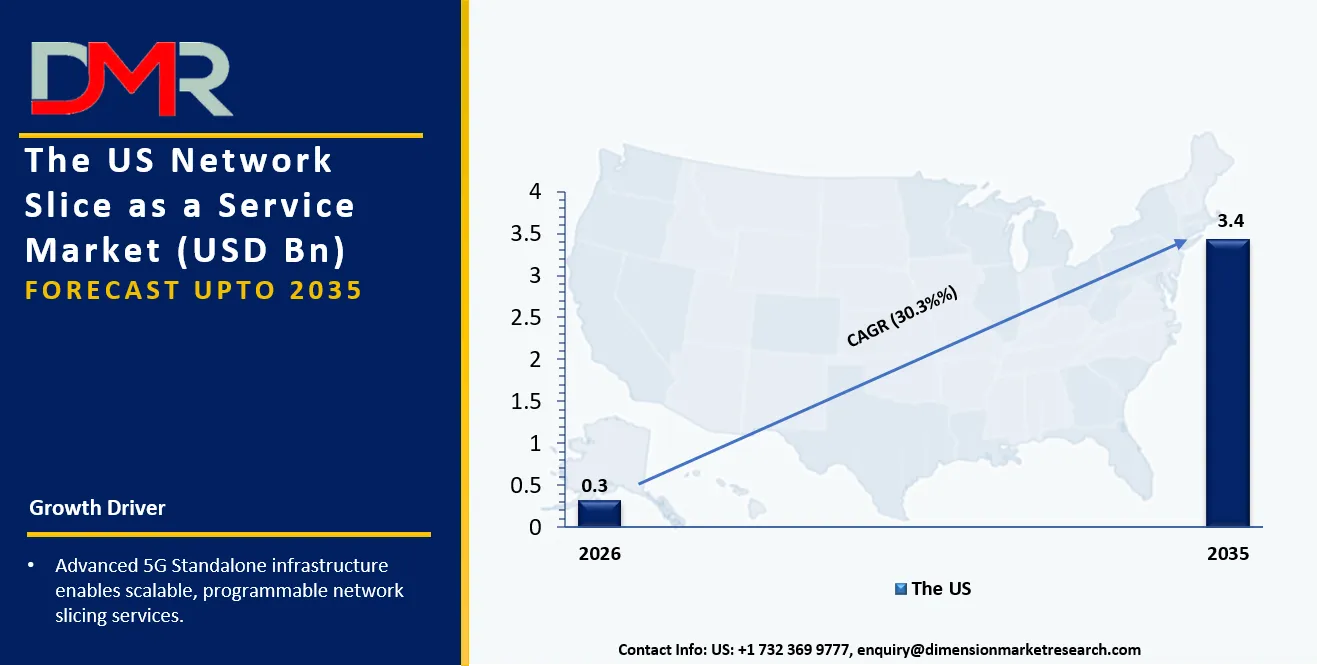
The United States represents a major country market for Network Slice as a Service, supported by advanced telecom infrastructure, enterprise cloud adoption, 5G investment, and growing demand for programmable connectivity. Telecom operators are strengthening 5G Standalone capabilities that can support differentiated service levels for enterprise and consumer applications. Manufacturing, healthcare, media and entertainment, logistics, transportation, utilities, and public services provide attractive opportunities for commercial network slicing. Enterprises are also investing in Industrial IoT, edge computing, automation, and data-intensive applications that require predictable network performance. The presence of major networking, cloud, software, and telecom technology companies supports innovation and ecosystem development. Expansion of network APIs and automated service orchestration is expected to create further opportunities for scalable NSaaS business models across the United States.
China Network Slice as a Service Market
China is an important Network Slice as a Service market due to its extensive 5G infrastructure, large manufacturing sector, strong telecom ecosystem, and continued investment in industrial digitalization. Smart factories, ports, mines, energy facilities, transportation networks, and connected urban infrastructure provide significant opportunities for dedicated network services. Industrial organizations are adopting robotics, machine vision, sensors, automated equipment, and edge computing, increasing demand for connectivity with application-specific performance characteristics. Major domestic telecom equipment companies and operators strengthen the country's ability to develop and commercialize network slicing technologies. Government support for digital infrastructure, industrial internet development, and advanced manufacturing further improves the market outlook. Continued expansion of 5G Standalone capabilities is expected to widen NSaaS opportunities in China.
India Network Slice as a Service Market
India is emerging as a high-potential Network Slice as a Service market as telecom operators expand 5G coverage and strengthen the infrastructure required for enterprise-grade digital services. Growth in manufacturing, logistics, healthcare, financial services, smart cities, utilities, and transportation is increasing demand for reliable and differentiated connectivity. India's expanding Industrial IoT ecosystem and government-backed digitalization and manufacturing initiatives create opportunities for network slices supporting factories, ports, warehouses, campuses, and critical applications. Telecom operators can use public and hybrid slicing models to provide enterprises with customized performance without requiring every organization to operate a complete private network. Continued investment in 5G Standalone, cloud infrastructure, edge computing, data centers, network automation, and domestic digital infrastructure is expected to support long-term NSaaS adoption in India.
ℹ
To learn more about this report –
Download Your Free Sample Report Here
Competitive Landscape
The Network Slice as a Service market has a competitive ecosystem spanning telecom equipment manufacturers, network software providers, service orchestration specialists, cloud infrastructure vendors, and enterprise networking companies.
Some of the prominent players in the Network Slice As A Service Industry are:
- Juniper Networks, Inc.
- Samsung Electronics Co., Ltd.
- Amdocs Limited
- Ericsson
- ZTE Corporation
- Hewlett Packard Enterprise (HPE)
- Nokia Corporation
- Mavenir Systems, Inc.
- Cisco Systems, Inc.
- Huawei Technologies Co., Ltd.
- Others
Competition is increasingly based on end-to-end automation, 5G core capabilities, service assurance, network exposure, API support, multivendor integration, security, cloud-native architecture, and the ability to translate network resources into commercial enterprise services.
Vendors are positioning their portfolios to help telecom operators move beyond connectivity toward programmable and differentiated services. Ericsson emphasizes network slicing as a route to tailored performance and new revenue opportunities, while Nokia has developed slicing capabilities across radio, transport, and core environments. Software-focused suppliers compete through orchestration, policy control, monetization, charging, and service lifecycle management, while enterprise networking companies can integrate slices with campus, cloud, security, and edge environments. As the Network Slice as a Service market expands, partnerships between operators, equipment vendors, hyperscalers, application developers, device manufacturers, and industry specialists are expected to become increasingly important for delivering complete vertical solutions and converting network slicing technology into repeatable commercial services.
Regulatory Landscape
The regulatory landscape for the Network Slice as a Service market is evolving as telecom authorities address service quality, spectrum use, cybersecurity, data protection, interoperability, and fair access across 5G networks. Regulators are increasingly examining how differentiated network performance can be offered without creating conflicts with net neutrality principles or consumer protection rules. Operators must also comply with data residency, critical infrastructure security, lawful interception, and cross-border data requirements when delivering enterprise network slices. In addition, service-level transparency is becoming important as businesses depend on guaranteed latency, bandwidth, reliability, and availability. Regulatory clarity around private 5G, enterprise slicing, spectrum sharing, and network APIs can accelerate commercial deployment, while inconsistent rules across countries may increase compliance costs. Vendors and operators therefore need flexible architectures that support policy control, auditability, security assurance, and regional regulatory requirements.
Investment and White Space Analysis
Investment opportunities in the Network Slice as a Service market are expanding across 5G Standalone core upgrades, orchestration platforms, edge computing, network APIs, service assurance, cybersecurity, and industry-specific managed services. The strongest white space exists where operators can move beyond generic connectivity and offer outcome-based slices for manufacturing, logistics, healthcare, media, energy, and connected transportation. Enterprises increasingly need predictable performance but may not want to deploy and operate fully private networks, creating room for public and hybrid NSaaS models. Additional opportunities exist in automated slice provisioning, SLA monitoring, AI-assisted optimization, multi-cloud integration, and developer-friendly API marketplaces. Smaller enterprises remain relatively underpenetrated, presenting potential for standardized and lower-cost service packages. Strategic investors may also find value in companies that bridge telecom networks with enterprise applications, helping operators convert technical slicing capabilities into scalable recurring revenue and differentiated digital services.
Recent Developments
-
June 2026: ZTE showcased Dynamic 5G Slice Management with agentic-AI automation, enabling intelligent slice creation, assurance, optimization and lifecycle control for enterprise requirements.
- August 2026: India’s TRAI proposed QoS rules for commercial 5G slicing, including advance launch notices, capacity safeguards and separate performance obligations for each slice.
- April 2026: Huawei Technologies Co., Ltd. and e& UAE completed a regional proof of concept for dynamic 5G-Advanced slicing, allowing slice resources to adjust to enterprise demand and radio conditions.
- February 2026: Cisco Systems, Inc. and AT&T commercially activated a 5G standalone IoT platform, exposing programmable capabilities such as network slicing and application-aware performance at scale.
- May 2026: Mavenir Systems, Inc. and Deutsche Telekom enabled video telephony over a commercial 5G standalone slice, adding a new German use case for dynamic, application-specific connectivity.
- February 2026: Nokia Corporation and AWS introduced an intent-based, agentic-AI 5G-Advanced slicing solution with du and Orange, enabling slices to adapt automatically to real-world conditions.
- February 2026: Hewlett Packard Enterprise (HPE) expanded its service-provider portfolio at MWC 2026 with network and compute innovations designed to support carrier modernization and future slice-enabled services.
- February 2026: Ericsson and BT expanded their 5G Core partnership, adding NSSF and NEF capabilities to support application-aware slice selection and more predictable enterprise connectivity.
- May 2026: Amdocs and Verizon demonstrated how AI can operationalize network slicing, improving automation, visibility and reliability for enterprise connectivity services.
- January 2026: Samsung’s Networks review emphasized advances in virtualized infrastructure, intelligent automation and AI-led operations that strengthen its end-to-end slicing proposition.
- July 2025: Juniper highlighted interoperability progress in transport networking, supporting more flexible, automated architectures required for scalable network-slicing deployments.
Report Details
| Report Characteristics |
| Market Value (2025) |
USD 512.9 Million |
| Market Value (2026) |
USD 712.4 Million |
| Forecast Revenue (2035) |
USD 13,847.6 Million |
| CAGR (2026–2035) |
38.7% |
| Historical Data |
2020 – 2024 |
| Forecast Data |
2026 – 2035 |
| Base Year |
2025 |
| Estimate Year |
2026 |
| Report Coverage |
Revenue Forecast, Market Dynamics, Competitive Landscape, Regional Analysis, Recent Developments |
| Segments Covered |
By Service (MMTC Slice as a Service, Private/Customized Network Slice as a Service, EMBB Slice as a Service, URLLC Slice as a Service); By Deployment Mode (Hybrid Network Slice, Private Network Slice, Public Network Slice); By Application (AR/VR, Industrial IoT, Smart Cities, Autonomous Vehicles, Smart Manufacturing); By Enterprise Size (Small Enterprises, Medium Enterprises, Large Enterprises) |
| Regional Coverage |
North America – US, Canada; Europe – Germany, France, UK, Spain, Italy, Rest of Europe; Asia-Pacific – China, Japan, South Korea, India, Australia, Rest of APAC; Latin America – Brazil, Mexico, Rest of Latin America; Middle East & Africa – GCC, South Africa, Rest of MEA |
| Prominent Players |
Juniper Networks, Inc., Samsung Electronics Co., Ltd., Amdocs Limited, Ericsson, ZTE Corporation, Hewlett Packard Enterprise (HPE), Nokia Corporation, Mavenir Systems, Inc., Cisco Systems, Inc., Huawei Technologies Co., Ltd., and Other Key Players |
| Purchase Options |
We have three licenses to opt for: Single User License (Limited to 1 User), Multi-User License (Up to 5 Users), and Corporate Use License (Unlimited Users & Printable PDF) along with customization based on project requirements. |
Frequently Asked Questions
What is the current size of the Network Slice as a Service Market?
▾ The Network Slice as a Service market is USD 712.4 million in 2026 and may reach USD 13,847.6 million by 2035.
What is the growth rate of the Network Slice as a Service Market?
▾ The Network Slice as a Service market is expected to grow at a strong CAGR of 38.7% during the 2026-2035 period.
Which region dominates the global Network Slice as a Service Market?
▾ North America leads the Network Slice as a Service market, accounting for a 36.8% global revenue share in 2026.
What factors are driving the growth of the Network Slice as a Service Market?
▾ 5G SA expansion and demand for reliable enterprise connectivity are driving the Network Slice as a Service market.
What are the major challenges restraining the Network Slice as a Service Market?
▾ Complex orchestration, integration costs, security, and regulatory issues restrain the Network Slice as a Service market.
Which segment holds the largest share of the Network Slice as a Service Market?
▾ EMBB Slice as a Service leads the Network Slice as a Service market's service segment with a 34.2% share in 2026.
Who are the leading companies in the global Network Slice as a Service Market?
▾ Juniper Networks, Inc., Samsung Electronics Co., Ltd., Amdocs Limited, Ericsson, ZTE Corporation, Hewlett Packard Enterprise (HPE), Nokia Corporation, Mavenir Systems, Inc., Cisco Systems, Inc., and Huawei Technologies Co., Ltd. are leading companies in the Network Slice as a Service market.
How is AI influencing the Network Slice as a Service Market?
▾ AI improves slice orchestration, traffic prediction, resource allocation, and assurance in the Network Slice as a Service market.
What are the future opportunities and trends in the Network Slice as a Service Market?
▾ Network APIs, dynamic slicing, edge computing, and industry-specific services offer major NSaaS market opportunities.