Market Overview
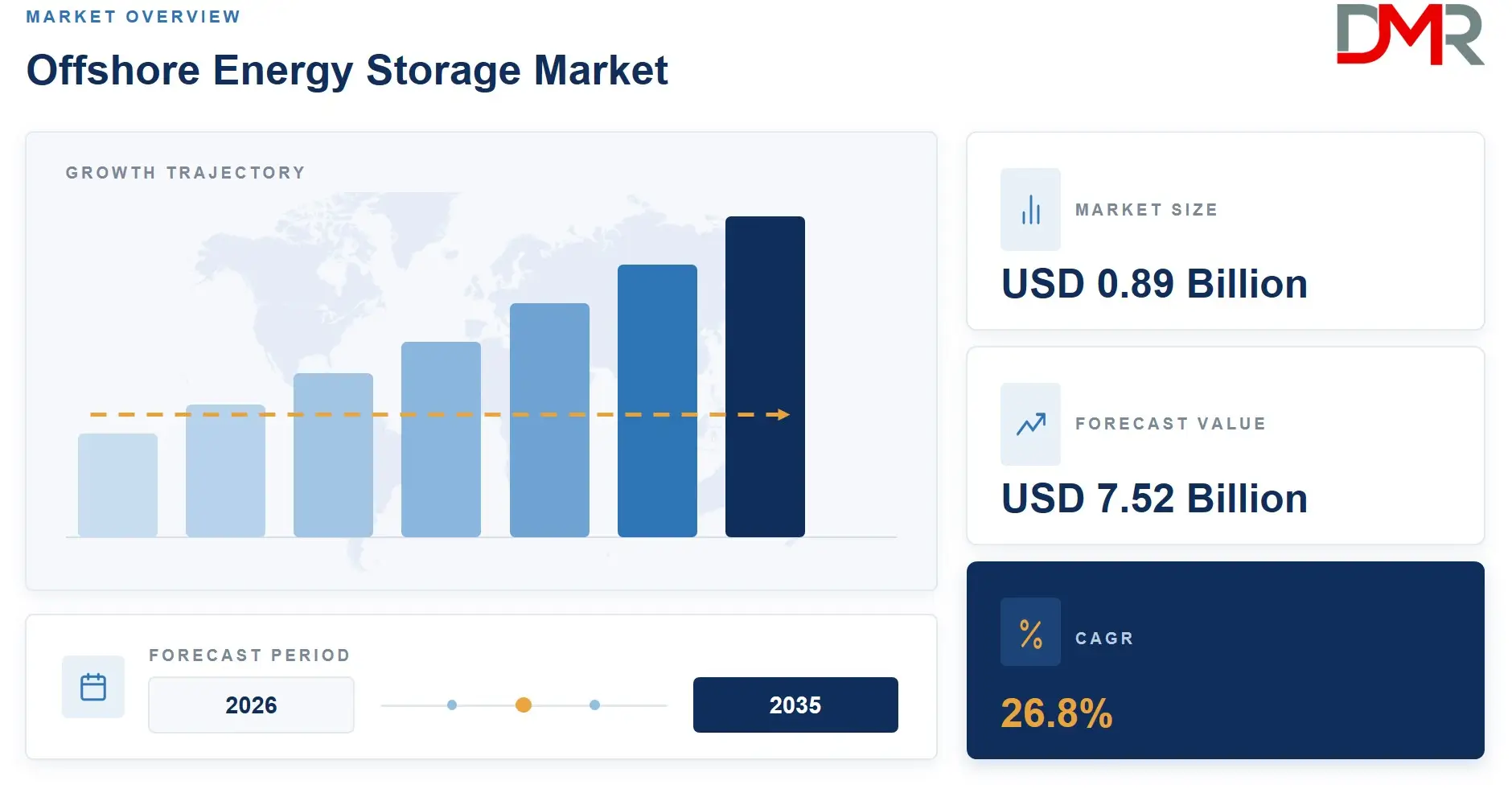
The Global Offshore Energy Storage Market size is estimated at USD 0.89 Billion in 2026, and is projected to reach USD 7.52 Billion by 2035, exhibiting a CAGR of 26.8% during the forecast period. As reported by Ipieca's May 2025 technical compendium, subsea battery systems exceeding 1 MWh had already reached the pilot stage, confirming that commercial-scale offshore deployment is no longer a distant prospect but an active procurement consideration for project developers. Offshore energy storage covers battery, mechanical, hydrogen, and thermal systems deployed on fixed platforms, floating structures, and subsea installations beyond the shoreline.
Energy Storage Systems of this class serve offshore wind farms, oil and gas platforms, maritime vessels, and island-grid programs as primary or backup power assets. The market excludes onshore grid-scale batteries, utility substations, and shore-based peaking plants, even when those assets support offshore renewable output dispatch. RWE commissioned a 35 MW/41 MWh battery at Eemshaven in March 2025 as part of integration works for the OranjeWind offshore wind project, as confirmed by RWE's official press release. That project represents the type of near-shore offshore-tied installation pulling capital toward this market ahead of deeper-water deployments. Forecast assumptions rest on continued offshore wind capacity additions across Europe, accelerating platform electrification programs in the North Sea and Baltic, and cost reductions in marinized battery enclosures.
ℹ
To learn more about this report –
Download Your Free Sample Report Here
Key Takeaways
- The market size is USD 0.89 Billion in 2026, and is projected to hit USD 7.52 Billion by 2035 at a CAGR of 26.8%.
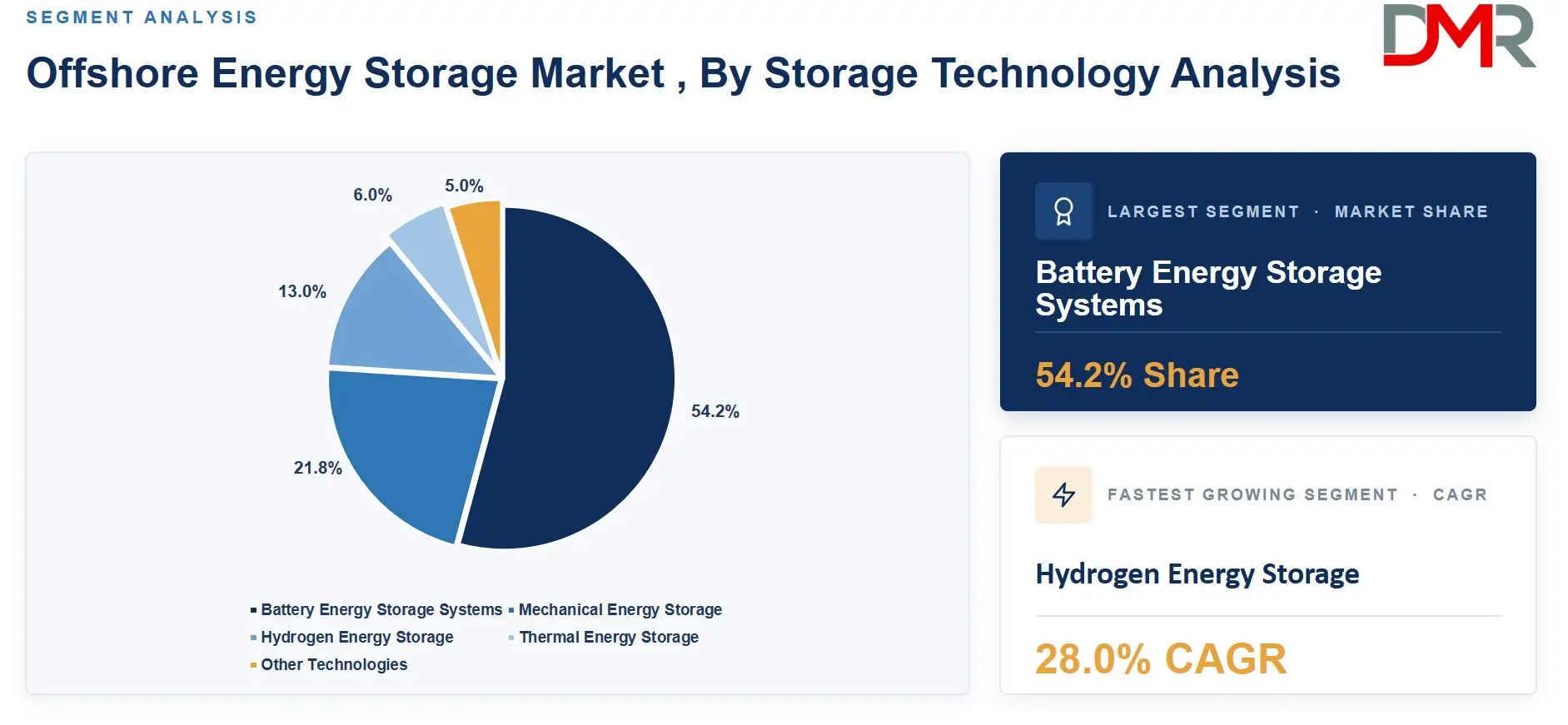
- By Storage Technology: Battery Energy Storage Systems led with a 54.2% share in 2026.
- By Battery Technology: Lithium-Ion Batteries led with a 71.2% share in 2026.
- By Mechanical Technology: Compressed Air Energy Storage led with a 42.4% share in 2026.
- By Deployment Type: Fixed Offshore Systems led with a 67.8% share in 2026.
- By Storage Duration: 4–8 Hours led with a 37.4% share in 2026.
- By Application: Offshore Wind Energy Integration led with a 46.8% share in 2026.
- By End User: Offshore Wind Farm Operators led with a 50.7% share in 2026.
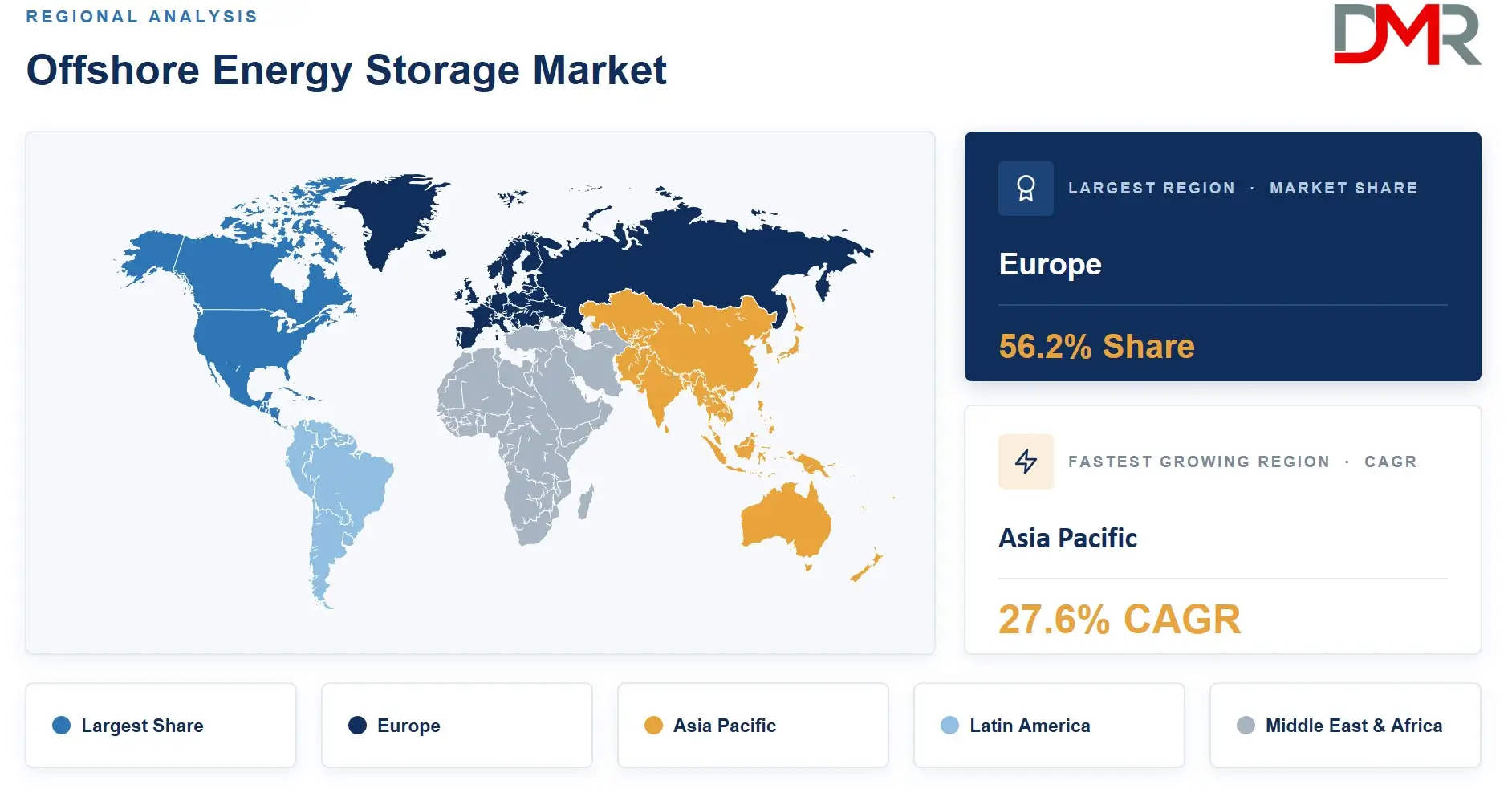
- By Region: Europe led with a 56.2% share, valued at USD 0.39 Billion, in 2026.
- Top key players include Siemens Energy, GE Vernova, ABB Ltd., Wärtsilä, and Fluence Energy, Inc.
Storage Technology Analysis
Battery Energy Storage Systems accounted for 54.2% of Storage Technology demand in 2026, the highest of any category. Offshore wind operators chose Battery Energy Storage Systems over competing technologies because BESS units deliver frequency response in milliseconds, a speed no mechanical or thermal alternative matches on an offshore platform. A 54.2% share places BESS as the structural backbone of offshore energy storage, and the margin over second-place technologies reflects the cost and response-time gap that buyers cannot close with alternatives. The integration economics of offshore wind curtailment made co-located battery systems the default specification for new floating and fixed-platform projects through 2026. Hydrogen Energy Storage captured a smaller share in 2026 but carries the fastest growth trajectory across all storage technology categories.
Thermal Energy Storage holds a niche position in process-heat applications on offshore platforms where waste heat recovery offsets fuel consumption. Mechanical storage, covering compressed air, gravity, flywheel, and subsea pumped hydro, serves longer-duration applications where BESS cycle economics deteriorate. Buyers selecting technology now face a trade-off between BESS's proven offshore track record and hydrogen's emerging ability to store energy over weeks rather than hours.
ℹ
To learn more about this report –
Download Your Free Sample Report Here
Battery Technology Analysis
With a 71.2% share in 2026, Lithium-Ion Batteries outpaced all other Battery Technology categories. Lithium-ion batteries hold a dominant position because their energy density of 150–300 Wh/kg, as reported by Ipieca 2025, is a decisive advantage on offshore structures where weight and deck space are priced at a premium. Competing chemistries such as flow batteries deliver only 5–25 Wh/kg, making them weight-prohibitive for most topside offshore applications. Round-trip efficiency of 85–95% for lithium-ion, versus 70–90% for flow batteries per the same Ipieca 2025 compendium, reinforces why operators default to lithium-ion when specifying offshore systems. Cycle life spans 500–3,000 cycles for conventional lithium-ion cells, rising to 7,000 cycles for lithium-titanate variants, as confirmed by Ipieca 2025. Sodium-Based Batteries and Flow Batteries serve specialized offshore roles where cycle longevity matters more than weight. Flow batteries offer 10,000–20,000 cycles per Ipieca 2025 data, making them candidates for subsea and semi-permanent floating installations where maintenance access is severely restricted. Lead-Acid systems persist on legacy oil and gas platforms as backup power assets but face replacement pressure as lithium-ion costs decline. The fastest-growing battery sub-segment is not lithium-ion but the emerging sodium and flow chemistries targeting long-duration applications where lithium-ion's cycle limits create a commercial gap.
Mechanical Technology Analysis
Compressed Air Energy Storage captured 42.4% of the Mechanical Technology segment in 2026, ahead of all rivals. Compressed Air Energy Storage leads the mechanical segment because existing subsea geological formations and decommissioned offshore structures provide ready-made pressure vessels that eliminate the capital cost of custom containment. A 2025 peer-reviewed offshore-platform study published by the University of Malta modeled a hybrid system sized at 390 MWh of batteries for short-term demand and 1,260 MWh of subsea compressed-air storage for longer renewable-energy shortfalls, confirming that compressed air fills the duration gap that batteries cannot economically cover alone. Gravity-Based Storage and Subsea Pumped Hydro Storage remain at prototype or concept stage in 2026, though both received pilot funding in European offshore energy programs. Flywheel Energy Storage targets short-burst frequency regulation on offshore platforms where its high power density and near-zero maintenance make it competitive against smaller BESS installations. The mechanical segment as a whole addresses storage durations from minutes to days, filling a gap that battery chemistries do not close cost-effectively beyond the 8–12 hour range.
Deployment Type Analysis
Fixed Offshore Systems led the Deployment Type segment with a 67.8% share in 2026. Fixed Offshore Systems dominate because the majority of commissioned offshore wind farms and active oil and gas platforms occupy shallow-water zones where fixed-structure installation costs remain manageable. A 67.8% share reflects the installed base of shallow-water offshore infrastructure accumulated over decades of North Sea, Gulf of Mexico, and Asian coastal development. Operators on fixed platforms accept higher initial civil costs in exchange for structural stability, easier cable management, and simpler maintenance access than floating alternatives provide. Floating Offshore Systems carry the fastest growth rate across all deployment categories, a distinction that reflects the geographic shift toward deep-water offshore wind development beyond the reach of fixed foundations. As floating wind capacity additions accelerate in Europe and Asia Pacific, on-deck battery integration becomes standard specification practice rather than an optional upgrade. Vendors designing marinized BESS enclosures for floating platforms face motion-compensating structural requirements that fixed-platform counterparts do not, creating a technical differentiation opportunity for specialists.
Storage Duration Analysis
A 37.4% share made 4–8 Hours the clear leader across Storage Duration categories in 2026. The 4–8 Hour duration window aligns directly with offshore wind generation variability cycles and the typical peak shaving requirements of offshore platform power systems. A 37.4% share confirms that buyers price and procure storage primarily around daily load-leveling needs rather than multi-day backup or sub-hour frequency response. Battery chemistries optimized for this duration band, specifically lithium-iron-phosphate cells, dominate offshore procurement specifications because their cycle economics are strongest in the 4–8 hour discharge regime. Below-4-Hour systems address frequency regulation and spinning reserve replacement, where BESS response time in milliseconds creates value that mechanical alternatives cannot replicate. The 8–12 Hour and Above-12-Hour segments are growing as floating wind projects with no grid connection require self-sufficiency across extended periods of low wind output. Buyers selecting Above-12-Hour systems face chemistry trade-offs: lithium-ion costs rise steeply beyond 8 hours of storage duration, pulling procurement interest toward compressed air and flow battery alternatives for multi-day buffering.
Application Analysis
Offshore Wind Energy Integration led the Application segment with a 46.8% share in 2026. Offshore wind curtailment creates direct revenue loss for farm operators, and co-located storage converts that loss into dispatchable generation. A 46.8% share for Offshore Wind Energy Integration confirms that storage procurement decisions in this market are primarily driven by the economics of capturing constrained generation rather than by grid operator mandates or platform safety requirements. Operators who install storage recover curtailed output during peak dispatch windows, improving project internal rates of return without additional turbine capital expenditure. Grid Balancing and Peak Shaving represent adjacent applications where offshore storage assets provide ancillary services revenue on top of their primary wind integration function. Offshore Platform Power Management and Backup Power serve the oil and gas segment, where diesel replacement economics and Scope 1 emission targets are pushing hybrid battery-renewable system adoption. Green Hydrogen Production and Storage is the smallest application category in 2026 but carries strategic long-term importance as offshore platforms seek to produce pipeline-ready hydrogen fuel at scale.
End User Analysis
Offshore Wind Farm Operators led the End User segment as the largest category in 2026, with a 50.7% share. Offshore Wind Farm Operators account for more than half of end-user demand because storage is now a standard co-investment in new offshore wind projects across Europe and Asia Pacific. A 50.7% share reflects procurement patterns where wind farm developers include battery storage in their project finance structures from the planning stage rather than as a retrofit decision. Energy Storage Developers represent the fastest-growing end-user category as third-party storage-as-a-service models attract capital from investors who prefer storage revenue streams over direct wind ownership. Oil and Gas Offshore Platforms represent a structurally important end-user group as platform electrification programs spread across the North Sea, Gulf of Mexico, and Southeast Asian basins. Utilities and Grid Operators procure offshore storage primarily as grid balancing assets tied to subsea cable infrastructure programs. Government and Renewable Energy Projects underpin early-stage markets in island nations and coastal communities where offshore storage replaces submarine cable investment entirely.
Key Market Segments
By Storage Technology
- Battery Energy Storage Systems
- Lithium-Ion Batteries
- Sodium-Based Batteries
- Flow Batteries
- Lead-Acid Batteries
- Other Battery Technologies
- Mechanical Energy Storage
- Compressed Air Energy Storage
- Gravity-Based Storage
- Flywheel Energy Storage
- Subsea Pumped Hydro Storage
- Hydrogen Energy Storage
- Thermal Energy Storage
- Other Technologies
By Deployment Type
- Fixed Offshore Systems
- Floating Offshore Systems
By Storage Duration
- Below 4 Hours
- 4–8 Hours
- 8–12 Hours
- Above 12 Hours
By Application
- Offshore Wind Energy Integration
- Grid Balancing
- Peak Shaving
- Backup Power
- Offshore Platform Power Management
- Green Hydrogen Production & Storage
By End User
- Offshore Wind Farm Operators
- Oil & Gas Offshore Platforms
- Utilities & Grid Operators
- Energy Storage Developers
- Government & Renewable Energy Projects
Regional Analysis
Europe led the regional breakdown with a 56.2% share, valued at USD 0.39 Billion, in 2026.
Europe
Europe's 56.2% share reflects two decades of offshore wind development in the North Sea and Baltic that created both the installed base and the grid integration need for co-located storage. RWE's Eemshaven installation contains 110 lithium-iron-phosphate battery racks connected through approximately 26 kilometres of cabling, as confirmed by RWE's March 2025 press release, illustrating the scale of offshore-tied storage infrastructure now entering service across the continent. Distributed Energy Resources programs across Germany, the Netherlands, and the United Kingdom are accelerating subsea grid node development that requires local storage buffers. Regulatory frameworks in the EU supporting offshore renewable hydrogen and grid flexibility further cement Europe's lead position through the forecast period.
Asia Pacific
Asia Pacific carries the fastest regional growth rate across all geographies, driven by offshore wind capacity additions in China, South Korea, and Taiwan that are outpacing grid infrastructure upgrades. Chinese offshore wind developers face curtailment rates that make co-located storage economically compelling without any subsidy support. Japan and South Korea are funding offshore storage pilot programs as part of national energy transition strategies that prioritize energy security alongside decarbonization. The combination of rapid capacity growth and underdeveloped grid integration infrastructure creates a structurally larger addressable market for offshore storage in Asia Pacific than in any other region through 2035.
ℹ
To learn more about this report –
Download Your Free Sample Report Here
North America
North America trails Europe and Asia Pacific in offshore energy storage deployment because the US offshore wind sector only entered commercial-scale construction from 2023 onward, creating a one-cycle lag relative to European market maturity. Gulf of Mexico oil and gas operators are procuring hybrid battery-diesel systems for platform electrification, which represents a near-term revenue base ahead of the larger offshore wind-tied storage wave. Federal investment tax credit structures under US clean energy legislation support battery procurement for offshore wind projects, reducing first-mover financial risk for developers willing to commit before standards fully consolidate.
Latin America
Latin America's offshore energy storage market remains nascent, with activity concentrated in Brazil's pre-salt offshore oil and gas sector where platform electrification economics are beginning to justify battery-hybrid investments. Island nations across the Caribbean represent a distinct addressable segment where offshore-deployable storage removes the need for submarine cable connections to mainland grids. The absence of a large offshore wind sector limits Latin America's growth rate relative to Europe and Asia Pacific, but the region's coastal geography creates long-term potential for floating wind and co-located storage projects.
Middle East & Africa
Middle East and African offshore energy storage demand centers on oil and gas platform electrification programs in the Gulf of Mexico analog basins of West Africa and the Arabian Gulf, where national oil companies face shareholder pressure on Scope 1 emissions. Gulf Cooperation Council sovereign wealth fund commitments to green hydrogen production create a secondary demand pathway for offshore storage assets serving electrolysis platforms. South Africa's offshore gas development program represents an emerging offshore storage opportunity as new platforms require independent power management systems in areas without subsea grid connections.
Key Regions and Countries
North America
Europe
- Germany
- France
- The UK
- Spain
- Italy
- Rest of Europe
Asia Pacific
- China
- Japan
- South Korea
- India
- Australia
- Rest of APAC
Latin America
- Brazil
- Mexico
- Rest of Latin America
Middle East & Africa
- GCC
- South Africa
- Rest of MEA
Macroeconomic Impact
Offshore energy storage capital expenditure correlates directly with offshore wind project finance conditions. Rising interest rates between 2022 and 2024 compressed project returns across European and US offshore wind pipelines, and several developers deferred or restructured storage procurement as a cost-reduction measure. Battery procurement for the BW Group electric offshore commissioning-service vessel specified close to 25 MWh of lithium-iron-phosphate storage as its primary power source, as reported by BW Group in 2025, illustrating that maritime electrification investment continues even when broader offshore project economics tighten. Currency movements affect offshore storage supply chains because lithium-ion cell manufacturing is concentrated in China and South Korea, denominated in renminbi and Korean won. Euro and US dollar depreciation against Asian currencies raises imported battery module costs for European and North American project developers. Trade policy uncertainty around critical mineral supply chains, particularly lithium, cobalt, and nickel, creates budget risk for project developers pricing multi-year offshore storage procurement contracts in volatile commodity environments.
Market Dynamics
Driver: Wind Curtailment Economics and Platform Electrification Demand
Offshore wind operators lose direct revenue when grid congestion forces curtailment of generation that has no storage outlet. A 2025 peer-reviewed offshore-wind resilience study published in ScienceDirect found that the optimal BESS capacity for wind farm integration is approximately 16% of one day's full-rated wind-farm generation, providing a standardized sizing reference that reduces procurement uncertainty and accelerates project approval timelines. The practical consequence is that storage becomes a predictable line item in wind farm capex models rather than a discretionary add-on, pulling procurement decisions earlier in the project development cycle. Grid Scale Energy Storage performance standards confirm why BESS outcompetes all alternatives on offshore platforms. As reported by Ipieca's 2025 compendium, BESS achieves a typical round-trip efficiency of 85–90% in offshore power-generation systems, and its spinning reserve response operates in milliseconds compared to the 10-second maximum allowed under standard frequency-regulation requirements. That speed advantage means a single BESS installation can simultaneously replace spinning reserve capacity, provide peak shaving, and dispatch curtailed wind generation, compressing the number of storage assets a platform needs to procure.
Restraint: Marine Engineering Costs and Operational Expenditure
Battery enclosures deployed offshore must survive salt spray, corrosion, wave loading, and pressure rating requirements that onshore systems never face. Those marinization requirements multiply system costs well beyond onshore equivalents, narrowing the addressable project pipeline to cases where the storage revenue premium justifies the cost premium. Offshore maintenance logistics compound the capital cost problem: weather windows, vessel charter rates, and specialized technician availability all create operational expenditure structures that make offshore storage roughly two to three times more expensive to maintain per MWh than equivalent onshore installations.
Opportunity: Floating Wind Integration and Green Hydrogen Platforms
Floating offshore wind platforms operating beyond cable distance from shore require on-deck storage to become fully dispatchable energy assets rather than intermittent generators. A University of Malta 2025 peer-reviewed study confirmed that a hybrid configuration of 390 MWh of batteries combined with 1,260 MWh of subsea compressed-air storage eliminated energy-deficit hours entirely for the modeled offshore platform, demonstrating that hybrid storage architecture can guarantee power availability in fully grid-disconnected offshore environments. Long Duration Energy Storage requirements on offshore hydrogen production platforms represent a structurally different opportunity from wind integration. Conventional spinning and non-spinning reserves must be available within 10 minutes and operate for at least 2 hours, while slower replacement reserves require 30 minutes or more to activate, as documented by Ipieca 2025. Offshore hydrogen platforms need storage that covers the full electrolyzer operating cycle rather than short-burst frequency events, creating demand for flow batteries and compressed air systems in the duration ranges that lithium-ion cells do not serve cost-effectively.
Porter's Five Forces
Competitive rivalry in the offshore energy storage market is high among a relatively small group of specialist vendors, because the total addressable market in 2026 remains narrow and each project win carries disproportionate revenue significance. Barriers to entry are substantial: new entrants must obtain classification society certifications from DNV or Lloyd's for offshore battery systems, clear maritime structural engineering requirements, and demonstrate subsea or topside track records that project developers require before committing nine-figure procurement budgets. Supplier power sits at moderate-to-high because lithium-ion cell manufacturing is geographically concentrated, and Ipieca 2025 confirms that both lithium-ion and flow batteries deliver reaction times of under 1 second, a performance threshold that narrows the qualified cell supplier base to a handful of manufacturers with proven marine-grade products. Buyer power is increasing as offshore wind developers standardize storage sizing specifications and use competitive tender processes to extract price concessions from battery integrators. The threat of substitutes is limited in the 0–8 hour duration segment because no technology matches BESS on response speed and energy density simultaneously for offshore topside applications, but compressed air and pumped hydro emerge as credible substitutes for longer-duration requirements above 12 hours.
AI and Gen AI Impact
Artificial intelligence is reshaping offshore energy storage primarily at the system-performance and predictive-maintenance layers of the value chain. Battery management systems using machine learning now optimize charge-discharge cycles in real time against forecast wind generation curves, extending cell life beyond nameplate cycle ratings by avoiding stress conditions that accelerate degradation. SubCtech's 2026 full-load test, where an underwater battery supplied 50 kW continuously for more than 50 minutes at 35°C without thermal throttling, demonstrates the precision control that AI-enabled battery management delivers in extreme offshore thermal environments. That test also exceeded the customer's minimum 45-minute full-power requirement by more than 11%, raising demonstrated continuous output from 35 kW to 50 kW, outcomes that would be difficult to achieve without real-time thermal management algorithms. Autonomous inspection robotics, guided by computer vision and generative AI diagnostic tools, are beginning to replace human technician dispatch for routine offshore battery system checks. Vendors who deploy AI-driven predictive maintenance platforms reduce the weather-window dependency that drives offshore operational expenditure upward, directly attacking the primary cost restraint holding back market adoption.
Market Trends
Synthetic Inertia and Classification Standards Reshaping Procurement
Offshore battery systems are moving beyond simple charge-discharge functions toward grid-forming capabilities that provide synthetic inertia to weak offshore grids. RWE's Moerdijk power station installation, rated at 7.5 MW/11 MWh and equipped with synthetic-inertia technology, illustrates how grid stability functions are now embedded in offshore-tied storage specifications rather than treated as an optional software feature, as confirmed by RWE's 2025 press release. Classification society standards from DNV and Lloyd's are consolidating around shared offshore BESS certification rules, reducing permitting uncertainty for developers and creating a clearer qualification pathway for new market entrants. Project financing structures are simultaneously evolving from sovereign-backed grants toward merchant and hybrid offtake models as technology risk perceptions decrease among institutional lenders.
Market Competition Overview
The offshore energy storage market in 2026 is fragmented among a mix of diversified energy technology conglomerates, specialist marine energy companies, and vertically integrated battery manufacturers. No single vendor holds a dominant share across all deployment types, storage chemistries, and application segments, because the technical requirements of subsea, topside-fixed, and floating-offshore installations differ enough that broad portfolio coverage requires either deep internal R&D investment or active partnership strategies. A 2025 peer-reviewed life-cycle assessment published in Springer modeled a North Sea offshore low-head pumped-hydro storage facility at 2 GW of installed power and 8 GWh of average daily storage capacity, reflecting the scale at which non-battery mechanical storage is entering serious competitive consideration against BESS for longer-duration offshore applications. Vendors with established offshore oil and gas installation experience hold a structural advantage because their existing marine logistics networks and certification portfolios reduce project execution risk for buyers. Battery manufacturers without offshore-specific marinization capabilities are entering the market through partnerships with established offshore engineering firms rather than competing independently. The competitive boundary between energy storage integrators and offshore engineering contractors is blurring as both sides invest to capture the full project value chain from battery procurement through installation and long-term operations and maintenance.
Pricing Analysis
Offshore energy storage commands a significant price premium over onshore equivalents because marinized enclosures, structural certification, and offshore installation logistics add cost at every stage from manufacturing through commissioning. Pricing varies substantially by deployment type: fixed-platform topside systems carry lower installation costs per MWh than floating or subsea systems, where motion compensation, pressure rating, and remote access logistics multiply total installed cost. A University of Malta 2025 offshore platform study modeled a platform with a 24 MVA platform-to-ship system serving 4 berths at up to 6 MVA each, illustrating the power delivery scale at which offshore storage pricing must compete against diesel genset alternatives to win procurement decisions. Market leaders price on a total cost of ownership basis that amortizes certification and marinization costs over long asset lives, while challengers compete on upfront battery module cost by using commercial onshore cell specifications with minimal offshore adaptation. That pricing gap is narrowing as classification standards consolidate and marinized enclosure designs become more standardized across vendors. Regional pricing reflects the concentration of offshore wind project activity in Europe, where higher competition among storage integrators is already compressing margins relative to Asia Pacific markets where fewer certified vendors operate.
Company Profiles
Siemens Energy positions itself as a full-scope offshore energy technology provider, combining grid integration hardware, power conversion systems, and battery storage modules under a single project delivery framework. The company's established relationships with offshore wind developers across Europe and Asia Pacific give it early access to storage procurement decisions before competitive tenders open. Siemens Energy's hydrogen module development program, advanced in March 2026, extends its offshore storage addressable market into the green hydrogen production segment, where storage and electrolysis must be integrated at the platform level. SubCtech GmbH occupies a specialist position in subsea and underwater battery systems that larger diversified vendors do not yet serve at commercial scale. SubCtech's 2025 subsea Battery Storage Skid carries a capacity of 1 MWh with a modular design scalable to 6 MWh, as confirmed by SubCtech's technical documentation, giving project developers a validated subsea storage product in a segment where alternatives are still at prototype stage. SubCtech's engineering architecture uses 12 stainless-steel pressure tubes as deep-sea battery casings, a structural approach that addresses the corrosion and pressure rating requirements that disqualify commercial onshore battery enclosures from subsea deployment.
Key Players
- Siemens Energy
- GE Vernova
- ABB Ltd.
- Wärtsilä
- Fluence Energy, Inc.
- Tesla, Inc.
- CATL
- BYD Company Ltd.
- Equinor ASA
- Ørsted A/S
- RWE AG
- Saipem S.p.A.
- Subsea 7 S.A.
- NOV Inc.
- Hitachi Energy
- Schneider Electric SE
- Kraken Robotics Inc.
- SubCtech GmbH
- Verlume Ltd.
- TNO
Supply Chain and Value Chain Analysis
Raw material supply for offshore energy storage flows from lithium, cobalt, nickel, and manganese mining operations concentrated in Australia, Chile, and the Democratic Republic of Congo into cell manufacturing facilities primarily in China and South Korea. SubCtech's 2025 subsea Battery Storage Skid design uses 12 stainless-steel pressure tubes as its deep-sea battery casing, as confirmed by SubCtech technical documentation, highlighting how the offshore supply chain adds a specialized marinization fabrication stage that onshore battery supply chains do not require. That marinization layer, covering pressure-rated enclosures, saltwater-resistant connectors, and corrosion-protected structural frames, represents the highest unit-cost addition to offshore storage systems relative to their onshore equivalents. The SubCtech 2026 underwater battery system operates at approximately 600 V nominal with more than 40 kWh of nominal energy capacity per module, as documented in SubCtech's test reports, defining the electrical interface specifications that offshore cable and connector suppliers must qualify against. Value creation concentrates at the system integration and commissioning stages, where technical complexity and offshore logistics costs are highest. The biggest supply chain bottleneck is the shortage of marine-certified technicians capable of commissioning and maintaining subsea battery systems, a constraint that increases both cost and project schedule risk for buyers.
Regulatory Landscape
Offshore battery energy storage systems must comply with classification society rules from DNV and Lloyd's Register, which define structural, electrical, and fire safety standards for topside and subsea installations. A 2025 peer-reviewed life-cycle assessment published in Springer defined offshore low-head pumped storage as operating with a water-level difference of 30 metres or less between its two water bodies, illustrating how regulatory definitions are being formalized around specific technical parameters that create clarity for permitting authorities and project developers simultaneously. The EU's offshore renewable energy strategy, including targets for offshore wind capacity and hydrogen production, creates a regulatory pull effect that aligns permitting timelines with storage procurement schedules across Northern European markets. North American offshore storage projects navigate a more fragmented regulatory environment where US Coast Guard, Bureau of Safety and Environmental Enforcement, and state-level environmental agencies share jurisdiction depending on water depth and proximity to shore. Asia Pacific regulatory frameworks are consolidating more slowly, with national standards in China, Japan, and South Korea diverging on certification requirements in ways that complicate multinational vendor qualification strategies. Regulatory convergence around DNV and Lloyd's standards in Europe offers vendors who achieve those certifications first a meaningful compliance head start in markets where permitting timelines currently add 12 to 24 months to project schedules.
Investment and White Space Analysis
Investment in offshore energy storage is concentrating in the floating offshore wind integration segment, where deep-water project pipelines in Europe and Asia Pacific are creating a predictable forward procurement calendar that institutional investors can underwrite. A University of Malta 2025 model combining 200 MW of floating wind with 300 MW of floating solar connected through an approximately 20-kilometre MVDC link defines the infrastructure architecture attracting project finance into fully offshore power island concepts. Clean Energy Technology capital is flowing toward storage vendors with demonstrated offshore certification credentials, because technology risk is the primary concern restricting underwriter appetite for first-of-kind subsea and floating storage projects. White space exists in the decommissioned offshore oil platform repurposing segment, where existing structural assets and grid connection rights reduce development costs for offshore storage hubs to a fraction of greenfield alternatives. Offshore aquaculture and maritime microgrid applications represent a second underserved segment: remote, grid-disconnected marine operations require autonomous, low-maintenance storage that no vendor currently serves at commercial scale with a purpose-built product. Both segments offer lower competition and higher margin potential than the mainstream offshore wind integration market, where established vendors already compete aggressively on price and project execution credentials.
Recent Developments
- February 2025: Corvus Energy confirmed it would supply a near-25 MWh lithium iron phosphate battery system for BW Group's fully electric offshore construction support vessel, marking a shift in maritime energy storage from auxiliary installations toward primary propulsion-scale systems.
- February 2025: SubCtech began manufacturing a new 1 MWh subsea battery system engineered specifically for persistent underwater deployment, targeting remote marine energy sites that surface-based storage cannot serve reliably.
- January 2025: The FLASC project secured €2.50 million in EU funding, followed in February 2025 by the Dutch OESTER consortium receiving €2.49 million to validate monopile-integrated batteries with partners including Verlume, advancing two separate subsea storage pilot tracks simultaneously with European public financing.
- March 2025: Ocean Grazer obtained pilot approval for utility-scale pumped hydro seabed storage, and in June 2026 Wärtsilä structured a joint venture to accelerate marine hybrid system rollouts, connecting mechanical and battery storage development tracks through distinct partnership strategies.
- August 2025: Equinor advanced offshore energy integration strategies across its North Sea asset portfolio, while in October 2025 Hydrostor progressed compressed air energy storage concepts targeting offshore long-duration applications where battery economics are weakest.
- January 2026: Ocean Grazer expanded testing of its seabed energy storage arrays, ABB advanced marine storage integrations in February 2026, and Siemens Energy announced hydrogen module developments in March 2026, reflecting a simultaneous acceleration by three distinct technology categories within a single quarter.
Report Scope
| Report Characteristics |
| Market Value (2026) |
USD 0.89 Billion |
| Forecast Revenue (2035) |
USD 7.52 Billion |
| CAGR (2026 to 2035) |
26.8% |
| Base Year for Estimation |
2025 |
| Historic Period |
2020 to 2024 |
| Forecast Period |
2026 to 2035 |
| Report Coverage |
Revenue Forecast, Market Dynamics, Competitive Landscape, Recent Developments |
| Segments Covered |
By Storage Technology (Battery Energy Storage Systems, Mechanical Energy Storage, Hydrogen Energy Storage, Thermal Energy Storage, Other Technologies), By Battery Technology (Lithium-Ion Batteries, Sodium-Based Batteries, Flow Batteries, Lead-Acid Batteries, Other Battery Technologies), By Mechanical Technology (Compressed Air Energy Storage, Gravity-Based Storage, Flywheel Energy Storage, Subsea Pumped Hydro Storage), By Deployment Type (Fixed Offshore Systems, Floating Offshore Systems), By Storage Duration (Below 4 Hours, 4–8 Hours, 8–12 Hours, Above 12 Hours), By Application (Offshore Wind Energy Integration, Grid Balancing, Peak Shaving, Backup Power, Offshore Platform Power Management, Green Hydrogen Production & Storage), By End User (Offshore Wind Farm Operators, Oil & Gas Offshore Platforms, Utilities & Grid Operators, Energy Storage Developers, Government & Renewable Energy Projects) |
| Regional Analysis |
North America (US and Canada), Europe (Germany, France, The UK, Spain, Italy, and Rest of Europe), Asia Pacific (China, Japan, South Korea, India, Australia, and Rest of APAC), Latin America (Brazil, Mexico, and Rest of Latin America), Middle East & Africa (GCC, South Africa, and Rest of MEA) |
| Competitive Landscape |
Siemens Energy, GE Vernova, ABB Ltd., Wärtsilä, Fluence Energy Inc., Tesla Inc., CATL, BYD Company Ltd., Equinor ASA, Ørsted A/S, RWE AG, Saipem S.p.A., Subsea 7 S.A., NOV Inc., Hitachi Energy, Schneider Electric SE, Kraken Robotics Inc., SubCtech GmbH, Verlume Ltd., TNO |
| Customization Scope |
Customization for segments and region or country level will be provided. Additional customization can be done based on requirements. |
| Purchase Options |
Three license options: Single User License, Multi-User License (Up to 5 Users), Corporate Use License (Unlimited Users and Printable PDF) |
Frequently Asked Questions
What is the biggest investment opportunity in the Offshore Energy Storage market?
▾ Floating offshore wind integration represents the largest near-term investment opportunity, as deep-water projects across Europe and Asia Pacific require on-deck battery storage to become fully dispatchable assets. Decommissioned offshore oil platforms offer a second compelling entry point, where existing structural assets and grid connection rights reduce greenfield development costs substantially. Both segments remain underserved relative to the capital now entering mainstream fixed-platform storage procurement.
Who are the top companies in the Offshore Energy Storage market?
▾ Leading companies include Siemens Energy, GE Vernova, ABB Ltd., Wärtsilä, and Fluence Energy, Inc., alongside specialist vendors such as SubCtech GmbH and Verlume Ltd. that serve subsea and monopile-integrated applications. Battery manufacturers CATL, BYD Company Ltd., and Tesla Inc. supply cell technology that integrators deploy within offshore-certified enclosures. Classification-certified system integrators with established offshore logistics networks hold the strongest competitive positions across most project types.
Which segment is growing fastest in the Offshore Energy Storage market and why?
▾ Floating Offshore Systems is the fastest-growing deployment type, driven by the geographic shift toward deep-water offshore wind development beyond the reach of fixed foundations. Hydrogen Energy Storage is the fastest-growing storage technology, as offshore platforms seek to produce pipeline-ready green hydrogen using stranded renewable generation. Energy Storage Developers are the fastest-growing end-user category as third-party storage-as-a-service models attract project finance capital away from direct asset ownership structures.
Which region is growing fastest in the Offshore Energy Storage market and why?
▾ Asia Pacific is the fastest-growing region because offshore wind capacity additions in China, South Korea, and Taiwan are outpacing grid infrastructure upgrades, creating curtailment economics that make co-located storage financially compelling without subsidy support. Chinese offshore wind developers face curtailment rates that justify storage procurement on a merchant basis alone. Japan and South Korea are running publicly funded offshore storage pilot programs that will establish certified vendor ecosystems ahead of commercial-scale procurement waves.
What is the biggest challenge holding in the Offshore Energy Storage market back?
▾ Marine environment engineering requirements for battery enclosures multiply system costs well beyond onshore equivalents, and offshore maintenance logistics create operational expenditure structures that narrow the addressable project pipeline to high-revenue sites. Weather-window dependency for technician dispatch and vessel charter costs add budget uncertainty that deters project developers from committing to offshore storage without long-term operational expenditure visibility. Autonomous inspection and maintenance robotics are beginning to address this constraint, but widespread commercial deployment of robotic maintenance solutions remains two to three years away for most offshore storage asset classes.