Market Snapshot
- Market Size (2026): USD 2.8 Bn
- Forecast Value (2035): USD 12.2 Bn
- CAGR (2026-2035): 17.8%
- Largest Region (2026): North America, approximately 42%
- Fastest-Growing Region: Asia Pacific
- Leading By Grade (2026): GMP Clinical Grade, around 44%
- Leading By Application (2026): Viral Vector Production, close to 32%
- Key Players: Thermo Fisher Scientific, Lonza, Catalent, and others
What is Plasmid DNA Contract Manufacturing Market and its Market Size?
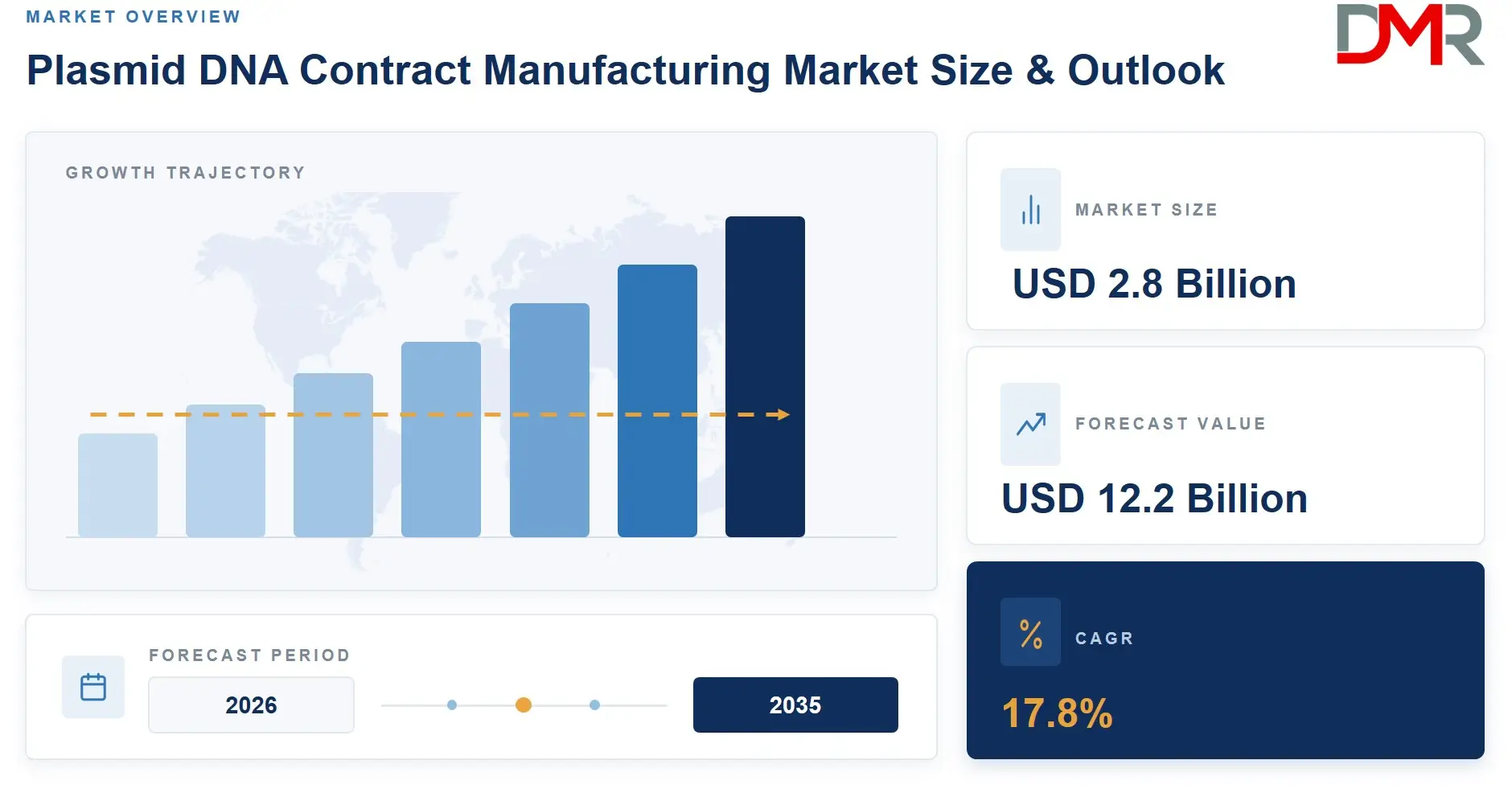
Global Plasmid DNA Contract Manufacturing Market size is estimated to reach USD 2.8 Bn in 2026 and is further anticipated to reach USD 12.2 Bn by 2035, at a CAGR of 17.8%.
ℹ
To learn more about this report –
Download Your Free Sample Report Here
The market covers third party development and manufacturing of plasmid DNA, the circular bacterial construct used as a starting material, gene delivery vehicle or direct therapeutic across gene therapy, cell therapy, DNA vaccines and mRNA production. It spans fermentation, purification, fill and analytical release performed by contract development and manufacturing organizations on behalf of biopharmaceutical sponsors, from research grade batches supporting early discovery through GMP clinical and commercial grade lots that feed approved products. Revenue is counted where a sponsor pays a CDMO for plasmid production services; internal production run by a biopharmaceutical company inside its own facility is excluded.
Buyers are overwhelmingly biotechnology and pharmaceutical companies that lack in-house fermentation and purification capacity for a raw material with narrow regulatory tolerances, alongside academic spin-outs and government-funded vaccine programmes that need small, fast-turnaround batches before a larger sponsor takes over the programme. Plasmid DNA sits upstream of viral vector, lipid nanoparticle and cell therapy manufacturing, so its quality directly gates downstream yield; a contaminated or low-purity plasmid bank can force a sponsor to repeat months of vector production. That dependency, more than price, is what pushes sponsors toward specialist CDMOs with validated platforms rather than toward the lowest-cost bidder.
The number of active cell and gene therapy programmes in clinical development has kept climbing even as overall biotech funding tightened, and each programme typically needs several plasmid constructs across preclinical, toxicology and clinical stages before a single commercial sequence is locked. That has pulled specialist capacity away from broad-based biologics CDMOs toward pure-play plasmid manufacturers and dedicated business units inside larger CDMOs, while newer non-viral formats such as minicircle and doggybone DNA are starting to compete with conventional bacterial plasmid for delivery applications that prize a smaller, backbone-free construct.
Use Cases
- Clinical-Stage Gene Therapy Sponsors: Small and mid-size biotechs advancing AAV and lentiviral gene therapy candidates outsource plasmid backbone and transfer-plasmid production to CDMOs that already hold validated fermentation trains, cutting the months a sponsor would otherwise spend qualifying its own bacterial strain and purification train before a first-in-human batch can ship.
- DNA Vaccine Developers: Public health and biodefence-funded vaccine programmes commission GMP plasmid batches as the direct drug substance for DNA vaccine candidates, relying on a CDMO's existing potency and identity assays rather than building analytical methods from scratch for a single-programme vaccine effort.
- Large Biopharma Commercial Supply Chains: Established manufacturers of an approved cell or gene therapy dual-source commercial-grade plasmid production across two CDMO sites to protect a single-product supply chain from a facility outage, accepting a premium for redundancy once a therapy is generating revenue.
- CAR-T Manufacturing Networks: Autologous and allogeneic CAR-T developers order plasmid lots sized to match viral vector production schedules rather than a fixed annual volume, drawing on CDMOs that can run smaller, more frequent GMP batches; CAR-T and cell therapy applications account for close to 14% of 2026 plasmid CDMO demand.
Key Takeaways
- Market Size & Share: The market is projected to grow from USD 2.8 Bn in 2026 to USD 12.2 Bn by 2035.
- By Grade Analysis: GMP Clinical Grade is expected to remain the leading grade in 2026, accounting for around 44% of revenue, while GMP Commercial Grade output is projected to expand at a CAGR of 25.6% through 2035.
- Regional Analysis: North America is expected to hold the largest share of the market in 2026 at approximately 42%, while Asia Pacific is set to post the fastest regional CAGR of 24.6% through 2035.
- Manufacturing Capacity Expansion: New GMP suites dedicated to plasmid production opened across North America and Europe through 2025 and 2026, adding capacity that had lagged the growth in clinical-stage programme count for much of the preceding decade.
- Outsourcing Penetration: Viral vector production is projected to remain the leading application in 2026 at close to 32% of demand, while mRNA and LNP starting material use is expected to grow fastest at a CAGR of 27.3% through 2035.
How AI/Gen AI is Transforming the Plasmid DNA Contract Manufacturing Market?
Artificial intelligence in plasmid DNA contract manufacturing is mostly operational rather than a headline generative application: CDMOs use it to compress the design and troubleshooting work that sits between order placement and first GMP batch, not to replace the fermentation and purification chemistry itself. Sequence design tools flag problematic repeats, cryptic promoters and toxic ORFs in a candidate plasmid before it reaches the bench, cutting the number of failed cloning attempts a process development team has to work through.
On the shop floor, machine learning models trained on historical batch records help predict fermentation yield and supercoiled content from early process parameters, letting operators intervene before a batch drifts out of specification rather than discovering the problem at release testing. Computer vision is being layered onto chromatography and filtration steps to catch equipment or membrane anomalies in real time, while language models increasingly draft the batch records and regulatory documentation a plasmid CDMO must generate for every lot, work that previously consumed a disproportionate share of quality staff time relative to the manufacturing step itself.
- Sequence Liability Screening: computer-aided design flags repeat elements, cryptic promoters and toxic sequences before cloning begins.
- Yield and Quality Prediction: models trained on historical fermentation data forecast supercoiled plasmid content and titre from early-stage process signals.
- Automated Batch Documentation: language models draft batch records and release documentation for quality review rather than manual compilation.
- Process Anomaly Detection: computer vision monitors chromatography and filtration steps for deviations during downstream purification.
Key Drivers in the Global Plasmid DNA Contract Manufacturing Market
Demand for outsourced plasmid production is being pulled by two forces that operate on different time horizons: near-term regulatory pressure to use qualified GMP material, and the longer clinical pipeline of programmes that need a plasmid supply chain in place.
- Expanding Cell and Gene Therapy Pipeline: The number of active gene therapy, cell therapy and DNA vaccine programmes in clinical development has continued to grow even as broader biotech funding tightened through 2024 and 2025, and each programme typically requires several distinct plasmid constructs across preclinical, toxicology and clinical stages before a commercial sequence is locked. Sponsors rarely build in-house fermentation capacity for what is a single upstream raw material, so nearly every new programme becomes a new CDMO order rather than an internal build decision. This structural link between pipeline count and outsourced plasmid demand means the market grows with clinical activity even when individual programme budgets shrink.
- Regulatory Convergence on GMP Plasmid Quality: Health authorities including the FDA and EMA have tightened expectations for plasmid purity, supercoiled content and host-cell impurity limits used as starting material for viral vectors and cell therapies, reflecting lessons from early gene therapy manufacturing failures. Sponsors now qualify plasmid suppliers earlier in development rather than treating plasmid as a commodity input purchased late, and CDMOs with an established regulatory track record and validated analytical panels win a disproportionate share of new contracts. This has concentrated demand among a smaller set of GMP-capable providers even as the number of programmes needing supply keeps expanding.
Restraints in the Global Plasmid DNA Contract Manufacturing Market
Growth is checked by real constraints on capacity, talent and downstream compatibility that a favourable pipeline outlook does not remove.
- Capital Intensity of GMP Suite Build-Out: A dedicated GMP plasmid suite, including fermentation trains, chromatography skids and the analytical infrastructure to support release testing, typically requires tens of millions of dollars and eighteen to twenty-four months before it can accept its first paying client, which discourages smaller CDMOs from entering the segment and slows how quickly aggregate capacity can respond to a demand spike. Sponsors have consequently faced multi-month queues at established providers during periods of peak clinical activity, pushing some to sign reservation agreements well before a programme is ready to manufacture.
- Skilled Workforce Shortage: Fermentation scientists, downstream purification specialists and quality personnel experienced specifically with bacterial plasmid processes remain scarce relative to the broader biologics workforce, and CDMOs compete for the same limited pool as they expand capacity in parallel. Training a new hire to lead a GMP plasmid batch independently commonly takes the better part of a year, which caps how fast a facility can scale output even after the physical suite is built and validated, and turnover at any single site can delay client programmes by months.
Growth Opportunities in the Global Plasmid DNA Contract Manufacturing Market
The clearest white space sits where plasmid manufacturing intersects an underserved buyer group or a technically differentiated construct rather than in broad capacity expansion alone.
- Integrated Plasmid-to-Vector Service Models: CDMOs that bundle plasmid production with downstream viral vector or lipid nanoparticle manufacturing under one technology transfer agreement are capturing sponsors who want to avoid managing multiple vendor interfaces and multiple sets of release specifications for a single programme. This integration shortens the calendar time between a locked plasmid sequence and a shippable vector or drug product lot, and it gives the CDMO a stickier, higher-value relationship with the sponsor than a standalone plasmid order would.
- Emerging Biotech Hubs Outside Traditional Centres: Contract manufacturers building GMP plasmid capacity in secondary biopharma clusters, rather than only in the established Boston, Bay Area and Rhineland corridors, are picking up smaller sponsors that would otherwise face long lead times and higher freight and import costs from established providers. Government-backed biomanufacturing incentives in several markets are lowering the capital cost of entering these secondary locations, widening the pool of CDMOs able to compete on turnaround time rather than only on price.
Trends in the Global Plasmid DNA Contract Manufacturing Market
Beyond the demand drivers, the way plasmid is designed, produced and priced is itself shifting.
- Non-Viral Vector Formats Gaining Ground: Minicircle and doggybone DNA constructs, which remove the bacterial backbone and antibiotic resistance genes that regulators scrutinise most closely, are moving from academic proof-of-concept into commissioned CDMO production for gene therapy and DNA vaccine sponsors seeking a smaller, lower-immunogenicity construct. Uptake remains concentrated among specialist providers with the enzymatic or in vitro production platforms these formats require, rather than being available across the broader CDMO base.
- Shift Toward Reservation-Based Capacity Contracts: Sponsors are increasingly signing multi-year capacity reservation agreements with a plasmid CDMO ahead of a programme reaching manufacturing readiness, trading a committed spend for guaranteed slot access, a structural change from the largely transactional, order-by-order purchasing pattern that characterised the segment through the early 2020s. This shift gives CDMOs more predictable utilisation planning and is starting to influence how new capacity gets sited and sized.
Research Scope and Analysis
Segment performance is assessed across five axes: grade, application, end user, plasmid type and scale of operation. Each axis identifies the sub-segment carrying the largest share of 2026 revenue and the one expanding fastest through 2035, along with the commercial reason behind each position.
ℹ
To learn more about this report –
Download Your Free Sample Report Here
By Grade
GMP Clinical Grade is projected to hold the largest share by grade in 2026, accounting for around 44% of revenue, since most active programmes have already advanced past preclinical screening into IND-enabling and early clinical work that requires GMP-qualified material rather than research-grade plasmid. Established CDMOs concentrate their validated fermentation trains and analytical panels on this grade because it commands the highest margin and the longest client relationships. Growth, however, is concentrated in GMP Commercial Grade, expanding at a CAGR of 25.6% between 2026 and 2035 as the first wave of approved cell and gene therapies moves into steady-state commercial supply and sponsors convert clinical-grade contracts into long-term commercial agreements.
By Application
Viral vector production is projected to remain the leading application in 2026, accounting for close to 32% of demand, because transfer and packaging plasmids are consumed in every AAV and lentiviral vector batch a CDMO runs, tying plasmid orders directly to the broader vector manufacturing boom. Gene therapy programmes that manufacture their own vectors in-house still purchase plasmid externally more often than any other upstream input. The steeper trajectory sits with mRNA and LNP starting material, growing at a CAGR of 27.3% through 2035 as DNA templates used to produce mRNA drug substance become a standard, repeatable order rather than a one-off pandemic-era purchase.
By End User
Biopharmaceutical and biotechnology companies are projected to account for approximately 58% of 2026 revenue by end user, reflecting their position as the sponsors that ultimately own the clinical programme and carry regulatory responsibility for the plasmid used in it. Academic and government-funded groups place smaller, less frequent orders that rarely match this volume. The fastest-growing end user is CDMOs and CROs themselves, expanding at a CAGR of 22.6% as mid-size integrated CDMOs increasingly subcontract plasmid production to specialist providers rather than building their own fermentation lines, effectively adding a second layer of outsourcing inside the supply chain.
By Plasmid Type
Standard bacterial plasmid DNA is projected to hold approximately 61% of 2026 revenue by construct type, since it remains the default format taught in process development playbooks and accepted without additional justification by regulators reviewing an IND. The steeper trajectory belongs to doggybone DNA, a linear, enzymatically produced construct expanding at a CAGR of 29.4% through 2035 as sponsors chasing a smaller, backbone-free delivery vehicle move early-stage programmes onto platforms offered by a small number of specialist producers.
By Scale of Operation
Mid-scale operations, generating between one and one hundred grams of plasmid per batch, are projected to account for around 46% of 2026 revenue, matching the batch sizes most clinical-stage gene and cell therapy programmes actually need. Growth, however, is concentrated in large-scale operations above one hundred grams per batch, expanding at a CAGR of 23.8% through 2035 as approved therapies move into commercial-volume manufacturing and sponsors convert clinical suites into dedicated commercial-scale trains.
The Global Plasmid DNA Contract Manufacturing Market Report is Segmented Based on the Following
By Grade
- Preclinical/Process Development Grade
- Research Use Grade
- GMP Clinical Grade
- GMP Commercial Grade
- Others
By Application
- Viral Vector Production
- Gene Therapy
- DNA Vaccines
- CAR-T & Cell Therapy
- mRNA & LNP Starting Material
- Others
By End User
- Biopharmaceutical & Biotechnology Companies
- CDMOs & CROs
- Academic & Research Institutes
- Government & Public Health Agencies
- Others
By Plasmid Type
- Standard Plasmid DNA
- Minicircle DNA
- Doggybone DNA (dbDNA)
- Large/MegaPlasmids
- Others
By Scale of Operation
- Small-Scale (Under 1 g)
- Mid-Scale (1 to 100 g)
- Large-Scale (Over 100 g)
- Others
Regional Analysis
Demand for outsourced plasmid production in 2026 concentrates where clinical-stage biopharma activity and GMP manufacturing capacity already sit together, with North America and Europe together accounting for the large majority of global spend and Asia Pacific closing the gap fastest.
Region with the Largest Revenue Share
North America is projected to hold the largest share of the market in 2026, at approximately 42%, anchored by the United States' concentration of clinical-stage gene and cell therapy sponsors and its cluster of GMP-qualified plasmid CDMOs built up over the past decade. Regulatory familiarity plays a role too: sponsors running FDA-regulated trials frequently prefer a domestic supply chain to simplify import documentation and shorten the logistics chain for a temperature-sensitive biological material. Canada adds a smaller but growing share through CDMOs that have expanded plasmid capacity alongside broader biologics investment.
Region with the Highest CAGR
Asia Pacific is projected to post the fastest regional CAGR in the market, at 24.6% between 2026 and 2035, as China, India, Japan and South Korea each expand domestic GMP plasmid capacity to serve both a growing local biotech sector and export-oriented CDMO contracts from Western sponsors. Government biomanufacturing incentives across several of these markets have lowered the capital cost of building a first GMP suite, while established regional CDMOs use plasmid as an entry point into the broader cell and gene therapy manufacturing chain. Wage and construction cost advantages relative to North America and Europe compound the effect for CDMOs still building a regulatory track record.
By Region
North America
Europe
- Germany
- France
- The UK
- Italy
- Spain
- Rest of Europe
Asia Pacific
- China
- Japan
- India
- Australia
- South Korea
- Rest of APAC
Latin America
- Mexico
- Brazil
- Colombia
- Argentina
- Rest of LATAM
Middle East & Africa
- Saudi Arabia
- The UAE
- South Africa
- Rest of MEA
Regulatory Landscape
Plasmid DNA used as GMP starting material sits under the same quality expectations as the biologic it feeds, and the FDA and EMA have both tightened guidance on supercoiled content, host-cell protein and residual antibiotic marker limits following early gene therapy manufacturing setbacks. What is shifting now is earlier regulatory engagement, with sponsors bringing plasmid CDMOs into pre-IND discussions rather than treating the construct as a late-stage commodity purchase. The commercial opening sits with CDMOs able to show an inspection-ready quality system spanning both FDA and EMA expectations from a single supply chain. The risk is that a rising qualification bar keeps concentrating GMP-grade demand among a limited set of established providers, constraining how fast new capacity can enter the market.
Patent Analysis
Patent activity in plasmid DNA manufacturing centres on vector backbone design, high-copy origin-of-replication elements and antibiotic-free selection systems rather than on the fermentation process itself, which is largely trade secret know-how instead of patented method. What is shifting now is a wave of filings around non-viral, backbone-minimised formats such as minicircle and doggybone DNA, as the specialist developers behind these platforms work to protect enzymatic production methods before broader licensing. The commercial opening sits with CDMOs that can offer licensed access to a differentiated backbone or production platform rather than a generic bacterial plasmid, letting them compete on construct quality instead of price alone. The brake is that overlapping claims around antibiotic-free selection markers have already triggered freedom-to-operate disputes that slow adoption of otherwise attractive platforms.
Competitive Landscape
The plasmid DNA contract manufacturing market is moderately fragmented, split between diversified biologics CDMOs that added plasmid capacity as an extension of an existing vector or biologics business, and pure-play plasmid specialists built specifically around fermentation and purification of this one product class. Competition centres on validated GMP track record, turnaround time from sequence to shippable batch, and analytical breadth, since sponsors weigh a plasmid supplier's quality history heavily given how directly plasmid purity affects downstream vector yield. Pricing power sits with providers holding an established regulatory footprint across both FDA and EMA jurisdictions, while newer entrants compete primarily on faster scheduling and smaller minimum batch sizes for early-stage programmes. Consolidation has picked up as diversified CDMOs acquire specialist plasmid producers to fill a capability gap, and several regional players in Asia Pacific are using plasmid as an entry point into broader cell and gene therapy manufacturing contracts.
Some of the Prominent Players in the Global Plasmid DNA Contract Manufacturing Market Are
- Thermo Fisher Scientific
- Lonza
- Catalent
- WuXi Biologics
- Charles River Laboratories
- FUJIFILM Diosynth Biotechnologies
- Merck KGaA (MilliporeSigma)
- Samsung Biologics
- Boehringer Ingelheim BioXcellence
- AGC Biologics
- Aldevron
- VGXI Inc.
- Nature Technology Corporation
- PlasmidFactory GmbH & Co. KG
- Eurogentec
- ProBioGen
- SK pharmteco
- Forge Biologics
- Genezen
- Andelyn Biosciences
- Exothera
- Batavia Biosciences
- Biovian
- Vibalogics
- Waisman Biomanufacturing
- Resilience (National Resilience Inc.)
- Cytovance Biologics
- BioCina
- Eurofins CDMO
- ProBio Inc.
- Aragen Life Sciences
- Syngene International
- GenScript ProBio
- Bora Pharmaceuticals
- Enzene Biosciences
- JHL Biotech
- Sartorius
- Repligen
- Cytiva
- Takara Bio
- Other Key Players
Recent Developments
- In January 2026, Bionova Scientific formed a strategic manufacturing alliance with Syenex to expand access to GMP plasmid DNA for next-generation gene delivery programmes, addressing persistent pricing and supply reliability bottlenecks in cell and gene therapy development.
- In April 2025, ProBio launched GMP plasmid DNA manufacturing services at its Hopewell, New Jersey facility, integrating plasmid production with planned viral vector capabilities under one site to shorten technology transfer timelines for sponsors.
- In March 2025, WuXi Biologics launched a new platform intended to accelerate recombinant protein and plasmid DNA production, aiming to compress process development timelines for early-stage biopharmaceutical clients.
- In September 2024, Agilent Technologies completed its acquisition of BioVectra, a Canadian CDMO with plasmid DNA, mRNA and lipid nanoparticle manufacturing capabilities, adding upstream biologics capacity to its portfolio.
- In June 2024, Bionova Scientific announced a facility investment to expand into plasmid DNA production at a new site in The Woodlands, Texas, with GMP manufacturing capability planned to come online in 2026.
Report Details
| Report Characteristics |
| Market Size (2026) |
USD 2.8 Bn |
| Forecast Value (2035) |
USD 12.2 Bn |
| CAGR (2026-2035) |
17.8% |
| The US Market Size (2026) |
USD 941.0 Mn |
| Historical Data |
2021 - 2025 |
| Forecast Data |
2026 - 2035 |
| Base Year |
2025 |
| Segments Covered |
By Grade, By Application, By End User, By Plasmid Type, By Scale of Operation, and By Region |
| Regional Coverage |
North America - The US and Canada; Europe - Germany, France, The UK, Italy, Spain, Rest of Europe; Asia-Pacific - China, Japan, India, Australia, South Korea, Rest of APAC; Latin America - Mexico, Brazil, Colombia, Argentina, Rest of LATAM; Middle East & Africa - Saudi Arabia, The UAE, South Africa, Rest of MEA |
Frequently Asked Questions
How big is the Global Plasmid DNA Contract Manufacturing Market?
▾ The Global Plasmid DNA Contract Manufacturing Market size is estimated to reach USD 2.8 Bn in 2026 and is projected to reach USD 12.2 Bn by 2035, expanding at a CAGR of 17.8% as clinical pipeline growth keeps pulling plasmid production out of sponsors' own facilities and into specialist CDMOs.
What is the growth rate of the Global Plasmid DNA Contract Manufacturing Market?
▾ The market is projected to grow at a CAGR of 17.8% between 2026 and 2035, driven by an expanding base of cell and gene therapy programmes in clinical development and tightening regulatory expectations that favour established, GMP-qualified plasmid CDMOs over in-house or informal production.
Which region holds the largest share in the Global Plasmid DNA Contract Manufacturing Market?
▾ North America holds the largest share of the market in 2026, at approximately 42%, supported by its concentration of clinical-stage gene and cell therapy sponsors and its cluster of GMP-qualified plasmid CDMOs built up over the past decade.
Who are the key players in the Global Plasmid DNA Contract Manufacturing Market?
▾ Key players include Thermo Fisher Scientific, Lonza, Catalent, WuXi Biologics, Charles River Laboratories, Aldevron and Samsung Biologics, among others, competing on GMP track record, turnaround time and analytical breadth.
Which grade leads the Global Plasmid DNA Contract Manufacturing Market?
▾ GMP Clinical Grade leads the market by grade in 2026, accounting for around 44% of revenue, since most active programmes have progressed past preclinical screening into stages that require GMP-qualified material rather than research-grade plasmid.
Which application accounts for the largest share of the Global Plasmid DNA Contract Manufacturing Market?
▾ Viral vector production accounts for the largest share by application in 2026, at close to 32% of demand, because transfer and packaging plasmids are consumed in every AAV and lentiviral vector batch a CDMO runs.
What is driving demand for outsourced plasmid manufacturing?
▾ Demand is being driven primarily by the expanding number of clinical-stage cell and gene therapy programmes, each of which typically needs several distinct plasmid constructs before a commercial sequence is locked, combined with regulatory expectations that increasingly favour specialist, GMP-qualified CDMOs over informal or in-house production.