What is the Preemptive Cybersecurity Market Size?
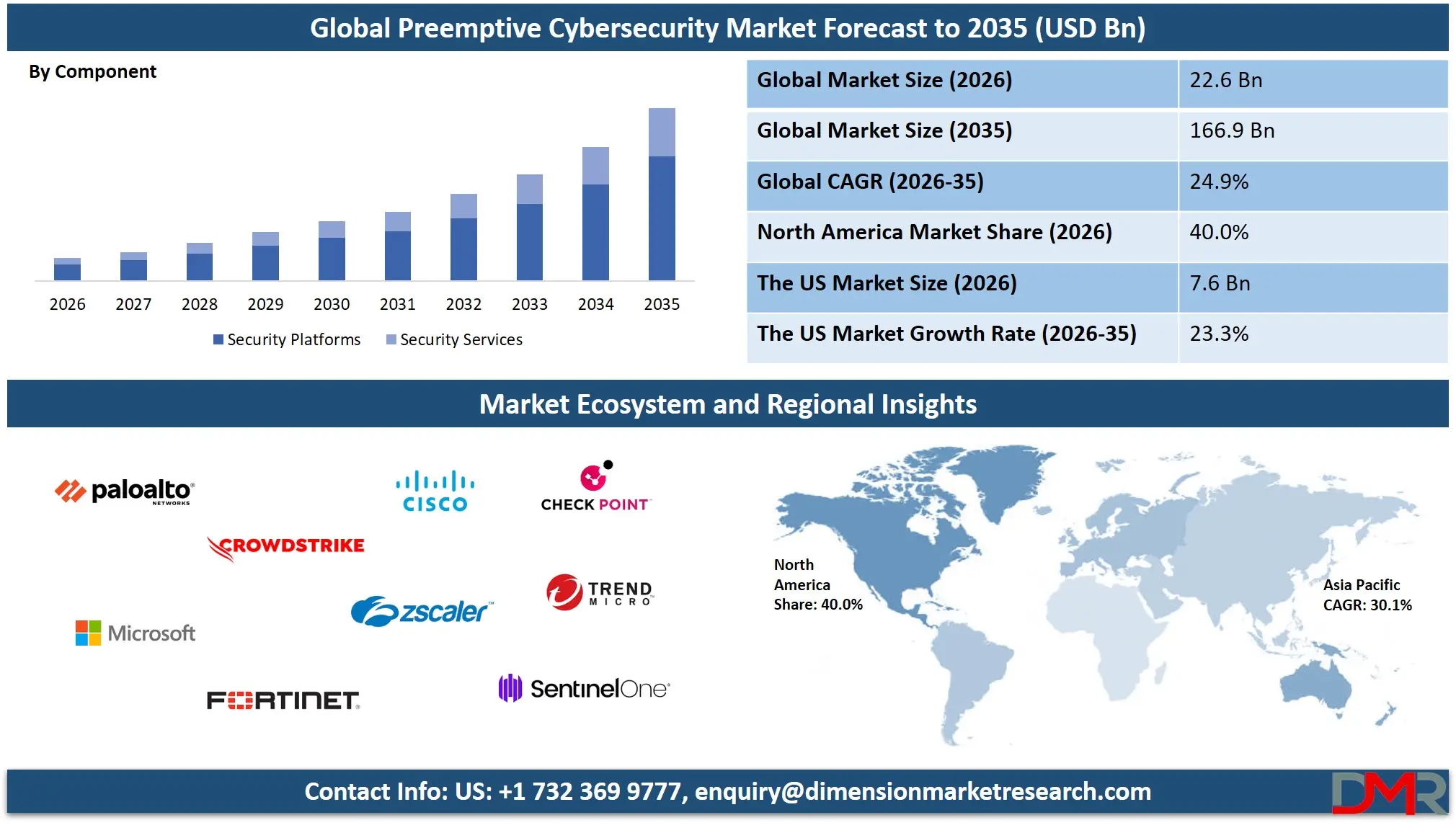
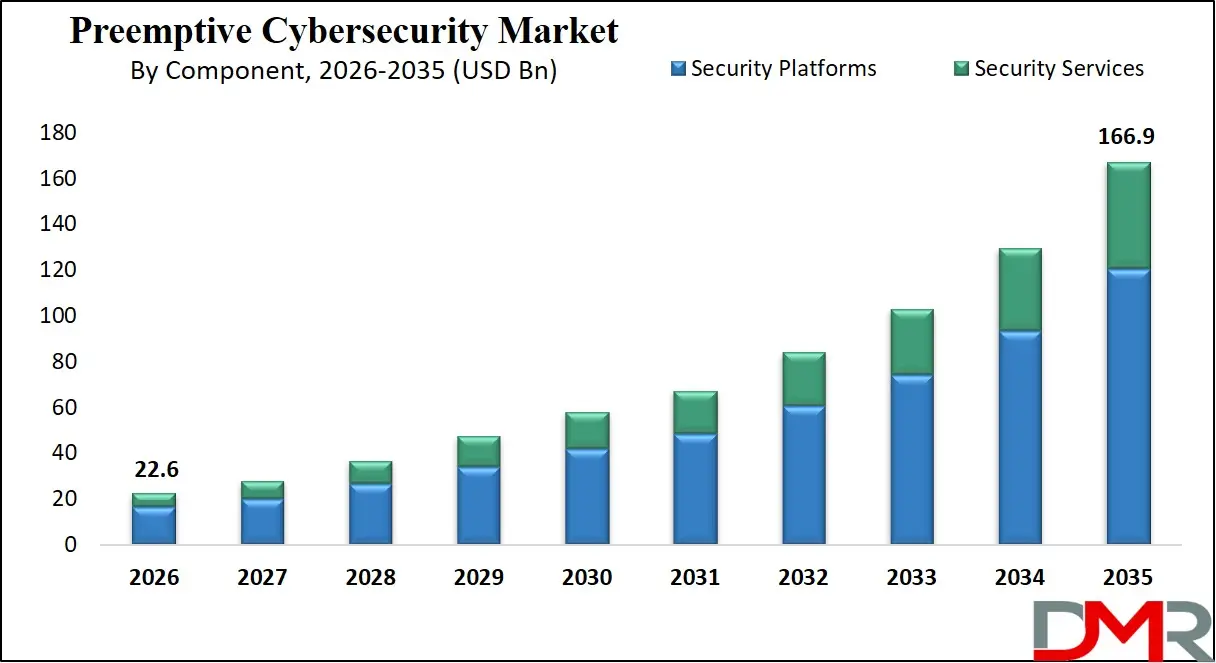
The Global Preemptive Cybersecurity Market is projected to reach USD 22.6 billion in 2026 and expand to USD 166.9 billion by 2035, growing at a CAGR of 24.9%. Preemptive cybersecurity focuses on identifying, anticipating, and mitigating cyber threats before they result in successful attacks or significant operational disruption. Unlike traditional reactive approaches, preemptive security combines artificial intelligence, predictive analytics, threat intelligence, continuous exposure management, and automated security controls to reduce vulnerabilities and disrupt potential attack pathways.
ℹ
To learn more about this report –
Download Your Free Sample Report Here
The increasing sophistication of cyberattacks, growing adoption of cloud computing, and expansion of interconnected digital environments are accelerating demand for proactive security technologies. Organizations are investing in AI-powered threat detection, attack surface management, automated vulnerability validation, and zero trust security frameworks to strengthen cyber resilience. Regulatory requirements and heightened concerns about critical infrastructure protection are also encouraging businesses to adopt continuous security monitoring and preventive risk management strategies.
Furthermore, the growing use of AI-driven security platforms enables organizations to analyze potential threats, identify abnormal behavior, prioritize critical vulnerabilities, and automate selected defensive actions. Increasing enterprise investment in predictive cybersecurity, cloud workload protection, and integrated security management is expected to support sustained market growth throughout the forecast period.
ℹ
To learn more about this report –
Download Your Free Sample Report Here
US Preemptive Cybersecurity Market
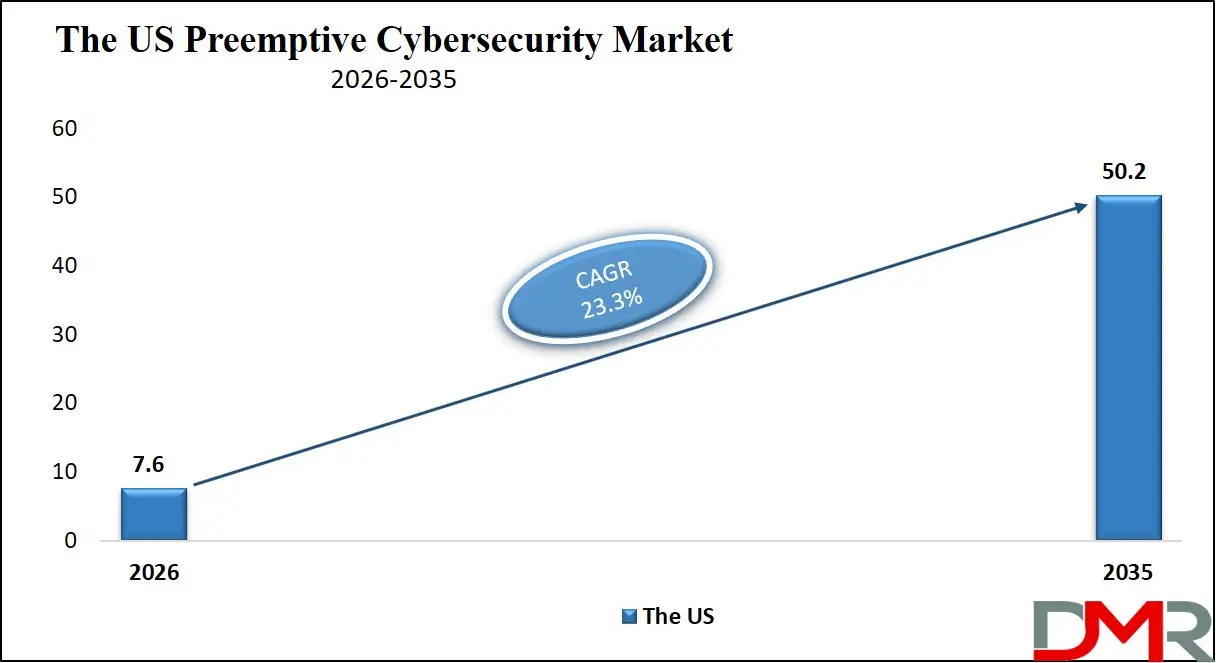
The US Preemptive Cybersecurity Market is projected to reach USD 7.6 billion in 2026 and grow at a compound annual growth rate of 23.3%, reaching USD 50.2 billion by 2035.
ℹ
To learn more about this report –
Download Your Free Sample Report Here
The U.S. Preemptive Cybersecurity Market is the global leader, with AI threat intelligence, zero trust, and predictive defense systems. The trend toward increasing attacks on critical infrastructure, BFSI, and cloud platforms contributes to growth and the need to protect proactively. Agencies such as CISA and DHS are enhancing unremitting checking and automatic action. Large adoption of cloud increases the demand for real-time risk and attack surface management. Vigorous investments and quick adoption of technology promote innovation. The U.S. is the most developed and powerful preemptive cybersecurity market in general.
Europe Preemptive Cybersecurity Market
Europe Preemptive Cybersecurity Market is anticipated to reach USD 5.5 billion in 2026, expanding at a CAGR of 23.7%, driven by increasing adoption of AI-based threat intelligence and zero trust security frameworks. Strong regulatory frameworks such as GDPR are pushing enterprises toward proactive cybersecurity investments. Rising cloud migration and cross-border data protection requirements are further accelerating demand. Growing focus on critical infrastructure protection is reinforcing market expansion across the region.
Japan Preemptive Cybersecurity Market
Japan Preemptive Cybersecurity Market is anticipated to reach USD 1.3 billion in 2026, expanding at a CAGR of 22.3%, driven by increasing adoption of AI-based cybersecurity and advanced threat detection systems. Rising digital transformation across manufacturing and telecom sectors is strengthening demand for proactive security solutions. Government-led initiatives focused on national cyber resilience are accelerating deployment of zero trust frameworks. Growing exposure to sophisticated cyber threats is further pushing enterprises toward predictive and automated defense systems.
Key Takeaways
- Market Size: The global Preemptive Cybersecurity Market is projected to reach USD 22.6 billion in 2026 and expand to USD 166.9 billion by 2035, reflecting strong adoption of AI-driven predictive and preventive security solutions across enterprises.
- Growth Rate and Outlook: The market is expected to grow at a CAGR of 24.9% from 2026 to 2035, driven by rising cyber threats, accelerated cloud adoption, and increasing deployment of proactive security frameworks.
- Primary Growth Drivers: Key growth drivers include increasing cyberattack sophistication, expansion of cloud and hybrid IT environments, rising use of AI-based threat intelligence systems, and stricter regulatory compliance requirements pushing preventive security adoption.
- By Component Analysis: Security Platforms dominate with 72% share in 2026, driven by demand for integrated AI-powered threat detection, attack surface management, and automated prevention systems.
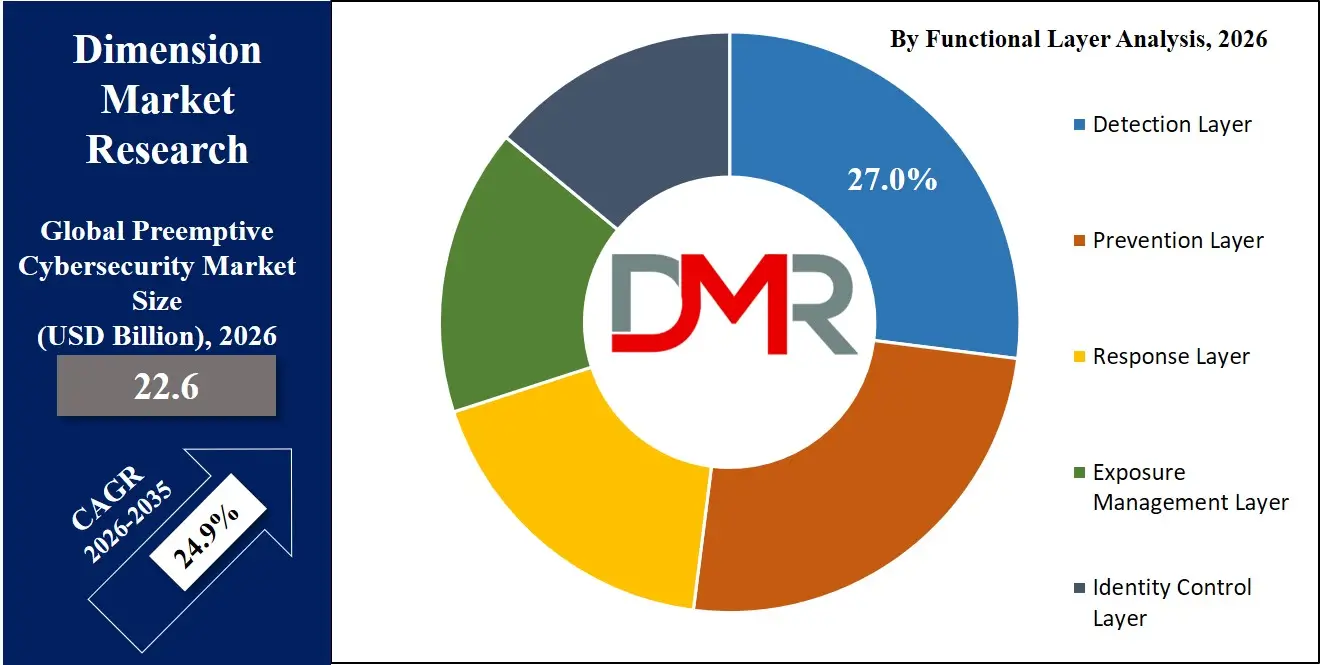
- By Functional Layer Analysis: Detection Layer leads with 27% share in 2026, supported by real-time threat identification, behavioral monitoring, and early-stage intrusion detection capabilities.
- By Technology Base Analysis: AI Security Systems hold 38% share in 2026, driven by machine learning, predictive analytics, and autonomous response capabilities across cybersecurity operations.
- Regional Leadership: North America leads the market with approximately 40% share in 2026, driven by advanced cybersecurity infrastructure, strong enterprise adoption, and high investment in AI-based security technologies.
What is Preemptive Cybersecurity?
Preemptive Cybersecurity is a proactive model of defense that prevents cyber threats prior to their implementation with the help of AI, machine learning, and behavioral analytics. It identifies initial action of the attackers like reconnaissance and lateral movement. International cybersecurity standards focus on the ongoing risk tracking and dynamic defense solutions to strengthen against changing threats. It puts the principles of zero trust in place to authenticate all users, devices and access requests before they are allowed access. Digital resilience models in the public sector encourage the disruption of threats and safeguarding of infrastructure early in critical systems. The major methods are attack surface reduction, deception settings, and automated threat elimination. In general, it is a transition to a predictive, intelligence-driven security environment that aims at preventing breaches early.
Stats & Facts
- Cybersecurity Incidents: The ENISA Threat Landscape 2025 analyzed 4,875 cybersecurity incidents recorded across its July 2024–June 2025 reporting period.
- Critical Infrastructure Exposure: ENISA's 2026 Threat Landscape reported that 73% of targeted organizations in its analyzed incidents were classified as essential or important entities under the NIS2 framework.
- Most Targeted Sector: Public administration accounted for 32% of targeted organizations in ENISA's 2026 analysis.
- Cybersecurity Framework: The NIST Cybersecurity Framework 2.0, published in February 2024, identifies six core functions: Govern, Identify, Protect, Detect, Respond, and Recover.
- Preventive Security: NIST emphasizes continuous risk identification, protection, and detection activities as important components of comprehensive cybersecurity risk management.
- Security Validation Investment: In March 2025, Pentera announced USD 60 million in Series D funding to expand its automated security validation capabilities.
Use Cases
- Critical Infrastructure Protection: Preemptive cybersecurity is used to safeguard energy grids, transportation systems, and utilities from advanced persistent threats. It enables early detection of intrusion attempts targeting operational technology environments. Automated response systems help prevent disruptions before physical or digital damage occurs.
- Financial Fraud Prevention: Banks and financial institutions use preemptive cybersecurity to detect suspicious transactions and identity anomalies in real time. AI-driven behavioral analytics identify fraud patterns before transactions are completed. This reduces financial losses and strengthens regulatory compliance.
- Cloud Workload Security: Enterprises use preemptive security to monitor cloud environments for misconfigurations and abnormal access behavior. It predicts potential breach paths across multi-cloud and hybrid infrastructures. Automated controls neutralize risks before workloads are compromised.
- Insider Threat Detection: Organizations apply preemptive cybersecurity to identify risky employee behavior and unauthorized data access attempts. Machine learning models track deviations from normal user activity patterns. Early alerts help prevent data leakage and internal sabotage.
How AI is Transforming the Preemptive Cybersecurity Market?
The preemptive cybersecurity industry is being revolutionized by AI as it allows predicting threats in real-time based on sophisticated behavioral analytics and machine learning algorithms. It reinforces early monitoring of the attack patterns, and systems can detect and prevent threats prior to execution.
Automation powered by AI is faster to respond, as it isolates risks and mitigates vulnerabilities in real-time. In general, it is transforming cybersecurity into reactive monitoring to intelligent and self-adaptive prevention mechanisms.
Market Dynamics
Key Drivers in the Global Preemptive Cybersecurity Market
Rapid Cloud Adoption and Digital Transformation
Businesses are quickly embracing cloud-based and hybrid solutions, exposing them to cyber risks. This is stimulating the need to have proactive and predictive security systems. Organizations require real-time distributed environments visibility. Preemptive cybersecurity assists in securing workloads in multi-cloud environments. The trend is gaining momentum in the world towards enhanced security platforms.
Increasing Sophistication of Cyber Threats
The level of cyberattacks is advancing, with AI and automation to avoid more classic defense mechanisms. Organizations are becoming exposed to zero-day and multi-vector attacks. This is driving the need to have predictive and behavior-based security models. Businesses are investing in threat intelligence and analytics software. A significant growth factor is the changing threat environment.
Restraints in the Global Preemptive Cybersecurity Market
High Deployment Complexity
Preemptive cybersecurity needs sophisticated infrastructures and competent expertise to execute it. It can be challenging and time-consuming to integrate with legacy systems. There are numerous organizations that encounter operational difficulties in the course of deployment. Small businesses are faced with cost and technical impediments. This curtails quicker market penetration.
Data Privacy and Regulatory Compliance Challenges
Continuous behavioral monitoring and data collection raise privacy and compliance concerns. In most areas, there are stringent rules that limit data gathering and use. Implementation is more complex due to compliance requirements. Organizations need to strike a balance between security requirements and the law. These aspects slow down adoption of regulated industries.
Growth Opportunities in the Global Preemptive Cybersecurity Market
Expanding Cyber Risk Landscape
The organizations are experiencing an increase in complex cyberattacks against cloud, networks, and endpoints. This is driving up the need of proactive and predictive security solutions. Businesses are moving towards preventive rather than reactionary models. The attack surface is further broadening due to the continuous digitalization. This is greatly driving market growth in the world.
Increasing Adoption of AI-Driven Security
Machine learning and AI are now at the core of a new cybersecurity paradigm. Organisations are implementing smart technologies to predict real-time threats and respond automatically to them. These technologies make it shorter to detect, and more accurate. The use of AI-based security platforms is increasing as more money is invested in them. This is contributing greatly towards market growth.
Trends in the Global Preemptive Cybersecurity Market
Shift Toward Zero Trust Architecture
Zero trust models are fast being adopted by organizations to eradicate the implicit access trust. Access requests are always authenticated to minimize the risk of breaches. The model is gaining popularity in enterprise security models. It is closely connected with the principles of preemptive cybersecurity. There is a growing adoption both in the public and private sector.
Growth of Autonomous Security Systems
The future of cybersecurity is moving towards autonomous and automated security. Such systems have the ability to identify, process and react to threats automatically. This decreases the reaction period and operational load on security staffs. The trend towards automation with AI is becoming a staple of the market. It is transforming the way organizations deal with cyber defense.
Research Scope and Analysis
By Component Analysis
The Preemptive Cybersecurity Market is projected to be dominated by the security platforms segment with 72.0% share in the component segment in the year 2026 due to the need to have AI based threat intelligence, attack surface management and automated preventive systems. Companies would like to have single-source solutions of real-time, predictive cloud and network security. Security Services contribute to this ecosystem by providing managed security, consulting, and integration to streamline deployments and operations. They assist organizations in maintaining constant monitoring, enhance effectiveness in responding, and compliance. The services prove particularly valuable to companies that do not have cybersecurity specialists in-house.
By Functional Layer Analysis
The Detection Layer is projected to dominate the Global Preemptive Cybersecurity Market, accounting for approximately 27.0% of total market revenue in 2026. Although preemptive cybersecurity emphasizes preventing attacks before they cause damage, early-stage detection is an essential component of proactive defense. Advanced detection technologies identify suspicious behavior, attacker reconnaissance, anomalous network activity, and potential exploitation attempts before they escalate into successful security breaches.
ℹ
To learn more about this report –
Download Your Free Sample Report Here
AI-powered behavioral analytics, real-time monitoring, and predictive threat intelligence enable organizations to identify early warning signals and initiate preventive action. Meanwhile, the Prevention Layer focuses on reducing attack exposure through automated blocking, zero trust enforcement, access restrictions, and security policy management. The Exposure Management Layer further strengthens proactive security by identifying and prioritizing exploitable weaknesses before attackers can take advantage of them. Together, these functional layers enable organizations to shift from incident-focused response toward continuous risk reduction and early threat disruption.
By Technology Base Analysis
The Preemptive Cybersecurity Market is projected to be dominated by AI Security Systems that are projected to take a 38.0% share in the technology base segment of the market in 2026 due to their capability to deliver predictive threat detection services, automated incident response services and adaptive defense services based on machine learning and behavioral analysis. These systems continuously update themselves with attack patterns to enhance accuracy and speed of prevention of threats. Data Analytics Engines help this ecosystem, by processing high volumes of security data to detect anomalies, correlations, and trending threat patterns. They serve as the baseline intelligence layer that supplies AI models with organised insights to make decisions.
By Security Domain Analysis
The security domain segment of the Preemptive Cybersecurity Market is likely to be dominated by Network Security Domain with a share of 28.0% in 2026, due to the growing demand to secure enterprise network systems against advanced persistent threats, intrusion attacks and lateral movement attacks. It allows real-time monitoring of traffic, detection of anomalies as well as blocking threats in a complex network infrastructure. This is complemented by Cloud Security Domain that protects the data, applications and workloads that are stored in the public, private and hybrid cloud environments. It concentrates on the misconfiguration detection, identity protection, and workload security in distributed cloud systems. Collectively, the two domains provide end-to-end protection of the core digital infrastructures.
By Architecture Type Analysis
AI-driven Security Architecture is expected to dominate the Global Preemptive Cybersecurity Market, accounting for approximately 36.0% of market revenue in 2026. This segment benefits from growing adoption of machine learning, predictive threat intelligence, behavioral analytics, and automated defense technologies that enable organizations to anticipate and mitigate potential cyberattacks.
Security Mesh Architecture supports the integration of distributed security controls across cloud platforms, endpoints, networks, and applications. Meanwhile, Zero Trust Security Architecture strengthens identity verification, access management, and continuous authorization by eliminating implicit trust. Exposure Management Architecture focuses on identifying, prioritizing, validating, and reducing exploitable vulnerabilities across enterprise environments. Together, these architectures support proactive threat prevention and improved cyber resilience.
By Operation Mode Analysis
Continuous Monitoring Mode is expected to dominate the operational mode segment of the Preemptive Cybersecurity Market with a 30.0% share in 2026, driven by the need for real-time visibility into network activity, user behavior, and system anomalies across complex digital environments. It enables uninterrupted tracking of security events to detect threats at the earliest stage. Predictive Defense Mode complements this by using AI and behavioral analytics to anticipate potential attacks before they occur and trigger automated preventive actions. It focuses on forecasting risk patterns and neutralizing threats proactively.
By Deployment Model Analysis
Cloud-native will take control of the deployment model category of the Preemptive Cybersecurity Market with a 62.0% share in 2026, due to the adoption pace of scalable, flexible, and AI-enhanced security solutions by cloud-first companies. It allows detection of threats in real time, automatic reaction, and unified protection of distributed environments. This is complemented with hybrid deployment, which integrates on-premise infrastructure and cloud-based security systems to offer a higher level of control, data sovereignty, and flexibility of gradual migration to the cloud. Several industries that are controlled and are in need of balanced security and compliance use it extensively. Both models can be used together to enable safe and scalable enterprise cybersecurity policies.
By Organization Size Analysis
The organization size segment of the Preemptive Cybersecurity Market is projected to be dominated by Large Enterprises with a share of 67.0% in 2026 because of their complex IT infrastructure, high-value data assets, and being more vulnerable to advanced cyber threats. To safeguard their operations internationally, they spend a lot of money on AI-based security, predictive analytics, and automated defense mechanisms. On the other hand, SMEs are turning to cheaper cloud-based cybersecurity systems as they seek to deal with the growing cyber threats with minimal budgets and internal knowledge. Managed security services and scalable subscription-based models make their adoption possible.
By Industry Vertical Analysis
BFSI is expected to dominate the industry vertical segment of the Preemptive Cybersecurity Market with a 24.0% share in 2026, driven by the high frequency of cyber fraud, digital payment risks, and sensitive financial data protection requirements. It heavily relies on AI-driven threat detection, fraud analytics, and real-time transaction monitoring. Government & Defense complements this by focusing on national security, critical infrastructure protection, and defense network resilience against advanced persistent threats. It adopts strict zero trust frameworks and proactive cyber defense strategies to prevent state-sponsored and large-scale cyberattacks. Together, both sectors are key drivers of advanced cybersecurity adoption.
The Global Preemptive Cybersecurity Market Report is segmented on the basis of the following:
By Component
- Security Platforms
- Threat Intelligence Systems
- Attack Surface Management Systems
- Security Orchestration Systems
- Deception Systems
- Security Services
- Managed Security Services
- Consulting and Integration Services
By Functional Layer
- Detection Layer
- Prevention Layer
- Response Layer
- Exposure Management Layer
- Identity Control Layer
By Technology Base
- AI Security Systems
- Data Analytics Engines
- Deception Technologies
- Security Automation
- Post-quantum Security
By Security Domain
- Network Security Domain
- Cloud Security Domain
- Endpoint Security Domain
- Identity & Access Domain
- Data Security Domain
By Architecture Type
- AI-driven Security Architecture
- Security Mesh Architecture
- Zero Trust Security Architecture
- Exposure Management Architecture
By Operation Mode
- Continuous Monitoring Mode
- Predictive Defense Mode
- Active Mitigation Mode
- Risk Hardening Mode
By Deployment Model
- Cloud-native
- Hybrid
- On-premises
By Organization Size
By Industry Vertical
- BFSI
- Government & Defense
- IT & Telecom
- Healthcare
- Manufacturing
- Retail & E-commerce
- Energy & Utilities
Regional Analysis
Leading Region by Market Share
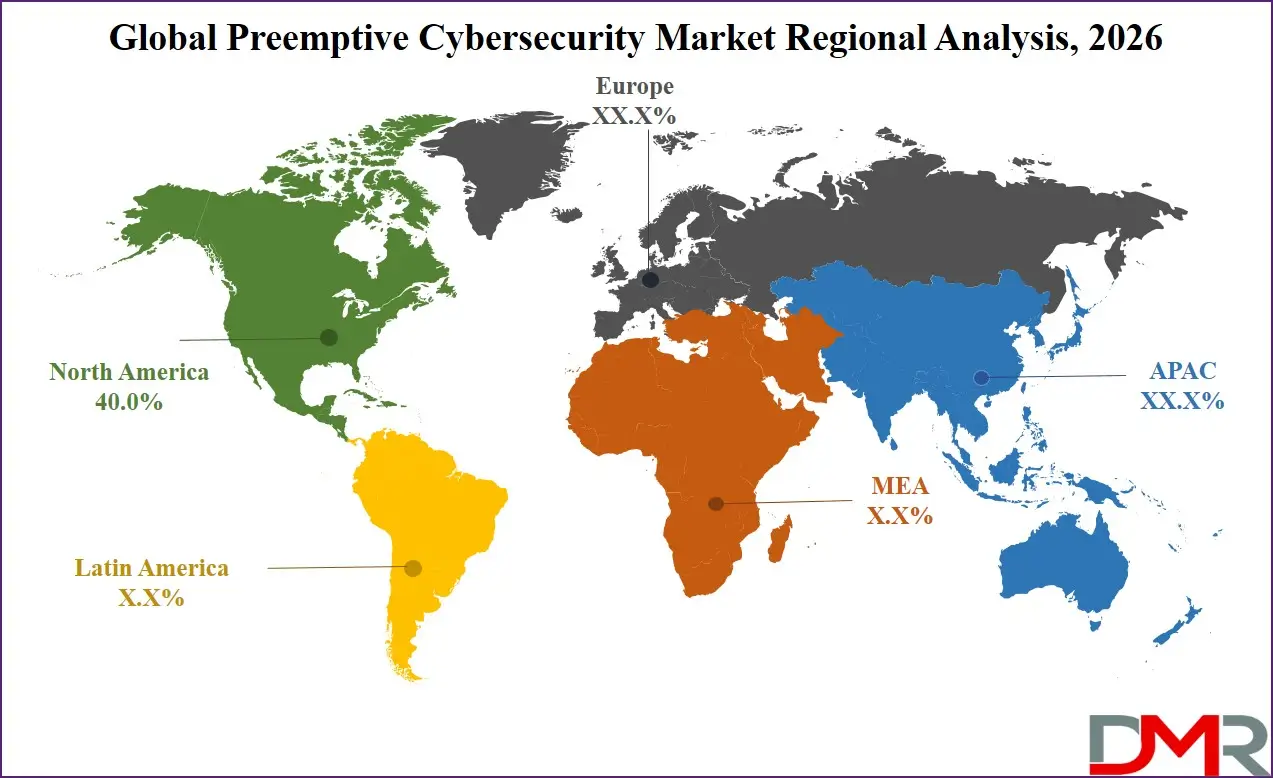
North America is expected to lead the Preemptive Cybersecurity Market with a 40.0% share in 2026, driven by strong adoption of AI-based security, zero trust frameworks, and advanced threat intelligence systems. The region benefits from high cybersecurity investments and early technology adoption across enterprises and government sectors. Presence of major tech infrastructure and rising cyber threats further strengthen its market dominance.
ℹ
To learn more about this report –
Download Your Free Sample Report Here
Fastest-Growing Regional Market
Asia Pacific is expected to be the fastest-growing regional market in preemptive cybersecurity, driven by rapid digital transformation, expanding cloud adoption, and increasing cyber threat exposure across enterprises and governments. Strong investments in national cybersecurity frameworks and AI-based security technologies are accelerating demand. The region is witnessing high growth in smart infrastructure, fintech, and telecom sectors, further boosting adoption of proactive security solutions.
By Region
North America
Europe
- Germany
- The U.K.
- France
- Italy
- Russia
- Spain
- Benelux
- Nordic
- Rest of Europe
Asia-Pacific
- China
- Japan
- South Korea
- India
- ANZ
- ASEAN
- Rest of Asia-Pacific
Latin America
- Brazil
- Mexico
- Argentina
- Colombia
- Rest of Latin America
Middle East & Africa
- Saudi Arabia
- UAE
- South Africa
- Israel
- Egypt
- Rest of MEA
Competitive Landscape
The competitive landscape of the Preemptive Cybersecurity Market is driven by rapid innovation in AI-based threat detection, predictive analytics, and automated defense systems. Players are focusing on integrated platforms for end-to-end security across cloud, network, and endpoints. Competition is increasing with adoption of zero trust and real-time threat intelligence. Continuous R&D and partnerships are shaping a fast-evolving, technology-driven market.
Some of the Prominent Players in the Global Preemptive Cybersecurity Market Are:
- Palo Alto Networks, Inc.
- CrowdStrike Holdings, Inc.
- Microsoft Corporation
- Fortinet, Inc.
- Cisco Systems, Inc. (Splunk)
- Check Point Software Technologies Ltd.
- Zscaler, Inc.
- SentinelOne, Inc.
- Trend Micro Incorporated
- International Business Machines Corporation (IBM)
- Amazon.com, Inc. (Amazon Web Services)
- Alphabet Inc. (Google Cloud)
- Cloudflare, Inc.
- Okta, Inc.
- CyberArk Software Ltd.
- Rapid7, Inc.
- Tenable Holdings, Inc.
- Proofpoint, Inc.
- Darktrace
- Other Key Players
Recent Developments
- July 2026: Picus Security launched its Autonomous Exposure Validation Platform, integrating breach and attack simulation, autonomous penetration testing, and exposure validation into a unified system. The platform helps enterprises identify exploitable weaknesses, validate security controls, prioritize remediation, and verify that vulnerabilities have been addressed.
- January 2026: Pentera announced that its annual recurring revenue had exceeded USD 100 million, reflecting increasing enterprise investment in automated security validation. The company highlighted the expansion of its adversarial exposure validation capabilities and AI-powered remediation workflows.
- March 2025: Pentera secured USD 60 million in Series D funding led by Evolution Equity Partners, with participation from Farallon Capital Management. The investment was intended to support the company's expansion in automated security validation and continuous threat exposure management.
Report Details
| Report Characteristics |
| Market Size (2026) |
USD 22.6 Bn |
| Forecast Value (2035) |
USD 166.9 Bn |
| CAGR (2026–2035) |
24.9% |
| Historical Data |
2021 – 2025 |
| Forecast Data |
2027 – 2035 |
| Base Year |
2025 |
| Estimate Year |
2026 |
| Segments Covered |
By Component (Security Platforms, Security Services),
By Functional Layer (Detection Layer, Prevention Layer, Response Layer, Exposure Management Layer, Identity Control Layer),
By Technology Base (AI Security Systems, Data Analytics Engines, Deception Technologies, Security Automation, Post-quantum Security),
By Security Domain (Network Security Domain, Cloud Security Domain, Endpoint Security Domain, Identity & Access Domain, Data Security Domain),
By Architecture Type (AI-driven Security Architecture, Security Mesh Architecture, Zero Trust Security Architecture, Exposure Management Architecture),
By Operation Mode (Continuous Monitoring Mode, Predictive Defense Mode, Active Mitigation Mode, Risk Hardening Mode),
By Deployment Model (Cloud-native, Hybrid, On-premises),
By Organization Size (Large Enterprises, SMEs),
By Industry Vertical (BFSI, Government & Defense, IT & Telecom, Healthcare, Manufacturing, Retail & E-commerce, Energy & Utilities) |
| Regional Coverage |
North America – The US and Canada;
Europe – Germany, The UK, France, Russia, Spain, Italy, Benelux, Nordic, & Rest of Europe;
Asia-Pacific – China, Japan, South Korea, India, ANZ, ASEAN, Rest of APAC;
Latin America – Brazil, Mexico, Argentina, Colombia, Rest of Latin America;
Middle East & Africa – Saudi Arabia, UAE, South Africa, Turkey, Egypt, Israel, & Rest of MEA |
Frequently Asked Questions
How big is the Preemptive Cybersecurity Market?
▾ The global Preemptive Cybersecurity Market is projected to reach USD 22.6 billion in 2026 and expand to USD 166.9 billion by 2035, driven by rising demand for AI-based predictive and preventive security solutions.
What is the CAGR of the Preemptive Cybersecurity Market from 2026 to 2035?
▾ The market is expected to grow at a CAGR of 24.9% from 2026 to 2035, supported by increasing cyber threats, digital transformation, and adoption of proactive security frameworks.
What factors are driving the growth of the Preemptive Cybersecurity Market?
▾ Growth is driven by rising cyberattacks, rapid cloud and digital adoption, increasing use of AI-driven security systems, and stricter regulatory and compliance requirements. Organizations are shifting from reactive defense to predictive threat prevention models.
What are the major trends in the Preemptive Cybersecurity Market?
▾ Key trends include adoption of zero trust architecture, AI-powered threat intelligence, automated security orchestration, predictive risk analytics, and expansion of continuous monitoring and autonomous defense systems.
Which region held the largest share of the Preemptive Cybersecurity Market in 2026?
▾ North America held the largest share in 2026 at around 40%, driven by advanced cybersecurity infrastructure, high enterprise adoption, strong government initiatives, and significant defense spending.
Which region is expected to grow the fastest in the Preemptive Cybersecurity Market?
▾ Asia Pacific is expected to record the fastest growth, supported by rapid digitalization, expanding cloud ecosystems, increasing cyber threats, and strong government investments in cybersecurity modernization.
Who are the key players in the Preemptive Cybersecurity Market?
▾ Key players include Palo Alto Networks, CrowdStrike, Microsoft, Fortinet, Cisco, Check Point Software, Zscaler, SentinelOne, Trend Micro, IBM Security, AWS Security, Google Cloud Security, Cloudflare, Okta, CyberArk, Splunk, Rapid7, Tenable, Proofpoint, Darktrace, and other emerging vendors.
How is the Preemptive Cybersecurity Market segmented?
▾ The market is segmented by Component, Functional Layer, Technology Base, Security Domain, Architecture Type, Operational Mode, Deployment Model, Organization Size, and Industry Vertical.