Market Overview
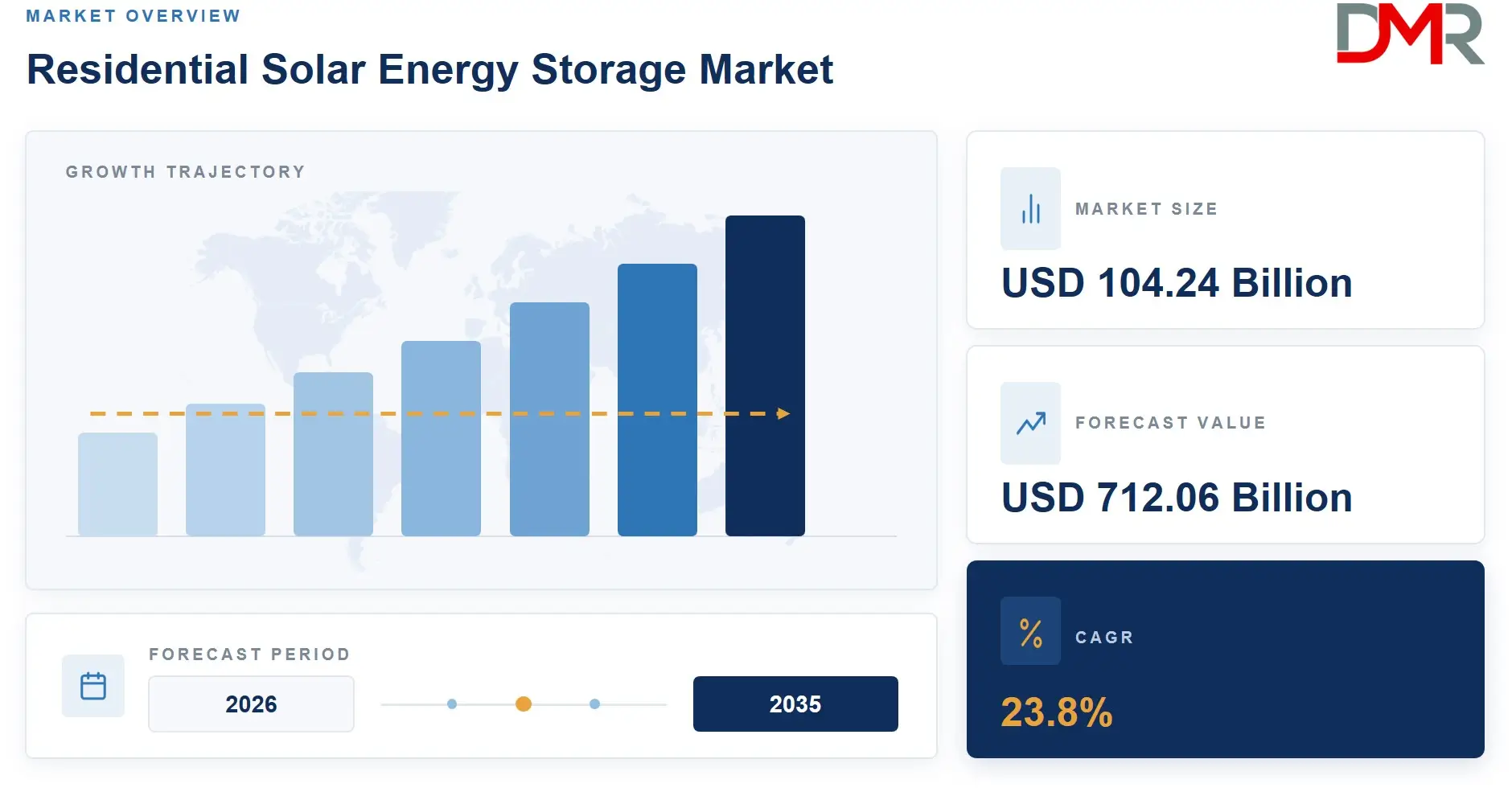
The Global Residential Solar Energy Storage Market size is estimated at USD 104.24 Billion in 2026, and is projected to reach USD 712.06 Billion by 2035, exhibiting a CAGR of 23.8% during the forecast period. Household adoption climbed steadily as battery prices fell and grid reliability worries spread across major economies. Solar installers folded storage into standard proposals rather than pitching it as an add-on, a shift that pulled demand forward across income segments. Global battery storage deployment reached 108 GW in 2025, a jump of 40% over 2024 and eleven times the volume recorded in 2021, according to Residential Battery Energy Storage Systems tracking by the International Energy Agency. That trajectory signals a market moving past early adoption into mainstream infrastructure planning for homeowners and utilities alike. A correctly sized home battery raises solar self-consumption from a typical 25-40% in solar-only setups to 60-90% in 2025 residential configurations, as reported by SolarTech Online. Homeowners now capture far more of their own generated power instead of exporting it at reduced compensation rates. This shift changes the entire value proposition of rooftop solar, turning batteries into the component that determines whether a system pays for itself on the homeowner's terms or the utility's.
This market covers battery systems, inverters, and controllers built for single-family and multi-family residential use. It excludes utility-scale and commercial-industrial storage installations. Energy Storage Systems connect residential storage to the broader distributed energy resource industry, where aggregators increasingly treat home batteries as dispatchable grid assets rather than isolated backup devices.
ℹ
To learn more about this report –
Download Your Free Sample Report Here
Key Takeaways
- The market size is USD 104.24 Billion in 2026, and is projected to hit USD 712.06 Billion by 2035 at a CAGR of 23.8%.
- By Power Rating: 3 kW-6 kW led with a 55.2% share in 2026.
- By Technology: Lithium-Ion led with a 98.8% share in 2026.
- By Connectivity: On-Grid led with a 77.8% share in 2026.
- By Ownership: Customer-Owned led with a 69.5% share in 2026.
- By System Configuration: DC-Coupled led with a 50.4% share in 2026.
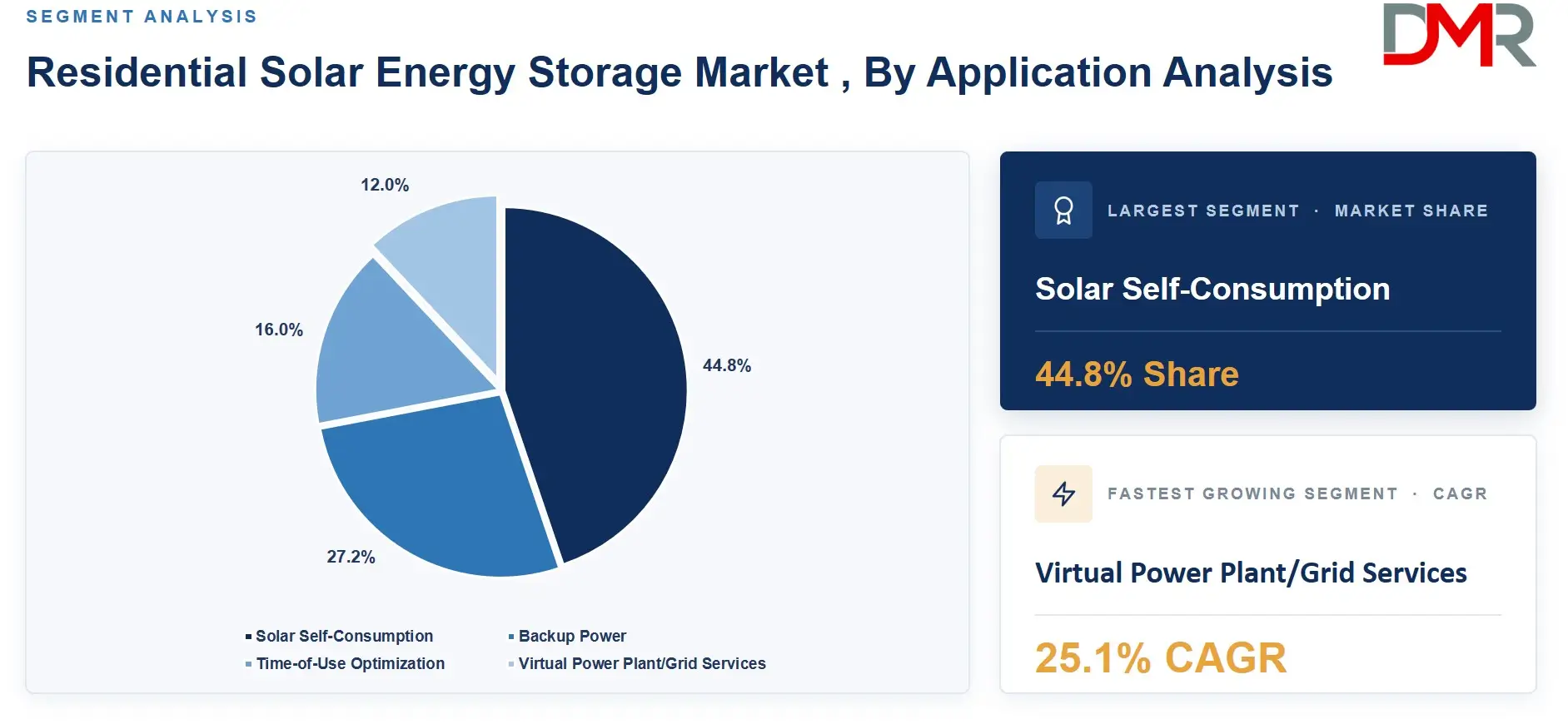
- By Application: Solar Self-Consumption led with a 44.8% share in 2026.
- By Region: Europe led with a 37.8% share, valued at USD 31.1 Billion, in 2026.
- Top 5 key players: Schneider Electric SE, Tesla Inc., Enphase Energy Inc., LG Energy Solution, and ABB Ltd.
Power Rating Analysis
3 kW-6 kW captured 55.2% of the power rating segment in 2026, ahead of all rivals. Most single-family homes in developed markets run daily loads that fit squarely inside the 3 kW-6 kW band, which is why installers default to this range for standard proposals. A 2025 model-based optimization study found self-consumption rising from 18% with no storage to 25% at 4 kWh of battery capacity, then flattening beyond 6 kWh, according to ScienceDirect research. That plateau explains why vendors concentrate engineering investment in this exact range instead of chasing larger pack sizes. Systems rated below 3 kW serve smaller apartments and budget-conscious buyers, while units above 6 kW target larger homes running heat pumps and EV chargers. A typical 13.5 kWh residential battery system cost about $15,647 in 2026, with whole-home configurations above 25 kWh running $25,000 to $45,000 or more, based on data from AVE Battery. Vendors below the mainstream band compete on price. Vendors above it compete on whole-home electrification bundling.
Technology Analysis
With a 98.8% share in 2026, Lithium-Ion outpaced all other technology categories. Lithium-ion chemistry dominates because it delivers higher energy density and longer cycle life than lead-acid at a comparable installed footprint. Lithium-ion systems in 2025 achieve 88-94% AC round-trip efficiency, with battery-level DC efficiency reaching 95-98%, as per Sunlit Energy figures. That efficiency gap keeps lead-acid confined to legacy retrofits and off-grid budget installs where upfront cost outweighs long-term performance. Lead-acid holds the remaining share almost entirely through replacement cycles on older installed systems. Few new residential projects specify lead-acid today, since Solar Energy and Battery Storage buyers increasingly demand the cycle life and depth of discharge that only lithium chemistry supports at scale.
Connectivity Analysis
On-Grid accounted for 77.8% of connectivity demand in 2026, the highest of any category. Grid-tied systems dominate because most residential buyers want net metering credits alongside backup capability, not full energy independence. Off-grid remains a niche choice for rural properties beyond utility reach or buyers pursuing complete self-sufficiency. Net metering policy rollbacks in states like California, Nevada, and Hawaii are pushing on-grid customers toward self-consumption strategies rather than pure export models, which sustains on-grid dominance while changing how those systems get used.
Ownership Analysis
Customer-Owned systems led the ownership segment as the largest category in 2026. Homeowners who buy their systems outright capture the full economic upside from tax credits and utility bill savings, which keeps direct ownership the preferred path where financing is accessible. Third-party ownership models serve buyers without upfront capital or strong credit profiles, while utility-owned programs remain rare and concentrated in pilot markets. Financing innovation including PACE loans and HELOC-linked products could shift this balance by unlocking storage demand among lower credit score households who currently sit outside the ownership pool.
System Configuration Analysis
DC-Coupled systems accounted for 50.4% of system configuration demand in 2026, the highest of any category. DC-coupled architecture wins on efficiency because power moves between panels and battery without an extra AC conversion step, cutting energy loss during charging. AC-coupled systems remain common in retrofit scenarios where an existing solar inverter is already installed and swapping it out adds unnecessary cost. Hybrid integrated systems are gaining ground fastest, since manufacturers now bundle inverter, battery, and controller into single enclosures that simplify installer labor and shrink the physical footprint installers need on a garage wall.
Application Analysis
Solar Self-Consumption captured 44.8% of the application segment in 2026, ahead of all rivals. Buyers install batteries primarily to use more of their own generated power rather than sell it back at reduced export rates. For an Irish home in 2025, self-consumption without a battery runs 30-50%, and adding a battery lifts it to 60-80%, according to Solarinfo.ie figures, a pattern echoed across most net-metered markets. That gap is the entire economic argument installers use to convert a solar-only customer into a solar-plus-storage customer. Backup Power ranks second as extreme weather grid outages turn batteries into resilience infrastructure rather than a financial nice-to-have. Time-of-Use Optimization is growing among buyers on dynamic tariffs, while Virtual Power Plant participation is the fastest-growing application as utilities pay households directly for Solar-plus-Storage grid dispatch access. That VPP shift turns a static asset sitting in a garage into a revenue-generating grid resource.
ℹ
To learn more about this report –
Download Your Free Sample Report Here
Key Market Segments
By Power Rating
- ≤3 kW
- 3 kW-6 kW
- 6 kW and above
By Technology
By Connectivity
By Ownership
- Customer-Owned
- Third-Party Owned
- Utility-Owned
By System Configuration
- DC-Coupled
- AC-Coupled
- Hybrid Integrated Systems
By Application
- Solar Self-Consumption
- Backup Power
- Time-of-Use Optimization
- Virtual Power Plant/Grid Services
Regional Analysis
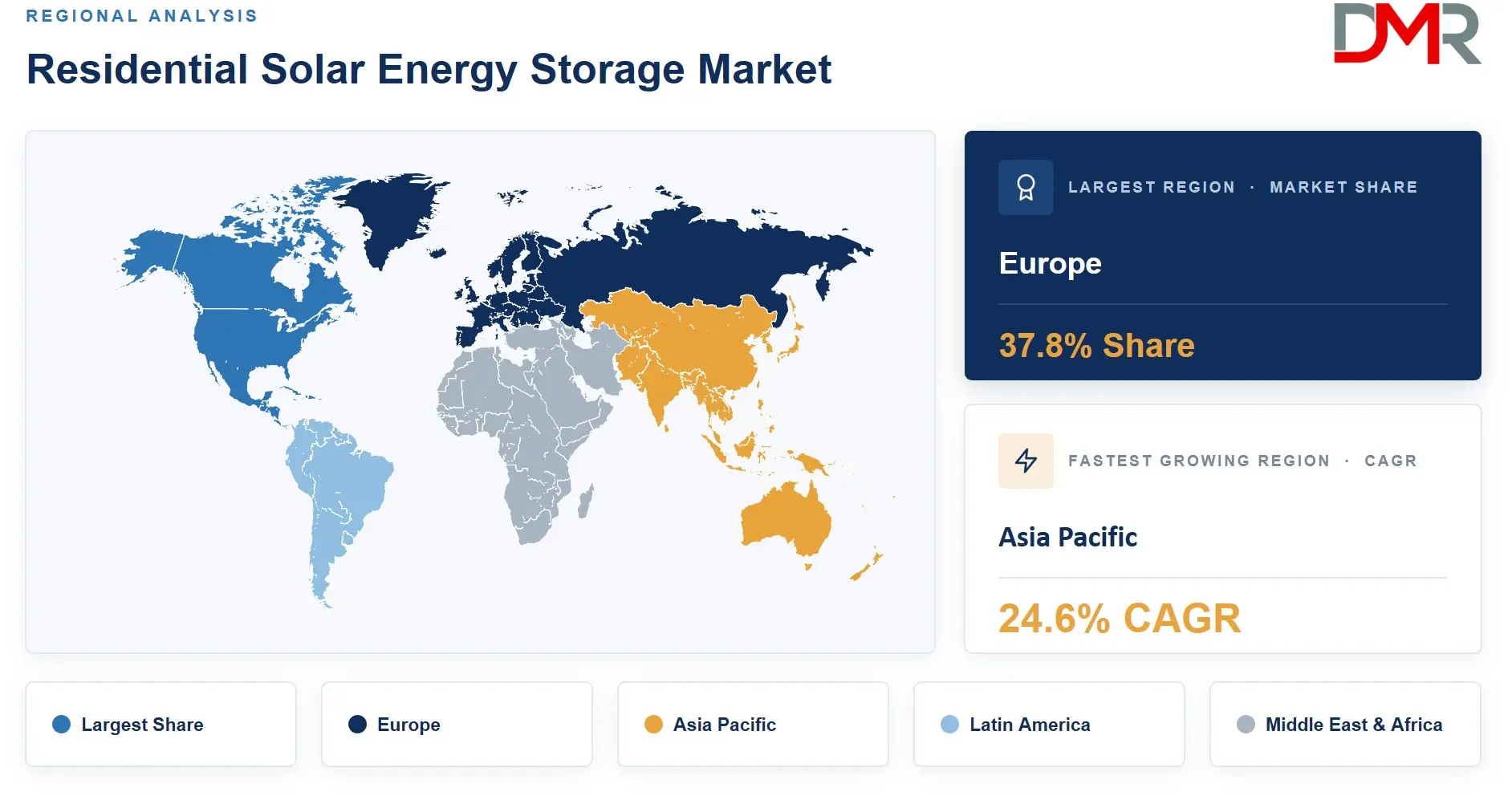
Europe led the market with a 37.8% share, valued at USD 31.1 Billion, in 2026.
Europe
Europe's dominance rests on high electricity prices and a policy environment that rewards self-consumption over grid export. Germany's feed-in tariff structure makes storage nearly mandatory for any homeowner chasing a reasonable payback period. That pricing pressure, more than any single subsidy, keeps European households buying batteries at a pace few other regions match. Homeowners across the region increasingly pair storage with Distributed Energy Resources programs run by regional grid operators, converting individual batteries into aggregated capacity that utilities can call on during peak demand. Germany, France, and the UK anchor volume, while Southern European markets are catching up as summer cooling loads strain local grids.
Asia Pacific
Asia Pacific is the fastest-growing region, driven by two very different national stories. In India, the average residential solar payback period after the PM Suryaghar subsidy runs 3-5 years, and 1.5-2.5 years for high-bill households with strong tariffs, based on data from Heaven Green Energy. That short payback window is pulling first-time solar buyers straight into storage instead of treating it as a future upgrade. Australia shows what happens when a rebate program lands directly on installer economics. The country recorded 19,592 solar battery installations in July 2025 alone, the first month of the Cheaper Home Batteries program, totaling 344.1 MWh of nominal capacity, according to SolarQuotes data. Average battery capacity jumped from 11-12 kWh in early 2025 to 18.2 kWh that same July, and the Clean Energy Regulator logged 271,528 installations across 2025 overall. Momentum carried into the back half of the year, with 183,245 batteries sold in the second half of 2025 per the Clean Energy Council.
ℹ
To learn more about this report –
Download Your Free Sample Report Here
North America
United States attachment rates roughly doubled from about 20% in 2022 to 40-45% in 2025-2026, with California reaching 69% in 2026, according to Wood Mackenzie and SEIA figures cited by SurgePV. Sunrun alone installed 392 MWh of home batteries in Q2 2025, up 48% from the prior year, and had reached more than 237,000 storage customers representing roughly 4.0 GWh of networked capacity by the end of 2025. Extreme weather outage frequency across the region keeps converting cautious buyers into committed storage customers.
Key Regions and Countries
North America
Europe
- Germany
- France
- The UK
- Spain
- Italy
- Rest of Europe
Asia Pacific
- China
- Japan
- South Korea
- India
- Australia
- Rest of APAC
Latin America
- Brazil
- Mexico
- Rest of Latin America
Middle East & Africa
- GCC
- South Africa
- Rest of MEA
Macroeconomic Impact
Federal tax policy sets the floor for household adoption more than any other macro variable. A Stanford study found that 63% of US households could weather local or regional blackouts using a solar-battery system, meeting roughly half their electricity needs during an outage, a resilience calculation that households increasingly weigh alongside pure financial return. Removing the federal tax credit would drop the share of households for which solar-battery systems are economically viable from 60% down to about 32%, per the same Stanford research. Interest rate movements shape financing-dependent buyers most directly, since third-party ownership and loan products carry monthly payments tied to prevailing rates. Falling rates would unlock demand faster than any single subsidy renewal, particularly among households currently priced out by high loan costs.
Market Dynamics
Driver: Grid Outages Reframe Batteries as Resilience Infrastructure
Extreme weather events are rising in frequency, and utilities across outage-prone regions are struggling to maintain reliability during peak stress periods. Sunrun customers relied on home batteries during more than 650,000 outages in 2025, delivering a combined 3.8 million hours of backup power, according to a company earnings report. That volume of real-world reliance shows storage has moved past the marketing pitch stage into genuine household dependency. Net metering rollbacks in California, Nevada, and Hawaii removed the financial case for solar without storage, forcing a structural shift toward self-consumption. Installers responded by bundling batteries into every standard proposal rather than pitching them as an optional upgrade, converting storage from an upsell into the default line item on every quote.
Restraint: Soft Costs and Buyer Confusion Slow Conversion
Electrical panel upgrades and interconnection permit delays add $2,000 to $5,000 in soft costs on top of the battery itself, a markup that can erase much of the payback advantage storage promises. Permitting timelines vary so widely by jurisdiction that installers cannot quote a reliable project schedule upfront. Buyers routinely confuse battery sizing, backup duration, and warranty terms, which stretches sales cycles well beyond what a straightforward solar-only sale requires. That confusion falls hardest on first-time buyers who lack a reference point for what a realistic backup duration actually looks like under real household load.
Opportunity: Financing Innovation Unlocks Underserved Households
A 2025 peer-reviewed study found that combining virtual power plant participation with government incentives can cut the payback period by up to five years while improving annual bill savings, based on findings published in a Sciencedirect journal. That combination gives installers a concrete selling point for buyers who previously saw storage as financially marginal. Affordable housing and multi-tenant residential buildings remain near-zero in storage penetration today, a gap that community solar-storage shared models could close without requiring individual unit-level installations. Vehicle-to-home integration adds a second path forward, letting dual EV-solar households use an existing EV battery instead of buying a standalone unit, which lowers the entry cost for the exact households most price-sensitive to upfront capital.
Porter's Five Forces
New entrants face a moderately high barrier built from manufacturing scale requirements and installer channel relationships that incumbents have spent years building. Suppliers of lithium cells hold meaningful bargaining power given how concentrated battery cell production remains among a handful of Asian manufacturers. Buyers, meanwhile, hold rising power of their own as financing options multiply and price transparency improves through online comparison platforms. Substitutes are limited since generator backup and grid-only reliance both lack the daily self-consumption value a battery delivers, though vehicle-to-home integration is emerging as a genuine substitute for standalone battery purchases among EV-owning households. Rivalry runs intense at the top of the market, where Tesla, Enphase, and SolarEdge compete on ecosystem lock-in rather than price alone, while regional players compete more directly on installed cost per kWh.
AI and Gen AI Impact
Software increasingly determines how much value a battery extracts from a given hour of sunlight or grid pricing signal. Load management algorithms now decide in real time whether to charge, discharge, or export, a decision that used to rely on simple time-based schedules. A 10 kWh home battery running a 500 W essential load lasts about 20 hours, while the same battery under a 2.5 kW load lasts only around 4 hours, based on 2026 operating data from AVE Battery. That gap shows why intelligent load prioritization during outages matters as much as raw battery capacity. Early movers are building Residential Energy Management platforms that forecast household consumption and automate VPP participation without homeowner input. Laggards risk selling a static asset while competitors sell a self-optimizing one, a gap that will widen as utilities pay more for predictable, software-coordinated dispatch.
Market Trends
Virtual Power Plants Turn Idle Batteries Into Grid Assets
Utilities and aggregators are enrolling households into VPP programs that pay bill credits in exchange for battery dispatch access during peak demand. A Lawrence Berkeley National Laboratory analysis found that a system with just 10 kWh of storage can meet backup needs through a 3-day outage in virtually all US counties when heating and cooling loads are excluded. Second-generation battery platforms now bundle modular capacity expansion with bidirectional EV charging, positioning the home battery as the control center for a Smart Grid connected household rather than a standalone appliance.
Market Competition Overview
The market remains fragmented across component types, with pure battery makers, inverter specialists, and vertically integrated solar companies all competing for the same installer relationships. Vertically integrated players who control panels, inverters, and batteries under one brand are gaining share by simplifying the installer's bill of materials and the homeowner's warranty experience. Attachment rate gains at large installers signal where competitive momentum sits. One major US installer reported a record 71% storage attachment rate on new installations in the fourth quarter of 2025, up from 62% a year earlier, showing that the fastest-growing competitors win by converting existing solar customers rather than chasing new ones.
Pricing Analysis
Backup-enabled home battery storage costs about $1,000 to $1,500 per kWh installed in 2025, putting a 10 kWh system at roughly $10,000 to $15,000 before incentives, according to Solar.com data. Pricing scales with capacity, so buyers choosing larger whole-home configurations pay a premium that only partially declines on a per-kWh basis. Time-of-use arbitrage adds a second pricing lever entirely separate from the hardware purchase. Under a typical 2026 scenario, a home battery shifting about 3 kWh per day at a $0.44 per kWh price spread saves roughly $480 per year, based on figures from VIP Boss Power. Market leaders price hardware at a premium and recover margin through longer warranties, while challengers compete on raw installed cost per kWh.
Company Profiles
Tesla, Inc. anchors its residential strategy around a fully integrated hardware stack. The company expanded its Powerwall 3 deployment in June 2024, a 13.5 kWh unit with a fully integrated solar inverter, then moved further into vertical integration in January 2026 by launching its own Tesla Solar Panel series manufactured in Buffalo, New York. Tesla's Florida virtual power plant now pays participants up to $275 per Powerwall per year, giving the company a recurring revenue angle that pure hardware sellers cannot match. SolarEdge Technologies is pushing into the third-party ownership market it previously underserved. The company introduced its Nexis Solar+Storage Platform at the RE+ conference in September 2025 specifically to target North American TPO buyers, a segment where Tesla's direct-ownership model has less reach. SolarEdge's bet is that TPO customers, who skip upfront capital costs entirely, represent the fastest path to volume growth outside its traditional inverter business.
Key Players
- Schneider Electric SE
- Tesla, Inc.
- Enphase Energy, Inc.
- LG Energy Solution
- ABB Ltd.
- BYD Company Ltd.
- Panasonic Holdings Corporation
- Samsung SDI
- Sonnen GmbH
- Generac Holdings Inc.
- SolarEdge Technologies
- SMA Solar Technology AG
- Sungrow Power Supply Co., Ltd.
- Delta Electronics, Inc.
- Huawei Digital Power
- Fronius International GmbH
- FranklinWH Energy Storage Inc.
- Lunar Energy, Inc.
- Growatt New Energy Co., Ltd.
- Pylontech Technologies Co., Ltd.
Supply Chain and Value Chain Analysis
The chain runs from lithium cell production through pack assembly, inverter integration, and installer-led deployment at the home. Maximum value concentrates at the cell and pack level, where chemistry and manufacturing scale determine both cost and performance. Modern LFP batteries are rated for at least 6,000 full charge and discharge cycles at 25 degrees Celsius before capacity declines to about 70% state of health, giving installers a durability claim that supports premium pricing, per EsySunhome data. The Tesla Powerwall 3 delivers 13.5 kWh total energy with 11.5 kWh usable capacity, roughly 85% depth of discharge, and 89% round-trip efficiency, illustrating how tightly pack-level specifications now compete on paper before installation labor even begins. Installer capacity, not battery supply, increasingly forms the tightest bottleneck in the chain.
Regulatory Landscape
Net metering rollbacks in California, Nevada, and Hawaii function as de facto storage mandates, since exporting power without a battery now earns far less than it once did. Warranty regulation is tightening too. The RENON residential warranty, dated January 2025, guarantees at least 70% of initial capacity at the 10 year mark and a minimum throughput of 3 MWh per rated kWh, setting a benchmark buyers now expect from every vendor. Emissions policy adds a second regulatory lever. Residential rooftop solar emits about 41 grams of CO2 equivalent per kWh generated, roughly 12 times less than natural gas and 20 times less than coal, a gap regulators increasingly cite when designing clean energy incentive programs.
Investment and White Space Analysis
Capital is flowing toward companies that can bundle financing with hardware, since buyers without upfront cash represent the largest untapped pool. A Stanford study found that about 60% of US families could cut electricity costs by an average of 15% by installing a solar-battery system after accounting for full capital and operating costs, a margin that makes the mass middle market the clearest current opportunity. Affordable housing and multi-tenant buildings remain the starkest white space, sitting at near-zero storage penetration despite representing a large share of total housing stock. Retrofit sales targeting the installed base of three to five year old solar systems without storage represent a second underexploited entry point, since these households already understand solar economics and need only be sold the storage upgrade.
Recent Developments
- January 2026: Tesla launched its own Tesla Solar Panel series (TSP-415 and TSP-420), manufactured in Buffalo, New York, completing a single-ecosystem hardware stack alongside the Powerwall.
- March 2026: SolarEdge launched the Nexis Residential Solar & Storage System in Germany, featuring modular scaling up to 78.4 kWh and a high-efficiency hybrid inverter.
- April 2026: Enphase Energy integrated its IQ Batteries with the Evergen orchestration platform to target energy retail networks in Australia and New Zealand.
- August 2026: Enphase Energy ramped up US manufacturing lines to increase output of domestic-content qualifying IQ Microinverters and residential batteries.
- January 2026: SunPower increased its Equity Line of Credit with White Lion Capital to $55 million to fund an acquisition-led growth strategy.
Report Scope
| Report Characteristics |
| Market Value (2026) |
USD 104.24 Billion |
| Forecast Revenue (2035) |
USD 712.06 Billion |
| CAGR (2026 to 2035) |
23.8% |
| Base Year for Estimation |
2025 |
| Historic Period |
2020 to 2024 |
| Forecast Period |
2026 to 2035 |
| Report Coverage |
Revenue Forecast, Market Dynamics, Competitive Landscape, Recent Developments |
| Segments Covered |
By Power Rating (≤3 kW, 3 kW-6 kW, 6 kW and above), By Technology (Lithium-Ion, Lead-Acid), By Connectivity (On-Grid, Off-Grid), By Ownership (Customer-Owned, Third-Party Owned, Utility-Owned), By System Configuration (DC-Coupled, AC-Coupled, Hybrid Integrated Systems), By Application (Solar Self-Consumption, Backup Power, Time-of-Use Optimization, Virtual Power Plant/Grid Services) |
| Regional Analysis |
North America (US and Canada), Europe (Germany, France, The UK, Spain, Italy, and Rest of Europe), Asia Pacific (China, Japan, South Korea, India, Australia, and Rest of APAC), Latin America (Brazil, Mexico, and Rest of Latin America), Middle East & Africa (GCC, South Africa, and Rest of MEA) |
| Competitive Landscape |
Schneider Electric SE, Tesla Inc., Enphase Energy Inc., LG Energy Solution, ABB Ltd., BYD Company Ltd., Panasonic Holdings Corporation, Samsung SDI, Sonnen GmbH, Generac Holdings Inc., SolarEdge Technologies, SMA Solar Technology AG, Sungrow Power Supply Co. Ltd., Delta Electronics Inc., Huawei Digital Power, Fronius International GmbH, FranklinWH Energy Storage Inc., Lunar Energy Inc., Growatt New Energy Co. Ltd., Pylontech Technologies Co. Ltd. |
| Customization Scope |
Customization for segments and region or country level will be provided. Additional customization can be done based on requirements. |
| Purchase Options |
Three license options: Single User License, Multi-User License (Up to 5 Users), Corporate Use License (Unlimited Users and Printable PDF) |
Frequently Asked Questions
What is the biggest investment opportunity in the Residential Solar Energy Storage market?
▾ Affordable housing and multi-tenant residential buildings sit at near-zero storage penetration today, making community solar-storage shared models the clearest untapped opportunity. Vehicle-to-home integration also opens a second path by letting EV-solar households skip a standalone battery purchase.
Who are the top companies in the Residential Solar Energy Storage market?
▾ Tesla, Schneider Electric, Enphase Energy, LG Energy Solution, and ABB lead the competitive field. Tesla and Enphase compete most directly on integrated hardware and software ecosystems.
Which segment is growing fastestin the Residential Solar Energy Storage market and why?
▾ Virtual Power Plant and Grid Services applications are growing fastest as utilities pay households directly for battery dispatch access. That revenue angle turns a static asset into an ongoing income source for homeowners.
Which region is growing fastestin the Residential Solar Energy Storage market and why?
▾ Asia Pacific is growing fastest, led by Australia's rebate-driven installation surge and India's short payback window under the PM Suryaghar subsidy. Both markets are converting first-time solar buyers directly into storage buyers.
What is the biggest challenge holding in the Residential Solar Energy Storage market back?
▾ Electrical panel upgrades and interconnection permitting add $2,000 to $5,000 in soft costs that erode project economics. Buyer confusion over battery sizing and warranty terms further extends sales cycles industry-wide.