Saudi Arabia Polyanionic Cellulose Market Snapshot
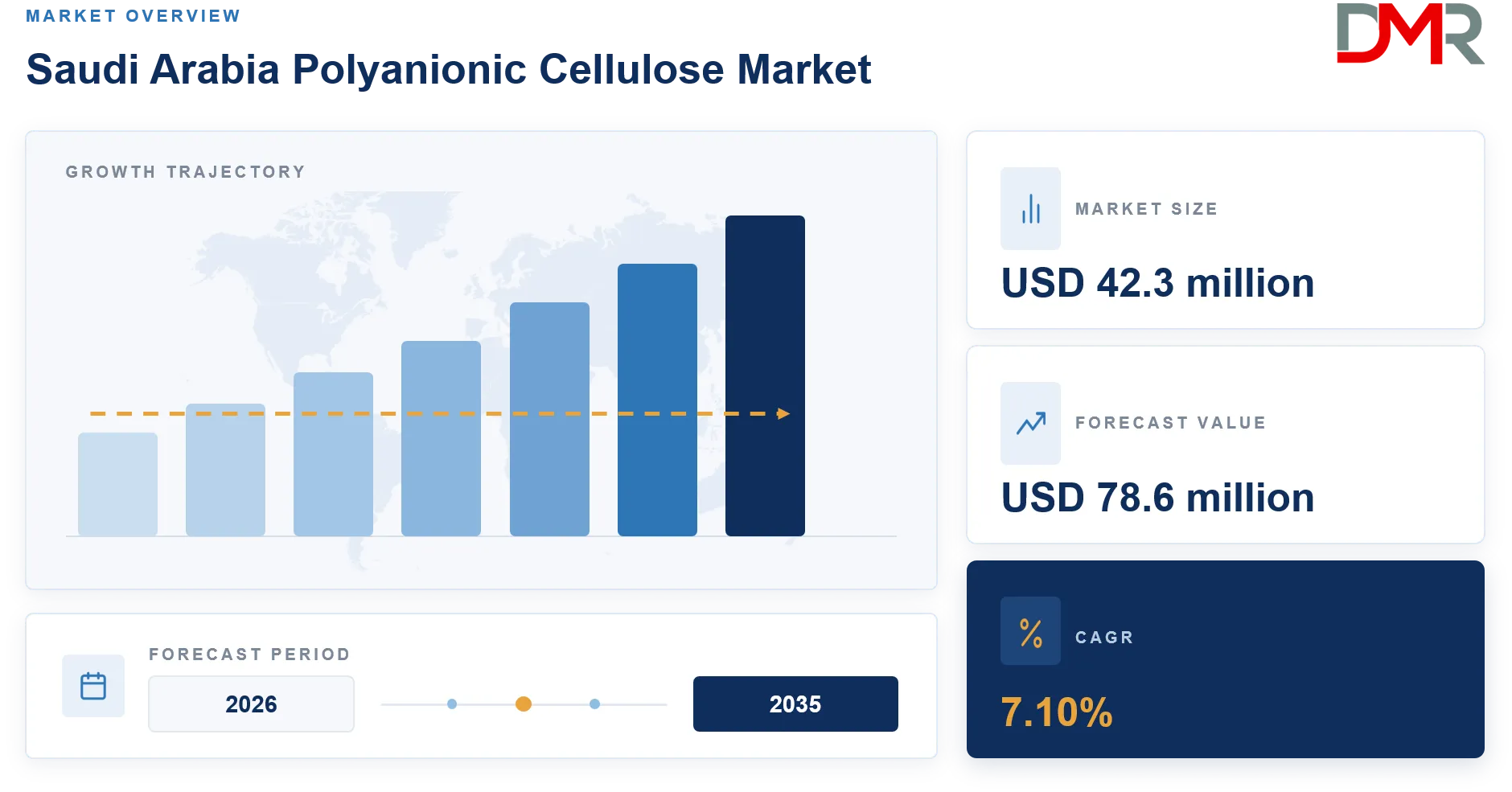
- Market Value: Saudi Arabia polyanionic cellulose market is valued at USD 42.3 million in 2026 and is expected to reach USD 78.6 million by 2035.
- CAGR: Saudi Arabia polyanionic cellulose market is expected to grow at a CAGR of 7.1% from 2026 to 2035.
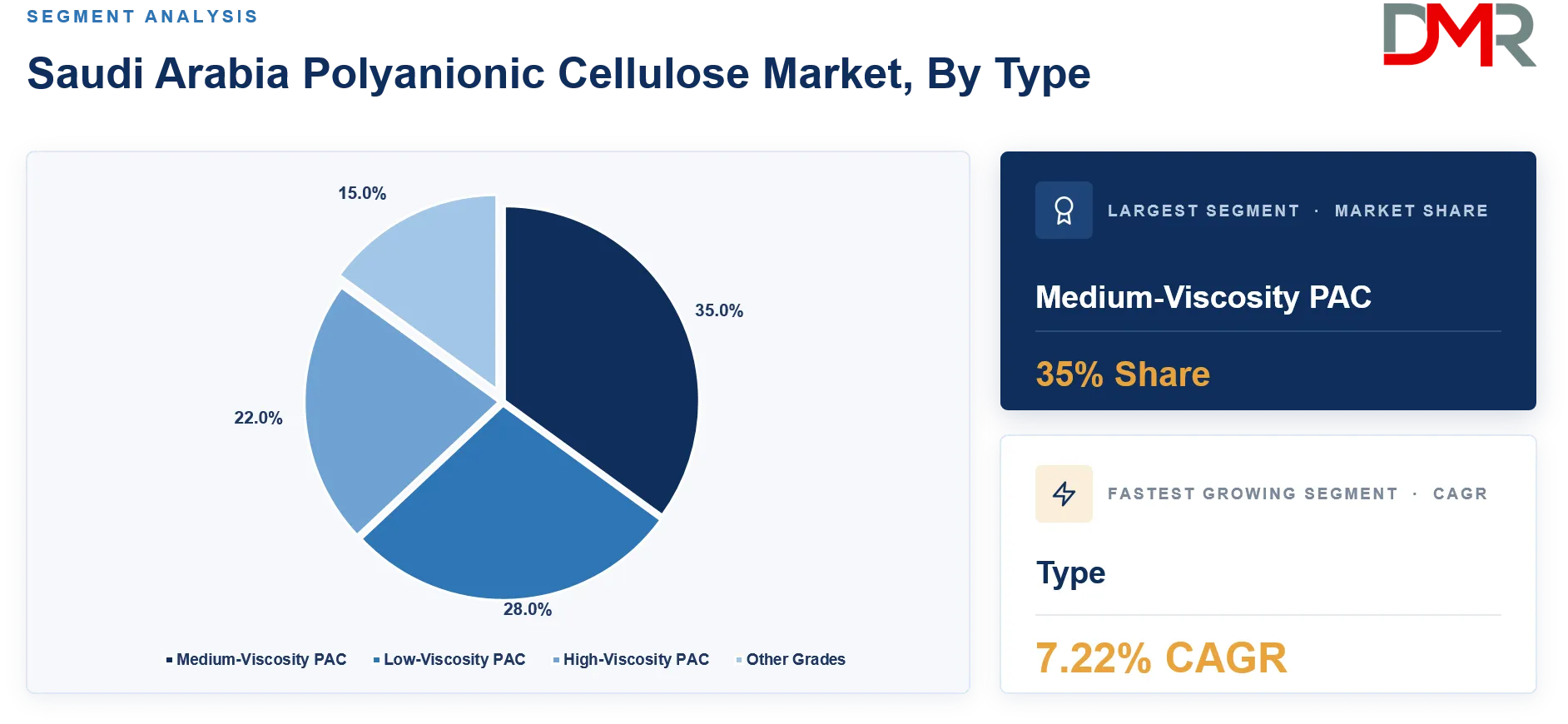
- By Type Segment Analysis: Medium-viscosity PAC led the type segment with a 35.0% share in 2026.
- By Function Segment Analysis: Fluid-loss control led the function segment with a 38.0% share in 2026.
- By Application Segment Analysis: Oil & gas drilling fluids held a 52.0% share in 2026.
- By End User Segment Analysis: Oilfield services companies accounted for a 30.0% share in 2026.
- Major Players: Albattal Factory for Chemical Industries Co., Nassguard, Polymers Oil & Gas Factory, Stellar Exports, and Millennium Energy.
What is the Saudi Arabia Polyanionic Cellulose Market and its Market Size?
The Saudi Arabia Polyanionic Cellulose Market size is projected to be valued at USD 42.3 million in 2026 and is expected to reach USD 78.6 million by 2035, expanding at a CAGR of 7.1% during the forecast period. Polyanionic cellulose, commonly known as PAC, is a water-soluble cellulose derivative used to control fluid loss, viscosity, filtration behavior, suspension stability, and water retention. Saudi demand is strongly connected with drilling-fluid consumption because oil and gas drilling fluids account for 52.0% of the market in 2026.
ℹ
To learn more about this report –
Download Your Free Sample Report Here
The Saudi Arabia polyanionic cellulose market growth is also supported by demand from water treatment, construction materials, pharmaceuticals, food processing, paper, textiles, coatings, ceramics, and chemical formulation. However, oilfield operations remain the key commercial center of the industry. PAC procurement decisions are influenced by viscosity grade, filtration performance, salt tolerance, thermal stability, product purity, supply reliability, and compatibility with water-based drilling-fluid systems. These factors make technical consistency and application-specific formulation important competitive parameters for suppliers.
Use Cases
- Drilling Fluid Filtration Control: PAC is added to water-based drilling fluids to limit filtrate penetration into underground formations. Lower fluid loss can improve borehole stability, protect formation integrity, and maintain more consistent mud properties. This application is particularly relevant to Saudi drilling contractors and oilfield service companies operating complex conventional and unconventional wells.
- Rheology and Viscosity Management: Medium and high-viscosity PAC grades help drilling-fluid formulators adjust carrying capacity and flow behavior. Proper viscosity supports the transport of drilled cuttings to the surface while improving suspension when circulation slows. The requirement for controlled rheology helps explain the strong market position of medium-viscosity PAC, which holds 35.0% share in 2026.
- Water Treatment Formulation: PAC can support industrial water-treatment formulations where thickening, suspension, stabilization, and filtration properties are required. Saudi Arabia's expanding desalination, wastewater treatment, water reuse, and industrial water infrastructure creates an adjacent demand pool for functional cellulose derivatives, particularly for suppliers seeking revenue beyond oilfield applications.
- Construction and Industrial Materials: PAC is used in selected cementitious systems, coatings, ceramics, detergents, and industrial formulations to improve water retention, consistency, suspension stability, or application behavior. Growth in Saudi construction and industrial manufacturing gives specialty PAC grades opportunities in applications where predictable viscosity and controlled water interaction are important.
- Food and Pharmaceutical Processing: Higher-purity cellulose derivatives can serve as stabilizing, thickening, or formulation aids in controlled food and pharmaceutical applications where permitted specifications are met. This creates a smaller but higher-specification opportunity for PAC suppliers capable of delivering purity, traceability, consistent molecular characteristics, and tighter quality assurance than standard industrial grades.
How AI/Gen AI is Transforming the Saudi Arabia Polyanionic Cellulose Market?
Digital analytics are changing how drilling-fluid companies select and manage PAC formulations. Real-time well data can be combined with drilling parameters, mud properties, temperature, salinity, pressure, and historical fluid performance to improve treatment decisions. For PAC suppliers, this shift increases the importance of consistent product specifications because digital drilling systems work best when material behavior is predictable. Oilfield service companies can also use predictive models to estimate chemical consumption, monitor filtration performance, identify abnormal mud behavior, and reduce unnecessary chemical additions.
Generative and predictive tools are also improving commercial processes across procurement, formulation development, inventory planning, and technical service. Suppliers can analyze customer specifications faster, compare PAC grades against application requirements, forecast stock needs, and organize technical documentation for different end users. In Saudi Arabia, these capabilities can be useful where oilfield chemicals must reach drilling sites reliably and meet demanding operating specifications. The commercial advantage is likely to favor companies that combine PAC manufacturing or distribution capacity with strong laboratory support, digital quality records, responsive logistics, and application expertise.
Key Drivers in the Saudi Arabia Polyanionic Cellulose Market
Expansion of Complex Oil and Gas Drilling Activity
Saudi oil and gas operations remain the strongest demand driver for PAC because drilling fluids represent 52.0% of the market in 2026. PAC performs critical fluid-loss and rheology functions in water-based mud systems used during well construction. More technically demanding wells can require tighter control of filtration, viscosity, solids transport, and wellbore stability. This creates recurring consumption for drilling-grade PAC and strengthens demand from drilling contractors, petroleum operators, mud-service companies, and specialized chemical formulators.
Growing Requirement for High-Performance Water-Based Drilling Fluids
Operators increasingly focus on drilling-fluid systems that provide reliable performance while supporting operational efficiency and easier fluid management. PAC is well established in water-based systems because it can deliver filtration control and viscosity modification without requiring a completely separate treatment chemistry. Medium-viscosity PAC benefits particularly from this requirement and holds 35.0% of the type segment in 2026. Suppliers able to maintain consistent viscosity, moisture, purity, substitution level, and salt tolerance can capture higher-value drilling-fluid contracts.
Restraints in the Saudi Arabia Polyanionic Cellulose Market
Raw Material and Imported Supply Exposure
PAC economics depend on cellulose feedstock, chemical processing inputs, energy, freight, packaging, and quality-control costs. Suppliers that depend heavily on imported raw materials or finished PAC can face changes in landed cost and delivery schedules. These factors matter to Saudi buyers because drilling programs require dependable chemical availability rather than price alone. Large fluctuations in procurement cost can pressure distributor margins and encourage oilfield service companies to qualify multiple suppliers, negotiate longer contracts, or optimize PAC dosage.
Competition from Alternative Rheology and Fluid-Control Additives
PAC competes with other drilling-fluid polymers and hydrocolloids selected according to temperature, salinity, formation characteristics, cost, and required rheology. Xanthan-based materials, modified starches, guar derivatives, and other synthetic or natural polymers can substitute for part of PAC consumption in certain formulations. This limits suppliers that compete only on commodity pricing. PAC producers must demonstrate measurable filtration performance, compatibility, thermal stability, ease of mixing, and total treatment economics to maintain share in technically demanding applications.
Growth Opportunities in the Saudi Arabia Polyanionic Cellulose Market
Localization of Oilfield Chemical Supply
Saudi Arabia offers a significant opportunity for companies that can localize PAC blending, finishing, warehousing, quality testing, packaging, or full-scale manufacturing. Oilfield customers place high value on reliable supply because chemical shortages can interrupt drilling-fluid programs. Local inventory also reduces delivery lead times and enables faster technical response. Domestic suppliers can strengthen their position through Saudi-based laboratories, application support, customer-specific grades, bulk storage, and closer integration with drilling-fluid and petroleum service companies.
Diversification into Water and Industrial Applications
Oilfield demand currently anchors the market, but PAC suppliers can reduce concentration risk by developing applications in water treatment, construction materials, coatings, ceramics, detergents, paper, textiles, and specialty formulations. Each sector requires different viscosity, purity, particle size, dissolution, and performance characteristics. This creates room for specialty grades rather than a single commodity product. Companies that develop application-specific PAC portfolios can address smaller industrial segments while improving margins and building recurring demand outside drilling cycles.
Trends in the Saudi Arabia Polyanionic Cellulose Market
Shift Toward Application-Specific PAC Grades
Saudi customers are moving from basic polymer purchasing toward performance-based qualification. Medium-viscosity PAC leads with 35.0% share because it provides a practical balance between viscosity development and filtration control across multiple formulations. High-viscosity and specialty grades address more demanding conditions where stronger rheology or targeted fluid behavior is needed. Suppliers are therefore differentiating through viscosity range, purity, substitution consistency, salt resistance, dispersibility, and compatibility with complete drilling-fluid packages.
Greater Focus on Supply Reliability and Technical Service
Purchasing decisions increasingly consider more than price per kilogram. Oilfield service companies evaluate batch consistency, delivery reliability, technical documentation, laboratory results, product traceability, packaging, and supplier response time. This trend favors manufacturers and distributors that maintain local stocks and provide formulation support. For international producers, partnerships with Saudi distributors or oilfield chemical specialists can improve market access, while domestic companies can compete through shorter lead times and closer customer relationships.
Research Scope and Analysis
The Saudi Arabia Polyanionic Cellulose Market is segmented based on Type, Function, Application, End User, and other relevant commercial categories. The study provides an in-depth analysis of key segments and sub-segments, covering their applications, industry adoption, demand patterns, procurement requirements, and contribution to overall market growth.
ℹ
To learn more about this report –
Download Your Free Sample Report Here
By Type
Medium-viscosity PAC dominates the type segment with 35.0% market share in 2026. Its leading position reflects its ability to provide both rheological support and filtration control without producing the stronger viscosity increase associated with high-viscosity products. This balance makes medium-viscosity PAC suitable for a broad range of water-based drilling-fluid formulations. Low-viscosity PAC remains important where fluid-loss control is required with limited impact on overall mud viscosity, while high-viscosity grades serve applications requiring stronger thickening and suspension. Specialty grades address customer-specific temperature, salinity, purity, or industrial processing requirements.
By Function
Fluid-loss control leads the Saudi Arabia PAC market by function with a 38.0% share in 2026. During drilling, uncontrolled filtrate movement can affect filter-cake quality and wellbore conditions, which makes filtration management a core fluid-design requirement. PAC helps build a lower-permeability filter cake and control liquid invasion when properly selected and dosed. Rheology modification and thickening form another important demand area because PAC can support cuttings transport and suspension. Water retention, stabilization, filtration control, and lubricity-related applications broaden the polymer's role across industrial formulations.
By Application
Oil & gas drilling fluids account for 52.0% of Saudi PAC demand in 2026, making the application segment the central revenue pool for manufacturers and distributors. PAC is used in drilling-fluid systems to manage fluid loss, rheology, suspension, and filtration performance under changing downhole conditions. Saudi Arabia's large upstream petroleum sector creates recurring demand from drilling contractors and mud-service providers. Water treatment, construction, pharmaceuticals, food, coatings, paper, textiles, ceramics, and detergents provide additional demand, although these markets typically require different product specifications and commercial channels.
By End User
Oilfield services companies represent the largest end-user category with 30.0% share in 2026. These businesses frequently formulate, supply, maintain, or manage drilling fluids directly at well sites, placing them close to the point of PAC consumption. Their procurement decisions therefore influence approved supplier lists, formulation standards, stocking requirements, and demand for different viscosity grades. Petroleum and drilling companies also create significant demand through contractor specifications. Outside oilfields, water-treatment companies, construction-material manufacturers, pharmaceutical producers, food processors, paper mills, textile manufacturers, and chemical formulators support market diversification.
The Saudi Arabia Polyanionic Cellulose Market Report is segmented on the basis of the following:
By Type
- Low-Viscosity PAC
- Medium-Viscosity PAC
- High-Viscosity PAC
- Specialty/Other Grades
By Function
- Fluid-Loss Control
- Rheology Modification and Thickening
- Suspension and Stabilization
- Water Retention
- Filtration Control
- Lubricity Enhancement
- Other Functions
By Application
- Oil & Gas Drilling Fluids
- Water Treatment
- Food & Beverages
- Pharmaceuticals
- Construction and Building Materials
- Paper Manufacturing
- Textile Processing
- Paints and Coatings
- Ceramics
- Detergents and Household Chemicals
- Other Industrial Applications
By End User
- Oilfield Services Companies
- Petroleum and Drilling Companies
- Water-Treatment Companies
- Food and Beverage Manufacturers
- Pharmaceutical Companies
- Construction-Material Manufacturers
- Paper Mills
- Textile Manufacturers
- Chemical Formulators
- Other Industrial Users
Competitive Landscape
The Saudi Arabia polyanionic cellulose market combines local chemical manufacturers, oilfield chemical suppliers, distributors, exporters, and multinational specialty-material producers. Competition centers on product performance, viscosity consistency, filtration control, pricing, technical service, approved-vendor status, local stock availability, and delivery reliability. Albattal Factory for Chemical Industries Co., Nassguard, Polymers Oil & Gas Factory, Stellar Exports, Millennium Energy, Modern Petrochemicals Co. Ltd., and Delmon Oil & Gas Supplies and Services strengthen the local and regional supply environment, while international companies add global manufacturing capabilities and technical portfolios. Oilfield customers often require laboratory qualification before commercial use, giving proven product consistency an advantage over purely price-led offers. Suppliers with Saudi warehousing, technical support, flexible packaging, customer-specific grades, and reliable raw-material sourcing can compete more effectively for recurring drilling-fluid demand. Over the forecast period, localization, formulation expertise, supply-chain resilience, and expansion into non-oilfield applications are expected to become increasingly important competitive factors.
Some of the prominent players in the Saudi Arabia Polyanionic Cellulose Industry are:
- Albattal Factory for Chemical Industries Co.
- Nassguard
- Polymers Oil & Gas Factory
- Stellar Exports
- Millennium Energy
- Modern Petrochemicals Co. Ltd.
- Delmon Oil & Gas Supplies and Services
- Global Drilling Fluids and Chemicals Limited
- The Dow Chemical Company
- Ashland Global Holdings Inc.
- Shin-Etsu Chemical Co., Ltd.
- Lotte Fine Chemical
- Shandong Head Co., Ltd.
- CP Kelco
- Akzo Nobel
- Others
The Saudi Arabia polyanionic cellulose market presents investment white space in localized production, specialty PAC grades, oilfield chemical formulation, technical testing, and supply-chain infrastructure. With the market projected to rise from USD 42.3 million in 2026 to USD 78.6 million by 2035 at a 7.1% CAGR, capacity aimed at drilling applications offers a clear opportunity, as oil & gas drilling fluids account for 52.0% of demand. Medium-viscosity PAC, which holds a 35.0% share, creates an attractive entry point for producers serving fluid-loss and rheology requirements. Investors can also target Saudi-based blending, warehousing, quality laboratories, and customized packaging to shorten delivery cycles for oilfield service companies. Further white space exists in high-performance grades designed for demanding salinity and temperature conditions. Beyond drilling, water treatment, construction materials, coatings, pharmaceuticals, and industrial formulations provide opportunities to diversify revenue and reduce dependence on upstream activity.
Saudi Arabia's polyanionic cellulose trade structure creates opportunities for both import substitution and regional exports as domestic demand expands. International supply remains relevant because PAC manufacturing requires controlled cellulose chemistry, consistent substitution, viscosity management, and application-specific quality standards. Imports can therefore address specialty grades or customer specifications not available from domestic production. At the same time, Saudi manufacturers have an opportunity to replace part of imported supply through local production, finishing, blending, packaging, and inventory development. Oilfield services companies, which account for 30.0% of PAC demand in 2026, benefit from shorter lead times and dependable local stocks for drilling programs. Saudi Arabia can also serve as an export platform for PAC and formulated drilling chemicals across GCC and neighboring Middle Eastern markets. Competitive exports will depend on production scale, consistent quality, technical certification, logistics costs, port connectivity, customer approvals, and the ability to compete with established Asian and global suppliers.